THE EFFECTS OF INDIVIDUALLY DESIGNED PROGRAMS
OF PHYSICAL TRAINING BASED ON US ARMY STANDARDS
ON MOTOR ABILITIES OF SLOVENE ARMED FORCES PERSONNEL
Damir Karpljuk, Edvin Derviševič, Suzana Tkavc, Mare Novak, Maks Žitko,
Mateja Videmšek, Vedran Hadžič, Franc Rožman
Faculty of Sport, University of Ljubljana, Ljubljana, Slovenia
Submitted in May, 2005
Adequate physical readiness is a significant aspect of universal armed forces readiness and an integral part of military support. The aim of this research was to ascertain the effect of a training program, based on individually adapted intensity levels, on motor abilities of the Slovene armed forces (SV) personnel. The sample of subjects in-cluded 34 members of SV (16 in the experimental group – ES, and 18 in the control group – KS), aged between 35 and 40. Results have been processed by the SPSS 8.0 for Windows program. Data processing was carried out in several phases. First, the basic statistical characteristics and the distribution of individual variables have been determined, the measures of central tendency and the measures of dispersion have been calculated and a method for the analysis of variance with 5% risk has been used. The results have shown that a characteristic enhancement of certain motor abilities of the sample studied can be improved by means of training process economisation and individually adapted training intensity levels. Statistically significant differences between the experimental and control groups were found in measurements of body fat (KG), push-ups (SK), curl-ups (DT), a 3200 meter run (T3200M) and the morning heart beat frequency (FSUs). Although the research sample was small, these studies, at least in theory support the need for future research in these areas, as our evidence strongly suggests the effectiveness of individually designed training protocols on the physical readiness of Slovenian armed personnel.
Keywords: Motor readiness, physical training plan, NATO.
INTRODUCTION
The contemporary way of life has many negative con-sequences and is marking the way of life of the Slovene people as well, where the Slovene armed forces (SV) is no exception. Despite the fact that physical training in SV is well rounded legally, formally and theoretically, SV is facing the negative influences of our contemporary way of life, too (Tkavc, 1999). The rate of motor and lo-comotor injuries and cardiovascular disorders is rapidly increasing among SV personnel; due to insufficient exer-cising, many are facing an increased body weight (Kar-pljuk, D., Žitko, Rožman, Suhadolnik, & Kar(Kar-pljuk, K., 2001) causing health disorders, etc. These factors sig-nificantly affect the combat readiness of SV soldiers and SV as a whole. The motor efficiency of an individual soldier and of a unit – a principle element of combat readiness – is more and more important in readiness programs of every contemporary army (Picarielo, 2000; Jaenen, 2000). As the way of life is changing significant-ly, the abilities of an individual as well as the abilities of an entire society are changing along with it. Sport plays a more and more important role in developing and maintaining the motor efficiency of a contemporary
excellent motor abilities. Individuals are often facing problems related to their own health state (overweight and accompanying health factors, stressful situations on a daily basis, motor apparatus and cardiovascular disorders, etc.). All of the previously mentioned factors have negative consequences and affect the daily military duties of commanders, military equipment duty person-nel, officers managing contemporary weapons, etc. (Kar-pljuk et al., 2001).
Adequate physical readiness is a significant aspect of universal armed forces readiness and an integral part of military support (Jaenen, 2000). Despite an increase in number and enhanced military equipment, mechaniza-tion, means of transport, etc., a number of combat op-erations still depend on physically well prepared soldiers (Jaenen, 2000; Karpljuk et al., 2001). For example, Ca-nadian armed forces personnel (Jaenen, 2000) must be physically prepared to successfully carry out military op-erations in a geographically and climatologically diverse landscape. All profiles, from officers to soldiers undergo the process of a highly well rounded physical readiness program. Their physical readiness is evaluated through various assessments based on the Human Rights Act (Jaenen, 2000), which the personnel is informed upon joining the Canadian armed forces.
US army personnel start their physical training pro-gram the first day upon entering the forces, and the program lasts until the end of an individual’s military career. The sporty way of life in the US army is not an exception but rather a general activity of all the employ-ees. The assessment of physical efficiency is based on the Annual physical training test (also used by some NATO members), and is comprised of push-ups, curl--ups and a 3200 meter (2 mile) run (Picarielo, 2000; Karpljuk et al., 2001). Picarie lo (2000) stresses that the physical efficiency readiness is based on endurance, strength, and agility as well as on developing mental abilities, cohesiveness within a group and factors related to combat situations.
In the Slovene armed forces, physical readiness assessment based on American standards has been practiced since 1996. The assessment, even though it seems like a simple evaluation comprised of three tests (push-ups, curl-ups and a 3200 meter run), may be quite a strenuous task. As an encouraging thought to achiev-ing a good assessment result, Tkavc (1999) says that individuals who regularly take care of their health by exercising, and who are occasionally in sports, will not have great difficulties with the assessment or will achieve relatively good results.
The doctrine of the US land forces has been pre-sented in detail by Grizold (Grizold & Ferfila, 2000), stating that the changes applied to the doctrine of the US land forces enable an efficient employment of US armed forces wherever in the world it is needed in
a rather short period of time, that requires the support of excellent logistics, which in the US army is the case, and physically well prepared soldiers, which, as stated by Picarielo (2000), is not a disturbing factor.
Liu (2000) exposed the importance of sport in the armed forces. He has analyzed the differences of the two notions, “military sport” and “sport in the military”. Military sport is defined as a specific type of sport, where the training process is based upon combat readi-ness representing a baseground of the Chinese national strategy of defense system, and upon readiness for war or war-like conditions. Sport activities include different types of shooting with combat weapons, parachuting, military pentathlon, etc., all activities directly related to assessment of the soldiers’ combat capacities. On the other hand, sport in the military primarily includes the most common types of sport like football, athletics, bas-ketball, handball, cycling, etc., that is the types of sport characteristic for ordinary, civilian society. Liu (2000) emphasized that these sport activities in the context of armed forces do have certain specifics; at the same time the options are open as to an individual sport soldiers can have in addition to the military sport activities.
Tkavc (1999) defines sport in SV as an entity, and thus takes up the same point of view as Zechner. Based on definitions by Liu (2000) – military sport and sport in the military and according to the purpose of sport in SV, her definitions could be related as follows. Mili-tary sport is a regular sport activity and assessment of motor abilities, while sport in the military represents any other sport activities ranging from sport for all to sports competitions. Despite different points of view and definitions it is obvious that there is a universal no-tion of sport and that the principle goal of sport in the military is adequate physical readiness of soldiers to successfully attend to their regular and combat duties (Tkavc, 1999).
pos-sible (climatic, health related…) which soldiers would face in war conditions.
Bonev (2000) has introduced a systematic defini-tion of the above mendefini-tioned physical training factors – a common term for “physical education” in the military. The author provided a basic model of sport training that should comprise the following elements: sport training as a part of regular armed forces personnel duties – 2 to 3 hours weekly; morning exercises – 30 minutes; ele-ments of sport for all profiles (90 minutes) to be carried out off-duty; physical training aimed at enhancing com-bat readiness. Particular elements of training, explicitly emphasized, are athletics, marching various distances, movements with acceleration and changes of direction, sport gymnastics (floor, gymnastics, permitted appara-tus adjustments), running, swimming, alpine and cross-country skiing, rowing, combat sports, etc.
We are of the opinion that taking up appropriate ap-proaches and having adequate professional knowledge in the field of sports and related fields, can positively influence and enhance motor readiness of SV person-nel, and decrease a number of negative consequences of a contemporary way of life. According to contemporary course of events and the demands of the leading world armed forces, SV sport should go beyond the character of being a promotional, occasional and motivational fac-tor. Sport activities should actively be integrated into the working and living sphere of every (healthy) individual of the SV armed forces. A handful of athletes employed at SV, who participate at national and beyond competi-tions are by no means indicators of the actual state, being regular army, commissioned officers, non-commis-sioned officers, civil SV or MORS personnel, or the con-tractual reserve army, which should in the future change their current foundations. It is necessary to emphasize that any kind of training will have a more significant effect, if it is adapted to an individual (Bonev, 2000), his/her motor abilities, motivation and expectations.
The aim of this research is to ascertain the effects of a three-month long, individually adapted training pro-gram carried out three times a week on the development of some functional, motor and morphological dimen-sions with SV regular and reserve officers.
GOALS
The goal of this research was to find out the differ-ences in results of selected functional, motor and mor-phological variables, tested with SV regular and reserve officers – differences between the initial and final meas-urements of the experimental and the control group.
METHODS
The training program of the experimental group (ES) was adapted to individuals. The program was based on running endurance, agility, coordination, speed and strength. The control group (KS) performed regular sport activities, in the same extent as before the research (fitness, running, cycling, and games). The initial assess-ment was carried out prior to experiassess-mental program ini-tiation, based on which, the subjects were grouped into two equivalent groups according to the 3200 meter run results. All measurements were done at the Ljubljana athletic stadium and were carried out according to the instructions of the US armed forces standards (Karpljuk et al., 2001). Each group was given instructions on the training program for the following three months. The final assessment was carried out in the same manner as the initial one.
Sample of subjects
The research is based on studying 34 members of the SV, 16 in the experimental and 18 in the control group.
Sample of variables
Three sets of variables were defined according to the subject and the goals of this study, and according to the hypotheses set forth.
Functional variables
FSUm heart beat frequency, beats/min morning, resting
Motor variables
SK push-ups (2 min) number
of repetitions
DT curl-ups (2 min) number
of repetitions
T3200M 3200 meter run seconds
Morphologic variables
ATV height mm*
ATM weight kg
AKGN body fat mm
AOS femur volume cm
DATA PROCESSING METHODS
Results have been processed by the SPSS 8.0 for Windows program. Data processing was carried out in several phases. First, the basic statistical characteristics and the distribution of individual variables have been determined, the measures of central tendency and the measures of dispersion have been calculated. The analy-sis of variance with a 5% risk has been used to calculate differences between the experimental and the control group (initial and final measurements).
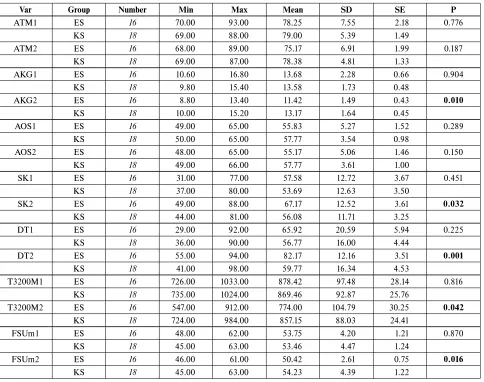
TABLE 1
Differences between the initial (1) and final (2) measurements of ES and KS with tests: ATM1–ATM2, AKG1–AKG2, AOS1–AOS2, SK1–SK2, DT1–DT2, T320M1–T3200M2 in FSUm1–FSUm2
Var Group Number Min Max Mean SD SE P
ATM1 ES 16 70.00 93.00 78.25 7.55 2.18 0.776
KS 18 69.00 88.00 79.00 5.39 1.49
ATM2 ES 16 68.00 89.00 75.17 6.91 1.99 0.187
KS 18 69.00 87.00 78.38 4.81 1.33
AKG1 ES 16 10.60 16.80 13.68 2.28 0.66 0.904
KS 18 9.80 15.40 13.58 1.73 0.48
AKG2 ES 16 8.80 13.40 11.42 1.49 0.43 0.010
KS 18 10.00 15.20 13.17 1.64 0.45
AOS1 ES 16 49.00 65.00 55.83 5.27 1.52 0.289
KS 18 50.00 65.00 57.77 3.54 0.98
AOS2 ES 16 48.00 65.00 55.17 5.06 1.46 0.150
KS 18 49.00 66.00 57.77 3.61 1.00
SK1 ES 16 31.00 77.00 57.58 12.72 3.67 0.451
KS 18 37.00 80.00 53.69 12.63 3.50
SK2 ES 16 49.00 88.00 67.17 12.52 3.61 0.032
KS 18 44.00 81.00 56.08 11.71 3.25
DT1 ES 16 29.00 92.00 65.92 20.59 5.94 0.225
KS 18 36.00 90.00 56.77 16.00 4.44
DT2 ES 16 55.00 94.00 82.17 12.16 3.51 0.001
KS 18 41.00 98.00 59.77 16.34 4.53
T3200M1 ES 16 726.00 1033.00 878.42 97.48 28.14 0.816
KS 18 735.00 1024.00 869.46 92.87 25.76
T3200M2 ES 16 547.00 912.00 774.00 104.79 30.25 0.042
KS 18 724.00 984.00 857.15 88.03 24.41
FSUm1 ES 16 48.00 62.00 53.75 4.20 1.21 0.870
KS 18 45.00 63.00 53.46 4.47 1.24
FSUm2 ES 16 46.00 61.00 50.42 2.61 0.75 0.016
KS 18 45.00 63.00 54.23 4.39 1.22
RESULTS
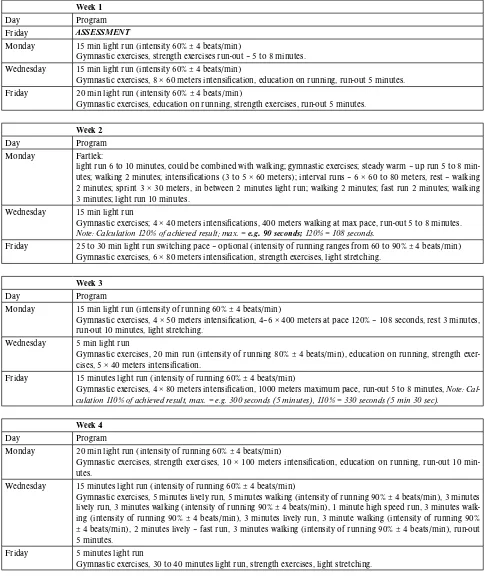
Fig. 1
Physical training program of experimental group
Week 1
Day Program
Friday ASSESSMENT
Monday 15 min light run (intensity 60% ± 4 beats/min)
Gymnastic exercises, strength exercises run-out – 5 to 8 minutes. Wednesday 15 min light run (intensity 60% ± 4 beats/min)
Gymnastic exercises, 8 × 60 meters intensification, education on running, run-out 5 minutes. Friday 20 min light run (intensity 60% ± 4 beats/min)
Gymnastic exercises, education on running, strength exercises, run-out 5 minutes.
Week 2
Day Program
Monday Fartlek:
light run 6 to 10 minutes, could be combined with walking; gymnastic exercises; steady warm – up run 5 to 8 min-utes; walking 2 minmin-utes; intensifications (3 to 5 × 60 meters); interval runs – 6 × 60 to 80 meters, rest – walking 2 minutes; sprint 3 × 30 meters, in between 2 minutes light run; walking 2 minutes; fast run 2 minutes; walking 3 minutes; light run 10 minutes.
Wednesday 15 min light run
Gymnastic exercises; 4 × 40 meters intensifications, 400 meters walking at max pace, run-out 5 to 8 minutes. Note: Calculation 120% of achieved result; max. = e.g. 90 seconds; 120% = 108 seconds.
Friday 25 to 30 min light run switching pace – optional (intensity of running ranges from 60 to 90% ± 4 beats/min) Gymnastic exercises, 6 × 80 meters intensification, strength exercises, light stretching.
Week 3
Day Program
Monday 15 min light run (intensity of running 60% ± 4 beats/min)
Gymnastic exercises, 4 × 50 meters intensification, 4–6 × 400 meters at pace 120% – 108 seconds, rest 3 minutes, run-out 10 minutes, light stretching.
Wednesday 5 min light run
Gymnastic exercises, 20 min run (intensity of running 80% ± 4 beats/min), education on running, strength exer-cises, 5 × 40 meters intensification.
Friday 15 minutes light run (intensity of running 60% ± 4 beats/min)
Gymnastic exercises, 4 × 80 meters intensification, 1000 meters maximum pace, run-out 5 to 8 minutes, Note: Cal-culation 110% of achieved result, max. = e.g. 300 seconds (5 minutes), 110% = 330 seconds (5 min 30 sec).
Week 4
Day Program
Monday 20 min light run (intensity of running 60% ± 4 beats/min)
Gymnastic exercises, strength exercises, 10 × 100 meters intensification, education on running, run-out 10 min-utes.
Wednesday 15 minutes light run (intensity of running 60% ± 4 beats/min)
Gymnastic exercises, 5 minutes lively run, 5 minutes walking (intensity of running 90% ± 4 beats/min), 3 minutes lively run, 3 minutes walking (intensity of running 90% ± 4 beats/min), 1 minute high speed run, 3 minutes walk-ing (intensity of runnwalk-ing 90% ± 4 beats/min), 3 minutes lively run, 3 minute walkwalk-ing (intensity of runnwalk-ing 90% ± 4 beats/min), 2 minutes lively – fast run, 3 minutes walking (intensity of running 90% ± 4 beats/min), run-out 5 minutes.
Friday 5 minutes light run
Week 5
Day Program
Monday Fartlek:
light run 10 minutes; gymnastic exercises; steady warm-up run – 3 minutes; walking – 2 minutes; intensifications (3 to 5 × 50 meters); faster run – 1, 2 and 3 minutes, in between rest periods – walking 2 minutes; 1 minute high speed run (maximum pace); walking 2 minutes; 1 minute high speed run (maximum pace); walking 2 minutes; 2 intensifications at distances from 30 to 40 meters; light run 10 minutes.
Wednesday 15 minutes light run
Gymnastic exercises, 4 × 90 seconds fast run, in between 3 minutes walking, run-out 10 to 15 minutes. Friday 5 minutes light run
Gymnastic exercises, 35 to 45 minutes light run (intensity of running 75% ± 4 beats/min), 4 × 60 meters intensi-fication.
Week 6
Day Program
Monday 15 minutes light run (intensity of running 60% ± 4 beats/min)
Gymnastic exercises, 3 × 60 meters intensifications, 1000 meters for 5 minutes, rest 6 minutes; 600 meters for 2 minutes and 50 sec., rest 6 minutes; 400 meters for 100 seconds, rest 6 minutes; 300 meters at maximum pace, rest 6 minutes; 600 meters at maximum pace, rest 6 minutes; run-out 5 to 8 minutes.
Wednesday 10 minutes light run (intensity of running 60% ± 4 beats/min)
Gymnastic exercises; 20 minutes light run (intensity of running 70% ± 4 beats/min); strength exercises; light stretching.
Friday 10 minutes light run (intensity of running 60% ± 4 beats/min)
Gymnastic exercises; 10 × 100 meters intensifications; run-out 10 minutes.
Week 7
Day Program
Monday 5 minutes light run
gymnastic exercises; 30 to 45 minutes light run (intensity of running 75% ± 4 beats/min), education on running; 4 × 60 meters intensifications.
Wednesday 10 minutes light run
Gymnastic exercises; 4 × 40 meters intensifications; 10 × 400 meters for 100 seconds, rest 3 minutes; run-out 5 to 8 minutes.
Friday 25 to 30 minutes light run (intensity of running 65% ± 4 beats/min) Gymnastic exercises; strength exercises; light stretching.
Week 8
Day Program
Monday 10 minutes light run
gymnastic exercises; 4 × 80 meters intensifications; 2000 meters at maximum pace, rest 5 minutes (intensity of run-ning 100%); 1200 meters at maximum pace, rest 5 minutes (intensity of runrun-ning 100%); run-out 5 minutes. Wednesday 20 minutes light run (intensity of running 60% ± 4 beats/min )
Gymnastic exercises; strength exercises; light stretching. Friday 10 minutes light run
Gymnastic exercises; 6 × 80 meters intensifications; 10 × 200 meters for 45 seconds, rest 2 minutes; run-out 10 minutes.
Week 9
Day Program
CONCLUSION
Differences between ES and KS in body fat measure-ments were 2 mm (TABLE 1) and were statistically char-acteristic (P = 0.010). There were differences in body weight (ATM) – of approximately 3 kg, however, these differences were not statistically significant. The subjects have maintained a relatively active way of life even prior to this study. This experiment was by no means aimed at changing their existing way of living, including their nutrition habits. Prior to the study, the subjects were given the instructions that their nutrition should remain the same. There were differences in KG at final measure-ments, suggesting that the kind of activities they were involved in, could have had an indirect, positive effect on the individual’s health state. In the armed forces, increased body weight (overweight) and the accompany-ing circumstances are no exception.
There were no statistically characteristic differences between the groups with the AOS (femur volume) vari-able. A more detailed inspection of the results presented in TABLE 1 however shows that the femur volume in the ES has slightly decreased. Similar results, where the AOS has decreased, can be observed in the study (Bevc, 2002), a preliminary study to this one. It is assumed that exercising has indirectly influenced a decrease in body weight, body fat and ITM (body mass index). The ITM values for the ES group were 23.63 – final measure-ments (initial measuremeasure-ments 24.61; p = .000), while for the KS the ITM values were 24.03 – final measurements (initial measurements 24.21; p = 0.221).These results indicate that in the ES group, statistically significant differences in the ITM variable occurred at the end of the research.
When training for the assessment of motor abilities, it is encouraging to examine the results of ES enhance-ments and the statistically significant differences of all three motor variables (DT, SK, T3200M) as presented in TABLE 1. Even before the program, some prelimi-nary studies have been carried out (Karpljuk et al., 2001; Karpljuk, Videmšek, Cecic-Erpic, Žitko, Štihec, & Kondrič, 2001; Bevc, 2002), as well as studies con-firming that economisation of the training process and individually adapted intensity of training characteristi-cally help to enhance certain motor abilities (Karpljuk, 1999). It is assumed that economisation of the training process is required in order to achieve a general level of SV personnel’s motor readiness. At the same time, it is a prerequisite for fundamental physical fitness abilities and the development of those motor abilities, required to fulfill the work and duties of all profiles in the Slov-ene armed forces. The latter will inevitably become an important factor these days, when Slovenia has been invited to become a NATO member.
The final aspect of this study, with which we wanted to confirm the physical training efficiency of the SV
per-sonnel, was monitoring the morning heart beat fre-quency (Ušaj, 1996). While examining the early effects of exercising (Karpljuk, 1999), the FSUm represented a variable whose positive results indicated that the ES training program was appropriate and that the heart beat frequency while resting decreased within the range predicted by many researchers (Willmore & Costill, 1994). Also in the course of the research, no increase of the morning heart beat frequency in the ES group was detected. Based on this, we have concluded that the training process does not cause any forms of fatigue – the indicator of which could be an increased heart beat frequency while resting (Willmore & Costill, 1994).
This study is one of the rare ones in the Slovene armed forces which would systematically and profession-ally examine the aspects of training for the assessment of motor abilities, following US military standards. Up until now, training for the assessment has in many cases been a matter of the last month or even the last week before the assessment. This approach is inappropriate for many reasons, here mentioning primarily the one closely related to the health state of the SV personnel, which is further related to their physical readiness. The campaign excursus mentioned earlier, treating an as-sessment as an “adventure” into the unknown may lead tragic consequences. Physical training of the SV person-nel, including the reserve (now a professional reserve), should be continued all year round or throughout one military career, which in the leading NATO member countries represents a clearly understood integrated part of their duties. This point of view in the SV has not been put to practice yet (except for some professional athletes, recreational athletes and some conscious indi-viduals), despite numerous attempts and the legal and formal ground.
It is assumed that the results of this research will contribute to theoretical findings in the field of endur-ance training in the SV, to examining other armed forc-es, particularly of the NATO member countries. We hope that these findings will be used as a baseground for similar studies that may follow – and, as it is most common in other countries, to a closer interaction and complementation of military, civil scientific and profes-sional spheres.
REFERENCES
Anonymous (1996). Univerzalni svet športa. Slovenska vojska, (122), 30.
Bevc, S. (2002). The effects of endurance training on a runner’s motor and morphological dimensions. Di-ploma thesis, University of Ljubljana, Ljubljana. Bonev, I. (2000). Physical education in the armed
forc-es. In International scientific symposium (pp. 6–7).
Grizold, A., & Ferfila, B. (2000). Security policies of su-perpowers. Ljubljana: Faculty of social sciencies. Jaenen, S. (2000). Physical Fitness. In International
sci-entific symposium (p. 9). Gaborone–Botswana. Karpljuk, D. (1999). The effect of an experimental
train-ing program on the endurance development of school girls and boys in the pre-adolescence period. Doctoral
thesis, University of Ljubljana, Faculty of sport, Ljubljana.
Karpljuk, D., Videmšek, M., Cecic-Erpic, S., Žitko, M., Štihec, J., & Kondrič, M. (2001). Understanding of gender differences as an important factor in effec-tive physical fitness of Slovenian military forces. Acta Univ. Carol., Kinanthropol., 37(2), 81–92.
Karpljuk, D., Žitko, M., Rožman, F., Suhadolnik, G., & Karpljuk, K. (2001). Theoretical and practical el-ements of physical training for Slovene high-ranking officers. Ljubljana: Republic of Slovenia, Ministry of
defense.
Liu, D. (2000). The difference between military sport and sport in the army. In International scientific sym-posium (p. 5). Gaborone–Botswana.
Mashiane, M. (2000). The influence of temperature on physical fitness. In International scientific symposium
(p. 16). Gaborone–Botswana.
Mudambo, K. S. (1996). Energy and fluid requirements and physiological response to heat stress in military personnel during field exercise in the heat. Thesis,
Uni-versity of Dundee, Scotland.
Mudambo, K. S. (2000). The negative effects of pro-longed strenuous physical training on human health. In International scientific symposium (pp. 18–19). Ga-borone–Botswana.
Picarielo, J. M. (2000). Battle-focused physical training: a career-long commitment. In International scientific symposium (pp. 11–13). Gaborone–Botswana.
Tkavc, S. (1999). Sport in the Slovene armed forces.
Slovene Army Bulletin, 1(1), 85–95.
Ušaj, A. (1996). A short review of sports coaching ele-ments. Ljubljana: Faculty of Sport.
Willmore, J. H., & Costill, D. L. (1994). Physiology of sport and exercise. Champaign, IL: Human Kinetics.
ÚČINKY
INDIVIDUÁLNĚ NAVRŽENÝCH PROGRAMŮ TĚLESNÉ PŘÍPRAVY
ZALOŽENÝCH NA NORMÁCH AMERICKÉ ARMÁDY
NA MOTORICKÉ SCHOPNOSTI ZAMĚSTNANCŮ SLOVINSKÝCH OZBROJENÝCH SIL
(Souhrn anglického textu)
Přiměřená fyzická zdatnost je významným aspektem obecné připravenosti ozbrojených sil a nedílnou součástí armádní podpory. Cílem tohoto průzkumu bylo zjistit účinky výcvikového programu, založeného na individuál-ně přizpůsobené míře intenzity, na motorické schop-nosti zaměstnanců slovinských ozbrojených sil (SV). Vzorek zahrnoval 34 členů SV (16 zařazených do ex-perimentální skupiny – ES a 18 do kontrolní skupiny – KS) ve věku od 35 do 40 let. Výsledky byly zpracovány pomocí programu SPSS 8.0 pro Windows. Zpracování výsledků bylo prováděno v několika etapách. Nejprve byly stanoveny základní statistické charakteristiky a dis-tribuce individuálních proměnných, byla vypočtena míra střední tendence a stupeň disperze, byla použita metoda pro analýzu s rizikem odchylky 5 %. Výsledky prokázaly, že charakteristického zvýšení úrovně urči-tých motorických schopností sledovaného souboru lze dosáhnout pomocí ekonomizace výcvikového postupu a individuálně přizpůsobené intenzity výcviku. Statistic-ky významné rozdíly mezi experimentální a kontrolní skupinou byly zjištěny při měření tělesného tuku (KG), kliků (SK), hrudních předklonů v lehu pokrčmo, běhu na 3200 metrů (T3200M) a klidové srdeční frekvence (FSUs). Přestože byl zkoumaný vzorek malý, tyto studie alespoň teoreticky potvrzují potřebu dalšího výzkumu v této oblasti, protože naše důkazy výrazně naznačují účinnost individuálně navržených výcvikových proto-kolů na tělesnou připravenost zaměstnanců slovinských ozbrojených sil.
Doc. Dr. Damir Karpljuk, Ph.D.
Education and previous work experience
Works at department for people with special needs of the Faculty of Sport in Ljubljana. His research activities are focused on adapted physical sport education. First-line publications
Karpljuk, D., Žitko, M., Rožman, F., Suhadolnik, G., & Karpljuk, K. (2000). Teoretične osnove in praktična izhodišča športne vadbe, namenjene višjim častnikom slovenske vojske. Ljubljana: Ministrstvo za obrambo. Karpljuk, D., & Žitko, M. (2000). Calculations of
diffe-rences in heart rate frequencies based on 4 equations
as estimate stress of exercising and base for develo-ping endurance trainings. In International Scientific Symposium. Gaborone (Botswana): International Military Sports Council.
Žitko, M., & Karpljuk, D. (2000). High relationship among verification of movable abilities and quality exercise training planning. In International Scienti-fic Symposium. Gaborone (Botswana): International
Military Sports Council.
Karpljuk, D., Videmšek, M., Cecic-Erpic, S., Žitko, M., Štihec, J., & Kondrič, M. (2001). Understanding of gender differences as an important factor in effecti-ve physical fittnes of Sloeffecti-venian military forces. Acta Univ. Carol., Kinanthropol., 37(2), 81–92.
Karpljuk, D., Žitko, M., Videmšek, M., & Karpljuk, K. (2002). Razumevanje razlik med spoloma kot pot k učinkovitejši splošni in specifični telesni pripravlje-nosti pripadnic in pripadnikov slovenske vojske. In
L. Jelušič & M. Pešec (Eds.), Seksizem v vojaški uni-formi (pp. 67–86). Ljubljana: Fakulteta za družbene vede: Ministrstvo za obrambo Republike Slovenije, Generalštab Slovenske vojske.