Abstract— In today’s time wild elephants often kill people, raid crops and destroy property. In India, over 2500 people are killed by elephant each year and this rate is growing year by year. The proposed work is to develop a security level application that is could be used by forest department. This security level application segment, identified and tracking the elephant object in an image. If elephant passes outside the boundary of forest then send the message or trigger warning to the related forest ranger. In this system we will calculate the total distance between the starting position of elephant object and suspected boundary. This application is useful prevent the attack on the humans, raid of crops and destruction of property by elephant in future aspect. The security level system contain four main major parts segment the elephant object, identification of elephant object, track the elephant object and calculate the distance traveled by the target elephant object from starting position to the suspected boundary. If elephant pass out the coordinate of suspected boundary then generate a message elephant goes outside the boundary.
Keywords:- Image Processing, Feature Extraction, Feature Detection, image segmentation, Object Identification, Object Tracking.
I. INTRODUCTION
This chapter gives an introduction about the concept of the segmentation and identification of elephant object movement to trigger warning. In today’s time wild elephants often kill people, raid crops and destroy property. In India, over 2500 people are killed by elephant each year and this rate is growing year by year. The proposed work is to develop a
security level application that is could be used by forest department. This security level application identified and tracking the special object (Elephant) and object passes outside the boundary of forest then send the message or trigger warning to the related forest ranger. This application is useful prevent the attack on the humans, raid of crops and destruction of property by elephant in future aspect. In this dissertation, we have to find the better result of segmentation using Fixed Region Technique based on continuous edges corresponding to earlier segmentation technique based on discontinuous of edges. In this dissertation we have to identify the elephant in images using old Interest Point Matching and new purposed Putatively Feature Matching Technique and then tracking the elephant in video with the help of purposed Point Change Over Technique. This tracking technique applied on sequence of elephant images or video. In this correspondence if elephant goes outside the suspected forest boundary means if elephant tracking coordinate is greater than suspected boundary coordinate then a message would be sent to the forest ranger so that appropriate action can be taken timely. In this dissertation find the total distance between the starting position of object and the suspected boundary using Coordinate Distance Technique. In this technique find the initial position of target object in each image in terms of x and y coordinate. Calculate the change between first target object position and second target object position using Euclidean Distance formula and this process continue to the suspected boundary position then add each change and find out the distance travelled by object from starting point to suspected boundary.
Problem Statement
Now-a-days, segmentation is more popular for object identification. The identification of object is more useful in real word application. In this dissertation improve the result of segmentation using Fixed Region Technique (FRT). Wild elephants often kill people, raid crops and destroy property. In India, over 2500 people are killed by elephant each year and this rate is growing year by year. The proposed work is to
SEGMENTATION AND IDENTIFICATION OF
SPECIAL OBJECT (ELEPHANT) IN AN
IMAGE
Shaukin Ahamad M-Tech student, Computer Science and Engineering Roorkee College of Engineering, Roorkee
develop a security level application that is could be used by forest department. This security level application identified and tracking the special object (Elephant) and object passes outside the boundary of forest then send the message or trigger warning to the related forest ranger.
Objectives
The aim of this report is to study and design an efficient segmentation technique and developed a security level application that identified and tracking the special object (Elephant) and then object passes outside the boundary of forest then send the message or trigger warning to the related forest ranger. This application is useful prevent the attack on the humans, raid of crops and destruction of property by elephant in future aspect.
II. Image Processing
Image processing is mutate process which convert an input image into digital form and applied some additional operations on the input image, in order to get an renovate image or to extract some meaningful information from the input image. In this process whose input and output is always the form of images and in addition, encompasses process that extract feature from images up to end including the identification of particular object in image.
Figure 1: Block Diagram of Fundamental Steps of Image Processing System [2]
III. Image Segmentation
Image segmentation is to partition an image into meaningful regions with respect to a particular application [16]. The analysis of image objects begin with finding them-judge
which object belong to related pixel values. This is known as image segmentation, the technique of extracting objects from the background in an image [17]. Segmentation is the approach of separating a image into its meaningful parts or regions or object.
Figure 2: Objet Segmentation [1]
Types of Image Segmentation
There are two types of image segmentation:
1. Edge Based Segmentation:
In image processing edge may be simplify as a group of connected pixels that belong to boundary between from one regions to other [7]. Basically, edge detection is a method of segmentation which is extract an image into discontinuity region. This method plays an vital role in image processing system and usual aspects of our real world life. In image processing edge detection is a fundamental tool used for segmentation, basically for feature extraction and identification, which goal to identify points in a image where contrast of image changes intensely and find out the discontinuities [13]. The aim of edge detection is valuable lacking the amount of data in an image and keeps the structural attributes for forward image processing. The process of separating a image into various regions or group of pixels is known image segmentation. The edge define the boundary between from one homogeneous regions to other. The process of detecting and locating intense changes of discontinuities in an image. In image processing for a noisy image it is hard to find edges as both noise and edge contains maximum frequency contents which outcome in distorted and blurred result. In this paper we analyse lot of edge detection techniques as Robert, Canny and Sobel method. [5]The edge detection makes use of lot of operators to find changes in the gradients of the grey scale images. The edge widely exists between objects and background, objects and primitives. It contains rich information, step property, shape etc, which is able to describe the target object [18].
Figure 3: Edge Based Segmentation [3]
There are five types of edge detection method [4].
(A). Sobel edge detection: The Sobel operator of edge detection used for segmentation of image extract edges with the help of Sobel mask to the derivative[6]. Sobel method precedes the edges at those points where the intensity of pixel is highest. The outcome of the Sobel method shows a two-dimensional map which define gradient at each point. It can be viewed as supposing it is itself viewed as image, with
the areas of maximum intensity.
Figure 4: Sobel Edge Detection Method
(B). Roberts edge detection: In image segmentation Roberts method extract edges with the help of Roberts mask to the derivative. It back to edges at those points where the intensity of pixel is maximum.
Figure 5: Roberts Edge Detection Method
(C). Prewitt edge detection: Prewitt method for edge detection masks are the one of the olden and good understandable methods of extract edges in images .The
Prewitt edge detector is an appropriate way to estimate the magnitude and orientation of an edge. In image segmentation the Prewitt method extract edges with the help of Prewitt mask to the derivative. It back to edges at those points where the intensity of pixel is maximum.
Figure 6: Prewitt Edge Detection Method
(D). Laplacian of gaussian: Laplacian of a Gaussian method is introduced to as LOG. The inventors of Laplacian of Gaussian method are Marr and Hildreth (1980). The Gaussian filtering is grouped with Laplacian to partition the image where the intensity varies to find the edges imposing.
(E). Canny edge detection: In image segmentation Canny method extract edges by looking for maxima in local form of the gradient of image. The calculation of gradient using the derivative of a filter. The method work on two thresholds, to detect weak and strong edges, and involve the weak edges in the result only if they are linked to strong edges. This method less effective than the others to be decieve by noise, and accurately likely to find true weak edges in an image. The comparison of edges detection techniques is defined by to all of edge detection techniques [5].
2. Thresholding Based Segmentation: Thresholding is probably the most frequently used technique to segment an image. The grayscale image (also referred as intensity images) can be converted to binary image by a process called thresholding. The histrogram thresholding technique are used to segment an image.[10]
Figure 8: Thresholding Based Segmentation[8]
IV. Object Identification
In image processing object identification is the method of seeking a given target object in an image sequence or video. In an image any object, there are lot off 'features' which are strongest points on the object that can be extracted to produce a "feature" detail of the object [11]. This detail extracted from a training target image can then be used to detect the object when try to locate the target object in test entire image containing other objects.
Figure 9: Object Identification
Technique of Object Identification
1. Template Matching: Template matching is a approach for seeking mini parts of an image which match a sample template target image. Template matching is a straightforward process. In this technique template images for different objects are stored. When an image is given as input to the system, it is matched with the stored template images to determine the object in the input image. Templates are frequently used for recognition of characters, numbers, objects, etc. It can be performed on either color or gray level images. Template matching can either be pixel to pixel matching or feature based. In feature based the features of template image is compared to features of sub-images of the given input image; to determine if the template object is present in the input image[12].
2. Color Based Matching: Color provides potent information for object recognition. A simple and efficient object detection scheme is to represent and match images on the basis of color histograms.
V. Object Tracking
Object tracking is the approach of locating object when moving over time in an image sequence. It has a variety of uses, some of which are: human-computer interaction, security and surveillance, video communication and compression, augmented reality, traffic control, medical imagingand video editing. Video tracking can be a time consuming process due to the amount of data that is contained in video.
Figure 10: Block Diagram of Object Tracking System [14] Types of Tracking
There are three types of tracking: 1. Point Tracking In an image structure, moving objects are represented by their feature points during tracking. Point tracking is a complex problem particularly in the incidence of occlusions, false detections of object. Recognition can be done relatively simple, by thresholding, at of identification of these points. (A). Kalman filter: They are based on Optimal Recursive Data Processing Algorithm. The Kalman Filter performs the restrictive probability density propagation. Kalman filter is a group of equations of maths that produce an well-formed numeration means to judge the process state in various aspects: it provide estimations of future, present, and even past states, and it can work the same even when the precise nature of the modelled system is unknown. The Kalman filter evaluate a growth by using a feedback control form. (B). Particle filtering: The particle filtering generates all the models for one variable before moving to the next variable. Algorithm has an advantage when variables are generated dynamically and there can be unboundedly numerous variables. It also allows for new operation of resampling. One restriction of the Kalman filter is the assumption of state variables are normally distributed (Gaussian). Thus, the Kalman filter is poor approximations of state variables which do not Gaussian distribution. (C). Multiple hypothesis tracking (MHT)
:
In MHT algorithm, several frames have been observed for bettertracking outcomes MHT is an iterative algorithm. Iteration begins with a set of existing track hypotheses. Each hypothesis is a crew of disconnect tracks. For each hypothesis, a prediction of object’s position in the succeeding frame is made. 2. Kernel Based Tracking Kernel tracking is usually performed by computing the moving object, which is represented by a embryonic object region, from one frame to the next. The object motion is usually in the form of parametric motion such as translation, conformal, affine, etc. These algorithms diverge in terms of the presence representation used, the number of objects tracked, and the method used for approximation the object motion. In real-time, illustration of object using geometric shape is common [15].
(A).Simple Template Matching: Matching of template is a method of brute force that look for the Region of Interest in the image sequence. The approach of template matching, a target object image is inspect with the frame that is parted from the image sequence. The process of tracking can be done for only one object in the image sequence and cover partly of object is done partly. (B). Mean Shift Method: Mean-shift tracking tries to find the area of a video frame that is locally most similar to a previously initialized model. The image region to be tracked is represented by a histogram. A gradient ascent procedure is used to move the tracker to the location that maximizes a similarity score between the model and the current image region. In object tracking algorithms target representation is mainly rectangular or elliptical region. It contain target model and target candidate. To characterize the target color histogram is chosen. (C). Support Vector Machine (SVM): SVM is a broad classification method which gives a set of positive and negative training values. For SVM, the positive samples contain tracked image object, and the negative samples consist of all remaining things that are not tracked. It can handle single image, partial occlusion of object but necessity of a physical initialization and necessity of training. (D). Layering Based Tracking: This is another method of kernel based tracking where multiple objects are tracked.
Each layer consists of shape representation (ellipse), motion such as translation and rotation, and layer appearance, based on intensity. Layering is achieved by first compensating the background motion such that the object’s motion can be estimated from the rewarded image by means of 2D parametric motion. Every pixel’s probability of calculated based on the object’s foregoing motion and shape features. It can capable of tracking multiple images and fully occlusion of object. 3. Silhouette Based Tracking Some object will have complex shape such as hand, fingers, shoulders that cannot be well defined by simple geometric shapes. Silhouette based methods afford an accurate shape description for the objects. The aim of a silhouette-based object tracking is to find the object region in every frame by means of an object model generated by the previous frames. Capable of dealing with variety of object shapes, Occlusion and object split and merge. (A). Contour tracking: Contour tracking methods, iteratively progress a primary contour in the previous frame to its new position in the current frame. This contour progress requires that certain amount of the object in the current frame overlay with the object region in the previous frame. Contour Tracking can be performed using two different approaches. The first approach uses state space models to model the contour shape and motion (B). Shape Matching: These approaches examine for the object model in the existing frame. Shape matching performance is similar to the template based tracking in kernel approach. Another approach to Shape matching is to find matching silhouettes detected in two successive frames.
VI. METHODOLOGY / FRAMEWORK
This chapter gives an introduction about the previous old edge detection technique for segmentation and purposed fixed region technique for segmentation better result. In this Chapter purposed putatively feature matching technique in image and video for object identification, point change over technique for object tracking and coordinate distance
technique for calculate the distance from the starting position of object to suspected boundary. 1. Old Segmentation Methodology 1.1 Old Edge Detection Technique In this, we analyize the technique named as “edge detection technique”. The algorithm is designed for segment the edges of the whole image using Sobel, Prewitt, Canny method. It is also called discontinuity detection technique. In discontinuity detection technique, one view point is to separate an image based on suddenly changes in intensity and extract the edges of entire image not selected region. It is known as Edge-based segmentation. 2. Purposed Segmentation Methodology 2.1 Purposed Fixed Region Technique Fixed Region Technique as image segmentation method is that they partition an image into sub-regions with continuous boundaries. This approach partitions an image into regions of object that are identical ethically to a group of fixed criteria. It is only segment the selected area. 3. Purposed Object Identification Methodology 3.1 Old Object Identification Methodology Find the corners point of both source and target image. In this technique only detect the corners feature of image. The corner feature is found on boundary of the object because the color intensity is high at the edges of the object. But in this technique low intensity point or feature is not found so object detection is not accurate. We purposed new putative feature matching technique which detect the corners and surface feature of whole object than find the maximum number of feature point of object. In this technique object detection is accurate. 4. Purposed Object Identification Methodology in Image 4.1 Purposed Putatively Feature Matching Technique In Image Find the homologous points between source and target images with respect to each other. In this technique find the corners feature point and surface feature point of image and match the strongest feature point of source and target image. When the sample target object feature strongly match with source target image then detect the object on source image on the basis of sample image feature.
FRAMEWORK 1.Image Processing Tool MATLAB Image processing system toolbox provides a extensive set of context-standard technique and tools for graphics in image processing, visualization, alnaysis and technique growth. We can perform image improvement, feature extraction, noise removal, image deblurring, image segmentation, geometric change, and image registry. Many functions of toolbox are multipurpose to get advantage of multiprocessor computers. Toolbox provide a various group of image types, inside dynamic high range, resolution of gigapixel, inset ICC outline, The tools of graphics let you find out an image, look into a pixels related to regions, adjust the brightness, develop histograms, and handle regions of interest. Using algorithms of toolbox you can give back demoted images, find out and extract features, analyze color and adjust color balance.
2. Graphical user interface (GUI) The lot of devices, or components contains and a user can perform interactive tasks with the help of graphical user interface (GUI).In image processing the user do these tasks, the user of the graphical user interface does not have to generate a script or type commands at the command window and does not have to understand the details of the process at hand. The GUI components can be
axes,
panel,
push buttons,
edit etc. In MATLAB, a Graphical user interface can show data in tabular form or show images in axes or plot graph and can group similar components.
VII. RESULTS AND DISSCUSSION
This chapter provides the experiments that have been done to validate our proposed methodology. For this work, we have done with the help of the MATLAB tool.
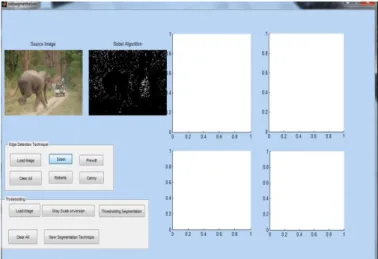
1. Results of Old Edge Detection Segmentation Technique The algorithm is designed for segment the edges of the whole image using Sobel, Prewitt, Canny method. It is also called discontinuity detection technique.
Figure 11:Extract Edges from Source Image using Sobel Edge Detection
2. Results of Fixed Region Segmentation Technique Fixed Region is technique for image segmentation. An advantage of fixed region technique as image segmentation is that they partition an image into sub-regions with continuous boundaries.
3. Results of Corners Feature Point Matching Technique in Image Find the corners point of both source and target image. In this technique only detect the corners feature of image. The corner feature is found on boundary of the object because the color intensity is high at the edges of the object. But in this technique low intensity point or feature is not found so object detection is not accurate.
4. Results of Putatively Feature Matching Technique in Image
Find the homologous points between source and target images with respect to each other. In this technique find the corners feature point and surface feature point of image and match the strongest feature point of source and target image. When the sample target object feature strongly match with source target image then detect the object on source image on the basis of sample image feature.
Figure14: Purposed Putatively Feature Matching Technique In Image
VIII. CONCLUSIONS AND FUTURE SCOPE
In previous chapter, it is clear that we have implemented the proposed technique with result using the specified tools. In this chapter, we have concluded our research work and giving some future directions
1. Conclusions:
This Project focuses mainly on the segmentation and identification of Special Object Elephant. The interaction between image segmentation and object recognition in the framework of the Sobel, Prewitt, Roberts, Canny are studied and build new own Technique for better result in future. It provides information for identification or recognition and interpretation of object. It is useful to in various real-world application in which object identification is very important like Elephant Identification and find out the movement of Elephant or other special object in forest department which prevent the attack on human, destroy property by Elephant or other special wild animals.
2. Scope for Future Work:
Developed a security level application that identified and tracking the special object (Elephant) and .object passes
outside the boundary of forest then send the message or trigger warning to the related forest ranger. This application is useful prevent the attack on the humans, raid of crops and destruction of property by elephant in future aspect. Developed application in various field like Security, Medical, Forest Department and Astronomical application based on Segmentation identification.
REFERENCES
[1] Mr. Salem Saleh Al-amri, Dr. N. V Kalyankar, Dr. Khamitkar, “Image Segmentation by using Edge detection”,
International Journal on Computer Science and Engineering, Vol. 02, No. 03, 2010
[2]Rashmi, Mukesh Kumar, Rohini Saxena, “Algorithm and Technique on Various Edge Detection :Survey”, Signal
& Image Processing : An International Journal (SIPIJ),
Vol.4, No.3, June 2013
[3]G. T Shrivakshan, Dr. C. Chandrasekar, “A Comparison of various Edge Detection Techniques used in Image Processing”, International Journal of Computer Science
Issues, Vol.9,Issues 5,No 1, September 2012
[4]Saiful Islam, Majidul Ahmed, “A Study on Edge Detection Techniques for Natural Image Segmentation”,
International Journal of Innovative Technology and Exploring Engineering (IJITEE), ISSN: 2278-3075,
Volume-2, Issue-3, February 2013
[5]H.S. Bhadauria, Annapurna Singh, Anuj Kumar, “ Comparison between Various Edge Detection Methods on Satellite Image”, International Journal of Emerging
Technology and Advanced Engineering, Volume 3, Issue 6,
June 2013
[6]Li Bin, Mehdi Samiei yeganeh, “Comparison for Image Edge Detection Algorithms”, IOSR Journal of Computer
Engineering (IOSRJCE), Volume 2, Issue 6 (July-Aug. 2012)
[7]Piotr Doll´ar, Zhuowen Tu, Serge Belongie, Supervised Learning of Edges and Object Boundaries”, IEEE Computer
Society Conference on Computer Vision and Pattern Recognition (CVPR’06), 0-7695-2597-0/06,2006
[8]Salem Saleh Al-amri1, N.V. Kalyankar2 and Khamitkar, “Image Segmentation by Using Thershod Techniques,
Journal of Computing, Volume 2, Issue 5, May 2010
[9]Jamil A. M. Saif , Ali Abdo Mohammed Al-Kubati, Abdultawab Saif Hazaa, Mohammed Al-Moraish, “Image Segmentation Using Edge Detection and Thresholding”,
International Arab Conference on Information Technology,
ISSN:1812-0857, December 2012
Histogram Thresholding
Using Fuzzy Sets”, IEEE Transactions on Image
Processing,Vol 11,No 12, December 2002
[11]Adewole A. Philip and Mustapha Mutairu Omotosho, “Image Processing Techniques for Denoising Object Identification and Feature Extraction”, Proceedings of the
World Congress on Engineering,Vol 3, July 3 – 5,2013
[12]Y.Ramadevi,T.Sridevi, B.Poornima,
B.Kalyani”,Segmentation and Object Recognition using Edge Detection Techniques”, International Journal of
Computer Science & Information Technology (IJCSIT), Vol
2, No 6, December 2010
[13]Krishan Kumar , Rajender Kumar, “Enhancement of image Segmentation using Morphological Operation”,
International Journal of Emerging Technology and Advanced Engineering, Volume 3, Special Issue 2, January
2013
[14] R. Revathi, M. Hemalatha, “ Certain Approach of Object Tracking using Optical Flow Techniques”,
International Journal of Computer Applications, Volume
53– No.8, September 2012
[15] Prajna ParimitaDash, Dipti patra, Sudhansu Kumar Mishra, Jagannath Sethi, “
Kernel based Object Tracking using Color Histogram Technique”, International Journal of Electronics and
Electrical Engineering, Volume 2 Issue 4 April 2012
[16]“Image Segmentation”,
http://electronicimaging.spiedigitallibrary.org [17]“Image Segmentation”,
http://www.emt.tugraz.at/~vmg/research/OR [18]“Edge Based Segmentation”,
![Figure 1: Block Diagram of Fundamental Steps of Image Processing System [2]](https://thumb-us.123doks.com/thumbv2/123dok_us/8219331.2179179/2.893.455.816.202.378/figure-block-diagram-fundamental-steps-image-processing.webp)
![Figure 3: Edge Based Segmentation [3]](https://thumb-us.123doks.com/thumbv2/123dok_us/8219331.2179179/3.893.69.446.73.204/figure-edge-based-segmentation.webp)
![Figure 10: Block Diagram of Object Tracking System [14]](https://thumb-us.123doks.com/thumbv2/123dok_us/8219331.2179179/5.893.76.437.78.376/figure-block-diagram-object-tracking.webp)