ISSN: 2147-611X
www.ijemst.com
The Development of a Socioscientific
Issues-Based Curriculum Unit for Middle
School Students: Global Warming Issue
Nejla Atabey1, Mustafa Sami Topcu2 1
Mus Alparslan University 2Yıldız Technical University
To cite this article:
Atabey, N. & Topcu, M.S. (2017). The development of a socioscientific issues-based
curriculum unit for middle school students: Global warming issue.
International Journal of
Education in Mathematics, Science and Technology (IJEMST), 5
(3), 153-170.
DOI:10.18404/ijemst.296027
This article may be used for research, teaching, and private study purposes.
Any substantial or systematic reproduction, redistribution, reselling, loan, sub-licensing,
systematic supply, or distribution in any form to anyone is expressly forbidden.
Authors alone are responsible for the contents of their articles. The journal owns the
copyright of the articles.
Volume 5, Number 3, 2017
DOI:10.18404/ijemst.296027
The Development of a Socioscientific Issues-Based Curriculum Unit for
Middle School Students: Global Warming Issue
Nejla Atabey, Mustafa Sami Topçu
Article Info
Abstract
Article History
Received: 11 July 2016
In this study, we aimed at developing ―Human and Environment‖ unit around SSI based instruction. We followed action research methodology in development and implementation of the unit. The participants of this study were 24 seventh graders students and the instruction was extended to eight and a half weeks, taking four hours in a week. The data collection tools included the teacher’s, the students’ diaries, midterm exams, and video records. The SSI-based instructional framework of Presley and colleagues (2013) guided us to develop this unit for middle school. We also used the framework for analyzing student and teachers’ diaries. The correct answers were scored with 1 point while wrong answers were evaluated with 0 point for mid-term exams which were multiple choice exams. Video records were evaluated in terms of SSI-based instruction observation form. Our findings showed that the framework of Presley and colleagues (2013) was useful for the development of an effective SSI-based instruction. At the end of the study a unit started with a global warming, interacting with science ideas and practices, and ended with a final activity was presented.
Accepted: 26 February 2017
Keywords
Socioscientific issues Science teaching Development of a SSI-based unit
Middle school students
Introduction
Scientific knowledge is developing in parallel with the needs of the societies. As scientific development creates different reactions in society we call these reactions socio scientific issues (SSI; Ratcliffe & Grace, 2003). Some current SSIs are the production of genetically modified organisms, use of the mobile phones and construction of nuclear power plants. Such SSI has become a popular research context and subject matter of study for science education researchers. The important science education research centers like NRC (1996) emphasizes that people should discuss, analyze and make evidence-based decisions about SSI. Helping students to gain these qualifications would support educating people for science literacy. The researches on this field show that SSI-based instruction supports understanding nature of science (Eastwood, Sadler, Zeidler, Lewis and Amiri and Applebaum, 2012), decision making process (Gutierez, 2015), argumentation quality (Tal and Kedmi, 2006; Zohar and Nemet, 2002), informal reasoning ability (Wu and Tsai, 2007), motivation to lessons (Lin and Mintzes, 2010) and interest (Dawson and Venville, 2009), learning scientific context (Klosterman and Sadler, 2010). Thus considering these advantages AAAS (1990) supports including SSI in science curriculum we developed a SSI-based unit for the 7th graders in order to integrate SSI-based instruction to science lessons. Our focus on SSI was global warming which is so important for both nationally and globally.
Socioscientific Issues Based Instructional Frameworks
A number of instructional frameworks for teaching SSI existed in the literature. Rundgren and Rundgren (2010), for instance, developed the instructional model of the SEE-SEP, which associated with six disciplines – Sociology/Culture, Environment, Economics, Science, Ethics/Morals and Politics; and three personal dimensions -values, knowledge and experiences. The six disciplines highlighted the interdisciplinary nature of SSI and three personal dimensions were considered as factors, which determined the people’s qualities of argumentation and informal reasoning. Rundgren and Rundgren (2010) created 18 codes by putting together the first two initials of the six disciplines and the first initials of the personal dimensions. For instance, students might state that genetically modified organisms might reduce the usage of agriculture chemicals, but might cause an environmental problem in time to come. In this case, students expressed both their values and the environmental dimension of the issue. This argument by the students was encoded as EnV (Environment-Value).
Kolstø (2001) designed another SSI-based instructional framework, which showed that scientific dimensions of SSI could be classified under four categories: science as a social process, the boundaries of science, values in science and critical approach. Under these four categories, eight elements were handled and it was asserted that these elements must be instructed in science lessons. The elements were called ―the role of consensus in science‖, ―science being developed‖, ―science as a social aspect‖, ―descriptive and normative states‖, ―demands for underpinning evidence‖, ―scientific models‖, ―scientific evidence‖, ―suspension of belief‖, ―to scrutinize science-related knowledge claims‖.
Sadler (2011) has developed another SSI-based instructional framework including four main elements: class atmosphere, teacher’s approaches, design elements, and students’ experiences. Class atmosphere emphasizes the participation of the students, cooperation and respect in the class. Teacher’s approaches concern that teacher should be willing to share his authority with students and conduct student-oriented activities. Elements of the organization indicated that the teacher and other participants should cooperate in the process of organizing SSI-based practices. The student experiences emphasize the abilities and knowledge that should be gained by students at the end of SSI-based instruction.
Another SSI-based instruction framework belongs to Presley, Sickel, Muslu, Johnson, Witzig, Izci and Sadler (2013). In this framework, the core elements of SSI-based instruction are: design elements, students’ experiences, and teacher attributes. Classroom environment and peripheral influences encapsulate the core elements. According to this model, SSI-based instructions should be initiated with an interesting and controversial issue (Presley et al., 2013). The relevant issue must be at the heart of the lessons and the instruction should be developed around it. Technology must be put in if necessary, to enable more effective instruction in class and life instances should be related; media should be used for this purpose (Presley et al., 2013). The model also deals with the qualities of the elements such as teacher, students and the class atmosphere. For instance, in SSI-based instruction, the students should be involved in superior activities, such as argumentation and questioning and must collect scientific data and analyze it (Sadler & Murakami, 2014). Besides, students should be aware of social issues. Teachers must be knowledgeable on both scientific and social aspects of the issue but must confess that they might not have boundless knowledge on the issue (Presley et al., 2013). Teacher should be willing to share his authority with students and in-class atmosphere should be marked with cooperation, interaction and mutual respect between teacher and students (Sadler, 2011).
The Rationale and the Purpose of the Research
The meaning of scientific literacy has changed in time due to the current technological and scientific developments. For Hurd (1958) who used the term science literacy for the first time, the main aim of science literacy was just to learn the science content. Today, science literacy is defined as the ability to make an informed decision about a certain issue; along with having knowledge of present scientific theories and facts (Tal & Kedmi, 2006). Major science education organizations such as National Research Council (NRC, 1996) and American Association for the Advancement of Science, (AAAS) (1990) also emphasize the necessity for an individual to analyze issues concerning science and technology, to discuss and to make informed decisions about scientifically related social issues.
Researchers claimed that SSI-based instruction is scarcely applied in science classrooms because of two major reasons (Friedrichsen, Sadler, Graham & Brown, 2016): first, instructional materials for the instruction are not plentiful and second teachers do not receive sufficient support for implementing of such an instruction (Hofstein, Eilks & Bybee, 2011). There are not sufficient studies either, to guide teachers on how they can design and carry out this instruction in science classrooms (Sadler, Friedrichsen, Graham, Foulk, Tang & Menon, 2015). We aimed to develop an SSI based unit of instruction for middle school science lesson in order to overcome these limitations. Because of its great importance for Turkey, we chose global warming issue for this unit. It is estimated that Turkey will be affected by global warming in different ways. For example it is expected that in the summer, the temperature will increase 3 degrees Celsius and in winter it will be 1 degree colder than before (Dalfes, Karaca & Şen, 2007). Water resources are affected by global warming and that’s why some areas have been desertificated in Turkey (Dalfes, Karaca & Şen, 2007). Türkeş (2001) defines that if carbon dioxide reduction is not controlled, the average annual precipitation will decrease by 0-1 mm/day and the annual flow of river would decrease by %20-50. As a results of these cases, Turkey will have a water shortage problem, agricultural production will decrease between percent 0-2, 5 until 2080.
There are some studies focused on global warming issue as a socioscientific issue in Turkey. For example İşbilir (2010), Topçu, Sadler and Yılmaz-Tüzün (2010) searched preservice teachers’ argumentation and informal reasoning about socioscientific issues in the context of global warming. However these studies don’t emphasize designing SSI-based unit. In these studies participants only discuss and present their ideas about global warming issue. Also Sadler (2011) designed a SSI-based instruction on global warming and the major themes of the unit were ecological interactions, climate change, nutrient cycling, energy flow and biodiversity. They used argumentation and modelling as scientific practices. They completed the unit through 6 lessons 5 of them 90 minutes and one of them 60 minutes. They used lectures, presentations, field trip, simulation, modelling and discussing activities. There is such an example for Turkish science teachers to teach a unit through SSI-based instruction. Therefore, researchers use ―Human and Environment‖ unit because they were connected to each other and the main SSI of unit ―global warming‖. The contexts and activities were explained under the heading of methodology. The research question guided our study is: How can we develop a SSI-based unit for 7th graders students?
Method
The Research Model
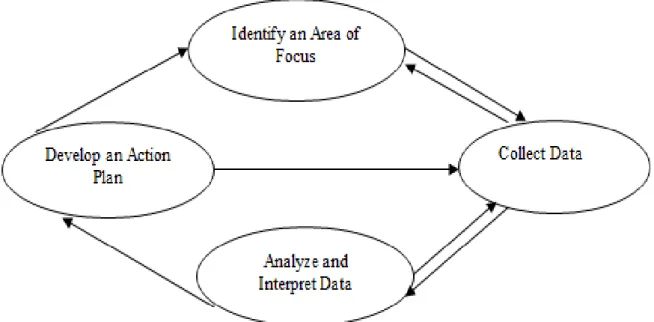
Figure 1. Action research cycle (Adapted from Mills, 2003)
Identify an Area of Focus: The researchers firstly reviewed the literature to identify the research focus. It was seen that there was a gap in terms of implementation of SSI-based instruction. The main two problems are the limited curriculum materials and the lack of support to teachers about SSI-based instruction (Hofstein et al., 2011). The researchers interviewed five science teachers to define research problems. Four of the science teachers explained that they did not have any information about SSI-based instruction and didn’t implement it in their classrooms. They also added that they had no training in their universities about SSI and SSI-based instruction. Therefore it was defined that there was a big gap in terms of implementation of SSI-based instruction especially in Turkey. So developing SSI-based unit instruction was defined as the focus area of the study.
Data Collection: Data collection tools used in the study were student diaries, teacher diaries, mid-term exams and video records for the lessons. Students and teacher completed their diaries at the last five minutes of lessons. The teacher analyzed these diaries every week according to framework of Presley et al. (2013) and tried to develop SSI-based instruction according to feedbacks gathered from diaries. Other data collection tools, mid-term exams, were applied every two weeks and new activities and lesson plans were designed to accumulate knowledge defined by these exams. The lessons were also recorded and the validity committee consisting of two experts on SSI-based instruction and action research watched these videos every week. Committee members filled SSI-based instruction observation forms while watching the videos and teacher implemented SSI-based instruction according to their critics. Data collection process and tools were given at Table 1.
Acting: The research went on 8, 5 weeks for 4 hours per week. Lessons were conduct according to the SSI-based lesson plans which were prepared at the beginning of the research. Every lesson was recorded. Validity committee members watched these videos every week and revisions were made in lesson plans according to their critics. Three midterm exams were completed to define whether students gained the target acquisitions. New activities were designed for the questions below %70 success. If one question was answered with a rate of 70 percent, we accepted that the content related to this question was learned sufficiently. Çakmak and Kara (2015) defined the lower limit of full learning as 70-75 percent. In the study which researchers investigated the levels of prospective elementary school teachers’ understanding of physical and chemical change, accepted the rate of %70 as highly accurate response rate (Sağır, Tekin and Karamustafaoğlu, 2012).
The Participants of the Study
Twenty-four students of 7th grade students were the participants of the present study. The class contained different students in terms of their academic performance and residence. Some of the students were living in towns while the rest were living in villages. The class also comprised students who were motivated and successful to learn, and also some of them were unmotivated and unsuccessful. Throughout the study, students participated in heterogenic groups and the same teacher led all the activities. The teacher, a Ph.D. candidate, had sufficient knowledge and experience about action research. The teacher had also extensive knowledge and experience about SSI-based instruction. Throughout the research, her academic mentor and thesis supervision committee assisted and guided her. She has been working as a middle school science teacher since 2004.
Study Context and Data Collection
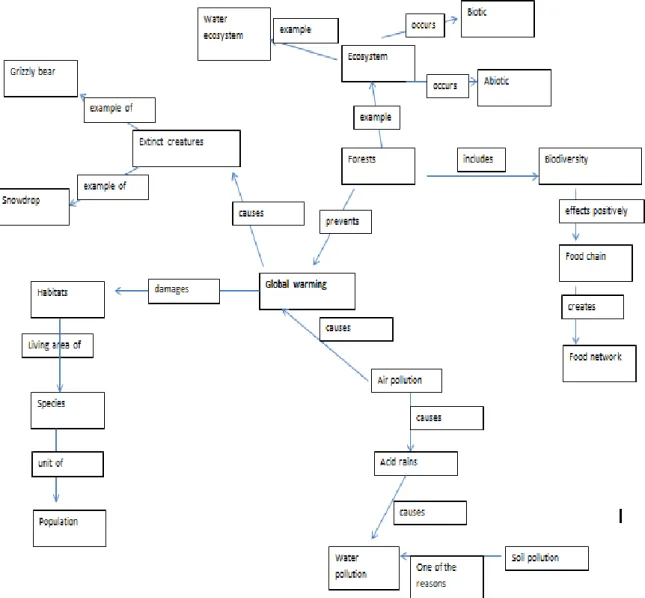
Development and implementation of SSI-based unit of instruction continued for eight and a half weeks, taking four hours a week. The teacher was also researcher and used SSI unit in the classroom. The researcher was a doctoral student and has been studying SSI, argumentation subjects through her Ph.D. education. To supplement validity and conformity of the study various data collection tools, classroom observations, excerpt from students’ and teachers’ diaries, experts’ opinions were considered. The teacher tried to develop and implement SSI-based instruction according to feedbacks gathered from data collection tools. The unit was developed around global warming issue. The concept map of the unit was presented at Figure 3.
The instruction began with presenting the focal issue, global warming to the students. Students watched a video about global warming and then the teacher asked the students some questions about global warming in order to enhance their understanding of the issue. After the students finished watching the video, some questions asked such as: ―What do you think about the video?‖, ―Is global warming a problem?‖, ―Why is global warming a problem?‖, ―Is it only about environment?‖, ―Who and where will be more affected?‖ Teacher wrote the students’ answers on board which was divided 3 parts. The teacher wrote students’ answers about ―Is global warming a problem? on the first part of the board. The answers for ―Why is global warming a problem?‖ were written on the second part and the causes and importance of second answers were written on the third part of the board. Then teacher defined that scientists live such a process to find a solution or discover new knowledge. Teacher went on explaining that scientists present a ―claim‖ for the problem firstly, then they explain their evidences to support their claims and lastly they explain why their evidences support the claim. The teacher also emphasized that students’ answers for the first question was their claims, their answers’ written on the second part of the board were their evidences and the answers on the third part of the board were their reasoning. In the next lesson the students should find an answer for this question ―Do you have a stake in global warming?‖ in groups. They used encyclopedias, magazines, books. Teacher aimed students to obtain knowledge about the air, water and soil pollution, ozone layer, greenhouse effect through this activity.
In the next lessons students experienced laboratory activities such as ―greenhouse effect‖, ―let’s measure the carbon dioxide in air, breath and exhaust‖, ―the effect of acid rains‖ in groups. Teacher aimed students to collect evidence for their claims about ―Do you have a stake in global warming?‖ through these activities. In the following lessons students interpreted the results of laboratory activities. Then they completed an activity including calculation of how much energy they used for one day. Also they read the interviews which they completed with elder people about climate change. Teacher aimed students to notice how people cause global warming and how global warming affects our lives.
In the next lesson, the first midterm exam was applied. The results of the first exam showed that, correct responses were below 70 percent for the questions about soil pollution and greenhouse effect were answered correctly below 70 percent. That’s why teacher designed new activities for these contents. In the following lesson, the students participated in forest trip. A forest engineer gave information about the effects of forests on global warming and the importance of forests for biodiversity and food chain. Then students discussed their learnings through forest trip. At the end of the lesson the activity called ―my food chain‖ was completed in groups. Then the 2th midterm exam was applied. The results of the second exam showed that, the questions about food chain were answered correctly below 70 percent. That’s why the teacher designed a new activity for food chain.
In the next lessons, students searched ―why global warming is a problem‖ and ―what are its effects on livings?‖ via websites. By the means of this activity teacher aimed at helping students to gain information about populations, species, habitats, extinct creatures. Then students discussed their learnings which they gained from websites. Then, teacher presented PowerPoint slides about the content.
In the next lesson students completed the 3th midterm exam. The results showed that correct response rate for the question about habitats was below 70 percent. In this purpose a new activity was designed by the teacher named ―let’s create a habitat for caretta carettas‖. Then students discussed in groups to answer ―Should the countries reduce their carbon dioxide emissions to the air?‖ All groups presented one authority such as ecologic group, factory owner, thermal power owner, government. After that the groups presented their arguments in front of the class.
Data Collection Instruments
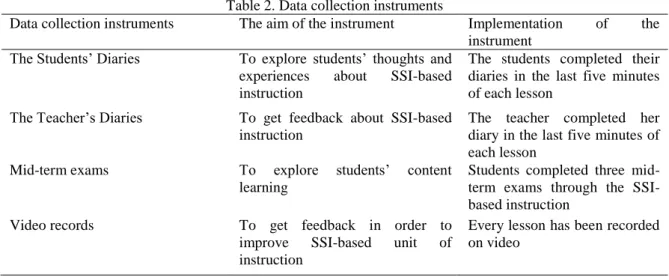
The instruments used in the present study are: Teacher and student diaries, mid-term exams, video records.
Table 2. Data collection instruments
Data collection instruments The aim of the instrument Implementation of the instrument
The Students’ Diaries To explore students’ thoughts and experiences about SSI-based instruction
The students completed their diaries in the last five minutes of each lesson
The Teacher’s Diaries To get feedback about SSI-based instruction
The teacher completed her diary in the last five minutes of each lesson
Mid-term exams To explore students’ content
learning
Students completed three mid-term exams through the SSI-based instruction
Video records To get feedback in order to
improve SSI-based unit of instruction
Every lesson has been recorded on video
As seen in Table 2, two of the data collection instruments were the diaries of the students and the teacher. The teacher kept a diary to reflect her experiences about implementing SSI-based instruction. While the teacher jots down details about students’ interactions and conversations, students also kept diaries during the implementation of SSI-based instruction. The teacher handed out blank diaries to the students at the end of each lesson and collected them later. The teacher thus aimed to prevent excuses like ―I left my diary at home‖.
Another data collection instrument was mid-term exams. Three mid-term exams were applied to the students in order to determine what extent students learnt science concepts. New activities were designed to improve students’ knowledge about science concepts if the questions of mid-term exams were answered by the %70 of the students or less. The other data collection instrument was video records. The validity committee watched the videos every week and filled out SSI-based instruction observation forms regularly.
Data Analysis
Students’ and the teacher’s diaries were analyzed in light of SSI-based instruction framework of Presley et al. (2013). Teacher tried to explain if the features of SSI-based instruction were fulfilled during the lessons. Descriptive analysis as a qualitative data analysis method was utilized to analyze diaries. In the findings section, each main element of the SSI-based instruction framework was accepted as a title of findings section and excerpts from diaries were reported under these titles. Another data collection tool was mid-term exams including multiple choice and fill-in-the-gap questions. For the multiple choice questions, each correct answer was rated as 1 point and for the fill-in-the-gap questions, every correct phrase was rated as 1 point. The validity committee assessed all the video-recorded lessons by offering three options: ―never, scarcely and frequently‖ based on the SSI observation protocol (Topçu, Pitiporntapin, Foulk, & Sadler, 2016). The committee completed the observation protocols while watching the videos and presented feedback to the teacher about the SSI-based instruction.
Results and Discussion
Development of an SSI-based Unit of Instruction
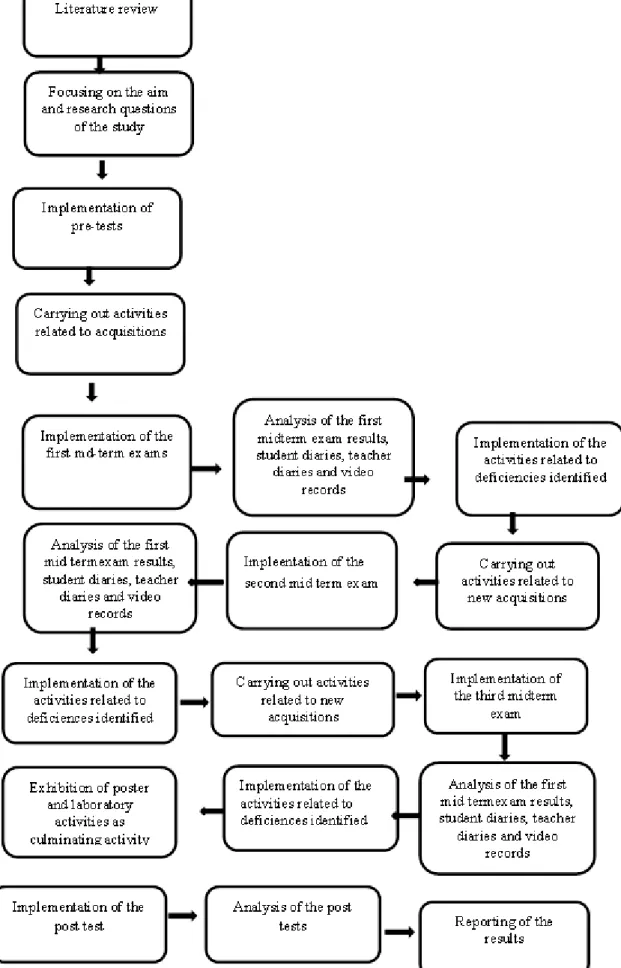
issue, continue with scientific activities and conclude with culminating activity (Friedrichsen et al., 2016). The present study also began with a focal issue, continued with various science activities and lasted with an exhibition in school garden. The process of SSI-based instruction was showed in Figure 3.
Figure 3. Development of SSI-based unit of instruction
In the process of designing SSI-based instruction, the researchers considered all of the main elements of Presley et al.’s (2013) SSI-based instruction framework. The process of developing SSI-based unit of instruction in light of these reports was explained in the following sections. With the help of statements received from students and teacher’s diaries, decisions taken at validity committee and results of mid-term exams, the researchers tried to explain how SSI-based unit instruction was developed according to each core elements and essential features of SSI-based instruction framework by Presley et. al. (2013). The findings were presented within design elements, learner experiences, teacher attributes, class atmosphere, and peripheral influences. In addition, essential features were also explained under the headings of these elements.
Design Elements
The design elements of SSI-based unit of instruction include ―designing instruction around an interesting issue‖, ―presenting the issue first‖, ―using technological devices to let the students learn better‖, ―providing culminating practice‖, ―using the media to connect the class activities to real life‖, and ―providing framework for higher-order thinking‖. Since designing SSI-based unit of instruction around an interesting issue is an important feature of this instruction, all activities were designed around the global warming issue. The students’ expressions revealed that the feature emphasizing the importance of designing instruction around a compelling issue was achieved:
I think it was fun and I think it was an issue that must be discussed (Student 2).
It was highly educative. It was interesting because it concerned issues that make our lives difficult (Student 16).
The issue and the activities were interesting because they concerned the whole humanity. What we had to do was explained about global warming (Student 14).
The teacher also jot down that ―almost all students wanted to answer the questions I asked and express their ideas after watching the video about global warming. I think the issue drew attention and curiosity of students.
Introducing the focal issue Video about global warming
Interacting science ideas and practices Searching books, magazines, journals Laboratory experiments
Field trip
Hands on activities Web search Argumentation
Culminating activity Preparing poster
Another feature of design elements emphasizes presenting the controversial issue first. The validity committee members approved the item of SSI-based instruction observation form including ―the teacher first presented the issue and later frequently mentioned it‖ and added their comment as ―all aspects of the global warming were discussed‖. The feedback from the validity committee members proved that the teacher presented the problem first.
Another feature of the design elements is using technology to let students learn better. One student noted in her diary: ―We used a projection and discussed between each other in the classroom‖ (Student 15). The teacher also stated that ―the students were looking for the results of global warming through internet and they didn’t have any difficulty using computer and finding information they needed‖. These statements revealed that the teacher benefited from technology to support students’ learning.
Other two design elements are ―presenting a culminating activity‖ and ―connecting the class activities to real life‖. The teacher let students summarize their learnings at the end of the lessons. In addition, the students prepared posters to reflect their new grasp throughout SSI-based instruction and exhibited their posters and laboratory activities in the school garden. A student expressed: ―I think the lesson was educative because we worked to prepare posters, therefore, we had to search. We tried to use whatever we learnt on the posters‖ (Student 16). The teacher also noted in her diary that students mentioned about different aspects of SSI and referred their learnings on posters and used these statements:
Students reflected their learning related to the reasons and results of global warming. They found and drew effective and meaningful pictures, found slogans. I can understand that students learnt the unit contents when I looked at the posters prepared by students.
The validity committee members also emphasized that teacher often used culminating activities.
Based on these statements, the researchers concluded that the students presented culminating activities at the end of SSI based instruction. The students also noted the statements in their diaries: ―I enjoyed preparing a poster and we cut the daily news out of the papers and pasted them on the posters, and it worked out very well (Student 2)‖. These statements might be interpreted that the feature of ―connecting the class activities to the real life‖ was achieved as well.
Another feature of the design element is ―providing framework for higher-order practices‖. In the first and second weeks, the committee members criticized the teacher by claiming, ―The teacher scarcely presented higher-order practices and didn’t meet science modeling‖. In the following weeks, the teacher let students use elements of argumentation to defend their opinions and let them use science models. Therefore, the committee members changed their opinions based on their observations as the teacher frequently presented a framework for higher-order practices and used claim, evidence and reasoning elements. Students also jot down these statements in their diaries:
Today we learned new knowledge: Claim, evidence, reasoning. We will use these components while discussing.
Teacher jot down about this feature:
I think students didn’t have difficulty to understand claim and evidence. However they had difficulty to understand reasoning.
Students’, teachers’ and validity committee members’ statements prove that teacher presented a framework for higher order thinking.
Teacher Attributes
following lessons, the teacher tried to support the students’ opinions with her own opinions and knowledge thus she aimed to present her knowledge about the issue much more clearly. She jot down in her diary:
The committee members stressed that I should emphasize more strongly that I knew the content last week. This lesson I made detailed expressions and presented additional actual information to help students connect the subject with their daily life after laboratory activities.
After these lessons the committee members changed their first comments and reported that the teacher frequently indicated her knowledge about the issue. In addition to having sufficient science knowledge about SSI, teacher should be honest about her knowledge limitations in the process of SSI-based instruction. The students’ statements given below showed that the teacher was aware of her knowledge limitations. The students noted some statements on their diaries: ―Global warming affects everything. It affects farmers, workers and also government. Knowing everything is very difficult. I can’t decide. Our teacher also explained that having knowledge about all aspects of SSI is not possible‖ (Student 3). The teacher jot down these statements about this feature:
Students sometimes asked very detailed questions. For example how much polluted gas do thermal power plants release to the air? How many years do we have that we won’t have a water shortage? I have difficulty to guide students and answer all of the questions. At this point I explained that controversial issues like global warming had several dimensions, it was not possible to explain all dimensions and there were contents that I don’t have deeper information about all dimensions.
The validity committee members also confirmed that teacher often showed that she knew the content. Another feature of the teacher attributes is ―being aware of the social aspect of the issue‖. The committee members stated that ―the teacher scarcely mentioned the social dimensions of the issue‖ and ―students discussed the issue as a problem but they didn’t mention political and economic dimensions of it‖ for the first and second weeks. In the following weeks, the students started to mention about different views of authorities (politician, farmer, and factory manager) and defended their positions concerning the issue. The students jot down these statements in their diaries about this feature: ―Global warming affects different people like farmer, government and factory worker‖.
The teacher’s notes also supported that different activities helped being aware of different dimensions of SSI: I designed an argumentation activity among groups to help students explore the different dimensions of global warming. Every group represented different authorities (farmer, owner of factory, government, environmental group) and presented and discussed their arguments about ―Do the countries decrease their gas emissions to the air?‖ to all class.
At the end of the study, the committee members reported that the teacher emphasized the social dimension of the issue sufficiently. The statements gained form diaries and committee members’ observations show that the teacher was aware of the social dimensions of global warming. In addition the positive change of committee members’ ideas might be interpreted that teacher improved her SSI-based instruction.
Learner Experiences
Another element of the framework is the learner experience and it comprises ―confronting with scientific opinions and theories concerning the issue‖, ―collecting scientific data and analyze it‖, ―negotiating the social dimension of the issue‖, ―engaging in higher-order practices‖, ―confronting the ethical dimension of the issue‖, and ―thinking about the nature of the science regarding the issue‖. Throughout the SSI-based instruction, students searched the science magazines and encyclopedias to answer the question: ―Do you have a role in the global warming?‖ After the search, the students jot down some statements in their diaries:
Today we searched through various sources and tried to find an answer to the teacher’s question. Everybody found different answers. Later, we discussed these answers and found out that every person had a role in the global warming and me also (Student 14).
Today we searched through magazines and encyclopedias to find out whether we had a role in global warming. We discovered interesting facts and discussed them (Student 11).
These statements revealed that students confronted with different scientific opinions and explanations about the global warming issue while they collected and analyzed scientific data about this issue. Students also discussed the social dimension of SSI. They worked in groups and discussed SSI in terms of different authorities’ perspectives. Thus students tried to explore social dimensions of SSI. Another feature, categorized under the learner experiences, is to deal with higher-order practices. Students noted some statements about this feature in their diaries:
Today we represented the environmentalist group. We discussed that the countries should decrease their greenhouse gas emission because global warming causes glaciers to melt and when the glaciers melt, the livings like polar bear will lose their homes. These are our arguments (Student 15).
The teacher jot down these statements in her diary:
In my opinion students didn’t have any difficulty to understand claim and evidence. However it was difficult to emphasize the right point while presenting the reasoning. I think understanding the reasoning was difficult for students.
The validity committee members explained that students rarely engaged in higher order practices and more emphasize should be placed on argumentation. In the following lessons teacher encouraged students to use argumentation elements while discussing otherwise she warned. Teacher also designed new lessons that students could represent different authorities and present their arguments to class. The students jot down their diaries about these lessons:
We are environmental group today. We claim that countries should decrease their greenhouse gas emissions to prevent global warming. Because global warming melts glaciers. When glaciers melt, polar bears can’t find a life area. These are our claim and evidences.
In the following lessons the teacher jot down in her diary that when students didn’t use the elements of arguments, they noticed their fault and corrected their fault. They became accustomed to argumentation process. In addition to these statements, the committee members stated, ―the students frequently participated in higher-order practices particularly in argumentation activities and they justified their ideas by using arguments elements‖. These indicators showed that the students engaged in higher-order practices sufficiently through SSI-based unit instruction.
the results of global warming at the end of the internet researches. Melting of glaciers, climate changes, desertification and extinction of animals were some of the information that students gave‖.
The committee members criticized the teacher that students rarely collected data. After these critiques, teacher organized new activities that students could collect data. For example teacher designed laboratory activities called ―greenhouse effect‖, ―measure the amount of carbon dioxide in the air, our breath and exhaust‖ and such. Teacher noted in her diary: ―students made observations and measurement during laboratory activities. They analyzed, interpreted and connected the laboratory results with their lives. After these lessons committee members defined that students frequently collected and analyzed scientific data. Another feature of learner experiences is being aware of social dimension of SSI. Students’ statements about this feature are like: ―We correlated the results of laboratory activities with our lives and discussed their effects to our life‖. ―Global warming affects everybody: Farmer, factory workers and government‖.
The validity committee members defined that students confronted with social dimensions but they didn’t discuss these dimensions deeply‖. Considering these critiques teacher designed new activities that students could discuss social dimensions of SSI. Argumentation activity, calculating personal energy consumption, interviewing with elders about climate change are some of these activities. After these lessons committee members changed their critiques that students often discussed the social dimensions of SSI.
Another feature of the learner experiences is that students should confront the ethical dimension of the issue. Through the SSI-based unit instruction, students participated in a field trip. A forest engineer lectured about the role of the forests in global warming, ecosystems, plant diversity, food chain and food network, and then the students had a field trip in the forest. They observed the forest ecosystem. The feedback from the students was:
The issue and the activity were excellent. It was interesting. We both had fun and learned about the forest. We learned the role of the forest on global warming but we learned that we couldn’t save the forests properly and we couldn’t do our duty well (Student 15).
While visiting the forest, I saw a lot of garbage. People unfortunately ruin forests (Student 11).
Teacher jot down her diary these statements:
Students complained that people polluted and irresponsible about environment while collecting garbage and they defined that this behavior was not correct.
Validity committee members also defined that students confronted with ethical dimension of the issue. Based on these statements, we can claim that students confronted with the ethical dimension of SSI. Another feature of the student experiences is ―to think about the nature of science concerning the issue‖. Students wrote on their diaries about this feature:
The lesson was fun, and I enjoyed online research. The most interesting thing to me was that the countries have different solutions and perspectives on this issue. Their perspectives are always changing in order to address the global warming issue. Some countries, though recognizing it as a problem, don’t want to take precautions against it (Student 14).
Teacher jot down some statements about this feature:
Students defined that every country had different opinions about decreasing their gas emissions. This inference shows that students gained awareness that scientific information has cultural and social structure.
Validity committee members also defined that students considered the nature of science elements through SSI-based instruction‖. These statements highlighted that students noticed the nature of science aspect about the issue.
Class Atmosphere
students feel safe in the class‖. The teacher noted in her diary that students focused on activities, they tried to find evidences for their claims, and all students collectively participated in activities. Students revealed similar statements in their diaries:
I think that lesson was very useful today. We studied in the lesson actively as a group (Student 1).
I liked the activities. They were interesting. We studied as a group and saw the importance of collaboration (Student 11).
Some group members had different opinions but we respected them (Student 7).
Teacher jot down in her diary:
Students seemed that they focused on activity. They are all willing to find evidence for their claims.
The committee members also emphasized the mutual respect between the teachers and the students by stating that ―everybody could tell their opinions. Students waited for their turn to speak. Respect and kindness were obvious‖. Teacher jot down that students were respectful each other while sharing information and interpreting them.‖ Based on students’, teacher’s and committee members’ statements, we might claim that the classroom had collaborative and interactive atmosphere, there was a mutual respect between the teachers and students and they felt safe in the class through the SSI-based instruction.
Peripheral Influences
Peripheral influences includes: ―flexibility of curriculum that allows teachers to adapt SSI-based instruction‖, ―connections between based curricula and state- or national-level curriculum objectives‖, ―access to SSI-based materials‖, ―awareness of local community issues to prompt SSI-SSI-based lessons‖.
In the present study the selected SSI was global warming. In the process of designing and developing SSI based unit of instruction, objectives of the Turkish middle school science curriculum were considered. The researchers prepared lesson plans, activity sheets, data collection tools, experiment sheets, and technological devices considering objectives of the national science curriculum. Therefore we can claim that researchers designed and developed a SSI-based unit of instruction considering the Turkish national curriculum and connected SSI-based unit of instruction to the national-level curriculum objectives.
The last feature of the peripheral influences is the ―existence and awareness of local community issues‖. The statements from the students’ diaries about this feature were given below:
I think the issue is good: It is not only one of the problems for our country but also for the whole world. It was good for us to engage and deal with it (Student 10).
It rains little sometimes and a lot other times. I learned that it is due to the global warming (Student 3).
Field trips also helped to emphasize on this feature. The statements derived from students’ diaries showed that students were aware of the existence of regional and local issues. Here are the some excerpts showing students’ awareness about these issues:
Today was great. We learnt much information about the forests of our country. A forest engineer informed us about the importance of forests for people. It was a great lesson. We found garbage in the forest and noticed that humans ruin forests (Student 5).
Conclusions and Implications
laboratory studies. SSI-based instruction was finalized with the culminating activity. Various data collection tools including teacher and students’ diaries, video records, and the midterm exams were used to develop this unit of instruction. At the end of the whole research process, this study presents an example SSI based unit for science teachers to utilize and implement it in their lessons.
Features of SSI Based Instruction
SSI-based instruction should be designed around a compelling issue and should begin with the introduction of SSI. A selected SSI should be interesting and actual (Dawson &Venville, 2009) and should be suitable for the curriculum and student level (Lenz & Willcox, 2012). It should also allow students to discuss content of the issue from different perspectives (Sadler et. al., 2015). In the present study global warming was selected as an SSI topic. Feedbacks from students’ diaries showed that the global warming issue was interesting to the students and the students were motivated to complete the activities related to this issue. We concluded that the global warming issue created an effective SSI-based learning environment for student’s discussions from different perspectives. There are studies, using global warming issue as a context for SSI-based instruction in the literature emphasizing its importance for creating interesting and motivating learning environments for the students (Nuangchalerm & Kwuanthong, 2010). Therefore, the global warming issue could be suggested to researchers as an SSI topic in order to create effective learning environments for SSI based instructions.
Engaging students with higher-order thinking practices is stated as another essential feature of SSI-based unit instruction (Presley et al., 2013). The validity committee members reported that the teacher mostly created learning environment in which she focused on students’ higher-order thinking practices. The teacher frequently encouraged students to use argumentation elements involving claims, evidences and reasoning during the instruction. Other researchers also used argumentation as an essential feature of SSI-based instructions (Dolan, Nichols, & Zeidler, 2009; Tal & Kedmi, 2006; Topçu & Atabey, 2014). Therefore we can claim that the present SSI-based unit of instruction included this essential feature of SSI based instruction and provided opportunities for the students to improve their higher-order thinking practices.
Students should confront with ethical dimension of SSI. In the present study students defined that people polluted the environment and this behavior was not correct after field trips. So field trips might be used to notice ethical dimension of SSI. When the students evaluated ethical and scientific dimensions, scientific literacy would be supported (Zediler and Kahn, 2014).
The SSI based instruction also recommends collaborative and interactive learning environment. SSI-based environments require mutual respect and tolerance and these features should be expected attitudes in general in the classrooms (Zeidler & Nichols, 2009). However developing a collaborative, respectful and safety class atmosphere is not an easy task and requires time (Presley et. al., 2013). The students should feel safe to share their opinions and to defense their arguments in the SSI-based classrooms. In order to provide such an environment, the teacher in the present study designed group activities and underlined respect, tolerance and collaboration throughout group activities. In such an atmosphere the students did not hesitate to reveal their opinions and therefore they presented unique opinions.
In order to implement SSI-based instruction effectively, designing student-centered activities is also important. In the present study, students engaged in several collaborative and student-centered activities such as laboratory studies and field trips. The students performed many laboratory experiments in groups. In order to connect the findings of the laboratory experiments with scientific part of the SSI, teacher asked some questions to the students at the end of the lab sessions. The teacher noticed that most of the students could understand the scientific dimension of SSI thanks to laboratory studies. Students also participated in a field trip after laboratory studies. The students revealed positive feedbacks about the field trip in their diaries: ―Thanks to field trips, I am aware of that this issue is an universal issue. It was good to deal with and think about it‖ (Student 10), and ―it sometimes rains little and sometimes a lot. I learned lots of things from the field trip that it is because of the global warming‖ (Student 3). Therefore, we concluded that student-centered activities such as collective laboratory studies and field trips are very useful activities for effective implementation of SSI based instructions.
students to revise their learnings (Sadler & Murakami, 2014). Parallel with the current literature, we also observed that culminating activities at the end of the instruction gave opportunity to the students for presenting their final thoughts and practices about SSI based unit of instruction. Therefore we think that posters and exhibitions might be used as culminating activity.
As a conclusion, this study presents a very good example of SSI based unit begins with first presenting global warming, second goes on scientific activities and third ended with a culminating activity and an exhibitions. The unit is not only for science teachers to utilize and implement it in their lessons, but it is also for science education researchers to design and develop new SSI based unit of instructions. Therefore, the SSI based research agenda needs new studies designing and developing SSI-based unit of instructions for different science topics and grade levels. We believe that our study will encourage and motivate teachers to implement SSI-based instructions in their classrooms and lead them in this process. The studies focuses on developing SSI-based instruction for different units will help engaging with and developing SSI-based instruction in science classrooms.
SSI-based instruction requires different dimensions. There are responsibilities for both students and teachers through SSI-based instruction. To direct and organize SSI-based instruction effectively, teacher should have experiences about this instruction. The present study suggests that new action research studies in this context will help teachers to control their roles, duties and develop their SSI-based instruction.
Developing a SSI-based unit is a difficult issue. First of all deciding the focus SSI is so important, because all of the unit content should be related to both each other and focus SSI to design a unit around a SSI. It is also important to decide how we can associate all unit content with focus on SSI. Concept map might help to elicit and see these connections. If the unit content increases, making these connections might be more difficult. Therefore if we want SSI-based instruction to take place more in science classrooms, curriculum developers might develop new science units that give opportunity to be designed around SSI.
References
American Association for the Advancement of Science. (1990). Science for all Americans. New York: Oxford University Press.
Barrett, S. E., & Nieswandt, M. (2010). Teaching about ethics through socioscientific issues in physics and chemistry: Teacher candidates’ beliefs. Journalof Research in Science Teaching, 47, 380–401.
Bryce, T., & Gray, D. (2004). Tough acts to follow: The challenges to science teachers presented by biotechnological progress, International Journal of Science Education, 26(6), 717-733.
Burek, K. (2012). The impact of socioscientific issues based curriculum involving environmental outdoor education for fourth grade students. (Unpublished doctoral dissertation). University of South Florida, USA.
Çakmak, Z. & Kara, C. (2015). İlköğretim 7. sınıf öğrencilerinin sosyal bilgiler ―iletişim ve insan ilişkileri‖ ünitesinde yer alan kavramlari anlama ve kazanma düzeyleri, Akademik Sosyal Araştırmalar Dergisi,
3(17), 82-96.
Dawson, V., & Venville, G. J. (2009). High – school students’ informal reasoning and argumentation about biotechnology: An indicator of science literacy. International Journal of Science Education, 31(1), 1421 – 1445.
Demirel, Ö. (2005). Eğitim sözlüğü. Ankara: Pegema Yayıncılık.
Dolan, T. J., Nichols, B. H., & Zeidler, D. L. (2009). Using socioscientific issues in primary classes. Journal of Elementary Science Education, 21, 1-12.
Eastwood, J. L., Sadler, T.D., Zeidler, D. L., Lewis, A., Amiri, L. ve Applebaum, S. (2012). Contextualizing nature of science instruction in socioscientific issues. International Journal of Science Education, 34
(15), 2289-2315.
Friedrichsen, P., Sadler, T. D., Graham, K., & Brown, P. (2016). Design of a socio-scientific issue curriculum unit: Antibiotic resistance, natural selection and modeling. International Journal of Designs for Learning, 7(1), 1-18.
Hofstein, A., Eilks, I., & Bybee, R. (2011). Societal issues and their importance for contemporary science education—a pedagogical justification and the state-of-the-art in Israel, Germany, and the USA.
International Journal of Science and Mathematics Education, 9(6), 1459-1483.
İşbilir, E. (2010). Investigating pre-service science teachers‟ quality of written argumentations about socio-scientific issues in relation to epistemic beliefs and argumentativeness. (Unpublished doctoral dissertation). Middle East Technical University, Ankara
Kemmis, S., & McTaggart, R. (2005). Participatory action research: Communicative action and the public sphere. In N. Denzin, & Y. Lincoln (Eds.), The Sage handbook of qualitative research (pp. 559-603). USA: Sage.
Kolstø, S. D. (2001). Scientific literacy for citizenship: Tools for dealing with the science dimension of controversial socioscientific issues. Science Education,85(3), 291-310.
Lenz, L., & Willcox, M. (2012). Issue-oriented science: Using socioscientific ıssues to engage biology students.
American Biology Teacher, 74, 551–556.
Lewin, K. (1948). Action research and minority problems. Journal of Social Issues, 2(4), 34–46.
Mills, G. E. (2003). Action research ‘A guide for the teacher researcher’. New Jersey: Merrill Prentice Hall.National Research Council. (1996). National science education standards. Washington, DC: National Academy Press.
Nuangchalerm, P., & Kwuanthong, B. (2010). Teaching ―Global warming‖ through socioscientific issues-based instruction. Asian Social Science, 6(8), 42-47.
Presley, M. L., Sickel, A. J., Muslu, N., Merle-Johnson, D., B. Witzig, S. B., İzci, K., & Sadler, T. D. (2013). A framework for socio-scientific issues based education. Science Educator, 22(1), 26-32.
Ratcliffe, M., & Grace, M. (2003). Science education for citizenship: Teaching socio-scientific issue.
Maidenhead: Open University Press.
Rundgren, S. N., & Rundgren, C. J. (2010). SEE-SEP: From a separate to a holistic view of socioscientific issues. Asia-Pacific Forum on Science Learning and Teaching, 11(1), 1-24.
Sadler, T. D. (2011). Socioscientific issues in the classroom: Teaching, learning, and research. New York: Springer.
Sadler, T. D., & Murakami, C. D. (2014). Socio‐ scientific issues based teaching and learning: Hydrofracturing as an illustrative context of a framework for implementation and research. Revista Brasileira de Pesquisa em Educação em Ciências, 14(2), 331-342.
Sadler, T. D., Friedrichsen, P., Graham, K., Foulk, J., Tang, N., & Menon, D. (2016). Socio-scientific Issue Based Education for Three-Dimensional Science Learning: Derivation of An Instructional model. Paper presented at NARST Conference, Chicago, America.
Sağır, Ş. U., Tekin, S., & Karamustafaoğlu, S. (2012). sınıf öğretmeni adaylarının bazı kimya kavramlarını anlama düzeyleri. Dicle Üniversitesi Ziya Gökalp Eğitim Fakültesi Dergisi, 19, 112-135.
Şimşek, H. (2007). A teacher development program for young learners of English: An action Research. Unpublished doctoral dissertation, Adana.
Tal, T., & Kedmi, Y. (2006). Teaching socioscientific issues: Classroom culture and students’ performances.
Cultural Studies of Science Education, 1(4), 615–644.
Topçu, M. S., Sadler, T. D., & Yılmaz-Tüzün, O. (2010). Preservice science teachers’ informal reasoning about socioscientific issues: The influence of issue context. International Journal of Science Education, 32(18), 2475-2495.
Topçu, M. S., & Atabey, N. (2014). Sosyobilimsel Konu İçerikli Alan Gezilerinin Ortaokul Öğrencilerinin Argümantasyon Niteliğine Etkisi. Paper presented at 11th National Science and Mathematics Education Congress, Adana, Turkey.
Topçu, M. S., Pitiporntapin, S., Foulk, J., & Sadler, T. D. (2016). The Classroom Observation Protocol for Socioscientific Issue-Based Instruction: Development and Implementation of A New Instrument. Paper presented at NARST Conference, Baltimore, USA.
Türkeş, M. (2001). Hava, İklim, Şiddetli Hava Olayları ve Küresel Isınma. Retrieved July 2015, from http://www.mgm.gov.tr/files/iklim/havaiklim.pdf
Yıldırım, A., & Şimşek, H. (2006). Sosyal bilimlerde nitel araştırma yöntemleri. Ankara: Seçkin Yayıncılık Yuladır, C., & Doğan, S. (2009). Eylem araştırmasının eğitimde kullanımı. Ekev Akademi Dergisi, 13, 105-122. Zeidler, D. L., & Nichols, B. H. (2009). Socioscientific issues: Theory and practice. Journal of Elementary
Science Education, 21(2), 49-58.
Author Information
Nejla Atabey
Muş Alparslan University Muş, Turkey
Contact e-mail: [email protected]
Mustafa Sami Topçu
Appendix
Lessons The Content
Lesson 1-2-3 (120 minutes)
Proximal and distal questions were answered. Pre-Survey argumentation forms were filled-in. Lesson 4-5
(80 minutes)
A video on global warming was watched. Elements of argumentation were explained. A brief in-group discussion was realized. Class discussion was realized
Lesson 6-7 (80 minutes)
The causes of the global warming were searched in sources like science technique magazines and encyclopedias.
In sources like science-technique magazines, issues such as earth, air, water pollution, greenhouse effect, ozone layer depletion, acid rains and nuclear pollution waste disposal were searched.
Lesson 8-9 (80 minutes)
Experiments: ―The Green House Effect‖, ―Quantify the Carbon dioxide in the Exhaust Fumes in the Air and in Our Breath‖. ―The influence of Acid Rains on Plants‖,‖ the Influence of Acid Rains on Marble‖, ―the Influence of Earth Pollution on the Growth of Plants‖ were performed and the consequences being discussed.
Lesson 10 (40 minutes)
The experiment results were interpreted
Lesson 11 (40 minutes)
The energy consumption of an individual was calculated.
Interviews made with elder people about climate change were presented.
Lesson 12 (40 minutes)
First mid-term exam was implemented.
Lesson 13 (40 minutes)
To recover the learning shortcomings revealed in the first mid-term exam, experiments titled, ―Carbon dioxide’s Influence of Global Warming‖ and ― Soil Erosion‖ were performed
Lesson 14-15 (80 minutes)
Field study, with collaboration of Milas District Forest Department was realized.
Lesson 16-17 (80 minutes)
The information gained in the field study was discussed in class and the activity titled, ―My Food Chain‖ was completed.
Lesson 18-19 (80 minutes)
Second mid-term exam was implemented
The activity titled ―Form a Food Chain‖ was completed to recover the learning shortcomings revealed in the second exam.
Lesson 20-21
(80 minutes) The causes of global warming were searched by the students on the internet
Lesson 22 (40 minutes)
A slide show was presented about habitat, population, species, the extinct species
Lesson 23 (40 minutes)
Third mid-term exam was implemented
Lesson 24 (40 minutes)
An activity titled, ―Build habitat for Caretta Caretta Sea Turtles‖ was completed in order to recover learning shortcomings revealed in the third exam.
Lesson 25-26 (80 minutes)
Students selecting a figure of authority, like environmentalist group member, factory manager, fossil fuel plant manager, government official and arguing their positions from the perspectives of these figures to a find a response to the question, ―Should countries diminish the greenhouse gases?‖
Lesson 27 (40 minutes)
The unit was revised
Issues like global warming were defined as SSI Lesson 28-29
(80 minutes)
Posters were made Slogans were created Lesson 30-31
(80 minutes)
Posters were exhibited
Lesson 32-33-34 (120 minutes)