© 2019, IRJET | Impact Factor value: 7.34 | ISO 9001:2008 Certified Journal
| Page 2647
Enhancing Performance Measures in Electrical Discharge Machining of
Monel 400
TMusing Paraffin-Servotherm
Dr. R. Jothimurugan
1, Sree Ram Sai
2, G. Suresh
31
Professor, HolyMary Institute of Technology & Science, Hyderabad
2
PG student
3
PG Student
---***---Abstract - Electrical discharge machining (EDM) process is a most reliable technology to machine wide varieties of materials to required complicated shapes, since it is widely used in aerospace, automotive, mould making, tool and die casting industries. Many researchers have strived to improve the performance of EDM process by introducing various tool materials, dielectric fluids and additives, despite the machining efficiency of this process being much less than conventional machining processes. In general, kerosene is used as a dielectric fluid in both die sinker and wire-cut EDM applications. In general, paraffin is conventional dielectric fluids in electrical discharge machining (EDM), despite their poor performance measures being major drawbacks. It was focussed to develop a dielectric fluid offering good performance measures in the EDM process, by determining the appropriate proportion of paraffin oil–servotherm and analyzing its performance with and without the additive concentration in EDM of Monel 400TM. Sixteen samples of paraffin–servotherm of varying proportions were used in this study. The optimum proportion of paraffin–servotherm was found to be 70:30, which resulted in the highest material removal rate (MRR) as compared with other proportions and tool wear rate (TWR), and surface finish (SR) are found to be poorer than when using paraffin oil alone.
Key Words:Dielectric; Electrode; Graphite; paraffin; Material; Servotherm; Tool.
1. INTRODUCTION
EDM process is a unconventional electro-thermal process which is being widely employed Tool and Die Industries Automotive and Air craft industries, Medical equipment industries and armament industries. The major drawback found in EDM process is more time of machining and high tool wear rate, since total cost of machining is much more than conventional machining process. In addition, poor surface finish is imparted to the machined work piece coupled with showing some surface defects Singh et.al [1]. The dielectric fluid employed in the EDM process should possess high breakdown potential, instantaneous recovery of breakdown potential after ionization, high thermal steadiness, lower viscosity, the ability to keep the machining zone free from debris, lower cost, and ready availability [2]. Machining output is influenced by the type of dielectric and flushing method employed [3]. Leao et al. [4] indicated that kerosene and hydrocarbon oil are the dielectric fluids generally used in the EDM process. These contain more carbon and at high temperature they deposit an energy consuming carbon layer over the surface of the machined work piece. This carbon layer results in a low material removal rate (MRR) and poor surface finish. Singh et al. [5] mentioned that researchers have attempted to improve the performance measures of the EDM process by introducing the additives kerosene and hydrocarbon oil.
2. Experimental details
© 2019, IRJET | Impact Factor value: 7.34 | ISO 9001:2008 Certified Journal
| Page 2648
Table 1 Monel 400TM chemical composition (wt. %)
Elements Composition (wt. %)
C 0.30 max
Mn 2.00 max S 0.024 max Si 0.50 max Ni 63.0 min Cu 28.0 – 34.0
[image:2.595.78.519.119.530.2]Fe 2.5
Table 2 Experimental Design
Working conditions Description
Work-piece Monel 400TM (Density 27.68 g/cm3)
Electrode Copper (Density 8.96 g/cm3), Melting point 1083 C
Dielectric type Paraffin–Servotherm (70:30)
Current 10 A
Power supply in voltage 30 V
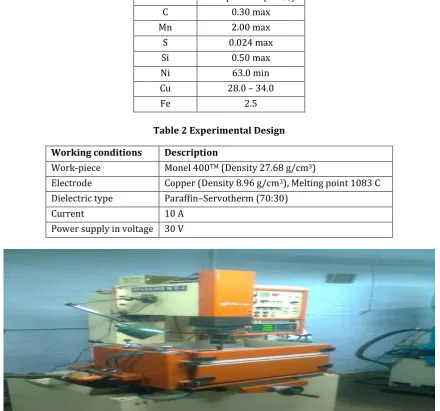
Fig. 1 Picture of experimental setup
2.1 RESULTS AND DISCUSSION
© 2019, IRJET | Impact Factor value: 7.34 | ISO 9001:2008 Certified Journal
| Page 2649
Figure 2 MRR vs. Lt % of Servotherm in paraffin oil
Figure 3 TWR vs. Lt % of Servotherm in Paraffin oil
[image:3.595.170.432.540.742.2]© 2019, IRJET | Impact Factor value: 7.34 | ISO 9001:2008 Certified Journal
| Page 2650
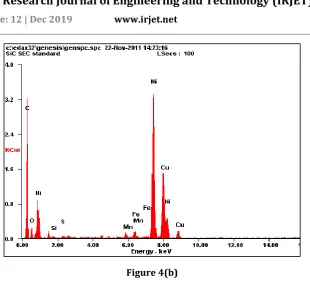
Figure 4(b)
Figure 4 (a) SEM and (b) EDAX images of machined surface for Paraffin
3. CONCLUSION
Electrical discharge machining of Monel 400TM was carried out using paraffin –servotherm in 16 different proportions The results obtained from the study are summarized below. Servotherm significantly reduced ignition delay since the mixture of paraffinand servotherm (70:30) enhanced MRR 1.9-fold that of paraffinalone. The mixture of paraffin and servotherm (70:30) reduced TWR by 14 %that of paraffindue to the formation of nickel coating (spark erosion resistance) over the tool surface during machining. The mixture of paraffin and servotherm (85:15) has been considered for EDM applications instead of EDM oil alone since it offers more MRR and reduced TWR.
4. REFERENCES
1.Singh et al. (2006) conducted experimental investigation in AEDM of cast aluminium metal matrix composites (Al/Al2O3P-20%) using silicon carbide powder in dielectric and reported better machining rate as compared to simple
die sinking. Further, they optimized the process parameters using Taguchi methodology and published “Electrical discharge machining (EDM) of aluminium metal matrix composites using powder-suspended dielectric fluid”, Journal of Mechanical Engineering 2006, vol. 57, no. 5, pp. 271-290.
2.Singh et al. (2006) conducted experimental investigation in AEDM of cast aluminium metal matrix composites (Al/Al2O3P-20%) using silicon carbide powder in dielectric and reported better machining rate as compared to simple
die sinking. Further, they optimized the process parameters using Taguchi methodology.
3.Xue Bai et.al (2018) studied the EDM process using three-phase flow dielectric medium and arrived optimum combat ion so that achieve better machining measures and published Experimental study on the electrical discharge machining with three-phase flow dielectric medium in International journal of advanced manufacturing process
[image:4.595.145.456.43.326.2]© 2019, IRJET | Impact Factor value: 7.34 | ISO 9001:2008 Certified Journal
| Page 2651
BIOGRAPHIESDr. R. Jothimurugan Professor
Department of Mechanical Engg Holymary Institute of Technology & Science