Malware Triage
by
Omid Mirzaei
in partial fulfillment of the requirements for the degree of Doctor in
Computer Science and Engineering
Universidad Carlos III de Madrid
Advisor(s):
Dr. José María de Fuentes
Dr. Juan Tapiador
My deepest gratitude to my father who has done his best in my home country, Iran, to support me both financially and spiritually from the very beginning of my childhood till now. Without his supports, I could not reach my biggest goal in life. His honesty and hard working at his career have always been an inspiration for me. My highest respect and deepest gratitude to my mother as well who has spent a huge amount of time and energy to support me emotionally. Her endless enthusiasm and attempt to change my life for the better has always been unbelievable to me. There are no words to express the level of appreciation I do have for her. My greatest thanks to my kind and awesome brother who has supported me continuously from high-school until today in graduate studies. A success can hardly achieve in life without having a wonderful and friendly family. Thus, with million thanks to you, I wish you all the best in life. Love you all!!
The current thesis is a gesture of research outcomes obtained from my doctoral studies I spent at Universidad Carlos III de Madrid, Spain. Here, I had the opportunity to specialize on a very interesting and demanding area in cybersecurity which was related to the security of smartphone devices in general and the Android operating system in particular.
I would like to thank my supervisors, Dr. Jose Maria de Fuentes and Dr. Juan Tapiador for their supports in both academic and non-academic issues, their valuable advice and their great encouragements during the whole period.
I would like to thank Prof. Arturo Ribagorda, the head of Computer Security Lab (COSEC), for his kind welcome at the beginning when I entered this group, and for his trust on me which gave me the chance to work at this active group and to fulfill the objectives of my doctoral education.
I am willing to thank Dr. Lorena González-Manzano for her kind
guidance and encouragements during my doctoral studies.
I am also grateful for the warm welcome, hospitality and technical weekly advice of Dr. Gianluca Stringhini during my research visit from Information Security Research Group at University College London (UCL).
Carmen, Mohammed, Pedro, Ana, José René, Sergio, and Benjamin who helped me a lot during my stay in Madrid.
I am very thankful to the lovely, sociable and peaceful people of Spain who respect all beliefs, religions and races.
Finally, I am grateful for the co-funding of my PhD education that was mainly provided by the Community of Madrid and the European Union.
Content
The work contained in this dissertation has resulted in 2 journal papers,one
already accepted for publicationandone currently under review. Also,
it has resulted to a very competitive conference publication. Below, all
publications are listed along with their details:
• TriFlow: Triaging Android Applications Using Speculative Informa-tion Flows,
PhD candidate role: first author,
Published in: Proceedings of the 2017 ACM on Asia Conference on
Computer and Communications Security (ASIACCS’17),
Acceptance Rate: 18% (67/359),
URL: https:// dl.acm.org/ citation.cfm?id=3053001,
DOI: 10.1145/3052973.3053001,
Note: wholly included in the thesis in Chapter 3,
Statement: Since this source is literally fully included in Chapter 3, for the sake
of clarity, I have applied no typographical means to single it out.
• Androdet: An Adaptive Android Obfuscation Detector,
PhD candidate role: first author,
Published in: Journal of Future Generation Computer Systems,
Impact Factor: 4.639 (Q1),
URL: https:// www.sciencedirect.com/ science/ article/ pii/ S0167739X18309312,
DOI: 10.1016/j.future.2018.07.066,
Note: wholly included in the thesis in Chapter 5,
Statement: Since this source is literally fully included in Chapter 5, for the sake
Submitted to: Journal of Expert Systems with Applications,
Impact Factor: 3.768 (Q1),
URL: https:// www.journals.elsevier.com/ expert-systems-with-applications,
Note: wholly included in the thesis in Chapter 4,
Statement: Since this source is literally fully included in Chapter 4, for the sake
Other contributions made during this PhD include:
• Privacy models in wireless sensor networks: A survey,
PhD candidate role: third author,
Published in: Journal of Sensors,
Impact Factor: 2.057 (Q2),
URL: https:// www.hindawi.com/ journals/ js/ 2016/ 4082084,
DOI: 10.1155/2016/4082084
• Dynamic Risk Assessment in IT Environments: A Decision Guide,
PhD candidate role: first author,
Published in: Handbook of Research on Information and Cyber
Security in the Fourth Industrial Revolution,
URL: https:// www.igi-global.com/ chapter/
dynamic-risk-assessment-in-it-environments/ 206786,
Android is the leading operating system in smartphones with a big dif-ference. Statistics show that 88% of all smartphones sold to end users in the second quarter of 2018 were phones with the Android OS. Regard-less of the operating systems which are running on smartphones, most of the functionalities of these devices are offered through applications. There are currently over 2 million apps only on the official Google store, known as Google Play. This huge market with billions of users is tempting for attackers to develop and distribute their malicious apps (or malware).
Mobile malware has raised explosively since 2009. Symantec reported an increase of 54% in the new mobile malware variants in 2017 as com-pared to the previous year. Additionally, more incentive has been provided for profit-driven malware by the growth of black markets. This rise has happened for Android malware as well since only 20% of devices are run-ning the newest major version of Android OS based on Symantec report in 2018. Android continued to be the most targeted platform with the biggest number of attacks in 2015. After that year, attacks against the Android platform slowed for the first time as attackers were faced with improved security architectures though Android is still the main appealing target OS for attackers. Moreover, advanced types of Android malware are found which make use of extensive anit-analysis techniques to evade static or dynamic analysis.
To address the security and privacy concerns of complex Android mal-ware, this dissertation focuses on three main objectives. First of all, we propose a light-weight yet efficient method to identify risky Android ap-plications. Next, we present a precise approach to characterize Android malware based on their malicious behavior. Finally, we propose an
adap-Identifying potentially dangerous and risky applications is an important step in Android malware analysis. To this end, we develop a triage system to rank applications based on their potential risk. Our approach, called Tri-Flow, relies on static features which are quick to obtain. TriFlow combines a probabilistic model to predict the existence of information flows with a metric of how significant a flow is in benign and malicious apps. Based on this, TriFlow provides a score for each application that can be used to prioritize analysis. It also provides the analysts with an explanatory report of the associated risk. Our tool can also be used as a complement with computationally expensive static and dynamic analysis tools.
Another important step towards Android malware analysis lies in their accurate characterization. Labeling Android malware is challenging yet crucially important, as it helps to identify upcoming malware samples and threats. A key challenge is that different researchers and anti-virus ven-dors assign labels using their own criteria, and it is not known to what extent these labels are aligned with the apps’ real behavior. Based on this, we propose a new behavioral characterization method for Android apps based on their extracted information flows. As information flows can be used to track why and how apps use specific pieces of information, a flow-based characterization provides a relatively easy-to-interpret summary of the malware sample’s behavior.
Not all Android malware are easy to analyze due to advanced and easy-to-apply anti-analysis techniques that are available nowadays. Obfuscation is the most common anti-analysis technique that Android malware use to evade detection. Obfuscation techniques modify an app’s source (or ma-chine) code in order to make it more difficult to analyze. This is typically applied to protect intellectual property in benign apps, or to hinder the pro-cess of extracting actionable information in the case of malware. Since malware analysis often requires considerable resource investment, detect-ing the particular obfuscation technique used may contribute to apply the right analysis tools, thus leading to some savings.
Therefore, we propose AndrODet, a mechanism to detect three popular types of obfuscation in Android applications, namely identifier renaming,
ments that need to operate in a continuous manner. We compare our results with a batch learning algorithm using a dataset of 34,962 apps from both malware and benign apps. Experimental results show that online learning approaches are not only able to compete with batch learning methods in terms of accuracy, but they also save significant amount of time and com-putational resources.
Finally, we present a number of open research directions based on the outcome of this thesis.
Android es el sistema operativo líder en teléfonos inteligentes (también
denominados con la palabra inglesasmartphones), con una gran diferencia
con respecto al resto de competidores. Las estadísticas muestran que el
88% de todos los smartphones vendidos a usuarios finales en el segundo
trimestre de 2018 fueron teléfonos con sistema operativo Android. Inde-pendientemente de su sistema operativo, la mayoría de las funcionalidades de estos dispositivos se ofrecen a través de aplicaciones. Actualmente hay más de 2 millones de aplicaciones solo en la tienda oficial de Google, cono-cida como Google Play. Este enorme mercado con miles de millones de usuarios es tentador para los atacantes, que buscan distribuir sus
aplica-ciones malintencionadas (omalware).
El malwarepara dispositivos móviles ha aumentado de forma exponen-cial desde 2009. Symantec ha detectado un aumento del 54% en las nuevas
variantes de malware para dispositivos móviles en 2017 en comparación
con el año anterior. Además, el crecimiento del mercado negro (es decir, plataformas no oficiales de descargas de aplicaciones) supone un incentivo para los programas maliciosos con fines lucrativos. Este aumento también ha ocurrido en el malware de Android, aprovechando la circunstancia de que solo el 20% de los dispositivos ejecutan la versión más reciente del sis-tema operativo Android, de acuerdo con el informe de Symantec en 2018. De hecho, Android ha sido la plataforma que ha centrado los esfuerzos de los atacantes desde 2015, aunque los ataques decayeron ligeramente tras ese año debido a las mejoras de seguridad incorporadas en el sistema
op-erativo. En todo caso, existen formas avanzadas demalwarepara Android
que hacen uso de técnicas sofisticadas para evadir el análisis estático o dinámico.
primer lugar, se propone un método ligero y eficiente para identificar apli-caciones de Android que pueden suponer un riesgo. Por otra parte, se
pre-senta un mecanismo para la caracterización del malware atendiendo a su
comportamiento. Finalmente, se propone un mecanismo basado en apren-dizaje adaptativo para la detección de algunos tipos de ofuscación que son empleados habitualmente en las aplicaciones maliciosas.
Identificar aplicaciones potencialmente peligrosas y riesgosas es un
paso importante en el análisis de malware de Android. Con este fin, en
esta Tesis se desarrolla un mecanismo de clasificación (llamado TriFlow) que ordena las aplicaciones según su riesgo potencial. La aproximación se basa en características estáticas que se obtienen rápidamente, siendo de
especial interés los flujos de información. Un flujo de información existe
cuando un cierto dato es recibido o producido mediante una cierta fun-ción o llamada al sistema, y atraviesa la lógica de la aplicafun-ción hasta que llega a otra función. Así, TriFlow combina un modelo probabilístico para predecir la existencia de un flujo con una métrica de lo habitual que es encontrarlo en aplicaciones benignas y maliciosas. Con ello, TriFlow pro-porciona una puntuación para cada aplicación que puede utilizarse para priorizar su análisis. Al mismo tiempo, proporciona a los analistas un in-forme explicativo de las causas que motivan dicha valoración. Así, esta herramienta se puede utilizar como complemento a otras técnicas de análi-sis estático y dinámico que son mucho más costosas desde el punto de vista computacional.
Otro paso importante hacia el análisis de malware de Android radica
en caracterizar su comportamiento. Etiquetar el malware de Android es
un desafío de crucial importancia, ya que ayuda a identificar las próxi-mas muestras y amenazas de malware. Una cuestión relevante es que los diferentes investigadores y proveedores de antivirus asignan etiquetas uti-lizando sus propios criterios, de modo no se sabe en qué medida estas eti-quetas están en línea con el comportamiento real de las aplicaciones. Sobre esta base, en esta Tesis se propone un nuevo método de caracterización de comportamiento para las aplicaciones de Android en función de sus flujos de información. Como dichos flujos se pueden usar para estudiar el uso de cada dato por parte de una aplicación, permiten proporcionar un resumen
A pesar de la utilidad de las técnicas de análisis descritas, no todos los programas maliciosos de Android son fáciles de analizar debido al uso de técnicas anti-análisis que están disponibles en la actualidad. Entre ellas, la
ofuscación es la técnica más común que se utiliza en el malware de
An-droid para evadir la detección. Dicha técnica modifica el código de una aplicación para que sea más difícil de entender y analizar. Esto se suele aplicar para proteger la propiedad intelectual en aplicaciones benignas o para dificultar la obtención de pistas sobre su funcionamiento en el caso del malware. Dado que el análisis de malware a menudo requiere una in-versión considerable de recursos, detectar la técnica de ofuscación que se ha utilizado en un caso particular puede contribuir a utilizar herramientas de análisis adecuadas, contribuyendo así a un cierto ahorro de recursos. Así, en esta Tesis se propone AndrODet, un mecanismo para detectar tres tipos populares de ofuscación, a saber, el renombrado de identificadores, cifrado de cadenas de texto y la modificación del flujo de control de la apli-cación. AndrODet se basa en técnicas de aprendizaje automático en línea (online machine learning), por lo que es adecuado para entornos con re-cursos limitados que necesitan operar de forma continua, sin interrupción. Para medir su eficacia respecto de las técnicas de aprendizaje automático tradicionales, se comparan los resultados con un algoritmo de aprendizaje
por lotes (batch learning) utilizando un dataset de 34.962 aplicaciones de
malware y benignas. Los resultados experimentales muestran que el en-foque de aprendizaje en línea no solo es capaz de competir con el basado en lotes en términos de precisión, sino que también ahorra una gran canti-dad de tiempo y recursos computacionales.
Tras la exposición de las contribuciones anteriormente mencionadas, esta Tesis concluye con la identificación de una serie de líneas abiertas de investigación con el fin de alentar el desarrollo de trabajos futuros en esta dirección.
Omid Mirzaei is a Ph.D. candidate in the Computer Security Lab (COSEC) at the Department of Computer Science and Engineering of Universidad Carlos III de Madrid (UC3M). His Ph.D. is funded by the Community of Madrid and the European Union through the research project CIBER-DINE (Ref. S2013/ICE-3095). His main area of research is computer security. He is particularly interested in mobile security (e.g., security of smartphones and autonomous vehicles), system security, malware anal-ysis and reverse engineering. In addition, he is eager to tackle security issues from a multi-objective perspective, i.e. trying to deal with such problems by consuming the least possible amount of in hand resources. During his Ph.D., he could achieve two outstanding awards, including the third place award from CSAW-Europe’17 and the best previously pub-lished paper award from JNIC’18. He has obtained a B.Sc. in Computer Engineering-Software and a M.Sc. in Computer Engineering-Artificial In-telligence from Azad University, Mashhad Branch, Iran. Additionally, he has worked here for three years as a lecturer before joining COSEC at Universidad Carlos III de Madrid.
Acknowlegements v
Published and Submitted Content vii
Other Research Merits ix
Abstract xi
Resumen xv
Biography xix
1 Introduction 1
1.1 Motivation and Objectives . . . 3
1.2 Contributions and Organization . . . 4
2 Background 7
2.1 Android’s Architecture and Security Model . . . 7
2.1.1 Android’s Architecture . . . 7
2.1.2.1 Application Sandboxing . . . 10 2.1.2.2 Permissions . . . 11 2.1.2.3 Inter-Process Communication . . . 11 2.1.2.4 SELinux . . . 12 2.1.2.5 Code Signing . . . 12 2.1.2.6 Multi-User Support . . . 13 2.2 Dalvik Bytecode . . . 13
2.3 Android Application Structure . . . 14
2.4 Android Malware Evolution . . . 16
2.4.1 2010 - Android Malware Comes into Existence . . 17
2.4.2 2011 - The Rise of Repackaged Malware . . . 18
2.4.3 2012 - Targeting User’s Pocket and Privacy . . . . 21
2.4.4 2013 - The Evolution of Advanced Trojans . . . . 22
2.4.5 2014 - The Emergence of Ransomware . . . 23
2.4.6 2015 - Charging Users by Sending Text Messages . 25
2.4.7 2016 - Looking for Super-User Privileges . . . 25
2.4.8 2017 - The Rise of Android Screen Lockers . . . . 27
2.4.9 2018 - Android Malware Predictions . . . 27
2.5 Android Malware Research Datasets . . . 27
2.5.1 Malgenome . . . 28
2.5.2 Drebin . . . 29
2.5.3 Contagio Mobile Mini-dump . . . 29
2.5.4 PRAGuard . . . 30
2.5.6 AndroZoo . . . 32
2.6 Android Malware Analysis . . . 33
2.6.1 Reverse Engineering Tools . . . 33
2.6.1.1 Disassemblers . . . 33
2.6.1.2 Decompilers . . . 34
2.6.2 Information Flow Analysis . . . 34
2.7 Anti-Analysis in Android Malware . . . 36
2.8 Data Mining Tools for Malware Analysis . . . 37
2.8.1 Classification . . . 39
2.8.2 Clustering . . . 40
2.8.3 Frequent Pattern Mining . . . 41
2.9 Adversarial Machine Learning in Android Malware Analysis 42
3 TriFlow: Triaging Android Applications Using Speculative
In-formation Flows 45
3.1 Introduction . . . 45
3.2 Approach . . . 48
3.2.1 System Overview . . . 48
3.2.2 Predicting Information Flows . . . 50
3.2.3 Informative Information Flows . . . 51
3.3 Evaluation . . . 52
3.3.1 Experimental Setting . . . 52
3.3.2 Flow Prediction Accuracy . . . 54
3.3.4 App Triage . . . 61
3.3.4.1 Scoring and Prioritizing Apps . . . 61
3.3.4.2 Score Breakdown . . . 63 3.3.5 Efficiency . . . 64 3.4 Discussion . . . 65 3.4.1 Accuracy . . . 65 3.4.2 Risk Notion . . . 66 3.4.3 Datasets . . . 68 3.4.4 Evasion Attacks . . . 68 3.5 Related Work . . . 69
3.5.1 Information Flow Analysis in Android . . . 69
3.5.2 Permission-Based Risk Metrics for Android Apps . 71
3.6 Conclusion . . . 72
4 Behavioral labeling of Android malware families 75
4.1 Approach overview . . . 75
4.2 Frequent Information Flow Patterns in Malware Families . 78
4.2.1 Datasets . . . 78
4.2.2 Extracting Information Flows . . . 78
4.2.3 Frequent Patterns of Information Flows . . . 80
4.2.4 Malware Family Classification Using Flow Patterns 81
4.2.5 Behavioral Similarity Among Families . . . 83
4.2.6 Classifying Apps into Families . . . 84
4.3.1 Behavioral Features . . . 85
4.3.2 Feature Selection . . . 88
4.3.3 Clustering . . . 89
4.3.4 Behavioral Relevance of Clusters and Relation to
Families . . . 90
4.3.5 Examples . . . 94
4.3.5.1 Same Family, Same Behavior . . . 94
4.3.5.2 Different Family, Same Behavior . . . . 97
4.3.5.3 Same Family, Different Behavior . . . . 99
4.3.5.4 Summary . . . 102 4.4 Discussion . . . 104 4.4.1 Accuracy . . . 105 4.4.2 Datasets . . . 105 4.4.3 Repackaged Apps . . . 106 4.5 Related Work . . . 106
4.5.1 Information Flow Analysis . . . 106
4.5.2 Android Malware Detection Using InfoFlows . . . 107
4.5.3 Pattern Mining in Android Apps . . . 108
4.5.4 Malware Characterization and Classification . . . 109
4.6 Conclusions . . . 110
5 AndrODet: An Adaptive Android Obfuscation Detector 112
5.1 Introduction . . . 112
5.3 Approach . . . 117
5.3.1 Overview . . . 117
5.3.2 Goals . . . 118
5.3.3 Dataset Description . . . 119
5.3.4 Feature Extraction and Feature Selection . . . 120
5.3.4.1 Features for Identifier Renaming Detection120
5.3.4.2 Features for String Encryption Detection 122
5.3.4.3 Features for Control Flow Obfuscation
Detection . . . 123
5.3.5 Classification Algorithms and Hyper-Parameter
Tuning . . . 124
5.4 Evaluation . . . 125
5.4.1 Experimental Settings . . . 125
5.4.2 Identifier Renaming Detection . . . 126
5.4.3 String Encryption Detection . . . 127
5.4.4 Control Flow Obfuscation Detection . . . 129
5.4.5 Performance Evaluation for Combined Techniques 129
5.4.6 Comparison Against Batch Learning Algorithms . 130
5.4.6.1 Identifier Renaming Detection . . . 131
5.4.6.2 String Encryption Detection . . . 131
5.4.6.3 Control Flow Obfuscation Detection . . 132
5.4.6.4 Combined Obfuscation Techniques . . . 132
5.4.7 Performance Comparison: Time and Memory . . . 133
5.6 Related Work . . . 136
5.7 Conclusion . . . 138
5.8 Supplemental Data . . . 138
5.8.1 Distribution of Features for Identifier Renaming
Detection . . . 138
5.8.2 Distribution of Features for String Encryption
De-tection . . . 144
5.8.3 Distribution of Features for Control Flow
Obfus-cation Detection . . . 148 6 Conclusions 153 6.1 Awards . . . 154 6.2 Tools . . . 154 6.3 Research Visits . . . 155 6.4 Future Work . . . 155 References 159
2.1 The Android OS architecture [1]. . . 8
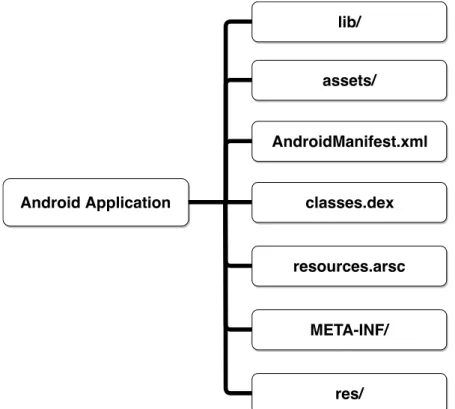
2.2 The structure of a typical Android application. . . 15
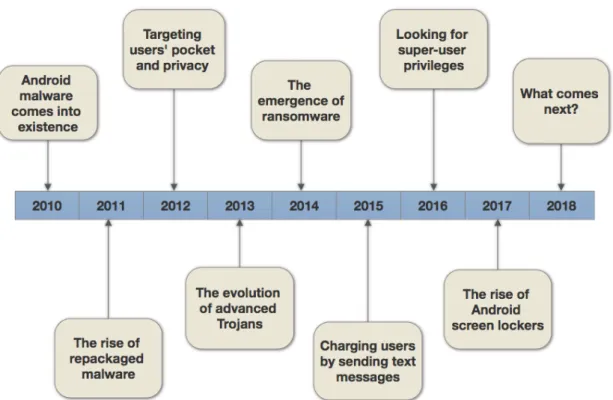
2.3 The Android malware evolution over years. . . 17
2.4 An excerpt of smali code extracted from one of the main
FakePlayer classes. . . 18
3.1 TRIFLOW Architecture. . . 49
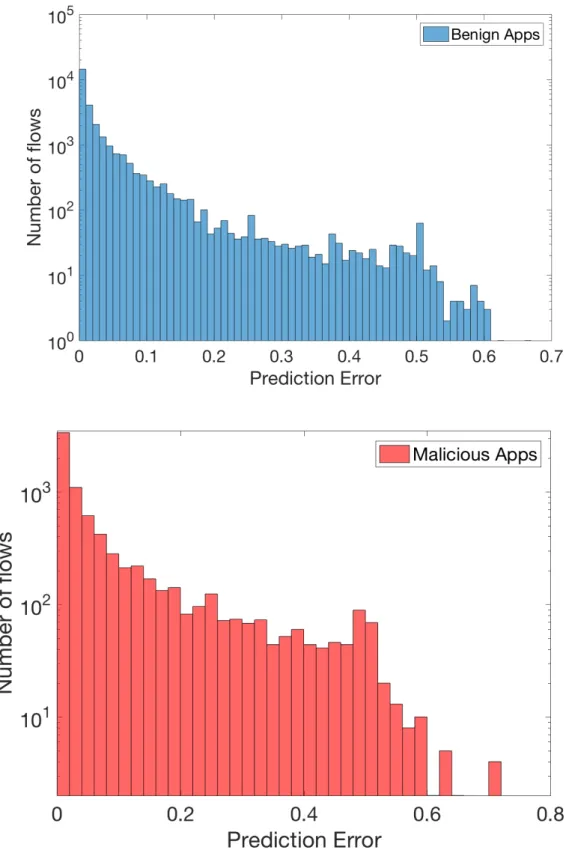
3.2 Distribution of the prediction errors for all information
flows in the two datasets. Note that the in both plots the
y-axis is in logarithmic scale. . . 56
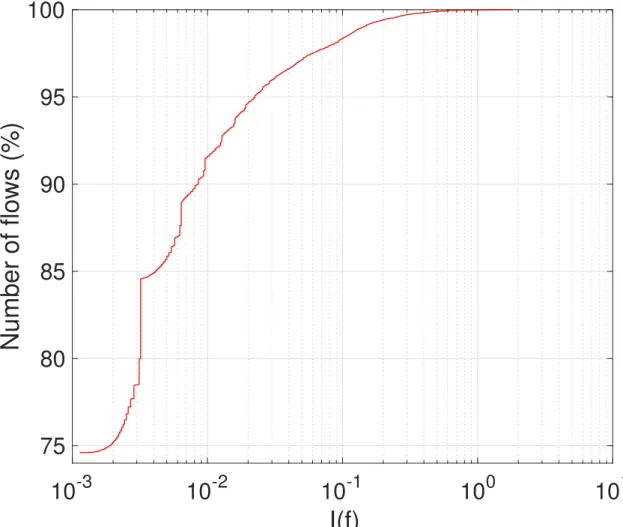
3.3 Cumulative probability distribution of the flow weight
val-uesI(f). Note that the x-asis is given in logarithmic scale. 58
3.4 (a) Average and (b) maximum values of the flow
weight distribution with flows grouped by SuSi categories (sources are placed in rows and sinks in columns). The
group NO_CATEGORY refers to sources and sinks
classi-fied as non-sensitive in SuSi. . . 60
3.5 Results of the triage evaluation. Each plot shows the
dis-tribution of the fraction of malware correctly prioritized (y-axis) when a market operator can only afford to
ana-lyzew% of the samples (x-asis) at each time interval (e.g.,
daily-basis). Results are given for both RSS (left) and TRI
-FLOW (right). The red arrows within each plot represent
the gain achieved by each scoring system with respect to a
random prioritization policy. . . 62
3.6 Snippet of a TRIFLOWreport for a malware app belonging
to the Plankton family. . . 63
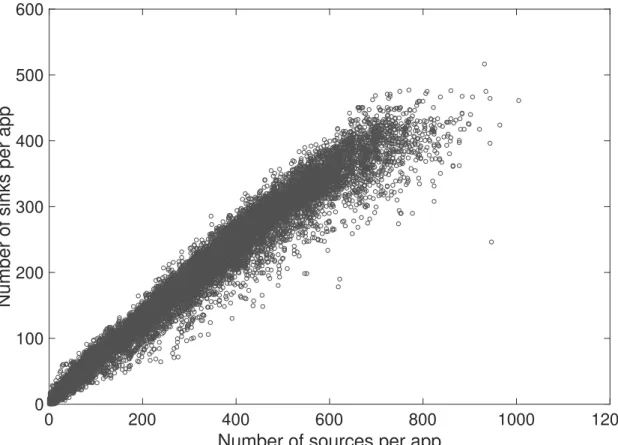
3.7 Number of sources vs number of sinks for all the apps in
3.8 Scoring time for all the apps in our datasets as a function of each app’s size measured as the total number of possible
information flows. Note that the plot is in log-log scale. . 66
3.9 Cumulative time (in seconds) required to extract all
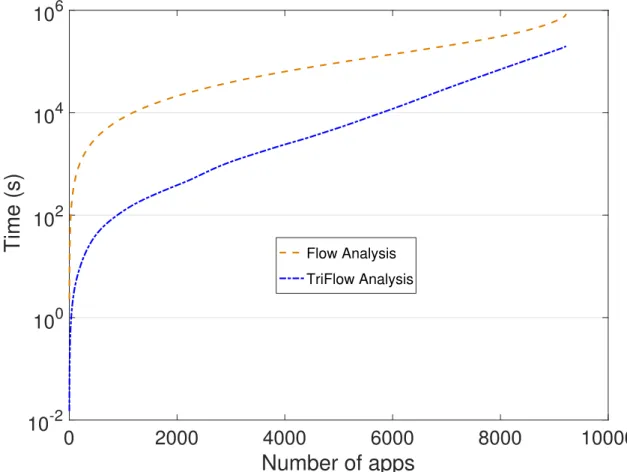
possi-ble information flows of a set of apps. . . 67
4.1 Behavioral analysis procedure . . . 77
4.2 The intersection of AMD and Drebin datasets. . . 79
4.3 Distribution of pattern sizes (Drebin dataset). . . 81
4.4 Distribution of patterns support values (in logarithmic
scale) in Drebin dataset. . . 82
4.5 Similarity matrices between malware families using the
cosine similarity between the TF-IDF vectors associated with information flow patterns. Each row and column in the matrix represents a family. Families have been ar-ranged in the same order from left to right and from top to down, hence the maximum similarity observed along the main diagonal. Family labels have been removed for
better readability. . . 83
4.6 Feature selection trials for different values of threshold. . . 89
4.7 Elbow evaluation to select the optimal number of clusters. 91
4.8 Centroids obtained after clustering the Drebin dataset. . . . 92
4.9 Centroids obtained after clustering the AMD dataset. . . . 92
4.10 Distribution of samples into clusters. . . 93
4.11 Number of clusters in which each family of the Drebin
dataset is present. . . 95
4.12 Number of clusters in which each family of the AMD
dataset is present. . . 96
5.1 ANDRODET architecture. . . 118
5.2 Distribution of methods with length 1 in obfuscated (a) and
non-obfuscated (b) apps. . . 121
5.3 Data preparation (left) and the overall architecture of
classification process (right), including parameter tuning, model training and testing. White squares: non-obfuscated apps; dark blue squares: apps with string encryption cation; dashed blue squares: apps with ID renaming
obfus-cation. . . 126
5.4 Evolution of detector modules’ accuracies over time. . . . 128
5.6 Comparison of time and memory consumption between online learning algorithms using MOA (a) and batch learn-ing algorithms uslearn-ing ATM (b) for Android obfuscation
de-tection. . . 135
5.7 Distribution of the average wordsize of methods in (a)
ob-fuscated and (b) non-obob-fuscated apps. . . 139
5.8 Distribution of the average ASCII distances between
con-secutive extracted methods in (a) obfuscated and (b)
non-obfuscated apps. . . 139
5.9 Distribution of methods with length 1 in (a) obfuscated and
(b) non-obfuscated apps. . . 140 5.10 Distribution of methods with length 2 in (a) obfuscated and
(b) non-obfuscated apps. . . 140 5.11 Distribution of methods with length 3 in (a) obfuscated and
(b) non-obfuscated apps. . . 141 5.12 Distribution of the average wordsize of classes in (a)
ob-fuscated and (b) non-obob-fuscated apps. . . 141 5.13 Distribution of the average ASCII distances between
con-secutive extracted classes in (a) obfuscated and (b)
non-obfuscated apps. . . 142 5.14 Distribution of classes with length 1 in (a) obfuscated and
(b) non-obfuscated apps. . . 142 5.15 Distribution of classes with length 2 in (a) obfuscated and
(b) non-obfuscated apps. . . 143 5.16 Distribution of classes with length 3 in (a) obfuscated and
(b) non-obfuscated apps. . . 143 5.17 Distribution of the average entropy of strings in (a)
obfus-cated and (b) non-obfusobfus-cated apps. . . 144 5.18 Distribution of the average wordsize of strings in (a)
ob-fuscated and (b) non-obob-fuscated apps. . . 144 5.19 Distribution of the average length of strings in (a)
obfus-cated and (b) non-obfusobfus-cated apps. . . 145 5.20 Distribution of the average number of ’=’ characters in (a)
obfuscated and (b) non-obfuscated apps. . . 145 5.21 Distribution of the average number of ’-’ characters in (a)
obfuscated and (b) non-obfuscated apps. . . 146 5.22 Distribution of the average number of ’/’ characters in (a)
5.23 Distribution of the average number of ’+’ characters in (a)
obfuscated and (b) non-obfuscated apps. . . 147 5.24 Distribution of the average sum of repetitive characters in
(a) obfuscated and (b) non-obfuscated apps. . . 147 5.25 Distribution of the number of nodes in the CFG of (a)
ob-fuscated and (b) non-obob-fuscated apps. . . 148 5.26 Distribution of the number of sinks in the CFG of (a)
ob-fuscated and (b) non-obob-fuscated apps. . . 148 5.27 Distribution of the number of edges in the CFG of (a)
ob-fuscated and (b) non-obob-fuscated apps. . . 149 5.28 Distribution of the number of Goto instructions per line of
code in (a) obfuscated and (b) non-obfuscated apps. . . 149 5.29 Distribution of the number of NOP instructions per line of
code in (a) obfuscated and (b) non-obfuscated apps. . . 150 5.30 Distribution of the total number of lines of code in (a)
ob-fuscated and (b) non-obob-fuscated apps. . . 150 5.31 Distribution of the total number of lines of code in (a)
3.1 Overview of the datasets used in this work. The upper part of the table shows the source of our dataset together with the number of samples from each source. The bottom part shows the training/testing splits used during
cross-validation and the malware-to-goodware ratios. . . 53
3.2 Statistics of the training dataset. The size (in MB), number
of sources (src), number of sinks (snk), memory consumed (in GB), and time (in seconds) are given on average per app. The amount of memory (in GB) required represents
the maximum average. . . 54
3.3 Flow prediction error statistics after 5-fold cross-validation
using only malware, only benign apps, and both. . . 55
3.4 Top ranked flows and their weight. . . 59
3.5 Most relevant sources and sinks from sensitive categories. . 60
3.6 Information flow analysis tools for Android. . . 70
4.1 Source and sink categories in SuSi ( [2]) . . . 86
4.2 Number and distribution of flows extracted from the
appli-cations in the Drebin dataset grouped by SuSi categories. Only flows whose contribution is greater than 1% of the
total are shown. . . 87
4.3 Number and distribution of flows extracted from the
appli-cations in the AMD dataset grouped by SuSi categories. Only flows whose contribution is greater than 1% of the
total are shown. . . 87
4.4 Selected features for the Drebin and AMD datasets. . . 88
4.5 Examples of samples from the same family of Drebin
dataset exhibiting similar behaviors. . . 97
4.6 Examples of samples from the same family of AMD
4.7 Examples of samples in different families of Drebin
dataset with similar behaviors. . . 100
4.8 Examples of samples in different families of AMD dataset
with similar behaviors. . . 101
4.9 Examples of samples in the same family of Drebin dataset
exhibiting different behaviors. . . 102 4.10 Examples of samples in the same family of AMD dataset
exhibiting different behaviors. . . 103 4.11 Average amount of time and memory consumed in each
step of our clustering approach per application. . . 104
5.1 Number of apps per obfuscation technique . . . 120
5.2 Set of all features considered for each detector module . . 120
5.3 Examples of identifiers extracted from an obfuscated
mal-ware sample in the Obad family. . . 122
5.4 Examples of identifiers extracted from a non-obfuscated
malware sample in the Univert family. . . 122
5.5 A snapshot of constant strings extracted from obfuscated
malware in the Kyview and Triada families. . . 123
5.6 Performance metrics for each detection module. . . 128
5.7 Confusion matrix for multi-label classification with MOA
(real classes on rows and predicted classes on columns). . . 130
5.8 Comparison of the accuracy between two systems for
An-droid obfuscation detection based on online and batch
learning algorithms (maximum accuracies). . . 131
5.9 Confusion matrix for multi-label classification with MOA
on unseen applications (real classes on rows and predicted
classes on columns). . . 133
5.10 Confusion matrix for multi-label classification with ATM on unseen applications (real classes on rows and predicted
1
Introduction
Human life has witnessed a dramatic change with the rapid emergence and evolution of new smart devices in particular, and the Internet of Things (IoT) in general. These devices, either mobile such as smartphones and smart vehicles, or non-mobile like smart TVs and smart buildings, have opened up new opportunities. Nevertheless, growing capabilities of such devices and their wide range of access to private sensitive information pose serious security and privacy risks to their users.
Smartphones are now one of the most widespread devices in daily lives
with around 2.53 billion users in 2018 [3]. This world-wide popularity
has several reasons. First, they are usually small in size thanks to the improvements in electronics and circuits design. Second, they are light-weight and easily portable. Last but not least, they provide a great range of functionalities based on various built-in equipment and technologies, including high-quality cameras, powerful processors, GPS, cellullar data, virtual intelligent assistants (e.g., Bixby in Samsung or Siri in Apple), and their sensors. Most of these functionalities are currently offered to users through applications which run on different operating systems.
Smartphone operating systems do not have the same market share. An-droid is by far the dominant operating system at the moment with around 2 billion monthly active users announced by the Google’s CEO, Sundar Pichai, in his keynote speech at the Google I/O 2017. Also, its market share is 77.15% as of July 2018 compared to the second most popular
op-erating system, iOS, with a market share of 19.09% [4]. However, this
popularity has been abused by malware campaigns and has turned to be the main root of concerns.
Although vulnerabilities have been identified at various layers of An-droid operating system, applications are known to be the main cause of
vulnerabilities for several reasons. Google Play [5], the official market of
though Google has tightened up its security regulations and defense mech-anisms, many apps can bypass security checks and enter this repository of apps which is used by millions of users every day. Google Play
Pro-tect [6] is another effort made by Google to protect Android smartphone
users against malware at real-time. However, despite all these attempts, Android malware can still find their ways into devices and leak users’ sen-sitive information. Furthermore, many tools are available at no cost which help malware developers to reverse engineer famous benign Android apps and to embed their malicious code into a repackaged version of such apps. Ultimately, Android anti-analysis tools (including commercial ones) such as obfuscators and packers are also widely abused by malware authors to
hide their malicious intents in Android applications [7] [8].
The rise in Android malware has been explosive since 2009; specially, with the increase in the number of black markets which foster the
devel-opment of profit-driven malware [9]. Also, new variants of already known
malware specimens have outnumbered the new malware families
accord-ing to various security threat reports [10] [11]. All these show that security
enhancing mechanisms and systems are not yet mature enough to reduce the number of Android malware security threats.
Malicious Android applications pose different amounts of risks to users depending on how they treat sensitive user’s or device’s data. Sensitive data can be in the form of any Personally Identifiable Information (PII) which may be leaked in different ways either through the network or via text
messages [12]. Specifically, Android security model is the root cause of
many security and privacy risks apps pose to users. For instance, apps can request different permissions whereas they may not use all of the granted permissions (e.g., over-privileged apps). On the contrary, some apps may use third-party libraries which are not inline with their main functionality
(e.g., advertising or tracking libraries [13] [14]). As libraries inherit the
same set of permissions granted to the apps, they can abuse them without users’ consent.
Several tools have been proposed in recent years either to analyze and characterize Android malware or to assess the security and privacy risks posed to users by these malicious applications. Generally, all these tools are classified into two main categories based on the type of features they consider. The first group of tools make use of static features whereas the second group is based on dynamic features extracted during apps’ runtime.
The majority of these tools have their own limitations. The first group misses parts of the app’s behavior which is exercised at runtime, and, thus, cannot estimate its risk accurately while the second group requires sub-stantial amount of resources both from time and memory.
1.1
Motivation and Objectives
This dissertation is highly motivated by some fundamental issues we found in the area of Android malware analysis.
Firstly, both static and dynamic analysis tools suffer from specific short-comings. Static analysis tools are usually imprecise and have high false positive rates as they cannot model apps’ runtime behavior. Moreover, they cannot scale well with the number of applications. Last but not least, tools which are based on static features can be bypassed at low or no cost using advanced obfuscation techniques. In contrast, dynamic analysis tools have a high runtime overhead considering the fact that may also miss behav-ior which are not exposed explicitly at runtime. Furthermore, they can be evaded using emulation detection techniques.
Secondly, despite the existence of several Android malware datasets, malware labels (known as families) are not consistent with apps’ real
be-havior [15]. One of the main causes for these inconsistencies is the lack of
appropriate standards for naming malware across different vendors [16].
In most cases, these labels are assigned to malicious apps based on static information, including data about the developer, the source country, code
structures [17], etc. While these features could be obtained quickly, they
might be imprecise as they do not reflect how malware interacts with the victim device and data. Moreover, they can be modified simply to bypass
the labeling system [18].
Thirdly, advanced anti-analysis techniques are vastly applied to recent Android malware by both commercial and off-the-shelf anti-analysis tools
which hinders their accurate analysis [19]. In particular, obfuscated and
packed Android malware are now pervasive [7] [8]. According to a recent
study [20], 15% of the apps in the Google Play app store which is supposed
to contain benign apps are obfuscated. This amount is much higher in the malicious apps that are present in the wild. Furthermore, both benign and malicious apps make use of different packing techniques to hide their code.
The complexity and diversity of tools and techniques for either obfuscation or packing have introduced new barriers in protecting Android users.
The main goal of this dissertation is to address all the above issues we encountered during our studies on Android malware analysis. Thus, we have set the following main objectives:
• Developing a fast yet accurate triage system to identify Android ap-plications with potentially dangerous and risky behaviors.
• Proposing a new characterization and labeling scheme for Android malware which does not only rely on static features.
• Alleviating the difficulties in the current analysis of advanced An-droid malware which are obfuscated with popular obfuscation tech-niques.
1.2
Contributions and Organization
In this PhD dissertation, we have made the following contributions:
• A fast triage system, known as TRIFLOW, is presented in this
the-sis. It is a lightweight information flow based triage mechanism to identify Android apps with potentially dangerous behavior. Here, we do rely on information flows which can be effectively used to give
an informative summary of an application’s behavior. TRIFLOW
in-troduces the notion of speculative information flows. This means
that TRIFLOW extracts some features from apps, and, then, predicts
the existence of a flow based on them. Each predicted flow is then
scored by TRIFLOWin terms of its potential risk, which depends on
the flow’s observed prevalence in malware and benign applications. • A behavioral-based labeling for Android malware is proposed in
this thesis based on information flows. In particular, our scheme to characterize malware is based on patterns of flows rather than flows themselves. Although flows are interesting as they show how apps treat sensitive data, they provide limited information about apps’ be-havior. Therefore, our approach considers a larger scale which is different combinations of flows which do appear together in each application.
• An adaptive Android obfuscation detection system, called An-drODet, is developed and proposed in this thesis with some outstand-ing features. first, it is a modular system to detect three common types of obfuscation in Android applications. Second, it is to deal with multidex Android applications. Last but not least, it is an adap-tive system which can improve its accuracy over time and does not need to be re-trained.
The organization of this dissertation is as follows. We first provide the readers with some background information in Chapter 2. Chapter 3 presents our fast triage system to identify risky Android applications. Behavioral-based labeling of Android malware is discussed in Chapter 4 followed by an adaptive system to detect three common obfuscation tech-niques in Android applications in Chapter 5. We finally conclude this dis-sertation and propose some future research directions in Chapter 6.
2
Background
This chapter contains the background needed for readers to understand the whole proposals of this dissertation. In particular, we explain the Android’s architecture and its security model in Section 2.1. Then, Dalvik bytecode is briefly presented in Section 2.2 followed by an overview of the Android application’s structure in Section 2.3. Section 2.4 discusses the evolution of Android malware from the very beginning till today, and, also, provides the readers with some predictions about future types of Android malware that might come into existence. Android malware research datasets are all presented in Section 2.5, and some common techniques used for Android malware analysis are provided in Section 2.6. Furthermore, anti-analysis techniques used by Android malware to evade detection are briefly ex-plained in Section 2.7, and we end this chapter with a discussion of data mining tools for Android malware analysis in Section 2.8.
2.1
Android’s Architecture and Security Model
This section presents the Android’s architecture and some basic concepts related to its security model.
2.1.1
Android’s Architecture
Android operating system consists of several layers which are usually com-posed of different components written either in Java or other programming languages such as C/C++. Some of these components are developed by third-party contributors of the Android Open Source Project (AOSP) such
as the Original Equipment Manufacturers (OEM) [21].
A Linux kernel forms the basis of Android operating system architec-ture as shown in Fig. 2.1. Similar to other Unix-based systems, this kernel provides all required drivers ranging from hardware and filesystem access
Linux Kernel HAL Native Daemons Native Libraries init Native Userspace Runtime (Dalvik/ART) System Services Android Framework Libraries Java Runtime Libraries Applications System Applications UserInstalled Applications
Figure 2.1: The Android OS architecture [1].
to process management and networking. However, it is different from the Linux kernels you may find in other devices or operating systems.
Partic-ularly, the difference is in the new features (known as Androidisms [22])
added to the Linux kernel of Android from which Binder and paranoid net-working are the most important ones. The most important role of Binder is to handle the Inter-Process Communication (IPC) between applications, whereas paranoid networking manages applications’ access to network sockets.
On top of the Linux kernel, there is an important layer, called Native Userspace, that consists of four main components, including Native Dae-mon, Native Libraries, Hardware Abstraction Layer (HAL) and init. The binary file, init, is the first process that starts running, and, next, starts all other processes. Also, several native libraries (Non-Java libraries which are mainly used by the system like C or C++ libraries) and native daemons (programs written in languages other than Java and are running in the back-ground) are accessible at this layer. The HAL component is a bridge be-tween high-level representations of the hardware used in the libraries and low-level representations used by the kernel. It defines a standard interface for hardware vendors to implement that enables Android to be agnostic about lower level driver implementations.
As Android apps are developed mainly in Java, they need to be com-piled and then executed by a Java Virtual Machine (JVM) which is known as Runtime in the Android architecture. Dalvik was the first runtime in-troduced in the earlier versions of Android (before Android 4.4 or KitKat) which was based on Just-In-Time compilation (JIT). Thus, apps’ source codes were compiled and then executed dynamically at runtime. However, due to performance reasons, this runtime was replaced by another variant, called Android Runtime (ART). ART is based on Ahead-Of-Time (AOT) compilation, and, thus, apps are compiled using the on-device dex2oat tool at install time. This can lead to a significant saving in memory consump-tion.
Runtime Java libraries, defined mainly in java.* and javax.* packages, are provided by the Java Runtime Libraries. These libraries may have some native code dependencies as well. These native codes are linked into An-droid’s core Java libraries by Java Native Interface (JNI). JNI handles both calls to native codes from Java codes and the ones to Java codes from na-tive codes. This layer is directly accessible from the Applications layer as well as system services.
System Services implement the most fundamental features of Android operating system, including telephony, network connectivity and display. Each system service defines a remote interface that can be called from other applications and services. Similar to runtime Java libraries, services are mainly implemented in Java though some others are written in native code.
Android Framework Libraries (also called framework) are in the next layer of Android architecture. The framework includes all Java libraries
which are for the most part hosted under the android top-level package
and are not part of the standard Java runtime (java.*, javax.*, etc.). It also includes the basic classes needed to develop Android applications such as the ones for creating activities, services, content providers (in the android.app.* packages) and GUI widgets (in the android.view.* and an-droid.widget packages) to name a few. Furthermore, it provides necessary classes to app developers in order to interact with device hardware.
Applications stand on the topmost layer of Android operating system architecture. Apps are programs with which smartphone users do interact directly. There exists two common types of apps, known as system
appli-cations and user-installed appliappli-cations. The apps in both groups have the same structure and are built on top of Android framework.
System apps (typically mounted as /system) are included in the Android
operating system’s image, and, thus, cannot be manipulated or uninstalled by users. However, users can update these apps if and only if they are signed with the same private key. While these apps were treated similarly in the earlier versions of Android (up to Android Jelly Bean) by giving them the same number of permissions to access critical resources, only
privileged system apps (installed in /system/priv-app/) are allowed to
ac-cess these sensitive resources in the new versions of Android (from An-droid KitKat).
User-installed apps (typically mounted as /data) can be uninstalled at
any time by users. These apps are encapsulated in their own security sand-boxes and cannot affect apps in different sandsand-boxes, neither can they access other apps’ data. Moreover, user-installed apps are only allowed to access resources for which they have been granted a permission.
2.1.2
Android’s Security Model
Similar to its architecture, Android’s security model takes advantage of some security features offered by the Linux kernel. In what follows, pri-mary security features of Android operating system are discussed briefly.
2.1.2.1 Application Sandboxing
One of the most important security features of Android is application sand-boxing, also known as application isolation. In a Linux system, users’ re-sources as well as processes are isolated since it is a multi-user operating system. Thus, a user cannot access other users’ files without having an explicit permission from the operating system. Here, each process is as-signed a unique identity (called User ID or UID) based on the user that has started it.
Android follows the same strategy in isolation but for applications rather than users since smartphones are commonly known as personal devices. To do so, it assigns a unique UID (or app ID) to each application upon installa-tion. It then executes each application in a dedicated process (process-level isolation) with that UID. A directory is also considered for each app that other apps cannot read or write without required permissions (file-level
isolation). This isolation at both process-level and file-level is called appli-cation sandboxing. This kernel-level isolation is applied to all apps which are executed either in a native or a virtual machine process. It is worth mentioning that some apps (most often system applications) can have the same UID, also known as shared ID. In this case, they may share some system files and would run in one single process.
2.1.2.2 Permissions
As Android apps are isolated in sandboxes, they can solely access their own files and any publicly available resources on the device. However, apps cannot provide users with a rich functionality unless they are allowed to access some additional resources. Such an extra access right is known as permission. Android can control the access to many sensitive resources such as sensors’ data and Internet connectivity through permissions that can be enforced at various levels.
Apps should declare and request the required permissions in their mani-fest file (discussed in Section 2.3). Permissions granted to the applications during installation can be revoked or re-granted again at runtime in the recent versions of Android (starting from Android Marshmallow). In the earlier versions however, permissions could not be revoked once they were granted to the apps. User-installed apps can define custom permissions as well, restricting the access to an app’s resources and services to only those apps which are created by the same developer.
2.1.2.3 Inter-Process Communication
Similar to other Unix-like operating systems, a process in Android cannot access the memories of other processes and have its own address space. In other words, process isolation is another security feature Android inherits from its Linux kernel akin to Unix OS. Isolating processes improves the stability and security of the apps which are running on the device. How-ever, there are some cases in which one process may need to provide useful service(s) for other processes.
Inter-Process Communication (IPC) is a mechanism in Android that al-lows processes to discover and interact with services that are offered by
other processes. Due to the reliability and flexibility issues with the stan-dard IPC mechanisms, a customized version, called Binder, has been de-veloped for Android to handle communications between processes. Binder uses a combination of userspace libraries and kernel driver to implement IPC effectively.
2.1.2.4 SELinux
Another important difference between the Android’s Linux kernel and other Linux kernels (see 2.1.1 for others) is in the way they are imple-mented. The Android’s security model relies on apps isolation through creating sandboxes. While this prevents unauthorized access to each app’s files by other apps, it can still grant world access to its files either intention-ally or because of programming errors. Inappropriate permissions assigned to an app or system files are shown to be the main source of vulnerabilities in Android. Thus, the access control model of standard Linux kernel has been modified and re-implemented in Android.
In the standard Linux kernel access controls follow a discretionary mode, known as Discretionary Access Control (DAC). This implies that when users are granted necessary permissions to access particular re-sources, they can pass the same permissions and access levels to other users. In a different access control model, called Mandatory Access Con-trol (MAC), users’ access to resources conforms to a set of policies which can only be changed by an administrator, and, thus, users are not allowed to pass the acquired privileges to others. The Android’s Linux kernel has been implemented using MAC access control mechanism and is known as Security Enhanced Linux (SELinux). It isolates core system daemons and user-installed applications in different security domains and defines differ-ent access policies for each domain.
2.1.2.5 Code Signing
All Android applications, including system and user-installed apps, must be signed by their developers (see 2.3). As these apps are written mostly in Java, the same JAR signing method can be used to sign Android apps. One important advantage of code signing is that operating system can check if user-installed apps are coming from the same sources upon their updates
by comparing their signing certificates. This is known as the same origin policy in Android.
System apps are also signed by a number of platform keys. These keys are generated and controlled by whoever maintains the Android version installed on a particular device, including device manufacturers, carriers or even users for self-developed open source Android versions. System apps which are signed by a common platform key can share resources and run inside the same process.
2.1.2.6 Multi-User Support
Android did not support multiple users in the earlier versions as it was basically developed for smartphones that had a single physical user (see 2.1.2.1). However, it supports multiple physical users starting from An-droid Jelly Bean (version 4.2) and is only enabled on tablets which are assumed to be used by more than one user.
To support multiple users, Android assigns a unique UID and data
direc-tory (or system direcdirec-tory under /data/system/users/<UID>/) to each user.
Then, to distinguish apps for each user, it assigns a new effective UID to each application when it is installed for a particular user. The effective UID is obtained from the target physical user’s UID and the app’s UID in a single-user system (the app ID). This way of managing users and apps guarantees that applications will be limited to their own sandbox even if multiple instances of those apps are installed by multiple users.
2.2
Dalvik Bytecode
Android programs are written mostly in Java, although they can contain calls to binaries and other shared libraries known as native components
[23]. Once written, they are compiled to Java bytecode and, then, to Dalvik
bytecode. The final result is a Dalvik EXecutable (DEX) file with a .dex format or an optimized version of it with an .odex format.
The Dalvik Virtual Machine (DVM) is a register-based machine which executes Dalvik bytecode instructions (through a shared library, called lib-dvm.so) and provides a Java-level abstraction for the Java components of
applications [24], while Java Native Interface (JNI) supports the use of
is replaced by Android RunTime (ART) after Android version 4.4, which works based on Ahead-Of-Time (AOT) compilation and has led to
signifi-cant improvements in performance and memory consumption [25].
Analyzing Dalvik bytecode is simpler than machine code, it has a better readability for human analysts, and it provides better semantic information.
Also, it is easy to be reverse engineered using tools like Dexdump [26],
Dex2jar [27], Androguard [28], and Apktool [29] to name a few. Thus,
many static malware analysis tools [9], deobfuscators [7] [20], and
un-packers [30] [31] have been proposed which extract their features directly
from Dalvik bytecode. For instance, key program features such as method names, class names, field names, variables, and strings are very quick to obtain from the .dex file and give useful preliminary information.
2.3
Android Application Structure
Android applications which are installed on the device are in the form
of application package files (or APK files) with .apk extensions [1].
In-deed, they are compressed (or ZIP files) that contain both the apps’ source codes, their resources and other relevant information. In particular, a
typ-ical APK file is consisted of a manifest file (explicitly named as
Android-Manifest.xml), a dex file (classes.dex), a resource file (resources.arsc) and
four main directories, includingassets, lib, META-INF and res(Fig. 2.2).
The manifest file contains some fundamental information for each An-droid application, including its package name, its components, list of per-missions which may be requested to access protected system or app re-sources, and, last but not least, hardware and software features each app requires. An application can have up to four main components, namely activities, services, broadcast receivers and content providers. Activities are single and focused things each user can do. Thus, they are in form of a single screen with a user interface. Services are components that do not have any user interfaces and run in the background. Broadcast receivers are responsible for reacting to system-wide events called broadcasts, and content providers provide interfaces for apps’ data that are typically stored in databases.
The dex file is an executable code of each application. Android pro-grams are written in Java programming language though they can have calls to binaries and other shared libraries known as native components
Android Application assets/ lib/ res/ classes.dex AndroidManifest.xml META-INF/ resources.arsc
Figure 2.2: The structure of a typical Android application.
[23]. Once written, they are compiled to Java bytecode, and, then, to
Dalvik bytecode. The final result is a Dalvik EXecutable (DEX) file in .dex format or an optimized version of it in .odex format.
The resource file packages all application’s compiled resources such as strings and styles which are stored in separate binary XML files. Three types of resources are identifiable for an application, including colors, strings and dimensions. Strings usually represent labels that are visible in the user interface of the application while dimensions and colors show sizes and colors of such interfaces respectively. Note that each resource may have several configurations. Thus, the appropriate value is chosen and assigned to a resource at runtime by the Android runtime based on the configuration of the environment it is running on.
The assets directory bundles raw asset files with each application. Sounds, user interface pictures and fonts are some files that can be typ-ically found in this directory. Applications can take advantage of native libraries through Java Native Interface (JNI). These apps do contain an
extra directory calledlib with sub-directories for each supported platform
architecture.
an-droid.content.res.Resources class or indirectly via higher-level APIs, are
stored in res directory. However, each type of resource (e.g., animation,
menu, image, etc.) is stored in a separate sub-directory. The META-INF
directory contains app’s package manifest file and code signatures similar to JAR files. Android controls which apps are authorized to get permis-sions with the signature protection level that is performed through APK code signing.
Java code signing is performed by reusing and extending JAR manifest files in order to add a code signature to the JAR archive. Each Android
application has a main JAR manifest file (MANIFEST.MF) whose entries
are app’s filenames and their corresponding digest values. Also, another
manifest file (with .SF extension such as CERT.SF), known as signature
file, is used in the process of signing which contains the data to be signed and a digital signature. This signature is stored in the same directory as a binary file with one of the .RSA, .DSA, or .EC extensions, depending
on the adopted signature algorithm (CERT.RSA). Android apps are
com-monly signed and verified by the official JDK tools for JAR signing and
verification, jarsigner and keytool commands [32].
2.4
Android Malware Evolution
The evolution of Android malware may be anticipated to be quite simi-lar to desktop malware initially. However, Android’s great market share as well as its openness and its unique security features have all provided an interesting opportunity for the attackers. In addition, smartphones have introduced new technologies that can lead to more diverse and bigger at-tack vectors. For instance, mobile cellular data, high-quality cameras and sensors and location-aware services are appealing launching points for
at-tackers [9]. All these reasons have made Android malware evolve faster
over time [33].
In this section, we provide the readers with an evolution timeline of An-droid malware (Fig. 2.3) and some relevant information specific to each year gathered from security threat reports of popular cyber security firms, including F-Secure (Finish company), Kaspersky Lab (Russian company), McAfee (American company), Symantec (American Company), Trend Micro (Japanese company), and, finally, Avira (German company).
Figure 2.3: The Android malware evolution over years.
2.4.1
2010 - Android Malware Comes into Existence
The first malware in Android operating system was first detected in August
2010 [34]. This Trojan family, known as FakePlayer, pretended to be a
media player for watching porn video clips in Android [35]. However,
it was just an app that sent SMS text messages (with 798657 as body) to premium-rate numbers (in this case, 3353 and 3354 numbers) without
user’s consent (Fig. 2.4). It had an icon in itsres directory (recall Section
2.3) which looked very similar to the legitimate Windows Media Player application.
FakePlayer was an easy-to-analyze malware family with only 3 main classes and almost 350 lines of code. It was specifically developed to tar-get Russian smartphone users for two main reasons. First, Android official market (known as Android Market in 2010) was not accessible world-wide, and, second, money could be sent easily on Eastern European telecom car-riers.
Later on, cyber security companies discovered the first spyware in
An-droid malware, called Tapsnake [36] [37]. Tapsnake was a Trojan
Figure 2.4: An excerpt of smali code extracted from one of the main Fake-Player classes.
to a remote server every 15 minutes. It could also allow a third-party to track user’s geographical location by installing another paid app, called GPS Spy. Two key registration information, including an email address and a key were required to be typed in both Tapsnake and GPS Spy to enable geo-location tracking. These information were acquired by social engineering techniques.
Geinimi was another newsworthy Android malware family initially
de-tected by Lookout at the end of 2010 [38]. This family was the most
sophisticated malware found by that time with innovative capabilities. Firstly, it was a repackaged version of legitimate Android apps like Presi-dent vs. Aliens (an educational app) and Baseball Superstars 2010 (a game app) to name a few. Secondly, it made use of two anti-analysis techniques to hide its malicious behavior, including network communication encryp-tion and network communicaencryp-tion code obfuscaencryp-tion. Thirdly, it had some botnet-like capabilities with more than 20 commands implemented in its source code. Since then, Geinimi has been found in a wide range of loca-tions, ranging from unofficial marketplaces to official ones.
2.4.2
2011 - The Rise of Repackaged Malware
Malicious apps increased in number from 84 samples in 2010 to more than
1000 in 2011 [39] [40]. Also, inspired by the success of Geinimi in 2010,
repackaging benign apps was rapidly imitated by malicious apps from sev-eral new families such as ADRD, Pjapps, DroidDream, DroidDreamLight, Zsone, BaseBridge, DroidKungFu, jSMSHider, GoldDream and
Anserver-Bot [35] in 2011. In total, around 86% of malware specimens found in
ADRD and Pjapps were the first Trojan families detected in February 2011. Both of these families could steal sensitive device information, including International Mobile Equipment Identity (IMEI), International Mobile Subscriber Identity (IMSI), device ID, line number, subscriber ID and SIM serial number once special conditions were met. Later, they sent this information to remote servers. These types of malware are commonly known as Logic Bomb Trojans. ADRD could be activated once the op-erating system started, the network connectivity changed or whenever the device received a phone call. However, Pjapps only started execution when the device signal changed. In addition to stealing capability, ADRD fam-ily could change the device settings to enable/disable data connectivity in order to send or receive information all of which would result in high data usage. Also, Pjapps was able to send text messages, install a new applica-tion and to add a browser bookmark.
DroidDream and DroidDreamLight were the next family of malware discovered one and three years later which repackaged legitimate Android applications to compromise the target device. Similar to the earlier de-tected families in this year, they could steal sensitive information, includ-ing IMEI, IMSI, device model, device language and country and leak them to remote servers. DroidDreamLight could even steal information from text messages, contact lists, call logs and Google account credentials. The main difference between these two families was in the way they behaved in the infected device. DroidDream tried to get root privileges at the first step, after which It was able to manipulate the device settings, system files and SD card. On the contrary, DroidDreamLight ran in the background silently and leaked the sensitive information which were stored encrypted in a configuration file.
Zsone was another malware family found exactly at the same month as DroidDreamLight though with quite different characteristics. This Trojan was developed to target Chinese users mainly. Once installed on the de-vice, it could send text messages to premium-rate numbers related to sub-scription for SMS-based services to charge the user. It also kept a record of its sending status in an XML file. Incoming text messages from certain numbers could also be intercepted by this family.
BaseBridge and DroidKungFu - both with several variants and stealing capabilities - were the next families of Android malware detected in 2011. Additionally, similar to DroidDream family, they first attempted to gain
root privileges in the target device [41]. Once successful, they stole a va-riety of information, including IMEI, device model and manufacturer and OS version and sent them to remote servers. BaseBridge was also capable of sending/removing text messages, dialing phone numbers and monitor-ing phone usage. On the other hand, DroidKungFu could install/remove any packages and modify the homepage of web browser without user’s consent.
jSMSHider was the second malware family with big differences in be-havior comparing with the earlier discovered families. It was a Trojan which affected smartphones with a customized ROM. It could exploit a vulnerability in these devices and install a payload onto the ROM to com-municate with a remote server and receive operational commands. It was then able to read, send and remove text messages (to hide its malicious in-tent), install apps on ROMs, perform a silent install or update of the APK and download an application from a URL.
Detected after jSMSHider, GoldDream was another logic bomb Trojan with versatile stealing capabilities. It could record the date, time, message body and the senders of text messages upon receiving messages. It could also store the date, time and phone number once any calls were made or re-ceived. In addition, it was able to make phone calls, send text messages and install packages without user’s knowledge. Device ID, SIM serial number and Subscriber ID were among the most important sensitive information this malware family could steal from the compromised device.
AnserverBot was the third family with different behavior in contrast to its predecessors. It first tried to lure the device user by showing fake upgrade dialog boxes for the host app. It then installed the first payload that could run silently in the background. Afterwards, a second payload could be loaded and executed dynamically either by the host app or the first payload. Finally, it could connect to the remote server to take the commands. This family was one of the pioneers in using anti-analysis techniques as well. First of all, most of the code in both payloads were obfuscated. Second, AnserverBot had a mechanism to avoid the infected application from being repackaged again. Last but not least, it could detect the existence of three smartphone anti-virus software.
2.4.3
2012 - Targeting User’s Pocket and Privacy
Similar to p
![Figure 2.1: The Android OS architecture [1].](https://thumb-us.123doks.com/thumbv2/123dok_us/67004.2507729/44.892.174.720.128.532/figure-the-android-os-architecture.webp)