The development of a morphosyntactic tagset for Afrikaans
and its use with statistical tagging
Boris Haselbach, Ulrich Heid
University of Stuttgart, Institute for Natural Language Processing Azenbergstraße 12, 70174 Stuttgart, Germany
{haselbbs,heid}@ims.uni-stuttgart.de
Abstract
In this paper, we present a morphosyntactic tagset for Afrikaans based on the guidelines developed by the Expert Advisory Group on Language Engineering Standards (EAGLES). We compare our slim yet expressive tagset, MAATS (Morphosyntactic AfrikAans TagSet), with an existing one which primarily focuses on a detailed morphosyntactic and semantic description of word forms. MAATS will primarily be used for the extraction of lexical data from large pos-tagged corpora. We not only focus on morphosyntactic properties but also on the processability with statistical tagging. We discuss the tagset design and motivate our classification of Afrikaans word forms, in particular we focus on the categorization of verbs and conjunctions. The complete tagset in presented and we briefly discuss each word class. In a case study with an Afrikaans newspaper corpus, we evaluate our tagset with four different statistical taggers. Despite a relatively small amount of training data, however with a large tagger lexicon, TnT-Tagger scores 97.05 % accuracy. Additionally, we present some error sources and discuss future work.
1.
Introduction
The design of a part-of-speech (pos) tagset is a “trade-off between what is linguistically most desirable and com-putationally feasible” (Leech, 1997, p. 25). On the one hand, as much linguistic information as possible should be conveyed by annotations carried out according to a given tagset. However, on the other hand, the possibilities of sta-tistical pos-taggers limit the number of distinctions which can be annotated with sufficient precision and thus be ex-pressed in a tagset, as most taggers rely on differences in distribution. A tagset is thus a compromise between a pre-cise linguistic description on the one hand, and processabil-ity on the other, i.e. the abilprocessabil-ity of the tagger to identify each class of phenomena expressed by a given tag.
In section 2.1., we present an existing tagset for Afrikaans and motivate the development of another, linguistically slim yet expressive Afrikaans tagset. We then show, in sec-tion 2.2., the criteria according to which our tagset is de-veloped, before it is presented in section 3. Tagging results, a partial error analysis, and a comparison with the existing tagset are presented in section 4. We conclude and discuss future work in section 5.
2.
Design of an Afrikaans tagset
The Expert Advisory Group on Language Engineering Standards (EAGLES) provides recommendations for the design of morphosyntactic tagsets (Leech and Wilson, 1999). To our knowledge, most morphosyntactic tagsets adhere to these recommendations. Advocating cross-linguistic common standards for tagsets and their compara-bility, EAGLES makes use of an attribute-value formalism which takes morphosyntactic features into account. EA-GLES recommends 13 obligatory and many optional at-tributes. The first ones roughly correspond to the traditional classification of syntactic categories (noun, verb, adjective, adverb, etc.). The latter ones represent, for each word class, morphosyntactic subclassifications, such as, for example, type, gender, number, and case for nouns.
2.1. Motivation for the design of an Afrikaans tagset
To our knowledge, there exists only one tagset for Afrikaans, created by Suléne Pilon (Pilon, 2005). She has based her tagset on the EAGLES recommendations for the design of morphosyntactic tagsets (Leech and Wilson, 1999). Pilon’s goal, among others, is to develop a linguis-tically expressive tagset for Afrikaans that adheres to the EAGLES standards and is processable by a pos-tagger. She develops a tagset that comprises 139 pos-tags which, on the one hand, includes morphosyntactic features proposed by EAGLES, and, on the other hand, includes semantic fea-tures, especially in the nominal and adverbial domain. For example, nouns are split into 18 morphosyntactically and semantically distinctive subgroups (and pertaining tags), e.g. measure nouns, abstract nouns, etc.
In annotation experiments with her tagset, Pilon used the TnT-Tagger (Brants, 2000), scoring an accuracy of 85.87 %. In an experiment with a condensed tagset, that only comprises the 13 major word classes proposed by EA-GLES, she increased the accuracy up to 93.69 %. This re-sult may indicate that the original tagset by Pilon is too fine-grained, especially where it encodes semantic distinc-tions. Statistical taggers which are trained on corpus data and thus take distributional properties of words and pos-tags into account, can often not distinguish semantic sub-classes of items. Many semantically distinct lexemes have the same distribution. Consequently, the semantic distri-butions either must be covered by a (large) lexicon (which is hard to achieve for open word classes), or the attempt to use them with statistical taggers may involve a risk of lower tagging accuracy.
subcatego-VMB: base form of
simplex verb, e.g.werp“[to] throw” particle verb, e.g.afwerp“[to] throw off”
VMP: past participle of
simplex verb, e.g.gewerp“thrown” particle verb, e.g.afgewerp“thrown off”
VMX:
base form past participle
of prefix verb, e.g.ontwerp“[to] design/designed”
Figure 1: Verbal tags of MAATS
(4) . . . dat sy die boek lees.
“. . . that she reads the book.”
MAATS distinguishes coordinating conjunctions and sub-ordinating conjunctions. For subsub-ordinating conjunctions, MAATS provides tags for those with a finite clause, for those with an infinitive construction, and for those with a comparative construction.
Adpositions also play an important role for verbal subcate-gorization as prepositions can be subcategorized by verbs. Prepositions and postpositions show distributional differ-ences (cf. example (5) for a preposition and example (6) for a postposition). Thus, MAATS distinguishes the two types.
(5) Jannie stap op Tafelberg.
“Jannie is walking on Table Mountain.”
(6) Jannie stap Tafelberg toe.
“Jannie is walking to Table Mountain.”
Pronouns and determiners are relevant for the identifica-tion of noun phrases and thus they are not only strictly separated, but also their function is paid attention to, e.g. indefinite vs. personal, etc. Information about closed word classes is provided in the lexicon. However, MAATS does not distinguish between interrogative and relative pro-nouns/determiners. Not only do they lexically overlap (e.g.
wat“what/that” andwie“who”) but they also are systemat-ically ambiguous in headless relative clauses.
(7) Sy vra wat hy bekommer.
“She asks what he is worried about.”
(8) Sy eet wat hy kook.
“She eats what he cooks.”
Thewat-subclause in example (7) is subcategorized by the verbvra(“[to] ask”) whereas in example (8) it is not subcat-egorized by the verbeet(“[to] eat”), however it is a headless relative clause. This ambiguity cannot be resolved with-out verbal subcategorization information (abwith-out subclauses taking verbs). This, however, is not available yet as we aim to extract exactly this information from corpora.
For adjectives, adverbs, numerals, interjections, foreign words, unclassified residuals, and punctuation marks only one tag each is provided in MAATS. First, Afrikaans does not show much inflection and/or morphosyntactic variation here, and, secondly, distinctions within these categories are
not considered to be very important for verbal subcatego-rization.
The remaining pos-tags are due to characteristics of Afrikaans, such as the tags for particles and pronominal ad-verbs (e.g. the possessive particle:Arno se nommer“Arno’s telephone number”).
4.
Statistical pos-tagging with MAATS
In this section, we describe the use of MAATS with differ-ent statistical part-of-speech taggers.4.1. Taggers used
We compared four statistical taggers available under re-search license:
• MB-Tagger
• RFTagger
• TnT-Tagger
• TreeTagger
MB-Tagger (Daelemans et al., 1996) is a memory-based tagger storing a set of example cases extracted from a train-ing corpus. An example case contains a word with preced-ing and followpreced-ing context on the word and part-of-speech level. Disambiguating an unknown word, MB-Tagger de-termines its context and uses extrapolation from the most similar cases resulting in a “best guess” of the category for the word in its context (Feldman and Hana, 2010, pp. 14– 15).
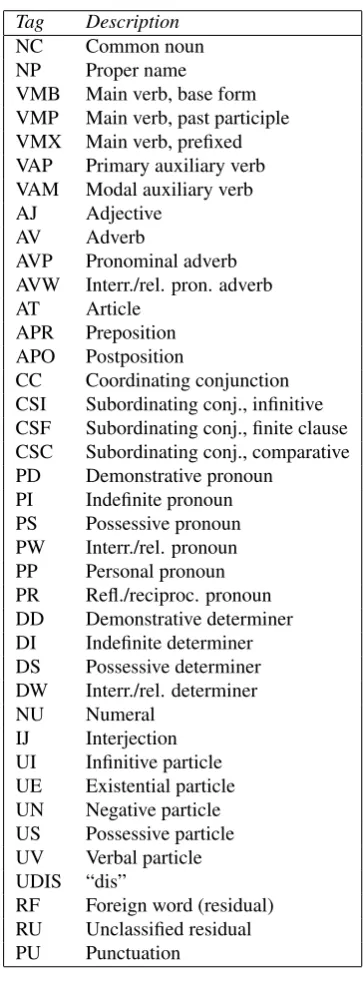
Tag Description
NC Common noun NP Proper name
VMB Main verb, base form VMP Main verb, past participle VMX Main verb, prefixed VAP Primary auxiliary verb VAM Modal auxiliary verb AJ Adjective
AV Adverb
AVP Pronominal adverb AVW Interr./rel. pron. adverb AT Article
APR Preposition APO Postposition
CC Coordinating conjunction CSI Subordinating conj., infinitive CSF Subordinating conj., finite clause CSC Subordinating conj., comparative PD Demonstrative pronoun
PI Indefinite pronoun PS Possessive pronoun PW Interr./rel. pronoun PP Personal pronoun PR Refl./reciproc. pronoun DD Demonstrative determiner DI Indefinite determiner DS Possessive determiner DW Interr./rel. determiner
NU Numeral
IJ Interjection UI Infinitive particle UE Existential particle UN Negative particle US Possessive particle UV Verbal particle UDIS “dis”
RF Foreign word (residual) RU Unclassified residual PU Punctuation
Table 1: Overview of MAATS
TreeTagger (Schmid, 1994) is a probabilistic decision tree tagger using a Markov model. During training, the tagger recursively builds binary branching decision trees from tri-grams. Utilizing the Viterbi algorithm, the decision trees are used to derive transition probabilities for a given state in a Markov model to determine the part of speech for an unknown word (Feldman and Hana, 2010, pp. 15–16).
4.2. Tagger lexicon
The publishing housePharos1 has provided word lists for
the major word classes of Afrikaans. The lists have been semi-automatically subdivided according to the MAATS tags and manually checked. The resulting lexicon is used as the tagger lexicon. It comprises approximately 75,000
1We want to thank the publishing housePharosmaking these
Afrikaans word lists available to us for the present research.
4,153 8,318 12,477 16,636
size of training data [tokens]
median tagging precision [%]
70
75
80
85
90
95
100
MB−Tagger RFTagger TnT−Tagger TreeTagger
Figure 2: Median tagging results
word form entries.
4.3. Corpus
The corpus we used comprises text from the Afrikaans newspaper Beeld (years: 1989–2000; http://www. beeld.com; a newspaper of theMedia24group,http: //www.media24.com). We tokenized the corpus with Schmid’s (2000) tokenizer and randomly selected a subcor-pus of approximately 16,000 words. A Perl script assigned all possible MAATS tags from the above-mentioned tagger lexicon to the tokens in the subcorpus. We manually disam-biguated and checked all annotations resulting in the gold standard for our experiment.2
4.4. Tagging evaluation
We split the corpus into four slices with an increasing num-ber3 of tokens: 4,153, 8,318, 12,477, and 16,636 tokens.
For each slice, we calculated for each tagger the median precision using a 10-fold cross validation. This means that each tagger was ten times trained on 90 % of a given slice. The tagging result of the complementary 10 % was then compared to the gold standard.
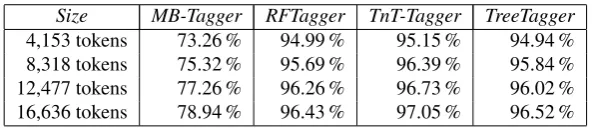
Table 2 shows the median tagging results of MB-Tagger, RFTagger, TnT-Tagger, and TreeTagger on each slice. The results are bar-plotted in figure 2.
MB-Tagger, which does not use a lexicon for training or tagging, had the lowest precision values in our experiment. However, with increasing amounts of training data, pre-cision of MB-Tagger clearly increased from 73.26 % on a training data set of 4,153 tokens to 78.94 % on 16,636 tokens. RFTagger, TnT-Tagger, and TreeTagger, which use a lexicon either for training or tagging, started with a
2
Thanks to Prof Elsabé Taljard and Prof Danie Prinsloo (Pre-toria) for the annotation of the first 2,000 tokens, as well as to Laurette Pretorius, jr., (Pretoria) for annotating another 5,000 to-kens.
3
Size MB-Tagger RFTagger TnT-Tagger TreeTagger
4,153 tokens 73.26 % 94.99 % 95.15 % 94.94 % 8,318 tokens 75.32 % 95.69 % 96.39 % 95.84 % 12,477 tokens 77.26 % 96.26 % 96.73 % 96.02 % 16,636 tokens 78.94 % 96.43 % 97.05 % 96.52 %
Table 2: Median tagging precision values
relatively high precision (94.94 % to 95.15 %). Although the size of training data increased, the precision values of RFTagger, TnT-Tagger, and TreeTagger only slightly in-creased. RFTagger and TreeTagger achieved consistently more or less equal results, whereas TnT-Tagger always out-performed both of them, however not significantly. With a maximum of 16,636 tokens of training data, TnT-Tagger reached a precision of 97.05 %. This accuracy is compa-rable to that obtained with TnT-Tagger for other languages (e.g. for German and English TnT-Tagger scores between 96 % and 97 %; cf. Brants, 2000).
4.5. Partial error analysis
Analysing the results, we found that adjectives in predica-tive use were frequently tagged erroneously as adverbs (cf. examples (9) and (10)).
(9) . . . sonder die nodige geriewe is alles vergeefsAJ/*AV.
“. . . without the necessary comfort, it is all in vain.”
(10) Dit is sekerlik nie maklikAJ/*AVom . . .
“This is certainly not possible that . . . ”
Another common source of errors are verb/noun homo-graphs such asdruk(“pressure/[to] press”) in example (11).
(11) Sy oefen seker te veel drukNC/*VMBop hom uit.
“She certainly exert too much pressure on him.”
Due to the large lexical overlap between pronouns and de-terminers, we assumed that the strict distinction of pro-nouns and determiners in MAATS might affect tagging pre-cision negatively. Examples are the demonstrativesHierdie
(“this/these”) anddaardie(“that/those”) which can be both pronouns and determiners. An example for an unambigu-ous pronoun isalmal(“everyone”). Alle(“every”), on the other side, is exclusively a determiner. However, dropping the pronoun/determiner distinction of MAATS and collaps-ing both categories into one, did not improve the taggcollaps-ing ac-curacy significantly. In an experiment with TnT-Tagger on 16,6336, we only scored 0.05 % better (97.10 %) without the pronoun/determiner distinction than with it. However, for modelling noun chunks for lexical data extraction we consider the pronoun/determiner distinction to be relevant. Thus, we opted for keeping this distinction in MAATS. Comparing both Afrikaans tagsets, Pilon (2005) and MAATS, TnT-Tagger performed with MAATS (i) better than with Pilon’s condensed tagset (93.69 %) and (ii) con-siderably better than with Pilon’s original tagset (85.87 %). However, we used a much bigger tagger lexicon than Pilon (2005), which helped to score a significantly higher accu-racy than with a small or with no tagger lexicon (Brants, 2000, p. 16). A similar effect was visible with MB-Tagger which does not use an external tagger lexicon but generates
its own tagger lexicon from the training data. With increas-ing amounts of trainincreas-ing data, and thus with an increased tagger lexicon, MB-Tagger performed considerably better than with less training data.
Nevertheless, this is an improvement, because MAATS with 39 pos-tags is more fine-grained than Pilon’s con-densed tagset. Indeed, it is semantically not as powerful as Pilon’s original tagset. However, for a variety of NLP applications, semantic distinctions are not imperative.
5.
Conclusion and future work
Pilon (2005, p. 4) concluded that 20,000 words of an Afrikaans training corpus are not enough for TnT-Tagger to compete with other state-of-the-art taggers. This may be true; however, her experiment of using only 13 pos-tags reached a significantly higher accuracy than her full tagset, which indicates that a semantically less fine-grained tagset increases accuracy. In combination with a detailed tag-ger lexicon, but based on training material of only 16,000 words, MAATS used with TnT-Tagger achieved an accu-racy at the same level as state-of-the-art tagging studies (Feldman and Hana, 2010).
We thus conclude that MAATS in combination with a sta-tistical tagger, especially TnT-Tagger, is well applicable to an Afrikaans corpus and that the resulting annotated corpus is usable for lexical data extraction.
For the future, we plan to analyse the tagging errors occur-ring in our data in greater detail in order to check for regular interferences between lexical classes their tags, and for data sparseness cases which might be solved by increasing the size of training data.
Additionally, we plan to tag the entire AfrikaansBeeld cor-pus from the years 1989 to 2000, with approximately 80 million words. This corpus will be our basis for the extrac-tion of verbal subcategorizaextrac-tion frames.
6.
References
Eric Atwell. 2008. Development of tag sets for part-of-speech tagging. In Anke Lüdeling and Merja Kytö, ed-itors, Corpus Linguistics. An International Handbook, volume 29.1 ofHandbooks of Linguistics and Communi-cation Science, chapter IV. Preprocessing corpora, pages 501–527. Mouton de Gruyter, Berlin.
Thorsten Brants. 2000. TnT – a statistical part-of-speech tagger. InProceedings of the Sixth Applied Natural Lan-guage Processing (ANLP-2000), Seattle, WA, USA. Walter Daelemans, Jakub Zavrel, Peter Berck, and Steven
Gillis. 1996. MBT: A memory-based part of speech tagger-generator. In Eva Ejerhed and Ido Dagan, editors,
Bruce C. Donaldson. 1993. A Grammar of Afrikaans. Mouton de Gruyter, Berlin.
Gertrud Faaß, Ulrich Heid, Daan J. Prinsloo, and Elsabé Taljard. 2009. Part-of-speech tagging of Northern Sotho: Disambiguating polysemous function words. In
Proceedings of the EACL 2009 Workshop on Language Technologies for the African Languages (AfLaT 2009), pages 38–45, 31 March.
Anna Feldman and Jirka Hana. 2010. A resource-light ap-proach to morpho-syntactic tagging. Number 70 in Lan-guage and Computers: Studies in Practical Linguistics. Rodopi, Amsterdam/New York.
Jan Hajiˇc. 2004. Disambiguation of Rich Inflection (Computational Morphology of Czech). Nakladatelství Karolinum, Prague.
Geoffrey Leech and Andrew Wilson. 1999. Standards for tagsets. In Hans van Halteren, editor, Syntactic Word-class Tagging, volume 9 ofText, Speech and Language Technology, chapter 5, pages 55–80. Kluwer Academic Publishers.
Geoffrey Leech. 1997. Introducing corpus annotation. In Roger Garside, Geoffrey Leech, and Anthony McEnery, editors,Corpus Annotation: Linguistic Information from Computer Text Corpora, pages 1–18. Longman, London. Suléne Pilon. 2005. Outomatiese Afrikaanse Woord-soortetikettering. Master’s thesis, North-West Uni-versity, Potchefstroom Campus, Potchefstroom, South Africa.
Helmut Schmid and Florian Laws. 2008. Estimation of conditional probabilities with decision trees and an ap-plication to fine-grained POS tagging. In Proceedings of the 22nd International Conference on Computational Linguistics (COLING-2008), Manchester, UK, 18–22 August.
Helmut Schmid. 1994. Probabilistic part-of-speech tag-ging using decision trees. In International Conference on New Methods in Language Processing, pages 44–49, Manchester, UK.