Facing the Identification Problem in Language-Related Scientific Data Analysis.
Joseph Mariani
1,2, Christopher Cieri
3, Gil Francopoulo
1,4,
Patrick Paroubek
2, Marine Delaborde
21IMMI, 2LIMSI
,
3LDC,
4Tagmatica1,2BP 133 - 91403 ORSAY cedex (France)
3Linguistic Data Consortium, 3600 Market Street, Philadelphia, PA 19104 (USA)
E-mail: [email protected], [email protected], [email protected], [email protected], [email protected]
Abstract
This paper describes the problems that must be addressed when studying large amounts of data over time which require entity normalization applied not to the usual genres of news or political speech, but to the genre of academic discourse about language resources, technologies and sciences. It reports on the normalization processes that had to be applied to produce data usable for computing statistics in three past studies on the LRE Map, the ISCA Archive and the LDC Bibliography. It shows the need for human expertise during normalization and the necessity to adapt the work to the study objectives. It investigates possible improvements for reducing the workload necessary to produce comparable results. Through this paper, we show the necessity to define and agree on international persistent and unique identifiers.
Keywords: Data identification, Normalization, ISLRN, Archive analysis, Bibliometrics, Scientometrics
1. Introduction
Several initiatives took place recently concerning the analysis of data in the literature related to research in Natural Language Processing (NLP) (ACL, 2012), Spoken Language Processing (SLP) or Language Resources (LR). The authors have conducted such studies
on the FLaReNet LRE Map (N. Calzolari et al., 2012), on
the ISCA Archive (J. Mariani et al., 2013) and on technical
papers mentioning the LRs distributed through LDC (E. Ahtaridis et al., 2012). All have experienced difficulties in correctly identifying the referents mentioned in the data they wished to study and invested significant manual effort to permit proper analysis. Difficulties concerned many aspects: authors’ name, affiliation, gender and
nationality, the citation title, source and
acknowledgments, the technical terms in the papers and the Language Resources’ name and type, the languages they cover, the modalities they address, etc.
Our experiences relate to the general problem of reference resolution in the context of scientific literature information mining, named entity annotation, or on a more general basis, the situation where a datum must be normalized to designate a unique referent.
2. Problem Classification
Four kinds of problem arise depending on the data cleaning performed:
1. The first concerns identification in synchrony,
in other terms, to identify a specific referent at a given point in time. There are two sub-cases: i) selecting a standardized name in a predefined list, for instance the name of a country, ii) standardizing a name when such list does not
(currently) exist, for instance when dealing with authors or titles of scientific papers. For the first situation, the obvious and best strategy is to use standardized codes such as ISO-3166-1 alpha-3. Defining ones own list of codes is not a good option for many reasons but also because difficult problems arise for example around national status: are “Palestine”, "Kurdistan", “Basque country” or a group like the “Baltic countries” to be considered? Such difficult problems are beyond the present study. If a non-standardized option is adopted, explaining the rationale is lengthy and complex. The problem of country name identification is just one example: ISO and W3C maintain lists of codes for various domains like language identification (see ISO-639-3), linguistic properties like grammatical
gender (see ISO-12620)1.
Concerning person names, it should be noted that, at the moment, there is no standardized list, though there are multiple proposals, and normalizing these names is a serious challenge. Different people have the same name and although the number of homographs is rather small within a specific scientific domain, the boundaries of scientific domains are not sharp, nor are they recognized by current search tools. Some cleaning must be done when comparing names of different length, like “Robert Smith” compared to “Robert D Smith” or variations with titles like “Sen. Robert Smith” or “Robert Smith Jr”.
2. The second problem concerns name changes over time (diachrony). Different sub-cases arise like a simple name change (e.g. “Belgian Congo” becoming “Democratic Republic of the Congo”), a division (e.g. “Czechoslovakia” split into “Czech Republic” and “Slovak Republic” or “Slovakia”), a merger (e.g. “German Democratic Republic”, informally “East Germany” and “Federal Republic of Germany”, informally “West Germany” merged into “Federal Republic of Germany”, informally now “Germany”), or possibly some slightly more complex situations which appear when cities are reorganized (e.g. in Quebec, the former city “Hull” has been merged with the suburban city “Gatineau” and the new association is called “Gatineau”). These phenomena should be handled in a coherent manner to allow consistent counting and annotation over the period. In some domains, ISO maintains a list specifically for this purpose, (e.g. ISO-3166-3 that defines codes and rules for countries deleted from ISO-3166-1 since its first publication in 1974). A person may change names over time too, for example at marriage in many cultures.
3. The third problem concerns reference precision.
The challenge is to name the intended item, group or abstraction, for instance, “WordNet” compared to “WordNet 1.5” or “WordNet 3.0”. The criteria for selecting the right level of designation reflect the precision needed for the study, the information available, and of course, the precision coherence from one resource to another.
4. The forth problem is of a different nature and is
more practical. It concerns the mismatch
between the appearance within input documents and the semantics of the references they contain. For instance, when the entry is a PDF file without the required fonts, the word segmentation is frequently erroneous. Another example is hyphenation (i.e. sentence splitting at the end of a line), which produces some small noisy strings difficult to fix automatically. Handling these problems is often difficult, and a hybrid strategy combining generic mechanisms like rules or data-driven behavior with specific exceptions is often needed.
3. Our experience in data normalization
within analytic studies
We will now provide some examples of the problems the authors faced and the solutions chosen in three different
studies: those of the LRE Map, of the ISCA Archive and of
the LDC Bibliography.
3.1. The
LRE Map
The LRE Map is produced by the authors of papers
submitted to various conferences, starting with LREC
2010. Authors provide information on the language resources mentioned in their paper, whether produced or used, when they submit it (N. Calzolari et al., 2012). The
LRE Map yielded the Language Matrices within the
T4ME project (N. Calzolari and J. Mariani, 2012). They provide the number of Language Resources by type and modality (text, speech, multimodal / multimedia) in
various languages, including Sign Languages. They
highlight the lack of resources for certain languages and thus can serve to guide efforts to equalize and complete coverage. They may also help computing a Language Resource Impact Factor (LRIF) in order to recognize the contribution to research of LR producers just as publications impact factors recognize the influence of papers authors.
The parameters of the study are the resource Type, Name, Modality and Language coverage.
3.1.1. LRE Map Processing
The analysis in our first study of the data gathered at LREC 2010 revealed that the same Language Resources were mentioned and described differently by different authors requiring human experts to normalize and map the information. The acquisition software was then improved
and used to complete the initial LRE Map with the data
coming from nine more conferences on Speech and Natural Language Processing until LREC 2012.
Just as for the initial LRE Map in 2010, it was also
necessary to clean up the resulting data in order to
produce a new set of Language Matrices. Even if the
process was less demanding this time, it was nonetheless very tedious and ostensibly unnecessary.
The data is kept as entered by the authors, including any errors they may have introduced, and the clean version of the information is added in parallel. The processed information is used for all analyses, but the raw data is provided to the users who wish to consult the database, leaving the full responsibility of the information to the authors.
Cleaning and modifying the data as a collaborative activity is very difficult, as some decisions are specific to the intended uses. The modifications are related to various issues (cases, spelling errors, introduction of a new term while the concept was already covered by or within an already existing term, etc.), but also raise in some cases more fundamental and theoretical questions, which should be discussed within the scientific community.
The data which were corrected are the following:
3.1.1.1. Resource Type
corresponding LR in research through publications, and more generally to trace the use, enrichment, or modification of such LRs by all Language Technology stakeholders (P. Labropoulou, C. Cieri and M. Gavriilidou, 2014). Just as a book is identified by an ISBN number, the same should be done for LR, in a coordinated way, through a single entity attributing such numbers. This appears as a big challenge if we consider its international dimension, and discussions are presently on going at the international level in order to define the
way to assign an International Standard Language
Resource Number (ISLRN) to each Language Resource (K. Choukri et al., 2012). Interestingly, the Biology community is currently conducting similar reflections on
Biological Resources (A. Cambon-Thomsenet al., 2011).
3.1.1.3. Resource Language(s)
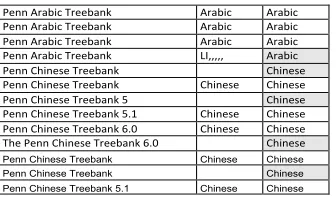
Here also, the input format was initially unconstrained. It was therefore necessary to review the data in order to harmonize the various spellings. Some authors provided the ISO code for languages, instead of the complete name. Some decisions were harder: we chose for example to consider British English, American English and English as a single (EU) language.
Penn$Arabic$Treebank$ Arabic$ Arabic$
Penn$Arabic$Treebank$ Arabic$ Arabic$
Penn$Arabic$Treebank$ Arabic$ Arabic$
Penn$Arabic$Treebank$ LI,,,,,$ Arabic$
Penn$Chinese$Treebank$ $$ Chinese$
Penn$Chinese$Treebank$ Chinese$ Chinese$
Penn$Chinese$Treebank$5$ $$ Chinese$
Penn$Chinese$Treebank$5.1$ Chinese$ Chinese$
Penn$Chinese$Treebank$6.0$ Chinese$ Chinese$
The$Penn$Chinese$Treebank$6.0$ $$ Chinese$
Penn Chinese Treebank Chinese Chinese
Penn Chinese Treebank Chinese
Penn Chinese Treebank 5.1 Chinese Chinese
!
Fig. 3. Examples of cleaning the inputs of the language(s) addressed by a LR (entered input in first column): Harmonization of the “Penn Arabic Treebank” to cover the Arabic language, and of the “Penn
Chinese Treebank” to address Chinese (third column).
The new acquisition software provides a list of languages encoded according to the ISO 639-3 codes based on the
Ethnologue survey of existing languages (P. Lewis, 2009),
which facilitates and normalizes the input of the 5 first languages corresponding to a LR. In case an LR addresses more languages, the others are entered in a free format.
In the first study of the Language Matrices, the focus was on EU languages. We therefore only considered the 23 official EU languages at that time; we merged all the regional EU languages (such as Basque, Catalan, Galician, Sami, Luxemburgish) in a single category (“European Regional languages”) and the non-EU European languages (such as Moldavian, Turkish, Norwegian) also in a single category (“Other European languages”). We finally completed the set of categories with “Multilingual”, “Language Independent” and “Non Applicable”.
In the second study, we considered a set of 4 Spanish regional languages (Catalan, Basque, Galician and Asturian) individually as well as the 23 official EU languages. We gathered all the other European languages in a single “Other European Languages” category (comprising 51 national and regional European
languages). We considered individually major
international languages (Arabic, Hindi, Chinese
Mandarin, Japanese and Korean), and gathered all the other ones in a single “Other Languages” category (comprising 133 languages). This represents a total of 216
languages mentioned in the LRE Map entries. We also
studied 21 Sign Languages and specifically a set of 27 European regional and minority languages (C. Soria and J. Mariani, 2013).
We decided that LRs which are relevant to several languages should be counted for each of those languages in the analysis of the language coverage.
3.1.1.4. Resource Modality(ies)
Here also, a limited set of suggestions was made to the authors. However, some LRs may be related to multiple modalities (such as spoken and written). In this case, we decided to mark them as such in a coherent way and we considered them for both modalities. Some authors introduced modalities that we considered as already covered (such as “Text” instead of “Written”, or “Any modality” instead of “Multimodal/Multimedia”), and we therefore had to correct a few cases.
National(Corpus(of(Polish( Written(and(Speech( Speech/Written( National(Corpus(of(Polish( Written(and(Speech( Speech/Written( National(Corpus(of(Polish( Written( Speech/Written( National(Corpus(of(Polish( Written( Speech/Written( National(Corpus(of(Polish( written(and(spoken( Speech/Written( National(Corpus(of(Polish( Written( Speech/Written(
!
Fig. 4. Examples of cleaning the modality of a LR (second column): harmonization of “National Corpus of Polish” to address both
spoken and written language (third column).
3.1.2. Summary of the Normalizations
A final normalization was still required on the full LRE
Map after merging the data from 10 conferences, in order
to ensure the overall homogeneity of Names and Types across conferences. 218 Types and 231 Names (about 5% of the entries) and 6 Modalities were still corrected in this final process.
Conference Date,
place Entries Existing Types Corrected Existing Types
New
Types Corrected New Types
Corrected
Names Corrected languages Corrected Modalities # corrections % corrected cells LREC 2010 May
17-23 2010, Valetta, Malta
1995 1720
(87%) 156 (8%) 104 15 889 (45%) 179 (9%) 122 (6%) 1361 17%
LREC 2012 May 21-27 2012, Istanbul, Turkey
1130 1012
(90%) 55 (5%) 43 20 95 (8%) 13 (1%) 83 (7%) 266 6%
Total 10
conferen ces
4395 3883
(89%) 283 (6%) 192 38 1149 (26%) 307 (7%) 437 (10%) 2214 13%
Table 1 Table presenting the number of corrections on Types, Names, Languages and Modalities for the first and final conference considered in the study (LREC 2010 and LREC 2012), and for the whole data corresponding to 10 conferences.
Table 1 gives some insight into the number of operations that were made for the first and last conference in the series, and for the analysis of the whole set. The number of corrections has been drastically reduced thanks to the new acquisition software regarding the names (45% to 8%) and the languages (9% to 1%) while it has remained stable for the Types and the Modalities. The number of corrections went down from 17% of the cells for LREC 2010 to 6% for LREC 2012. On the final complete table, more than 2,000 cells had to be manually modified, that is
13% of the cells considered in the LRE Map, which
represents many working hours.
3.2. The ISCA Archive
When the volume of data becomes very large, the hope of a comprehensive, ex post facto normalization becomes illusory. A study of the International Speech Communication Association (ISCA) Archive covering 25 annual conferences (ECST, Eurospeech, ICSLP and Interspeech) over a long duration (1987-2012) (J. Mariani et al., 2013) faced difficulties identifying the target information and requiring tedious cleaning on several occasions.
In addition to the detailed and substantiated look at the history of the ISCA community which provides valuable insights, this study enabled us to identify two important points to consider when doing community oriented bibliographic studies:
1. A cost-benefit perspective suggests that we focus
on the data that have the greatest influence on survey goals. Normalizing the names of authors who published only one or two papers over 25 years has only a small effect despite the required effort. This is especially important given that more than half of the authors (about 8,000) published only one paper. In contrast, resolving the different names of an active author is important, because otherwise this person will not appear at the correct ranking, defeating one of the objectives for identifying the most active authors.
2. For a similar reason, using expert domain
knowledge to ensure that the names of key people in the community are properly taken into account is unavoidable. Future work on multilingual enriched probabilistic parsing of person names is needed to increase the share of automated processing and improve referent identification performance.
3.2.1. Authors’ Name Normalization
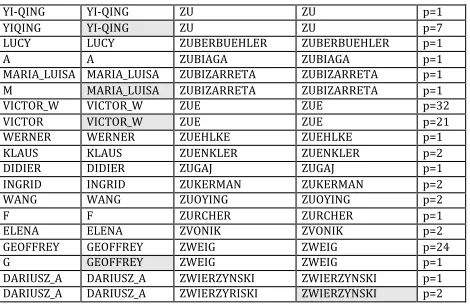
The data on the authors’ names was obtained from the ISCA Archive metadata. After an automatic cleaning, the authors’ names were listed in alphabetical order and a domain expert checked the top ranking authors according to frequency or domain importance and regarding the spelling of the family name and given name. The longest variant was retained as the reference. The substitution between the family name and the given name was also checked. From 16,892 person names, this processing reduced the list to 14,630 names, corresponding to an average ambiguity factor of 1.12 and a standard deviation of 0.448.
YI#QING' YI#QING' ZU' ZU' p=1'
YIQING' YI#QING' ZU' ZU' p=7'
LUCY' LUCY' ZUBERBUEHLER' ZUBERBUEHLER' p=1'
A' A' ZUBIAGA' ZUBIAGA' p=1'
MARIA_LUISA' MARIA_LUISA' ZUBIZARRETA' ZUBIZARRETA' p=1'
M' MARIA_LUISA' ZUBIZARRETA' ZUBIZARRETA' p=1'
VICTOR_W' VICTOR_W' ZUE' ZUE' p=32'
VICTOR' VICTOR_W' ZUE' ZUE' p=21'
WERNER' WERNER' ZUEHLKE' ZUEHLKE' p=1'
KLAUS' KLAUS' ZUENKLER' ZUENKLER' p=2'
DIDIER' DIDIER' ZUGAJ' ZUGAJ' p=1'
INGRID' INGRID' ZUKERMAN' ZUKERMAN' p=2'
WANG' WANG' ZUOYING' ZUOYING' p=2'
F' F' ZURCHER' ZURCHER' p=1'
ELENA' ELENA' ZVONIK' ZVONIK' p=2'
GEOFFREY' GEOFFREY' ZWEIG' ZWEIG' p=24'
G' GEOFFREY' ZWEIG' ZWEIG' p=1'
DARIUSZ_A' DARIUSZ_A' ZWIERZYNSKI' ZWIERZYNSKI' p=1'
DARIUSZ_A' DARIUSZ_A' ZWIERZYRISKI' ZWIERZYNSKI' p=2'
'
Fig. 5. Example of cleaning authors’ surnames (first and second columns) and names (third and fourth columns): the focus is on the most prolific authors (number of papers in fifth column), as merging variant wording may drastically change their ranking (see the case of
mentions of WSJ may also refer to the text data in the TIPSTER (e.g. LDC93T3A) or North American News Text corpora (e.g. LDC2008T15), and the read versions in the so-called CSR corpora (e.g. LDC93S6A), as well as
the syntactically annotated data in Treebank.
Complicating matters, the CSR corpora, which contain readings of the Wall Street Journal, were released in two sets commonly known as WSJ0 and WSJ1. However, even these mentions are inadequate since each set was published as three corpora: two differing importantly in the microphone used and a third, complete collection. Thus mentions in the literature of WSJ0, WSJ1 or worse, the Wall Street Journal Corpus fail to provide an adequate pointer to the data used for a researcher hoping to replicate or compare prior studies. The reference problems are not limited to older corpora either. More recent mentions of the Web 1T 5-gram corpus Version 1 (LDC2006T13) appear in the literature as Google Web 1T
n-gram, Google 5-gram and Google Ngrams.
Readers may have difficulty determining from such mentions which corpus was in fact used. LDC domain experts resolve these ambiguities through their knowledge of the LRs themselves and by cross-checking against the LRs known to be licensed to the paper’s author. However, knowing that no reader will have access to such information and also knowing that information extraction technologies are imperfect and expensive to build and maintain, it strikes us as wasteful to continue to try to address such entity and relation normalization problems ex post facto.
4. Conclusion
Each of the three studies that are mentioned in this paper has resulted in interesting results allowing for a better understanding of our field of research. They have benefited from a large amount of data and an extensive set of tools. However, they required a huge amount of manual work in order to normalize and identify the information related to the various parameters that were taken into account in the analysis, with the help of referential data whenever they exist.
This tedious activity has clearly demonstrated the need for normalizing, assigning and using persistent and unique identifiers for various entities: authors names, affiliations, gender and nationality, conferences, journals, books, papers references, Funding Agencies, Language Resources names, types and modalities, languages, etc. which would necessitate an international coordination, in order to be able to draw reliable statistics from existing scientific literature, a key asset for measuring science progress.
5. Acknowledgements
This paper results from studies conducted within the EC projects FLaReNet (Grant Agreement ECP-2007-LANG-617001) and T4ME (Grant Agreement no.: 249119)).
The authors wish to thank all the people who participated in those studies, especially Nicoletta Calzolari, Riccardo
del Gratta, Irene Russo and Claudia Soria (CNR-ILC “A. Zampolli”), and Khalid Choukri (ELRA-ELDA) for
fruitful discussions about the LRE Map content and
Denise DiPersio, Eleftheria Ahtaridis and Abby Graham for discussions of the LDC Bibliography.
6. References
ACL (2012) Proceedings of the ACL-2012 Special Workshop on Rediscovering 50 Years of Discoveries, ACL 2012, Jeju, July 10, 2012, ISBN 978-1-937284-29-9
Ahtaridis, Eleftheria; Cieri, Christopher and DiPersio, Denise (2012) LDC Language Resource Papers: Building a Bibliographic Database, In Proceedings of the Language Resources and Evaluation Conference (LREC 2012), Istanbul, Turkey, 23-25 May 2012. Calzolari, Nicoletta; Del Gratta, Riccardo; Francopoulo,
Gil; Mariani, Joseph; Rubino, Francesco; Russo, Irene and Soria, Claudia (2012) The LRE Map. Harmonising Community Descriptions of Resources, In Proceedings of the Language Resources and Evaluation Conference (LREC 2012), Istanbul, Turkey, 23-25 May 2012 Calzolari, Nicoletta and Mariani, Joseph (2012) A journey
from the LRE Map to the Language Matrices and the Language Resource Impact Factor (LRIF), Coco-FLaRe Workshop “Reinforcing International Collaboration on LRE“, LREC 2012, 26 May 2012
Cambon-Thomsen, A., Thorisson, G. A. and Mabile, L. (2011) The role of a bioresource research impact factor as an incentive to share human bioresources, Nature Genetics, 43, 503–504, 26 may 2011
Choukri, Khalid; Arranz, Victoria; Hamon, Olivier and Park, Jungyeul (2012) Using the International Standard Language Resource Number: Practical and Technical Aspects, In Proceedings of the Language Resources and Evaluation Conference (LREC 2012), Istanbul, Turkey, 23-25 May 2012
Councill, Isaac G.; Giles, C. Lee; Kan, Min-Yen (2008) ParsCit: An open-source CRF reference string parsing package. In Proceedings of the Language Resources and Evaluation Conference (LREC 2008), Marrakesh, Morocco, 28-30 May 2008
Labropoulou, Penny; Cieri, Christopher and Gavriilidou, Maria (2104) Developing a Framework for Describing Relations among Language Resources, In Proceedings of the Language Resources and Evaluation Conference (LREC 2014), Reykjavik, Iceland, 26-31 May 2014.
Lewis, Paul, ed. (2009) Ethnologue: Languages of the World, Sixteenth Edition, 2009, 1,248 pp., SIL International, ISBN 978-1-55671-216-6
Mariani, Joseph; Paroubek, Patrick; Francopoulo, Gil and Delaborde, Marine (2013) Rediscovering 25 years of Discoveries in Spoken Language Processing: a Preliminary Analysis of the ISCA Archive, Interspeech’2013, Lyon, 26-29 August 2013