Forward Security & Cipher text policy on Data Privacy preservation by
shared authority encryption
Mr.V.Sudarshan
1Mr.A.Dileep Kumar
21
Associative Professor ,Department of Computer 2 Asstistant Professor ,Department of Computer Science Science & Engineering,Khammam Institute of & Engineering, Khammam Institute of Technology &
Technology & Sciences(KITS),Khammam,T.S-India, Sciences(KITS),Khammam,A.P-India,
[email protected]. [email protected]
Ms.Shaik Farzana
33
PG Scholars
Science & Engineering,Khammam Institute of Technology & Sciences(KITS),Khammam,T.S-India
Abstract
Cloud computing is emerging as a prevalent data interactive paradigm to realize user’s data remotely
stored in an online cloud server.. A cloud storage
system, consisting of an accumulation of storage
servers, provides long-term storage accommodations
over the Internet. Storing data in a third party’s
cloud system causes solemn concern over data
confidentiality. Constructing a secure storage system
that fortifies multiple functions is challenging when
the storage system is distributed and has no central
ascendancy. We propose a proxy re-encryption
scheme that fortifies encoding operations over
encrypted messages as well as forwarding operations
over encoded and encrypted messages. Our method
plenarily integrates encrypting, encoding, and
forwarding. We analyze and suggest congruous
parameters for the number of replicas of a message
dispatched to storage servers and the number of
storage servers queried by a key server.
Keywords: Cloud computing, authentication
protocol, privacy preservation, shared authority,
encryption,Cipher text policy, Data anonymity,
Forward Security
.
1. Introduction
CLOUD computing is a promising information
technology architecture for both enterprises and
individuals. It launches an alluring data storage and
interactive paradigm with conspicuous advantages,
including on-demand self-accommodations,
ubiquitous network access, and location independent
resource pooling. Towards the cloud computing,
typical accommodation architecture is anything as an
accommodation (XaaS), in which infrastructures,
platform, software, and others are applied for
ubiquitous interconnections. Recent studies have
been worked to promote the cloud computing evolve
Subsequently, security and privacy issues are
becoming key concerns with the incrementing
popularity of cloud accommodations. Conventional
security approaches mainly fixate on the vigorous
authentication to realize that a utilizer can remotely
access its own data in on-demand mode. Along with
the diversity of the application requisites, users may want to access and apportion each other’s sanctioned
data fields to achieve pro- ductive benefits, which
bring incipient security and privacy challenges for
the cloud storage. In the cloud storage predicated
supply chain management; there are sundry interest
groups (e.g., supplier, carrier, and retailer) in the
system. Each group owns its users which are
sanctioned to access the sanctioned data fields, and
different users own relatively independent access
ascendant entities. It signifies that any two users
from diverse groups should access different data
fields of the same file. There into, a supplier intentionally may want to access a carrier’s data
fields, but it is not sure whether the carrier will
sanction its access request. If the carrier relicts its request, the supplier’s access desire will be revealed
along with nothing obtained towards the desired data
fields. Authentically, the supplier may not send the
access request or withdraw the unaccepted request in
advance if it firmly kens that its request will be
reelected by the carrier. It is adamant to exhaustively disclose the supplier’s private information without
any privacy considerations.
Case 1: The carrier withal wants to access the
supplier’s data fields, and the cloud server should
appraise each other and transmit the shared access
ascendancy to the both users.
Case 2: The carrier has no interest on other users’
data fields; consequently its sanctioned data fields
should be felicitously bulwarked, mean while the supplier’s access request will additionally be
concealed.
Case 3: The carrier may want to access the retailer’s
data fields, but it is not certain whether the retailer
will accept its request or not. The retailer’s
sanctioned data fields should not be public if the retailer has no fascinates in the carrier’s data fields, and the carrier’s request is withal privately
obnubilated. Towards above three cases, security
bulwark and privacy preservation are both
considered without revealing sensitive access desire
cognate information
In the cloud environments, a reasonable security
protocol should achieve the followingrequirements.
Authentication: a legal user can access its own data
fields, only the authorized partial or entire datafields
can be identified by the legal user, and any forged or
tampered data fields cannot deceive thelegal user.
Data anonymity: any irrelevant entity cannot
recognize the exchanged data and communication
stateeven it intercepts the exchanged messages via
an open channel.
User privacy: any irrelevant entity cannot know or guess a user’s ac-cess desire, which represents auser’s interest in another user’s authorized data
fields. If and only if the both users have
mutualinterests in each other’s authorized data
fields, the cloud server will inform the two users to
realizethe access permission sharing.
Forward security: any adversary cannot correlate
priorinterrogations according to the currently
captured messages.
In this paper, we address the aforementioned privacy
issue to propose a proxy based privacy
preservingauthentication protocol for the cloud data
storage, which realizes authentication
andauthorization without compromising a user’s
private information. The main contributions are
asfollows.
Identify a new privacy challenge in cloud
storage, and address a subtle privacy issue
during a user challenging the cloud server
for data sharing, in which the challenged
request itself cannot reveal the user’s
privacy no matter whether or not it can
obtain the access authority.
Propose an authentication protocol to enhance a user’s access request related
privacy, and the shared access authority is
achieved by anonymous access request
matching mechanism.
Apply cipher text policy attribute based
access control to realize that a user can
reliably access its own data fields, and adopt
the proxy re-encryption to provide temp
authorized data sharing among multiple
users.
2. Related Work
2.1 Existing System:
Despite the tremendous benefits, outsourcing
computation to the commercial public cloud is withal depriving customers’ direct control over the
systems that consume and engender their data during
the computation, which ineluctably brings in
incipient security concerns and challenges towards
this promising computing model.
On the one hand, the outsourced computation
workloads often contain sensitive information, such
as the business financial records, proprietary
research data, or personally identifiable health
information sets. The unauthorized information
leakage, sensitive data have to be encrypted afore
outsourcing. So as to provide end to- end data
confidentiality assurance in the cloud and beyond.
unauthorized information leakage, sensitive data
have to be encrypted afore outsourcing. So as to
provide end to- end data confidentiality assurance in
the cloud and beyond. For example, for the
computations that require a substantial amount of
computing resources, there are sizably voluminous
financial incentives for the cloud to be “lazy” if the
customers cannot tell the correctness of the output.
Besides, possible software bugs, hardware failures,
or even outsider attacks might additionally affect the
quality of the computed results.
Disadvantage of Existing System:
The cloud is intrinsically not secure from the
viewpoint of customers without providing a
mechanism for secure computation
outsourcing so to protect the sensitive input
and output information of the workloads.
The various motivations for cloud server to
behave unfaithfully and to return incorrect
results, i.e., they may behave beyond the
classical semi hones model.
2.2 Proposed System:
A shared ascendancy predicated privacy-preserving
privacy issue for cloud storage. In the SAPA, shared
access ascendancy is achieved by in nominate access
request matching mechanism with -*security and
privacy considerations (e.g., authentication, data
anonymity, utilize privacy, and forward security
attribute predicated access control is adopted to
realize that the utilizer can only access its own data
fields proxy re-encryption is applied by the cloud
server to provide data sharing among the multiple
users. Meanwhile, macrocosmic compos faculty
(UC) model is established to prove that the SAPA
theoretically has the design correctness.
It betokens that the proposed protocol realizing
privacy-preserving data access ascendancy sharing is
captivating for multi-utilizer collaborative cloud
applications. The outsourced computation workloads
often contain sensitive information, such as the
business financial records, proprietary research data,
or personally identifiable health information etc.
Planarity homomorphism encryption (FHE) scheme,
a general result of secure computation outsourcing
has been shown viable in theory, where the
computation is represented by an encrypted
combinational Boolean circuit that sanctions to be
evaluated with encrypted private inputs.
Advantages of Proposed System:
The outsourced computation workloads often
contain sensitive information, such as the business
financial records, proprietary research data, or
personally identifiable health information can be
secured utilizing private computing.
3. Implementation
The Implementation of the System is follows
Distributor
Supplier
Carrier
Customer
Authentication
Registration
Registration:
The system has a process of registration. Every user
need to submit their complete details including user
name and password in the form of registration.
Whenever a user registration completed then only a
user can get log in into the system by using his user
id and password.
Login:
In this module user can give the user id and
password after giving that we are checking that valid
person or not means here we are giving security for
our application.
The login page will restrict the UN authorized users.
A user must provide his credential like user Id and
password for log into the system. For that the system
maintains data for all users. Whenever a user enters
his user id and password, it checks in the database
for user existence. If the user is exists he can be
treated as a valid user. Otherwise the request will
throw back.
Distributor:
Customer wants to order products from a distributor
with the requirement that these must be delivered
before the drop-dead date. To satisfy such a request,
the distributor will try to find a supplier that has the
products available. If found, he will search for a
carrier that is able to deliver the products before the
drop-dead date. If both the supplier and the carrier
distributor will report to the customer that he can
fulfill the order.
Supplier:
Supplier can manage products in the system. He can
view all types of products details. He taken request
from the distributor. If the request result from the
supplier is positive, the BPEL process seeks a
suitable carrier to deliver the products. Otherwise,
the process will return a fault message indicating no
suitable supplier is available for the supply. He can
manage the personal details.
Carrier:
He took request from the distributor. if a carrier is
found, the process will ask the supplier to dispatch
the products, and ask the carrier to deliver the
products. Otherwise, the process will return a fault
message indicating no suitable carrier is available
for the delivery. After the successful delivery of the
products to the customer, the process is informed by
the distributor with the positive result, and it returns
a success message. He can manage the personal
details.
Customer:
He is a registered user to the Site. This user can view
all products and product details. He send the request
for products to the distributor and receive the
suitable response from distributor. He can manage
the personal details.
Fig.1 illustrates a system model for the cloud storage
architecture, which includes three mainnetwork
entities: users (Ux), a cloud server (S), and a trusted
third party
User: an individual or group entity, which owns its
data stored in the cloud for online datastorage and
computing. Different users may be affiliated with a
common organization, and areassigned with
independent authorities on the certain data field.
Cloud server: an entity, which is managed by a
particular cloud service provider or cloudapplication
operator to provide data storage and computing
services. The cloud server is regarded asan entity
with unrestricted storage and computational
resources.
Trusted third party: an optional and neutral entity,
which has advanced capabilities on behalfof the
users, to perform data public auditing and dispute
arbitration.
In the cloud storage, a user remotely stores its data
via online infrastructures, platforms, orsoftware for
cloud services, which are operated in the distributed,
parallel, and cooperative modes.During cloud data
accessing, the user autonomously interacts with the
assigned with the full and independent authority on
its own data fields. It isnecessary to guarantee that the users’ outsourced data cannot be unauthorized
accessed by otherusers, and is of critical importance to ensure the private information during the users’
data accesschallenges.
In some scenarios, there are multiple users in a
system (e.g., supply chain management), and
theusers could have different affiliation attributes
from different interest groups. In the system
model,assume that point-to-point com-munication
channels between users and a cloud server are
reliablewith the protection of secure shell protocol
(SSH). The related authentication handshakes are
nothighlighted in the following protocol
presentation.
Experimental Work
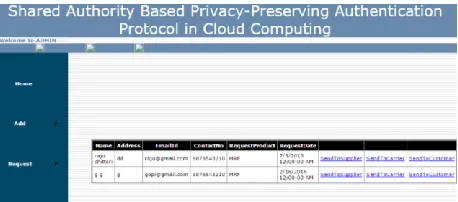
Fig 2: Registration form of the System.
Fig 2: Customer Request details Page.
Fig 3: Customer Request Processing Page.
4. Conclusion
In this work, we have identified a new privacy
challenge during data accessing in the cloud
computing to achieve privacy-preserving access
authority sharing. Authentication is established to
guarantee data confidentiality and data integrity.
Data anonymity is achieved since the wrapped
values are exchanged during transmission. User
privacy is enhanced by anonymous access requests
to privately inform the cloud server about the users’
access desires. Forward security is realized by the
session identifiers to prevent the session correlation.
It indicates that the proposed scheme is possibly
applied for privacy preservation in cloud
applications.
5. References
[1] P. Mell and T. Grance, “Draft NIST Working Definition of Cloud Computing,” National Institute
of Standards andTechnology, USA, 2009.
[2] A. Mishra, R. Jain, and A. Durresi, “Cloud
Computing: Net-working and Communication Challenges,” IEEECommunications Magazine, vol.
50, no. 9, pp, 24-25, 2012.
[3] R. Moreno-Vozmediano, R. S. Montero, and I. M. Llorente, “Key Challenges in Cloud Computing to Enable theFuture Internet of Services,” IEEE
ieeexplore.ieee.org/stamp/stamp
.jsp?tp=&arnumber=6203493,2
012.
[4] K. Hwang and D. Li, “Trusted Cloud Computing with Secure Resources and Data Coloring,” IEEE
InternetComputing, vol. 14, no. 5, pp. 14-22, 2010. [5] J. Chen, Y. Wang, and X. Wang, “On-Demand
Security Architec-ture for Cloud Computing,”
Computer, vol. 45, no.7, pp. 73-78, 2012.
[6] Y. Zhu, H. Hu, G. Ahn, and M. Yu, “Cooperative Provable Data Possession for Integrity
Verification in Multi-cloudStorage,” IEEE
Transactions on Parallel and Distributed Systems,
vol. 23, no, 12, pp. 2231-2244, 2012.
[7] H. Wang, “Proxy Provable Data Possession in
Public Cloud-s,” IEEE Transactions on Services
Computing,
[online]ieeex-plore.ieee.org/stamp/stamp.jsp?tp=&arnumber=6357
181, 2012.
[8] C. Wang, Q. Wang, K. Ren, N. Cao, and W. Lou, “Toward Secure and Dependable Storage Services in CloudComputing,” IEEE Transactions on Services
Computing, vol. 5, no. 2, pp. 220-232, 2012.
[9] X. Liu, Y. Zhang, B. Wang, and J. Yan, “Mona:
Secure Multi-Owner Data Sharing for Dynamic Groups in theCloud,” IEEE Transactions on Parallel
and Distributed Systems, [online]
ieeexplore.ieee.org/stamp/stamp.jsp?tp=&arnumber
=6374615,2012.
[10] M. Nabeel, N. Shang and E. Bertino, “Privacy
Preserving Pol-icy Based Content Sharing in Public Clouds,” IEEETrans-actions on Knowledge and
Data Engineering, [online]
ieeexplore.ieee.org/stamp/stamp.jsp?tp=&arnumber
=6298891,2012.
[11] L. A. Dunning and R. Kresman, “Privacy
Preserving Data Sharing With Anonymous ID Assignment,” IEEETransactions on Informa-tion
Forensics and Security, vol. 8, no. 2, pp. 402-413,
2013.
V.Sudharshan received the M.Tech degrees in
computer science Engineering and Information Technology from the JNTUH University, Hyderabad, in 2005 and 2010, respectively, and is currently pursuing the Ph.D. degree in Computer Science & Engineering at the JNTUH—Hyd..He has a vast experience in network-related software-development from several startup companies. His research interests include Secure Cloud Computing, content caching, cellular networks, and traffic
redundancy elimination.
Dileep Kumar received the
M.Tech degree in Computer Science & Engineering from the University JNTUH, Hyderabad.