3D Video Compression Using Split Algorithm
Govtham T, Prof. Venkateshappa,
M. Tech Student, Dept. of Electronics & Communication Engineering, M.S. Engineering College, Bangalore, India Dept. of Electronics & Communication Engineering, M.S. Engineering College, Bangalore, India
ABSTRACT: Video Compression method has huge demand in the position of video engineering due to storage space and bandwidth requests. The data amount is extremely huge for digital video and memory of storage space strategy and communication queue are not countless. So it is basically not achievable for us to store up complete digital video with no processing. Therefore, video compression principles, methods and algorithms had been urbanized to decrease the data amount. This paper will describe the dissimilar video compression principles based on different features. A paper also addresses the difficulty of combined video over "heterogeneous" systems. Present models for video compression are not planned to deal through this difficulty. We define a further number of metrics to calculate compression algorithms for this function. We next represent a well-organized algorithm for video compression in such an environment. The algorithm is an original arrangement of the distinct wavelet transform and hierarchical vector quantization.
KEYWORDS: Wavelet transforms, H.264 video coding, Split Algorithm, CABAC (Context based Adaptive Binary Arithmetic Coding).
I. INTRODUCTION
Digital video compression is a procedure of reducing the range of video records. To accomplish the good quality compression ratio video folder desires to be encoded and decoded from one form to a different form. The digital video is generally utilized in various applications as well as DVD, digital TV, and HDTV etc. These applications are more realistic as of its efficient video compression algorithm in the form of communication and computing technologies. Generally many of the video compression principles are positioned on the principles those can decrease the redundancy in digital video.
H.264 is the latest video coding model and is presently one of the warm subjects of video processing technologies. Coding superiority and compression fraction have been deeply enhanced in the novel model compared through the prior principles. The context-based adaptive equipment is introduced into the latest standard, which can be assumed to be a technology reconstruction of the video coding. The major entropy coding technologies of H.264 consist of VLC (Variable-Length Coding) and CABAC (Context based Adaptive Binary Arithmetic Coding). CAVLC is VLC and accepts the context-based adaptive equipment; hence the coding effectiveness is seriously enhanced. Variable Length Code (VLC) plays an essential task in the H.264 video compression pattern. A lot of the code expressions used by H.264 are stored in look up tables (LUTS). Option of a codeword is based on the frequency of occurrence of the symbol it represents. In H.264, some quality and properties of a frame are tracked in sequence to reduce the duration of future code expressions. Fundamentally, every symbol makes use of multiple VLC tables that are modified to the symbol’s circumstance to generate a code word. This is officially known as Context based Adaptive Variable Length Coding, or CAVLC. In my planned CAVLC encoder RAM (random access memory) is obtainable for storing formerly coded 4×4 blocks non-zero coefficients which is utilize for coding of coefficient coupon chunk and as it is interior it provides quick entrée so encoding becomes rapid.
II. LITERATURESURVEY
image for the JPEG and JPEG 2000 compression correspondingly. But these procedures do not use the video compression at all. Video signal has rich quality temporal redundancies due to the high relationship among succeeding frames. Essentially, this redundancy has not been exploited sufficient by these video compression methods. Subsequently the MPEG is exploited as a resolution to this difficulty. The MPEG is measured due to 3D conversions of the video blocks. So the Accordion based video compression is establish to be a enhanced scheme.
Ting Yu et.al [2] in this paper represents a novel approach to segmenting monocular videos captured by static or hand-held cameras picture sing big moving non-rigid foreground items. The foreground and background items are mould via spatial color Gaussian mixture models (SCGMM) and segmented with the graph cut algorithm, which decreases a Markov random area energy task containing the SCGMM methods. In observation of the survival of a modeling space among the accessible SCGMMs and segmentation job of a latest frame, one main contribution of our paper is the introduction of a latest foreground/background SCGMM joint tracking algorithm to link this gap, which deeply develops the segmentation presentation in case of composite or rapid motion. Particularly, we intend to merge the two SCGMMs into a generative mould of the complete image, and exploit the combined data likelihood using a controlled Expectation- Maximization (EM) algorithm. The efficacy of the projected algorithm is established on a variety of series.
Arun Kumar Pradhan et.al [3] in this paper Context-based adaptive variable-length coding (CAVLC) is an essential quality of the newest video coding model H.264/AVC. The coding method using conventional CAVLC based on region resourceful propose, the second is on small power plan architecture will direct to small throughput. In this paper, a resourceful CAVLC design is projected. The major theory is the FPGA based pipelining method for parallel dealing out of two 4x4 blocks. When one block is processed by the scanning machine to accumulate the necessary symbols, its preceding block is handled by the coding machine to convert symbols into bit stream. Our block based pipelined construction doubles the throughput of CAVLC at high bit charges. The projected construction can create a actual point processing of 1920X1080 @ 30fps. The combination restriction of a 200MHz clock makes use of altera cyclone-II FPGA.
III. METHODOLOGY
We divide the projected scheme in to different phases for compressing the video using split algorithm. The proposed system major parts are 3D video compression, Frame generator, Foreground-Background Segmentation, Split Algorithm,Video Encoding and Compressed File. The block diagram of proposed system is given bellow.
3.1 3D Video Compression
Occupied motion video needs a computer to distribute data at 30 MB per second. Now-days computers can hold this procedure, but the resultant video records in the gigabyte series for only a few minutes of video. Even if the computer can procedures the data, such huge files are not useful for storage space and transfer. This is mainly essential files that will be transferred in excess of the internet. Compression generates a novel file that stores data in a format that needs a smaller amount space. In several cases the compressed folder can later be decompressed or extended. Compression is attained throughout the use of a codec: a compression and decompression algorithm that appears for redundancy in information files.
Figure.3: Block diagram of Proposed Architecture.
3.2 Frame Generator
The Frame Generator allocates one or more prepared frames to be specified and created for SONET testing by Par BERT. It offers you with a graphical user interface (GUI) for incoming basic frame models, and lets you changed the resultant frame records. Frame Generator does not consider flexible practices or bend deformation according to recognized developed principles. As a end result, you can produce sharp bends that cannot essentially be manufactured due to material or developed procedure limits. It support of Positional demonstrations is restricted to alterations in the frame. Individual frame members do not travel relative to one or a different, even though they can shift or turn together.
3.3 Foreground-Background Segmentation
The Foreground-Background segmentation consists of two conventional approaches to affecting entity segmentation with respect to a static camera, sequential differencing and background elimination. Temporal differencing is extremely adaptive to dynamic backgrounds, as only the present frames are utilized for testing, but usually does a poor work of extracting the entire applicable objective pixels equivalent to objective motion. Temporal differencing would mainly fail if the objective motion among succeeding frames is small. This occurs particularly for affecting non-rigid things, where assured pieces of the objective may experience approximately zero motion among succeeding frames.
Background subtraction presents the most entire object data but is very responsive to dynamic scene changes due to illuminations and extraneous procedures. More modern adaptive back grounding techniques can handle much improved with environment vitality. However, they cannot switch multi-modal backgrounds and have troubles in scenes with lots of affecting objects. The adaptive background method based segmentation technique would only be sufficient for applications everywhere a rough estimation of the affecting foreground, in the form of asymmetrical space blobs, is satisfactory. Here the correct form of the affecting object need not becalculated and only several posts processing of the segmentation production using suitable filters would give the required blobs of attention. In recent times, the level set technique has turned into well-liked for object shape extraction and tracking intention.
3.4 Split Algorithm
that be retransmitted with possibility 1/2 leading to hopeful retransmission of one of them through probability 1/2 and the other then be transmitted in after that slot Information Net.
3.5 Video Encoding
The procedure of video encoding is the exchanging digital video records from one system to another system. Encoding is also called as “transcoding” or “video conversion.” At the period of recording, the tool provides the video records to a exacting system and previous specifications. If the video available to the owner, he must consider the different devices on which the video may play. All of the videos we observe on our computers have gone throughout an encoding procedure that exchanges the novel source video as a result that it is viewable on different output formats.
3.6 Compressed File
A Compression is completed throughout the make use of a codec: a compression – decompression algorithm that appears for redundancy in information records. For example, XXXYYYY could be decreased to 3X4Y. In this case, the compression is measured “lossless” since the folder can be decompressed and restored to the creative system without any failure of data. Video compression, conversely, is measured “lossy” since it results in a failure of data since most of the data from frame to frame is the similar, a smaller amount data desires to record. Compression is as well achieved by conveying small codes to often used superiority while a smaller amount often used qualities s are changed to longer codes. The quantity of compression that is achieved is called as the compression ratio.
IV. RESULT
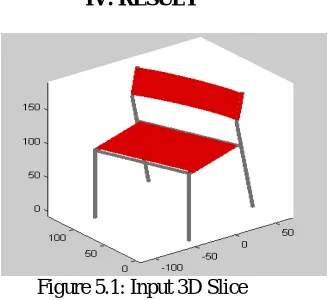
Figure 5.1: Input 3D Slice
Investigating the Experimental outcome in the procedure of analyzing the testing productions are accepted on the scheme. The established function has been tested with different inputs and the outcomes are tested for its presentation and accuracy. The particular figures are detailed investigation of the trials. The detailed information about result section is shown in the bellow figures.
(a) (b)
(c) (d)
(e) (f)
(g) (h)
Figure.5.3: 8 Angle Slices (a) Angle 0 (b) Angle 45 (c) Angle 90 (d) Angle 135 (e) Angle 180 (f) Angle 225(g) Angle 270 (h) Angle 315
V. CONCLUSION
else the recorded video is extremely huge storage space ability for frame charge is high. The high superiority image is the minor bit price in lesser bandwidth with complication in encoding and decoding, so we are make use of the H.264 method for compression of motion images in numerous application areas. It presents novel possibilities for creating improved video encoders and decoders that offer superior quality video streams at continued bit-rate. Latest architecture of CAVLC encoder is planned which use various approaches for decrease the area price and the optimization of the point in time of implementation in a video coding.
REFERENCES
[1] Hsing, T, Russell and Kou-Hu Tzou, "Video Compression Techniques: A Review", International Journal of Engineering Trends and Technology (IJETT) ,Vol. 13, No 7, 2014.
[2] Yu and Ting "Monocular video foreground/background segmentation by tracking spatial-color gaussian mixture models", IEEE, 2007, pp 5-5. [3] Pradhan, Arun Kumar, Lalit Kumar Kanoje and Biswa Ranjan Swain, "FPGA based High Performance CAVLC Implementation for H.264
Video Coding", International Journal of Computer Applications, No. 10, 2013.
[4] Gall and Didier. "MPEG: A video compression standard for multimedia applications." Communications of the ACM 34.NO. 4, 1991, pp 46-58. [5] Smolic and Aljoscha, "Coding algorithms for 3DTV—a survey", IEEE transactions on circuits and systems for video technology, Vol. 17, No.
11, 2007, pp 1606-1621.
[6] Vishwanath, Mohan and Phil Chou. "An efficient algorithm for hierarchical compression of video", Image Processing, IEEE International Conference, Vol. 3, 1994.
[7] Atitallah, A. Ben, Hassen Loukil and Nouri Masmoudi, "Fpga design for H. 264/avc encoder", International Journal of Computer Science, Engineering and Applications, Vol. 5, No. 5, 2011, pp 31-34. 119.
[8] Lu, Le and Gregory D. Hager, "Dynamic foreground/background extraction from images and videos uses random patches", Advances in Neural Information Processing Systems, 2007.
[9] Patel, Biren M., Ashish Kumar and Deepak Dembla, "An Analysis of H. 264 Codec Encode/Decode Video File and Quality Measurement of Video-Based on PSNR Algorithm", Vol. 5, No. 1, 2007.