Channel Allocation of Energy Efficient
Shortest Path Routing Protocol for Wireless
Sensor Networks
Dr. R. Prema
Associate Professor, Dept. of Electronics & Communication Systems, Karpagam University, Coimbatore, Tamilnadu,
India.
ABSTRACT: A Wireless Sensor Network is an infrastructure that consists of sensing, computing and communication elements. The network gives an administrator the ability to instrument, observe and react to events in a specified environment. The main object of wireless sensor networks is to reliably detect and estimate event features from the collective information provided by sensor nodes. The sensor nodes with non rechargeable batteries and without energy harvesting capabilities are focused. Due to limited energy resources and requirement of long operation time, innovative communication techniques need to be developed that consider to eliminate energy inefficiencies in all networking layers. Wireless Sensor Networks (WSNs) are applied across a broad range of application domains. One of the most relevant constraints that embody the design of WSN centers on increasing the energy efficiency, despite the advancements in hardware and software.
KEYWORDS: Wireless Sensor Networks (WSN), Energy Efficient, CDMA, Channel setup.
I.INTRODUCTION
The Wireless Sensors are usually powered by small batteries experience a difficulty in being replaced and consequently can only transmit a finite number of bits in their lifetime. A typical wireless sensor node components consist of the following subsystems.
A Sensing Subsystem (sensor + ADC);
Processing Subsystem (MCU + Memory);
Radio Subsystem (Communication Interface);
Power Supply Unit (Battery).
The radio subsystem is the component that consumes the highest energy. A study about comparison of computation and communication costs has shown that transmitting one bit over a distance 100m consumes approximately the same energy as executing 3000 instructions in Akyildiz et al. [1]. Therefore, to reduce energy consumption the number of communications should be minimized, even if it involves extra data processing. Due to the small transmission distance, the power consumed for receiving may be greater than the power consumed for transmitting. However, if a packet is sent by a node, all nodes in the radio range receive this packet even it is not addressed to them. This is called overhearing and needs to be minimized to decrease energy waste. However, for energy limited networks, the shortest path routing paradigm is replaced with energy efficient routing approaches in Mottola et al. [2]. The power consumption of the sensor node radio subsystem depends on the operational mode. Many sensor node device vendors provide low-power mode option for the radio.
exchange. This should be kept as low as possible to use the energy for useful data packets. In addition, in Neander et al. [3,4] authors show that energy consumption in electronics of the sensor node needs to be considered on the preference of multi-hop or direct communication for saving energy. As a conclusion, energy consumption of a node can be classified as communication related and computation related. In our proposed protocol, only communication related energy consumption is considered by identifying the shortest path.
II. LITERATURE SURVEY
Ajina et al. [1] investigated that routing is the process of moving packets through an internetwork, such as the Internet. Routing consists of two separate but related tasks: i) Defining and selecting path in the network ii) Forwarding packets based upon the defined paths from a designated source node to a designated destination node. Vazifehdan et al. [5] proposed a novel concept which facilitates anytime and anywhere interaction between the user and all the devices. Services are provided to the user of a Personnel Network (PN) by enabling multi-hop communication between his devices. Li et al. [6] proposed a routing protocol to improve MECN, in which a minimal graph is characterized with regard to the minimum energy property. This property implies that for any pair of sensors in a graph associated with a network, there is a minimum energy-efficient path between them; that is, a path that has the smallest cost in terms of energy consumption over all possible paths between this pair of sensors. Akyildiz et al. [8] proposed a routing algorithm that provides topology adaptation in an energy aware context at the network level. Among these, hierarchical algorithms are particularly adequate solutions for their scalability, power efficiency, extended network lifetime, and intrinsic adaptability abilities. Chang et al. [12] proposed a proxy tree for maintaining a tree connecting to a source sensor to multiple sinks that are interested in the source. This helps the source disseminate its data directly to those mobile sinks.
III.PROPOSED PROTOCOL
Main task of a routing protocol is to deliver the sensed data from source sensor nodes to a single or a few sink nodes. Due to Ad-hoc nature of the sensor networks, there is no fixed network infrastructure and the nodes have many possible paths to maintain connectivity to the sink node. Therefore, energy consideration plays an important role choosing the optimum path to access the sink node. In conventional ad hoc networks, the shortest path is chosen as the optimum data forwarding path. It minimizes the total energy consumed in reaching the destination, thus minimizing the energy consumed per unit or packet. Instead of trying to minimize the total consumed energy on the path, many studies related to sensor networks address the task of maximizing the lifetime of the network by considering residual energy of the nodes in the routing decision or focusing the load balancing between the nodes in Li et al. [6]. Although there are several definitions of network lifetime, this study focuses on the network lifetime definition in terms of energy deficiency of the nodes. Many existing sensor node devices provide transmission at different power levels. In general, multi hop routing will consume less energy than direct communication because transmission power of a wireless radio is proportional to distance squared or even higher order based on the type of the environment. However, there might be some bottleneck nodes in the multi-hop paths which may create the network partition since their battery will get exhausted earlier. For designing power aware routing protocols, one basic method is to integrate the energy consumption into the link cost and to apply a shortest path algorithm. Hence, energy consumption model plays a key role on defining the link costs.
IV.ENERGY EFFICIENT SHORTEST PATH ROUTING
Code Division Multiple Access (CDMA) is an attractive technique because of its simplicity in design and flexibility in traffic handling capabilities in the network to offer a variety of integrated services. It offers collision-free medium, but its high computational requirement is a major obstacle for less energy consumption objective of the sensor networks. In pursuit of low computational cost requirements of wireless CDMA sensor networks, there has been limited effort to investigate source and modulation schemes, If it is shown that the high computational complexity of CDMA could be traded with its collision avoidance feature, CDMA protocols could also be considered as candidate solutions for sensor networks. The target bit error rate (BER) which ensures successful communication across a link is assumed. The existing system has perfect error detection but no error correction capability. Automatic retransmission request is used so that a packet with error is retransmitted until received correctly.
required by a source node for transmitting data packets. It echoes the generation of destination sequence numbers to identify the most recent path. When an intermediate node receives a route request, it either forwards it or sends a route reply, if it can provide a valid route to the destination. The comparison of the sequence number at the intermediate node with the destination sequence number in the route request packet determines the validity of a route at the intermediate node. All the intermediate nodes that can offer valid routes endear to transmit the route reply packets to the source. CDMA avoids collision and puts a node to sleep when a neighbor node is transmitting to avoid overhearing.
V.LOCATION BROADCAST
Each node broadcasts its location information to its radio range neighbors. In CDMA based protocols, RTS/CTS are normally used to broadcast packets. The nodes that are redundant in meeting the application’s sensing objectives are turned off to conserve energy and reduce network interference. At the end of the location broadcast phase, each node should have a list with the locations of its radio range neighbors called Redundant Neighbor List (RNL). Each node ranks all its RNL neighbors from the location broadcast phase based on their distance relative to itself. These are treated as redundant nodes. These redundant nodes are preserved for future use, prolonging the network lifetime.
When a node receives a reply packet, it stores the information about the previous node in order to forward the data packet to the next node as the next hop towards the destination. The source and intermediate nodes store the next-hop information corresponding to each flow and the source node floods the route request packet in the network when a route is not available for the desired destination. The node updates its path information only if the destination sequence number of the current packet received exceeds that stored at the node.
The proposed protocol uses synchronous direct sequence CDMA in which nodes use variable spreading
sequences. The spreading factor for each transmitter can be adjusted to meet the Quality-of-Service (QoS) requirements. The minimum spreading gain between the nodes to reach a certain target SINR, is given in the below equation.
Where di,j the distance between the nodes is,
P is the path loss exponent,
is the thermal noise power.
VI.CHANNEL SETUP AND CHANNEL ALLOCATION
The first node that gets the media to transmit can inform its redundant neighbors to turn off by including the ID numbers of these nodes. A node turns itself off upon receiving such a request from a neighbor. Each active node has a near optimal set of neighbors, called minimum neighbor list. The minimum neighbor list is used in the channel setup process wherein a peer-to-peer communication channel will be setup for each neighbor in the minimum neighbor list. Each node estimates the transmission power required to reach its furthermost neighbor in its minimum neighbor list. It uses this reduced power level for negotiation.
Where, M is the length of the packet,
m represents the number of control/information bits in a packet, Pi is the constant transmit power.
The Robust Node (RN) is identified by,
The robust node is selected calculating the highest link quality between the nodes, residual power of the nodes and identifying the least energy consumption for transferring data to the preferred destination.
VII.EXPERIMENTAL RESULTS
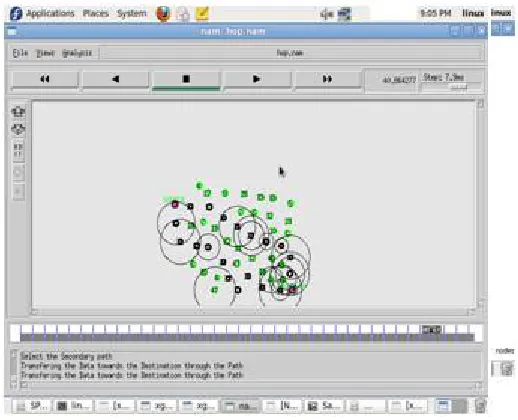
The network model shows the transmission of packets from source to destination. Node 0 is selected as a source node and Node 49 is selected as a destination node. The quality of the link is calculated for each node. The optimal path is selected for each node by calculating the cost of the path and quality of the link. The hop count is calculated between the nodes to reach the sink node.
Figure 1: Network Model
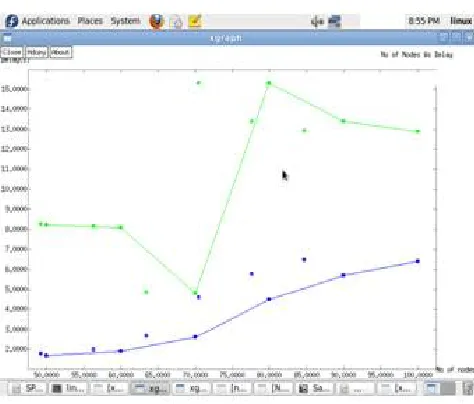
Figure 2: AODV vs Proposed protocol
The graph in figure 2 shows that the proposed protocol has reduced delay when compared with AODV protocol. The energy consumption of the network apparently increases for higher sized packet transfer. This favors a lower delay over the other protocols for an increased packet size transmission for a higher performance of a network with CDMA based proposed protocol.
VIII.CONCLUSION
This protocol justifies the major problems in wireless sensor networks. Due to the limited energy resources and requirement of long operation time, energy efficiency becomes one of the main challenging problems in wireless sensor network. An innovative energy efficient routing techniques are introduced in order to eliminate energy inefficiencies in the networking layer. The Energy Efficient Routing Protocol, attains application specified communication delays at low energy cost by dynamically adapting transmission power and routing decisions along with incorporating a novel cryptosystem. The performance of the scheme has been evaluated through simulation and metrics. The proposed protocol is compared with AODV protocol to highlight the superiority of the proposed protocol. The philosophy of the proposed mechanism has been realized in terms of energy consumption, packet delivery ratio and delay. This protocol attains preferred quality of service (QoS) such as packet delivery ratio, delay and reduce the power consumption between the nodes.
REFERENCES
[1] Ajina, A., Sakthidharan, G. R., and Miskin,K. M., “Study of Energy Efficient, Power Aware Routing Algorithm and Their Applications”, IEEE Communications, 2010.
[2] Mottola, L., and Picco, G. P., “Adaptive Energy Aware Multi Sink Routing in Wireless Sensor Networks”, IEEE Transactions on Mobile Computing, pp. 1694–1709, 2011.
[3] Neander, J., Hansen, E., Nolin, M., and Bjorkman, M., “Asymmetric Multi hop Communication in large Sensor Networks”, Wireless Pervasive Computing, 2006.
[4] Nikolaos. A., Pantazis, StefaNos, A., Nikolidakis and Dimitrios D. Vergados, “Energy Efficient Routing Protocols in Wireless Sensor Networks: A Survey”, IEEE Communications Surveys & Tutorials, Second Quarter, Vol. 15, No.2, pp. 551-589, 2013.
[5] Vazifehdan, J., Hekmat, R., Venkatesha Prasad, R., and Niemegeers, R., “A Bi-Objective Power Aware Routing Algorithm for Personal Networks”, IEEE Communications, 2009.
[6] Li, J., and Mohapatra, P., “Analytical Modeling and Mitigation Techniques for the Energy Hole Problem in Sensor Networks”, Pervasive Mobile Computing, pp. 233-254, June 2007.
[7] Sharma, S., Kumar, D., and Kumar, R., “QOS Based Routing Protocol in WSN”, Advances in Wireless and Mobile Communications, Vol. 1, No.1, pp.51-57, 2008.
[8] I.F. Akyildiz, I. F., Sue, W., Sankarasubarmaniam, Y., and. Cayirci , E., “ A Survey on Sensor Networks”, IEEE Communications Magazine, pp. 102-114, 2002.
[10] Singh, S.K., Singh, M.O., and Singh, D.K., “A Survey of Energy Efficient Hierarchical Cluster-based Routing in Wireless Sensor Networks”, International Journal of Advanced Networking and Application (IJANA), Vol. 02, issue 02, pp. 570–580, 2010.
[11] Kwok-Wo Wong, Sun-Wah Ho, and Ching-Ki Yung, "A chaotic cryptography scheme for generating short ciphertext", Physics Letters A, Volume 310, Number 1, Pages:67-73, 2003.