Curvelet and Wavelet Image Fusion using
Neural Network Algorithm
Ankita Kaushal 1, Paramjeet Kaur2
1
Indoglobal Group of Colleges 2
Assistant Professor, Indoglobal Group of Colleges
Abstract: - The Image fusion is a data fusion technology which keeps images as main research contents which refers to the techniques that integrate multi-images of the same scene from multiple image sensor data or integrate multi images of the same scene at different times from one image sensor. This paper describes a novel image fusion method, is suitable for pan-sharpening of multispectral (MS) bands which are based on multi-resolution analysis. The low-resolution MS bands are sharpened by injecting high-pass directional details extracted from the high-resolution panchromatic (Pan) image by means of the Wavelet and Curvelet transform, which is a non-separable MRA, whose basis function are directional edges with progressively increasing resolution. In this paper, we introduce a new method based on the Wavelet and Curvelet transform using Neural Network which represents edges better than wavelets. Therefore, edges play a fundamental role in image understanding; one important way to enhance spatial resolution is to enhance the edges. Wavelet and Curvelet-based image fusion method provides richer information in the spatial and spectral domains simultaneously.
Keywords: - Image Fusion, Curvelet, Wavelet, Neural Network, Gaussian Filter, Canny Edge Detection.
INTRODUCTION
The process of including complementary and redundant information from different images into one composite image which includes a better description of the underlying scene is known as image fusion. This results in a fused image more useful for human visual and machine processing. Image fusion strategies are basically classified into pixel level and region level approaches.
Pixel level techniques: The set of pixels in the source
image determine each pixel in the fused image. Basically pixel level techniques are classified into spatial domain and transform domain techniques.
Region level techniques: This technique involves the
segmentation of the images into regions and then based upon the extracted region fusion is performed.
Multi-sensor Image fusion is the process of combining information from two or more images into a single image in computer vision [1]. Multi-sensor Image fusion is the process of combining more informative than any of the input images. Three different traditional data fusion are Feature level, pixel level and decision level. These come under the fusion of data categorization. Different algorithms of image fusion are used in different levels and have different and particular applications.
The process of image fusion co mb ines two or more images. Different images contain different information is the main idea behind image fusion. Wavelet transforms is
that in which the transformation should allow only changes in time extension, but not shape. This is affected by choosing suitable basis functions that allow for these Changes in the time. Curvelet are an appropriate basis for representing images (or other functions) which is smooth apart from singularities along smooth curves, [2] where the curves have bounded curvature, [2] i.e. where objects in the image have a minimum length scale [2]. This property holds for cartoons, geometrical diagrams, and text [2].
ARTIFICIAL NEURAL NETWORKS
Artificial neural networks are composed of interconnecting artificial neurons (programming constructs that mimic the properties of biological neurons). The Artificial neural networks may either be used to gain an understanding of biological neural networks; or for solving artificial intelligence problems without necessarily creating a model of a real biological system. Then real; biological nervous system is highly complex: artificial neural network algorithms attempt to abstract this complexity and focus on what may hypothetically matter most from an information processing point of view. The application areas of ANNs include system identification and control (vehicle control; process control); game-playing and decision making (backgammon, chess, racing), pattern recognition (radar systems; face identification; object recognition); sequence recognition (gesture, speech, handwritten text recognition); medical diagnosis; financial applications; data mining (or knowledge discovery in databases; "KDD"); visualization and e-mail spam filtering.
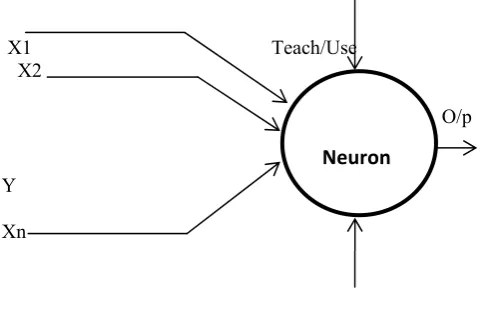
A. Architecture of Artificial Neural Network: The basic
architecture consists of three types of neuron layers: input; hidden; and output.
X1 Teach/Use X2
O/p
Y
Xn
Teaching Input Figure 1: Architecture of NN
Thus in feed-forward networks; the signal flow is from input to output units; strictly in a feed-forward direction. Then data processing can extend over multiple layers of units; but no feedback connections are present [8-9]. Recurrent networks contain feedback connections. The contrary to feed-forward networks; the dynamical properties of the network are important. Then some cases; the activation values of the units undergo a relaxation process such that the network will evolve to a stable state in which these activations do not change anymore.
B. Feed Forward Neural Networks: Feed-forward ANNs
allow signals to travel one way only; from input to output. There is no feedback (loops) i.e. the output of any layer does not affect that same layer. The Feed-forward ANNs tend to be straight forward networks that associate inputs with outputs. And they are extensively used in pattern recognition. Therefore this is a type of organisation is also referred to as bottom-up or top-down. Thus single-layer perceptron; multilayer perceptron and radial basis function are types of feed forward neural networks.
C. Single Layer Perceptron: The simplest kind of neural
network is a single-layer perceptron network; which consists of a single layer of output nodes; the inputs are fed directly to the outputs via a series of weights. This way it can be considered the simplest kind of feed-forward network. Then sum of the products of the weights and the inputs is calculated in each node; and if the value is above some threshold (typically 0) the neuron fires and takes the activated value (typically 1); otherwise it takes the deactivated value (typically -1). Neurons with this kind of activation function are also called artificial neurons or linear threshold units. The literature the term perceptron often refers to networks consisting of just one of these units. And a similar neuron was described by Warren McCulloch and Walter Pitts in the 1940s.A perceptron can be created using any values for the activated and deactivated states as long as the threshold value lies between the two. Most perceptron have outputs of 1 or -1 with a threshold of 0 and there is some evidence that such networks can be trained more quickly than networks created from nodes with different activation and deactivation values. Thus Perceptron can be trained by a simple learning algorithm that is usually called the delta rule. This calculates the errors between calculated output and sample output data; and uses this to create an adjustment to the weights; thus implementing a form of gradient descent [3]. Single-unit perceptron are only capable of learning linearly separable patterns.
D. Delta Rule: The delta rule is a gradient descent learning
rule for updating the weights of the artificial neurons in a single-layer perceptron. This is a special case of the more general back propagation algorithm. For a neuron j with activation function g(x); the delta rule for j’s; ith weight is given by
∆W = (t – y) g’ (h)x (1)
Then delta rule is commonly stated in simplified form for a perceptron with a linear activation function as
∆W = α (t -y) x ,
Where α is known as the learning rate parameter.
E. Multi-Layer Neural Networks: This class of networks
consists of multiple layers of computational units; usually interconnected in a feed-forward way. And each neuron in one layer has directed connections to the neurons of the subsequent layer. Therefore in many applications the units of these networks apply a sigmoid function as an activation function. Then universal approximation theorem for neural networks states that every continuous function that maps intervals of real numbers to some output interval of real numbers can be approximated arbitrarily closely by a multi-layer perceptron with just one hidden layer. The result holds only for restricted classes of activation functions; for example the sigmoid functions. The Multi-layer networks use a variety of learning techniques; the most popular being back-propagation. Then output values are compared with the correct answer to compute the value of some predefined error-function [6]. By various techniques, the error is then fed back through the network. This information; the algorithm adjusts the weights of each connection in order to reduce the value of the error function by some small amount. Then repeating this process for a sufficiently large number of training cycles; the network will usually converge to some state where the error of the calculations is small. This case; one would say that the network has learned a certain target function. And to adjust weights properly; one applies a general method for non-linear optimization that is called gradient descent. To this; the derivative of the error function with respect to the network weights is calculated; and the weights are then changed such that the error decreases (thus going downhill on the surface of the error function). To this reason; back-propagation can only be applied on networks with differentiable activation functions.
WAVELET TRANSFORM
A wavelet transform array is synthesized for the product image and populated from the source images based on a set of predefined rules. After population, this synthetic array is inverse wavelet transformed to create the product image. Graham [4] provides a more detailed discussion of the application of wavelet theory to image fusion. Our prototype system handles images which are co registered and the same size, with dimensions which are powers of two. A wavelet transforms using the Daubechies [SI basis
functions with filter lengths of 4, 12, or 20 are performed on all input images to be fused.
A significant part of our work centered on determining rules to use in combining wavelet transform array information. The system needed to allow operations to be performed on individual wavelet array blocks, so that low and high frequency components could be treated differently. The system needed to enable the use of many different combination rules. The approach taken to achieve this was to identify several primitive operations that would be required to implement a variety of combination rules. These primitive operations act upon individual frequency blocks in wavelet arrays or on whole wavelet arrays at once. The most useful primitive operation is to simply take the coefficient with the maximum amplitude from any input Image at each location in the wavelet transform array. Another operation is to average the values in all input wavelet transform arrays at each location. This operation, if performed on the entire wavelet array and inverse transformed, produces a result indistinguishable from the result of simply averaging the input images. We found this operator useful when performed on selected frequency blocks in combination with other operators.
CURVELET TRANSFORM
The Curvelet transform, like the wavelet transform, is a Multiscale transform [4], with frame elements indexed by scale and location parameters [14]. Unlike the wavelet transform parameters and the Curvelet pyramid contains elements with a very high degree of directional speci¯city. In addition, the Curvelet transform is based on a certain
anisotropic scaling principle which is quite deferent from
the isotropic scaling of wavelets. The elements obey a
special scaling law [14], where the length of the support of a frame elements and the width of the support are linked by the relation width ¼ length2. All of these properties are
very stimulating and have already leaded to a range of interesting idealized applications {for example in tomography and in scienti¯c computation [9, 10]. In e®ect, an understanding of the Curvelet transform concept opens one's eyes to the fact that in two and higher dimensions [14], new Multiscale representations are possible, having properties unavailable by wavelets and having stimulating structural features. While it is possible that this new idea will be quickly forgotten with the passage of time, we feel that the very novel features of the transform - anisotropy, anisotropy scaling - compel further investigation for the moment.
The Curvelet transform (CVT) is a multi-scale transform proposed by Candes and Donoho and is derived from the Ridgelet transform The Curvelet transform is suited for objects which are smooth away from discontinuities across curves [9]. Fourier Transform does not handle point's discontinuities well because a discontinuity point affects all the Fourier Coefficients in the domain. Moreover, Wavelet transform handles point discontinuities well and doesn't handle curve discontinuities well. Curvelet transform handles curve discontinuities well as they are designed to handle curves using only a small number of coefficients. Curvelet transform has several applications in various areas such as image denoising, image fusion, Seismic exploration, Turbulence analysis in fluid mechanics and so on. . Curvelet Transformation is an enhancement technique to reduce image noise and to increase the contrast of structures of interest in image. Compared to other techniques, this method can manage the vagueness and ambiguity in many image reconstruction applications efficiently.
PURPOSED WORK
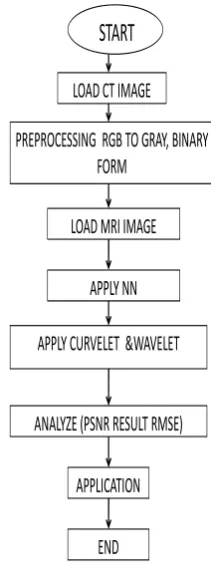
The following flow chart show the proposed work of image fusion:-
START
LOAD CT IMAGE
PREPROCESSING RGB TO GRAY, BINARY FORM
LOAD MRI IMAGE
APPLY NN
APPLY CURVELET &WAVELET
ANALYZE (PSNR RESULT RMSE)
APPLICATION
END
Figure 2: Flowchart of proposed work.
ROOT MEAN SQUARE ERROR (RMSE)
Where R (m, n) and F (m, n) are the reference (CT or MR) and fused images [15], respectively, and M and N are image dimensions [9]. Smaller the value of the RMSE, better the performance of the fusion algorithm [15].
PEAK SIGNAL TO NOISE RATIO (PSNR)
PSNR is the ratio between the maximum possible power of a signal and the power of corrupting noise that affects the fidelity of its representation [15]. The PSNR of the fusion result is defined as follows:
PSNR=10LogX
Where fmax is the maximum gray scale value of the pixels in the fused image [15]. Higher the value of the PSNR, better the performance of the fusion algorithm.
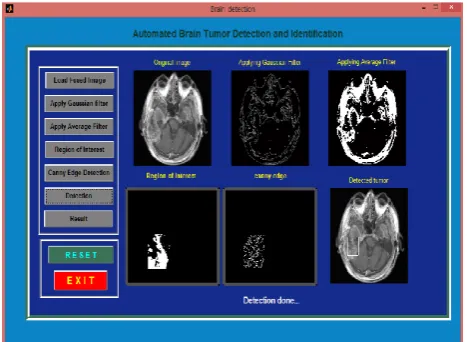
Figure 3: Implementation of Image Fusion
GAUSSIAN FILTER FOR SMOOTHENING
GF have the properties of having no overshoot to step function input while minimizing the rise and fall time. It smoothes an image by calculating weighted averages in a filter box. It removes high frequency components from the image to low pass filtering. 2D Gaussian filters are useful to provide image smoothing with minimal computations [14]. Smoothing can reduce high frequency noise in an image while creating an image where a pixel and its neighbours are correlated with each other. Gaussian filters are able to smooth images with minimal computations because they are separable [14]. This means that instead of using a 2D filter you can for example apply a 1D filter along the x-axis of the image and another 1D filter along the image's y-axis.
(a)Gaussian filter
CANNY EDGE DETECTION
An edge is a property attached to an individual pixel and is calculated from the image function behaviour in a neighbourhood of the pixel [13]. It is also considered as a vector variable (magnitude of the gradient, direction of an edge). The purpose of edge detection in general is to significantly reduce the amount of data in an image [16], while preserving the structural properties to be used for further image processing [22]. It significantly reduces the amount of data and filters out useless information while preserving the important structural properties in an image.
(b) Canny edge detection
CONCLUSION
The paper has presented a new trend in the fusion of digital image, MRI and CT images which are based on the Curvelet transform. A comparison study has been made between the traditional wavelet fusion algorithm and the proposed Curvelet fusion algorithm [15]. The experimental study shows that the application of the Curvelet transform in the fusion of MR and CT images is superior to the application of the traditional wavelet transform. The obtained Curvelet fusion results have minimum RMSE AND PSNR than in wavelet fusion results. At last, these fusion methods are used to detect brain tumors. In vision, the fusion algorithm proposed in this paper acquires better fusion result. In objective evaluation criteria, Curvelet fusion characteristic are superior to wavelet transform.
REFERENCES
[1] Prabhavathi. P, Mr. Ganesh Kumar. K: “Multi Focus Image Fusion Using Multi Spectral and PAN Images” IJIRCCE, Vol.2, Special Issue 1, March 2014.
[2] www.wikipedia.org
[3] K. Ranjani, M. Raja, B. Anitha “Maximum Power Point Tracking by ANN Controller for a Standalone Photovoltaic System” IJERECE, Vol.8, Special Issue 3, 2014.
[4] T.S. Anand, K. Narasimhan P.Saravanan: “Performance Evaluation of Image Fusion Using the Multi-Wavelet and Curvelet Transforms” March 30,31,2012
[5] Smt.G. Mamatha (Phd), L.Gayatri: “An Image Fusion Using Wavelets AND CURVELET TRANSFORMS” Vol1, Issue-2, 2012
[7] Daljit Kaur, P S Mann:“Medical Image Fusion Using Gaussian Filter, Wavelet Transform And Curvelet Transform Filtering” Volume-4, Issue-3, 2014
[8] J. L. Starck, E. J.Cand`es and D. L. Donoho, 2002. “The Curvelet transform for image denoising,” IEEE Trans. Image Processing, vol. 11.
[9] M.Masthanaiah, P.Janardhan Sai Kumar: “Development of Image Fusion Algorithms by Integrated PCA, Wavelet and Curvelet Transforms” Impact Factor 1.393, ISSN: 2320-5083, Volume 2, Issue 8, September 2014.
[10] Madhusudhanareddy P, Dr. I. Santi Prabha: “Novel Approach in Brain Tumor Classification Using Artificial Neural Networks” Vol. 3, Issue 4, Jul-Aug 2013,
[11] Priyanka, Balwinder Singh: “A Review on Brain Tumor Detection
Using Segmentation”Vol. 2, Issue. 7, July 2013,
[12] Sudipta Roy, Samir K. Bandyopadhyay: “Detection and
Quantification of Brain Tumor from MRI of Brain and its Symmetric Analysis” Volume 2 No. 6, June 2012
[13] Dina Aboul Dahab, Samy S. A. Ghoniemy, Gamal M. Selim: “Automated Brain Tumor Detection and Identification Using Image Processing and Probabilistic Neural” Volume 1, Issue 2, October 2012
[14] K. Somasundaram and T. Kalaiselvi : ”Automatic Detection of Brain Tumor from MRI Scans Using Maxima Transform” 2010
[15] Kimmi Verma1, Aru Mehrotra2, Vijayeta Pandey3, Shardendu Singh: Image Processing Techniques For The Enhancement Of Brain Tumor Patterns Vol. 2, Issue 4, April 2013”
[16] Nagalkar V.J. And Asoles.S : “Brain Tumor Detection Using Digital Image Processing Based On Soft Computing ”Volume 3, Issue 3, 2012
[17] https://en.wikipedia.org/wiki/artifical neural network
[18] M.I. Smith, J.P. Heather, 2005. "Fusion Technology Review of Image," Proceedings of the SPIE, Volume 5782.
[19] Xiao Xiang Zhu, Richard Bamler ‘A Sparse Image Fusion Algorithm with Application to Pan-Sharpening’, IEEE Transactions, vol. 51, no. 5, May 2013.
[20] Cheng, H. Zhang, H. Shen, and L. Zhang, ‘A practical Compressed sensing-based PAN- Sharpening method,’ IEEE Transaction vol. 9, no. 4, pp. 629–633, Jul.2012.
[21] Li .S and Yang B, ‘A new pan-sharpening method using a compressed Sensing technique,’ IEEE Transactions, vol. 49, no. 2, Feb. 2011.
[22] .Milindkumar V. Sarode, Prashant R. Deshmukh, ‘Evaluation of Fusion and Denoising Algorithm for Multi focus Images’, Proceedings, Vol II, July 2011.
[23] Naidu V.P.S., ‘Image Fusion Technique using Multi-resolution Singular Value Decomposition’, Defence Science Journal, pp. 479-484, vol. 61, no. 5,September 2011.