ISSN(Online): 2319-8753 ISSN (Print): 2347-6710
I
nternational
J
ournal of
I
nnovative
R
esearch in
S
cience,
E
ngineering and
T
echnology
(A High Impact Factor & UGC Approved Journal) Website: www.ijirset.com
Vol. 6, Issue 8, August 2017
Automatic Attendance System Based On Face
Recognition
Sujay Patole1, Yatin Vispute2
B.E Student, Department of Electronics and Telecommunication, PVG’s COET, Shivadarshan, Pune, India1
B.E Student, Department of Electronics and Telecommunication, PVG’s COET, Shivadarshan Pune, India2
ABSTRACT: Face Detection and Recognition is an important area in the field of substantiation. Maintenance of records of students along with monitoring of class attendance is an area of administration that requires significant amount of time and efforts for management. Automated Attendance Management System performs the daily activities of attendance analysis, for which face recognition is an important aspect. The prevalent techniques and methodologies for detecting and recognizing faces by using feature extraction tools like mean, standard deviation etc fail to overcome issues such as scaling, pose, illumination, variations. The proposed system provides features such as detection of faces, extraction of the features, detection of extracted features, and analysis of student’s attendance. The proposed system
integrates techniques such as Principal Component Analysis (PCA) for feature extraction and voila-jones for face
detection &Euclidian distance classifier. Faces are recognized using PCA, using the database that contains images of
students and is used to recognize student using the captured image. Better accuracy is attained in results and the system takes into account the changes that occurs in the face over the period of time.
KEYWORDS: Voila-jones Algorithm, Principal Component Analysis (PCA), Euclidian distance classifier, Real time. I. INTRODUCTION
Organizations of all sizes use attendance systems to record when student or employees start and stop work, and the department where the work is performed. An attendance system provides many benefits to organizations. There was a time when the attendance of the students and employees was marked on registers. However, those who have been a part of the classes when attendance registers were used know how easy it was to abuse such a method of attendance and mark bogus attendances for each other. Of course, technology had to play its role in this field just as well as it has done in other fields. The attendance monitoring system was created and it changed the way attendances were marked. The attendance monitoring system has made the lives of teachers and employers easier by making attendance marking procedure a piece of cake.
II. RELATED WORK
Till now there are various methods present for marking the attendance, some of them are traditional some of them are latest. Given below is an analytical survey of such existing systems.
1. Attendance Management System Using Face Recognition
ISSN(Online): 2319-8753 ISSN (Print): 2347-6710
I
nternational
J
ournal of
I
nnovative
R
esearch in
S
cience,
E
ngineering and
T
echnology
(A High Impact Factor & UGC Approved Journal) Website: www.ijirset.com
Vol. 6, Issue 8, August 2017
2. Face recognition based attendance marking system
The system consists of a camera that must be positioned in the class room to take snap shots of the room. These images are then sent to an enhancement module where Histogram Normalization is used for the contrast enhancement of the image, Median Filter is used for removing noise from the image. To avoid false detection skin classification technique is used. The enhanced image is then sent to a face detection and recognition module. This requires MATLAB software. Two databases are maintained, the first one is the Face database to store the face images and extracted features at the time of enrolment process and the second attendance database contains the information about the employees and is also used to mark attendance.
3. Study of Implementing Automated Attendance System Using Face Recognition Technique
The proposed system has been implemented in three basic steps. The first step is face detection and extraction. The user stands in front of the camera and an image is captured, which is taken as input. After the face is detected, it is converted into a grey scale image. The second step is to learn and train face images. The system needs to be initialized by feeding it a set of training images of faces. The PCA algorithm is performed on it. A subspace is found by using PCA and all the training images are converted to points in this subspace. The third step is the recognition and identification. In this step the frontal face that is to be recognized, test face, is extracted from the image. The Eigen value for the test face is re-calculated and is matched with the stored data for the closest neighbour. Finding the closest neighbour is implemented as a function that computes distance from the projected test face to each projected training set. The distance basis here is "Squared Euclidean Distance." When a face is matched the corresponding information is obtained from the database. The log table is then updated with the system time to mark the attendance of that person.
4. Face Recognition-based Lecture Attendance System
The system consists of two cameras one for determining the seating positions (fixed at the ceiling) and the other for capturing the students face (Fixed in front of the seats). One seat is targeted and camera is directed to capture the image. The face image capture is enhanced and recognized and are recoded into the database. Every seat has a vector of values that represent relationship between the student and seat. Attendance is estimated by interpreting the face recognition data obtained by continuous observation. The position and attendance of the student are recorded into the database.
5. Implementation of classroom attendance system based on face recognition in class
The system consists of a camera that captures the images of the classroom and sends it to the image enhancement module.Face detection algorithm was tested on variety of images with different face positions and lighting conditions. Algorithm is trained for the images of faces and then applied on the class room image for detection of multiple faces in the image. The next step is face recognition, where PCA is used. The detected faces are cropped from the image and compared with the face database using an Eigen face method. The face database consists of templates of face images of individual students that was collected and stored by an enrolment process. In this way the faces of students are verified one by one and the attendance is marked on the server. A time table module is attached to the system to obtain the subject, class, date and time. Teachers come in the class and just open the exe file to start the attendance process.
III. PROBLEM STATEMENT
ISSN(Online): 2319-8753 ISSN (Print): 2347-6710
I
nternational
J
ournal of
I
nnovative
R
esearch in
S
cience,
E
ngineering and
T
echnology
(A High Impact Factor & UGC Approved Journal) Website: www.ijirset.com
Vol. 6, Issue 8, August 2017
IV.BLOCK DIAGRAM
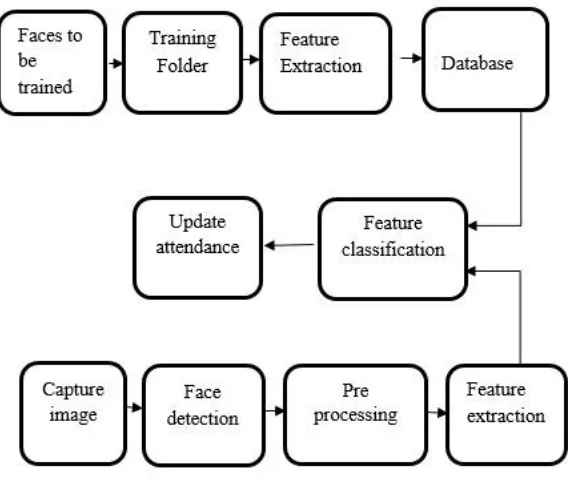
Fig. 1 consist of entire block diagram of automatic attendance system. Face recognition system is to identify a person using his face image. Face recognition module that recognizes the individual student’s face and update the student
attendance database automatically. Presently there are 2 databases which we are using in our project. The first database
is used for training purpose.The first step is that, to train our module means to save the images and create a database of the student’s faces and their feature vectors while the second database is used for testing purpose means the person whose face is going to be identified
Fig.1.BLOCK DIAGRAM OF AUTOMATIC ATTENDANCE SYSTEM
V. VIOLA-JONES ALGORITHM
We are using Viola-Jones algorithm for face detection. There is a inbuilt function n MATLAB named as “detector=vision.CascadeObjectDetector”.The cascade object detector uses the Viola-Jones algorithm to detect people’s faces.
ISSN(Online): 2319-8753 ISSN (Print): 2347-6710
I
nternational
J
ournal of
I
nnovative
R
esearch in
S
cience,
E
ngineering and
T
echnology
(A High Impact Factor & UGC Approved Journal) Website: www.ijirset.com
Vol. 6, Issue 8, August 2017
VI. PRINCIPAL COMPONENT ANALYSIS
1. FACE RECOGNITION PROCESS
The whole recognition process involves two steps:
A. Initialization process
B. Recognition process
The Initialization process involves the following operations:
A) Acquire the initial set of face images called as training set.
B) Calculate the Eigenfaces from the training set, keeping only the highest eigenvalues. These M images define the face space. As new faces are experienced, the eigenfaces can be updated or recalculated.
C) Calculate distribution in this M-dimensional space for each known person by projecting his or her face images onto this face-space.
These operations can be performed from time to time whenever there is a free excess operational capacity. This data can be cached which can be used in the further steps eliminating the overhead of re-initializing, decreasing execution time thereby increasing the performance of the entire system .
Having initialized the system, the next process involves the steps:
1. Calculate a set of weights based on the input image and the M eigenfaces by projecting the input image onto each of the Eigenfaces.
2. Determine if the image is a face at all (known or unknown) by checking to see if the image is sufficiently close to a ―free space.
3 .If it is a face, then classify the weight pattern as either a known person or as unknown.
4. Update the eigenfaces or weights as either a known or unknown, if the same unknown person face is seen several times then calculate the characteristic weight pattern and incorporate into known faces. The last step is not usually a requirement of every system and hence the steps are left optional and can be implemented as when the there is a requirement.
2. EIGENFACE ALGORITHM
Let a face image Γ(x, y) be a two dimensional M by N array of intensity values. In this thesis, I used a set of image by 120 x 80 pixels. An image may also be considered as a vector of dimension M × N, so that a typical image of size 120 x 80 becomes a vector of dimension 9600 or equivalently a point in a 9600 dimensional space.
Fig-: 2.Conversion of M × N image into MN ×1 vector
ISSN(Online): 2319-8753 ISSN (Print): 2347-6710
I
nternational
J
ournal of
I
nnovative
R
esearch in
S
cience,
E
ngineering and
T
echnology
(A High Impact Factor & UGC Approved Journal) Website: www.ijirset.com
Vol. 6, Issue 8, August 2017
Step 2: Prepare the data set Each face image Ii in the database is transformed into a vector and placed into a training set X.
X={T1 T2 T3 T4………TM}
In My example M = 20. Each image is transformed into a vector of size MN × 1 and placed into the set X. For simplicity, the face images are assumed to be of size N × N resulting in a point in dimensional space. An ensemble of images, then, maps to a collection of points in this huge space.
Step 3: compute the average face vector. The average face vector (Ψ) has to be calculated by using the following
formula:
= 1
Step 4: Subtract the average face vector The average face vector is subtracted from the original faces Ti and the result stored in the variable A.
A=Ti –
Step 5: Calculate the covariance matrix We obtain the covariance matrix L in the following manner, L=A’ * A
Step 6: Calculate the eigenvectors and eigenvalues of the covariance matrix The covariance matrix C in step 5 has a dimensionality of MN x MN , so one would have MN eigenface and eigenvalues. For a 120 x 80 image that means that on must compute a 9600 x 9600 matrix and calculate 9600 eigenfaces. Computationally, this is not very efficient as most of those eigenfaces are not useful for our task. In general, PCA is used to describe a large dimensional space with a relative small set of vectors.
Compute the eigenvectors V of A x A’.
The matrix is very large not practical!!!
Step 6.1: consider the matrix
L=A’ x A (M × M matrix)
Step 6.2: compute eigenvectors of L=A’ x A
What is the relationship between and ?
where, = A x
Thus, C=A x A’ and L= A’ x A have the same eigenvalues and their eigenvectors are related as follows:
= A x
Note 1: C=A x A’ can have uptoMN(120 x x80) eigenvalues and eigenvectors.
ISSN(Online): 2319-8753 ISSN (Print): 2347-6710
I
nternational
J
ournal of
I
nnovative
R
esearch in
S
cience,
E
ngineering and
T
echnology
(A High Impact Factor & UGC Approved Journal) Website: www.ijirset.com
Vol. 6, Issue 8, August 2017
Note 3: The M eigenvalues of C=A x A’ (along with their corresponding eigenvectors) correspond to the M largest eigenvalues of l=A’ x A (along with their corresponding eigenvectors).
Where is an eigenvector of L =A’ x A. From this simple proof we can see that A is an eigenvector of c=A x A’ .
The M eigenvectors of L =A’ x A are used to find the M eigenvectors of C that form our eigenface basis:
=∑ A
Where, are the Eigenvectors i.e. Eigenfaces.
Step 7: keep only K eigenvectors (corresponding to the K largest eigenvalues) Eigenfaces with low eigenvalues can be omitted, as they explain only a small part of Characteristic features of the faces.
3. PROJECTION OF TRAINING SAMPLES INTO THE EIGENFACE SPACE
Next we have to project the training sample into the Eigenface space. The feature weight for the training images can be calculated by the following formula:
= A
Where, is the ith Eigenfaces and i=1, 2, 3 . . . .K. The weight is obtained as above form a vector as follows:
=[ … … … … . ].
TESTING SAMPLE CLASSIFICATIONS
a) Read the test image and separate face from it.
b) Calculate the feature vector of the test face. The test image is transformed into its eigenface components. First we compare line of our input image with our mean image and multiply their difference with each eigenvectors. Each value would represent a weight and would be saved on a vector
( -m)
Where, is the ith Eigenfaces and i=1, 2, 3 . . . .K. The weight is obtained as above form a vector as follows:
=[ … … … … . ].
c) Compute the average distance (Euclidean distance) between test feature vector and all the training feature vectors.
Mathematically, recognition is finding the minimum Euclidean distance , between a testing point and a training point
given in the following equation
|| − ||
ISSN(Online): 2319-8753 ISSN (Print): 2347-6710
I
nternational
J
ournal of
I
nnovative
R
esearch in
S
cience,
E
ngineering and
T
echnology
(A High Impact Factor & UGC Approved Journal) Website: www.ijirset.com
Vol. 6, Issue 8, August 2017
VII. RESULTS
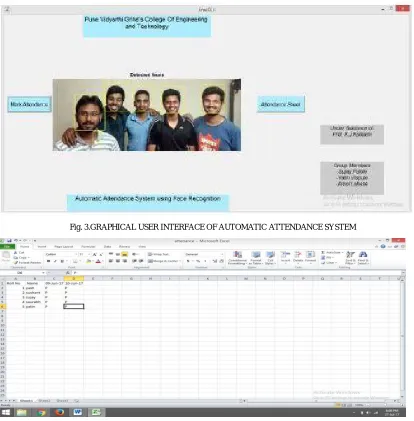
Figures shows the results of the automatic attendance system based on face recognition. This system is based on viola jones and principle component analysis (P.C.A)
Fig. 3.Gives an idea about the GUI of the system. As shown in the fig 2, GUI consist of two pushbuttons namely mark attendance and attendance sheet. By clicking on Mark attendance the module will capture the image of group of students and detect their faces as shown in fig by yellow boxes.
Fig. 4. By clicking on Mark attendance the module will automatically generate the attendance sheet and mark the attendance automatically for every student. If we press that button again the excel sheet is updated automatically
Fig. 3.GRAPHICAL USER INTERFACE OF AUTOMATIC ATTENDANCE SYSTEM
ISSN(Online): 2319-8753 ISSN (Print): 2347-6710
I
nternational
J
ournal of
I
nnovative
R
esearch in
S
cience,
E
ngineering and
T
echnology
(A High Impact Factor & UGC Approved Journal) Website: www.ijirset.com
Vol. 6, Issue 8, August 2017
VIII. CONCLUSION
With the help of a divergent combination of algorithms, this system helps us to achieve desired results with better accuracy and less time consumption. The database of subjects for distinct classes is cached in the backend of the system. The system is commenced at start of lecture. The subject name is fetched from the backend of the system for every hour and the attendance for the same is marked.
REFERENCES
[1] NirmalyaKar, MrinalKantiDebbarma, AshimSaha, and DwijenRudra Pal,” Study of Implementing Automated Attendance System Using Face Recognition Technique”,in proc. International Journal of Computer and Communication Engineering, Vol. 1, No. 2, July 2012
[2] AjinkyaPatil and MrudangShukla,” Implementation of Classroom Attendance System Based on Face Recognition in Class”, in proc. International Journal of Advances in Engineering & Technology, July, 2014.
[3] Jomon Joseph and K. P. Zacharia, ”Automatic Attendance Management System Using Face Recognition”, in proc. International Journal of Science and Research (IJSR).
[4] RohitChavan,Baburaophad,SankalpSawant and VinayakFutak,”Attendance Management System using face recognition”,in International journal for innovative Research in science and technology,Vol. 1,issue 11,April 2015.
[5] Naveed Khan Balcoh, M. HaroonYousaf,Waqar Ahmad and M. IraamBalg,”Algorithm for efficient attendance management:face recognition based approach”,in IJCSI International Journal of Computer Science Issues, Vol. 9, Issue 4, No 1, July 2012.