Development of Tool Database Management
System in Tool Store for Quality Production
Sayalee Jadhav1, Dr. Sanjay Yadav2
P.G. Student, Department of Automobile Engineering, Rajarambapu Institute of Technology, Maharashtra, India1
Associate Professor, Department of Automobile Engineering, Rajarambapu Institute of Technology,
Maharashtra, India2
ABSTRACT:Correct information of cutting tools during machining components is essential for the effectiveness of cutting process and product quality. Data should be felicitously organised for the ease of simplicity.It is evident that data digitalization may tap previously unused potentials in industry. However, the amount of approaches for implementing digitalization in tool management is too scarce. To close this barrier, this paper describes an approach to the design and development convenient Tool Lifecycle Management System in 5C machining and engine assembly plant in Maharashtra. By integrating tool-room functions, automated tool management can ensure optimum utilization of tools, guaranteeing their effective availability and highest tool life.This paper provides an overview of several concepts of Lean Manufacturing and strategies of Industry 4.0. Hence an attempt to overcome the barrier between theoretical and actual implementation, a small step is taken i.e. a user friendly software is proposed for data handling in tool store.
KEYWORDS:Industry 4.0, Lean Manufacturing, Tool Database,VSM.
I. INTRODUCTION
Nowadays, Industrial production is faced by global competition and there is need for fast adaptation of production to the ever-changing market requests. These requirements can be met only by implementing advances in current manufacturing technologies. Industry 4.0 is an assuring approach based on integration of the business and manufacturing processes. Industry 4.0 is the one which can take India to its next level in its development. Technical aspects of these requirements are addressed by the application of the generic concepts of Cyber-Physical Systems (CPS) and Internet of Things (IoT) to the industrial production systems. The execution system of Industry 4.0 is therefore based on the connections of physical data and softwares. The very essential thing for initializingand implementation of all the primary prerequisites for Industry 4.0. The basics start with the implementation of lean manufacturing technology and strict adherence to the manufacturing principles of lean.
line being analyzed. The first step of value stream mapping is to create a current state map to make a picture of the production flow and understand the company’s current cycle times, process communications, and machine equipment capacity. This provides the information needed to produce a future state map by creating a vision of an improved value flow. The goal is to identify and eliminate the waste, which is any activity that does not add value to the final product, in the production process.
Paper is organized as follows. Section II describes the rigorous literature review on Lean tools like VSM, strategies of Industry 4.0 and the current practices in database management in Tool Store Department of small and medium scale manufacturing organisations. Various Lean Manufacturing tools and Value Stream Mapping (VSM) is summarised in Section III. Section IV describes the ideology of Tool Lifecycle Management and various trends which can be inculcated to commence Industry 4.0 in India. Some of the possible ways for database management in Cyber-Physical Systems are discussed in Section V. Finally, Section VI presents the conclusion.
II. LITERATUREREVIEW
In early decades of 20th century, the world bowed down to impose the concepts of mass production laid down by Henry Ford. Many authors have discussed about various lean manufacturing tools and Value Stream Mapping concepts and implementations which are the basic building blocks of Industry 4.0. Many researchers have studied the potentials of implementing 4.0 and the positive impact on the productivity in organisations. Some of the investigations are discussed below.
The ideology of Tool Database began to take shape three decades ago. G. Subrahmanyam et al. formulated a tool management system for Valve production unit of Bharat Heavy Electricals Limited, Trichirapalli. They designed a ORACLE based centralised database for tools housing information regarding tooling, tool location, tool allocation, tool flow, tool storage and retrieval, its parts, machines where tool is to be used, Tool life, current stock of tool etc. [1].In the succeeding years, many industries began adopting web based tool management system to keep record of their cutting tools. G.C. Vosniakoset al. have made an effort to formulate a SQL based tool database in which records of tools were categorized according to the type like cutters, inserts, etc. These tools were saved with a unique part number along with its technical specifications and figure for quick reference. Graphics in the software were produced on Paintshop Pro and Dreamweaver was used for making some of the web pages. Though the tool data can be accessed, the remaining tool life of the inserts could not be analyzed and the industrialists denied about the possibility of registering remaining tool life, saying that inserts were cheap, except in very few special cases [2].Giovanni Tani has also given a considerable contribution in development of integrated management of tools withinthe tool store and other departments of the company [3].
Aneta Skowrondiscussed the functional areas and expectations of Tool Lifecycle Management. The software for Tool Data Management (TDM) is presented which houses the technical data of tool cutter including cutter number, cutter dimensions and its specifications, cutter drawings, its place of use and the calibration details of inspection equipment etc. Many organizations face different elemental wastes like over-production and Excess Inventory which cause for the increase in revenue cost and time wastage [4]. VSM is one of the most advanced way to cut down excess time and expenditure in managing the assets in tool room of Precision Tool manufacturing high precision tools for the automotive industry in Haryana. After studying and implementing VSM, it was estimated a reduction in Cycle Time (C/T) and Change-over Time (C/O) by 2.83% and 11.39% respectively [5].VSM was designed in the crankshaft manufacturing plant to get rid of non-value added activities like over-production, excess inventory, waiting etc. The number of operators and distance travelled by them was reduced and the productivity was increased. The process became more reliable and cost effective. Along with VSM, authors have stated various kaizen for process improvement which helped in creating product mix flexibility in the manufacturing cell for exporting crankshafts [6].
industrial revolution.Eva Schaupp et al. [9] have discussed the potentials of digitalization in machine tool management and frame-worked the work in three steps. The first step was about the definition of the company`s individual goals of tool management such as a high tool availability, a low tool inventory and a high product quality. In the second step, the digitalization levers and their influence on these three goals are determined. The most important phase among them were the development and the integration of databases. In the third step, the measures for the implementation process were discussed.
III.LEANMANUFACTURINGANDVALUE STREAM MAPPING (VSM)
Lean manufacturing is referred to as a manufacturing improvement process based on the fundamental goal of Toyota production system (TPS) which is to minimize or eliminate waste while maximizing production flow. Many manufacturing organizations realize the importance of practicing lean techniques. Various lean manufacturing tools are Gemba, Just-in-Time, Kanban, PDCA Cycle, Value Stream Mapping, 5S, Poka Yoke, Jidoka, Bottleneck analysis etc. Value stream mapping is one of the most powerful tool of lean manufacturing to show and improve the flow of inventory and information required to produce a product or service which is delivered to a consumer.This enhanced visual representation facilitates the identification of the value-adding steps in a Value Stream and elimination of the non-value adding steps, or wastes (muda). They are utilized to assess current manufacturing processes and create ideal and future state processes with total waste eradication. VSM enables a company to map the process flow that helps in identifying various factors like;
i. Value added time (total time taken for a process or manufacturing the end product),
ii. Non-Value added time (total time taken which don’t contribute in a process or manufacturing the end product),
iii. Cycle time (total time required to perform a particular process or operation), iv. Changeover time (time required to change tool and programming etc.).
VSM owes its wide popularity to the pictorial representation of processes of the organization making it easy to understand by all the people at leadership and workforce levels. Creating a VSM offers detail to the extent that goes much beyond the small amount of information that can be relayed by any standard flowchart. Many authors have worked upon the possible ways to implement VSM to different sections of tool store in manufacturing industries [5].
IV.TOOLLIFECYCLEMANAGEMENTANDINDUSTRY4.0
Digitalization can be defined as the conversion of text, pictures or sound into a digital form that can be processed by a computer. Nowadays, the highest level of digitalization in manufacturing industry is “Industrie 4.0”. According to Dragon Vuksanovic et al. [11], it is one of the most important concepts of securing the competitiveness of a company in a sustainable mannerand which enables companies to create smarter products by cheapened costs and rising efficiency. The deviceslike sensors, unmanned vehicles, Robots, etc. allows continuous data transfer within each other and technology along the value chain. The concept of Industry 4.0 is widely used across Europe, particularly in German’s manufacturing sector which helped in gaining fame with its newest trends in the manufacturing sector. Tool Lifecycle Management (TLM) is defined as a latest industrial strategy that comprises of methodical organization of cutting tools, tool accessories, fixtures, tool inspection instruments and other gauges utilized by production and assembly department for manufacturing the components. ERP (Enterprise Resource Planning) system is the central nucleus of TLM. The areas of using TLM embrace:
1. Introduction of new tool into the system i.e. Tool Nomenclature according to the different tool categories used in the organization.
2. Locate the actual position of the tools in store. 3. Define Tool Inventories.
4. Define various procurement inputs of tools according to their consumption patterns.
a. Necessities of Industry 4.0 [11]
i. Networked systems provide connectivity for local decentralized information processing.
ii. Intelligent field devices using software that allows for the global dynamic distribution of functionality is an integral part of the system integration.
iii. Mobile Device Management (MDM): man-machine interfaces for intuitive operation of complex systems without special training.
b. Advantages of Industry 4.0 [10]
i. Magnificentinnovation in production technologies. ii. Optimum utilization of material resources. iii. Unfluctuatingproduct flow within the organization. iv. Continuous real time tracking of tools.
v. Efficient energy consumption.
vi. Autonomous controlling of machines and greater flexibility within machining lines. vii. Detailed monitoring and complete transparency of products in real time.
viii. Complete data is secure and reliably backup system in cloud storage.
c. Challenges in Industry 4.0 [10]
i. Training cost of the employees. ii. Type of process and work organization.
iii. Fetch for mechatronic systems and machineries. iv. Strong network infrastructure required.
v. Highly efficient cyber security. vi. Effective plant layout.
The ultimate goal of tool life management system is to enable uninterrupted tool availability during the production run with no effect on the cycle time. The ability to store and exchange tool data and graphics and the high capability of their integration into the existing company systems environment is the biggest advantage of the systems based on Tool Lifecycle Management conception.
V. RELATEDWORK
The current system in the Store Department is manual. All the data handling is currently done manually. The reason for switching over to software based operation is to eliminate the human work in manual data computing. The Tool Store presently houses enormous tool and fixture data in Microsoft Excel printed form and at a larger scale which is difficult to achieve under a manual system. The computer software is expected to be more comprehensive and error free covering every aspect of the various operations. The proposed system has been designed after in-depth study of the existing manual system. The suggestions have been made keeping in view the demand of the organization, their ultimate effectiveness and the ease of operation.
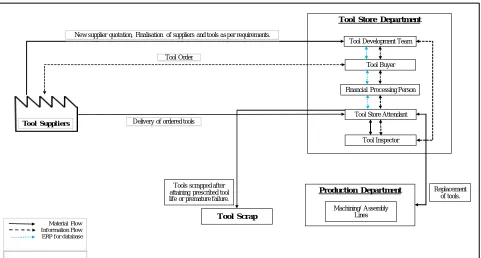
A SIPOC (Suppliers, Inputs, Process, outputs and customers) diagram is a widely used tool by process development team to identify all relevant elements of an existing process before work begins. It helps in defining a guideway to complex unorganised projects and it is employed at the measure phase of Six Sigma DMAIC (Define, Measure, Analyse, Improve and Control) methodology. The actual flow of processes and people involved in tool store are mentioned in the figure below.
Fig. 1.Overview of TLM in Tool Store
From the figure portrayed above, it is evident that the process within the tool stores initiates with the need of new tools or replacement of currently existing tools. The Tool Development team looks after the needs fromthe production department and caters with the tools which fulfil the desired quality and prescribed tool life. One has to know the existing process system in the organization. The current practises and techniques involved during whole tool journey must be well familiar to the working management. The TLM system should be designed in such a way that it rectifies all the hindrances in current system. All the consumable tools go through a series of sequential steps right from the ideology of new tool to the final disposal or scrap. These steps can be mainly divided into three major sections. The first section comprise of the idea of need of new tool. After the needs and purpose of new tool is finalised with the tool development team, the development team can call upon the respective suppliers who may fulfil the stated requirements. All the present products and the corresponding clients of those suppliers can be reviewed. After the supplier meetings, the supplier quotations of our convenience is taken. One of the best suited suppliers can be temporarily finalised and tools for trial can be ordered on free-of-cost basis. The tool ordered are checked for dimensions and tool geometry. Trials on the tool are carried out continuously for a period of about two or three months. If the trial tool serve the required purpose with proposed component quality and life, it is marked as OK tools. If the trial tool fails to yield the prescribed life or elevated quality issues, the trials can be stopped at any point of time and tool can be scrapped. New suppliers for similar tool can be fetched.
The second step begins with assigning unique item code to the newly introduced tool. Tool Procurement starts once the tool gets an item code. Presently, defining the item code is a manual process in many of the organisations whereas in small scale industries there is no such item code definition to tool which results in downtime of machines. Thus storage of tools in these cases and tracking inventory records of these tools becomes a difficult job for the operator. The time invested by the person to find the tool is surely elevated. Once the item code is assigned, the procurement process can be initiated as per the requirements in production department and the minimum maximum quantities in ERP. Once the tools attain the specified tool life, it can be replaced by a new or reworked tools from the tool store attendant. The tools which can’t be reworked can be scrapped directly by the store attendant.This is an ongoing process. Though, human intervention during initial stages of development is must, it can be minimised from the later stage to a greater extent with the aid of database management software.
Tool Store Department
Tool Development Team
Tool Buyer
Financial Processing Person
Tool Store Attendant
Tool Scrap
Production Department
Tool Inspector Tool Order
Tools scrapped after attaining prescribed tool life or premature failure.
Machining/ Assembly Lines
Tool Suppl iers Delivery of ordered tools
Replacement of tools.
Material Flow Information Flow ERP for database
The proposed system may be summarised as mentioned below in the following three phases: 1. Preliminary Investigation and Analysis
i) Understanding the existing system.
ii) Identifying the loopholes in current operations. iii) Objectives/advantages of the proposed system.
iv) Determine system requirements.
2. Design Phase
i) Determining of software and hardware requirements. ii) Design input and output parameters.
iii) Various reports generated as outputs.
3. Development Phase
i) Development of computer program.
ii) Testing of computer program with sample data. iii) Testing of computer program with real data.
The organisation is also associated with various reports on daily, monthly or annual basis. They may be the Budget report, monthly Tools Consumption Report, Excess-Less Consumption Report, Tool Inventory Reports etc. which involve lot of laborious calculation work. Even a slight error in calculations or formulae may lead to inaccurate interpretation of results. Hence creating and maintaining a standard database is always on the positive side. Any records of the previous years can be tapped momentarily by recognised personnel and the hazards of data missing or discrepancies are totally abolished.
From the proposed TLM system as stated above, it is a clear depiction that the development of TLM asks for several points to be cleared from the managerial level i.e. upto what extent the digitalization is rational. The management must venture on the infrastructure and encourage the employees to adopt the new changes.
VI. CONCLUSION
This paper mainly focuses on indispensable establishment of standard database and reorganization of information flow as the tool flows within the tool store. The study suggests and affirms the essence of Value Stream Mapping (VSM) as a lean transformation tool for identifying and eliminating wastes even from smallest setups in tool room. The study incorporated a review of application of the technique to the one of the departments of industry and its relevance in the present manufacturing scenario.Hence, future researches can be done by focusing on the obstacles and critical success factors of Industry 4.0 in different industries. Most of the articles are focused on the theoretical approach for vitality of Industry 4.0 which shows that it the base or the building blocks of Industry 4.0 is set though it lacks in data driven approach. Hence a user friendly software will attempt to overcome the barrier between the currently existing manual operations and proposed automation in tool store.
REFERENCES
[1] G. Subrahmanyam, A. Gunasekaran, S. Arunachalam and P. Radhakrishnan, “Development of a Tool Database Management System”, The International Journal of Advanced Manufacturing Technology, Vol.15, pp.562–565, 1999.
[2] G.C. Vosniakos, A. Daskalopoulos and N. Straggas, “A Web-Based Integrated Cutting Tool Management System”, 7TH Biennial Conference on Engineering Systems Design and Analysis, 2004.
[3] Giovanni Tani, “Tool Management in Manufacturing Systems Equipped with CNC Machines”, Belo Horizonte, Vol.7, pp.177-187, November 1997.
[4] Aneta Skowron, “Tool Lifecycle Management in Industrial Practice”, Management Systems in Production Engineering, Volume No 2 (18), pp. 69-75, 2015.
[5] Rushil Batra, Sahil Nanda, Shubham Singhal and Ranganath Singari, “Study of Lean Production System using Value Stream Mapping in Manufacturing Sector and Subsequent Implementation in Tool Room”, SAE International 2016-01-0342, 2016.
[6] K. Venkataraman, B.Vijaya Ramnath, V.Muthu Kumar and C.Elanchezhian, “Application of Value Stream Mapping for Reduction of Cycle Time in a Machining Process”, Procedia Materials Science 6,pp.1187 – 1196, 2014.
[8] Marina Crnjac, Ivica Veža and Nikola Banduka, “From Concept to the Introduction of Industry 4.0”, International Journal of Industrial Engineering and Management (IJIEM), Vol.8, pp.21-30, 2017.
[9] Eva Schaupp, Eberhard Abele and Joachim Metternich, “Potentials of digitalization in tool management”, Procedia CIRP 63, pp.144 – 149, 2017.
[10] Sagar B.S. and Praveen D Jadhav, “A study on impact of Industry 4.0 in India”, International Advanced Research Journal in Science, Engineering and Technology, Vol.4, Special Issue 7, May 2017.