MODIFIED PARTICLE SWARM OPTIMIZATION FOR
OPTIMIZATION PROBLEMS
1ZHAO PENGJUN, 2LIU SANYANG AND 3CHENG GUO
1Department of Mathematics and Computational Science, Shangluo University,
Shangluo 726000, P. R. China
2 Department of Applied Mathematics, Xidian University, Xi'an 710071, P. R. China 3 Department of Mathematics and Computational Science, Shangluo University,
Shangluo 726000, P. R. China
E-mail: [email protected] , [email protected] , [email protected]
ABSTRACT
In the paper a modified particle swarm optimization (MPSO) is proposed where concepts from firefly algorithm (FA) are borrowed to enhance the performance of particle swarm optimization (PSO). The modifications focus on the velocity vectors of the PSO, which fully use beneficial information of the position of particles and increase randomization item in the PSO. Finally, the performance of the proposed algorithm is compared with that of the PSO-TVIW. Simulation results demonstrate the effectiveness of the proposed algorithm.
Keywords: Particle Swarm Optimization; Firefly Algorithm; Meta-Heuristic Algorithm
1. INTRODUCTION
The optimization problems frequently arise in almost every field of the natural sciences and the engineering technology. During the last few decades, Nature-inspired Meta-heuristic algorithms have been proposed for solving the optimization problems. There are many different meta-heuristic algorithms for the optimization problems, such as differential evolution (DE) [1], ant colony optimization (ACO) [2], firefly algorithm [3-4], and so on.
Particle swarm optimization (PSO), proposed by Kennedy and Eberhart [5-6] in 1995 is a new, self-adaptive global optimization algorithm based on the swarm behavior of birds and fish, In the PSO, a potential solution for a given problem is considered as a particle, a particle flies through a D-dimensional, real-valued search space and adjusts its position vector according to its own experience and other particles’. The PSO approach is becoming very popular due to its simplicity of implementation and ability to quickly converge to a reasonably good solution; it has been successfully applied in a vast range of problems [5-8].To improve the performance of the PSO, Hong-qi Li et al. [9] proposed a novel hybrid particle swarm
optimization algorithm combined with harmony search for high dimensional optimization problems, O. Begambre et al. [10] proposed a hybrid particle swarm optimization – simplex algorithm for structural damage identification, Changsheng Zhang et al. [11] proposed a novel hybrid differential evolution and particle swarm optimization algorithm for unconstrained optimization.
Firefly algorithm (FA) is a new meta-heuristic algorithm which is inspired from social behavior of fireflies in nature. This algorithm was developed recently by Xin-She Yang at Cambridge University. It uses three idealized rules: All fireflies are unisex and can be attracted by other fireflies; attractiveness of each firefly is proportional to their brightness and brightness of each firefly is determined by evaluating objective function. Further details about the FA are given in [3-4].
611 The remainder of the paper is organized as follows: Section 2 describes the PSO. The proposed approach (MPSO) is presented in Section 3. Results of the experiments are presented and discussed in Section4. Finally, Section 5 concludes the paper.
2. THE PARTICLE SWARM ALGORITHM
In PSO, every particle has a position vector
1 2
( ,
,
,
D)
x
=
x x
⋅⋅⋅
x
and a velocityvector
v
=
( ,
v v
1 2,
⋅⋅⋅
,
v
D)
.At each time step t, the velocity of particle i is updated according to Eq.1 and then its position is updated according to Eq.2.
1 1 2 2
( 1) ( ) ( ( ))
( ( ))
i i i i
i
v t v t c r pbest x t
c r gbest x t
ω
+ = + −
+ − (1)
( 1) ( ) ( 1)
i i i
x t+ =x t +v t+
(2)
Where w is the inertial weight, and c1 and c2 are positive acceleration coefficients used to scale the contribution of cognitive and social components, respectively. pbesti is the best position that particle i
has been visited. gbest is the best position found by all particles in the swarm. r1 and r2 are uniform random number in [0,1],
v
id∈ −
[
V
max,
V
max]
, andVmax specify maximum of velocity.
PSO can be summarized as the pseudo code shown in Figure 1.
begin
initialize the particle population xi (i=1,2,…,n)
and vi
while (t <Max number of Generations)
evaluate the fitness f (x) , x = (x1, ..., xD)
update pbesti and gbest
calculate new velocity according to Eq.1
update the position according to Eq.2
end while
end
Figure 1 Particle Swarm Optimization
3. THE MODIFIED PARTICLE SWARM
ALGORITHM
In this section, the part thought of FA is used in the PSO to accelerate convergence speed and also
to enhance its capability for handling optimization problems.
The MPSO has exactly the same steps as the PSO with the exception that velocity vector is modified as follows:
In the MPSO, the distance between xi and pbesti,
respectively, is the Cartesian distance
2
, ,
1
( )
( )
px i i D
i k i k k
r pbest x t
pbest x =
= −
=
∑
−(3)
The distance between xi and gbest, respectively,
is the Cartesian distance
2 , 1
( )
( )
gx i
D
k i k k
r gbest x t
gbest x
=
= −
=
∑
−(4)
The velocity vectors v of the PSO is randomly mutated by using Eq.5.
2
2 1 1
2 2 3
( )
1
( )
2
( ) ( ( ))
( ( )),
( 1) ( ) ( ( ))
1
( ( )) ( )
2 ,
px
gx
i i i
i a
r
i i i i
r
i
v t c r pbest x t
c r gbest x t r p
v t v t r e pbest x t
r e gbest x t r
else
ω
ω
α −
−
+ −
+ − ≤
+ = + −
+ − + −
(5)
Where the third term is randomization with the control parameter
α
, which makes the exploration of the search space more efficient. pa is a mutationprobability, r3 is uniform random number in [0,1],
the proposed algorithm fully uses beneficial information of the solutions to modify the velocity vector v. Intuitively, this modification allows the MPSO to work efficiently in both continuous and discrete problems.
4. EXPERIMENTS
4.1 Benchmarks
In this section, four well known benchmark functions for minimization are chosen to test the performance of MPSO in comparison with PSO-TVIW [7]. The test functions are listed below:
Sphere function
2
1 ( )
D i i
f x x
=
=
∑
Rosenbrock function
1
2 2 2
1 1
( ) [100( ) ( 1) ]
D
i i i
i
f x x x x
− + =
=
∑
− + −(7)
Rastrigrin function
2
1
( ) [ 10 cos(2 ) 10]
D
i i
i
f x x πx
=
=
∑
− +(8)
Griewank function
2
1 1
1
( ) cos( ) 1
4000
D D
i i
i i
x
f x x
i
= =
=
∑
−∏
+(9)
Search space ranges of the above benchmark functions for the experiments are listed in Table 1.
Table 1 Search Space For Each Test Functions
Function Search space
Sphere
−
5.12
≤ ≤
x
i5.12
Rosenbrock
− ≤ ≤
30
x
i30
Rastigrin
−
5.12
≤ ≤
x
i5.12
Griewank
−
600
≤ ≤
x
i600
4.2 Algorithm’s Settings And Experimental Results
To evaluate the performance of the proposed PSO, all common parameters of PSO-TVIW [7] and MPSO are set the same to have a fair comparison. All functions were implemented in 30 dimensions. The results reported in this section are mean and standard dev. over 50 simulations. The maximum number of generations (Ng) was set to 2,000 for two algorithms, it is good to limit the Vmax to the
upper value of the range of search, D=40. For the
MPSO, pa=0.9, w (0.9 0.4)Ng t 0.4
Ng
−
= − + ,
1 2 2
c = =c .
Table 2 summarizes value data obtained by applying the two approaches to the benchmark
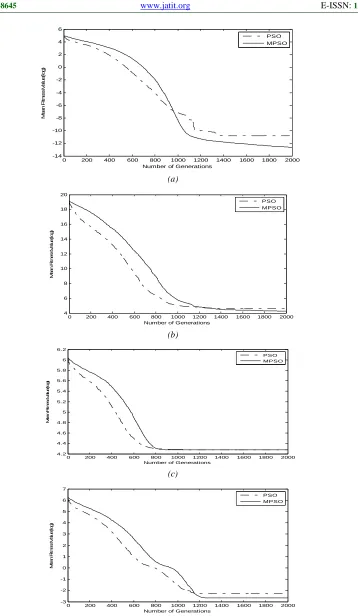
functions. As seen, for Sphere function, Rosenbrock function and Griewank function, the result generated by MPSO is better than those generated by PSO, for Rastigrin function, MPSO slightly outperformed PSO. It can be concluded that the MPSO outperformed PSO-TVIW in all four benchmark functions when the pre-defined number of generations is completed. The modified PSO that combines the distance information and randomization term is proved to be correct and effective in converging to the global optimal.
Table 2 Shows The Mean And STDEV. Of The
Benchmark Function Optimization Results
Functio n
Met hod
Mean Stdev.
Sphere PSO -TVI W MPS O
2.01554830096 0248e-5 3.27178869303 4994e-6
1.35034908313 9055e-4 5.32115488952 5446e-7
Rosenb rock
PSO -TVI W MPS O
1.00029514893 9649e+2 70.6183697610 29768
1.18761895175 5061e+2 1.10822347459 0161e+2
Rastigr in
PSO -TVI W MPS O
72.2543077481 91820
72.1946469048 94668
18.3263121401 93487
16.0408520628 08550
Griewa nk
PSO -TVI W MPS O
0.10133779637 7739
0.06879507945 9886
0.17678038033 0072
613
0 200 400 600 800 1000 1200 1400 1600 1800 2000 -14
-12 -10 -8 -6 -4 -2 0 2 4 6
Number of Generations
M
e
a
n
F
it
n
e
s
s
V
a
lu
e
(l
o
g
)
PSO MPSO
(a)
0 200 400 600 800 1000 1200 1400 1600 1800 2000 4
6 8 10 12 14 16 18 20
Number of Generations
M
e
a
n
F
it
n
e
s
s
V
a
lu
e
(l
o
g
)
PSO MPSO
(b)
0 200 400 600 800 1000 1200 1400 1600 1800 2000 4.2
4.4 4.6 4.8 5 5.2 5.4 5.6 5.8 6 6.2
Number of Generations
M
e
a
n
F
it
n
e
s
s
V
a
lu
e
(l
o
g
)
PSO MPSO
(c)
0 200 400 600 800 1000 1200 1400 1600 1800 2000 -3
-2 -1 0 1 2 3 4 5 6 7
Number of Generations
M
e
a
n
F
it
n
e
s
s
V
a
lu
e
(l
o
g
)
PSO MPSO
(d)
Figure 2 Variation Of The Mean That Are Best Fit With Time. (A) Sphere Function. (B) Rosenbrock Function. (C)
[image:4.612.133.491.76.692.2]Figure 2 show the search progress of the average values found by the two algorithms over 50 runs four functions, which plot the fitness values (log) against the number of generations. From Figure 2, it is clear that the MPSO converges significantly faster than PSO-TVIW for Sphere function, Rosenbrock function and Griewank function, the MPSO converges slightly faster than PSO-TVIW for Rastigrin function.
5. CONCLUSIONS
This paper proposes a new simple but effective and efficient modified PSO for continuous optimization problems. The results obtained show that by using the MPSO may yield better solutions than those obtained by using PSO-TVIW, and demonstrate the effectiveness and robustness of the proposed algorithm. In conclusion, my research work, therefore, suggests that the MPSO is potentially a powerful search and optimization technique for solving complex problems.
In this work, we only consider the unconstrained function optimization. Our future work consists on adding the diversity rules into MPSO for constrained optimization problems.
ACKNOWLEDGMENT
The authors would like to thank the anonymous referees for their constructive and useful comments that have helped me to improve the presentation of this paper. This work is supported by Research Program Project of Education Department of Shaanxi Provincial Government (Grant No.11JK0517) and Scientific Research Foundation of Shangluo University (Grant No. 10SKY024).
REFERENCES
[1] R. Storn and K. Price, Differential evolution – a simple and efficient heuristic for global optimization over continuous spaces. Journal of Global Optimization, 1997, vol.1, No. 4, pp. 341-359.
[2] M. Dorigo and T. Stǚ utzle, Ant colony optimization, MIT Press, Cambridge, MA, 2004.
[3] X.-S. Yang, Firefly Algorithms for multimodal optimization, Lecture Notes in Computer Science, 2009,vol. 5792, pp. 169-178.
[4] X.-S. Yang, Firefly Algorithm, Stochastic Test Functions and design optimization, International Journal of Bio-Inspired computation, 2010,Vol. 2, No. 2, pp. 78-84.
[5] J. Kennedy and R. C. Eberhart, Particle swarm optimization. Proceedings of the 1995 IEEE International Conference on Neural Networks, 1995, vol. 4, pp. 1942-1948.
[6] R. C. Eberhart and J. Kennedy, New optimizer using particle swarm theory, Proceedings of the 6th International Symposium on Micro Machine and Human Science, 1995, pp. 39-43.
[7] Y.Shi, Empirical study of particle swarm optimization. Proceedings of IEEE International Congress on Evolutionary Computation, 1999, vol. 3, pp.101-106.
[8] A. Ratnaweeta, S. K. Halgamuge and H. C. Watson, Self-organizing hierarchical particle swarm optimizer with time-varying acceleration coefficients. IEEE Transactions on Evolutionary Computation, 2004, Vol. 8, No. 3, pp.240-255. [9] Hong-qi Li and Li Li, A Novel Hybrid Particle
Swarm Optimization Algorithm Combined with Harmony Search for High Dimensional Optimization Problems. 2007 International Conference on Intelligent Pervasive Computing, 2007, pp.94-97.
[10] O. Begambre and J. E. Laier, A hybrid Particle Swarm Optimization – Simplex algorithm (PSOS) for structural damage identification. Advances in Engineering Software, Vol.40, No. 9, 2009, pp.883-891. [11] Changsheng Zhang, Jiaxu Ning and Shuai Lu,