935
DIGITAL IMAGE WATERMARKING ALGORITHM BASED
ON SIFT AND SVR
1
JIE ZHAO, 2YUXIA ZHAO 1
Department of Physics and Electronic Information Engineering, Shangluo University, Shangluo 726000,
Shaanxi, China
2
Department of Computer Science, Shangluo University, Shangluo 726000, Shaanxi, China
ABSTRACT
Digital color image watermarking algorithm based on scale-invariant feature transform(SIFT) and support vector regression(SVR) is proposed in this paper. The input feature vectors are selected in the wavelet domain and then the train model is obtained by applying the support vector regression theory. The watermark information can be embedded or extracted by utilizing the above trained SVR model. The proposed scheme can extract the digital watermark without the help of the original digital image. The scale-invariant feature transform(SIFT) is employed to against the scaling and rotation attacks. To improve the security and robustness, the original watermark is scrambled at first. Experimental results show that the proposed scheme is invisible and robust to common signal processing attacks such as adding noise, JPEG compression, sharpening, smoothing, filtering, contrast enhancement, cropping, rotation, scaling and so on.
Keywords: Digital Image Watermarking, Scale-invariant Feature Transform, Support Vector Regression
1. INTRODUCTION
The development of network and multimedia technology makes it convenient to access the multimedia information. These technologies bring people many conveniences but they also bring us some large side effects. The problem of multimedia copyright protection becomes increasingly serious. Digital image watermark technology is commonly achieved by certain modifications to the host signal. According to the embedding domain, the most traditional image watermark technology can be divided into two kinds: Spatial domain and transform domain method. Spatial watermarking method embeds watermark information into original digital image[1-2], while transform domain method performs watermark embedding in transform domain[3-6].
Generally, the spatial domain methods are of the advantage of simplicity and high capacity and the transform domain methods perform more robustness. In order to balance the watermarking imperceptibility and robustness, some scholars use the machine learning methods to optimize the embedding position, capacity or strength. Lou et al. used the neural networks to identify the optimum embedding strength and capacity of different image regions[7]. Davis and Najarian proposed a watermarking scheme in wavelet domain. The neural networks are used to implement an
936 this method retrieves the hidden watermark without the original image during watermark extraction. Most of the algorithms do not resist the geometric attacks. A novel method based on support vector regression(SVR) is proposed in [14]. The SVR and Krawtchouk moments are used to correct the geometric attacks. The watermark is embedded by Pseudo-Zernike moments. The drawback of this method is the large calculation and high complexity.
This paper proposed a method using SVR and scale-invariant feature transform(SIFT). By the trained SVR model, watermark information is embedded into the wavelet domain of the carrier image. This method could against scaling and rotation attacks by virtue of the SIFT which is already implemented by hardware[15]. The rest of this paper is as follows: The description of support vector regression is overviewed in Section 2. Section 3 describes the geometric correction by SIFT. Section 4 covers the watermark embedding and detection procedure. The experimental results are showed in Section 5. Section 6 concludes this paper.
2. SUPPORT VECTOR REGRESSION
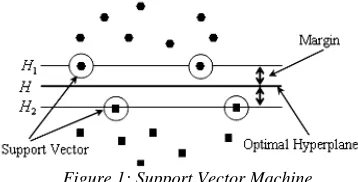
[image:2.612.106.285.599.690.2]Support vector machine(SVM) is a universal classification algorithm proposed by Vapnik in the middle of 1990s, which is regarded as a new innovation of learning machine based on the statistical learning theory[11]. The basic theory of SVM can be depicted by a typical two-dimensional case shown in Figure 1, in which ● and ■ denote two categories of samples,
H
is the separating hyperplane,H
1 andH
2 are parallel toH
and no training points fall between them. The optimal separating hyperplane in the case of structural risk minimization is the separating hyperplane which can separate the two categories with the maximum margin. Thus the problem of optimal separating hyperplane can be transformed into a constraint optimization problem.Figure 1: Support Vector Machine
Support vector regression(SVR) is an important application of support vector machine on the
regression learning. Generally, for the training sets:
{
(
x
1,
y
1),
(
x
2,
y
2),...,
(
x
n,
y
n)
}
, wherex
∈
R
n , andy
∈
R
to get the relation between the inputi
x
and outputy
i, it can seek an optimal regressionfunction
f
(
x
)
by SVR training. Then the difference between the output value and the corresponding objective value of every input sample is not more than errorε
. For the linear situation, the form of function is:f
(
x
)
=
ω
⋅
x
+
b
, andω
∈
x
,b
∈
R
. In order to get an optimal regression function, it needs a minimumω
, then the above problem can be described as an optimization problem:min 2
2
1
ω
, s.t.
≤
−
+
⋅
≤
−
⋅
−
ε
ω
ε
ω
i i
i i
y
b
x
b
x
y
,
i
=
1
,
2
,
3
,...,
n
(1)Considering the existence of regression error is permitted, so the positive slack variables
ξ
i≥
0
and
ξ
i*≥
0
are introduced, and the above formula can be described as follows:min
(
)
2
1
1
* 2
∑
=
+
+
ni
i i
C
ξ
ξ
ω
, s.t.
≤
−
+
⋅
≤
−
⋅
−
ε
ω
ε
ω
i i
i i
y
b
x
b
x
y
,
i
=
1
,
2
,
3
,...,
n
(2)where
C
is the penalty parameter which controls the trade-off between errors of the SVM on training data and margin maximization.The optimization problem is converted to the following problem according to this:
max
∑
∑
= =
−
+
+
−
=
ni
i i i n
i
i
i
y
1 * 1
* *
)
(
)
(
)
,
(
α
α
ε
α
α
α
α
ω
∑
=
−
−
−
−
nj i
j i j j i
i
x
x
1 ,
* *
)
)(
)(
(
2
1
α
α
α
α
s.t.
∑
=
=
−
n
i
i i 1
*
0
)
(
α
α
,i
=
1
,
2
,
3
,...,
n
(3)where
α
i and * iα
are Lagrange multiplying factors.Then the regression function is:
∑
=
+
−
−
=
ni
i i
i
x
x
b
x
f
1
* *
)
)(
(
)
937 where
α
i and* i
α
are few non-zero factors. The corresponding samples are called support vectors.*
b
is the parameter which determines the position of the separating hyperplane.For the nonlinear situation, the data is mapped to a high dimensional feature space by the nonlinear map and then the linear regression could be implemented.
3. GEOMETRIC CORRECTION BY SIFT
The scale-invariant feature transform(SIFT) is a great powerful feature point diction method and proves the invariant to image rotation and scaling and translation[16]. It is used widely and also can correct the geometric distortion. The basic idea is to get features through a series of filtering operation to extract stable point in the image scale space.
(1) The scale space of an image is defined as a function
L
(
x
,
y
,
σ
)
, that is produced from the convolution of a variable-scale Gaussian function)
,
,
(
x
y
σ
G
, with an input imageI
(
x
,
y
)
:)
,
(
*
)
,
,
(
)
,
,
(
x
y
G
x
y
I
x
y
L
σ =
σ
(5)where
∗
is the convolution operation, and2 2 2 )/2
( 2
2
1
)
,
,
(
σπσ
σ
x ye
y
x
G
=
− + (6))
,
,
(
x
y
σ
D
is used to get stable key point locations in scale space, which can be calculated from the difference of two nearby scales separated by a constant multipartite factork
:)
,
,
(
)
,
,
(
)
,
,
(
x
y
σ
L
x
y
k
σ
L
x
y
σ
D
=
−
(7)(2) Local extrema detection is implemented by comparing the pixel of difference-of-Gaussian images to its neighbors in the current and adjacent scales. It is selected only if it is larger than all of these neighbors or smaller than all of them.
The next procedure is to perform a detailed fit to the nearby data for location, scale, and ratio of principal curvatures after the key point candidate has been found by comparing a pixel to its neighbors. This information allows points to be rejected that have low contrast. The rejection to key points with low contrast is not enough to stability. The difference of Gaussian function will have a strong response along edges. These unstable responded points will also be rejected.
(3) The main orientation of the key points should be identified. The sample process is implemented by using a region around the key point. The statistical histogram of the gradient direction of neighborhood pixels is obtained. The peak of
histogram represents the principal direction of the key point. The gradient magnitude
m
and orientationθ
are calculated as:2 2
)) 1 , ( ) 1 , ( ( )) , 1 ( ) , 1 (
( + − − + + − −
= Lx y Lx y Lx y Lx y
m (8)
))
)
,
1
(
)
,
1
(
)
1
,
(
)
1
,
(
(
tan
1y
x
L
y
x
L
y
x
L
y
x
L
−
−
+
−
−
+
=
−θ
(9)(4) The SIFT feature vector is generated. If the image is scaled
s
times, the number of matching points isn
, the scale factor of key pointP
i in theoriginal image is
d
i, and the scale factor of thecorresponding matching key point
Q
i in the scaledimage is
q
i,then:n
d
q
s
n
i i
i
)
/
(
1
∑
=
=
(10)If rotation angle is
α
, the number of matching points isn
, the center angle of key pointP
i in the original image isφ
i, and the center angle of thecorresponding matching key point
Q
i in the rotatedimage is
ϕ
i, then:n
n
i
i i
)
)
/
(
(
1∑
=
−
=
ϕ
φ
α
(11)4. PROPOSED METHOD
938 and the watermark information can be embedded and extracted through the model.
Generally, let
I
represents an RGB color image with the size ofM
×
N
, andI
=
{
I
r,
I
g,
I
b}
whereI
r ,I
g ,I
b are the red, green and blue components respectively. The watermark imagew
is a meaningful binary image with the size of
P
×
Q
. The watermark is embedded into the blue channel since the human eye is relatively insensitive to the blue component.4.1 Watermark Embedding
(1) The SIFT feature vectors should be extracted at first, and the binary watermark
w
is scrambled by secret key and scanned to a sequencew0.(2) The blue component
I
b of imageI
to be watermarked is decomposed through DWT in four levels, and the low-pass subband is denoted asf
.(3) Some adjacent pixels in
f
are selected randomly. These pixels and their neighborhood pixels in every3
×
3
window are used to train the support vector machine.), 1 , ( ), 1 , ( ), 1 , 1 ( ), , 1 ( ), 1 , 1 ( { − − − − + − +
= f i j f i j f i j f i j f i j S
)}
,
(
),
1
,
1
(
),
,
1
(
),
1
,
1
(
i
j
f
i
j
f
i
j
f
i
j
f
+
−
+
+
+
)}
,
(
),
,
(
{
O
i
j
f
i
j
=
(12) The pixels setO
(
i
,
j
)
are the feature vectors for support vector regression training. The pixels set)
,
(
i
j
f
are the training objective of support vector regression. The support vector regression machine can be trained by appropriate kernel function and learning coefficients.(4) For each embedding position
(
x
,
y
)
, theeight pixels in
3
×
3
window are collected to form the datasetU
(
x
,
y
)
. TheP
×
Q
embedded positions are adjacent, not overlap and not equal to the pixels in step3. These embedded pixels are also not on the boundary.),
1
,
1
(
),
,
1
(
),
1
,
1
(
{
)
,
(
x
y
=
f
x
−
y
−
f
x
−
y
f
x
−
y
+
U
),
1
,
1
(
),
1
,
(
),
1
,
(
x
y
−
f
x
y
+
f
x
+
y
−
f
)}
1
,
1
(
),
,
1
(
x
+
y
f
x
+
y
+
f
(13) The datasetU
(
x
,
y
)
is extracted as the input vectors of the trained support vector regression and the output of support vector regressionδ
(
x
,
y
)
is obtained.(5) The watermark is embedded by modifying the pixel
f
(
x
,
y
)
at the embedding position as:if
w
0
(
t
)
=
1
(
t
=
1
,
2
,
3
,...,
P
×
Q
)
then)))
,
(
1
(
)
,
(
),
,
(
max(
)
,
(
*y
x
h
y
x
y
x
f
y
x
f
=
δ
×
+
(14)else ))) , ( 1 ( ) , ( ), , ( min( ) , ( * y x h y x y x f y x
f = δ × − (15)
where
h
(
x
,
y
)
is the embedding strength functionand
f
*(
x
,
y
)
is the modified wavelet coefficient at position(
x
,
y
)
.Given the perceptibility of the human visual system, the strength function
h
(
x
,
y
)
hasn’t been set as numerical variable. Generally human eyes are not very sensitive to the additional noise in the high luminance region, which means that high luminance background region can embed stronger information. Human eyes are more sensitive to the smooth region than the highly textured area; therefore, the stronger information can be added to the highly textured area of the image. The strength function)
,
(
x
y
h
is given by:)
,
(
)
,
(
)
,
(
x
y
B
x
y
T
x
y
h
=
β
⋅
⋅
(16) whereβ
is the intensity modulation factor,)
,
(
x
y
B
is the weighing function according to the local sensitivity of the image luminance and)
,
(
x
y
B
is given as:9
/
)
,
(
)
,
(
1 1 1 1∑ ∑
− = =−+
+
=
l kk
y
l
x
f
y
x
B
(17))
,
(
x
y
T
is the function according to the local sensitivity of the image texture and is given as:∑ ∑
− = =− − + + = 1 1 1 1 ) , ( ) , ( ) , ( l k y x B k y l x f y xT (18)
4.2 Watermark Detection
(1) If the test image is suffered scaling or rotation attack, the geometric correction by SIFT should be implemented at first. The blue component
I
b′
of thetest image
I
′
to be watermarked is decomposed through DWT in four levels, and the low-pass subband is denoted asf
′
.(2) For each detecting position
(
x
,
y
)
which is equal to the embedding procedure, the eight pixels in3
×
3
window are collected to form the dataset)
,
(
x
y
U
′
:), 1 , ( ), , 1 ( ), 1 , 1 ( { ) , ( = ′ − − ′ − ′ −
′ x y f x y f x y f x y U
f
′
(
x
−
1
,
y
+
1
),
f
′
(
x
,
y
+
1
),
f
′
(
x
+
1
,
y
−
1
),
)}
1
,
1
(
),
,
1
(
+
′
+
+
′
x
y
f
x
y
939 (3) The dataset
U
′
(
x
,
y
)
is extracted as the input vectors of the trained support vector regression and the output of support vector regressionδ ′
(
x
,
y
)
is obtained.(4) The watermark information is extracted as: if
f
′
(
x
,
y
)
>
δ ′
(
x
,
y
)
thenw
0
′
(
t
)
=
1
else
w
0
′
(
t
)
=
0
.(5) The watermark
w
′
is obtained fromw
0
′
by inverse scrambled which used the key which is used in the embedding procedure.5. EXPERIMENTAL RESULTS
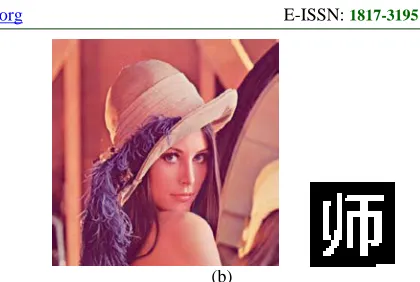
The color image Lena with the size of 512
×
512 is used as the original carrier image, and the meaningful binary image with the size of 32×
32 is used as the original watermark image, which are shown in Figure 2. The watermarked image and the extracted watermark image are also shown in Fig.3. Some parameters of the training support vector regression are briefly determined through experiments. The radius-based function(RBF) is adopted as the kernel function of the support vector regression since it performed better than others[14]. In order to get more appropriate parameters, a lot of experiments are implemented to the training support vector regression. Then the parameters are determined as: σ=10,ε
=
0
.
008
,C
=
1
. The support vector regression could not get enough training if the learning sample number is too small, and it also leads to over learning if the number is too large. The number is set as 200 by trial experiments. The bit error rate(BER) is used to show the watermark detection results. If the BER is less than the predetermined threshold, the watermark is considered to be existed, otherwise, the watermark does not exist. The BER is defined by:Q P
n m w n m w BER
P
m Q
n
× ′ ⊕ =
∑∑
=1 =1) , ( ) , (
(20)
where
w
is the original watermark andw
′
is the extracted watermark image.
(a)
(b)
Figure 2: (A) Original Carrier Image And Watermark (B) Watermarked Image And Extracted Watermark
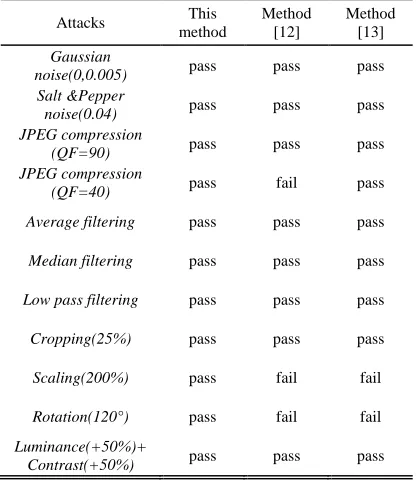
The speckle noise, image enhance, image sharpening and random printing attacks are tested, and are shown in Figure 3. In order to test the robustness of this watermark method, more common signal processing attacks are implemented to the watermarked image, such as add noise, JPEG compression, filtering, cropping, scaling, rotation and so on. Table 1 shows the test results compared with the method in literature[12] and[13]. The simulation results show that the proposed method performs better.
(a)
[image:5.612.312.522.74.215.2]
940
(c)
(d)
Figure 3: (a) Speckle noise attack(PSNR=19.39, BER=0.0471) (b) Image enhance attack(PSNR=19.01, BER=0.0209) (c) Image Sharpening attack(PSNR=38.75,
[image:6.612.91.301.423.671.2]BER=0.0166) (d) Random painting attack(PSNR=24.86, BER=0.0322)
Table 1 : The Results Of Common Processing Attacks
Attacks This
method
Method [12]
Method [13] Gaussian
noise(0,0.005) pass pass pass Salt &Pepper
noise(0.04) pass pass pass JPEG compression
(QF=90) pass pass pass JPEG compression
(QF=40) pass fail pass
Average filtering pass pass pass
Median filtering pass pass pass
Low pass filtering pass pass pass
Cropping(25%) pass pass pass
Scaling(200%) pass fail fail
Rotation(120°) pass fail fail
Luminance(+50%)+
Contrast(+50%) pass pass pass
6. CONCLUSION
Image watermarking technology has been developed for decades but there are even many difficulties in the watermark system. The
contradiction between the invisibility and robustness is still not easy to solve. In this paper, the watermark embedding strength is related to the image content based on the support vector regression. The SIFT is used to against scaling and rotation distortions. Experimental results show the robustness to common image processing attacks of this proposed algorithm.
ACKNOWLEDGEMENTS
This work was supported by the Science and Technology Foundation Project of Shangluo University(NO. 09SKY032, 09SKY033) and Scientific Research Program Funded by Shaanxi Provincial Education Department(Program No. 12JK0747).
REFERENCES:
[1] G. Voyatzis, I. Pitas, “Chaotic watermarks for embedding in the spatial digital image domain”,
Proceedings of International Conference on
Image Processing, IEEE Conference Publishing
Services, October 4-7, 1998, pp. 432-436. [2] Xianyong Wu, Zhihong Guan, “A novel digital
watermark algorithm based on chaotic maps”,
Physics Letters A, Vol. 365, No. 5, 2007, pp.
403-406.
[3] P. Bas, N. Le Bihan, J. M. Chassery, “Color image watermarking using quaternion Fourier transform”, Proceedings of International Conference on Acoustics, Speech, and Signal
Processing, IEEE Conference Publishing
Services, April 6-10, 2003, pp. 521-524. [4] Haohao Song, Songyu Yu, Xiaokang Yang, Li
Song, Chen Wang, “Contourlet-based image adaptive watermarking”, Signal Processing:
Image Communication, Vol. 23, No. 3, 2008,
pp. 162-178.
[5] Dazhi Zhang, Boying Wu, Jiebao Sun, Heyan Huang, “A new robust watermarking algorithm based on DWT”, International Congress on
Image and Signal Processing, IEEE Conference
Publishing Services, October 17-19, 2009, pp. 1-6.
[6] Ting Luo, Mei Yu, Gangyi Jiang, Aihong Wu, Feng Shao, Zongju Peng, “Novel DCT-based blind stereo image watermarking algorithm”,
Future Wireless Networks and Information
941 [7] DC. Lou, JL. Liu, MC. Hu, “Adaptive digital
watermarking using neural network technique”,
International Carnahan Conference on Security
Technology, IEEE Conference Publishing
Services, October 14-16, 2003, pp. 325-332. [8] KJ. Davis, K. Najarian, “Maximizing strength of
digital watermarks using neural networks”,
International Joint Conference on neural
networks, IEEE Conference Publishing
Services, July 15-19, 2001, pp. 2893-2898. [9] CS. Shieh, HC. Huang, FH. Wang, JS Pan,
“Genetic watermarking based on transform domain techniques”, Pattern Recognition, Vol. 37, No. 3, 2004, pp. 555-565.
[10] Xiaoxia Li, Jianjun Wang, “A steganographic method based upon JPEG and particle swarm optimization algorithm”, Information Sciences, Vol. 177, No. 5, 2007, pp. 3099-3109.
[11] Y. Fu, R. Shen, H. Lu, “Watermarking scheme based on support vector machine for color images”, IEEE Electronics Letters, Vol. 40, No. 16, 2004, pp. 986-987.
[12] R. Shen, Y. Fu, H. Lu, “A novel image watermarking scheme based on support vector regression”, The Journal of Systems &
Software, Vol. 78, No. 1, 2005, pp. 1-8.
[13] HH. Tsai, DW. Sun, “Color image watermark extraction based on support vector machines”,
Information Sciences, Vol. 177, No. 2, 2007,
pp. 550-569.
[14] XY. Wang, ZH. Xu, HY. Yang, “A robust image watermarking algorithm using SVR detection”,
Expert Systems with Applications, Vol. 36, No.
5, 2009, pp. 9056-9064.
[15] Leonardo Chang, José Hernández-Palancar, “A hardware architecture for SIFT candidate keypoints detection”, Progress in Pattern Recognition, Image Analysis, Computer Vision,
and Applications, Vol. 5826, 2009, pp. 95-102.
[16] David G. Lowe, “Distinctive image features from scale-invariant key points”, International
Journal of Computer Vision, Vol. 60, No. 2,