AN RFID-BASED CRM SYSTEM IN APPAREL RETAILING
1
SHAN YANG, 2GUOLIAN LIU, 3MENGMENG XU, 4HONGQIN DAI
1
National Engineering Laboratory for Modern Silk, College of Textile and Clothing Engineering, Soochow
University, Suzhou 215021, China
2
Nantong Textile Institute of Soochow University, Nantong 226000, China
E-mail: [email protected], [email protected], [email protected],
4
ABSTRACT
An RFID-based CRM system with intelligent characteristics for apparel retail has been proposed in this paper. It is composed of five functional modules: RFID-based garment information management module, RFID-based customer information management module, personalized recommendation and service module, sales management module, web-based communication and service module. The core function of this system is to identify a customer automatically and make personal recommendation to him/her by using RFID. With the implementation of this system, apparel retailers can achieve the purpose of building up a close but discriminating relationship with each customer.
Keywords: RFID; CRM System; Personalized Recommendation; Apparel Retailing
1. INTRODUCTION
Apparel Retailers face a dynamic and competitive retail environment. With growing competition from both traditional and online businesses, keeping customers satisfied, increasing potential sales, and maintaining customer loyalty become strategically important to business success [1]. Simultaneously, customers are also looking forward to convenient apparel shopping environment and efficient consumption condition.
More and more attentions have been drawn on the applications of RFID on the part of retail industry recently. RFID is a technology that is used to communicate with identified objects using radio waves, so that the objects can be recognized, tracked and traced [2]. The value of RFID technology is particularly apparent in apparel retailing, as the apparel business is characterized by a wide assortment of products, short life-cycles, high seasonality, high volatility, and high-impulse purchasing and complicated distribution and logistics operations [3].
The purpose of this paper is to build an intelligent RFID-based CRM system for apparel retail, which intent to create values in terms of responsiveness, relatedness and refinement. Indeed, with the built-in intelligence, the system can
identify a customer automatically and make personalized recommendation to him/her. In this way, apparel retailers are able to respond more quickly to customer’s needs and wants, strengthen customer relationships, and increase the purchasing rate more effectively.
2. RELATIVE KNOWLEDGE
RFID Technology. RFID is a wireless technology that uses transmitted radio signals to tag, recognize, track and trace the movement of an item automatically. These objects can be containers, trays, pallets, cases, product items [4], or even human objects. Most RFID infrastructures are composed of three principal components [5]: (1) a transponder, which is fixed on an object and identifies it, known as the RFID tag; (2) a reader, the main purpose of which is to serve as a communication channel; (3) data collection application comprising a software solution and an antenna.
431 personalizing needs of individual customers by differentiating products or services for each unique customer [7].
Personalization and Personalized Recommend ation System. The aim of personalization is to offer customers what they want without asking them exp licitly and to capture the social component of interp ersonal interaction. A personalized recommendation system can provide one-to-one service to customer s based on customers’ past behavior and through inf erence from other users with similar preferences [8] .
3. THE FRAMEWORK OF THE RFID-BASED CRM SYSTEM
The core function of this RFID-based CRM system is identifying a customer automatically and making personalized recommendation intelligently to the customer in a short time. When a customer with an RFID VIP card enters the shop, his/her personalized information including basic personal information, preferences and purchasing history can be detected, and then, the system may recommend the adequate services and suitable clothes to him/her to meet his/her individual requirements through analyzing customer’s purchasing intention. Figure1 illustrates the framework of such an intelligent RFID-based CRM system.
Figure1 The Framework Of The RFID-Based CRM System.
RFID-based Garment Information Manageme nt Module. Each garment in the apparel retail store is classified and quantified in advance. Classificatio n is primarily in accordance with the apparel-catego ry, fabric, price, brand etc. Quantification is generat ed and referring to Kansei Engineering learning. Th e criterion is designed for the style of clothing and t he standard of its adjective gradable antonym pairs: conservative – sexy, masculine - feminine, formal - arbitrary. The initial number of quantification is the average of the apparel assessment values which are
given by the target customer group and the experts. It is suggested that customers would grade the cloth es they have purchased and these new grades would alter the value of style quantification. All the clothe s are tagged by RFID respectively. And their classif ication and quantification data, along with the infor mation about shelves position, stock balance are all arranged in the product database.
manage and analyze customer’s personalized information which includes basic personal information, preference information and shopping record. The basic personal information includes name, age, sex, occupation, contact phone, QQ (Tencent Instant Messenger), address, height, weight, BWH (bust, waist, hips)/body shape etc; The preference information is related to favorite color, recent needs, shopping pattern, and individual taste (style preference); The shopping history includes date, try-on items, purchased items, shopping route etc. All the information is recorded in the consumer individual database. Through the issue of smart RFID VIP cards to loyal customers, the system can identify them accurately, and trace their shopping history whenever they visit the store. This module also can automatically update each customer’s style preference periodically according to the style of his/her purchased clothes if allowed.
Personalized Recommendation and Service Module. The module to make recommendation is the upgrade application of this system. Its main point is how to recommend clothes to satisfy customer’s purchase needs and improve sales rate. Firstly, according to one customer’s basic needs expression, the system search the corresponding classified clothing genera. Secondly, compare conformity between his/her style preference and those clothing’s quantitative style value. Thirdly, take consideration of his/her other personal information, which is body shape, favorite color and so on. Finally, the system makes recommendation order based on above steps. Moreover, the system may continue to introduce some additional clothes to him/her that coordinating with the target one, such as tops with bottoms, shirts with jeans, jackets with vests, or skirts with sweaters.
Customer’s style preference and clothing’s quantitative style value can be represented by using a triple.
S x x x
i( ,
1 2,
3)
is the description of clothingi
, wherex x x
1,
2,
3∈
[
-2, 2
]
.R y y y
j( ,
1 2,
3)
is thedescription of style preference of customer
j
,where
y
1,
y
2,
y
3∈
[
-
2
,
2
]
. The aforementionedsecond recommend process is performed according
to the distance between
S
iandR
j, which is given as Eq.1
2
1
(
)
n
ij l l l
D
x
y
=
=
∑
−
, wheren
=
3
.(1)
Sales Management Module. The function of this module is to make the process of sales transactions more transparent and, a rapid response is efficiently made when unexpected problems occur. Each garment has been attached by a special RFID tag, tracked exactly by the installed RFID reader at the checkout counter. In addition, the in-store inventory could be recorded more effectively and responsively, ensuring that a fuller range of sizes or styles of garments was available to customers.
Web-based Communication and Service Module.
The system sets a communication platform for customers to voice their options freely about the products, services and any other questions. It is suggested that customers would comment on the service and grade the clothes they have purchased. In addition, new arrivals and discounts information will be sent to VIP customers selectively and timely. They are also allowed to login and modify the basic personal information and the preference information on personalized information page.
4. SYSTEM REALIZATION
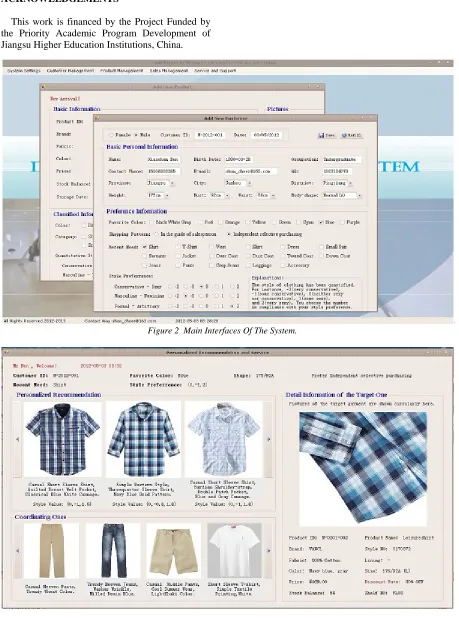
According to the framework expounded above, we use Microsoft Visual Studio 2008 to program. The main interfaces of adding new customer and new product are shown in Figure2. An example of personalized recommendation is shown in Figure3.
5. CONCLUSIONS
433
ACKNOWLEDGEMENTS
[image:4.612.89.548.101.719.2]This work is financed by the Project Funded by the Priority Academic Program Development of Jiangsu Higher Education Institutions, China.
Figure 2 Main Interfaces Of The System.
REFERENCES
[1] J.L. Anderson, L.D. Jolly, A.E. Fairhurst, Customer relationship management in retailing: a content analysis of retail trade journals, J. Retailing Consumer Services 14 (2007) 394– 399.
[2] P. Jones, C. Clarke-Hill, D. Comfort, D. Hillier, and P. Shears, Radio frequency identification and food retailing in the UK, Br. Food J. 107,6 (2005) 356-360.
[3] S. Li, J.K Visich, Radio frequency
identification: supply chain impact and implementation challenges, Int. J. Integr. Supply Manage. 2, 4 (2006) 407-424.
[4] K.L. Moon, E.W.T. Ngai, The adoption of RFID in fashion retailing: a business value-added framework, Ind. Manage. Data Syst.108, 5 (2008) 596-612.
[5] S. Shepard, RFID: Radio Frequency
Identification, McGraw-Hill, New York, NY, 2005.
[6] R. Chalmeta, Methodology for customer relationship management, J. Syst. Software 79 (2006) 1015–1024.
[7] D.P. Dien, R.V. Douglas, A model of customer relationship management and business intelligence systems for catalogue and online retailers, Inf. Manage. 47 (2010) 69–77.