R E S E A R C H
Open Access
In silico
tandem affinity purification refines an
Oct4 interaction list
Clara Yujing Cheong
1, Patricia Miang Lon Ng
1, Rhonda Ponnampalam
1, Heng-Hang Tsai
2, Guillaume Bourque
3and Thomas Lufkin
1*Abstract
Introduction:Octamer-binding transcription factor 4 (Oct4) is a master regulator of early mammalian development. Its expression begins from the oocyte stage, becomes restricted to the inner cell mass of the blastocyst and eventually remains only in primordial germ cells. Unearthing the interactions of Oct4 would provide insight into how this transcription factor is central to cell fate and stem cell pluripotency.
Methods:In the present study, affinity-tagged endogenous Oct4 cell lines were established via homologous recombination gene targeting in embryonic stem (ES) cells to express tagged Oct4. This allows tagged Oct4 to be expressed without altering the total Oct4 levels from their physiological levels.
Results:Modified ES cells remained pluripotent. However, when modified ES cells were tested for their functionality, cells with a large tag failed to produce viable homozygous mice. Use of a smaller tag resulted in mice with normal development, viability and fertility. This indicated that the choice of tags can affect the performance of Oct4. Also, different tags produce a different repertoire of Oct4 interactors.
Conclusions:Using a total of four different tags, we found 33 potential Oct4 interactors, of which 30 are novel. In addition to transcriptional regulation, the molecular function associated with these Oct4-associated proteins includes various other catalytic activities, suggesting that, aside from chromosome remodeling and transcriptional regulation, Oct4 function extends more widely to other essential cellular mechanisms. Our findings show that multiple purification approaches are needed to uncover a comprehensive Oct4 protein interaction network.
Introduction
Octamer-binding transcription factor 4 (Oct4) [1], also termed Oct3 or Pou5f1 [2], is an early developmental stage transcription factor. Oct4 expression begins in the oocyte from maternal sources and is continued by zygotic expression after the four-cell stage. Thereafter it becomes restricted to the inner cell mass, the epiblast and even-tually the germ cells [3]. During this time, Oct4 expression serves to regulate pluripotency and cell fate development [4]. Oct4-null mouse embryos become restricted to a tro-phectoderm lineage at the blastocyst stage, leading to peri-implantation lethality [5]. Such cell fate restriction is also observable in mouse embryonic stem (ES) cells when Oct4 levels decrease to less than 50% of the normal diploid expression. On the other hand, an increase in Oct4 levels
by 50% converts ES cells to a primitive endodermal and mesodermal fate [6,7]. Hence, the maintenance of pluripo-tency requires Oct4 to be present within a very narrow concentration range, and a change in Oct4 levels directs cells to different developmental fates. Oct4 with combina-tions of the following factors (Klf4, c-Myc, Sox2 and Esrrb) were also shown to be sufficient to induce pluripo-tency in various differentiated cell types [8-10]. Therefore, Oct4 is one of the key transcription factors involved in both the maintenance of ES cell pluripotency [11,12] and somatic cell reprogramming [10,13-17]. Oct4 performs its role via switching target genes on or off. Chromatin immunoprecipitation experiments andin silicoanalyses of Oct4 have identified at least 420 target genes with putative Oct4-binding motifs [18-21]. These target genes span mul-tiple biological processes and developmental stages. Regu-lation of these different genes (includingPou5f1itself) has been shown to be mediated via Oct4 interaction with other transcription factors [22-24]. To better understand * Correspondence: [email protected]
1
Stem Cell and Developmental Biology Group, Genome Institute of Singapore, 60 Biopolis Street, 138672, Singapore
Full list of author information is available at the end of the article
how Oct4 regulates a large number of genes, several studies on its protein interaction network have been attempted [25-28], and they have shown that Oct4 associ-ates with other transcription factors and epigenetic regula-tors [25-28]. Here we aim to further elucidate the Oct4 interaction network using a different approach. Unlike ear-lier studies, our study targets the endogenousOct4allele. This approach eliminates the altering of Oct4 from its physiological levels. Although previous studies strove to keep changes in Oct4 levels within perceived limits for ES cell maintenance, it is unknown whether this minor increase in dosage would affect embryonic development. This is a very real concern, since modulating Oct4 levels is an intrinsic mechanism used by the embryo to control cell fate [6].
The two most recent studies on the Oct4 interactome [26,27] showed an overlap of about 40% of the smaller set. Is the real Oct4 interactome therefore a union or intersection of these data [29], and are these data sets sufficiently saturated to describe the Oct4 interactome? Since identical tags were used, differences between the data sets were attributed to the different preparations of ES cells. Pardoet al.[26] extracted total ES cell lysate in a gentle buffer using mechanical disruption, and van den Berget al.[27] extracted only the nuclear extract using a high salt extraction method. Differences in data pro-cessing were another factor. These suggest that the type of interactors discovered is highly dependent on all of the experimental conditions and parameters. Therefore, the need for future studies to boost the confidence of proteins in these data sets remained [29]. Our study indicates that the Oct4 interactome can be expanded by varying purification conditions through the use of differ-ent tags to the same endogenous Oct4 protein. In all, 33 Oct4-associated proteins were identified in our study, and they associate with proteins beyond transcriptional regulatory modules. This indicates that Oct4 may utilize self-modification as a means of transcriptional regula-tion or may even be involved in other types of cellular processes alongside transcriptional regulation.
Materials and methods
Gene targeting of ES cell lines via homologous recombination
V6.4 (C57BL/6 × 129/Sv) ES cells [30] were used for gene targeting as previously described [31]. The targeting vec-tor was constructed by inserting a floxedneoselection cassette (loxP-PGK-Gb2-neo-loxP) in the 5’untranslated region of thePou5f1 (Oct3/4)gene in a mouse bacterial artificial chromosome (BAC) and insertion of a unique
FseI site immediately downstream of the translation start site of thePou5f1gene. Dual tags were inserted in-frame withPou5f1via theFseI site. Four different constructs bearing the dual tags protein A calmodulin-binding
peptide (CBP), biotin acceptor peptide (BAP)-6xHIS, S-CBP and 2xFLAG-6xHIS were made. These final con-structs were used to generate the four separately tagged Oct4 ES cell lines expressing N-terminal tandem affinity purification (NTAP)-Oct4, N-terminal BAP-HIS (NBH)-Oct4, terminal S peptide CBP (NSC)-Oct4 and N-terminal FLAG-HIS (NFH)-Oct4. Theneoselection cas-sette was removed by transient expression of Cre recom-binase. For the NBH-Oct4 cell line, a second targeting vector (pROSA26-hBirA-lacZ-loxP-neo, courtesy of M. Lee) was introduced. This vector bears a“humanized”
BirAligase (hBirA) gene, as well asneoandlacZmarkers, at theRosa26locus.
Generation of genetically modified mice
NTAP-Oct4 and NSC-Oct4 ES cells were injected into blastocysts and used to generate tagged Oct4 chimeras that were then used to derive heterozygous and homozy-gous animals. The Institutional Animal Care and Use Committee at our institution approved all animal proto-cols used in this study.
Affinity purification
150 mM NaCl, 1 mM MgOAc, 1 mM imidazole, 2 mM
CaCl2, 0.1% Nonidet P (NP)-40 and 10 mM b
-mercap-toethanol), washed in three CVs of wash buffer (50 mM Tris·HCl, pH 7.0, 350 mM NaCl, 0.2% NP-40 and 5 mM imidazole) before elution via release of the HIS-tagged calmodulin with elution buffer (50 mM Tris·HCl, pH 7.0, 350 mM NaCl, 0.1% NP-40 and 350 mM imida-zole). All buffers used in protein extraction and affinity purification were supplemented with Complete Protease Inhibitor EDTA-free Cocktail (Roche, Indianapolis, IN, USA). All resins were equilibrated in binding buffer before use. The incubation time of nuclear extract with resin ranged from 1.5 hours to overnight at 4°C.
Western blot analysis
Analyses were performed by resolving ES nuclear extraction or unbound, washed and eluted fractions from the purifications on gradient (4% to 15%) or 10% acrylamide gels by sodium dodecyl sulfate polyacryla-mide gel electrophoresis (SDS-PAGE), followed by transfer of the proteins onto polyvinylidene difluoride membranes for detection with relevant antibodies. The antibodies used were anti-Oct4 antibodies (ab27985; Abcam, Boston MA, USA), anti-S antibodies (sc-802; Santa Cruz Biotechnology, Santa Cruz, CA, USA), anti-6xHIS monoclonal antibody horseradish peroxidase (HRP) conjugate (631210; Clontech, Mountain View, CA, USA), anti-CBP (sc-33000; Santa Cruz Biotechnol-ogy) and anti-FLAG M2 monoclonal antibodies (F3165 or F1804; Sigma). Unlabeled primary antibodies were detected by using HRP-linked antirabbit antibody (NA934; GE Healthcare Life Sciences, GE Healthcare Pte Ltd., Life Sciences Consumables, Singapore, Singa-pore), HRP-linked antimouse antibody (NXA931; GE Healthcare Life Sciences) or HRP-linked antigoat anti-body (sc-2020; Santa Cruz Biotechnology). BAP tag was detected by using streptavidin-HRP (NEL750; PerkinEl-mer, Waltham Massachusetts, USA).
Mass spectrometry
Proteins eluted by affinity purification were resolved by SDS-PAGE and Coomassie-stained with SimplyBlue Safe-Stain (Invitrogen, Carlsbad, California, USA). Each gel lane was cut into five sections. Gel pieces were subjected to in-gel tryptic digestion. Each section was submitted as an individual sample for liquid chromatography-mass spectrometry (LC-MS/MS) analysis at the Genome Insti-tute of Singapore proteomic facility. Samples were injected using a nano-LC pump to a reversed-phase col-umn and analyzed by using an LTQ-MS/MS spectro-meter (ThermoFinnigan, San Jose, CA, USA). LC-MS/ MS spectra from each purification were identified using both SEQUEST and X!Tandem search engine algorithms. The results were then loaded onto the Scaffold Proteome
Software platform (Proteome Software, Inc., Portland, OR, USA), and the parameters of 95% probability of cor-rect protein and peptide identification were set as filters.
Results
Endogenous tagged Oct4 cell lines express tagged Oct4 at physiological levels and remain pluripotent
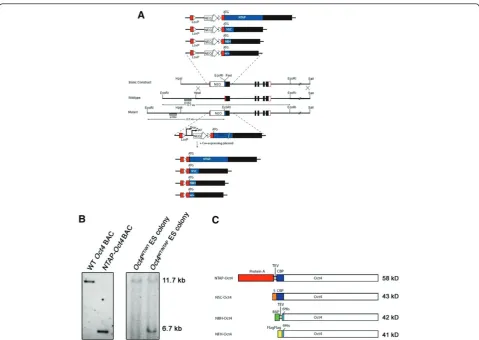
To look at Oct4 interacting proteins, we tagged the endo-genousOct4/Pou5f1locus via homologous recombination (Figure 1A). Four different mouse ES cell lines were gener-ated, each with two different affinity tags targeted to the N-terminal of Oct4. Targeting to the correct locus was verified by Southern blot analysis (Figure 1B) using a probe that lies outside the left homology arm (Figure 1A). The results show the presence of an expected shorter frag-ment of 6.7 kb coming from the tagged allele in addition to the 11.7-kb fragment from the unmodified allele for modified ES cells (Figure 1B). Correctly modified ES cells are annotatedOct4WT/TAG, and the proteins expressed are annotated NTAP-Oct4, NSC-Oct4, NFH-Oct4 and NBH-Oct4 (Figure 1C). The tagged NBH-Oct4 proteins that would be expressed from each of the cell lines have a span of various sizes, ranging from 41 kDa to 58 kDa, making the tagged proteins 3 kDa to 20 kDa bigger than Oct4.
Expression levels of the various tagged Oct4 proteins from each of the four cell lines were verified by Western blot analysis (Figures 2A through 2E). Expression was not observed until the neomycin cassette, which was inserted between the endogenousOct4promoter and the transla-tional start site ofNTAP-Oct4, was removed. The large differences between the tagged and wild-type Oct4 sizes in theOct4WT/NTAPcell line enabled us to examine the levels of tagged Oct4 relative to wild type using Oct4 anti-bodies. The levels are visually equivalent, confirming that the endogenously modifiedOct4gene retained normal levels of protein expression. It is unknown why a doublet is observed. One possibility is the posttranslational modifi-cation of Oct4, since this is also observed in the wild-type sample. For the small tagged Oct4 cell lines, loading an equal volume of total nuclear extract as wild-type ES cells produced comparable intensity when detected by anti-Oct4 antibody, suggesting that the level of anti-Oct4 is also unaltered (Figure 2B).
Expression of the tags was confirmed by using anti-S antibody (Figure 2C) and anti-FLAG antibody (Figure 2D) for the NSC-Oct4- and NFH-Oct4-expressing cell lines, respectively. For the NBH-Oct4 expressing cell line, detec-tion of the BAP tag was verified by using streptavidin (Figure 2E).
ES cells, suggesting that endogenous tagging does not affect ES cells.
NTAP-Oct4 cell line produces a lethal phenotype
Although all tagged ES cell lines performed equally well in culture, the ability of tagged Oct4 to drive the forma-tion of a whole animal was never verified. We checked for full Oct4 functionality by generating tagged Oct4 mice. Since large tags are more likely to affect protein function, we picked Oct4-tagged cell lines with the two largest tags, NTAP and NSC, for in vivo assessment. Mice were derived by blastocyst injection of the modi-fied ES cells, and chimeric mice were bred to obtain heterozygous and homozygous offspring. We obtained a
non-Mendelian ratio of live births for the offspring of
Oct4WT/NTAPcrosses. At two weeks of age, when mice
were genotyped, there was only one Oct4NTAP/NTAP
mouse (Table 1). This mouse died prior to sexual maturity. These results suggest that there was loss of function associated with the insertion of the NTAP tag at Oct4. Similar mating withOct4WT/NSC animals, how-ever, resulted in offspring at numbers close to expected ratios.c2testing of the data showed that the number of homozygous NSC-tagged pups obtained was consistent with the expected Mendelian ratio (Additional file 1). More importantly,Oct4NSC/NSChomozygous mice were viable and fertile, suggesting that the insertion of the NSC tag at Oct4 did not disrupt development. Since the
large NTAP tag was not tolerated in an in vivosystem, we proceeded with affinity purifications using only three of the four original cell lines:Oct4WT/NSC, Oct4WT/NFH andOct4WT/NBH. Given the even smaller size of the NFH and NBH tags and the identical position of tag insertion in all tag variants, we postulated that these two tag var-iants would also would not be deleterious to Oct4 func-tion as the NSC tag was.
Identification of Oct4 interacting proteins
In contrast to researchers in other studies, we identified Oct4 interacting proteins using four different affinity-tag purification approaches. The advantage of this method is that the protein interactors discovered are not limited
by the conditions of one approach. Western blot analy-sis of the purification was used to detect the tagged Oct4 following purification from OctWT/TAG or from wild-type ES cells as starting material. An example of purification for the S tag (Figure 2G) shows that Oct4 is enriched only in the tagged ES cell line, but not in the wild-type ES cell line. Detection using anti-S antibody confirmed the presence of the tag in the enriched Oct4, while detection for tubulin suggested a depletion of background protein after purification amid the enrich-ment of NSC-Oct4. Following affinity purification, elu-ates were separated by gel electrophoresis. Whole lanes were excised into multiple gel bands and subjected to further tryptic digestion and peptide identification by
Figure 2Modified ES cells show proper expression of both wild-type and affinity-tagged alleles.(A and B)Expression of NTAP-Oct4, NSC-Oct4 and NFH-Oct4 detected by anti-Oct4 shows amount of Oct4 equivalent to that found in wild-type ES cells.(C)Expression of NSC-Oct4 detected by anti-S antibody.(D)Expression of NFH-Oct4 detected by anti-FLAG antibody.(E)Expression of NBH-Oct4 was detected by using streptavidin-horseradish peroxidase (HRP). Wild-type ES cells were loaded as negative controls.(F)Alkaline phosphatase (AP) staining shows that modified ES cells are pluripotent like controlOct4WT/WTES cells.(G)S-tag affinity purification was performed onOct4WT/NSCES cells andOct4WT/WTES cells. Western blot
analysis was performed on the nuclear lysate (L) as well as on the unbound (U) fraction, the first wash (W1), the last wash (W4), the eluate (E) and the
boiled beads (B) after elution of the purification process. The marker sizes are indicated in kilodaltons. Anti-btubulin was used as a control.
Table 1 Number and percentage of pups belonging to each genotype as a result of mating heterozygotesa
Heterozygote mating
Oct4WT/NTAP
Oct4WT/NSC
Mating type Number (%) App Number (%) App
Wild-type pups (Oct4WT/WT) 25 (34.2%) WT 41 (27.7%) WT
Heterozygous pups (Oct4WT/TAG) 47 (64.4%) WT 82 (55.4%) WT
Homozygous pups (Oct4TAG/TAG) 1 (1.4%) † 25 (16.9%) WT
Total 73 (100%) 148 (100%)
a
LC-MS/MS. Raw MS/MS data were subjected to protein identification by searches using the mouse International Protein Index database (European Bioinformatics Insti-tute, Cambridge, UK). Only proteins identified in the overlap of two separate algorithm searches (Sequest and X!Tandem) were considered confident identifications and pursued for further analysis.
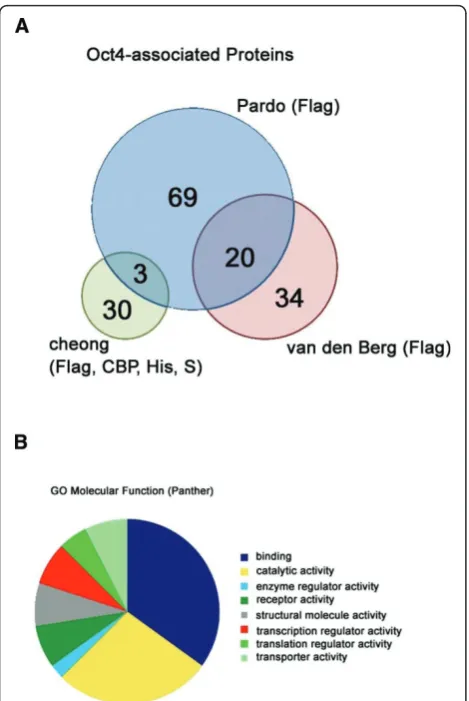
Although a true interactor may be found in only one of the four different approaches, we considered only proteins that were enriched by at least two approaches to keep the list robust. For better comparison with pre-vious publications, we also used the same cutoff value: Accepting proteins are not detected in the control puri-fications or are threefold the control puripuri-fications or greater. On the basis of these criteria, we compiled a list comprising 33 potential Oct4 interactors (Table 2 and Additional file 2). To compare proteins identified by using different approaches with those identified by FLAG-tag purification, we overlapped the proteins in our experiment with those described in two previous studies [26,27]. Those two studies represent the most current and largest sets of Oct4 interactors identified by purification of a FLAG-tagged Oct4 transgene. Only three of our proteins (cullin 4B, importin subunit a2 and DNA topoisomerase 2a) overlapped with the pro-teins described in the study published by Pardo et al. [26], while none of our proteins overlapped with those described in the study reported by van den Berget al. [27] (Figure 3A). Since the two previous studies showed 20 proteins that overlapped with each other, our pro-teins’degree of overlap with the proteins reported by Pardo et al. [26] is considerably smaller than that between studies using the same tag purifications. Con-sistent with this observation is that tandem purifications using two different tags resulted in only seven common proteins when results from a tandem FLAG-tag and CBP-tag purification were compared with those from a single FLAG-tag purification [26] and 30 proteins from a BAP-tag/FLAG-tag tandem affinity purification [28]. Hence, the tag used and the accompanying purification conditions change the type of interactors discovered, and the overlap is apparently small.
Oct4 interactors indicate Oct4 engagements with multiple cellular mechanisms
Of the 33 proteins, 24 were annotated by the PANTHER database [32] and are significantly enriched for proteins associated with binding activity [GO:5488] and catalytic activity [GO:3824] (Figure 3B). This suggests that pro-teins associated with Oct4 may determine its catalytic activity to Oct4-mediated regulation. Association with Oct4 could either lead to modifications of DNA and/or other proteins or of Oct4 itself. The exact catalytic activ-ities associated with our proteins include transcription
regulation, translation regulation, RNA splicing, helicase, kinase, ligase, GTPase, nucleotidyltranferase, oxidoreduc-tase and transferase activities (Table 3). These activities provide a hint of the possible mechanisms that Oct4 employs. To better understand the developmental impact of these Oct4-associated proteins, we combed the Mouse Genome Informatics database for the loss-of-function phenotypes associated with the genes of these proteins. Known developmental defects are present in approxi-mately 25% (9 of 33) of these interactors (Table 3). Aptly, all of the three transcription factors with loss-of-function phenotypes showed defects in fertility or inner cell mass formation, which is in agreement with the developmental stages in which Oct4 is known to be most essential [5,33,34]. Another six proteins not associated with tran-scription (Table 4) showed a range of phenotypes which could occur through either direct or indirect association with Oct4. Notably, Rad50 was a DNA repair protein that, in hypomorphic mutants, revealed a predisposition toward cancer, loss of spermatogenic stem cells and loss of hematopoietic stem cells. This suggests that Rad50 could facilitate Oct4 in its transcriptional regulatory role to control stem cell replication.
Novel transcriptional regulators coenriched with Oct4 As Oct4 is a transcription factor expected to interact with other transcription factors in a modular fashion to effect transcription regulation, we were most interested in the proteins with a role in transcription regulation. Five proteins, Fubp3, Fus, Psip1, Tardbp and Top2a, were annotated by the DAVID and/or PANTHER data-bases as proteins with a role in transcription regulation (Table 4). Of these five proteins, Top2a has been reported to be an Oct4 interactor [26], while the other four proteins have yet to be reported.
Discussion
Understanding the transcriptional regulatory role of Oct4 allows for the control of embryonic or induced pluripotent stem cell applications [35]. As a master regulator, Oct4 is already present in the unfertilized egg via maternal tran-scripts to modulate gene expression from the earliest stages of embryonic development. To coordinate gene reg-ulation both positively and negatively in the dynamic and temporal stages of development, Oct4 presumably must interact with multiple functional modules involved in dif-ferent areas of cellular regulation. Insights into such regu-latory mechanisms of Oct4 can come from understanding the Oct4 protein interaction network.
Table 2 Oct4-associated proteins using four different affinity tag approachesa
Gene name
Entrez Gene ID
Description Catalytic activity based on PANTHER CBP FLAG HIS S
Pou5f1 18999 POU domain, class 5, transcription factor 1 2.0 7.0 12.0 Exc
Cell cycle associated
Cdk1 12534 Cyclin-dependent kinase 1 Kinase 0.7 0.7 Exc Exc
Smc2 14211 Structural maintenance of chromosome 2 0.8 Exc Exc
Rad50 19360 RAD50 homolog (Saccharomyces cerevisiae) Exc Exc 1.3
Nup43 69912 Nucleoporin 43 Exc Exc 1.2
Metabolic processing
Trip12 14897 Thyroid hormone receptor interactor 12 9.0 Exc 0.5
Ribonucleoprotein complex
Ddx1 104721 DEAD (Asp-Glu-Ala-Asp) box polypeptide 1 Helicase, translation initiation 0.5 Exc Exc
Dhx15 13204 DEAH (Asp-Glu-Ala-His) box polypeptide 15 Helicase 0.6 3.0 22.5
Nop56 67134 Nucleolar protein 5A Exc Exc
RNA and protein transport and localization
Kpna2 16647 Karyopherin (importin)a2 Exc Exc
Nup93 71805 Nucleoporin 93 1.6 4.0 Exc
Nup85 445007 Nucleoporin 85 Transferase 3.5 Exc
Nop58 55989 Nucleolar protein 5 1.8 Exc Exc
Nup107 103468 Nucleoporin 107 3.3 Exc 0.8
Rcc1 100088 Regulator of chromosome condensation 1 Ligase, small GTPase regulator,
guanyl-nucleotide exchange factor
Exc 3.0
Thoc4 21681 THO complex 4 Exc Exc
Lbr 98386 Lamin B receptor Oxidoreductase Exc 3.5
Nup153 218210 Nucleoporin 153 Exc Exc
Nup155 170762 Nucleoporin 155 9.5 3.6 0.9
Tjp2 21873 Tight junction protein 2 2.0 Exc 0.5 Exc
Xpo1 103573 Exportin 1, CRM1 homolog (yeast) 3.0 Exc
RNA processing
Eftud2 20624 Elongation factor Tu GTP binding domain containing 2 Nucleotidyltransferase, GTPase, translation initiation and elongation
0.5 4.3 0.8 Exc
U2af2 22185 U2 small nuclear ribonucleoprotein auxiliary factor 2 Exc Exc
Syncrip 56403 Synaptotagmin binding, cytoplasmic RNA interacting protein
RNA splicing factor, transesterification mechanism
5.0 3.0
Signal transduction
Cul4b 72584 Cullin 4B Exc Exc
Rsu1 20163 Ras suppressor protein 1 Exc Exc
SWI/SNF Complex
Smarcd1 83797 SWI/SNF-related, matrix-associated, actin-dependent regulator of chromatin, subfamily d, member 1
1.0 6.0 1.0 Exc
Transcriptional regulation
Fubp3 320267 Far upstream element (FUSE) binding protein 3 3.3 4.0 Exc
Fus 233908 Fusion, derived from t(12;16) malignant liposarcoma RNA splicing factor, transesterification mechanism
Exc Exc
Pelp1 75273 Proline, glutamic acid and leucine rich protein 1 Exc Exc 0.6
Psip1 101739 PC4 and SFRS1 interacting protein 1 2.5 Exc 4.0
Tardbp 230908 TAR DNA binding protein RNA splicing factor, transesterification
mechanism
0.6 5.0 Exc 2.0
Top2a 21973 Topoisomerase (DNA) IIa 3.7 1.8 0.7 4.0
Translational regulation
Igf2bp1 140486 Insulin-like growth factor 2 mRNA binding protein 1 RNA splicing factor, transesterification mechanism
Exc Exc
a
work raises the concern that these changes would affect ES cells. Hence, there is a dilemma with regard to keeping the exogenous tagged Oct4 as low as possible to avoid changing cell fate and making it high so that the purifica-tion yield is better. Since our strategy does not change the
endogenous level of Oct4, we can have all the Oct4 pre-sent physiologically contribute to the purification yield. Indeed, we can get detectable Oct4 by using LC-MS/MS with a low starting material level of 400μg of nuclear extract to get a signal of 11 spectra for Oct4 in the tag purification and no signal in the wild-type control. This is a significant reduction compared to what is required (50 to 100 mg) when tagged Oct4 is expressed as a low per-centage of total Oct4 [36,37]. Also, since the endogenous Oct4 is modified, the presence of untagged Oct4 acting as a competitor for interactors is reduced.
While keeping Oct4 to its endogenous level is impor-tant, no previous study has addressed a separate concern that the tags used may impede the function of Oct4. We tested two different tags in animals and found that the classically used NTAP tag [38,39], comprising two pro-tein A and one calmodulin-binding propro-tein, prevents Oct4 from driving embryonic development normally. This information is especially useful for future work involving gene tagging in both in vitro and in vivo studies.
Three of four previous reports on Oct4 protein interac-tion network used the FLAG tag in their approach. The protein interactors found showed overlaps, lending confi-dence to what are identified as true Oct4 interactors. However, the use of a similar tag means that common contaminants raised from a specific affinity purification will also be repeatedly identified. Although tandem affinity tags have previously been used [26,28], the number of pro-teins found was lower than when single purifications are used, suggesting that the inclusion of different tags can produce a low overlap. One problem with tandem affinity purification is the loss of yield as the number of steps and experimentation time increase. To overcome this, we sim-ply performed the purifications using different tags on fresh ES cell samples and performedin silicotandem affi-nity purification instead. This method allowed us to dis-cover a total of 33 proteins using a low amount of starting material (400μg of nuclear extract) per purification.
In the online discussion by Pardo et al.[26] following his publications on Oct4 interactors, this study group suggested that heterogeneity in data sets can arise from the cell line, the tagging strategy and particularly the
Figure 3Profile of Oct4-associated protein.(A)Overlap of Oct4-associated proteins identified in three different studies. The three proteins that were shared between our Oct4 interactor lists, as well as the Oct4-associated proteins identified by Pardoet al.[26], were cullin 4B, importin subunita2 and DNA topoisomerase 2a. Cheong (present study); van den Berg [27].(B)Gene ontology molecular function of Oct4-associated protein according to the PANTHER database.
Table 3 Phenotypes for loss of function of Oct4-associated transcriptional regulators
Protein Biological process Loss-of-function phenotype
Psip1 Transcription factor activity (PANTHER) Perinatal death (survivors show reduced fertility)
Tardbp Transcription factor activity (PANTHER) Embryonic lethality before somite formation with impaired inner
cell mass proliferation Fus Positive regulation of transcription, DNA-dependent (DAVID),
transcription factor activity (PANTHER)
High neonatal mortality, and male sterility associated with lack of chromosomal pairing
purification procedure used. Therefore, to expand the list of interactors from the previous data sets, we tested whether we could find novel interactors that bind to Oct4 under different purification procedures using dif-ferent tags from difdif-ferent cell lines. Although our approach for protein extraction is similar to that of van den Berg et al., our purification procedure following protein extraction is different from those used in studies by both van den Berg et al. [27] and Pardoet al. [26]. Additionally, we included a different combination of tags for analysis. Using purification buffers for each affi-nity tag that differ by parameters including ionic charge, pH and the use of detergents, we intended to identify a group of Oct4 interactors that were robustly identified across varying conditions. These would be representative of stalwart Oct4 interactions that could occur despite the microenvironments that might arise in a cell. Also, by considering only interactors that remained bound to Oct4 under at least two different purification proce-dures, we ensured that these interactions were not an artefact of a specific purification procedure alone.
The focus of Oct4 interaction has been on chromatin modifiers and transcriptional factors. With the use of different approaches of purification, the majority of our proteins showed other catalytic activities in addition to transcriptional regulation. These include helicases, ligases and RNA processing. Oct4 may recruit these enzymes to modify itself or its associated proteins as an additional means of regulation. Consistent with this hypothesis is a report that Oct4 associates with the gly-cosylating enzyme Ogt [27], suggesting that posttransla-tional and splicing activities should not be overlooked in considering Oct4 function. Indeed, Oct4 and other tran-scription factors have been shown to regulate their activity viaO-GlcNAc modification [40-42]. Sumoylation of Oct4 has also been reported to enhance its stability, DNA binding and transactivation [43]. In a separate study, Oct4 was reported to be ubiquitinated by Wwp2, an E3 ubiquitin ligase [44]. Beyond modification of Oct4 activity levels, association with enzymes could give Oct4 the ability to modify DNA or other proteins. Potentially, associated helicases could be recruited to
Oct4-mediated transcriptional sites to keep the genome stable. In view of the fact that ES cells and embryos are both systems that require rapid DNA replication and tran-scription [45], there is a need for helicases to keep the genome stable when replication and transcriptional complexes collide [46].
In addition to transcription-related activities, Oct4 also affiliates with proteins involved in cell cycle regulation. Cdk1 has previously been established in an Oct4 interac-tion network [28] and is critical for the self-renewal of ES cells [47]. Because of the unique cell cycle phasing of ES cells with a short G1/S phase that promotes rapid prolif-eration [48-50], the coupling of Oct4 activity with cell cycle kinases such as Cdk1 may be necessary for rapid and direct coordination of genomic activity with cell division, failing which apoptosis may occur, as shown by ES cells depleted of Cdk1 [47]. A separate Oct4 interactor discov-ered in our study, Smc2, forms part of the condensins I and II protein complexes required for proper DNA com-paction during the interphase [51,52]. An RNA interfer-ence screen in ES cells identified Smc2 as a protein essential for proper chromosomal compaction in ES cells, and a deficiency in Smc2 results in metaphase arrest in these cells [53]. As ES cells are known to maintain much of their chromatin in a heterochromatin state [54], there is a significant role for Oct4 in mediating both epigenetic machinery and condensin complexes to enable the removal of activating histone modifications that can per-turb proper compaction for mitosis.
Cul4b has also previously been identified as an Oct4 interactor [26] and is an E3 ubiquitin ligase [55]. Interest-ingly, like Oct4, Cul4b is involved in Wnt signaling through its repression of nuclearb-catenin levels that can otherwise serve as a positive factor for differentiation [56]. Separately, Oct4 and Cul4b have also been shown to interact withb -catenin in immunoprecipitated complexes [56-58].
In addition to the role of Oct4 in cell cycle regulation and inhibition of differentiation through the Wnt path-way, it appears that Oct4 also associates with a number of proteins involved in nuclear transport. While Kpna2 is a previously known Oct4 interactor [59] itself, Kpna2 and another novel Oct4 interactor, Rcc1, are both
Table 4 Phenotypes for loss of function of Oct4-associated proteins that are not known to be transcriptional regulators
Gene Loss-of-function phenotype
Cdk1 Death prior to embryonic day 1.5
Igf2bp1 Increased neonatal lethality associated with multiple abnormalities Lbr Impaired growth and skin defects
Nup155 Embryonic lethality associated with atrial fibrillation
Rad50 Embryonic death. Hypomorphic mutant shows predisposition toward cancer and loss of spermatogenic and hematopoietic stem cells, leading to death.
specifically involved in the nuclear import of proteins [60]. In our study, various nucleoporins were also found to associate with Oct4, which suggests that a complex comprising nuclear pore proteins supporting factors such as Kpna2 and Rcc1 work in tandem with Oct4, although their imported cargo is as yet unclear. Given the known link between Rcc1 and chromatin [61], it is highly plausible that Oct4 utilizes Rcc1 as an intermedi-ary between the current chromatin state and the trans-port of necessary proteins for gene expression from their cytosolic compartment.
The diversity in function of novel and known Oct4 interactors identified in our work clearly highlights the need for a multifaceted approach for the completion of the Oct4 interaction network. We believe that our use of endogenous tagging methods and a combinedin silico analysis of identified proteins from different purification conditions serves as a resource for research in this direc-tion. While future work should include validation of the interactors and a detailed investigation into the molecular mechanism of each interactor, we are confident that our present findings are of great value in expanding our frame-work for understanding Oct4 interactions beyond tran-scriptional control alone.
Conclusions
In summary, we have used endogenously tagged Oct4 to study its interaction under physiological Oct4 levels. The use of multitag purification platforms allowed for a wide scope in the discovery of interactors. The proteins identi-fied in this study include novel transcription factor inter-actions and a demonstrated role for Oct4 in ES cells that involves catalytic activities other than transcriptional regulation.
Additional material
Additional file 1: Supplemental Table S1.c2testing of pups from heterozygote mating.
Additional file 2: Supplemental Table S2. Spectral counts of Oct4-associated proteins identified using four different affinity tag approaches.
Abbreviations
CV: column volume; ES: embryonic stem; NBH: N-terminal biotin acceptor peptide HIS; NFH: N-terminal FLAG HIS; NSC: N-terminal S peptide calmodulin-binding peptide; NTAP: N-terminal tandem affinity purification.
Acknowledgements
We thank Stephanie Lim Wai Lin for technical assistance in performing mass spectrometry and Chan Hsiao-Yun, Geraldine Leong and Petra Kraus for animal work done within the GIS-GAP facility. This work was supported by the Agency for Science, Technology and Research (Singapore).
Author details
1
Stem Cell and Developmental Biology Group, Genome Institute of Singapore, 60 Biopolis Street, 138672, Singapore.2Proteomics, Genome
Institute of Singapore, 60 Biopolis Street, 138672, Singapore.3Computational
and Mathematical Biology, Genome Institute of Singapore, 60 Biopolis Street, 138672, Singapore.
Authors’contributions
CYC participated in the design of the study, carried out the experimentation, helped in the interpretation of the results and helped to draft the manuscript. PMLN carried out the experimentation, helped in the
interpretation of the results and helped to draft the manuscript. RP and HHT carried out the experimentation. GB participated in the interpretation of the data. TL conceived of the study, participated in its design and coordination and helped to draft the manuscript. All authors read and approved the final manuscript.
Competing interests
The authors declare that they have no competing interests.
Received: 31 January 2011 Revised: 5 April 2011 Accepted: 13 May 2011 Published: 13 May 2011
References
1. Schöler HR, Dressler GR, Balling R, Rohdewohld H, Gruss P:Oct-4: a germline-specific transcription factor mapping to the mouse t-complex.
EMBO J1990,9:2185-2195.
2. Okamoto K, Okazawa H, Okuda A, Sakai M, Muramatsu M, Hamada H:A novel octamer binding transcription factor is differentially expressed in mouse embryonic cells.Cell1990,60:461-472.
3. Schöler HR, Hatzopoulos AK, Balling R, Suzuki N, Gruss P:A family of octamer-specific proteins present during mouse embryogenesis: evidence for germline-specific expression of an Oct factor.EMBO J1989,
8:2543-2550.
4. Boiani M, Schöler HR:Regulatory networks in embryo-derived pluripotent stem cells.Nat Rev Mol Cell Biol2005,6:872-884.
5. Nichols J, Zevnik B, Anastassiadis K, Niwa H, Klewe-Nebenius D, Chambers I, Schöler H, Smith A:Formation of pluripotent stem cells in the mammalian embryo depends on the POU transcription factor Oct4.Cell 1998,95:379-391.
6. Niwa H, Miyazaki J, Smith AG:Quantitative expression of Oct-3/4 defines differentiation, dedifferentiation or self-renewal of ES cells.Nat Genet 2000,24:372-376.
7. Shimozaki K, Nakashima K, Niwa H, Taga T:Involvement of Oct3/4 in the enhancement of neuronal differentiation of ES cells in neurogenesis-inducing cultures.Development2003,130:2505-2512.
8. Feng B, Jiang J, Kraus P, Ng JH, Heng JC, Chan YS, Yaw LP, Zhang W, Loh YH, Han J, Vega B, Cacheux-Rataboul V, Lim B, Lufkin T, Ng HH:
Reprogramming of fibroblasts into induced pluripotent stem cells with orphan nuclear receptor Esrrb.Nat Cell Biol2009,11:197-203.
9. Chang CW, Lai YS, Pawlik KM, Liu K, Sun CW, Li C, Schoeb TR, Townes TM:
Polycistronic lentiviral vector for“hit and run”reprogramming of adult skin fibroblasts to induced pluripotent stem cells.Stem Cells2009,
27:1042-1049.
10. Takahashi K, Yamanaka S:Induction of pluripotent stem cells from mouse embryonic and adult fibroblast cultures by defined factors.Cell2006,
126:663-676.
11. Niwa H:How is pluripotency determined and maintained?Development 2007,134:635-646.
12. Smith AG:Embryo-derived stem cells: of mice and men.Annu Rev Cell Dev Biol2001,17:435-462.
13. Nakagawa M, Koyanagi M, Tanabe K, Takahashi K, Ichisaka T, Aoi T, Okita K, Mochiduki Y, Takizawa N, Yamanaka S:Generation of induced pluripotent stem cells without Myc from mouse and human fibroblasts.Nat Biotechnol2008,26:101-106.
14. Yamanaka S:A fresh look at iPS cells.Cell2009,137:13-17. 15. Okita K, Ichisaka T, Yamanaka S:Generation of germline-competent
induced pluripotent stem cells.Nature2007,448:313-317.
16. Wernig M, Meissner A, Foreman R, Brambrink T, Ku M, Hochedlinger K, Bernstein BE, Jaenisch R:In vitroreprogramming of fibroblasts into a pluripotent ES-cell-like state.Nature2007,448:318-324.
18. Chen X, Xu H, Yuan P, Fang F, Huss M, Vega VB, Wong E, Orlov YL, Zhang W, Jiang J, Loh YH, Yeo HC, Yeo ZX, Narang V, Govindarajan KR, Leong B, Shahab A, Ruan Y, Bourque G, Sung WK, Clarke ND, Wei CL, Ng HH:Integration of external signaling pathways with the core transcriptional network in embryonic stem cells.Cell2008,133:1106-1117. 19. Sharov AA, Masui S, Sharova LV, Piao Y, Aiba K, Matoba R, Xin L, Niwa H,
Ko MS:Identification ofPou5f1, Sox2, andNanogdownstream target genes with statistical confidence by applying a novel algorithm to time course microarray and genome-wide chromatin immunoprecipitation data.BMC Genomics2008,9:269.
20. Sridharan R, Tchieu J, Mason MJ, Yachechko R, Kuoy E, Horvath S, Zhou Q, Plath K:Role of the murine reprogramming factors in the induction of pluripotency.Cell2009,136:364-377.
21. Loh YH, Wu Q, Chew JL, Vega VB, Zhang W, Chen X, Bourque G, George J, Leong B, Liu J, Wong KY, Sung KW, Lee CW, Zhao XD, Chiu KP, Lipovich L, Kuznetsov VA, Robson P, Stanton LW, Wei CL, Ruan Y, Lim B, Ng HH:The Oct4 and Nanog transcription network regulates pluripotency in mouse embryonic stem cells.Nat Genet2006,38:431-440.
22. Wang ZX, Teh CH, Kueh JL, Lufkin T, Robson P, Stanton LW:Oct4 and Sox2 directly regulate expression of another pluripotency transcription factor, Zfp206, in embryonic stem cells.J Biol Chem2007,282:12822-12830. 23. Okumura-Nakanishi S, Saito M, Niwa H, Ishikawa F:Oct-3/4 and Sox2
regulateOct-3/4gene in embryonic stem cells.J Biol Chem2005,
280:5307-5317.
24. Rodda DJ, Chew JL, Lim LH, Loh YH, Wang B, Ng HH, Robson P:
Transcriptional regulation ofNanogby OCT4 and SOX2.J Biol Chem 2005,280:24731-24737.
25. Liang J, Wan M, Zhang Y, Gu P, Xin H, Jung SY, Qin J, Wong J, Cooney AJ, Liu D, Songyang Z:Nanog and Oct4 associate with unique transcriptional repression complexes in embryonic stem cells.Nat Cell Biol2008,
10:731-739.
26. Pardo M, Lang B, Yu L, Prosser H, Bradley A, Babu MM, Choudhary J:An expanded Oct4 interaction network: implications for stem cell biology, development, and disease.Cell Stem Cell2010,6:382-395.
27. van den Berg DL, Snoek T, Mullin NP, Yates A, Bezstarosti K, Demmers J, Chambers I, Poot RA:An Oct4-centered protein interaction network in embryonic stem cells.Cell Stem Cell2010,6:369-381.
28. Wang J, Rao S, Chu J, Shen X, Levasseur DN, Theunissen TW, Orkin SH:A protein interaction network for pluripotency of embryonic stem cells.
Nature2006,444:364-368.
29. Lemischka IR:Hooking up with Oct4.Cell Stem Cell2010,6:291-292. 30. Eggan K, Akutsu H, Loring J, Jackson-Grusby L, Klemm M, Rideout WM,
Yanagimachi R, Jaenisch R:Hybrid vigor, fetal overgrowth, and viability of mice derived by nuclear cloning and tetraploid embryo
complementation.Proc Natl Acad Sci USA2001,98:6209-6214.
31. Lufkin T, Dierich A, LeMeur M, Mark M, Chambon P:Disruption of the Hox-1.6homeobox gene results in defects in a region corresponding to its rostral domain of expression.Cell1991,66:1105-1119.
32. Thomas PD, Campbell MJ, Kejariwal A, Mi H, Karlak B, Daverman R, Diemer K, Muruganujan A, Narechania A:PANTHER: a library of protein families and subfamilies indexed by function.Genome Res2003,
13:2129-2141.
33. Hall J, Guo G, Wray J, Eyres I, Nichols J, Grotewold L, Morfopoulou S, Humphreys P, Mansfield W, Walker R, Tomlinson S, Smith A:Oct4 and LIF/ Stat3 additively induce Krüppel factors to sustain embryonic stem cell self-renewal.Cell Stem Cell2009,5:597-609.
34. Okamura D, Tokitake Y, Niwa H, Matsui Y:Requirement of Oct3/4 function for germ cell specification.Dev Biol2008,317:576-584.
35. Amabile G, Meissner A:Induced pluripotent stem cells: current progress and potential for regenerative medicine.Trends Mol Med2009,15:59-68. 36. Wang J, Cantor AB, Orkin SH:Tandem affinity purification of protein
complexes in mouse embryonic stem cells using in vivo biotinylation.
Curr Protoc Stem Cell Biol2009,Chapter 1:Unit1B.5.
37. Kim J, Cantor AB, Orkin SH, Wang J:Use ofin vivobiotinylation to study protein-protein and protein-DNA interactions in mouse embryonic stem cells.Nat Protoc2009,4:506-517.
38. Li Y:Commonly used tag combinations for tandem affinity purification.
Biotechnol Appl Biochem2010,55:73-83.
39. Xu X, Song Y, Li Y, Chang J, Zhang H, An L:The tandem affinity purification method: an efficient system for protein complex purification and protein interaction identification.Protein Expr Purif2010,72:149-156.
40. Kuo M, Zilberfarb V, Gangneux N, Christeff N, Issad T:O-GlcNAc modification of FoxO1 increases its transcriptional activity: a role in the glucotoxicity phenomenon?Biochimie2008,90:679-685.
41. Issad T, Kuo M:O-GlcNAc modification of transcription factors, glucose sensing and glucotoxicity.Trends Endocrinol Metab2008,19:380-389. 42. Webster DM, Teo CF, Sun Y, Wloga D, Gay S, Klonowski KD, Wells L,
Dougan ST:O-GlcNAc modifications regulate cell survival and epiboly during zebrafish development.BMC Dev Biol2009,9:28.
43. Wei F, Schöler HR, Atchison ML:Sumoylation of Oct4 enhances its stability, DNA binding, and transactivation.J Biol Chem2007,
282:21551-21560.
44. Xu HM, Liao B, Zhang QJ, Wang BB, Li H, Zhong XM, Sheng HZ, Zhao YX, Zhao YM, Jin Y:Wwp2, an E3 ubiquitin ligase that targets transcription factor Oct-4 for ubiquitination.J Biol Chem2004,279:23495-23503. 45. Koledova Z, Kafkova LR, Calabkova L, Krystof V, Dolezel P, Divoky V:Cdk2
inhibition prolongs G1 phase progression in mouse embryonic stem cells.Stem Cells Dev2010,19:181-194.
46. Pomerantz RT, O’Donnell M:What happens when replication and transcription complexes collide?Cell Cycle2010,9:2535-2541.
47. Zhang WW, Zhang XJ, Liu HX, Chen J, Ren YH, Huang DG, Zou XH, Xiao W:
Cdk1 is required for the self-renewal of mouse embryonic stem cells.J Cell Biochem2011,112:942-948.
48. Burdon T, Smith A, Savatier P:Signalling, cell cycle and pluripotency in embryonic stem cells.Trends Cell Biol2002,12:432-438.
49. Fluckiger AC, Marcy G, Marchand M, Négre D, Cosset FL, Mitalipov S, Wolf D, Savatier P, Dehay C:Cell cycle features of primate embryonic stem cells.Stem Cells2006,24:547-556.
50. Becker KA, Ghule PN, Therrien JA, Lian JB, Stein JL, van Wijnen AJ, Stein GS:
Self-renewal of human embryonic stem cells is supported by a shortened G1 cell cycle phase.J Cell Physiol2006,209:883-893. 51. Losada A, Hirano T:Dynamic molecular linkers of the genome: the first
decade of SMC proteins.Genes Dev2005,19:1269-1287.
52. Belmont AS:Mitotic chromosome structure and condensation.Curr Opin Cell Biol2006,18:632-638.
53. Fazzio TG, Panning B:Condensin complexes regulate mitotic progression and interphase chromatin structure in embryonic stem cells.J Cell Biol 2010,188:491-503.
54. Mattout A, Meshorer E:Chromatin plasticity and genome organization in pluripotent embryonic stem cells.Curr Opin Cell Biol2010,22:334-341. 55. Jackson S, Xiong Y:CRL4s: the CUL4-RING E3 ubiquitin ligases.Trends
Biochem Sci2009,34:562-570.
56. Tripathi R, Kota SK, Srinivas UK:Cullin4B/E3-ubiquitin ligase negatively regulatesβ-catenin.J Biosci2007,32:1133-1138.
57. Takao Y, Yokota T, Koide H:β-catenin up-regulates Nanog expression through interaction with Oct-3/4 in embryonic stem cells.Biochem Biophys Res Commun2007,353:699-705.
58. Abu-Remaileh M, Gerson A, Farago M, Nathan G, Alkalay I, Zins Rousso S, Gur M, Fainsod A, Bergman Y:Oct-3/4 regulates stem cell identity and cell fate decisions by modulating Wnt/β-catenin signalling.EMBO J2010,
29:3236-3248.
59. Li X, Sun L, Jin Y:Identification of karyopherin-α2 as an Oct4 associated protein.J Genet Genomics2008,35:723-728.
60. Richards SA, Carey KL, Macara IG:Requirement of guanosine triphosphate-bound ran for signal-mediated nuclear protein export.Science1997,
276:1842-1844.
61. England JR, Huang J, Jennings MJ, Makde RD, Tan S:RCC1 uses a conformationally diverse loop region to interact with the nucleosome: a model for the RCC1-nucleosome complex.J Mol Biol2010,398:518-529.
doi:10.1186/scrt67