Applications of Dynamic Program Analysis in a CRM
Process: A Futuristic Concept
Debabrata Das, Prasenjit Kundu
Abstract- Being a much talked about topic in today‟s business
environment, Customer Relationship Management is an area of modern marketing management where there is wide scope for conceptual and empirical research. Recent empirical study has resulted in the development of a CRM process model viz; PREMASA Model, which attempts to integrate the aspects of relationship marketing with consumer behaviour by incorporating the concept of cognitive dissonance. Implementing PREMASA model requires lots of practical considerations including developing an application software program which can measure, track, store and retrieve key parameters related with CRM. In this paper, first a measurement module which will be an important part of future CRM software , has been conceptualized and then applying the concept of software reverse engineering and dynamic program analysis a conceptual process has been developed through which the proposed measurement module can be inserted into an existing CRM software without altering its execution at runtime.
Index Terms- customer relationship management, customer satisfaction, PREMASA model, dynamic program analysis, measurement of cognitive dissonance.
I. INTRODUCTION
esearch on CRM has confined itself on service quality enhancement and betterment of post purchase customer service etc but the effect of consumer behaviour on CRM has been ignored. Major research on CRM has only a single purpose and that is to provide a managerially useful, end-to-end view of the CRM process from a management perspective [1]. In other words, these models focus what the managers need to know about their customers and how that information should be used to develop a complete CRM process[2].All these models are excellent tools for practicing marketing managers but it lacks the framework on the basis of which marketing analysts and researchers can further improve the CRM process because no such serious effort has been made to explore the relation between consumer behaviour and CRM and also the effect of consumer behaviour on CRM. Recent empirical research with an objective to identify the key factors on which the market and customer relationship depends in services marketing scenario resulted in developing a new model on customer relationship management and this model is PREMASA model[3].PREMASA model proposes a detailed step by step process in which the level of cognitive dissonance of the consumers need to be measured at certain steps and at certain time intervals to create a cognitive dissonance (CD) profile of the customers and positive
reinforcements need to be administered to the customers in order to minimize their post purchase dissonance and thus building customers‟ trust, creating satisfaction and ensuring their loyalty & commitment. PREMASA model stresses on developing knowledge repositories in which the customer related data including the cognitive dissonance profiles should be stored for future analysis and application. Dynamic program analysis is the analysis of computer software which is performed by executing programs built from that software system to predict the behaviour of the system as well as to fine tune performance. Dynamic analysis produces output, or feeds into a subsequent analysis, that enables human understanding of the code and makes the design and testing task easy for the developers. This paper shows a roadmap through which PREMASA Model can be applied in actual practice. This paper also integrates the concepts of marketing management with software engineering thus making a synergistically relevant attempt to pave the way for practical applications of IT in marketing. Application of dynamic program analysis makes the concepts developed in this paper perfect for implementation level algorithm development in future.
II. PREMASA MODEL : A PARADIGM SHIFT IN CRM
PREMASA model proposes total eight steps. Some of these steps have only one activity & some steps have several activities. Out of these ten activities some are needed to be performed simultaneously & some are needed to be performed sequentially. The model is multi dimensional in nature because some of the activities are simultaneous & some of these activities are sequential. The model integrates these sequential & simultaneous activities into eight steps. The steps 4 & 5 have two simultaneous activities each and activities A4 & A4' as well as the activities A5 and A5' are needed to be performed simultaneously. All these ten activities have been arranged into five categories of phases & these are as follows:-
Activity A1 & A2 fall into Preparation Phase. Activity A3, A4, & A4' fall into Measurement Phase. Activity A5 & A5' fall into Action Phase.
Activity A6 falls into Satisfaction Phase. Activity A7 & A8 fall into Application Phase.
The categorization of the activities in five phases has been done on the basis of the tasks performed by the activities. Another important basis of categorization of activities into five unique phases is that activities are grouped together as per their time of execution. Each phase denotes a unique period of time
R
International Journal of Scientific and Research Publications, Volume 2, Issue 4, April 2012 2 ISSN 2250-3153
Fig.1 The PREMASA Model when the activity /activities within that phase are needed to be
performed [3]. Fig.1shows the interrelationship of the activities, steps and phases of the PREMASA model.
In traditional CRM software there is no option to measure the cognitive dissonance and satisfaction levels of the customers and that is why the activities mentioned in the measurement and
action phase of the PREMASA model need to be integrated and arrangements must be made so that these activities can be done through a CRM software.
III. DEVELOPING THE MEASUREMENT MODULE
According to the PREMASA model, in the Measurement Phase the marketer should start measuring the cognitive dissonance level of the customers just after the sale & should continue the process in periodic intervals. In the Action Phase the marketer should introduce some positive reinforcement related to the existing services as added incentives or benefits to the customers so that the customers can be able to reduce their dissonance regarding their purchase. In this phase the marketer should create a cognitive dissonance (CD) profile of the customers on the basis of the measurement done in the previous phase [3]. The measurement module is the part of the proposed CRM software package which follows the PREMASA model guidelines to measure cognitive dissonance of the customers. As specified in the PREMASA model, the cognitive dissonance should be measured in regular intervals i.e. it should be measured in a time dependent longitudinal study. This module must create a cognitive dissonance profile of the customers by comparing the values of cognitive dissonance at different point of time as well as by correlating it with the values of customer satisfaction. Research shows that high level of cognitive dissonance results low levels of customer satisfaction but it also outlines that lowering the cognitive dissonance levels may or may not increase the level of customer satisfaction[4].Researchers also believe that to counter such dissonance, the marketer‟s after sale communications should provide evidence and support to help consumers feel good about their brand choices[5].That is why PREMASA model proposes that the marketer should introduce some positive reinforcement related to the existing services as added incentives or benefits to the customers so that the customers can be able to reduce their dissonance regarding their purchase[3]. Recent empirical study on customer satisfaction in banking services in India has identified key factors of the extended Ps of services marketing i.e. People, Process and Physical Evidence on which the customer satisfaction depends [6]. According to this study the identified factors of 3Ps are as follows:
In terms of People (the 5th P)
i) Employees‟ knowledge about services factor. (Pe₁)
ii) Employees‟ attitude and behaviour factor. (Pe₂)
iii) Employees‟ service delivery efficiency factor. (Pe₃) In terms of Process (the 6th P)
i).Time saving factor. (Pr₁)
ii). Convenience factor. (Pr₂)
In terms of Physical Evidence (the 7th P)
i). Ambience and environmental conditions factor. (Ph₁)
ii). Layout and functionality factor. (Ph₂)
iii). Location factor. (Ph₃)
This study shows that customer satisfaction can be determined using the following algebraic equations:-
Spe = -0.938 + 0.367Pe₁ + 0.459Pe₂ + 0.311Pe₃---- (1)
Spr = -0.510 + 0.571Pr₁ + 0.494 Pr₂ --- (2)
Sph = -1.118 + 0.391Ph₁ + 0.477Ph₂ + 0.292Ph₃ -- (3) S = -1.171 + 0.369 Spe + 0.532Spr + 0.253Sph---- (4)
Where, Spe = Customer„s satisfaction based on the overall impression he or she has of the employees of the bank; Spr = Customer„s satisfaction based on the overall impression he or she has of the various processes of the bank through which the bank delivers customer services; Sph = Customer„s satisfaction based on the overall impression he or she has of the physical evidences present in the bank; S = Customer„s overall satisfaction on the services of the bank. Pe₁, Pe₂, Pe₃, Pr₁, Pr₂, Ph₁, Ph₂, Ph₃ are
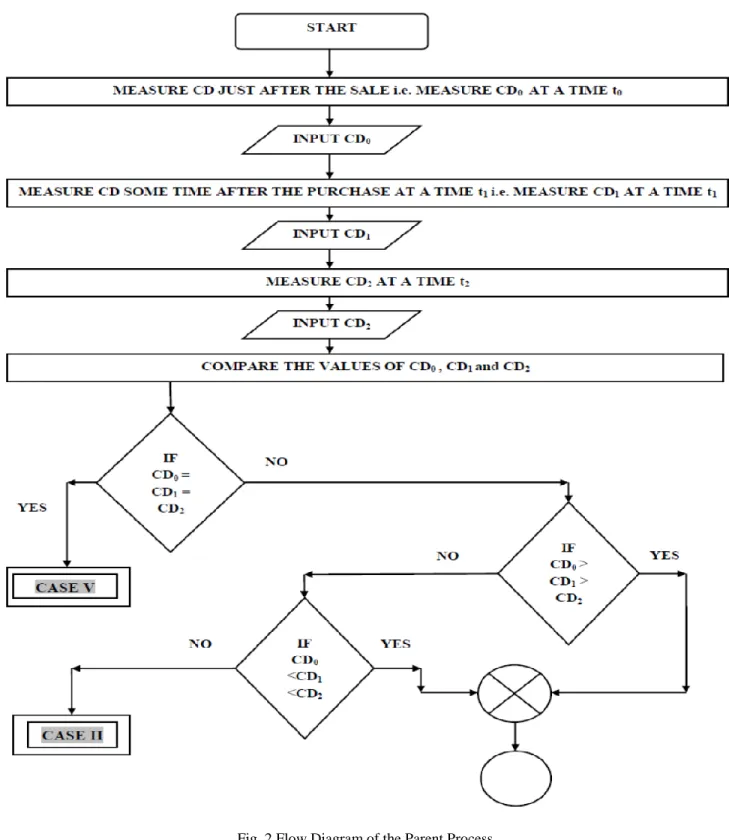
the independent variable indicating customer„s satisfaction on the basis of the identified factors of people, process and physical evidence[6].The proposed measurement module should measure customer satisfaction using equation (1), (2), (3) and (4). Based on this logic the conceptual process within the measurement module has been developed. There is a parent process which first measures the cognitive dissonance of the customers at three different time intervals:
(1) It measures cognitive dissonance just after the purchase i.e. at time t0 and labels it as CD0 ;
(2)It again measures CD at time t1 and labels it as CD1 ; and lastly
(3) It measures CD at time t2 and labels it as CD2.
Next it checks the variations in the values of CD at different time intervals and segregates the customers in four different categories like
(1) Category I: Customers whose CD level is decreasing continuously i.e. CD0>CD1>CD2 ;
(2) Category II: Customers whose CD level is increasing continuously i.e. CD0<CD1<CD2 ;
(3) Category III: Customers whose CD level is same at different time intervals i.e. CD0=CD1=CD2 and
(4) Category IV: Customers whose CD level varies across different time intervals but not in the same ways like CD0>CD1>CD2 or CD0<CD1<CD2 i.e. all other cases except CD0>CD1>CD2, CD0<CD1<CD2 and CD0=CD1=CD2.
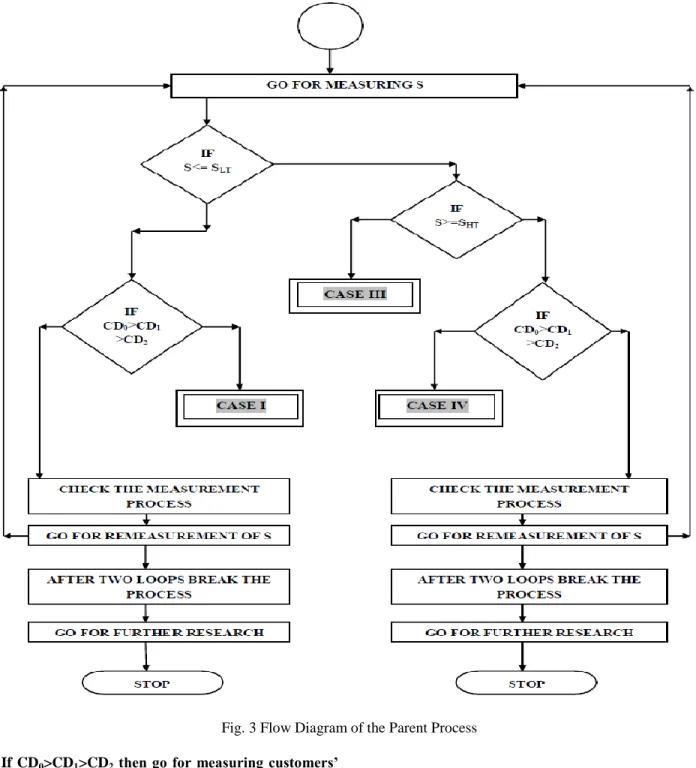
Based on this categorization the parent process concludes to five different end points and from these end points, five child process starts which completes the measurement process of CD and customer satisfaction and creates CD profile of the customers and in some cases suggests conducting further research (Ref.Fig.2 & Fig.3) The parent process uses the following operational logic and gives birth five child processes:
International Journal of Scientific and Research Publications, Volume 2, Issue 4, April 2012 4 ISSN 2250-3153
Fig. 3 Flow Diagram of the Parent Process
Logic I: If CD0>CD1>CD2 then go for measuring customers’
satisfaction S
Sub Logic I: If S is low then go for further research.
Sub Logic II: If S is high, administer positive reinforcement.
Logic II: If CD0<CD1<CD2 then go for measuring customers’
satisfaction S
Sub Logic I: If satisfaction S is low, administer positive reinforcement.
Sub Logic II: If satisfaction S is high, check the measurement process and go for remeasurement.
Sub Logic III: If satisfaction S is at medium level, go for positive reinforcement.
Logic III: If CD0=CD1=CD2 , go for administering positive
International Journal of Scientific and Research Publications, Volume 2, Issue 4, April 2012 6 ISSN 2250-3153
Fig.4 Flow Diagram of the 1st Child Process The five different cases that denote five different child processes
are as follows:-
Case I: Low level of satisfaction S but CD level is increasing over the time.
Case II: All other cases except CD0>CD1>CD2,
CD0<CD1<CD2 and CD0=CD1=CD2
Case III: Medium level of satisfaction S.
Case IV: High level of S but CD level is decreasing over the time.
Case V: CD at same level over the time i.e. CD0=CD1=CD2
International Journal of Scientific and Research Publications, Volume 2, Issue 4, April 2012 8 ISSN 2250-3153
International Journal of Scientific and Research Publications, Volume 2, Issue 4, April 2012 10 ISSN 2250-3153
Fig.9 Program Instrumentation The child processes also conceive the idea of threshold in
measuring customer satisfaction level. Based on the equations (1), (2), (3) and (4) , customer satisfaction level can be measured and based on the actual data a lower and higher threshold level of customer satisfaction ( SLT and SHT) can be introduced in the measurement logic. If satisfaction level goes below SLT , it means the customers are actually dissatisfied with the service. On the other hand if satisfaction level increases above SHT , it means that customers are completely satisfied and firms don‟t need to do anything more to please the customers. If S goes below SLT, it is basically a warning signal for the firms because dissatisfied customers may shift their loyalty to other competitors (Ref.Fig.4, Fig.5, Fig.6, Fig.7, and Fig.8).
IV. OPTIMIZATION OF CRM SOFTWARE USING DYNAMIC PROGRAM ANALYSIS
Dynamic program analysis is the analysis of computer software that is performed by executing programs built from that software system on a real time basis. For dynamic program analysis to be effective, the target program must be executed with sufficient test inputs to extract and produce interesting behaviour.Dynamic program analysis helps to make a computational system reason automatically (or at least with little human assistance) about the behaviour of a program and draws conclusions that are useful to help the software developers to determine exploitability of vulnerabilities or to rapidly develop an exploit code[7].Dynamic analysis produces output, or feeds into a subsequent analysis, that enables human understanding of the code and makes the design and testing task easy for the developers. Dynamic program analysis approach attempts to tune the application software during execution without stopping, recompiling or even rerunning the application. To achieve this objective it is necessary to use dynamic instrumentation techniques that allow the modification of the application code on the fly [8]. (Ref.Fig.9).
Program instrumentation is a general way to understand what an executing program is doing[9].The principle of dynamic program
instrumentation involves deferring program instrumentation until it is in execution and then inserts, alter and delete this instrumentation dynamically during the actual program execution. The Paradyn group at the University of Wisconsin and University of Maryland first used this approach to develop a special API that supports dynamic instrumentation and the result of their work was called DynInst API. DynInst is an API for runtime code patching that provides a C++ class library for machine independent program instrumentation during application execution. It allows attaching to an already running process or starting a new process, creating a new piece of code and finally inserting created code into the running process. The next time the instrumented program executes the modified block of code i.e. the new code is executed and the program being modified is able to continue its execution and does not require to be recompiled, re linked or restarted [8].Now the proposed Measurement Module is needed to be inserted within the existing CRM software by using dynamic program instrumentation by performing the program instrumentation on the binary at runtime. It will eliminate the need to modify or recompile the application‟s source and it will also support the instrumentation of programs that dynamically generate code[10].Research shows that it is also possible to change instrumentation at any time during execution by modifying the application‟s binary image[11].Since dynamic program analysis is being used to modify an existing software system (CRM package) to make it more powerful and updated, program optimization is the desirable option to achieve faster execution, less memory storage and to draw less power. Dynamic analysis is preferred rather than static analysis for this proposed framework because it has the following advantages [12]:-
It identifies vulnerabilities in a runtime environment.
Automated tools provide flexibility on what to scan for.
It allows for analysis of applications in which the actual code is inaccessible.
It identifies vulnerabilities that might have been false negatives in the static code analysis.
International Journal of Scientific and Research Publications, Volume 2, Issue 4, April 2012 12 ISSN 2250-3153
Fig.10 Insertion of Measurement Module within CRM Software through Program Instrumentation
It permits the developer to validate static code analysis findings.
It can be conducted in virtually any application.
In fig.10, within the measurement module there are a total of six processes and one of them is the Parent Process (PP) and other five are the Child Processes (CP 1 , CP 2 , CP 3 , CP 4 , CP 5 ).The dynamic program instrumentation shall insert the measurement module within the business entity components without hampering the current execution of the software package. The alteration and updating will be performed on real time basis and during the actual runtime of the CRM software. When finished, the updated package will contain the measurement module and it can perform the predefined task (Ref.Fig.10).
V. LIMITATION & FUTURE DIRECTIONS
First, the logic developed to construct the measurement module need to be universally validated through more empirical
research. Secondly, the parent process and the five child processes constructed actually denote the logical process flow but these do not represent the actual codes that can be implemented as a software program. Thirdly, PREMASA model stresses on measuring cognitive dissonance of the customers and also it gives utmost importance in incorporating the concepts of cognitive dissonance into a CRM process but PREMASA model is silent regarding how the cognitive dissonance of the customers can be measured in practice. The measurement module developed in this paper follows the PREMASA model and also proposes to measure cognitive dissonance levels of the customers but does not tell about how it will be measured. So empirical research is required to construct a quantitative framework through which the cognitive dissonance of the customers can be measured and then only the measurement module can be able to do its work in practice. Fourthly, the dynamic program analysis and program instrumentation is still at the nascent stage and actual application in practice is an uphill task due to lack of
efficient and faster program optimization techniques. Future conceptual and empirical research should address the above limitations.Irrespective of the above limitations the concept and logic developed and outlined in this paper are unique in the sense that this paper focuses on embedding an external component in an existing CRM software package without altering or hampering the normal execution of the software at runtime. Researchers have already proposed to develop CRM processes as services using the concept of Service Oriented Architecture (SOA) [13], and the concept developed in this paper will definitely add value to this work. It will also open up many avenues of research in this domain in future and it will pave the way for practical applications of IT in marketing.
REFERENCES
[1] E.W.T.Ngai, “Customer relationship management research (1992-2002): An academic literature review and classification,” Marketing Intelligence & Planning, vol. 23, no. 6, pp.582 – 605, 2005.
[2] R.S. Winer, “Customer Relationship Management: A Framework, Research Directions, and the Future,”2001. Retrieved January 12, 2012, from
http://groups.haas.berkeley.edu/fcsuit/PDF-papers/CRM%20paper.pdf
[3] D.Das, “PREMASA Model: An Integrated Approach To Customer Relationship Management,” IEM International Journal of Management & Technology, vol.2, no.1, pp. 111-118, Jan.2012.
[4] J. C .Sweeney, G. N. Soutar, L. W .Johnson, “Are Satisfaction and Dissonance the same Construct? A preliminary Analysis,” Journal of Consumer Satisfaction, Dissatisfaction and Complaining Behavior, vol.9, pp 138-143, 1996.
[5] L.G. Schiffman, & L.L. Kanuk, Consumer Behavior. New Delhi: Pearson, 2007, pp.284-285.
[6] D.Das, “An Empirical Study To Build A Theoretical Framework That Can Determine Customer Satisfaction In Terms Of People, Process & Physical Evidence,” in Service Marketing Practices in India: Changing Paradigms, S. Saibaba, A. Santikary, & P.K. Mohanty, Eds. Hyderabad: SSIM,2012, pp. 135–143.
[7] R.R. Branco, “Dynamic Program Analysis and Software Exploitation: From the crash to the exploit code,”2011. Retrieved January 15, 2012, from
http://www.troopers.de/wp-content/uploads/2011/04/TR11_Branco_Dynamic_program_analysis.pdf
[8] E. Cesar, A. Morajko, T. Margalef, J. Sorribes, A. Espinosa, E. Luque, “Dynamic performance tuning supported by program specification,” in Performance oriented application development for distributed architectures, M.Gerndt, Ed. Amsterdam: IOS Press, 2002, pp. 35-44. [9] R.E .Ladner, R.Fortna, B.H. Nguyen, “A Comparison of Cache Aware and
Cache Oblivious Static Search Trees Using Program Instrumentation,” in Experimental algorithmics: from algorithm design to robust and efficient software, R.Fleischer, B. M. E. Moret, & E.M.Schmidt, Eds. Berlin: Springer –Verlag, 2002, pp.78-92.
[10] M.Bach, M.Charney, R.Cohn, E.Demikhovsky, T.Devor, K.Hazelwood, A.Jaleel, C.K.Luk, G.Lyons, H.Patil, A.Tal, “Analyzing Parallel Programs with Pin,” 2010.Retrieved January 15, 2012, from
http://www.cs.virginia.edu/kim/docs/ieeeComputer10.pdf
[11] P.Kundu, “Visualization of Program for Extracting Object Oriented Behaviour & Optimization: A Futuristic Approach,” in Research and Higher Education in Computer Science and Information Technology, S. S. Sau and A. D. Gupta, Eds. Kolkata: SM, 2012, pp.108-112.
[12] W.Jackson, “Static vs. dynamic code analysis: advantages and disadvantages,” 2009.Retrieved January 15, 2012, from
http://gcn.com/articles/2009/02/09/static-vs-dynamic-code-analysis.aspx
[13] D.Das, and P.Kundu, “Application of Service Oriented Architecture (SOA) in Implementing a CRM Process: A Conceptual Approach,” in Research and Higher Education in Computer Science and Information Technology, S. S. Sau and A. D. Gupta, Eds. Kolkata: SM, 2012, pp.148-152.
AUTHORS
First Author – Debabrata Das, B.Tech, MBA, Bengal School of
Technology & Management. Email id - [email protected]
Second Author – Prasenjit Kundu, MCA, MBA, MPhil, PhD
(Registered), Research Scholar, Utkal University. Email id - [email protected]