A Consolidated and Simulation Analysis of
Routing Protocols using Various Mobility
Model in MANET
Ashish Gupta
Guest Faculty, Department of Computer Science and Engineering, Mahamaya College of Agricultural Engineering and
Technology, Ambedkar Nagar, Uttar Pradesh, India
ABSTRACT: Mobile Ad hoc networks (MANET) are characterized by multihop wireless connectivity, infrastructure
less environment and frequently changing topology. It’s characterized by multi-hop wireless connection and frequently changing networks. This paper involves study of four routing protocols (GRP, Epidemic Routing, HSR and SRMP), and performance comparisons between these routing protocols on the basis of performance metrics (throughput, packet delivery ratio, and end to end delay measured after simulation of network) with the help of OPNET Simulator. In this study we have considered three mobility scenarios: Random Waypoint, Group Mobility and Freeway Models. The effort allows a fair comparison of the capabilities and limitations of different types of mobility patterns and their suitability for contemporary MANET routing protocols.
KEYWORDS: MANET, GRP, Epidemic, HSR, SRMP, Random waypoint, Group Mobility, Freeway Mobility
I. INTODUCTION
Mobile Ad-hoc Network (MANET) [1] is a collection of wireless mobile nodes and connected in dynamic
manner. Nodes forming a temporary/short-lived network without any fixed infrastructure where all nodes are free to move about arbitrarily. A mobile ad hoc network constitutes multiple wireless stations called nodes which are mobile. The advantages of such network are flexibility, rapid deployment, robustness, and inherent support for mobility. The mobility model is designed to describe the movement pattern of mobile users, and how their location, velocity and acceleration change over time. However, to model and analyze the mobility models in MANET, we are more interested in the movement of individual nodes at the microscopic-level, including node location and velocity relative to other nodes. The main aim of this paper is:
• Describing the detailed understanding of adhoc routing protocols. • Implementing the Mobility models
• Analyze and compare the performance of routing protocols under different mobility models. The purpose is to provide understanding of how mobility affects routing in ad hoc networks and how to quantize those effects.
The rest of the paper is organized as follows. In following section, we first present an entity model named Random Way Point mobility model [4], Freeway mobility model and Random Point Group Mobility model (RPGM) [5]. Further briefly discusses the MANET routing protocols description and the functionality of the four familiar routing protocols GRP, Epidemic, HSR and SRMP. Further it shows the simulation results and performance comparison of the four above said routing protocols. Finally, it concludes with the comparisons of the overall performance of four routing protocols based on metrics like packet delivery ratio (PDR), the average end-to-end delay and Throughput.
II. RELATED WORK
Rachit Jain, Laxmi Shrivastava [10] analyzed the performance of GRP & Epidemic on the basis of Path Loss Propagation Models based on various performance metrics in order to create a substantial understanding of choosing the correct protocol for any active operating environment. Dhananjay Bisen et al. [11] studied the effect of pause time on GRP, HSR and SRMP routing protocols in mobile ad hoc networks based on parameters like Packet Drop Ratio (PDR), Throughput, Jitter and End to End Delay with variations in Pause Time of network. They concluded that HSR performs better than Epidemic and SRMP under different situations with variation in pause time and performance of SRMP is better than HSR in some situations. Monika at el. [12] compared GRP, Epidemic and HSR Routing Protocols in Vehicular Network Using EstiNet Simulator based on parameters like throughput, number of packets dropped. The performance of SRMP found to be better in most situations. M.L Sharma et al. [13] analyzed the performance of MANET routing protocols under CBR and FTP traffic classes under different network scenarios like pause time, offered load (i.e. number of source destination pairs), node speed. The results shows that for CBR traffic, SRMP performs better than HSR and GRP in terms of Packet Delivery Ratio(PDR), Throughput and routing overhead and for FTP traffic, HSR performs better than Epidemic and GRP in terms of packet delivery ratio and throughput. Liang Qin, Thomas Kunz [14] provides a method to increase the packet delivery ratio in HSR by link protection through link breakage prediction algorithm. They also proposed that Enhanced route cache maintenance based on the link status can further reduce the number of dropped packets.
III. MOBILITY MODELS
Different mobility models can be used according to their purpose. Some of them are described below:-
A. Random Waypoint Mobility Model
The random way point model [4] is the simplest model but still the most widely used model to evaluate the performance of MANETs. The random way point model includes pause time between changes in direction and/or speed[7]. As a Mobile Node begins to move, it stays in one location for a certain period of time i.e. pause time. Once the pause time is elapsed, the Mobile node randomly chooses the next destination in the simulation area and selects a
random speed uniformly distributed between [minspeed, maxspeed] and travels with a speed v which is uniformly
chosen between the interval (0, Vmax). Then, the Mobile Node continues its journey toward the newly selected
destination at the chosen speed. As the mobile node arrives at the destination, it stays again for the specified pause time before continuing the process. The Random Waypoint Mobility Model is very widely used in simulation studies of MANET. As described in the performance measures in mobile ad hoc networks are affected by the mobility model used.
B. Random Point Group Mobility Model
Random Point Group Mobility (RPGM) [5] Model described as another way to simulate group behavior, The RPGM Group mobility may be used in rescue operations and military battlefield applications, where the commander and soldiers form a logical group. In reference point group mobility model, simulate group behavior, where each node belongs to a group where every node follows a logical centre (group leader) that determines the group’s motion behavior. The nodes in a group are randomly distributed around a reference point. Each node uses their own mobility model and is then combined to the reference point, which directs them in the direction of group. The movement of a group leader determines the movement of the members of that group. This generic description of group mobility can be
used to create diversity of models for different types of mobility applications.
C. Freeway Mobility Model
IV. DESCRIPTION OF ROUTING PROTOCOLS
A. Gathering-based Routing Protocol
Gathering-based Routing Protocol is hybrid routing protocols that have the advantage of both proactive and reactive routing protocols to balance the delay and control overhead (in terms of control packages). Hybrid routing protocols try to maximize the benefit of proactive routing and reactive routing by utilizing proactive routing in small networks (in order to reduce delay), and reactive routing in large-scale networks (in order to reduce control overhead). The function of Gathering-based Routing Protocol (GRP) for mobile ad hoc network is to gather network information rapidly at a source node without spending a large amount of overheads. The source node can equip promising routes on the basis of the collected information, thereby continuously transmitting data packets even if the current route is disconnected, its
results in achieving fast (packet) transfer delay without unduly compromising on (control) overhead performance.
B. Epidemic
Epidemic is a routing protocol which is aimed for separated networks never having a connected path form source to a destination node. The goals of epidemic routing are to maximize message delivery rate, minimize message latency and minimize the total resources consumed in message delivery rate. Epidemic routing supports the eventual delivery of messages to arbitrary destinations with minimal assumption regarding the underlying topology and connectivity of the underlying network. Only periodic pair-wise connectivity is required to ensure eventual message delivery.
The protocol relies upon the transitive distribution of messages through ad hoc networks, with messages eventually reaching their destination. Each host maintains a buffer consisting of messages that it has originated as well as messages that it has received from other nearby hosts. Each host stores a bit vector called the summary vector that indicates which entries in their local hash tables are set. When two hosts come into communication range of one another, the host with the smaller identifier initiates an anti-entropy session with the host with the larger identifier. To avoid redundant connections, each host maintains a cache of hosts that it has spoken recently.
During anti-entropy session the two hosts exchange their summary vectors to determine which messages stored remotely have not been seen by the local host. In turn, each host then requests copies of messages that it has not yet seen. The receiving host maintains total autonomy in deciding whether it will accept a message.
C. Hierarchical State Routing
HSR is a Proactive Routing Protocol which is also known as Table driven protocol. It combines dynamic, distributed
multilevel hierarchical clustering technique with an efficient location management scheme. This protocol partitions the network into several clusters where each elected cluster head at the lower level in the hierarchy becomes member of the next higher level. The basic idea of HSR is that each cluster head summarizes its own cluster information and passes it to the neighbouring cluster heads using gateways. After running the algorithm at any level, any node can flood the obtained information to its lower level nodes. The hierarchical structure used in this protocol is efficient enough to deliver data successfully to any part of the network.
D. Source Routing-based Multicast Protocol
In SRMP, route selection takes place through establishing a multicast mesh, started at the multicast receivers, for each multicast session. SRMP is classified as a mesh-based protocol. A mesh (an arbitrary subnet) is built to connect multicast group members providing robustness against link failure due to topology changes and channel fading. To minimize the flooding scope, the Forwarding Group (FG) nodes concept is used in SRMP. In fact, a population of appropriate nodes is selected to cooperate to find the best route to deliver the packets to the destination. Four metrics are used in SRMP to select FG nodes: neighbourhood association stability, link signal strength, battery life and link availability estimation.
V. SIMULATION ENVIORMENT
OPNET: Optimized Network Engineering Tools
libraries and simulators. With help from a rich suite of integrated, GUI-based debuggers and analyzers the setup, configuration can be done.
How OPNET works: OPNET inherently has three main functions: modelling, simulating, and analysis.
Modelling: it provides intuitive graphical environment to create all kinds of models of protocols for
modelling.
Simulating: it uses different advanced simulations technologies and can be used to address a wide range of
studies.
Analysis: in this phase the emulation results and data can be analyzed and displayed very easily for convince
of its users. User friendly graphs, charts, statistics, and even animation can be generated by OPNET.
LANGUAGE USED IN OPNET SIMULATOR:
C (C++): The main programming language in OPNET is C (recent releases support C++ development). The initial
configuration (topology setup, parameter setting) is usually achieved using Graphical User Interface (GUI), a set of XML files or through C library calls. Simulation scenarios (e.g., parameter change after some time, topology update, etc.) usually require writing C or C++ code; although in simpler cases one can use special “scenario” parameters (e.g., link fail/restore time) [13]. The component diagram of OPNET is given in the Figure 1.
Figure 1: Working of OPNET and Architecture of OPNET
VI. RESULTS
Three performance metrics are used for measuring the performance of GRP, Epidemic Routing, HSR and SRMP Routing Protocols. The simulation results are shown in the form of graph that represents (i) Packet Delivery Ratio, (ii) Average End to End Delay and (iii) Throughput.
A. Packet Delivery Ratio: Number of Data Packets Delivered over Number of Data Packets Generated. “Number of Data
Packets Delivered” is the total number of received data packets by destinations; “Number of Data Packets Generated” is the total number of generated data packets by sources.
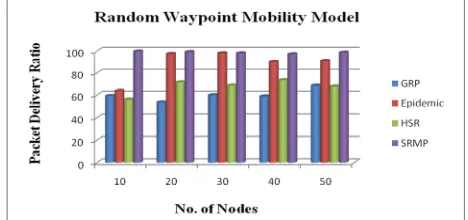
Figure 2 (a). PDR with Random Way Point model
Create Models
Simulation Apply Statistics
View Results
New event reaches head of event list, which causes Simulation Kernel to deliver
an interrupt to the
appropriate module
Process within the
module gains control and processes interrupt
Simulation Kernel deletes event from event list, allowing new event to reach head of list
Simulation Kernel
Fig 2(a) shows the graph of GRP, Epidemic Routing, HSR and SRMP routing protocol for packet delivery ratio between the number of nodes and mobility model is random way point mobility model. Fig 2(a) shows that value of PDR for SRMP w.r.t. various no. of nodes is highest among all mobility models.
Figure 2 (b). PDR with Freeway mobility model
Fig 2(b) shows the graph of GRP, Epidemic Routing, HSR and SRMP routing protocol for packet delivery ratio between the number of nodes and mobility model is freeway mobility model. Fig 2(b) shows that value of PDR for SRMP w.r.t. various no. of nodes is highest among all mobility models.
Figure 2 (c). PDR with Random point group mobility model
Fig 2(c) shows the graph of GRP, Epidemic Routing, HSR and SRMP routing protocol for packet delivery ratio between the number of nodes and mobility model is random point group mobility model. Fig 2(c) shows that value of PDR for SRMP w.r.t. various no. of nodes is highest among all mobility models.
B. Average End to End Delay: Average packet delivery time from a source to a destination. First for each
source-destination pair, an average delay for packet delivery is computed. Then the whole average delay is computed from each pair average delay.
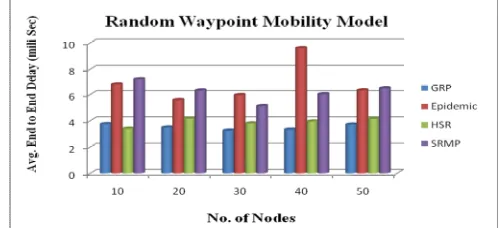
Fig 3(a) shows the graph of GRP, Epidemic Routing, HSR and SRMP routing protocol for Average End to End Delay between the number of nodes and mobility model is random way point mobility model. Fig 3(a) shows that value of Average End to End Delay for HSR w.r.t. various no. of nodes is lowest among all mobility models.
Figure 3 (b). End to End Delay with Freeway mobility model
Fig 3(b) shows the graph of GRP, Epidemic Routing, HSR and SRMP routing protocol for Average End to End Delay between the number of nodes and mobility model is freeway mobility model. Fig 3(b) shows that value of Average End to End Delay for HSR w.r.t. various no. of nodes is lowest among all mobility models.
Figure 3 (c). End to End Delay with Random point group mobility model
Fig 3(c) shows the graph of GRP, Epidemic Routing, HSR and SRMP routing protocol for Average End to End Delay between the number of nodes and mobility model is random point group mobility model. Fig 3(c) shows that value of Average End to End Delay for HSR w.r.t. various no. of nodes is lowest among all mobility models.
C. Throughput: Throughput is the number of packet that is passing through the channel in a particular unit of
time. This performance metric show the total number of packets that have been successfully delivered from source node to destination node and it can be improved with increasing node density.
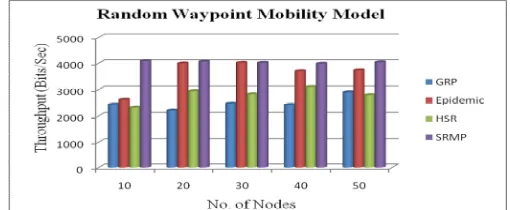
Fig 4(a) shows the graph of GRP, Epidemic Routing, HSR and SRMP routing protocol for throughput between the number of nodes and mobility model is random way point mobility model. Fig 4(a) shows that value of throughput for SRMP w.r.t. various no. of nodes is highest among all mobility models.
Figure 4 (b). Throughput with Freeway mobility model
Fig 4(b) shows the graph of GRP, Epidemic Routing, HSR and SRMP routing protocol for throughput between the number of nodes and mobility model is freeway mobility model. Fig 4(b) shows that value of throughput for SRMP w.r.t. various no. of nodes is highest among all mobility models and for some nodes, value of HSR is highest.
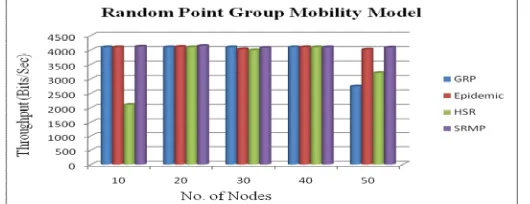
Figure 4 (c). Throughput with Random point group mobility model
Fig 4(c) shows the graph of GRP, Epidemic Routing, HSR and SRMP routing protocol for throughput between the number of nodes and mobility model is random point group mobility model. Fig 4(c) shows that value of throughput for SRMP w.r.t. various no. of nodes is highest among all mobility models.
VII. CONCLUSION AND FUTURE WORK
In this paper we have simulated the GRP, Epidemic Routing, HSR and SRMP routing protocols on OPNET Simulator. The performance of the protocols was measured with respect to metrics like Packet delivery ratio, end to end delay and Throughput. Simulations were carried out with identical networks and running different protocols on the mobile node. The simulation is divided in three parts basis on the mobility model (random waypoint mobility, random point group mobility model and freeway mobility model). Here we conclude as:
1. SRMP performs well than Epidemic, GRP and HSR (in reference to packet delivery ratio) if the node mobility is random waypoint and random point group mobility model.
2. SRMP has performed well when the node mobility model is freeway mobility model. 3. Packet delivery ratio is increases as the number of nodes increases.
4. Freeway mobility model is better than the other two mobility models in terms of Packet Delivery Ratio.
5. HSR performs better than GRP, SRMP and Epidemic in terms of average end to end delay and random waypoint mobility model is better than random point group mobility model and freeway mobility model.
6. Random point group mobility is better in compare to freeway mobility model and random way point mobility model in terms of throughput.
For the above discussion we can say that all the routing protocols and mobility models have their own significance they all have their own advantages and disadvantages its depends upon the situation where we have to use. In some situation SRMP Routing is better and in some situation HSR is better. In some cases Random Waypoint mobility model is better and in some cases Random Point Group mobility model is better.
Future work may include same experiments for CEDAR, CBRP, LBM and MAODV Routing, measuring the average end to end delay, packet delivery rate and drop ratio and the same experiments for different node mobility speed of the simulation and other mobility models. Another Future work is to perform the experiments for various different node migration speeds. Further study should be assigned to the Boundless mobility model on the real implementation to be sure if it is suitable to be deployed in real-life implementation.
REFERENCES
[1]NANCY GARG,“NETWORK SIMULATORS:ACASE STUDY”,IJARCSSE,VOL.5, PP.651-655,2015.
[2] Yassine MALEH, DR. Abdellah Ezzati “Comparative Analysis of Routing Protocols AODV DSDV and DSR in MANET”,IJCSMC, Vol. 3,pp. 364-376, 2014. [3] Danish Vasan, “A Consolidated Analysis of MANET Routing Protocols”, IJWCNT, 3(2), February – March 2014, 30- 34.
[4]Sanjeev Kumar, “Investigate and Improving Routing Mobility Based On Random Way Point Mobility Model Using FTP Traffic in MANET” ,IJARCSSE, Vol. 3, pp. 332-337, 2013.
[5] Dr.S.S.Dhenakaran1 , A. Parvathavarthini2, “An Overview of Routing Protocols in Mobile Ad-Hoc Network”, IJARCSSE, Vol. 3, pp. 251-259, 2013.
[6] Preeti Gaharwar1, Mr. Sunil R. Gupta2 Performance Comparison of AODV, DSDV & DSR Routing Protocols in MANET IJARSSE, Vol. 3, pp. 423-435, 2013.
[7] Preeti Gaharwar1, Mr. Sunil R. Gupta2 “Performance Comparison of Routing Protocols” IJACCE Vol. 2,pp. 537-549, 2013.
[8] Somya Jain1, Deepak Aggarwal2 “Performance Evaluation of Routing Protocols for MAC Layer Models”, IOSR-JCE, Vol. 10, pp. 71-77, 2013.
[9] Robinpreet Kaur & Mritunjay Kumar Rai, A Novel Review on Routing Protocols in MANETs, Undergraduate Academic Research Journal (UARJ), Vol. 1, pp. 77-86 2012.
[10] Rachit Jain1, Laxmi Shrivastava “Study and Performance Comparison of AODV & DSR on the basis of Path Loss Propagation Models” International Journal of Advanced Science and Technology, Vol. 32, pp. 48-59, 2011.
[11] Dhananjay Bisen at el. “Effect of Pause Time on DSR, AODV and DYMO Routing Protocols in MANET” Manuscript received November 20, 2009.
[12] Monika at el. “Comparative Study of AODV, DSDV and DSR Routing Protocols in Vehicular Network Using EstiNet Simulator” International Journal of Scientific & Engineering Research, Vol. 3, pp. 347-359, 2012.
[13] M.L Sharma at el.“ Performance Evaluation of MANET Routing Protocols under CBR and FTP traffic classes” Int. J. Comp. Tech. Appl., Vol 2, pp. 392-400, 2004. [14] Liang Qin Thomas Kunz “Increasing Packet Delivery Ratio in DSR by Link Prediction” Proceedings of the 36th Hawaii International Conference on System Sciences, 2003.
[ 1 5 ] C. Bettstetter, H. Hartenstein, and X. Perez-Costa, Stochastic Properties of the Random Waypoint Mobility Model, in ACM/Kluwer Wireless Networks, Special Issue on Modeling And Analysis of Mobile Networks, vol. 10, pp. 253-264, 2004.
[16] Dr. Kamaljit I. Lakhtaria, “Analyzing Reactive Routing Protocols in Mobile Ad Hoc Networks”, Int. J. Advanced Networking and Applications Vol. 3, pp. 1416-1421, 2012.
BIOGRAPHY
Ashish Gupta received the B.TECH degree in Computer Science and Engineering from
Inderprastha Engineering College Ghaziabad, affiliated with GAUTAM BUDDH TECHNICAL
UNIVERSITY, Lucknow, India. After qualifying GATE, He completed M.TECH in Computer