© 2014, IJCSMC All Rights Reserved 605 Available Online atwww.ijcsmc.com
International Journal of Computer Science and Mobile Computing
A Monthly Journal of Computer Science and Information Technology
ISSN 2320–088X
IJCSMC, Vol. 3, Issue. 10, October 2014, pg.605 – 612
RESEARCH ARTICLE
Simulation Based Performance
Comparison of AODV, AOMDV, DSR and
MDART Routing Protocols in MANETS
Mamta Samkaria
1, Anita Ganpati
2¹Himachal Pradesh University, India
²Himachal Pradesh University, India
1[email protected];
2[email protected]
Abstract— Mobile ad hoc network is a self organizing, autonomous network of mobile nodes that can be established anywhere without any need of fixed infrastructure or central administration. In MANETS topology is highly dynamic and resources are limited so routing has been a very important area of research. Many routing protocols have been proposed by various researchers. Still there is a scope for improvement of these existing protocols or some new protocols can be proposed. In this paper, an attempt has been made to simulate AODV, AOMDV, DSR and MDART using NS2 simulator and compare their performance for different metrics packet delivery ratio, normalized routing load, routing overhead and number of packets dropped. DSR performed the best and MDART performed the worst in most of the scenarios.
Keywords— MANET, AODV, AOMDV, DSR, MDART
I. INTRODUCTION
Mobile ad hoc network is a self configuring and self organizing, multi hop network of mobile nodes that can communicate via wireless medium. They don’t require any fixed infrastructure or central administration [6]. They can be set up as and when required. Each node acts as a router and a host [16]. The network topology is highly dynamic. Each node can move independently in any direction, and thus it can change its links randomly and frequently [17]. As MANETS don’t require any infrastructure and can be easily set up anywhere, they can be used in remote areas, military battlefields and wireless sensor networks. MANETS face various challenges like limited bandwidth, dynamic network topology, distributed operation, no centralized control, energy constraints, security issues, quality of service, hidden terminal problem, etc. So, routing of information in MANETS has been a very difficult task. A number of routing protocols have been proposed and implemented for MANETS.
II. OVERVIEW OF AODV, AOMDV, DSR AND MDART ROUTING PROTOCOLS
© 2014, IJCSMC All Rights Reserved 606 routing tables are checked for routes. If route is not present in the table then route discovery process is initiated by broadcasting the route request (RREQ) packet to its neighbours [9]. This RREQ packet contains Destination Sequence Number. If the node that receives RREQ is the destination node or if it has a route to the destination node then it checks the destination sequence numbers that it knows with the destination sequence number contained in the RREQ. It sends a route reply message to the source node if the destination sequence number is equal to or greater than the one contained in RREQ [10]. In route maintenance process, if source node moves then route discovery process is initiated. And if an intermediate node moves then a route error is sent to the source node. On receiving RERR source nodes starts new route discovery process [11]. AODV sends HELLO packets to maintain local connectivity. It is loop free and scalable in nature [12] but its latency is high [13].
Ad hoc on demand multipath distance vector (AOMDV) is an extended form of AODV routing protocol which maintains multiple loop free and disjoint routes [2]. The route entry for a destination node consists of list of next hops information and their corresponding hop counts. Same sequence number is assigned to all next hop nodes [3]. A node maintains an advertised hop count for each destination. This advertised count is the maximum hop count for all the paths and is used for sending route advertisements of the destination node. A duplicate route advertisement received by a node defines an alternate path to the destination. [7]. If a node receives a route advertisement with a greater sequence number for a node then the next-hop list and the advertised hop count are reinitialized [3].
Dynamic Source Routing is a source based reactive routing protocol. It is based on link state algorithm. It maintains a route cache. It uses route discovery and route maintenance processes. In this protocol, when the source node wants to communicate with another node then it checks the route cache for the availability of route to that node. If the route is not found in route cache or if it contains the expired route then route discovery process is initiated by sending route request packets (RREQ) [9]. Route maintenance process uses error messages and acknowledgement for maintenance of routes [5]. If any link to source node is broken then an error message (RERR) is sent to the source node [13]. DSR does not use HELLO packets. There is no need of keeping routing tables. It supports multiple paths to a destination [12] but it is not scalable to large networks [16].
Multi path dynamic address routing protocols (MDART) was proposed by J. Eriksson, M. Faloutsos and S. Krishnamurthy. It is an extended version of DART. It is based on distance vector and uses hop by hop routing strategy [1]. It discovers multiple routes between a source and a destination [4].
III. LITERATURE SURVEY
Anit Kumar and Pardeep Mittal (2013) [9] have compared performance of AODV and DSR on the basis of Packet Delivery Ratio (PDR) using NS-2.34. DSR outperformed AODV.
Jaspreet Singh & Sandeep Singh Kang (2013) [15] have compared AODV, AOMDV and MDART on the basis of average throughput, packet delivery ratio, traffic load and residual energy by varying number of nodes using NS2. MDART performed the best or comparable to the best for most of the scenarios.
Manveen Singh Chada et.al. (2012) [2] have compared AODV, DSR and AOMDV by varying simulation time. AOMDV performed better than AODV and DSR for packet delivery fraction & throughput but performed worst for end to end delay. DSR performed the best for end to end delay.
Gurmukh Singh et. al. (2012) [14] have compared AOMDV and MDART for metrics packet delivery ratio, throughout, energy consumption and end to end delay. MDART performed better for all considered metrics. Shivlal Mewada et. al. (2012) [11] has evaluated performance of DSR and AODV on the basis of network size, node mobility and pause time using NS-2. DSR performed better than AODV for packet delivery fraction and throughput.
Avinash Giri et. Al (2012) [4] have compared AODV, AOMDV and MDART on the basis of average throughput, packet delivery ratio, normalized routing overhead and average end to end delay. As number of nodes increases, MDART performs better for all considered metrics.
IV. NEED AND SCOPE OF STUDY
© 2014, IJCSMC All Rights Reserved 607 delivery ratio, normalized routing load, routing overhead and number of packets dropped by varying simulation area and sending rate of packets.
V. OBJECTIVES
A. To have general understanding of AODV, AOMDV, DSR and MDART routing protocols of mobile ad
hoc networks.
B. To simulate and evaluate the performance of AODV, AOMDV, DSR and MDART on the basis of
various performance metrics by varying simulation area and packet sending rate.
VI. RESEARCH METHODOLOGY
The theoretical study of MANET routing protocols has been studied from various sources like journals, research papers, books and internet. NS 2.35 has been used for the simulation of various scenarios. The results obtained from the simulations have been used for the empirical study and performance analysis of the protocols.
VII. RESULTS AND ANALYSIS
A. Simulation Setup
Ns-2.35 simulator has been used for simulating the scenarios. It is an open source, event driven simulator which can simulate both wired and wireless network scenarios. It provides support for TCP, UDP and various unicast and multicast routing protocols.
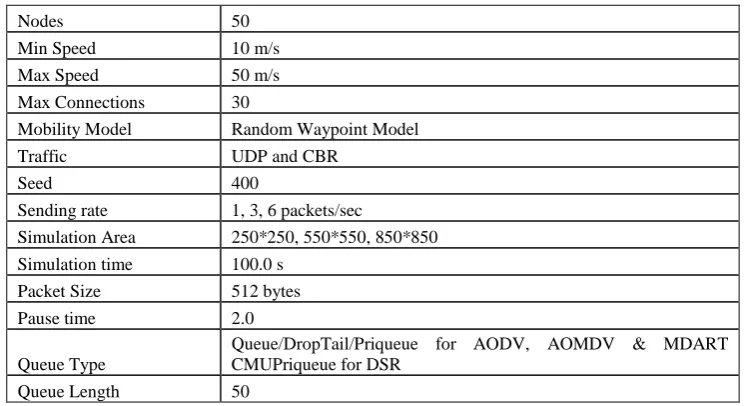
We have compared AODV, AOMDV, DSR and MDART by varying simulation area and packet sending rate. Setdest and cbrgen.tcl has been used for the mobility and traffic generation respectively in our scenarios. The various simulation parameters considered are as follows:
TABLE 1. SIMULATION PARAMETERS
Nodes 50
Min Speed 10 m/s
Max Speed 50 m/s
Max Connections 30
Mobility Model Random Waypoint Model
Traffic UDP and CBR
Seed 400
Sending rate 1, 3, 6 packets/sec
Simulation Area 250*250, 550*550, 850*850
Simulation time 100.0 s
Packet Size 512 bytes
Pause time 2.0
Queue Type
Queue/DropTail/Priqueue for AODV, AOMDV & MDART CMUPriqueue for DSR
Queue Length 50
B. Performance Metrics
The performance metrics considered for analysis are as follows:
1) Packet Delivery Ratio: It is defined as the ratio of total number of packets received at the destination to the total number of packet sent by the source.
PDR = (Total no. of packets received / Total no. of packets sent) * 100
© 2014, IJCSMC All Rights Reserved 608 3) Normalized routing load: It is defined as the ratio of number of routing packets to the number of
data packet received at the destination.
NRL = Routing overhead / Total no. of packets received
4) Number of packets dropped: It is the number of packets that are not successfully sent to the destination.
C. Analysis
To analyze the performance of AODV, AOMDV, DSR and MDART routing protocols in MANETS, various scenarios were generated by varying the simulation area and packet sending rate.
1) Effect of varying simulation area:
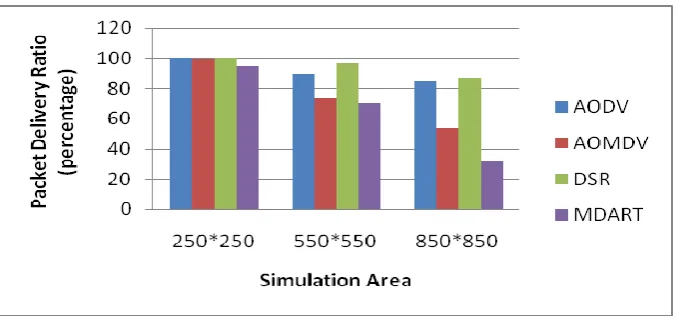
The simulation area has been varied to 250*250, 550*550, 850*850. As the simulation area is changed, the density of nodes changes accordingly. When area is 250*250 node density is the highest and when area becomes 850*850 density becomes the lowest among all considered scenarios.
(i) Packet Delivery Ratio: The following graph shows the effect of change in simulation area on the packet delivery ratio for all AODV, AOMDV, DSR and MDART. PDR decreases with increase in simulation area (or decrease in node density).
Figure 1. Packet delivery ratio v/s simulation area
We can observe that the packet delivery ratio is the highest for DSR and lowest for MDART. So, DSR is best among all in terms of PDR.
© 2014, IJCSMC All Rights Reserved 609 Figure 2. Routing Overhead v/s Simulation area
(iii) Normalized routing load: We can observe from the graph that the normalized routing load increases with increase in simulation area. DSR has the lowest normalized routing load, and MDART has the highest NRL. AODV has lesser NRL than AOMDV and MDART. So, DSR and AODV are better than AOMDV and MDART.
Figure 3. Normalized routing load v/s simulation area
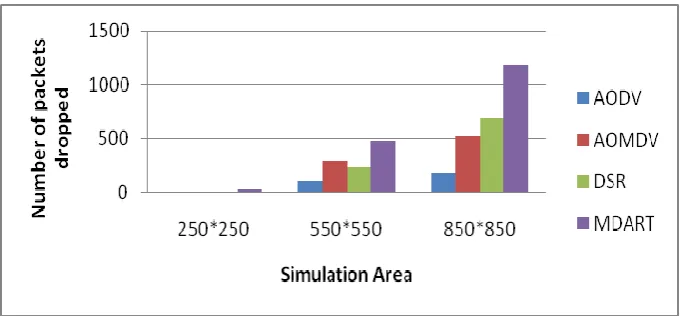
(iv) Number of packets dropped: From the graph, we can see that the number of packets dropped increases with increase in simulation area. Number of packets dropped is minimum for AODV and maximum for MDART. Packets dropped for AOMDV is lesser than DSR and MDART. So, AODV is the best and MDART is the worst.
© 2014, IJCSMC All Rights Reserved 610 2) Effect of variation in Sending Rate:
The packet sending rates used for simulation are 1 packet/sec, 3packets/sec and 6packets/sec.
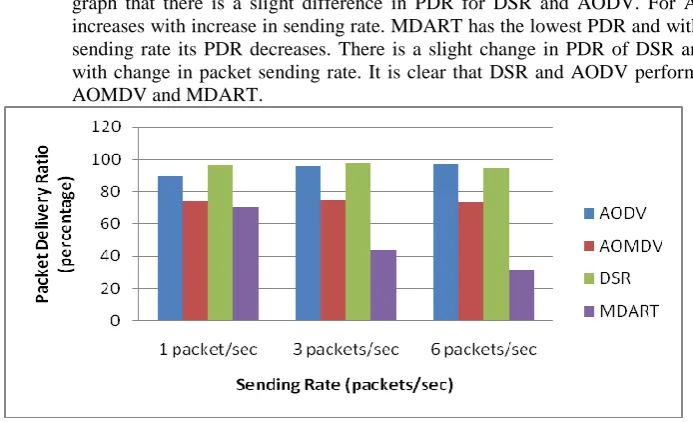
(i) Packet Delivery Ratio: The following graph shows the effect of change in sending rate on packet delivery ratio for AODV, AOMDV, DSR and MDART. We can observe in the graph that there is a slight difference in PDR for DSR and AODV. For AODV, PDR increases with increase in sending rate. MDART has the lowest PDR and with increase in sending rate its PDR decreases. There is a slight change in PDR of DSR and AOMDV with change in packet sending rate. It is clear that DSR and AODV perform better than AOMDV and MDART.
Figure 5. Packet delivery ratio v/s sending rate
(ii)
Routing Overhead: The following graph shows that the routing overhead increases with increase in packet sending rate for AODV, AOMDV and MDART. For DSR, routing overhead increases when sending rate is increased from 1 packet/sec to 3 packets/sec then it decreases when the sending rate is increased to 6 packets/sec. Routing overhead is lowest for DSR and highest for MDART. So, DSR is the best and MDART is the worst if routing overhead metrics is considered.Figure 6. Routing overhead v/s sending rate
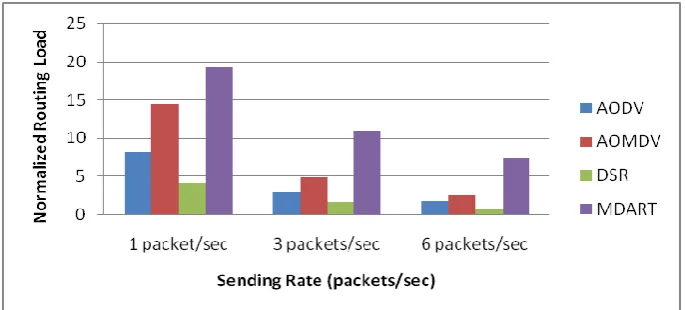
© 2014, IJCSMC All Rights Reserved 611 Figure 7. Normalized routing load v/s sending rate
(iv) Number of packets dropped: From the graph below, we can see that the number of packets dropped increases with increase in packet sending rate. Number of packets dropped is minimum for AODV and maximum for MDART. So, AODV is the best and MDART is the worst among all considered protocols. DSR performs better than AOMDV and MDART.
Figure 8. Number of packets dropped v/s sending rate
VIII. CONCLUSIONS AND FUTURE SCOPE
In this paper AODV, AOMDV, DSR and MDART have been compared for their performance on the basis of packet delivery ratio, routing overhead, normalized routing load and number of packets dropped by varying the parameters simulation area and sending rate. The scenarios were simulated using NS-2.35. We observed that when simulation area was increased, PDR decreased while routing overhead, NRL and number of packets dropped increased. When sending rate was increased, routing overhead and number of packets dropped increased while NRL decreased. For both change in simulation area and sending rate, DSR performed the best and MDART performed the worst in case of PDR, routing overhead and NRL. AODV was better in terms of number of packets dropped. So, we can conclude that DSR is the best among all for the considered metrics. In future, we can compare other protocols using various performance metrics.
REFERENCES
[1] Caleffi, M., & Paura, L. (2010). M-DART: multi-path dynamic address routing. Wireless Communications And Mobile Computing [2] Chadha, M., Joon,R., & Sandeep. (2012). Simulation and Comparison of AODV, DSR and AOMDV Routing Protocols in MANETs.
International Journal of Soft Computing and Engineering (IJSCE), 2(3).
[3] Dahiya, P., Madan, G., & Gupta, G. (2014). Performance evaluation of AODV and AOMDV on the basis of throughput. International Journal of Computer Science and Mobile Computing, 3(9).
© 2014, IJCSMC All Rights Reserved 612 [5] Gite, P., & Thakur, S. (2013). Comparative Study and Simulation Based Analysis of MANET Routing Protocols Using NS-2.
International Journal of Emerging Science and Engineering (IJESE), 2(3).
[6] Gupta, R., & Bhatia, R. (2014). A Review of Performance Comparison of DSR, AODV and TORA Routing Protocols. International Journal of Advanced Research in Computer Science and Software Engineering (IJARCSSE), 4(8).
[7] Jacob, J., & Seethalakshmi, V. (2012). Performance analysis and enhancement of routing protocol in MANET. International Journal of Modern Engineering Research (IJMER), 2(2).
[8] Jayakumar, G., & Ganapathy, G. (2007). Performance comparison of mobile ad-hoc network routing protocol. International Journal of Computer Science and Network Security (IJCSNS), 7(11).
[9] Kumar, A., & Mittal, P. (2013). A Comparative Study of AODV & DSR Routing Protocols in Mobile Ad-Hoc Networks. International Journal of Advanced Research in Computer Science and Software Engineering, 3(5).
[10] Manickam, P., Baskar, T. G., Girija, M., & Manimegalai, D. (2011). Performance Comparisons Of Routing Protocols In Mobile Ad Hoc Networks. International Journal of Wireless & Mobile Networks, 3(1).
[11] Mewada, S., Singh, U. K., & Sharma, P. K. (2012). Simulation Based Performance Evaluation of Routing Protocols for Mobile Ad-hocNetworks (MANET). IRACST - International Journal of Computer Science and Information Technology & Security (IJCSITS), 2(4).
[12] Moses, G. J. (2012). A Simulation Based Study of AODV, DSR, DSDV Routing Protocols in MANET Using NS-2. International Journal of Advanced Research in Computer Science and Software Engineering, 2(3).
[13] Sesay, S., Zongkoi, Y., Biao, Q., & He, J. (2004). Simulation Comparison of Four Wireless Ad Hoc Routing Protocols. Information Technology Journal, 3(3).
[14] Singh, G., Gupta, S., & Singh, S. (2012). Performance Evaluation of DHT Based multi-path Routing Protocol for MANETs. International Journal of Scientific and Research Publications, 2(6).
[15] Singh, J., & Kang, S. (2013). QOS BASED ANALYSIS OF MDART USING AODV AND AOMDV. International Journal of Computer Science Engineering and Information Technology Research (IJCSEITR), 3(5).
[16] Taneja, S., & Kush, A. (2010). A Survey of routing protocols in mobile ad hoc networks. International Journal of Innovation, Management and Technology, 1(3).