An Efficient Secure Anonymous Proxy Signature Scheme
*Jue-Sam Chou 1, Shih-Che Hung 2, Yalin Chen 3
1 Department of Information Management, Nanhua University Chiayi 622, Taiwan *: corresponding author
Tel: 886+ (0)5+272-1001 ext.56226
2 Department of Information Management, Nanhua University Chiayi 622, Taiwan [email protected]
Tel: 886+ (0)6+215-5319
3
Institute of information systems and applications, National Tsing Hua University, Taiwan
Abstract
Proxy signature schemes can be used in many business applications such as when the original signer is not present to sign important documents. Any proxy signature scheme has to meet the identifiability, undeniability, verifiability and unforgeability security requirements. In some conditions, it may be necessary to protect the proxy signer’s privacy from outsiders or third parties. Recently, several studies about proxy signature schemes have been conducted but only Yu et al.’ anonymous proxy signature scheme proposed in 2009 attempting to protect the proxy signer’s privacy from outsiders. They claimed their scheme can make the proxy signer anonymous. However, based on our research, we determined that this was not the case and the proxy signer’s privacy was not anonymous. Hence, in this paper, we propose a new anonymous proxy signature scheme that truly makes the proxy signer anonymous while making it more secure and efficient when compared with Yu et al.’s scheme in 2009. Our proxy signature scheme consists of two constructions. First, we mainly use random numbers and bilinear pairings to attain the anonymous property in our proxy. Secondly, we increase the security, integrity, and efficiency of our proxy through modifications.
Keywords: Proxy signature, Anonymous, Bilinear pairings, undeniability,
1. Introduction
In 1996, Mambo et al. [1] first proposed the concept of proxy signature. In their proposal, there are three parties: a user also called original signer, a proxy signer whom is delegated to sign a message on behalf of the original signer, and a verifier who verifies whether a signed message is legal or not. Proxy signature schemes can be used in many business applications such as when the original signer is not present to sign important documents. For example, an important document needs to be signed by the CEO, but the CEO is out of the office or not immediately available. At this time, the CEO can use the proxy signature scheme to designate the general manager or business executive to sign the document on his or her behalf. The signed document will be valid, and can be verified by everyone without the CEO actually signing it.
Since Mambo et al.’s 1996 scheme, many proxy signature schemes have been proposed [2-31]. Overall, generally speaking, there are two main categories of proxy signature schemes, the first category is one-to-one and the other is one-to-many. The one-to-one schemes are [8, 12, 15, 17, 18, 20, 23] and the proxy blind signature [5], which is a special digital signature scheme first introduced by Chaum [25] in 1983. In the one-to-many, there are there two subsets, one is the proxy multi-signature and the other is the ( , )t n threshold proxy signature. In the proxy multi-signature [10, 11 14, 16, 26, 27, 28, 29, 30, 31], the original signer has an authorize proxy signer group, each proxy signer has to generate a partials proxy signature. If all partials of signatures are correct, the proxy signature will be generated by summation or multiplication operation of the partial proxy signatures. In the ( , )t n threshold proxy signature [3, 6, 16, 24], the original signer can choose the threshold and a proxy signing key is shared by n proxy signers. Any t of proxy signers can cooperatively derive the proxy signing key to sign the message. In any proxy signature, the following security properties are required:
Unforgeability [1, 13, 14, 15, 19, 21, 22, 24, 28]: Only a designated proxy
signer can create a valid proxy signature for the original signer. In other words, nobody can forge a valid proxy signature without the delegation of the original signer.
Verifiability [1, 3, 4, 11, 14, 15, 19, 21, 24]: After checking and verifying the
proxy signature, a verifier can be convinced that the received message is signed by the proxy signer authorized by the original signer.
Undeniability [1, 3, 4, 15, 19, 21, 24]: The proxy signer cannot repudiate the
signature he produced.
Identifiability [1, 3, 4, 14, 15, 24]: Anyone including the original signer can
Anonymity [10, 13, 15, 21]: The relating studies about anonymous property in
proxy signature scheme aims to protect the identity of the proxy signer, keeping the secrecy of the proxy signer to outsider.
Although proxy signatures incorporate the above mentioned security functions, they still face many threats such as frame attack and public-key substitute attack. The detailed about these two attacks can be referred to studies [30] and [16, 31] respectively. In 2009, Yu et al. [13] further proposed an anonymous proxy signature (APS) scheme which provides anonymity property for proxy multi-signature. In their scheme, there is a group of proxy signers, but only one proxy signer can anonymously signs the message. By using a group of signers, Yu et al. wanted to provide privacy and anonymous protection for the proxy signer such that any other proxy signer cannot know who the real signer is. However, based on our research using transmitted data along with public information, we were able to isolate and identify the proxy signer. More detail of the analysis is described in Section 3.2.
The rest of the paper is organized as follows. In Section 2, we present the basic concepts of bilinear pairings and some related mathematical problems. In Section 3, we review and show the weakness of Yu et al.’s scheme. Section 4 shows the proposed scheme and Section 5 makes comparison in computation efficiency between Yu et al.’s scheme and ours. Finally, a conclusion is given in Section 6.
2. Background
In this section, we describe the concept of bilinear pairings which is used as the mathematical basis of this design.
Bilinear Pairings
Let G1 be a cyclic additive group of order q generated by a base point P on
Elliptic curve and G2 be a cyclic multiplicative group with the same order. It is considered that solving the Elliptic curve discrete logarithm problem (ECDLP) in G1
and discrete logarithm problem (DLP) problem in G are difficult. A bilinear map 2
e is defined as e:G1×G1 →G2 which has the following properties: (1) Bilinear: (e aP bQ, )=e P Q( , )ab,where P Q, ∈G1 and all a,b∈Zq*.
(2) Non-degeneracy: There exists P Q, ∈G1 such that e P Q( , )≠1; in other words, the map does not send all pairs in G1×G1 to the identity in G2.
(3) Computable: There is an efficient algorithm to compute e P Q for all ( , )
1
,
P Q∈G .
3. Review of Yu et al.’s scheme
3.1 Yu et al.’s APS scheme
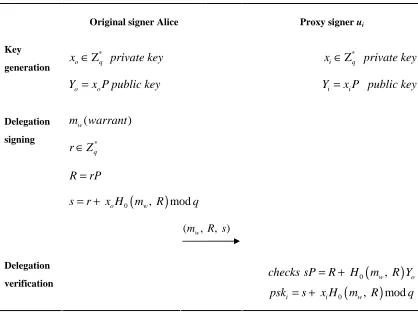
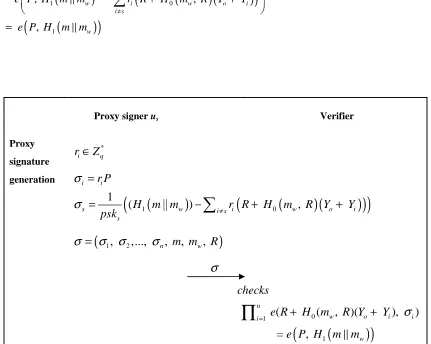
There are six phases in Yu et al.’s APS scheme: (1) the parameter generation phase, (2) the key generation phase, (3) the delegation signing phase, (4) the delegation verification phase, (5) the APS generation phase, and (6) the APS verification phase. We describe them as follows, and also depict phases (2), (3), and (4) in figure 1 and phases (5), (6) in figure 2.:
(1) In the parameter generation phase, on input of security parameter k , a system
parameter generation algorithm outputs
(
G1, G2, , , q e P)
, including a cyclic additive group G of order q , a multiplicative group G1 2 of the same order, a bilinear map e G: 1× G1→G2, and a generator P of G1. This algorithm also outputs two cryptographic hash functions: H0:{0, 1}*× G1→Zq* and* 1:{0, 1} 1
H →G .
(2) In the key generation phase as shown in Fig. 1, the original signer Alice selects
*
o q
x ∈Z as her private key and computes her public key as Yo = x Po . Each
proxy signer ui∈U randomly selects xi∈Zq*as his/her private key and sets the corresponding public key as Yi = x Pi .
(3) In the delegation signing phase, Alice firstly generates a warrant m which w contains some explicit descriptions about the delegation relation such as the identities of both the Alice and the proxy signers, the expiration time of the delegation, and the signing power in the warrant. Then, Alice randomly picks a number r∈Zq* , and computes R=rP and s= +r x Ho 0
(
mw, R)
modq .Finally, Alice sends
(
mw, , R s)
to the proxy signers in set U ={ , ..., }u1 un .(4) Upon receiving
(
mw, , R s)
, each proxy signer u checks if the equation i(
)
0 w, o
Original signer Alice Proxy signer ui Key generation * Z o q
x ∈ private key
o o
Y =x Ppublic key
* Z
i q
x ∈ private key
i i
Y =x P public key
Delegation signing ( ) w m warrant * q r∈Z
R=rP
(
)
0 , mod
o w
s= +r x H m R q
(mw, , )R s
Delegation verification
(
)
(
)
0 0 , , modw o
i i w
checks sP R H m R Y psk s x H m R q
= + = +
Fig. 1: Key generation, delegation signing and delegation verification phase of Yu et al.’s scheme
(5) In the APS generation phase as shown in Fig. 2, proxy signer us∈U with his proxy secret keypsk signs on a message s m on behalf of the original signer, Alice, in an anonymous way. u first chooses random numbers s *
i q
r ∈Z , where {1, 2, ..., }
i∈ n and i≠s , computes both
σ
i =r Pi and(
)
(
(
)(
)
)
(
1 0)
1
,
s w i s i w o i
s
H m m r R H m R Y Y
psk
σ = −
∑
≠ + + , and sends(
1, 2, ..., n, , m mw, R)
σ
=σ σ
σ
to the verifier.(6) In the APS verification phase, given public keys Yo, , ..., Y1 Y and a received n anonymous proxy signature
σ
, the verifier can examine the validity of the signatureσ
by checking whether the following expression holds.(
)(
)
(
)
(
(
)(
)
)
(
)(
)
(
)
(
)
(
)(
)
(
)
(
(
)(
)
)
0 1 0 0 1, 0 1,0 1 0
( ( , )( ), ) , , , , , , 1 , , , n
w o i i
i n
w o i i w o s s
i i s n
i w o i
i i s
w o s w i w o i
i s s
e R H m R Y Y
e R H m R Y Y e R H m R Y Y e r R H m R Y Y P
e R H m R Y Y H m m r R H m R Y Y
(
)(
)
(
)
(
)
(
)
(
(
)(
)
)
(
)
(
)
0 1,
1 0
1
, ,
, ,
,
n
i w o i
i i s
w i w o i
i s w
e r R H m R Y Y P e P H m m r R H m R Y Y
e P H m m
= ≠
≠
= + +
− + +
=
∏
∑
i
Proxy signer us Verifier
Proxy
signature
generation
*
i q
r ∈Z
i r Pi
σ
=(
)
(
(
)(
)
)
(
1 0)
1
( ) ,
s w i s i w o i
s
H m m r R H m R Y Y
psk
σ = −
∑
≠ + +(
1, 2,..., n, , m mw, R)
σ
=σ σ
σ
σ
(
)
(
)
0 1
1
( ( , )( ), ) = ,
n
w o i i
i
w
checks
e R H m R Y Y e P H m m
σ
= + +
∏
Fig. 2: APS generation phase and the APS verification phase of Yu et al.’s scheme
3.2 Weakness of Yu et al.’s scheme
After reviewing Yu et al.’s scheme above, we now examine the scheme’s anonymous property which they emphasized as follows:
Since R ,H0
(
mw, R)
and(
Yo+ Ys)
are public, we can obtain psk P by sdeducing psk Ps = +R H0
(
mw, R Y)(
o+ Ys)
, because(
)
(
)
(
)
(
)
(
)
(
)(
)
0
0 0
0 0 0
( , )
( , , )
( ( ) , )
( (( ) , ))
,
s i w
o w i w
o i w
o i w
w o s
psk P s x H m R P
r x H m R x H m R P
r x x H m R P
rP x x H m R P
R H m R Y Y
= +
= + +
= + +
= + +
Next, we define an inspector X to be e(pskxP, σj), where pskx is ux’s secret proxy signing key, σj is a specific sub-signature in σ, and x, j∈{1, …n}. In addition, we define Y to be
(
(
0(
)(
)
)
)
1, , ,
n
w o i i
i= ≠i xe R+ H m R Y + Y
σ
∏
. Then, if there exist somex and j satisfying X.Y =e P H m m
(
, 1(
w)
)
, we can determine that x should be equal to j, and uj is then the right proxy signer. This is because if uj is the right proxy, then the corresponding sub-signature σj must have the factorj psk
1
, and therefore only
applying the right pskxP, i.e., x = j, can cancel the factor result in the holing of the end. Otherwise, we continue to examine next possible x or j. By doing this way, we can deduce the right proxy signer at most n2 times which is not computationally infeasible.
For more clarity, we take three proxy signers, u1, u2, u3, as an example. Suppose u2 is the real proxy signer, then σ1 = r1P, σ2 =
) || ( ( )
(psk2 −1 H1 m mw 3
1, 1
i= ≠i
−
∑
r Ri( +H0(mw, )(R Yo + )))Yi and σ3 = r3P.If we first try σ1 with different x = 1, 2, 3, then we have three tries as the following.
(1.1) When x = 1 and thus X = e(psk1P, σ1), the value X.Y should be
(
)(
)
(
)
(
)
(
)(
)
(
)
(
)
(
)(
)
(
)
(
)
(
(
(
)(
)
)
)
(
)
(
)
31 1 1, 1 0
3
1 1 1, 1 0
1 1 0 1 2 0 3 3
1
( , ) , ,
( , ) , ,
( , ) , , , ,
,
i w o i
i i
w o i i
i i
w o w o
w
e psk P e r R H m R Y Y P e P psk e R H m R Y Y r P
e P psk r P e R H m R Y Y e R H m R Y Y e P H m m
σ σ σ σ = ≠ = ≠ + + = + + = + + + + ≠
∏
∏
i ii i i
(1.2) When x = 2 and thus X = e(psk2P, σ1), the value X.Y should be
(
)(
)
(
)
(
)
(
)(
)
(
)
(
)
(
)(
)
(
)
(
)
(
(
(
)(
)
)
)
(
)
(
)
32 1 1, 2 0
3
2 1 1, 2 0
2 1 0 1 1 0 3 3
1
( , ) , ,
( , ) , ,
( , ) , , , ,
,
i w o i
i i
w o i i
i i
w o w o
w
e psk P e r R H m R Y Y P e P psk e R H m R Y Y r P
e P psk r P e R H m R Y Y e R H m R Y Y e P H m m
σ σ σ σ = ≠ = ≠ + + = + + = + + + + ≠
∏
∏
i ii i i
(1.3) When x = 3 and thus X = e(psk3P, σ1), the value X.Y should be
(
)(
)
(
)
(
)
3
3 1 1, 3 0
( , ) i w, o i ,
i i
e psk P
σ
e r R H m R Y Y P= ≠ + +
∏
(
)(
)
(
)
(
)
(
)(
)
(
)
(
)
(
(
(
)(
)
)
)
(
)
(
)
33 1 1, 3 0
3 1 0 2 1 0 1 2
1
( , ) , ,
( , ) , , , ,
,
w o i i
i i
w o w o
w
e P psk e R H m R Y Y r P
e P psk r P e R H m R Y Y e R H m R Y Y e P H m m
σ σ σ = ≠ = + + = + + + + ≠
∏
ii i i
Secondly, if we try σ2 with different x = 1, 2, 3, then we have three tries as the following.
(2.1) When x = 1 and thus X = e(psk1P, σ2), the value X.Y should be
(
)(
)
(
)
(
)
(
)(
)
(
)
(
)
(
)(
)
(
)
(
)
(
(
(
)(
)
)
)
(
)
(
)
31 2 1, 1 0
3
1 2 1, 1 0
1 2 0 1 2 0 3 3
1
( , ) , ,
( , ) , ,
( , ) , , , ,
,
i w o i
i i
w o i i
i i
w o w o
w
e psk P e r R H m R Y Y P e P psk e R H m R Y Y r P
e P psk r P e R H m R Y Y e R H m R Y Y e P H m m
σ σ σ σ = ≠ = ≠ + + = + + = + + + + ≠
∏
∏
i ii i i
(2.2) When x = 2 and thus X = e(psk2P, σ2), the value X.Y should be
(
)(
)
(
)
(
)
(
)(
)
(
)
(
)
(
)
(
(
)(
)
)
(
)(
)
(
)
(
)
32 2 1, 2 0
3
2 2 1, 2 0
2 1 0
2 2 3 0 1, 2 ( , ) , , ( , ) , , 1 ( , , ) , , ( ,
i w o i
i i
i w o i
i i
w i w o i
i
i w o i
i i
e psk P e r R H m R Y Y P
e P psk e r R H m R Y Y P
e P psk H m m r R H m R Y Y
psk
e r R H m R Y Y P e P
σ
σ
= ≠ = ≠ ≠ = ≠ + + = + + = − + + + + =∏
∏
∑
∏
i i i i(
)
(
(
)(
)
)
(
)(
)
(
)
(
)
1 0 2 3 0 1, 2 , ) , ,w i w o i
i
i w o i
i i
H m m r R H m R Y Y
e r R H m R Y Y P
≠ = ≠ − + + + +
∑
∏
i(
)
(
)
(
)(
)
(
)
(
)
(
(
(
)(
)
)
)
(
)(
)
(
)
(
)
(
(
(
)(
)
)
)
(
)
(
)
(
)(
)
(
)
(
)
(
(
(
)(
)
)
)
(
)(
)
(
)
(
)
11 0 1 3 0 3
1 0 1 3 0 3
1
1 0 1 3 0 3
1 0 1 3
, , , , , , , , , , , , , , , , w
w o w o
w o w o
w
w o w o
w o
e P H m m
e P r R H m R Y Y e P r R H m R Y Y e P r R H m R Y Y e P r R H m R Y Y
e P H m m
e R H m R Y Y e R H m R Y Y
e R H m R Y Y e
σ σ σ σ = + + + + + + + + = + + + + + + i i i i
(
)(
)
(
)
(
)
(
)
(
)
0 3 1 , , , w o wR H m R Y Y e P H m m
+ +
=
(2.3) When x = 3 and thus X = e(psk3P, σ2), the value X.Y should be
(
)(
)
(
)
(
)
3
3 2 1, 3 0
( , ) i w, o i ,
i i
e psk P
σ
e r R H m R Y Y P= ≠ + +
∏
(
)(
)
(
)
(
)
(
)(
)
(
)
(
)
(
(
(
)(
)
)
)
(
)
(
)
3
3 2 1, 3 0
3 2 0 1 1 0 3 2
1
( , ) , ,
( , ) , , , ,
,
w o i i
i i
w o w o
w
e P psk e R H m R Y Y r P
e P psk r P e R H m R Y Y e R H m R Y Y
e P H m m
σ
σ σ
= ≠
= + +
= + + + +
≠
∏
i
i i i
From above demonstration, for inspector X = e(pskxP, σj), only when the subscript x = j = 2, the result of X.Y is e P H m m
(
, 1(
w)
)
. Therefore, wedetermined that u2 is the right proxy signer and the anonymous property that they emphasized is broken.
4. Proposed scheme
In this section, we propose a new APS to Yu et al.’s 2009 APS scheme to correct the anonymous flaw as discovered in Section 3. Our scheme is the same as theirs in the first two phases. The differences are in the last four phases, the delegation signing, delegation verification, APS generation, and APS verification phase. More detail of our APS is shown in Section 4.1. Its correctness is demonstrated in Section 4.2 and the APS requirements are analyzed in Section 4.3.
4.1 The new proposed APSs scheme
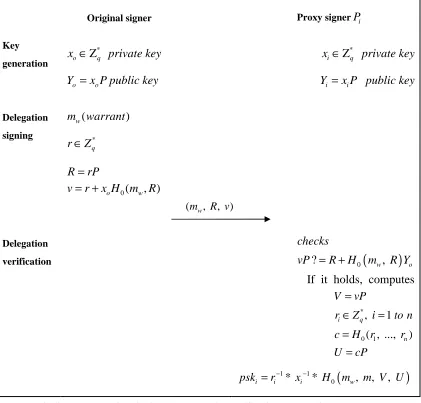
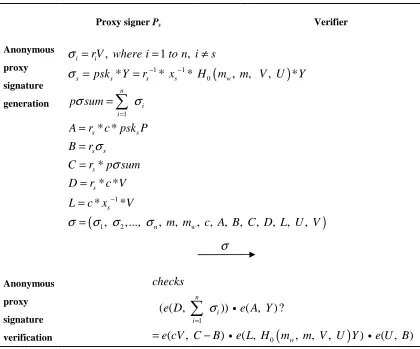
In our APS scheme, there also exist an original signer Alice and a proxy signer group Pi∈{ , , ..., }P P1 2 Pn where i=1, ..., n and only one proxy signer of proxy signers group can sign the message. For more clarity, we show our improvement in detail as follows. The proposed scheme consists of six phases: (1) the parameter generation phase, (2) key generation phase, (3) delegation signing phase, (4) delegation verification phase, (5) APS generation phase, and (6) APS verification phase. Phase (1) and (2) are the same as in Yu et al.’s scheme which has been delineated on Section 3.1. We omit these phases in the following but show phase (3) and (4) in figure 3 and phase (5) and (6) in figure 4.
(3) In the delegation signing phase, as shown in Fig. 3, the original signer randomly selects a number r∈Zq* , and uses r to computes R=rP , and
0( , )
o w
Original signer Proxy signerPi Key
generation
* Z
o q
x ∈ private key
o o
Y =x Ppublic key
* Z
i q
x ∈ private key
i i
Y =x P public key
Delegation
signing
( )
w
m warrant
*
q r∈Z
R=rP
0( , )
o w
v= +r x H m R
(mw, , )R v
Delegation
verification ? 0
(
w,)
ochecks
vP = +R H m R Y If it holds, computes
*
0 1
, 1 ( , ..., )
i q
n
V vP
r Z i to n c H r r U cP
=
∈ =
= =
(
)
1 1
0
* * , , ,
i i i w
psk =r− x− H m m V U Fig. 3: The delegation signing and delegation verification phases of our scheme
(4) In the delegation verification phase, after receiving (mw, , )R v , each member
i
P in the proxy signers group first checks whether the equation
(
)
0 w, o
vP= +R H m R Y holds. If it doesn’t, stop the protocol, otherwise, the message will be accepted. Second, they compute V =vP and each chooses n random numbers ri∈Zq*, i=1 to n, and computes c=H r0( , ..., )1 rn , U =cP, and pski =ri−1* xi−1* H0
(
mw, , , m V U)
.(5) In the APS generation phase, as shown in Fig. 4, let Ps be the proxy signer. He computes
σ
i =rVi , where i∈{1, 2, ..., }n and i≠s and computes1
* s *
L=c x − V , then sets Y,
σ
s, p sum A B Cσ
, , , and D , as1
n i i
Y Y
=
=
∑
,(
)
1 1
0
* * * , , , *
s psks Y rs xs H mw m V U Y
σ
= = − − ,1
n i i
p sumσ σ
=
=
∑
,* *
s s
the anonymous proxy signature and sends
σ
to the verifier.Proxy signer Ps Verifier
Anonymous
proxy
signature
generation
(
)
(
)
1 1
0
1
1
1 2
, 1 ,
* * * , , , *
* *
* * * * *
, ,..., , , , , , , , , , ,
i i
s s s s w
n i i
s s
s s s
s
s
n w
rV where i to n i s
psk Y r x H m m V U Y p sum
A r c psk P B r
C r p sum D r c V L c x V
m m c A B C D L U V
σ
σ
σ
σ
σ
σ
σ
σ σ
σ
− −
=
−
= = ≠
= =
=
= = = = =
=
∑
σ
Anonymous
proxy
signature
verification
(
)
1
0 ( ( , )) ( , ) ?
( , ) ( , , , , ) ( , )
n i i
w checks
e D e A Y
e cV C B e L H m m V U Y e U B
σ
== −
∑
ii i
Fig. 4 Anonymous proxy signature generation phase and the verification phase of our scheme
(6) In APS verification phase, upon receiving the proxy signature the verifier computes
1
n i i
Y Y
=
=
∑
and checks whether theequation 0
(
)
1
( , ) ( , ) ? ( , ) ( , , , , )
n
i w
i
e D σ e A Y e cV C B e L H m m V U Y
=
= −
∑
i i( , )i e U B holds.
If it holds, the verifier accepts the signature, otherwise rejects it.
4.2 Correctness
In the delegation verification phase, the proxy signers can check whether the equation holds vP?= +R H0
(
mw, R Y)
o holds as follows:Proof 1.
(
)
? ,
0 0 0 ( ( , )) ( , ) ( , ) o w o w w o
vP r x H m R P rP x H m R P R H m R Y
= +
= +
= +
If it holds, the proxy signers can know that the message is sent from the original signer. Because in the verification equation, he uses the original signer’s public key
o
Y to examine it. If any adversary intercepts the message and modify it, it cannot pass the verify equation.
In the proxy signature verification phase, the following equation gives the correctness of the verification:
Proof 2.
(
)
1 1 0 1, 1 1 1, ( ( , )) ( , ) ( ( , )) ( , ) ? ( , ) ( , , , , ) ( , ) ( ( , ) ( , )) ( * * , ) ( , ) ( , * * n n i i i i w ns i s s s s
i i s n
s i s s s
i i s
e D e A Y e D e A Y
e cV C B e L H m m V U Y e U B e cr V e cr V e r c psk P Y
e cr V e cr V r x
σ
σ
σ
σ
σ
= = = ≠ − − = ≠ = = − = =∑
∏
∏
∏
i i i i i ii H0
(
mw, , , m V U)
* ) (Y ie cP r psk Y, s s )(
)
(
)
(
)
1 1 0 1, 1 0 1, 0 1, 1 ( , ) ( , * * , , , * ) ( , ) ( , ) ( * , , , , * ) ( , ) ( , ) ( , , , , ) ( , ) ( , ns i s s s w s s
i i s n
s i s w
i i s n
s i w
i i s
s i
e cr V e cr V r x H m m V U Y e cP r
e cr V e x cV H m m V U Y e U B
e cr V e L H m m V U Y e U B
e cr V
σ
σ
σ
σ
− − = ≠ − = ≠ = ≠ = = = = =∏
∏
∏
i i i i i i(
)
(
)
(
)
(
)
0 , 0 0 0 ) ( , , , , ) ( , ) ( , ) ( , , , , ) ( , ) ( , ( )) ( , , , , ) ( , ) ( , ( )) ( , , , , ) ( , ) n i w i ss s w
s s w
s s w
e L H m m V U Y e U B
e cr V p sum e L H m m V U Y e U B
e cV r p sum e L H m m V U Y e U B
e cV r p sum e L H m m V U Y e U B
σ
σ
σ
σ
σ
σ
σ
≠ = − = − = − =∑
i ii i
i i
i i
(
)
0
( , ) ( , w, , , ) ( , )
e cV C−B i e L H m m V U Y i e U B
4.3 Security analyses
In this section, we demonstrate that our APS scheme can satisfy the security
our scheme is anonymous, thus identifability is not required. Our scheme satisfies these four security properties as follows:
(1) Verifiability. In APS verification phase, after checking and verifying the
proxy signature
σ
whereσ
=(σ σ
1, 2,...,σ
n, , m mw, , , , ,c A B C , , , )D L U V , the verifier can calculate to check whether the verification equation1
( ( , )) ( , ) ?
n i i
e D σ e A Y
=
=
∑
i e cV C( , −B) ( , ie L H m0( w, , ,m V) ) ( , )U Y i e U B holds. If it does, the verifier can be convinced that the received message is signed by one of the proxy signer members authorized by the original signer because
1
( )
n i i
Y Y
=
=
∑
and V(=vP= +R H0(
mw, R Y)
o) areused in the verification equation.
(2) Unforgeability. It means that any entity, including the original signer, other
than the proxy signer himself cannot generate a valid proxy signature. Only an authorized proxy signer P can create a valid proxy signature s
σ
. If any attacker wants to forge a proxy signature, he must be authorized by the original signer signing on a warrant m and use the proxy signer’s proxy secret key ws
psk to compute σs. However, this is impossible since the identity of the attacker wasn’t in m signed by the original signer. Not to mention, he w doesn’t know psk . Under this situation (with a valid s
σ
in hand and without the knowledge of psk ), even if he wants to (1) fake the proxy signer s key as psk , (2) change value s' c to c , or (3) randomly select ' rs'∈Zq*, trying to counterfeit the proxy signature, we demonstrate that his attempts deem to fail. We demonstrate the reasons for the failures of these three cases in the following.Case 1. If an attacker does not know the proxy secret key psk , he cannot s generate valid σs(= psks* )Y ,
1
( )
n i i
p sumσ σ
=
=
∑
, A(=rs* *c psk Ps ), ( s s)B =rσ , and C(=rs*p sumσ ). Even if he uses a random psk s' to sign the message, since 1 1
(
)
0
* * , , ,
s s s w
psk =r− x− H m m V U , he cannot evaluate the right value xs−1 to compute L to be successfully verified in the verification equation.
Case 2. Because c is changed to c , at least one of the random numbers ' r i should also be modified. Without loss of generality, we let
1
i s
(
)
1 1
0
( * * , , , )
s s s w
psk =r− x− H m m V U ,
σ
s(= psks* )Y ,1
( )
n i i
p sumσ σ
=
=
∑
, A(=rs* *c psk Ps ), B(=rsσs), C(=rs*p sumσ ),( s* * )
D =r c V , and L(=c x* s−1* )V are all changed as well. That is, '
σ = (σ σ1', 2,..., σ σs', s+1,..., σn, , m mw, ', ', ', ', ', ',c A B C D L
', )
U V . Apparently, the verification
equation 0
1
( ( , )) ( , ) ? ( , ) ( , ( , ,
n
i w
i
e D σ e A Y e cV C B e L H m m
=
= −
∑
i i, ) ) ( , )V U Y ie U B cannot hold. Below, we only show the inequality of portion of the verification equation ( ', )e A Y =e U( ', ')B .
( ', ) ( '* '* ' , ) ( ' , ' ' )
( ' , ' ) ( , )
s s
s s
s s
e A Y e r c psk P Y
e c P r psk Y e c P r
e U B
σ
= =
= ≠
Case 3. In this case, if any attacker randomly selects rs'∈Zq* and tries to generate the valid proxy signature σ'. Accordingly, the parameters
( )
U =cP , 1 1
(
)
0
( * * , , , )
s s s w
psk =r− x− H m m V U , σs(=rs−1* xs−1*
(
)
0 w, , , * )
H m m V U Y ,
1
( )
n i i
p sumσ σ
=
=
∑
, A(=rs* *c psk Ps ) ,( s s)
B =rσ , C(=rs*p sumσ ) , D(=rs* * )c V , and L(=c x* s−1* )V are all changed as well, similar to Case 2. Finally the signature
becomes σ'=(σ σ1, 2,...,σ σs', s+1,..., σn, , m mw, ', ', ', ', ',c A B C D ', ', )
L U V . As in Case 2, when the verifier checks whether
( ', ) ( , ')
e A Y =e U B holds, he will found it doesn’t.
(3) Undeniability. As in Section 4.2 Proof 2, the verifier uses the verification
equation 0
(
)
1
( ( , )) ( , ) ( , ) ( , , , , )
n
i w
i
e D σ e A Y e cV C B e L H m m V U Y
=
= −
∏
i i( , )i e U B to check whether the proxy signature comes from one member of the proxy signer group. Since in the equation V(=vP= +R H0
(
mw, R Y)
o)includes the original signer’s public key Y and o
1
n i i
Y Y
=
original signer and the proxy signer group cannot repudiate their participations in the signature creation.
(4) Anonymity. In the APS generation phase, all the parameters A, B, C, D, and L
have to be multiplied by rs∈Zq* to make the proxy signature
σ
anonymous. If any attacker wants to know who is the real signer, he must know the value r s to use rs−1 to unrandomize all parameters to get A'(=c'*psk Ps' ), B(=σ
s'),'( ')
C = p sumσ , D'(=c V'* ), and
σ
s'(=xs−1* H0(
mw, , , m V U)
* )Y . But now σi =rV ii , ≠s, each is randomized by r respectively. Even the attack i knows r , without the knowledge of s r and i x , he cannot know who the real s signer is. Not to mention in reality, he in reality cannot know the value of r . It s means that anyone cannot know who signs the signature. So our APS scheme can achieve the anonymous property.5. Comparisons
In this section, we compare the computational cost between Yu et al.’s APS scheme and ours and summarize the result in Table 1. We denote e as the pairing operation Pm and Pa as the point multiplication and point addition on G1 respectively, and n denote the number of proxy signers. In Yu et al.’s APS scheme, the generation and verification of psk in column 3 of Table 1 should be 2n Pm + nPa instead of (n+1) Pm operations. Because in Yu et al.’s scheme, the generation and verification of psk are R=rP and sP= +R H0
(
mw, R Y)
0, the sP should be computed by n proxy signers. The APS verification should be (n+1)e+n Pm +2n Pa rather than the original (n+1)e+n Pm +(n+1) Pa as listed in the table of [13]. From Table 1, we can see that our scheme is more efficient then Yu et al.’s.Table 1: Comparison of computational costs of our scheme and Yu’s scheme
Key generation
Generation and
verification of psk
APS generation APS verification
Yu’s scheme Same 2nPm+nPa (3n−2)Pm+(n+1)Pa (n+1)e+nPm+ 2nPa
Our scheme Same 4nPm+nPa (n+5)Pm+nPa 5e+2Pm+(n+1)Pa
6. Conclusions
et al.’s original protocol was not secured and could not satisfy the anonymous property. Accordingly, we proposed a novel APS scheme to reach the goal. Our construction uses a random number r , one-way hash function and bilinear pairings s to make the proxy signature attain the anonymous property. After analyses and comparisons, we conclude that our new protocol is a significant improvement against attackers concerning security and is more efficient in computation overhead as demonstrated in this paper.
Reference
[1] M. Mambo, K. Usuda, E. Okamoto, “Proxy signature: delegation of the power to sign messages, “IEICE Trans. Fundam. Volume E79-A(9), September,
pp.1338–1354, 1996.
[2] S. Saeednia, “An identity-based society oriented signature scheme with anonymous signers, ”Information Processing Letters 83, pp.295–299, 2002. [3] C. L. Hsua, T. S. Wu, T. C. Wu, “Group-oriented signature scheme with
distinguished signing authorities, ”Future Generation Computer Systems 20, pp.865–873, 2004.
[4] C. Y. Lin, T. C. Wu, F. Zhang, and J. J. Hwang, “New identity-based society oriented signature schemes from pairings on elliptic curves, ”Applied Mathematics and Computation 160 , pp.245–260, 2005.
[5] R. X. Lu, Z. F. Cao, and Y. Zhou, “Proxy blind multi-signature scheme without a secure channel, ”Applied Mathematics and Computation 164, pp.179–187, 2005. [6] H. F. Huang, and C. C. Chang, “A novel efficient (t, n) threshold proxy signature
scheme, ”Information Sciences 176, pp.338–1349, 2006.
[7] Z. Shao, “Certificate-based verifiably encrypted signatures from pairings, ” Information Sciences 178, pp.2360–2373, 2008.
[8] B. Kang, C. Boyd, and E. Dawson, “Identity-based strong designated verifier signature schemes: Attacks and new construction, ”Computers and Electrical Engineering, 2008.
[9] J. Zhang, and J. Mao, “A novel ID-based designated verifier signature scheme, ”Information Sciences 178, pp.766–773, 2008.
[10] K. L. Wu, J. Zou, X. H. Wei, and F. Y. Liu, “Proxy group signature: a new anonymous proxy signature scheme, ”Proceedings of the Seventh International Conference on Machine Learning and Cybernetics, Kunming, pp.12-15, 2008. [11] Z. Shao, “Improvement of identity-based proxy multi-signature scheme, ”The
Journal of Systems and Software 82, pp.794–800, 2009.
Posts and Telecommunications, 16(4): 116–124, 2009.
[13] Y. Yu, C. Xu, X. Huang, and Y. Mu, “An efficient anonymous proxy signature scheme with provable security, ”Computer Standards & Interfaces 31, pp.348– 353, 2009.
[14] F. Cao, and Z. Cao, “A secure identity-based proxy multi-signature scheme, ”Information Sciences 179, pp.292–302, 2009.
[15] A. Yang, and W. P. Peng, “A Modified Anonymous Proxy Signature With a Trusted Party, ”First International Workshop on Education Technology and Computer Science, 2009.
[16] J. H. Hu, and J. Z. Zhang, “Cryptanalysis and improvement of a threshold proxy signature scheme, ”Computer Standards & Interfaces 31, pp.169–173, 2009. [17] Y. Yu, C. X. Xu, X. S. Zhang, and Y. J. Liao, “Designated verifier proxy signature
scheme without random oracles, ”Computers and Mathematics with Applications 57, pp.1352–1364, 2009.
[18] J. H. Zhang, C. L. Liu, and Y. I. Yang, “An efficient secure proxy verifiably encrypted signature scheme, ”Journal of Network and Computer Applications 33, pp.29–34, 2010.
[19] B. D. Wei, F. G. Zhang, and X. F. Chen, “ID-based Ring Proxy Signatures, ”ISIT2007, Nice, France, pp.24–29, 2007.
[20] T. S. Wu, and H. Y Lin, “Efficient self-certified proxy CAE scheme and its variants, ”The Journal of Systems and Software 82, pp.974–980, 2009.
[21] Y. F. Chung, Z. Y. Wu, and T. S. Chen, “Ring signature scheme for ECC-based anonymous signcryption, ”Computer Standards & Interfaces 31, pp.669-674, 2009.
[22] L. J. Mordell, Diophantine equations, Academic Press. ISBN 0-12-506250-8, 1969.
[23] S. Lal, V. Verma, “Identity base strong designated verifier proxy signature schemes, ”Cryptography eprint Archive Report394, 2006.
[24] C. H. Yang, S.F. Tzeng, M. S. Hwang, “On the efficiency of nonrepudiable threshold proxy signature scheme with known signers, ”Syst. Softw. 73 (3) pp.507–514, 2004.
[25] D. Chaum, “Blind signatures for untraceable payments, ”Advances in Cryptology - Crypto '82, Springer-Verlag, pp.199-203, 1983.
[26] H. Xiong, J. Hua, Z. Chen, F. Li, “On the security of an identity based multi-proxy signature scheme, ”Computers and Electrical Engineering’ 37, pp. 129-135, 2011.
pp.1471-1479, 2011.
[28] Y. Sun, C. Xu, Y. Yu, B. Yang, “Improvement of a proxy multi-signature scheme without random oracles,”Computer Communications 34, pp. 257-263, 2011. [29] Z. Liu, Y. Hu, X. Zhang, H. Ma, “Provably secure multi-proxy signature scheme
with revocation in the standard model,” Computer Communications 34, pp. 494-501, 2011.
[30] H. Bao, Z. Cao, S. Wang, “Improvement on Tzeng et al.'s nonrepudiable threshold multi-proxy multi-signature scheme with shared verification,” Appl. Math. Comput. 169, pp. 1419-1430, 2005.