Proceedings of the 27th International Conference on Computational Linguistics: System Demonstrations, pages 25–29 25
Real-time Scholarly Retweeting Prediction System
Zhunchen Luo†* and Xiao Liu‡*
†Information Research Center of Military Science, PLA Academy of Military Science
100142 Beijing, China
‡School of Computer Science and Technology, Beijing Institute of Technology
100081 Beijing, China
Abstract
Twitter has become one of the most import channels to spread latest scholarly information be-cause of its fast information spread speed. How to predict whether a scholarly tweet will be retweeted is a key task in understanding the message propagation within large user communities. Hence, we present the real-time scholarly retweeting prediction system that retrieves scholarly tweets which will be retweeted. First, we filter scholarly tweets from tracking a tweet stream. Then, we extract Tweet Scholar Blocks indicating metadata of papers. At last, we combine scholarly features with the Tweet Scholar Blocks to predict whether a scholarly tweet will be retweeted. Our system outperforms chosen baseline systems. Additionally, our system has the potential to predict scientific impact in real-time.
1 Introduction
The volume of information about scientific papers is enormous on Twitter, and most data is real-time, even before the paper content is published and shortly after the notifications of acceptance. Besides, lots of scholars post tweets to express their excitement when their papers got accepted (Priem and Costello, 2010). We call the tweets that imply accepted papers scholarly tweets (STs) and the rest non-scholarly tweets (NSTs). Retweeting is an action of reposting others’ tweet by using theretweetbutton on Twitter or other mechanism. To help understand the message propagation within large user communities, we develop a real-time scholarly retweeting prediction system.
Our task is to predict whether aST will be retweeted. The problem of retweeting prediction has at-tracted more and more attention. Zhang et al. (2016) propose a deep learning method to predict retweet-ing. However, due to the special and structural ways using combinations of different Tweet Scholar Blocks (TSBs) encoding scholarly information about papers, venues, and authors, different methods should be explored to solve our task.
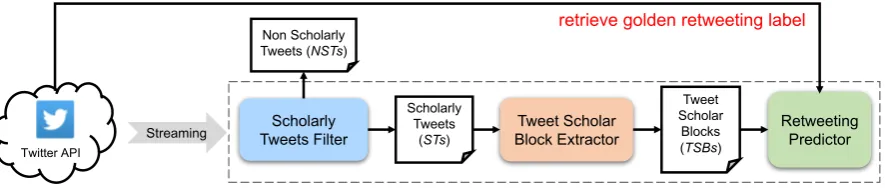
In this work, we propose a real-time scholarly retweeting prediction system by exploitingTSBsand scholarly features. We only focus on retweets made using the retweet button in Twitter. Under this circumstance, the tweet-retweet connection is unambiguously and can be retrieved directly by Twitter’s API. At first, we trace a data stream by tracking “paper accepted” in Twitter using the Twitter API, but there are someNSTsin the data stream, so we build a classification model to filterST tweets. It is investigated that most STsconsist of text blocks calledTwitter Scholar Blocks(TSBs) indicating meta data, and we build a sequence tagger to extractTSBsto gather metadata information. At last, we build a binary classification model by combiningTSBswith scholarly information in Twitter to predict whether theSTwill be retweeted. Experimental results show that our system outperforms chosen baseline systems and has the potential to predict scientific impact in real-time.
* indicates equal contribution.
2 Real-time Scholarly Retweeting Prediction System
2.1 System Overview
Given a tweett, our goal is first to learn a functionST F that estimate the likelihood of whethertis a scholarly tweet, then learn a functionRP to estimate the probability of whethertwill be retweeted. By incorporating with theTSBsand scholarly features, we use the system to predict whether theSTswill be retweeted. The framework of our approach is shown in Figure 1.
Tweet Scholar
Figure 1: Framework of Our Approach
2.2 Scholarly Tweets Filter
We regard filteringSTsfrom the data stream as a classification problem. In our scholarly tweets filter (STF) module, we build a classification model based on support vector machine.
To capture the information in social networks, we design a featureuser’s scholarly membership of academic institutionsby examining whether user descriptions contain one of the high-frequency words of academic institution names in Wikipedia (we choose top sixty words in experiments). Additionally, we designbag of words, words with trending symbols and length of the tweetas features. We also find that almost no one would hide happiness if her paper were accepted, and we use a tweet-specified sentiment analysis API1to generatesentiment labelsfor tweets.
2.3 Tweet Scholar Block Extractor
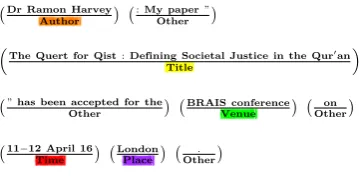
Inspired by previous works on structuring tweets (Luo et al., 2012; Luo et al., 2015), we investigate that researchers postSTs in structural ways using combinations of different Tweet Scholar Blocks (TSBs) encoding scholarly information about papers, venues, and authors. In this work, we propose six types ofTSBs: Author, the names of authors;Title, the title of the paper;Venue, the short or entire name of the venue;Time, the time when the venue will be held; Place, the place where the venue will be held; Other, the rest part of tweet text. An example of extractedTSBsof a tweet is given in Figure 2.
In our tweet scholar block extractor (TSBE) module, we build a sequence tagger based on conditional random fields with BIO schema. We usetokens starting with “@”, surrounded by pairwise symbols, capitalized, trending symbols, POS-Tagging labels and NER labelsas our features. Tokens starting with “@” inSTsare often mentioned co-authors. Besides, the paper titles usually occupy up to 40% text content which is often surrounded by pairwise symbols or all capitalized to show different formats.
2.4 Retweeting Predictor
In our retweeting predictor (RP) module, we build a classification model based on support vector machine (SVM). Apart from using text information generated from the extractedTSBsas our features, we take scholarly features from social networks information in Twitter into account. Apart from extractedTSBs, we categorize the rest scholarly features into following two categories:
Author Social Features: Previous work shows that the overall impact of all co-authors should have the potential to influence a paper’s quality and popularity (Dong et al., 2015). We use extractedAuthortype ofTSBsto find the authors inST tweets. We think the influence of an individual is related to herfriend’s
1
:Defining Societal Justice in the Qur′an Title
)
(”has been accepted for the Other
Figure 2: An Example of Extracted Tweet Scholar Blocks
number, followers number, and statuses quantity. To show the influence of a group, we calculate thesum, maximum value, minimum value and average valueof influences of all participants in that group. In spite of these, we design a binary feature indicatingwhether a user is verifiedas verification is used by Twitter mostly to confirm the authenticity of celebrity accounts.
Venue Popularity Features: Different venues have large differences in their influences. Since the well-respected venues are better platforms for researchers to publish their work or results, our intuition is that better sites help scholars spread their scientific impact more. Scholars often use Twitter as a note-taking tool (Mapes, 2016) during venues, sothe number of statuses in the venue topicmay reflect the popularity and influence of the site. Considering the developments and the trends of the venues, we also takethe total historical quantity of statusesinto account.
3 Experiments
Predicted Golden User Tweet
not not @Neonatal Brain New ultrasound marker for #brain growth. Paper is accepted. Nice and easy for both fetal and neonatal measurements. https://t.co/W17Wcnqv4L
yes yes @danieldekok \o/. ACL short paper by me and Erhard Hinrichs on dependency
parsing with topological fields (and BiDi LSTMs) accepted.
yes not @manaalfar Short paper on non-distributional word vectors accepted
at ACL 2015 #chinacl2015 #acl2015 #nlproc
not yes @dimazest finally I got an email from emnlp and
it’s positive, the paper got accepted!
Table 1: Examples of predicted scholarly tweets and the golden labels of whether they will be retweeted
3.1 Data Preparation and Experiment Settings
To evaluate our system, we first track a tweets stream posted from Jan. 2012 to Apr. 2018 by tracking the key phrase “paper accepted” using Twitter API. randomly crawl 6,500 tweets Then we randomly sample 6,500 tweets and manually label them asSTsandNSTsfor training scholarly tweets filter. Next, we choose 1,400 originalSTsout of them by checking their “retweeted status” attributes are empty from Twitter API. We use tweet-specific annotators (Owoputi et al., 2013; Ritter et al., 2011) to tokenize those tweets and get pos-tagging and NER labels, then manually labelTSBsin BIO schema for training our tweet scholar block extractor. Last but not least, we get the golden labels of whether an originalST will be retweeted by finding the corresponding retweets. Additionally, five-fold cross-validation is used in our experiments and accuracy is used as the evaluation metric.
3.2 Baseline Comparison and Feature Selection
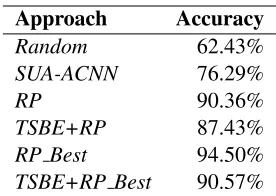
TSBE+RP Best and Golden+RP Best respectively. Results are shown in Table 2. Besides, Table 1 demonstrates some predicted examples of ourTSBE+RP Bestsystem.
Approach Accuracy
Random 62.43%
SUA-ACNN 76.29%
RP 90.36%
TSBE+RP 87.43%
RP Best 94.50%
TSBE+RP Best 90.57%
Table 2: Comparing With Baselines and the Best Feature Conjunction
Overall, our system outperforms the baseline, and it is feasible to predict scientific impact in Twitter in real time. Moreover, the performance ofTSBE+RPis lower than the performance ofRPon manually labeled TSBs, because the errors produced inTSBE might affect the performance ofRP. Besides, the best feature conjunction consisted ofSum Friends Count,Sum Followers Count,Max Followers Count.
3.3 Ablation Study
To find the effectiveness of each feature and which features are in particular highly valued byRP Best, we also removed each feature fromRP Best andTSBE+RP Best respectively to evaluate the effectiveness of each feature by the decrement of accuracy.
By comparing the results shown in Table 3, we can see thatSum Followers Countis very effective to ourRP Best. The reason might be thatSum Followers Countis more suitable to stand for the influence of the authors’ group.
Approach Accuracy
RP Best 94.50%
RP Best-Sum Friends Count 89.57% RP Best-Sum Followers Count 88.93% RP Best-Max Followers Count 89.14%
TSBE+RP Best 90.57%
TSBE+RP Best-Sum Friends Count 86.71% TSBE+RP Best-Sum Followers Count 85.14% TSBE+RP Best-Max Followers Count 86.43%
Table 3: Comparing Results by Decaying Every Feature One by One
4 Conclusion
In this paper, we propose our real-time scholarly retweeting prediction system which solves the scholarly tweets retweeting prediction problem. We introduce the three modules in our system: scholarly tweets filter, tweet scholar block extractor and retweeting predictor. In addition, our system has the potential to predict scientific impact in real-time. Sufficient experimental results demonstrate that our model outperforms the baseline systems. Hope our system can help researchers to stand on the shoulders of right giants.
Acknowledgement
References
Yuxiao Dong, Reid A. Johnson, and Nitesh V. Chawla. 2015. Will this paper increase yourh-index?: Scientific impact prediction. InProceedings of the WSDM 2015, pages 149–158.
Zhunchen Luo, Miles Osborne, Sasa Petrovic, and Ting Wang. 2012. Improving twitter retrieval by exploiting structural information. InProceedings of the AAAI 2012, pages 648–654.
Zhunchen Luo, Yang Yu, Miles Osborne, and Ting Wang. 2015. Structuring tweets for improving twitter search. JASIST, 66(12):2522–2539.
Kristen Mapes. 2016. A qualitative content analysis of 19, 000 medieval studies conference tweets. In Proceed-ings of the SIGDOC 2016, page 48.
Olutobi Owoputi, Brendan O’Connor, Chris Dyer, Kevin Gimpel, Nathan Schneider, and Noah A. Smith. 2013. Improved part-of-speech tagging for online conversational text with word clusters. In Proceedings of the NAACL-HLT 2013, pages 380–390.
Jason Priem and Kaitlin Light Costello. 2010. How and why scholars cite on twitter. Proceedings of The Asist Annual Meeting, 47(1):1–4.
Alan Ritter, Sam Clark, Mausam, and Oren Etzioni. 2011. Named entity recognition in tweets: An experimental study. InProceedings of the EMNLP 2011, pages 1524–1534.