NATIVE LANGUAGE OLAP QUERY EXECUTION
Hiba Tabbara A thesis in The Department ofComputer Science and Software Engineering
Presented in Partial Fulfillment of the Requirements For the Degree of Doctor of Philosophy
Concordia University Montréal, Québec, Canada
September 2012 c
Concordia University
School of Graduate Studies
This is to certify that the thesis prepared
By: Miss Hiba Tabbara
Entitled: Native language OLAP query eXecution
and submitted in partial fulfillment of the requirements for the degree of
Doctor of Philosophy (Computer Science)
complies with the regulations of this University and meets the accepted standards with respect to originality and quality.
Signed by the final examining commitee:
Dr. Chun-Yi Su Chair
Dr. Rokia Missaoui External Examiner Dr. Rachida Dssouli Examiner
Dr. Peter Grogono Examiner
Dr. Joey Paquet Examiner
Dr. Todd Eavis Supervisor
Approved by Dr. Volker Haarslev
Chair of Department or Graduate Program Director
20 June 2012 Robin Drew, Ph.D., Dean
Abstract
Native language OLAP query eXecution
Online Analytical Processing (OLAP) applications are widely used in the compo-nents of contemporary Decision Support systems. However, existing OLAP query languages are neither efficient nor intuitive for developers. In particular, Microsoft’s Multidimensional Expressions language (MDX), the de-facto standard for OLAP, is essentially a string-based extension to SQL that hinders code refactoring, limits compile-time checking, and provides no object-oriented functionality whatsoever.
In this thesis, we present Native language OLAP query eXecution, or NOX, a framework that provides responsive and intuitive query facilities. To this end, we exploit the underlying OLAP conceptual data model and provide a clean integration between the server and the client language. NOX queries are object-oriented and sup-port inheritance, refactoring and compile-time checking. Underlying this functionality is a domain specific algebra and language grammar that are used to transparently convert client side queries written in the native development language into algebraic operations understood by the server. In our prototype of NOX, JAVA is used as the native language. We provide client side libraries that define an API for programmers to use for writing OLAP queries. We investigate the design of NOX through a series of real world query examples. Specifically, we explore the following: fundamental SELECTION and PROJECTION, set operations, hierarchies, parametrization and query inheritance. We compare NOX queries to MDX and show the intuitiveness and ro-bustness of NOX. We also investigate NOX expressiveness with respect to MDX from an algebraic point of view by demonstrating the correspondence of the two approaches in terms of SELECTIONand PROJECTION operations.
We believe the practical benefit of NOX-style query processing is significant. In short, it largely reduces OLAP database access to the manipulation of client side, in memory data objects.
Acknowledgments
It was always the insightful comments and positive criticism of my supervisor Dr. Todd Eavis that helped me be on the right track to complete my thesis work. Without his continuous support the research presented in this thesis would not have been possible.
I would like to thank all my colleagues in the Computer Science and Software Engineering department at Concordia University, as well as the staff and faculty of the department for their commitment to further education.
This thesis will not have been completed without the full support and love of my family especially my mom, dad, brother and sister. Special thanks go to my study mates and friends Bassel Bitar, Rania Khattab, Mazen El Masri, Genevieve Turmel, Rasha Samaha and Jocelyne Faddoul for their continuous encouragement.
Contents
List of Figures ix
List of Tables xi
List of Listings xii
1 Introduction 1
1.1 Motivation for the current research . . . 3
1.2 Core Research Objectives . . . 5
1.3 Overview of Proposed Solution . . . 8
1.4 Research Evaluation . . . 11
1.5 Thesis Outline . . . 12
2 Background Material 14 2.1 Data Warehousing . . . 15
2.1.1 The Data Warehouse Architecture . . . 15
2.1.2 The Star Schema . . . 16
2.2 What is OLAP? . . . 17 2.3 Multidimensional Modeling . . . 19 2.4 OLAP Hierarchies . . . 20 2.5 OLAP Operators . . . 22 2.5.1 Slice . . . 22 2.5.2 Dice . . . 23
2.5.3 The other Algebraic Multidimensional Operators . . . 23
2.7 What is Document Type Definition (DTD)
Schema? . . . 28
2.8 Conclusion . . . 29
3 Related Work 30 3.1 Relational Databases Querying Languages . . . 31
3.1.1 Object Relational Mapping (ORM) Frameworks . . . 32
3.1.2 Language Specific Database Libraries . . . 37
3.2 Multidimensional Databases Querying Languages . . . 40
3.3 OLAP Algebras in Research . . . 45
3.4 Conclusion . . . 50
4 Native language OLAP query eXecution (NOX) 51 4.1 The Sidera System Architecture . . . 52
4.2 The NOX Framework . . . 54
4.3 Conceptual Model . . . 58
4.4 The NOX Algebra . . . 59
4.5 The NOX Grammar . . . 65
4.6 The Client Side API . . . 75
4.6.1 The NOX Pre-processor . . . 82
4.6.2 JJTree in the NOX Pre-processor . . . 89
4.7 Conclusion . . . 94
5 NOX Application Programming 95 5.1 UML of a Sample OLAP Query . . . 96
5.2 SELECTION . . . 98
5.2.1 SELECTION Syntax in NOX . . . 98
5.2.2 A SimpleSELECTION . . . 100
5.2.3 A More Sophisticated SELECTIONQuery . . . 105
5.3 PROJECTION . . . 114
5.3.1 PROJECTION Syntax in NOX . . . 116
5.3.2 A SimplePROJECTION . . . 118
5.4 Set Operations . . . 119
5.5 Query Inheritance . . . 128
5.7 Evaluation of the NOX Language . . . 141
5.7.1 Extension of the Project Method . . . 141
5.8 Conclusion . . . 147
6 Manipulating Hierarchies 148 6.1 Supplemental Hierarchy Classes . . . 148
6.2 Hierarchies Examples . . . 150 6.2.1 Hierarchy Example 1 . . . 153 6.2.2 Hierarchy Example 2 . . . 155 6.2.3 Hierarchy Example 3 . . . 159 6.2.4 Hierarchy Example 4 . . . 159 6.3 Conclusion . . . 164 7 Parameterization in NOX 165 7.1 Parameter Parsing in NOX . . . 167
7.2 Parameter Parsing Pseudocode . . . 170
7.3 Parameter Insertion DOM Utility . . . 172
7.4 Run-time Parameter Handling . . . 174
7.5 NOX Parametrization in Practice . . . 176
7.6 Parametrized NOX Queries versus Parametrized MDX Queries . . . . 180
7.7 Conclusion . . . 185
8 The NOX Language Expressiveness 186 8.1 Grammatical Structure . . . 188
8.2 OLAPSELECTION . . . 190
8.2.1 SELECTION Production Rules in MDX . . . 190
8.2.2 Mapping the SELECTION Production Rules between MDX and NOX . . . 194
8.2.3 SELECTION Constraints . . . 198
8.3 OLAPPROJECTION . . . 205
8.3.1 PROJECTION Production Rules in MDX . . . 206
8.3.2 Mapping of PROJECTION Production Rules between MDX and NOX . . . 210
8.3.3 PROJECTION Constraints . . . 214
8.3.5 Nested Attribute Display . . . 218 8.4 Conclusion . . . 220
9 Conclusion 222
9.1 Research Methodology and Contribution . . . 225 9.2 Future Work . . . 226 Bibliography 229 Appendices 239 A Abbreviations 240 B DTD Schema 243 C Complex Query in XML 246
D MDX Grammar Production Rules 252
List of Figures
1 The Sidera system model . . . 11
2 Typical data warehouse architecture . . . 16
3 Star schema example . . . 18
4 A three dimensional data cube example . . . 20
5 A Customer hierarchies example . . . 21
6 A dimension table corresponding to the Customer hierarchies example 22 7 An OLAP slice . . . 23
8 An OLAP dice . . . 24
9 OLAP drill-down and roll-up . . . 24
10 OLAP pivoting . . . 25
11 Simple parse tree . . . 27
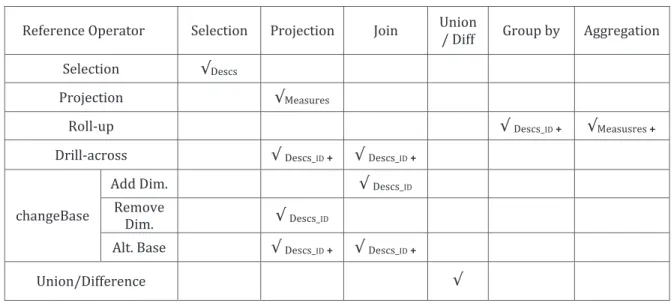
12 Reference operator matching between multidimensional and relational algebra operations . . . 49
13 The core architecture of the parallel Sidera OLAP server [EDD+07] . 54 14 The Sidera frontend [EDD+07] . . . 55
15 The Sidera backend node [EDD+07] . . . 56
16 NOX processing stack . . . 57
17 NOX conceptual query model . . . 58
18 A simple symmetric hierarchy . . . 59
19 Selection operation [AR] . . . 62
20 Projection operation [AR] . . . 62
21 Drill-across operation [AR] . . . 63
22 Set operations (Union) operation [AR] . . . 63
23 Change Level operation [AR] . . . 63
24 Change Base operation [AR] . . . 63
26 UML class diagram for the NOX API library . . . 81
27 The client compilation model. . . 84
28 Simple query parse tree. . . 91
29 UML class diagram for NOX programmer OLAP classes . . . 97
30 DOM tree representation of the XML string in Listing 5.3 . . . 107
31 A subtree of the more complex query parse tree . . . 109
32 ComplexQuery2: Subtree rooted at “CondAndNode” node of Figure 31 110 33 ComplexQuery3: Subtree rooted at tne first “EqualityExpression” node of Figure 31 . . . 111
34 ComplexQuery4: Subtree rooted at the second “EqualityExpression” node of Figure 31 . . . 112
List of Tables
1 OLAP Queries Comparison between NOX and MDX . . . 143 2 Parametrized NOX Queries versus Parametrized MDX Queries . . . . 183 3 Objectives and the Chapters/Sections where they were implemented . 224
Listings
2.1 DTD declaration . . . 28
3.1 In JDOQL [JDO, Rus03] . . . 33
3.2 In OQL [GBB+00, ODM] . . . 33
3.3 Predicate class and match method for querying the Student table . . 35
3.4 In Java using db4o [DB4] . . . 39
3.5 In .NET using LINQ [LIN] . . . 39
3.6 MDX query 1 . . . 42
3.7 MDX query 2 . . . 42
3.8 MDX query 3 . . . 42
3.9 A more sophisticated MDX query . . . 43
4.1 “ClientQuery.dtd” used to validate NOX XML files . . . 66
4.2 Example of a Selection XML string . . . 70
4.3 Example of INTERSECTION XML string . . . 72
4.4 Pseudocode for OLAP compilation . . . 76
4.5 Base class OLAP query with stub methods . . . 83
4.6 Saving first and last tokens of a class that extends OlapQuery using JJTree . . . 92
4.7 Pseudocode for constructing the parse tree in Java1.5.jjt (using JavaCC and JJTree) . . . 93
5.1 Simple OLAP query . . . 102
5.2 Re-written version of Listing 5.1 that contains the XML string and sends it to the server . . . 104
5.3 Simple query XML string . . . 106
5.4 A more complex OLAP query . . . 108
5.5 MDX SELECT statement . . . 113 5.6 A more complex MDX query corresponding to the query in Listing 5.4 115
5.7 Simple OLAP query projection . . . 120
5.8 Simple MDX query projection corresponding to the query in Listing 5.7 121 5.9 Set INTERSECTION operation using theselect method in NOX . . . . 122
5.10 The “Inner” query used in the INTERSECTIONoperation of Listing 5.9 123 5.11 MDX set INTERSECTIONquery corresponding to the query in Listing 5.9124 5.12 Set INTERSECTION operation using theproject method in NOX . . . 125
5.13 The “Inner” Query used in the INTERSECTION operation of Listing 5.12 126 5.14 MDX setINTERSECTIONquery corresponding to the query in Listing 5.12127 5.15 Example 1: Over-riding a query class . . . 129
5.16 MDX query corresponding to the NOX query of Listing 5.15 . . . 131
5.17 Example 2: Over-riding query classes . . . 133
5.18 MDX query corresponding to the NOX query of Listing 5.17 . . . 134
5.19 Simplified version of OlapResultSet grammar . . . 135
5.20 Partial listing of Result Set . . . 136
5.21 Trivial report method . . . 139
5.22 A more complex MDX query . . . 144
5.23 projectmethod extended in NOX and equivalent to MDX Listing 5.22145 6.1 Class OlapHierarchy . . . 151
6.2 Class OlapPath . . . 152
6.3 Simple OLAP dimension . . . 154
6.4 Class GeographicHierarchy . . . 155
6.5 Manipulating hierarchies: example 1 . . . 156
6.6 MDX query corresponding to the query in Listing 6.5 . . . 156
6.7 Manipulating hierarchies: example 2 . . . 158
6.8 MDX query corresponding to the query in Listing 6.7 . . . 158
6.9 Manipulating hierarchies: example 3 . . . 160
6.10 MDX query corresponding to the query in Listing 6.9 . . . 161
6.11 Manipulating hierarchies: example 4 . . . 162
6.12 MDX query corresponding to the query in Listing 6.11 . . . 163
7.1 Parametrized query invocation . . . 167
7.2 class MainQuery with parameter parm1 . . . 168
7.3 Parameters parsing pseudocode . . . 170
7.5 XMLparametersInsert pseudocode . . . 173
7.6 Intermediate Java file with execute() method . . . 175
7.7 class ExampleQuery2 with two parameters . . . 177
7.8 class ExampleQuery3 with four parameters . . . 178
7.9 Parametrized MDX query example [MSD] . . . 181
7.10 Parameter assignment using ADOMD . . . 182
7.11 Parametrized MDX query using ADOMD [Mic] . . . 184
8.1 MDX SELECT statement . . . 189
8.2 Top level NOX grammar . . . 189
8.3 Production rules for the MDX WHERE clause . . . 191
8.4 Grammar rules for the “Hierarchy List” . . . 198
8.5 MDX query returning values for customers living in the United States 199 8.6 NOX query returning values for customers living in the United States 200 8.7 XML description of the hierarchy used in the return statement of the selectmethod of the query in Listing 8.6 . . . 201
8.8 MDX query returning values for customers living in the United States and who bought products in “Category”with key 1 . . . 202
8.9 NOX query returning values for customers living in the United States and who bought products in “Category” with key 1 . . . 203
8.10 MDX query returning values for customers living in the United States or the United Kingdom and who bought products in “Category” with key 1 . . . 204
8.11 NOX query returning values for customers living in the United States or the United Kingdom and who bought products in “Category” with key 1 . . . 205
8.12 MDX SELECT-FROM-WHEREsyntax . . . 206
8.13 Production rules for the MDX <axis_specification> . . . 208
8.14 MDX query returning a subcube with sales measure on one axis and calendar year members on another axis . . . 215
8.15 NOX query returning a subcube with sales measure on one axis and calendar year members on another axis . . . 215
8.16 MDX query returning a subcube with sales measure on one axis and some specified calendar years on another axis . . . 217
8.17 NOX query returning a subcube with sales measure on one axis and
some specified calendar years on another axis . . . 217
8.18 MDX query returning a subcube with sales measure on one axis and the crossjoin of two sets on another axis . . . 219
8.19 NOX query returning a subcube with sales measure on one axis and two sets on two other axes . . . 220
B.1 DTD example . . . 244
C.1 XML string corresponding to the query in Listing 5.4 . . . 246
D.1 MDX grammar . . . 252
Chapter 1
Introduction
Information is often seen as a kind of digital treasure in the current era, with captured data providing a wealth of information and analytical opportunities. In industrial settings, data warehousing and Online Analytical Processing (OLAP) have become two of the most significant technologies in this regard. Together, they enable efficient, multidimensional analysis of data in a multitude of industries such as retail sales, telecommunications, financial services and real estate [CD97] [SBSR08]. In practice, consumer-focused companies collect terabytes of information on past transactions that, in turn, enables them to define and target both new and potential customers. Real world examples of the value and scope of the data analysis process include:
1. WalMart uses approximately half a petabyte of customer transaction data to forecast demand and increase revenue [Hay04]. Analysis of sales transactions after a hurricane resulted in the discovery that the normal volume of pop-tarts and beer sold increased by a factor of seven. An analysis of cold medicine purchases revealed that they are often accompanied with purchases of soup and
orange juice.
2. Pharmaceutical companies use data mining techniques to discover and extract useful patterns from their large sets of data. Manipulation and classification of this data helps improve the quality of drug discovery processes and delivery methods while still competing on lower costs [Ran05].
3. Financial companies rely on data warehousing to explore new customer oppor-tunities. For examples, users employ tools such as Microsoft Analysis Services and SAP’s Business Information Warehouse for the analysis of data held in the data warehouse. Ultimately, OLAP allows decision-makers to quickly and interactively analyze the multi-dimensionally modeled data relevant to various business considerations [Hil10].
Because of its impact, effective data collection and analysis has grown into a multi-billion dollar industry that is dominated by some of the world’s largest software companies. Still, the supporting data management applications and interfaces remain complex and unintuitive, particularly for users and developers with little OLAP ex-perience. For this reason, important opportunities exist for improved — or even completely new - data access and query models in this domain.
1.1
Motivation for the current research
Over the past three decades, relational database management systems (RDBMS) have secured their place as the cornerstone of contemporary data management envi-ronments [Sel08]. During that time, logical data models and query languages have matured to the point whereby database practitioners can almost unequivocally iden-tify common standards and best practices. In particular, the ubiquitous relational data model and the Structured Query Language (SQL) have become synonymous with the notion of efficient storage and access of transactional data.
That being said, a number of new and important domain-specific data manage-ment applications have emerged in the past decade. At the same time, general pro-gramming languages have evolved, driven by a desire for both greater simplicity, modeling accuracy, reliability, and development efficiency. As such, a motivation to explore new data models, as well as the languages that might exploit them, has emerged [CW00].
One particular area of interest is the aforementioned Business Intelligence (BI)/OLAP domain. Typically, such systems work in conjunction with an underlying relational data warehouse that houses an integrated, time sensitive, repository of one or more organizational data stores. At its heart, BI attempts to abstract away some of the often gory details of the large warehouses so as to provide users with a cleaner, more intuitive view of enterprise data. Very often, in fact, BI applications effectively serve as wrappers for the supporting warehouses and, with varying levels of success, seek to
hide some of the warehouse’s physical and design complexity. Beyond trivial exploita-tion of the BI facilities, however, meaningful analysis can become quite complex and can necessitate a considerable investment of the developer’s time and energy [SC05]. We note, however, that although BI has long been recognized as providing the technologies, applications and practices for the collection, integration and analysis of data, no standard query interface for OLAP DBMSs has been developed. In practice, Microsoft’s Multidimensional Expressions query language (MDX) — extended SQL — has become a de-facto choice in many production environments. Still, as will be discussed later in the thesis, use of such languages (MDX) can have a negative impact on programmer productivity. In particular, they force the programmer to become an expert in two very different languages (the implementation language and the query language) with completely different mental models. Moreover, the embedded query strings cannot be checked at compile time and the code cannot easily be refactored when the backend data model changes.
For this reason, there is a growing belief that the “one size fits all” approach does not and cannot meet current data management demands [SC05]. We believe that there is a need for more intuitive and powerful access languages that have the potential to dramatically enhance productivity, particularly in domains such as Busi-ness Intelligence that have unique but fairly well understood data models and query patterns.
1.2
Core Research Objectives
As noted, the OLAP/BI domain has not achieved the same level of standardization as seen in the world of transactional or operational databases. Of particular signifi-cance in this context is the awkward relationship between the development language and the data itself. For systems building directly upon an underlying relational data warehouse, BI querying still often relies upon non-procedural SQL or one of its pro-prietary variations. Unlike transactional databases, however, which are often cleanly modeled by a set-based representation, the nature of BI/OLAP environments argues against the use of such languages. In particular, OLAP concepts such as data cubes,
dimensions, aggregation hierarchies, granularity levels, and drill down relationships
map poorly at best to the standard logical model of relational systems.
A second related concern is the relative difficulty of integrating non-procedural query languages into application level source code. Larger development projects typ-ically encounter one or more of the following limitations:
• The non Object-Oriented nature of the model minimizes the ability to separate the application’s interface from its implementation.
• There are few possibilities for the code re-use that is afforded by OOP concepts such as inheritance and polymorphism.
• Utilizing two fundamentally distinct programming models concurrently (i.e., procedural OOP versus non-procedural non-OOP) complicates development.
• The use of embedded query strings (i.e., JDBC/SQL) severely limits the devel-oper’s ability to efficientlyrefactor source code in response to changes in schema design.
• Comprehensive compile-time type checking is often impossible since queries are simply passed to the backend DBMS at run time.
A final concern relates to the MDX language specifically. While it is true that the syntax of MDX is certainly more “OLAP friendly” than the set based SQL, it is important to note — particularly from an academic perspective — that MDX lacks any real formal basis. OLAP operators are not well-defined and no clean conceptual model is recognized. MDX is simply based on an ad hoc grammar that lacks an algebraic backbone. Not only is this aesthetically unappealing, it also limits query optimization opportunities by the supporting DBMS since it is difficult to cleanly represent the core operations of the language and the potential relationship between them.
Given the above, we may briefly list the primary research objectives of the current thesis as follows:
• We would like to provide an OLAP-specific algebra and associated language grammar that defines the core operations associated with the OLAP domain. • The algebra should be backed by a conceptual data model that directly supports
• The combination of algebra, grammar and data model should then provide or permit the following:
– An intuitive Object-Oriented query model,
– Associated code re-use afforded by OOP concepts such as inheritance and
polymorphism,
– The ability of developers to efficiently refactor source code in response to
changes in schema design,
– Comprehensive compile-time type checking.
• The formal elements of the framework (algebra, grammar, data model) should be supported by a practical implementation (i.e., language libraries) providing the following features:
– Developers should be able to write queries that interact with massive,
remote data repositories using standard OOP principles and practices.
– It should be possible to pass run-time parameters in a simple and intuitive
way.
– Query functionality should include support for the hierarchical access
pat-terns typical of OLAP settings.
– In terms of usability, the new approach should compare favorably to current
– Object-Oriented manipulation of results sets should be a component of the
API.
1.3
Overview of Proposed Solution
In practice, the introduction of new database query languages or models requires the implementation of significant infrastructure. In the current case, we note that our OLAP research was initially inspired by the Safe Query Object (SQO) approach first introduced by Cook in 2005 [CR05, CR06]. There, query functionality was encapsulated in the native language of the application developer (e.g., Java), with a series of classes and methods that allowed the developer to conceptually represent the database as a local, in-memory data object. While Safe Query Objects were proposed for general relational environments — and were actually quite limited as a result — the general idea maps well to environments with more consistent conceptual data models. OLAP, in fact is one such domain.
Building upon this initial concept, we have proposed what we now refer to as the Native language OLAP query eXecution system (NOX). Briefly, NOX consists of the following elements:
• OLAP conceptual model. NOX allows developers to write code directly at
the conceptual level; no knowledge of the physical or even logical schema is required.
• OLAP algebra. Given the complexity of directly utilizing the relational al-gebra in the OLAP context (via SQL or MDX), we define fundamental query operations against a cube-specific OLAP algebra.
• OLAP grammar. Closely associated with the algebra is a DTD-encoded
OLAP grammar that provides a concrete foundation for client language queries.
• Client side libraries. NOX provides a small suite of OOP classes
correspond-ing to the objects of the conceptual model. Collectively, the exposed methods of the libraries form a clean programming API that can be used to instantiate OLAP queries. In the prototype, we note that Java is used as the development language.
• Augmented compiler. At its heart, NOX is a query re-writer. During a
pre-processing phase, the framework’s compilation tools (JavaCC/JJTree) ef-fectively re-write source code to provide transparent model-to-DBMS query translation.
• Cube result set. OLAP queries essentially extract a subcube from the original
space. The NOX framework exposes the result in a logical, read-only multi-dimensional array.
In practice, each of these elements plays a role in the definition, instantiation, and execution of a NOX query. Specifically, a developer would access the database as follows. Using the client side API, the query is encoded in the native language.
In addition to the fundamental Query class(es), the API exposes model elements such as dimensions, hierarchies, cube cells, etc. At compile time, the NOX pre-parser (JavaCC/JJTree) analyzes the source code to identify query elements (i.e., API components). Query logic, as well as query types, are verified. If valid, the query is converted into an algebraic representation that is physically encoded in an XML grammar. The XML string is then encapsulated within a network call to the DBMS and the updated source is recompiled by the standard (Java) compiler. At run-time, the network call to the backend DBMS is automatically invoked and query results are returned to the client and loaded into a result set object. It is important to note that the entire process, except of course the initial query specification, is entirely transparent to the developer.
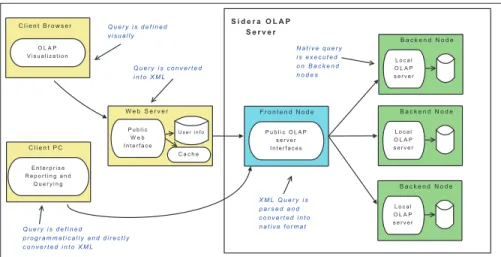
Finally, we note that while NOX can be seen as a standalone framework whose core principles could be applied to existing DBMSs, it is currently implemented as a com-ponent of a larger research system known as Sidera. This DBMS system, described by Eavis et al [EDD+07], provides a robust parallel server for high performance OLAP environments. As illustrated in Figure 1, the NOX infrastructure, including the li-braries and compiler tools, is accessible on the client PC/workstation. The output of the compilation phase is then transferred to the backend DBMS for optimization and execution, before the result is returned again to the client.
L o c a l O L A P s e r v e r B a c k e n d N o d e L o c a l O L A P s e r v e r B a c k e n d N o d e L o c a l O L A P s e r v e r B a c k e n d N o d e P u b l i c O L A P s e r v e r I n t e r f a c e s F r o n t e n d N o d e N a t i v e q u e r y i s e x e c u t e d o n B a c k e n d n o d e s X M L Q u e r y i s p a r s e d a n d c o n v e r t e d i n t o n a t i v e f o r m a t S i d e r a O L A P S e r v e r O L A P V i s u a l i z a t i o n C l i e n t B r o w s e r E n t e r p r i s e R e p o r t i n g a n d Q u e r y i n g C l i e n t P C P u b l i c W e b I n t e r f a c e U s e r i n f o W e b S e r v e r C a c h e Q u e r y i s c o n v e r t e d i n t o X M L Q u e r y i s d e f i n e d v i s u a l l y Q u e r y i s d e f i n e d p r o g r a m m a t i c a l l y a n d d i r e c t l y c o n v e r t e d i n t o X M L
Figure 1: The Sidera system model
1.4
Research Evaluation
Because the purpose of NOX, and client side querying in general, is to provide an intuitive and accessible query environment, it is important to demonstrate that the research does indeed provide this functionality. Our evaluation takes two forms. First, we provide extensive examples of NOX queries on common OLAP access patterns. In particular, we provide examples of OLAP operations such as “slice and dice”, “roll up” and ”drill down”, and pivot. We also demonstrate the ease with which aggregation hierarchies can be traversed. Query examples illustrating the use of run-time param-eters are listed as well. In many cases, we provide comparative examples using the MDX language so that readers can assess the relative simplicity/complexity of the two models. We emphasize the fact that because NOX provides a fully functionality prototype, all NOX queries listed in this thesis have been parsed, converted, and compiled using the structural components described above.
In addition to the implementation itself, we also provide an analysis of the lan-guage elements of NOX and MDX. Because MDX is associated with no formal algebra, we have performed the formal evaluation by way of a comparative classification of common OLAP query forms. In other words, we examine fundamental query pat-terns or classes, defining the algebraic features of each. We then show that the NOX native language model is in fact capable of supporting the primary forms found in practical settings. We note, of course, that NOX is also able to provide functionality that MDX can not, such as OOP-style inheritance, simplified refactoring, and compile time checking.
1.5
Thesis Outline
The remainder of this thesis is structured as follows. Chapter 2 introduces the basic data warehouse architecture, the OLAP multidimensional model and its grammar, JavaCC and JJTree language parsing, and the Document Type Definition (DTD) schema. In Chapter 3, we follow this up with a literature review of query languages in both the relational databases world and the OLAP world. We also look at the dif-ferences between existing string based query languages that are still much used nowa-days, as well as native language facilities utilized for querying relational databases.
We then present our new framework for querying OLAP systems in Java, namely Native language OLAP query eXecution (NOX), in Chapter 4. Chapter 5 illus-trates the fundamentals of NOX application programming and demonsillus-trates its usage through examples that have been implemented and tested in Java. Next, in Chapter 6,
we explore how NOX manipulates OLAP hierarchies and compare its performance to that of MDX in this context. Chapter 7 describes how passing parameters is done in NOX. We then investigate the formal basis by which we map the slicing and dicing operations of the NOX grammar to those of the MDX grammar in Chapter 8. Finally, Chapter 9 concludes the thesis and provides some pointers to future work.
Chapter 2
Background Material
In this chapter, we introduce some concepts that we need to be familiar with be-fore discussing the details of our research. This thesis core material is considered to combine ideas from a number of different fields: Data warehouses, OLAP systems, OLAP hierarchies and OLAP operations, Multidimensional modeling, JavaCC and JJTree, and DTD schema.
Section 2.1 gives an overview of a typical Data warehouse, its architecture, its materialization and its star schema implementation. Section 2.2 introduces OLAP systems, data cubes, and the grammars used for OLAP, while Section 2.3 illustrates
multidimensional modeling and its materialization. Then, the essential hierarchical
structure of dimensions in a data warehouse is investigated in Section 2.4. Section 2.5 describes the commercial OLAP operations, while Section 2.6 introduces JavaCC and JJTree parsing in Java. Finally, Document Type Definition (DTD) definition of legal building blocks of XML-format documents is presented in Section 2.7.
2.1
Data Warehousing
Decision Support Systems (DSS) are defined as interactive computer-based systems
intended to help decision makers utilize data and models in order to identify and solve problems and make decisions [Pow99]. A Data Warehouse is a repository of multiple heterogeneous data sources, organized under a unified schema in order to facilitate management decision making [HK06]. Data warehouse technology includes data cleansing, data integration, and OLAP analysis techniques with functionalities such as summarization, consolidation, and aggregation, as well as the ability to view information from different perspectives. In warehouses, data is typically represented in the form of decision cubes.
2.1.1
The Data Warehouse Architecture
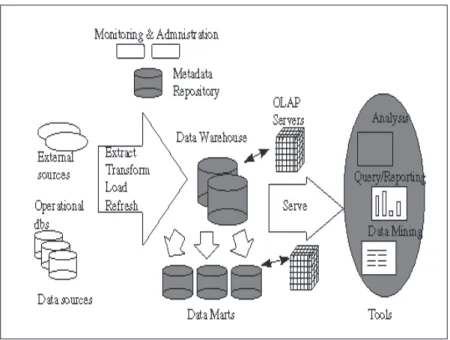
A data warehouse can be seen as a three-tier architecture [CD97, HK06]. The canon-ical data warehouse architecture is shown in Figure 2 [SH98], with the possible data sources shown at the bottom of the figure. Information is extracted from various legacy systems and operational sources, and is then consolidated, summarized, and loaded into the data warehouse using a process commonly known as ETL (Extract, Transform, and Load). Strictly speaking, this first step is not one of the three tiers, as its functionality is external to the warehouse proper.
At the first tier, there is the data warehouse server, along with several data marts. Essentially, each data mart is a small warehouse designed for a specific department or business process. At this stage, we can assume that the ETL processing is complete
and the data warehouse is fully loaded and contains the data required for basic “de-cision support”. The second tier houses the OLAP server/engine that allows users to access and analyze data in the warehouse, typically using more advanced techniques. Finally, the third tier includes the front end tools that provide a graphical interface for top managers and decision makers.
Figure 2: Typical data warehouse architecture
2.1.2
The Star Schema
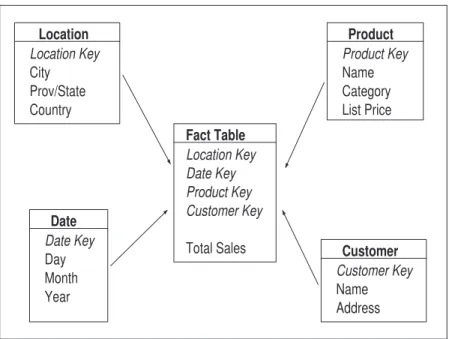
The Star Schema, proposed by Kimball [KR02], is perhaps the simplest and most intuitive logical model for data warehouse design. The term “Star Schema” is derived from the fact that a graphical depiction of the schema resembles a star. Star Schemas consist of two basic table types: dimension tables and fact tables. A fact table contains measurement records such as the “total sales” in the fact table of the star schema given in Figure 3. These records model the business process and provide us
with measurements (or facts) in terms of the key dimensions in our data warehouse. In effect, these are the numbers that allow decision makers to actually make decisions. Dimensions are data warehouse “subjects”. Dimensions in our example are Location, Product, Customer and Date tables. In practice, Fact tables are typically massive, holding perhaps billions of records (or facts), while Dimension tables are relatively small and contain information about the entries of a particular attribute in the fact table.
Note that the dimension tables are generallydenormalized, meaning that the tables maintain some of the redundancy that a good OLTP (OnLine Transaction Process-ing) system typically eliminates. An example of a denormalized table, where some data is repeated, is given in Figure 6. At query time, each dimension table is joined to the fact table as necessary. In this setting, denormalizing the dimension tables sig-nificantly decreases the number of costly joins that would otherwise be required with a normalized schema. Since the dimension tables are comparatively small when com-pared to the enormous fact tables, the redundancy produced by the denormalization is of little interest in most OLAP contexts.
2.2
What is OLAP?
The term OLAP was first presented by E. F. Codd in 1992. It was presented in the context of a vendor sponsored paper called “Providing OLAP (on-line analytical processing) to user-analysts: An IT mandate” [CCS92], where he described twelve rules of OLAP. Codd indicated twelve features that should be present in any OLAP
Fact Table Location Key Date Key Product Key Customer Key Total Sales Product Name Category List Price Product Key Customer Customer Key Name Address Location Location Key City Prov/State Country Date Date Key Day Month Year
Figure 3: Star schema example
application. The following four points, taken from that report, are probably the most significant of the twelve:
• Multidimensional conceptual view. In contrast to relational databases that manipulate individual records or concepts, the focal point in OLAP is the rela-tionship between multiple dimensions.
• Transparency. The end user should not have to worry about the details of data access or conversions. In addition, OLAP systems should be part of open systems that support heterogeneous data sources. Ultimately, the system should present a single logical schema of the data.
• Flexible reporting. Reporting must present data in a fully integrated manner, and minimize any restrictions in the way that basic data elements of dimensions are combined.
• Unlimited dimensional and aggregation levels. A serious tool should support more than just a few concurrent dimensions (Codd actually indicated that 15 -20 would be ideal).
2.3
Multidimensional Modeling
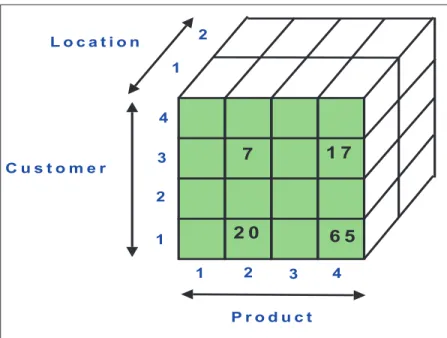
Both data warehouses and OLAP systems are based on a multidimensional model. Specifically, we logically represent data in a d-dimensional space such as the one de-picted in Figure 4. In this context, the multidimensional model can be described as a data abstraction allowing one to view aggregated data from a number of perspectives (dimensions). In fact, for a d-dimensional space, there are exactly2d distinct
dimen-sion combinations that represent the underlying Star Schema, each from a unique perspective. In OLAP terminology, we refer to this as thedata cube.
As previously noted, low level information is divided into facts and dimensions. An individual fact represents an item or transaction of interest to the user. In the multidimensional data cube model, facts are aggregated into measures that are con-tained within cells of the data cube. In Figure 4, one can see the measure values on the front face of the cube. Simply put, a given measure represents a series of fact values that have been aggregated for a given combination of dimensions. In Figure 4, for example, if we assume that the measure represents “Total Sales”, then we can see that total sales for Customer 3 in Location 1 for Product 2 has the value 7.
We note that the MD (Multi Dimensional) model is logical in nature. In other words, it makes no assumptions about how the data is physically stored. Advanced
7 1 7 2 0 6 5 L o c a t i o n C u s t o m e r P r o d u c t 3 2 4 2 1 3 4 2 1 1
Figure 4: A three dimensional data cube example
OLAP servers may in fact take the data from the tables of the original Star Schema and further process it. The new data may be stored in a series of new tables or even a multi-dimensional array that represents a one-to-one mapping between the logical data cube and the physical storage. We refer to the first type of system as ROLAP (relational OLAP), while the second is known as MOLAP (multi-dimensional OLAP). We will not go into details of the physical storage format, as it is distinct from the primary focus of our research.
2.4
OLAP Hierarchies
Data granularity refers to the level of detail at which measures are presented. This
is determined by a combination of the granularities within each dimension of the cube. For example, in Figure 4 the lowest level of granularity or detail in of the Customer dimension is Customer ID. However, the vast majority of common business
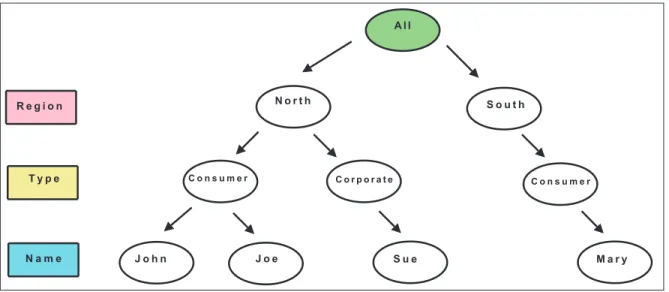
and scientific dimensions actually have a hierarchal structure. As a concrete example, the customer hierarchy, given in Figure 5, can be thought of in terms of NAME, TYPE, and REGION. In OLAP environments, the traversal of such “aggregation hierarchies” is perhaps the most fundamental of all query forms. Usually, OLAP tools only cope with hierarchies that ensure summarizability or that can be transformed so that summarizability conditions hold [LS97]. Summarizability refers to the correct aggregation of measures where a higher hierarchy level takes into account existing aggregations in a lower hierarchy level [MZ04].
As it turns out, there are in fact many different types of hierarchies in real-world applications. In the simplest case, we can think of a tree of dimension levels that is
A l l S o u t h N o r t h C o n s u m e r J o h n J o e C o n s u m e r C o r p o r a t e M a r y S u e R e g i o n T y p e N a m e
Figure 5: A Customer hierarchies example
constructed as a series of one-to-many relationships. An example of such a hierarchy is shown in Figure 5. Physically, simple trees like this are represented by additional columns in the associated dimension table, as depicted in the example in Figure 6. In fact, this is what we call a denormalized dimension. In a normalized model, there
would be three separate tables. In data warehouses, we typically denormalize the separate tables into a single table in order to improve performance by eliminating table joins. C u s t o m e r 1 N a m e T y p e R e g i o n I D 2 4 3 J o h n J o e S u e M a r y C o r p o r a t e N o r t h S o u t h C o n s u m e r N o r t h N o r t h C o n s u m e r C o n s u m e r
Figure 6: A dimension table corresponding to the Customer hierarchies example
2.5
OLAP Operators
Commercial OLAP systems may provide many OLAP functions and analytical exten-sions. In practice however, there are five fundamental operations that represent the bulk of query processing: Slice, Dice, Roll-up, Drill-down and Pivot. In the following section, we emphasize the slice and dice operations as they are the most relevant to the current thesis. Other operations are described briefly.
2.5.1
Slice
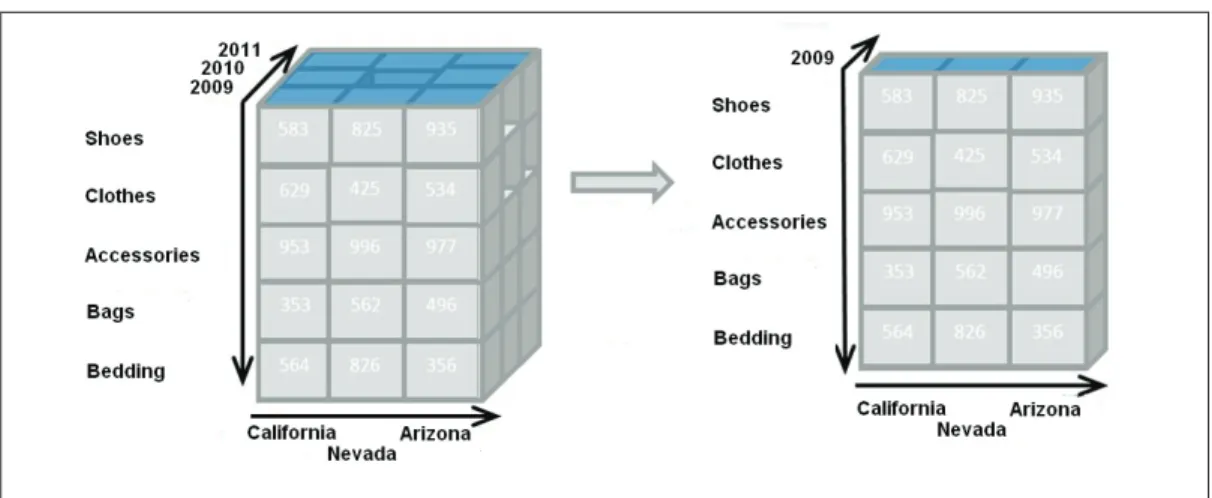
The slice operation performs a selection on one dimension of the given cube, thus resulting in a subcube. A slice is a subset of a multi-dimensional cube corresponding to a single attribute on one of the dimensions of the cube while allowing the other
Figure 7: An OLAP slice
dimensions to vary. Figure 7 shows a slicing operation where the sales figures of all states and all product categories of the company in the year 2009 are “sliced” out of the data cube.
2.5.2
Dice
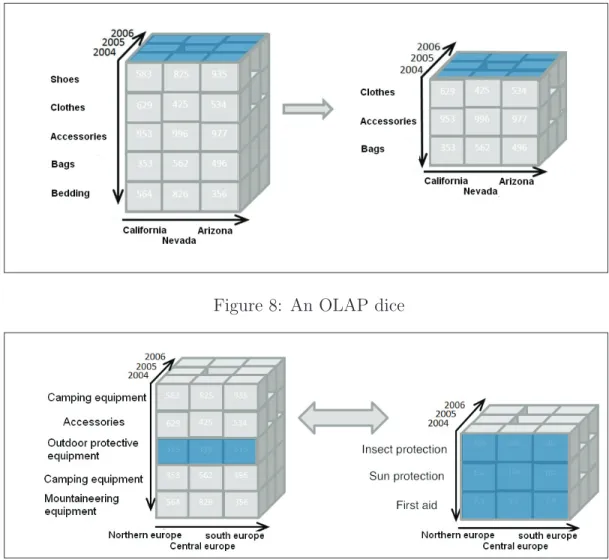
The dice operation is a slice on more than two dimensions of a data cube (or more than two consecutive slices). Figure 8 shows a dicing operation where the sales figures of a limited number of product categories are returned, and the time and region dimensions cover the same range as before.
2.5.3
The other Algebraic Multidimensional Operators
• Roll-up: The Roll-up operation acts on the hierarchical structure of a dimension. It aggregates values at a coarser level of granularity. Figure 9 shows a roll-up operation where values referring to insect protection, sun protection and first aid are summed up to values referring to outdoor protective equipment at a
Figure 8: An OLAP dice
Figure 9: OLAP drill-down and roll-up coarser level of the hierarchy of the dimension.
• Drill-down: The Drill-down operation also acts on the hierarchical structure of a dimension. It performs the opposite of what Roll-up does. It decomposes the aggregation at a finer level of detail. Figure 9 shows the drill-down operation where values referring to outdoor protective equipment are decomposed into values referring to insect protection, sun protection and first aid at a finer level of the hierarchy of the dimension.
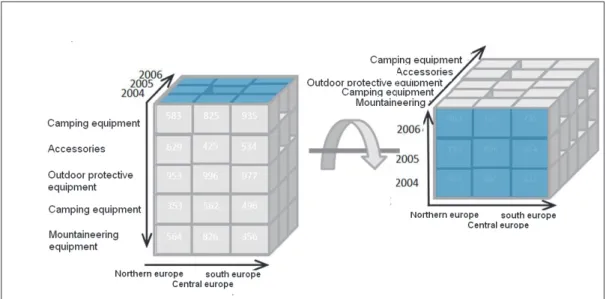
Figure 10: OLAP pivoting
• Pivot: The pivot operation acts on a cube by re-organizing its axes. The result can be more dramatic with a tabular representation. Figure 10 shows the pivot operation where the years dimension and the equipments dimension switched places.
2.6
JavaCC and JJTree Parsing
Java Compiler Compiler (JavaCC) and JJTree are language design tools that play a fundamental role in the Java prototype at the heart of this research. In this section, we give an overview of the structure and processing logic of both JavaCC and JJTree. At least a basic grasp of their processing logic is required for a meaningful understanding of the material presented in the thesis. JavaCC is the most popular parser generator for use with Java applications. In short, a parser generator is a tool that reads a grammar specification and converts it to a program that can recognize matches
to the grammar. In addition to the parser generator itself, JavaCC provides other standard capabilities related to parser generation such as tree building (via a tool called JJTree included with JavaCC), actions and debugging. The generated tree is known as AST (Abstract Syntax Tree) or parse tree.
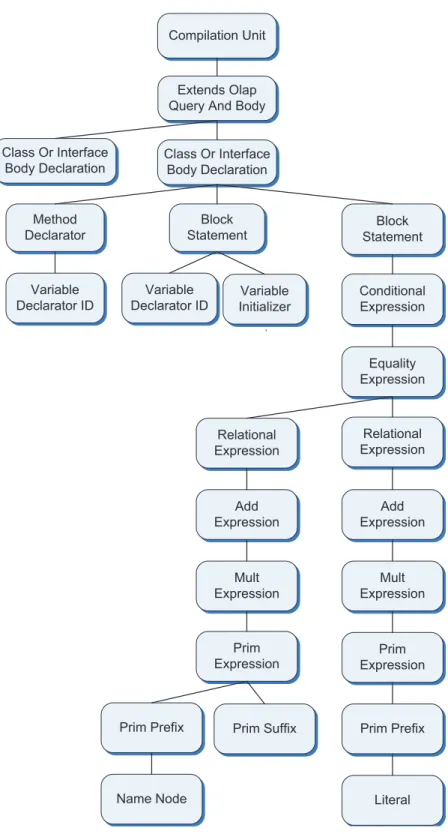
JJTree is a pre-processor to JavaCC that inserts parse tree building actions at various places in the JavaCC source. The output of JJTree is run through JavaCC to create the parser and its parse tree. Each node of the tree denotes a construct found in the source code. By default, JJTree generates code to construct parse tree nodes for each nonterminal in the language. This behavior can be modified so that some nonterminals do not have nodes generated, or so that a node is generated for a part of a production expansion [Jav, JJT]. An example of a parse tree is depicted in Figure 11, where a node is denoted by an oval shape with the name of the node written inside the shape.
JJTree defines a Java interface Node that all parse tree nodes must implement. The interface provides methods for operations such as setting the parent of the node, and for adding children and retrieving them. Now, the structure of the trees gives the abstract syntax of the input, but not, by default, the tokens. We can capture the tokens as needed.
Compilation Unit
Extends Olap Query And Body
Class Or Interface Body Declaration Class Or Interface Body Declaration Method Declarator Block Statement Block Statement Variable Declarator ID Variable Declarator ID Variable Initializer Conditional Expression Equality Expression Relational Expression Relational Expression Add Expression Add Expression Mult Expression Mult Expression Prim Expression Prim Expression Prim Prefix Prim Prefix Prim Suffix
Literal Name Node
2.7
What is Document Type Definition (DTD)
Schema?
As we will see, XML plays an important role in the concrete specification of our OLAP queries. ADocument Type Definition (DTD) defines the legal building blocks of an XML document. It defines the document structure with a list of legal elements and attributes. A DTD describes the structure of XML documents by declaring each eligible element and its attribute list. Element declarations name the allowable set of elements within the document, and specify whether and how declared elements and character data may be contained within each element. Attribute list declarations name the allowable set of attributes for each declared element, including the type of each attribute value, if not an explicit set of valid value(s). A DTD is associated with an XML document via a Document Type Declaration, which is a tag that appears near the start of the XML document. The declaration establishes that the document is an instance of the type defined by the referenced DTD [DTDb]. An example of a Document Type Declaration is given in Listing 2.1.
<?xml v e r s i o n = ‘ ‘ 1 . 0 ’ ’ e n c o d i n g = ‘ ‘UTF−8 ’ ’ s t a n d a l o n e = ‘ ‘ no ’ ’ ?> <!DOCTYPE QUERY SYSTEM ‘ ‘ dtd / C l i e n t Q u e r y . dtd ’ ’>
Listing 2.1: DTD declaration
2.8
Conclusion
We introduced in this chapter the concept of a data warehouse, its architecture and its design. A data warehouse is a repository of multiple heterogeneous data sources, organized under a unified schema in order to facilitate management decision making. The Star Schema is perhaps the simplest and most intuitive logical model for data warehouse design. Online Analytical Processing (OLAP) was introduced, including core functionalities such as aggregation, as well as the ability to view information from different angles. We also introduce the multidimensional modeling of OLAP systems, namely the data cube logical model. In addition, we discussed OLAP hierarchies as well as fundamental OLAP operations such as slice, dice, roll-up, drill-down and pivot. Next, we introduced the JavaCC (Java Compiler Compiler) and JJTree parsing. These are parser generator and tree building tools, respectively. We concluded the chapter with a brief discussion of the DTD, a mechanism that defines the legal building blocks of an XML document.
Chapter 3
Related Work
Much research has been done in the area of query frameworks for relational database systems (RDBMS). Our research is inspired by Cook’s work who introduced the notion of native querying language in RDBMS [CR06]. Traditionally, a popular ap-proach has been to utilize Object Relational Mapping (ORM) Frameworks. In fact, the limitations of these frameworks led to Cook’s native querying language. Other approaches include those that have language specific database libraries that allow queries to be written in the embedding language itself. While these techniques as well as Cook’s native language model targeted the relational database environment, we target the multidimensional database domain and propose the NOX framework.
For OLAP systems, Multidimensional Expression (MDX) language provides a specialized syntax for querying and manipulating the multidimensional data stored in data cubes. MDX has been supported by many OLAP vendors and has become the de-facto standard for OLAP systems. However, MDX is still a string-based language with many limitations. A string-based language is a language whose code is introduced as
strings when inserted within another language code. We compare and evaluate the NOX language against MDX considering it is widely used among OLAP developers. Concerning the multidimensional algebras, there are many in research. One alge-bra YAM2, created by Abello and Romero [RA07], is the product of comparing many existing algebras and finding their backbone algebra. We refer to this approach and use related concepts to develop the NOX algebra.
In this chapter, Section 3.1 explores recent relational databases querying languages that influence the industry and research work. Languages that query OLAP systems are investigated in Section 3.2. Section 3.3 illustrates the multidimensional OLAP algebraic operators and compares them to the relational operators.
3.1
Relational Databases Querying Languages
For more than 30 years, Structured Query Language (SQL) has been the de-facto standard for data access within the relational DBMS world. In conjunction with APIs such as ODBC and JDBC, it has served as the “query backbone” for small data management environments and massive enterprize settings alike. That being said, SQL despite numerous updates to the standard is now a relatively old language. For this reason, numerous attempts have been made to modernize database access mechanisms. Two themes in particular are noteworthy in the current context:
• The Object Relational Mapping (ORM) frameworks presented in Subsection 3.1.1
This is discussed in Subsection 3.1.2
3.1.1
Object Relational Mapping (ORM) Frameworks
In an attempt to minimize the impedance mismatch associated with tuple-to-object integration, ORM frameworks have been successfully used to define type-safe map-pings — typically with XML configuration files or languages-based annotations — between the tuples of the DBMS and the native objects of the external applications. As much as possible, the ORM framework attempts to provide transparent
persis-tence, the illusion that the DBMS-backed data is nothing more nor less than a simple
object. With respect to the Java language, JDO (Java Data Objects) [JDO] became the early standard, with EJB [EJB] and its Java Persistence API (JPA), emerging shortly after. The standards are now quite similar, with both providing POJO (Plain Old Java Objects) style persistence for individual objects. JDO, for instance, ac-complished this with a compile-time enhancement that modifies the byte-code to insert the appropriate mapping information. OQL is another ORM query language for databases that influenced the design of some of the newer database query lan-guages such as JDOQL and EJB. JDOQL is an object-based query language that lets programmers write in SQL while retaining the Java object relationship. Listing 3.1 provides an example of a query written in JDOQL. The query is created by querying
the Student class with the condition “age < 20”. Though JDOQL is “more” object
oriented than other ORM languages, it is still partially string-based as shown in the example.
Query query = p e r s i s t e n c e M a n a g e r . newQuery ( S t u d e n t .class , " age < 20 " ) ;
C o l l e c t i o n s t u d e n t s = ( C o l l e c t i o n ) query . e x e c u t e ( ) ; Listing 3.1: In JDOQL [JDO, Rus03]
An OQL query is given in Listing 3.2. The query asks forstudentswho are younger than 20 years. The OQL language is modeled after SQL as shown in the example and is string-based.
S t r i n g o q l = " s e l e c t ∗ from s t u d e n t i n S t u d e n t s where s t u d e n t . age < 20 " ;
OQLQuery query = new OQLQuery ( o q l ) ; O b j e c t s t u d e n t s = query . e x e c u t e ( ) ;
Listing 3.2: In OQL [GBB+00, ODM]
The open source community has also been active in this area, with the Hiber-nate framework [BK06] being the most mature project to date. Originally developed with its own proprietary API, it now also supports the JPA. Unlike JDO’s compile-time enhancers, Hibernate uses run-compile-timeReflection as the basis of its tuple-to-object conversions.
While the aforementioned mechanisms provide certain advantages to the devel-oper, particularly in terms of basic OOP syntax, they are far from a perfect solution. Primary limitations include:
• While the ORM frameworks do provide transparent persistence for individual objects, this transparency largely vanishes in the face of more complex query requirements. Here, the systems employ string based query languages such as JDOQL (JDO), JPQL (JPA), or HQL (Hibernate) to execute joins, complex selections, subqueries, etc. In practice, this leaves the ORM models in some-thing of a grey area between pure transparent persistence and glorified SQL substitution.
• Since modern Integrated Development Environments (IDEs) will not automat-ically refactor field names that appear in strings, refactorings can cause class models and query strings to be inconsistent.
• Developers are constantly required to switch contexts between implementation language and query language, and they have to learn the two languages. • There is no explicit support for creating reusable query components.
To address the above problems, Cook describes in [CR05] how to express a query in the native language like plain Java or C# using Safe Query Objects. Note that by native language, we are referring to the application development language, rather than the database access language. The goals for these native queries are:
• 100% native: Queries should be completely expressed in the implementation language, rather than a mix of two distinct languages
• 100% object-oriented: Queries should provide encapsulation and inheritance functionality
• 100% able: Queries should be fully accessible to modern IDE refactor-ing functionality (i.e., class/method updates)
• 100% type-safe: Query specifications should be checked for type safety at com-pile time
In [CR06], Cook presented Safe Query Objects, a technique for representing queries as statically typed objects while still supporting remote execution by a database server. To illustrate this idea, in the Java code of Listing 3.3, Cook expresses a query written in the Java programming language itself. He uses an abstract base class for queries, the “Predicate” class, and a method named “match” that defines the query. Of course, a way to pass a Student object to the expression, as well as a way to pass the result back to the query processor are also needed. Cook does this by defining a STUDENT parameter and by returning the result of the expression as a boolean value.
public abstract c l a s s P r e d i c a t e <ExtentType> {
public <ExtentType> P r e d i c a t e ( ) {}
public abstract boolean match ( ExtentType c a n d i d a t e ) ;
}
P r e d i c a t e <Student> p r e d i c a t e = new P r e d i c a t e <S t u d e n t > ( ) {
return s t u d e n t . getAge ( ) < 20 && s t u d e n t . Name . C o n t a i n s ( " f " ) ; }
L i s t <Student> s t u d e n t s = d a t a b a s e . query <Student> ( p r e d i c a t e ) ; Listing 3.3: Predicate class and match method for querying the Student table
The underlying idea here is to allow programmers to think of the target as though it were merely an object(s) residing in memory. In the example, it is as if we have an “in-memory” list of students and we want to “query” this list to find those students under the age of 20 and whose names contain the letter “f”. Because in Cook’s paper [CR06] they are dealing with arbitrary relational databases, they cannot use a loop to access the objects of the database since the database in fact is not an object and it is certainly not local. Instead, the method “match” is defined that returns a boolean value representing the success of the query operation against each possible data value in a given table. The proper type checking is performed by the native language’s regular compiler. The value of the boolean result indicates whether a given student in the Student table meets the criteria.
The key to safe query objects is that type-checked class definitions are translated into code to call standard database interfaces such as JDBC [HC97] or JDO [Rus03]. This new code is added to the class that contains the query to override a method (responsible for sending the new new code) in the base class. The translation could be performed on the classes during compilation, on byte-codes after compilation, or
during loading. Cook’s prototype uses OpenJava [TCIK99], which follows the first approach.
While Cook’s full representation of a query is used for relational databases, our work will be applied in OLAP systems. In fact, we are adapting this idea of translating the programmer’s code into a new querying format that can be delivered to the server, though it must be noted that we have a different set of problems and concerns which are specific to OLAP.
3.1.2
Language Specific Database Libraries
Another approach to simplified database access extends the development languages themselves. In fact, this has been an ongoing research theme, with work stretching back more than 20 years [AB87]. We look briefly at a few of the more interesting examples. The Ruby language [Rub] provides one of the simplest interfaces by em-ploying anActiveRecord which is a library built for Ruby that dynamically examines method invocations against the database schema. Explicit field/member mappings are not even required. The Haskell language has been extended with HaskellDB [Has]. Its monad-based syntax expression is intriguing in that queries are “decomposed” into a series of distinct algebraic operations (e.g., restrict, project). Even C++ has been extended to support native database access. ARARAT [GL07] is a C++ template library whose objective is type safe, and largely transparent, generation of SQL state-ments. With each of these examples, we note that the expressive power of the query facilities is limited and that an “SQL backdoor” may be needed in more sophisticated
environments.
Perhaps the most notable of the language-centric approaches is Microsoft’s LINQ extensions for its .NET family of languages (C# and VisualBasic) [BRK+08]. Syn-tactically, LINQ resembles embedded SQL in that, for more complex queries at least, the standard SELECT-FROM-WHERE format is employed (for better or for worse). While LINQ has been quite popular with developers, it has been subsumed under the new ADO.NET model [AMM07]. The overarching theme of ADO.NET is the Entity Framework (EF), a comprehensive attempt to pull back the abstraction level of development projects from the object-oriented logical level to the entity-focused conceptual level. In other words, use of EF and its Entity Data Model makes it possible, in theory, to program directly against user level concepts. Source code, pos-sibly written with LINQ, is then parsed into an internal command tree, which can subsequently be used to generate optimized SQL. While the move towards greater abstraction is quite appealing, initial reaction has been mixed, with many develop-ers concerned about the design and development complexity associated with the EF. Db4o (Database for objects) is another database language that allows to use the na-tive program language to query the database [NGD+08]. It is an embeddable open source object database for Java and .NET developers. In .NET, LINQ support is fully integrated in db4o. Although db4o offers nice language integrated queries, it suffers from some drawbacks of which a notable one is the difficulty to overcome its slow performance when retrieving a lot of objects.
who are less than 20 years old and whose grade is gradeA is returned. Note the match method that is common to db4o and Cook’s safe queries.
P r e d i c a t e <Student> p r e d i c a t e = new P r e d i c a t e <S t u d e n t > ( ) {
public boolean match ( S t u d e n t s t u d e n t ) {
return s t u d e n t . age ( ) < 20 && s t u d e n t . g r a d e ( ) == gradeA ; }
L i s t <Student> s t u d e n t s = db . query <Student> ( p r e d i c a t e ) ; Listing 3.4: In Java using db4o [DB4]
A query written in LINQ is given in Listing 3.5. Again, it returns students who are less than 20 years old and whose grade is gradeA. Note the usage of FROM-WHERE-SELECT which is similar to SQL syntax.
v a r r e s u l t = from S t u d e n t s i n c o n t a i n e r
where s . Age < 20 && s t u d e n t . Grade == gradeA s e l e c t s ;
Listing 3.5: In .NET using LINQ [LIN]
In addition to the disadvantages mentioned earlier for individual database query lan-guages, the main hindrance of db4o and LINQ, as is the case with many of the other tools, is the lack of interoperability that is taken for granted in the SQL world, such as industry standard connectivity, reporting tools, backup and recovery standards and OLAP functionality!
3.2
Multidimensional Databases Querying Languages
In terms of OLAP, there was also a flurry of interest in the design of supporting algebras [AGS97, GL97]. The primary focus of this work was to support an algebraic application programming interface (API) that would ultimately lead to transparent, intuitive support for the underlying data cube. In a more general sense, these algebras identified core elements of the OLAP conceptual data model. Recently, the various algebras have been directly compared so as to extract the operations common to each model [RA07].
A somewhat orthogonal pursuit in the OLAP context has been the design of domain-specific query languages and/or extensions. SQL, for example, has been updated to include the CUBE, ROLLUP, and WINDOW clauses in an attempt to more intuitively support standard OLAP query patterns [Mel02]. It must be noted, however, that support for these operations in DBMS platforms is inconsistent at best, leading most OLAP/BI vendors to provide their own proprietary implemen-tations [DKK05]. In addition to SQL, many commercial applications support Mi-crosoft’s MDX query language [WZP05]. MDX provides a specialized syntax for querying and manipulating the multidimensional data stored in data cubes. MDX has been embraced by wide majority of OLAP vendors and has become the de-facto standard for OLAP systems [SHW+06]. Still, MDX remains an embedded string based language with an irregular structure and is somewhat representative of the language philosophy of the 1980s and 1990s.
To give the reader a better sense of the MDX language, we will now present a series of simple MDX examples. The cube we are working with contains the following feature attributes:
• Customers
• Time
• Product
• DMA
The Measure attributes consist of: • Store Cost
• Profit
• RunningTotalSubs
The MDX query depicted in Listing 3.6 is a very simple query for finding store costs (a measure attribute in the data cube) associated with all customers in 1997.
The MDX query given in Listing 3.7 is similar to the previous MDX query, but this time the query is doing a drill down on the customers in the USA region. In the query given in Listing 3.8, we are doing a crossjoin on Customer and Gender to get all combinations by year, and we are using a different measure value Profit.
We note that while the queries included here are quite simple, and consequently quite readable, more sophisticated MDX queries can be virtually incomprehensible to
SELECT
{ [ Time ] . [ 1 9 9 7 ] } ON COLUMNS ,
{ [ Customers ] . [ A l l Customers ] } ON ROWS FROM [ S a l e s ]
WHERE ( [ Measures ] . [ S t o r e Cost ] )
Listing 3.6: MDX query 1
SELECT
{ [ Time ] . [ 1 9 9 7 ] } ON COLUMNS ,
{ [ Customers ] . [ A l l Customers ] . [ USA ] . CHILDREN }
ON ROWS
FROM [ S a l e s ]
WHERE ( [ Measures ] . [ S t o r e Cost ] )
Listing 3.7: MDX query 2
SELECT
{ [ Time ] . [ 1 9 9 7 ] } ON COLUMNS, {
{ [ Customers ] . [ A l l Customers ] . [ USA ] . CHILDREN } ∗
{ [ Gender ] . [ A l l Gender ] . [ F ] , [ Gender ] . [ A l l Gender ] . [M] }
} ON ROWS
FROM [ S a l e s ]
WHERE ( [ Measures ] . [ P r o f i t ] )
anyone other than the developers themselves. An example of a rather incomprehen-sible MDX query is depicted in Listing 3.9. In the query, measure VariantPercentage is created and defined using a formula in terms of RunningTotalSubs and some hi-erarchical attributes. Tuples are used here which complicates the query even more. They are used to indicate that RunningTotalSubs of a hierarchy path in the time hierarchy which refers to some date in 2004 is subtracted from that of 2005 date in the time hierarchy then divided by the total RunningTotalSubs of “all” “time” hier-archy. The “SELECT” on COLUMNS is similar to what we saw before, where the RunningTotalSubs and the VariantPercentage are displayed. However, “SELECT” on ROWS is more complex in this example. There is a CROSSJOIN of TopCount ( [DMA] .children , 5000 ,( [RunningTotalSubs] ) ) and [Time].[2004].& [1].[1].[1] ,[Time].[2005].&[1].[1].[1] ,[Time] ). This means that the top 5000 RunningTotal-Subs of the children of [DMA] are crossjoined with the hierarchy path referring to 2004 date of the time hierarchy, the hierarchy path referring to the 2005 date of the time hierarchy and “All Time”. These are all what will be displayed on ROWS and COLUMNS. They are selected FROM “Customers” cube where the slicing operation performs selection of “product ID” to be equal to 14.
WITH
MEMBER [ Measures ] . [ V a r i e n t P e r c e n t a g e ] AS
[ RunningTotalSubs ] ) −
( [ Time ] . [ 2 0 0 5 ] . \ & [ 1 ] . [ 1 ] . [ 1 ] , [ RunningTotalSubs ] ) ) /
( [ Time ] . [ A l l Time ] , [ RunningTotalSubs ] ) ’
SELECT { [ RunningTotalSubs ] , [ Measures ] . [ V a r i e n t P e r c e n t a g e ] } ON COLUMNS , C r o s s J o i n ( TopCount ( { [DMA] . CHILDREN} , 5000 , ( [ RunningTotalSubs ] ) ) , { [ Time ] . [ 2 0 0 4 ] . \ & [ 1 ] . [ 1 ] . [ 1 ] , [ Time ] . [ 2 0 0 5 ] . \ & [ 1 ] . [ 1 ] . [ 1 ] , [ Time ] } ) ON ROWS FROM [ Customers ]
WHERE ( [ Product ] . [ Product ID ] . \ & [ 1 4 ] )
Listing 3.9: A more sophisticated MDX query
Finally, we note that no discussion of OLAP query languages and models would be complete without a brief reference to the ill-fated JOLAP standard [JOL03]. Delivered in 2003, the JOLAP JSR-69 was an industry-backed attempt to define an e