Contents lists available at ScienceDirect
Information
Sciences
journal homepage: www.elsevier.com/locate/ins
Rough-fuzzy
rule
interpolation
Chengyuan
Chen
a,
Neil
Mac
Parthaláin
b,
Ying
Li
c,
Chris
Price
b,
Chai
Quek
d,
Qiang
Shen
b ,∗aSchoolofElectricalandInformationEngineering,ChongqingUniversityofScienceandTechnology,Chongqing401331,China bDepartmentofComputerScience,InstituteofMathematics,PhysicsandComputerScience,AberystwythUniversity,AberystwythSY23 3DB,UK
cSchoolofComputerScience,NorthwesternPolytechnicalUniversity,Xian710129,China dSchoolofComputerEngineering,NanyangTechnologicalUniversity,637457,Singapore
a
r
t
i
c
l
e
i
n
f
o
Articlehistory: Received 1 July 2015 Revised 7 January 2016 Accepted 18 February 2016 Available online 27 February 2016 Keywords:
Fuzzy rule interpolation Rough-fuzzy sets
Transformation-based interpolation
a
b
s
t
r
a
c
t
Fuzzyruleinterpolationformsanimportantapproachforperforminginferencewith sys-temscomprisingsparserulebases.Even whenagivenobservation hasnooverlapwith theantecedentvaluesofanyexistingrules,fuzzyruleinterpolationmaystillderivea use-fulconclusion.Unfortunately,verylittleoftheexistingworkonfuzzyruleinterpolation canconjunctivelyhandlemorethanoneformofuncertaintyintherulesorobservations. Inparticular, thedifficulty indefiningtherequiredprecise-valuedmembershipfunctions forthefuzzysetsthatareusedinconventionalfuzzyruleinterpolationtechniques signif-icantlyrestrictstheirapplication.Inthispaper,anovelrough-fuzzyapproachisproposed inanattempttoaddresssuchdifficulties.Theproposedapproachallowsthe representa-tion,handlingandutilisationofdifferentlevelsofuncertaintyinknowledge.Thisallows transformation-basedfuzzyruleinterpolationtechniquestomodelandharnessadditional uncertaininformationinordertoimplementaneffectivefuzzyinterpolativereasoning sys-tem.Finalconclusionsarederivedbyperformingrough-fuzzyinterpolationoverthis rep-resentation.Theeffectivenessofthe approachisillustratedbyapracticalapplicationto thepredictionofdiarrhoealdiseaseratesinremotevillages.Itisfurtherevaluatedagainst arangeofotherbenchmarkcasestudies.Theexperimentalresultsconfirmtheefficacyof theproposedwork.
© 2016TheAuthors.PublishedbyElsevierInc. ThisisanopenaccessarticleundertheCCBY-NC-NDlicense (http://creativecommons.org/licenses/by-nc-nd/4.0/).
1. Introduction
Thecompositional rule ofinference [1] offers an effective mechanismforperforming fuzzy inference withdense rule bases.Givensucharulebaseandalsoanobservationthatisatleastpartiallycoveredbythatrulebase,aconclusioncanbe inferredfromcertainrulesthatintersectwiththeobservation.However,forthecaseswhereafuzzyrulebasecontains‘gaps’ (termed:sparserulebase [2] ),ifagivenobservationhasnooverlapwiththeantecedent valuesofanyrule,conventional
∗ Corresponding author.
E-mail addresses: [email protected] (C. Chen), [email protected] (N.M. Parthaláin), [email protected] (Y. Li), [email protected] (C. Price), [email protected] (C. Quek), [email protected] (Q. Shen).
http://dx.doi.org/10.1016/j.ins.2016.02.036
0020-0255/© 2016 The Authors. Published by Elsevier Inc. This is an open access article under the CC BY-NC-ND license ( http://creativecommons.org/licenses/by-nc-nd/4.0/).
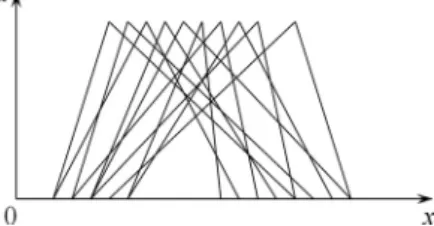
Fig.1. Different membership functions for a common underlying concept perceived by different people.
fuzzyinference methodscannot derive a conclusion.Fortunately,using fuzzyrule interpolation (FRI) [3,4] , certain useful conclusionsmaystillbeobtained.
TheapplicationoftraditionalFRImethodsmayleadtoabnormalfuzzyconclusions,however.Oneparticularissueisthat the convexity ofthe derived fuzzyvalues isnot guaranteed [5,6] ,but convexity isoften a crucial requirementfor fuzzy inference inordertoattainimprovedinterpretabilityoftheresults.Anumberofsignificantextensionstothe originalFRI methodshavebeenproposedinliteratureinanattempttoaddressthisissue,including [7–13] .Inparticular,thescaleand move transformation-basedFRI approach(abbreviatedto T-FRIhereafter) [14,15] andits generalisation [16,17] canhandle interpolationandextrapolationwhichinvolvemultiplefuzzyrules,whereeachruleconsistsofmultipleantecedents. Such workalsoguaranteestheuniqueness,aswellasthenormalityandconvexityoftheinterpolatedconclusion.Thisapproach hasrecentlybeenfurtherenhancedwithan adaptivemechanismsuch thatappropriate chainingoffuzzyinterpolative in-ferencescan beperformed [18] .Furtherdevelopmenthasalsobeenreportedthat allows thefuzzyruleinterpolation and extrapolationtobeperformedinabackwardmanner,i.e.,fromruleconsequencetoantecedentvariables [19] .
The aforementionedFRI techniquesprovide a basicmeans fordealingwithandinterpreting uncertaintyinrule-based reasoningby exploitingthe expressive poweroffuzzysets [20] .However, thereis littlework inthe areaof FRIthat can handleuncertaintyinfuzzinessitself.Thisisbecausetheseapproachesareimplementedusingconventionalfuzzysettheory asa basis fortheunderlyingrepresentations [21] .Whilstmembership functionsplayan important rolein defining fuzzy sets,it issometimesextremely difficult,ifnotimpossible, topreciselydefine suchmembership functions.Moregenerally, there maybe different types ofuncertainty infuzzy rule-basedsystems that need to be captured ormodelled [22] : (1) Thelinguisticvariablesthatareusedintheantecedentsandconsequencesofthegivenrulesmaybeindiscernible.(2)The interpretation of thevalues ofthe underlying linguisticvariables may be vague, e.g., the sameword can meandifferent thingstodifferentpeople.(3)Anelementcanbelongtoafuzzysetwithagivendegree,butthatdegreeofbelongingmay itselfbeuncertain.(4)Theobtainedrulesmaybeinconsistentwhenindividualviewsareprovidedfromagroupofexperts. (5)Observationsattainablebyinexactknowledgemaybenoisyandthereforerandomlydistributed.
Mostofthesetypesofuncertaintycanbedifficulttodealwithifcrispmembershipfunctionsofthefuzzysetshavetobe determined.Forinstance,thereare certainextremeweatherconditionsthatwouldbeconsideredto becoldbyallpeople, butotherlessextremeconditionsmaystillbeconsideredtobecoldonlybycertainindividuals.Themembershipfunctions fordifferentpeoplemaythereforebedifferent,dependingontheirperception,preference,experience,etc.Thisisshownin
Fig. 1 .Thatis,bothsimilaritiesanddifferencesmayexistindefiningagivenconcept.Therefore,therepresentationofa con-ceptshouldsatisfytherequirementsofnotonlytheimprecisedescriptionbutalsobothcommonandindividualperceptions. Inthiscase,usingonlythemembershipvaluesofaconventional(type-1)fuzzysetmaynotbeadequatetocapture,reflect, andmodelthegivenconcept.Whenfacedwithsuchhigherorderuncertainty,whichisessentiallytheuncertaintyof eval-uationaboutuncertainty,ageneralapproachwouldbetosimplyignorethishigher-levelinformation.However,anobvious drawbackofthisisthatvaluableinformationmaybelostaboutboththeconceptthatisbeingmodelledandtheimpactthat uncertaininformationmayhaveuponthatconcept.This,inturn,mayleadtounacceptableinference conclusions. Alterna-tiverepresentationsarethereforerequiredinordertoachieveabetterunderstandingoftheconceptandmanipulatethese differentlevelsofuncertaintysuchthattheycanbehandledappropriately.Thus,itisdesirabletodevelopanewmodelto representthemembershipfunctionsoffuzzysets,inordertoprovideabettermeansofaddressinguncertaintyinFRI.
Theconceptofroughsets [23] wasoriginallyproposedasamathematicaltooltodealwithincompleteorimperfectdata andknowledgeininformationsystems.Aroughsetisitselfanapproximationofavagueconceptbyapairofprecisesets, calledlowerandupperapproximations [24,25] .Thelowerapproximationcontainsallofthoseobjectswhichdefinitelybelong tothesetthatdenotesthegivenconcept,andtheupperapproximationcontainsallofthoseobjectswhichpossiblybelongto thatset.Assuch,roughsetsofferadistinctandcomplementaryapproachtofuzzysetsinsupportingapproximatereasoning. Inspiredbythisobservation,itispotentiallyusefultointegrateroughandfuzzytechniquesinordertoimprovetheability to handleuncertainty. This paperproposessuch an approachto rough-fuzzy set-based ruleinterpolation. A specification ofrough-fuzzy sets isintroduced to describe aparticular type ofhigherorder uncertainty,which ischaracterisedby the lower andupperapproximationmembership functions.This approachfacilitatesthe representationofuncertainfuzzyset membershipfunctionswithrough-fuzzyapproximations, therebyimprovingtheflexibilityofruleinterpolationinhandling differentlevels ofuncertainty that maybe presentinsparse rulebases andobservations.The work reflects theintuition thatthemoreusefulinformationavailabletotheinterpolationprocess,thebettertheinterpolatedresults.
Therestofthepaperisstructuredasfollows. Section 2 introducesthebasicconceptsthatareusedforthedevelopment ofrough-fuzzyruleinterpolation. Section 3 describesthemainsteps ofthe proposedrough-fuzzyrule interpolation algo-rithm. Section 4 presentsarealisticproblemapplicationthatshowsthepotentialforuseoftheproposed approachforthe predictionofdiarrhoealdiseasesinremotevillages. Section 5 providesfurtherexampleswhichillustratetheapplicabilityof theapproachandfurtherdemonstratetheefficacyofthework.Thepaperisconcludedin Section 6 ,includingsuggestions forfurtherdevelopment.
2. Rough-fuzzysetsandtheirrepresentativevalues
2.1. Rough-fuzzysets
Thestartingpointfortheproposedapproachistheabilitytorepresentcomplicateduncertainknowledgeinaneffortto performFRI.Whenexactmembershipvaluesarenolongersuitablefordescribingtheunderlyinguncertainty,itisdesirable toutilise an alternativehigher-order representation.Arough-fuzzy representation offers suchcharacteristics, withthe first orderrepresentationembeddedwithin it.Thisdiffersfromtheconcept ofconventionalrough sets,whichischaracterised bythe lowerandupperapproximationswhose elementsare offull memberships [23] .Ifhowever,the rough-fuzzy infor-mation or datadegenerates to the first orderrepresentation, the computational mechanismthat dealswith rough-fuzzy interpolationshouldalsonaturallydegeneratetothecorrespondingfirstordercalculus.
LetI=
(
U,A)
beaninformationsystem, whereUisanon-empty setoffiniteobjects(namely,theunderlyinguniverse ofdiscourse)andAisanon-empty finitesetofattributessuch thata:U→Va forevery a∈AwithVabeingthedomain thatattributeatakesvaluesfrom.WithanyP⊆AthereisacrispequivalencerelationIND(P) [23] :IND
(
P)
={
(
x,y)
∈U2|
∀
a ∈ P, a(
x)
= a(
y)
}
(1)If(x,y) ∈IND(P), then xand y are indiscernible by attributes fromP.The equivalence class with respect to such an indiscernibilityrelationdefinedonPisdenotedby[x]P,x∈U.
LetX⊆U,X beapproximated usingonly theinformationcontainedwithin P by constructingthe P-lower andP-upper
approximationsofX [23] :
PX =
{
x|
[x ]P⊆X}
PX =
{
x|
[x ]P∩X =∅}
(2) Thetuple
PX,PXiscalledaroughset.Definition2.1. WithanyP⊆A,analternative equivalencerelationIND(P) tothetraditionalone of Eq. (1) canbedefined by
IND
(
P)
={
(
x,y)
∈U2|
∀
Fg∈P, F g
(
x)
∈C, F g(
y)
∈C}
(3)whereFg,g∈
{
1,...,G}
,arefuzzysetsthatjointlydefineaparticularconceptCinX,X⊆U.Eq. (3) expressestheequivalencerelationbetweenthemembershipsofxandytodifferentfuzzysetsofgivenconcept. Usingthisequivalencerelation,thelowerandupperapproximationsforasingleCinXcanberedefinedasfollows. Definition2.2. LetIND(P)bean equivalencerelationonUandFg,g∈
{
1, . . . , G},befuzzysetsinC(C∈X),thelowerand upperapproximationsareapairoffuzzysetswithmembershipfunctionsdefinedbythefollowing,respectively:μ
PC(
x ∈[x ]P)
=inf{
μ
Fg(
x)
,g ∈{
1,...,G}|
x ∈[x ]P}
μ
PC(
x ∈[x ]P)
=sup{
μ
Fg(
x)
,g ∈{
1,...,G}|
x ∈[x ]P}
(4) Thetuple
PX,PX iscalledarough-fuzzy(RF) set(whichdiffersfromthealternativeuseofthistermintheliterature[26] duetotheparalleldevelopmentoftheserelatedbutdifferentconcepts).
Remark2.1. Asdiscussedpreviously,similarbutdifferentfuzzysets,whichareconsideredtobelongtoanequivalenceclass, maybeobtainedindescribingagivenconcept.Therefore,thelowerandupperapproximationsofanRFsetaredefinedon thebasisofthosefuzzysetswhichareknowntosharesuchanequivalencerelation.
Definition2.3. LetUbetheuniverse,anRFsetA˜onUishereindenotedbythelowerapproximation(LA)A˜Landtheupper approximation(UA)A˜U suchthat
˜ A =
x,[μ
LA˜(
x)
,μ
U ˜ A(
x)
]=A ˜ L,A ˜U,
∀
x ∈U (5) where0≤μ
L ˜ A(
x)
≤μ
U ˜A
(
x)
≤1,andthelowerandupperapproximationsaretwoconventionalfuzzysets,namely,twofirst orderfuzzysets.Remark2.2. The closerthe shapesof A˜L and A˜U are,the lessuncertainthe informationcontained within A˜is. When A˜L coincideswithA˜U,theRFsetdegeneratestoaconventionalfuzzyset,i.e.,
μ
L˜ A
(
x)
=μ
U ˜
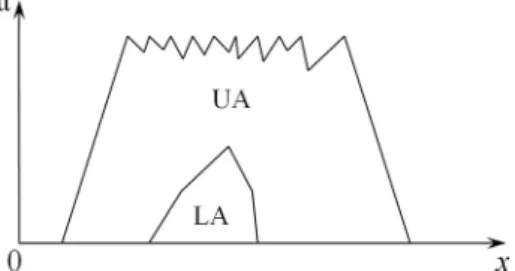
Fig.2. An RF set corresponding to the situation depicted by Fig.1.
Reconsider thesituationshownin Section 1 ,wheredifferentpeoplemayinterpretthesameconceptdifferently.As re-flected in Fig. 1 , it isdifficult to describe this situation usingconventional fuzzysets. However, RF sets can be adopted to representthisuncertain concept byexploiting thetwo approximations. In particular,the LA indicates theintersection amongst theregions that are agreedby individuals,whilethe UAindicates the unionofthe regionsthat are givenby at leastoneperson,asshownin Fig. 2 .RFsetsthereforeutiliseLAsandUAstoexpressthehigherorderuncertaintyinvolved indescribingapieceofknowledgeordata.
2.2. Basicnotions
Animportantconcepttointroduceisthe‘lessthan’relationbetweentwofuzzysets [3] .AnordinarysetA1 issaidtobe
lessthananotherordinaryfuzzysetA2,denotedbyA1 ≺A2,if
∀
α
∈(0,1],thefollowingconditionshold:inf
{
A 1α}
<inf{
A 2α}
, sup{
A 1α}
<sup{
A 2α}
(6)whereA1αandA2αarethe
α
-cutsetsofA1andA2,respectively,inf{Aiα}istheinfimumofAiα,andsup{Aiα}isthesupremum ofAiα,i=1, 2.Definition2.4. AnRFsetA˜1issaidtobelessthananotherRFsetA˜2,denotedasA˜1 ≺˜ A˜2,ifandonlyif ˜
A 1L≺A ˜L2, A ˜U1 ≺A ˜U2 (7)
Fromthis,thenotionofneighbouringrulesinvolvingRFsetscanbedefined. Definition2.5. TwoRFrules
R 1:If x 1 isA ˜11,x 2 isA ˜12,...,x M isA ˜1M, then y isB ˜1 R 2:If x 1 isA ˜21, x 2isA ˜22,..., x MisA ˜2M, then y isB ˜2
are said to be neighbouring rules if and only if: (1) A˜1j ≺˜ A˜2j or A˜2j ≺˜ A˜1j, j∈
{
1,...,M}
(where M is the number of antecedentvariablesinbothrules);and(2)thereisnoindividualrule“Ifx1 isA˜1, x2 isA˜2, . . . , xMisA˜M, thenyisB˜” such thatA˜1j≺˜ A˜j≺˜ A˜2jifA˜1j≺˜ A˜2j,orA˜2j≺˜ A˜j≺˜ A˜1jifA˜2j≺˜ A˜1j, j∈{
1,...,M}
.RF ruleinterpolationcanthen beachievedby extendingtheconventionalFRI. Inthiscase,theinput andoutput ofan interpolativeprocessareRFsetsratherthanconventionalfuzzysets.
Definition 2.6. Given an RF rule baseandan RF observation, rough-fuzzyrule interpolationis a process throughwhich a conclusionfromthegivenobservationisobtainedbyidentifyingtherulesintherulebasewhichflanktheobservationand interpolatingfromthoserules.
Notethat intheabovedefinition,tworules (e.g.,theR1 andR2 givenpreviously)aresaid toflank agivenobservation [3] ,say,O=
(
A˜∗1,A˜∗2,...,A˜∗M)
,ifA˜1j≺˜ A˜∗j ≺˜ A˜2j,orA˜2j≺˜ A˜∗j ≺˜ A˜1j, j∈{
1,...,M}
.2.3. Representativevalues
In orderto supportthe interpolation ofrules involving RF sets followingthe transformation-basedapproach [14] ,the ruleswhichhaveminimaldistancesfromagivenobservationneedtobeselectedfirst.Here,adistancebetweenagiven ob-servationandaruleintherulebaseismeasuredonthebasisofrepresentativevalue(Rep).TheconceptofRepisintroduced below.
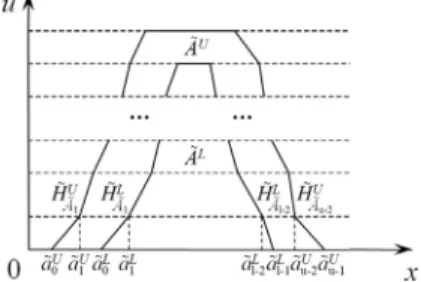
TheRepvaluecapturesimportantinformationsuchastheoveralllocationofanRFsetwithinthedefinitiondomain,and iscomputedandthenutilisedastheguidetoperformsubsequentinferenceduringtheinterpolationprocess.Forsimplicity, inthiswork,itisassumedthatonlypolygonalRFsetsareconsidered;thatis,boththelowerandtheupperapproximation are each represented by a polygonal-shaped first order fuzzy set. Note that in the existing T-FRI [15] , the Rep(A) of an
Fig.3. LA A˜ Land UA A˜ Uof a polygonal RF set A˜ .
ordinaryfuzzy setA isdefinedby the weightedaverageofthe xcoordinatevalues ofall oddpointsai,i∈
{
0,...,k−1}
, suchthat: Rep(
A)
= k−1 i=0 w ia i (8)withA=
(
a0, . . . , ak−1)
beingapolygonalfuzzysetofkoddpoints,andwidenotingtheweightassignedtothepointai. Definition2.7. SupposethatapolygonalRFsetA˜isgiven,asshownin Fig. 3 ,whoselowerandupperapproximationsare:˜ A=
(
a˜L 0,...,a˜Ll−1;H˜AL˜1,...,H˜ L ˜ Al−2)
,(
a˜ U 0,...,a˜Uu−1;H˜UA˜1,...,H˜ U ˜Au−2
)
. The lower andupperReps Rep(
A˜L
)
andRep(
A˜U)
ofA˜ are definedby⎧
⎪
⎪
⎪
⎨
⎪
⎪
⎪
⎩
Rep(
A ˜L)
x= l−1 i=0 w L ia ˜Li Rep(
A ˜L)
y= l−2 i=1 w L iH ˜AL˜i⎧
⎪
⎪
⎪
⎪
⎨
⎪
⎪
⎪
⎪
⎩
Rep(
A ˜U)
x= u−1 j=0 w Uja ˜Uj Rep(
A ˜U)
y= u−2 j=1 w U jH ˜UA˜j (9) wherewVv (V∈{L,U},
v
∈{
i,j}
)istheweightassignedtopointa˜Vv anditscorrespondingmembershipvalueH˜VA˜v,andxand ydenoteacertainvariabledimensionandthecorrespondingmembershipdistribution,respectively.Ingeneral,differentdefinitionscanbe adoptedforderiving differentRepvalues.Forinstance,thesimplestcaseisthat allpointstake the sameweight value,i.e., wL
i=1/l andwUj =1/u.The centreofcorecan alsobe usedasan alternative. In thiscase, the Repmay be solely determined by those pointswith a membership value of1: Rep
(
A˜U)
x= 12
(
a˜U(l/2)−1 +a˜U l−(l/2))
andRep(
A˜ U)
y= 12(
H˜AU˜ (l/2)−1+ ˜ HU ˜Al−(l/2)
)
.ThelowerRepsareomittedhere,whichcanbecalculatedinasimilar wayinvolvingthose pointsofthe maximummembership value. Other alternative definitionscan be found in [15] .For a givenapplication,oneoftheseweightingschemesneedstobetakenforimplementation.Remark2.3. In theexisting T-FRI,the Rep(A)y ofa givenconventional fuzzysetA isa constant, onlythe xcoordinateis thereforeconsideredastheRep(A).However,thisisnolongerthecaseinthisworkduetotheintroductionofhigherorder uncertainty,bothxandydimensionsmustbeconsidered.ThecalculationofRep
(
A˜)
yfollowsthatusedtocalculateRep(
A˜)
x inanefforttomaintainconsistency.Todistinguish amongst differentRF set shapes, the shape diversity factor fis also introduced here. The present work definesthisconceptbyfollowingtheconventionaldefinitionofstatisticalstandarddeviation(althoughthismaybedefined differentlyifdesiredforaparticularimplementation).
Definition2.8. Theloweranduppershapediversityfactors fL ˜ A and f U ˜ A aredefinedby
⎧
⎨
⎩
f L ˜ A= l−1 i=0(a˜Li−Rep(A˜L)x)2 l f U ˜ A = u−1 j=0(a˜Uj−Rep(A˜U)x)2 u (10)Remark2.4. A smallshapediversity factorimpliesthatthe oddpointsofA˜L (A˜U) tendtobe closeto thoseofthe lower (upper)Rep.Thatis,thesmallertheshapediversityfactor,thesmallertheareaofthelower(upper)approximation.
Toextendthemethodologyofconventional T-FRIto FRIinvolvingRF sets,a singleoverallRepofa givenRFset is re-quired.Forthis, theweightfactorwofthelower (upper)approximation isdefinedfirst,whichreflects therelative contri-butionofthelower(upper)shapediversityindepictingtheunderlyingRF set.Theintroductionoftheselower andupper
shapediversityfactors helpsminimisethepossibilitythat theuseofRFsets ofdifferentshapesleadstothesameoverall Repvalues.
Definition2.9. ThelowerandupperweightfactorswL ˜
A andw
U ˜
A aredefinedastheweightsoftheshapediversityfactors,in termsoftheareasofthelowerandupperapproximations,suchthat:
w V ˜ A = f V ˜ A f L ˜ A+ f U ˜ A , V = L,U (11) Remark2.5. Ingeneral, fL ˜ A+f U ˜ A =0.Ifhowever, f L ˜ A+f U ˜ A =0, i.e., f L ˜ A=0and f U ˜
A =0, theRFsetdegenerates toasingleton value,wL ˜ A=w U ˜ A =1/ 2.
Definition2.10. TheoverallRepofagivenRFsetA˜isdefinedby
Rep
(
A ˜)
= V∈{L,U} w V ˜ A e∈{x,y} Rep(
A ˜V)
e (12) wherewV ˜A istheweightassignedtoRep
(
A˜V
)
ofA˜V,V∈{L,U}.3. Rough-fuzzyruleinterpolation
3.1. SelectionofclosestNrules
AswithconventionalFRIapproaches,ingeneral,multipleruleswithmultipleantecedentsneedtobeconsideredinorder toobtainaninterpolatedconclusion.Forthis,thefirststepthatneedstobeconsideredistochoosetheclosestN(N≥2) rulesfromtherulebasewithrespecttothegivenobservation.Adistancemeasureisthusutilisedtomeasuretheproximity oftherulesbyexploitingsuchRepvaluesthatcapturespecificinformationembeddedinRFsets.
Withoutanylossofgenerality,supposethattherearenRFrulesinanRF rulebase.AruleRi,anobservationOandthe conclusionCarerepresentedbythefollowing,respectively:
R i:If x 1 isA ˜i1,...,x j isA ˜i j,...,x MisA ˜iM,then y isB ˜i
O :x 1 isA ˜∗1,...,x jisA ˜∗j,...,x M isA ˜∗M
C : y isB ˜∗
whereA˜i j denotestheRF setthatactsasthe valueofthejthantecedent ofRi,A˜∗j isthe observationofthevariablexj,B˜∗ is thedesiredinterpolated conclusion, andB˜i denotesthe consequent RF set ofRi with j∈
{
1, . . . , M}
, withMbeing the numberofantecedentvariables.Definition3.1. ThedistancedijbetweenapairofRFsetsA˜i j andA˜∗j isdefinedasfollows:
d i j=d
(
A ˜i j,A ˜∗j)
= d(
Rep(
A ˜i j)
,Rep(
A ˜∗j))
(13)whered(.,.)ishereincomputedusingtheEuclideandistancemetric(thoughanyotherdistancemetricmaybeusedasan alternative).
Definition 3.2. The distance di betweenthe rule Ri andtheobservation O isdeemed to be theaverage of thedistances betweentheRFsetsofeachruleantecedentandthecorrespondingvariableinO:
d i=
M j=1 d i j2, d i j= d i j maxj−minj (14)where maxj andminj are the maximumandminimum value inthe domainof thevariable xj, j∈
{
1,...,M}
. Theuse of normalised distance measure di j is to ensure that the resulting distances are compatible witheach other over different domains.Giventheabovedefinition,thedistancesbetweenagivenobservationandallrulesintherulebasecanbecalculated.The
NruleswhichhaveminimaldistancesarechosenastheclosestNruleswithrespecttothegivenobservation.Thechoiceof alargerNwillhelpconsiderawiderrangeofneighbouringrulesinperforminginterpolation,therebymorelikelytoresult inglobalresultsbutrequiringsignificantlymorecomputation.Onthecontrary,thechoiceofasmallerNwilltendtotake into accountonly neighbouring rulesand henceinvolvelesscomputationtime. Since FRI isin generalusedto derive an approximateresultinthefirstplace,inpracticalapplication,Ncanbechosentobe2.Thisisthecaseforconventionalrule interpolationalso.However,inthefollowingtheoreticaldevelopmenttomaintaingenerality, thenumberofclosestrulesis settoN(N≥2)unlessotherwisestated.
3.2.Constructionofintermediaterule
As witha number ofconventional FRI approaches, the approach in thiswork is developedfollowing the principle of analogicalreasoning [27] .First,anartificiallycreatedintermediateruleisinterpolatedsuchthattheantecedentofthe inter-mediateruleisas‘close’tothegivenobservationaspossible.Then,aconclusionisworkedoutfromthegivenobservation byfiringthisgeneratedintermediaterulethroughacertainanalogicalreasoningmechanism.
Definition3.3. SupposethatNclosestrulesarechosenwithrespecttoagivenobservation.Theserulesarerepresentedas
Ri,i∈
{
1,...,N}
,each havingMantecedent variablesA˜i j, j∈{
1,...,M}
,andare usedtoderive theintermediate rule.LetwA˜i j denote the weight to which the jth antecedent of theith closest rule contributes to the emerging intermediate rule,
whichisdefinedasthereciprocalofthecorrespondingdistancemeasure:
w A˜i j= 1 d i j = 1 d
(
A ˜i j,A ˜∗j)
(15) whereA˜∗jdenotestheobservedRFsetofantecedentvariablej.Thenormalisedweightw˜Ai j isthendefinedby w A˜ i j= w A˜i j N i=1w A˜i j (16) Remark3.1. Thisdefinitionreflectstheintuitionthatthelargerthedistanceis,thelessrelevantthecorrespondingattribute istotheobservation.Ingeneral, dij =0.Ifhowever,di j=0,then Rep
(
A˜i j)
=Rep(
A˜∗j)
.Inthiscase, theobservationis con-sideredtobeidenticaltothecorrespondingantecedentoftheruleRi,intermsoftheirRepvalues.Thus,wA˜i j issetto1fortheidenticalcaseswiththerestsetto0. TheantecedentA˜IFT
j oftheintermediateruleisconstructedfromtheantecedentsoftheidentifiedclosestrules.Aprocess
shiftisthenutilisedtomodifyA˜IFT
j sothattheantecedentoftheintermediaterulewillhavethesameRepasA˜∗j: ˜ A j=A ˜IFT j +
δ
A˜j(
maxj−minj)
, ˜ A IFT j = N i=1 w A˜ i j ˜ A i j (17)where
δ
A˜j isaconstantdefinedbyδ
A˜j=Rep
(
A ˜∗j)
−Rep(
A ˜IFTj
)
maxj−minj
(18) TheconsequenceoftheintermediateruleB˜iscalculatedbyanalogytothecomputationoftheantecedent,suchthat:
˜ B =B ˜IFT+
δ
˜ B(
max−min)
, B ˜IFT= N i=1 w B˜ i ˜ B i (19)whereB˜IFT istheconsequenceoftheintermediatefuzzyrule,maxandminarethemaximumandminimumvalueswithin thedomainoftheconsequentvariable,w˜
Bi and
δ
B˜arethemeansofwA˜i j andδ
A˜j, i∈{
1, . . . , N}
, j∈{
1, . . . , M}
, respectively, whicharedefinedbyw B˜ i= 1 M M j=1 w A˜ i j,
δ
B˜= 1 M M j=1δ
A˜j (20)3.3.Interpolationthroughsimilarity-constrainedtransformations
Theaforementionedartificiallyconstructedintermediateruleisderivedfromthechosenclosestruleswithrespecttoan observation.Itcan be usedto performinference without furtherreferenceto its originals.Suppose that a certain degree ofsimilaritybetweentheantecedent partofthisruleandtheobservationis established,itis intuitive torequirethat its consequentpartandtheeventualconclusionshouldattainthesamesimilaritydegree.Thatis,foranintermediaterule:“Ifx1
isA˜1,...,xjisA˜j,...,xMisA˜M,thenyisB˜”,andagivenobservationO=
(
A˜∗1,...,A˜∗j,...,A˜∗M)
,theshapedistinguishability betweenB˜andtheinterpolatedconsequenceB˜∗ isanalogoustothecombinationoftheshapedistinguishabilitiesbetween˜
AjandA˜∗j, j=1,2,...,M.Inordertoensurethis,thefollowingthreetransformationsaredesigned.
Notethatallthreetransformationsareseparatelyimplementedoneachdimensionandseparately calculatedoneachof thelowerandupperbounds.However,theunderlyingcomputationalmechanismsareidentical.Forpresentationalsimplicity, thedescriptionofthesetransformationsisgivenwithoutthesubscriptjandthesuperscriptLorU.
3.3.1. Scaletransformation
Consider the lower (upper) approximation of A˜ and that of A˜∗, respectively represented as A˜=
(
a˜0,. . .,a˜k−1;H˜ ˜ A1,. . ., ˜ H˜ Ak−2)
and A˜ ∗=(
a˜∗ 0,. . .,a˜∗k−1; H˜A∗˜1,. . ., ˜ H∗˜Ak−2
)
. The following parameters, termed the scale ratessp(p=0,. . .,
(
k/2)
−1)rescalethepthsupportofA˜inordertoapproximatethecorrespondingsupportofA˜∗:s p= ˜ a ∗k−p−1−a ˜∗p ˜ a k−p−1−a ˜p (21) From these scale rates, thefollowing scale ratios Sq (q=1,...,
(
k/2)
−1) modify the rescaled qth support of A˜ to furtherapproximatethecorrespondingsupportofA˜∗suchthattheresultingRFsetA˜isofthesamescaleasthatofA˜∗:Sq=
⎧
⎪
⎪
⎪
⎪
⎪
⎨
⎪
⎪
⎪
⎪
⎪
⎩
˜ a∗ k−q−1−˜a∗q ˜ a∗ k−q−˜a∗q−1− ˜ a k−q−1−˜aq ˜ a k−q−˜aq−1 1−a˜k−q−1−a˜q ˜ a k−q−˜aq−1 if s q≥s q−1 ˜ a∗k−q−1−a˜∗q ˜ a∗ k−q−˜a∗q−1− ˜ ak−q−1−a˜q ˜ a k−q−˜aq−1 ˜ a k−q−1−a˜q ˜ a k−q−˜aq−1 if s q−1>s q (22)Fromthis, byimposingtherequiredsimilarities,thecorrespondingscale ratesspthat willhelprescalethepthsupport ofB˜intotheemergingB˜∗canbeobtainedsuchthat
s p=
⎧
⎪
⎪
⎪
⎪
⎨
⎪
⎪
⎪
⎪
⎩
s p if p =0 sp−1(sp−sp−1) b˜ k−p−˜bp−1 ˜ b k−p−1−b˜p−1 sp−1 a˜ k−p−˜ap−1 ˜ a k−p−1−˜ap−1 +s p−1 if s p≥s p−1, p >0 sp−1sp sp−1 if s p−1> s p, p >0 (23)Theaboveshowsonlythesituationwhereoneantecedentvariableisconsidered(foreitheranLAoranUA).Ingeneral, foreach antecedent variablej andeachapproximation V, V∈{L,U},such a scaletransformation isrepeatedly appliedto transformA˜V
j totheintermediatetermsA˜
V
j withsVjp andSVjq.B˜V is thengenerated fromB˜
V usingthe aggregatedsV ˜ Bp and SV ˜ Bq,wheres V ˜ Bp= 1 M M j=1sjpV andS V ˜ Bq= 1 M M j=1SjqV. 3.3.2. Movetransformation
ThemoveratiosMr(r=0, . . . ,
(
k/ 2)
−2)shiftthelocationsofthesupportsofA˜(r−1)tothatofA˜∗(whereA˜(r−1)isthe termobtainedafterthe(
r−1)
thsub-movewiththeinitialisationA˜−1=A˜):Mr=
⎧
⎪
⎪
⎪
⎪
⎨
⎪
⎪
⎪
⎪
⎩
˜ a∗ r−a˜r(r−1) min ˜ a(rr−1)+···+a˜(r−1) (k/2)−1 (k/2)−r −a˜(rr−1),a˜(kr−1−r)−a˜(kr−1−r−1) ifa ˜∗r≥a ˜(rr−1) ˜ a∗ r−a˜( r−1) r min ˜ a(kr−1−r−1)−a˜ (r−1) k−(k/2)+···+a˜(r−1) k−r−1 (k/2)−r ,a˜r(r−1)−a˜(r−1r−1) ifa ˜(rr−1)>a ˜∗r (24)wherea˜(rr−1) isthenewpositionofa˜r after the
(
r−1)
thsub-move.Initially,when r=0,a˜0(−1)=a˜0, a˜( r−1) k−r −a˜(r−1) k−r−1 and
˜
ar(r−1)−a˜(r−r−11)arenotconsideredwithinthedenominatorsmin{.,.}.
Ingeneral, foreach antecedentvariablejandeachapproximation V,V∈{L,U},thismovetransformationisrepeatedly applied toobtain A˜(jr)V=
{
a˜(j0r)V,...,a˜(jr()kV −1)}
fromA˜ (r−1)V j usingM V jr.B˜( r)V ={
b˜(r)V 0 ,...,b˜( r)Vk−1
}
isthen obtainedfromB˜( r−1)V usingtheaggregatedMV˜ Br,whereM V ˜ Br= 1 M M j=1MVjr,resultinginA˜ ((k/2)−2)V j =A˜∗jV andB˜((k/2)−2)V =B˜∗V. 3.3.3. Heighttransformation
Theheightratesho(o=1,...,k−2)areutilisedtoadjusttheheightsH˜A˜L oof ˜ ALtotheheightsH˜∗L ˜ Ao of ˜ A∗L: h o= ˜ H ∗L ˜ Ao ˜ H L ˜ Ao (25) where0<H˜∗L ˜ Ao≤ ˜ H∗U ˜ Ao =1and0< ˜ HL ˜ Ao≤ ˜ HU ˜
Ao=1.Thisconstraintappliestotheinterpolatedconclusionaswell.Thatis,ifthe heightofB˜∗LisgreaterthantheheightofB˜∗U aftertheheighttransformation,thenH˜∗L
˜ Bo= ˜ H∗U ˜ Bo.
Ingeneral,foreach antecedentvariablejandeachapproximationV,V∈{L,U},thisheight transformationisrepeatedly appliedtotransformtheheightsofA˜L
j tothoseofA˜∗jL withhjo.Theheightoftheinterpolatedconclusionisthenobtained usingtheaggregatedhB˜o,wherehB˜o=
1 M
M
Fig.4. Causal diagram of a simplified application problem.
Remark3.2. ScaletransformationscalesA˜jupordowntoA˜j, retainingtheratiosbetweenleftandrightslopes,buthaving differentsupportwidths.Thecloserthescaleratiosto0,themoresimilarA˜jandA˜j.Move transformationshiftsA˜j toA˜∗j
whichhasthesamesupportwidth,buthavingdifferentlocations.Thecloserthemoveratiosto0,themoresimilarA˜j and ˜
A∗j.HeighttransformationadjuststheheightofA˜jtothatofA˜∗jwhiletheothercharacteristicsremainthesame.Thecloser theheightratesto1,themoresimilarA˜jandA˜∗j.
Scale,moveandheighttransformationsguaranteethat thetransferred setshavethesametypeofshapesasthatofthe original.Thatis,thesethree transformationsallow thesimilarity degreebetweenB˜ andB˜∗ tobe determined fromthose betweenA˜jandA˜∗j.
4. Applicationcasestudy
Inthis section, a practical problemconcerning the prediction ofdiarrhoeal disease in remote villages is employed in ordertodemonstratethepotentialoftheproposedwork.Itshowshowtheimplementedtechniquescanhelptorepresent theunderlyinghigherorderuncertaininformationandinterpolateafinalconclusion.
4.1. Problemoverview
Environmentalchangeinfluencesdiseaseburden [28,29] .Intensivestudieshavebeenmadeinanefforttoidentifylogical relationshipswhichliebehindsuchinfluences,predictingtheconsequencesofaparticularenvironmentalchange.Thisisof significantimportance inthe assessmentofthepotential impactof suchchanges upon theenvironmentandsociety, e.g., priortoproposinganylarge-scaleinfrastructureprojects.
Oneparticularapplicationinthisarea hasrecentlybeeninvestigatedin [17,18] ,whichis basedonthestudyof [30] .It addressestheissueofmeasuringhowtheconstructionofanewroadorrailwaynetworkinapreviouslyroadlessareamay affecttheepidemiologyofinfectiousdiseasesinnortherncoastalEcuador.Apredictivemodelhasbeenbuiltwheremanyof thefactorsarenotlinearlyrelated,butinteractwitheachotherinagridnetwork.Addressingthisapplicationproblem,an illustrativeexampleispresentedheretodemonstratetheapplicationoftheRF setsandRF ruleinterpolation.Theoriginal problemof [18] issimplifiedsuchthatallofthefactorsunderconsiderationarelinearlyconnected.Theresultingsimplified causalmodelisshownin Fig. 4 .
Thiscausaldiagramshowsthatthediarrhoealdiseaserateofaremotevillageisdirectlyaffectedbytwofactors.First,low socialconnectednesstendstoleadtofailureincreatingadequatewaterandsanitationinfrastructurebecausetheresidents areunlikelytoknowoneanotherwellandsharesocialnorms [31,32] ,therebyusuallyresultinginahighdiarrhoealdisease rate.Second,morefrequentcontactbetweentheresidentswithin avillageandthoseoutsidetendstoincrease therateof introductionofpathogens,therebyalsoraisingthediarrhoealdiseaserate.
Allfactorsconsideredinthisexamplearerepresentedassystemvariablesandeach relationbetweentwodirectly con-nectedfactorsisrepresentedasaruleassociatingtherelevantvariables.Insummary,therearefivevariablesintheproblem: contactoutsideofthevillage,reintroductionofpathogenicstrains,social connectedness,hygieneandsanitation infrastruc-ture,andinfectious diseaserate,denoted asx1,. . .,x5,respectively. Aselectionofthe originalrules containedintherule
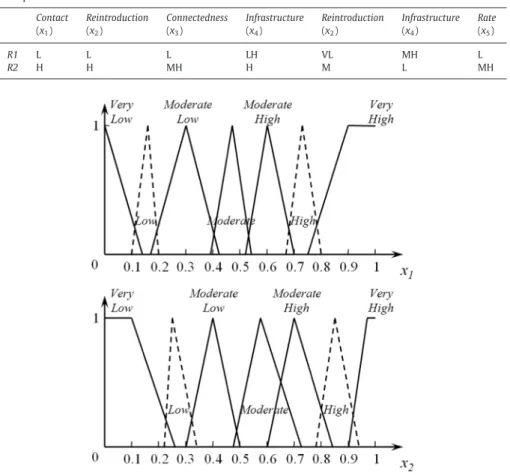
basearegivenin Table 1 ,wheretworulesaresufficientforinterpolation.Inthismodel,fuzzinessisnaturallyobtainedfrom thepresenceofthelinguistictermsthatdescribethereal-valueddomainvariables.Notethatdifferentvariablesaredefined upon differentdomains. Tosimplify knowledge representation,variabledomains are mapped onto thereal lineand nor-malised.Theillustrativefuzzysets thatrepresentthenormalisedlinguistictermsexpressedbyacertainexpertareshown
Table1
Example rules.
Contact Reintroduction Connectedness Infrastructure Reintroduction Infrastructure Rate
( x1) ( x2) ( x3) ( x4) ( x2) ( x4) ( x5)
R1 L L L LH VL MH L
R2 H H MH H M L MH
Fig.5. Definition of the linguistic terms for domain variables from a certain expert.
in Fig. 5 ,wherethetriangleswithdashedlinesindicatethetworulesgeneratedfromthisparticularexpert’sopinion.Itis importanttonotethattheoriginalrulebasecontainssubstantialgaps,whichmakesinterpolationessential.
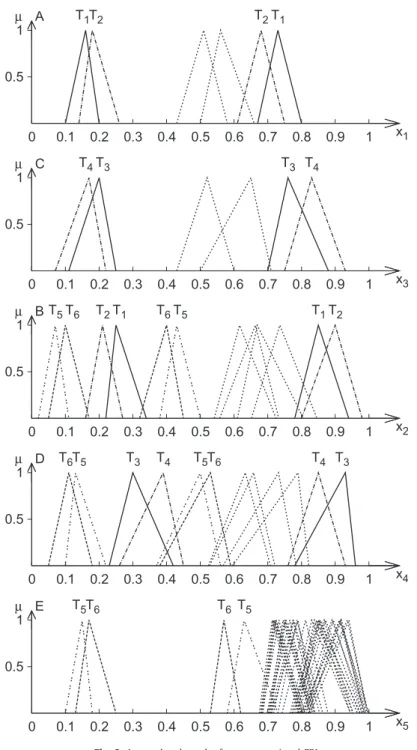
Inordertoevaluatethefinaldiseaserate,agroupofexpertsareselectedtoexpresstheirindividualviewoneachfactor. However,thisprocedurereliesheavilyupon theopinionsofexperts,who musthaveacomprehensiveanddetailed under-standingof theunderlying problem. Such opinionsare oftenbiasedandsubjectiveand/or inconsistentbetweendifferent individuals. Suppose that the opinions fromsix experts, denoted as T1,...,T6, in the group are shown in Fig. 6 , where
subsetsofrules(onesubset percausalimplication):A→B,C→DandB∧D→Eareestablishedbytheexpertswitheach supportedbytwoofthem.NotethatA=x1, B=x2, C=x3, D=x4andE=x5.Thisrevealstheunderlyinguncertaintyabout
theopinionsfromdifferentexpertsandreinforcestheneedforRF representation.In particular,opinionfromexpertT1 is
theonedisplayedin Fig. 5 .Forbrevity,othersareomittedhere.
4.2. Experimentationanddiscussion
4.2.1. Motivationrevisited
Givendifferentexpertrulesandobservations,one waytoresolvethe problemmight beto useaconventional FRI ap-proach,sayT-FRItoimplementtherequiredinterpolationseparately.Supposethat twopairsofexpertrulesarecontained inasub-rulebase:A1→B1 andA2→B2,whereA11→B11andA21 →B21areprovidedbyexpertT1,whileA12→B12and
A22 →B22areprovidedbyexpertT2.PresentedwithtwoobservationsA∗1andA∗2, theinterpolatedresultbytheuseofT-FRI
isasetwhichcontains4elements.Thecomputationwithrespecttotheremainderofthesubsetsofrulesfollowsthesame procedure,resultinginaconsequencesetof32interpolatedresults,aslistedin Table 2 .
Notethat thecardinality ofthesetofinterpolated consequentresultsincreasesrapidly alongwiththeincrease ofthe cardinalityofrulesubsetsandthenumberofobservations.Thisresultsinhighcomputationalcomplexity.Asoutlined previ-ously,thefirststepofinterpolationrequiresthecomputationoftheclosestrulesfromagivenrulebase.Adistancemeasure needs tobeemployed inordertoestimatetheproximity betweeneach ruleantecedentandtheobservation.Thisimplies a time complexity of O(xyz), where x is the number of observations to be interpolated, y is the number of antecedent variables,andzisthenumberoffuzzyrulesinvolvedintherelevantrulesubset.
0.5
1
0 0.1 0.2 0.3 0.4 0.5 0.6 0.7 0.8 0.9 1
x
1µ
A
T
1T
2T
2T
10.5
1
0 0.1 0.2 0.3 0.4 0.5 0.6 0.7 0.8 0.9 1
x
3µ
C
T
4T
3T
3T
40.5
1
0 0.1 0.2 0.3 0.4 0.5 0.6 0.7 0.8 0.9 1
x
2µ
B
T
5T
6T
2T
1T
6T
5T
1T
20.5
1
0 0.1 0.2 0.3 0.4 0.5 0.6 0.7 0.8 0.9 1
x
4µ
D
T
6T
5T
3T
4T
5T
6T
4T
30.5
1
0 0.1 0.2 0.3 0.4 0.5 0.6 0.7 0.8 0.9 1
x
5µ
E
T
5T
6T
6T
5Fig.6. Interpolated results from conventional FRI.
Table2
Interpolated results with T-FRI.
Values Values Values Values
E∗ 1 (0.771,0.845,0.953) E2∗ (0.805,0.914,0.999) E∗3 (0.767,0.830,0.945) E4∗ (0.799,0.890,0.989) E∗ 5 (0.775,0.867,0.952) E6∗ (0.809,0.936,0.998) E∗7 (0.772,0.851,0.945) E8∗ (0.802,0.913,0.988) E9∗ (0.786,0.852,0.975) E10∗ (0.821,0.918,0.991) E∗11 (0.781,0.838,0.966) E12∗ (0.814,0.894,0.981) E∗ 13 (0.792,0.871,0.980) E14∗ (0.826,0.941,0.995) E∗15 (0.788,0.856,0.972) E16∗ (0.819,0.917,0.985) E∗ 17 (0.678,0.721,0.798) E18∗ (0.710,0.775,0.840) E∗19 (0.675,0.713,0.791) E20∗ (0.698,0.750,0.826) E∗ 21 (0.682,0.733,0.799) E22∗ (0.712,0.790,0.840) E∗23 (0.679,0.725,0.792) E24∗ (0.701,0.765,0.825) E∗ 25 (0.685,0.724,0.810) E26∗ (0.717,0.777,0.854) E∗27 (0.681,0.717,0.804) E28∗ (0.705,0.754,0.838) E∗ 29 (0.708,0.753,0.833) E30∗ (0.742,0.812,0.879) E∗31 (0.704,0.745,0.826) E32∗ (0.730,0.786,0.863)
Table3
Relevant RF sets for sub-rule base A→B.
A1=(0 .14 ,0 .17 ,0 .17 ,0 .2 ;0 .75 ,0 .75),(0 .1 ,0 .16 ,0 .18 ,0 .26 ;1 ,1) Attribute values A2=(0 .67 ,0 .71 ,0 .71 ,0 .75 ;0 .62 ,0 .62),(0 .61 ,0 .68 ,0 .73 ,0 .8 ;1 ,1) B1=(0 .22 ,0 .24 ,0 .24 ,0 .27 ;0 .56 ,0 .56),(0 .16 ,0 .21 ,0 .25 ,0 .34 ;1 ,1) B2=(0 .8 ,0 .87 ,0 .87 ,0 .94 ;0 .74 ,0 .74),(0 .78 ,0 .85 ,0 .9 ,0 .98 ;1 ,1) Observation A∗=(0 .5 ,0 .54 ,0 .54 ,0 .58 ;0 .62 ,0 .62),(0 .43 ,0 .51 ,0 .56 ,0 .66 ;1 ,1) Table4
Relevant RF sets for sub-rule base B∧D→E.
B3=(0 .05 ,0 .08 ,0 .08 ,0 .11 ;0 .67 ,0 .67),(0 .02 ,0 .07 ,0 .10 ,0 .17 ;1 ,1) Rule 1 D3=(0 .10 ,0 .12 ,0 .12 ,0 .18 ;0 .8 ,0 .8),(0 .05 ,0 .11 ,0 .13 ,0 .22 ;1 ,1) E1=(0 .13 ,0 .16 ,0 .16 ,0 .18 ;0 .71 ,0 .71),(0 .1 ,0 .15 ,0 .17 ,0 .25 ;1 ,1) B4=(0 .38 ,0 .42 ,0 .42 ,0 .45 ;0 .7 ,0 .7),(0 .32 ,0 .4 ,0 .43 ,0 .5 ;1 ,1) Rule 2 D4=(0 .38 ,0 .51 ,0 .51 ,0 .56 ;0 .86 ,0 .86),(0 .37 ,0 .50 ,0 .53 ,0 .59 ;1 ,1) E2=(0 .58 ,0 .60 ,0 .60 ,0 .62 ;0 .4 ,0 .4),(0 .53 ,0 .57 ,0 .63 ,0 .73 ;1 ,1) Observation B∗=(0 .612 ,0 .682 ,0 .682 ,0 .733 ;0 .64 ,0 .64),(0 .565 ,0 .639 ,0 .697 ,0 .811 ;1 ,1) D∗=(0 .582 ,0 .679 ,0 .679 ,0 .708 ;0 .39 ,0 .39),(0 .531 ,0 .564 ,0 .722 ,0 .808 ;1 ,1)
Suppose thatthere arem1 rulesinthe formofA→ B,m2 rules inC→ D,m3 rulesin B∧D →E, n1 observationsfor
theantecedent ofthefirst rule,andn2 observationsforthesecond. Fromthis, thetime complexitiesfortherule subsets
depictingthe relationsA →B,C →D andB∧D →E are O(m1n1),O(m2n2) andO(m1n1m2n2m3), respectively.Apartfrom
thecomputationalcomplexity,thisleadsto difficultyindeterminingorinterpretingthefinalresult. Forexample,consider twointerpolatedresultsE∗8=
(
0.802,0.913,0.988)
andE25∗ =(
0.685,0.724,0.810)
.Usingthemethodin [33] ,thesimilarity betweenthesetwo fuzzysets is0.002.In thiscase,it isdifficult tomake achoice giventhealmost completely different conclusions. Clearly, it is important to be able to obtain a single consensus opinion which summarises the information containedindisparateordivergingopinions.Fortunately,theproposed RFapproachcanbeappliedwithoutsufferingfrom theabovedifficulty.AllsuchuncertainrelationscanbecapturedusingRFsetsandtheconclusioncanbederivedbyRFrule interpolation.4.2.2. ApplicationofRF-basedFRI
AnRFrulebaseandobservationcanbebuiltontopofthosesingle-expertrulebasesandobservationsusing Eq. (4) ,with examplesshownin Fig. 7 .Thatis,allfuzzyvaluesforasingleunderlyingvariableareaggregatedintoanRF set,wherethe uncertaintyisdescribedbythelowerandupperapproximations.Forthisexample,forsimplicity,eachvariableisassociated withtwofuzzyvalues.SucharulebaseandobservationincludesdifferentlevelsofuncertaintyandrepresentsthemasRF sets.Also,theyareconsideredintheprocessofinterpolationinordertoobtainconsensusinferenceconclusions.
TheresultantRFsetsforA→Barelistedin Table 3 .Theinterpolationprocessisdescribedasfollows:
1. ThelowerandupperReps,shapediversityfactorsandweightfactorsarecalculatedaccordingtoEqs. (9) , (10) and (11) , respectively.
2. The overall Reps, Rep
(
A1)
=0. 486, Rep(
A∗)
=0. 842, Rep(
A2)
=1. 002, are calculated from Eq. (12) . A=(
0.505,0.542,0.542,0.579;0.66,0.66)
, (0.452, 0.519, 0.559, 0.632; 1, 1) and B=(
0.620,0.674,0.674,0.732; 0.68, 0.68),(0.588,0.651,0.698,0.781;1,1)arethencomputed.3. The scale rates sL
B0=1. 084, sUB0=1. 273, sUB1=1. 229, the move ratios MLB0=−0. 179, MUB0=0. 093 andthe height rate
hB1=0.939intheintegratedtransformation fromA andA∗ arecalculatedwithregard toEqs. (21) , (24) and (25) , re-spectively.
4. The scale rates, move ratios and height rate are used to transform B to the interpolated conclusion B∗=
(
0.612,0.682,0.682,0.733;0.64,0.64)
,(0.565,0.639,0.697,0.811;1,1),assummarisedin Fig. 7 .Since theinterpolationforcalculatingD∗ fromC →D issimilarto theabove process,it isomittedheretoavoid rep-etition.HavinggeneratedB∗andD∗,B∧D →Eisthen utilisedtoderive thefinalresult. TheRF setsinvolvedarelisted in
Table 4 .
Note that both given rules inthe form ofB∧D → E lie on one side ofthe observation,the problem ofinterpolation thereforebecomesthatofextrapolation.However,theextensionofRFruleinterpolationtoextrapolationisstraightforward. 1. Forthefirstantecedent,thedistancesbetweenB3,B4 andthepreviouslyinterpolatedB∗arecalculatedby Eq. (13) .The
weights arecalculatedandnormalised using Eqs. (15) and (16) ,respectively, resultinginthenewweights of0.30and 0.70.The normalisedweights togetherwiththeparameter
δ
B=0. 60, whichiscomputedby Eq. (18) ,are thenusedto generatetherequiredintermediatefuzzysetB=(
0.634,0.671,0.671,0.701;0.69,0.69),(0.584,0.654, 0.684,0.754;1, 1),accordingto Eq. (17) .Dcanthenbecalculatedinthesameway.0.5
1
0 0.1 0.2 0.3 0.4 0.5 0.6 0.7 0.8 0.9 1
x
1µ
A
A
1A
*A
20.5
1
0 0.1 0.2 0.3 0.4 0.5 0.6 0.7 0.8 0.9 1
x
3µ
C
C
1C
*C
20.5
1
0 0.1 0.2 0.3 0.4 0.5 0.6 0.7 0.8 0.9 1
x
2µ
B
B
3B
1B
4B
*B
20.5
1
0 0.1 0.2 0.3 0.4 0.5 0.6 0.7 0.8 0.9 1
x
4µ
D
D
3D
1D
4D
*D
20.5
1
0 0.1 0.2 0.3 0.4 0.5 0.6 0.7 0.8 0.9 1
x
5µ
E
E
1E
2E
*Fig.7. Interpolated results from RF rule interpolation.
2.Tocomputetheconsequent,theaveragedweightsof0.26and0.74,and
δ
E=0. 49arecalculatedusing Eq. (20) .Fromthis, the intermediateoutput E=(
0.772,0.794,0.794,0.814;0.48,0.48)
,(
0.727,0.770,0.819,0.914; 1,1) isobtainedusingEq. (19) .
3.The average of two support scale rates (1.81 and 0.79) of the LAs is computed according to Eqs. (21) , (22)
and (23) , resulting in sL
E0=1. 30 and forming the scale rate of the aggregated LA. The scale rates of the ag-gregated UA sU
E0=1.38 and sUE1=3.31 can then be generated following the same procedure. Similarly, the aggre-gated move ratios ML
E0=0.81 and M
U
E0=1.41 are calculated from two move ratios (0.24 and 1.37) of the LAs and two move ratios (0.60 and 2.22) of the UAs using Eq. (24) . These, together with the aggregated height rate, namely, the average hE1=0.46 from Eq. (25) , are employed to transform E, achieving the final result E∗=
(
0.773,0.779,0.779,0.829;0.22,0.22)
,(
0.690,0.702,0.855,0.961;1,1)
. The interpolated result is again illustrated inTable5
Involved RF sets for Singleton-valued Interpolation. ˜ A1=(3 ,3 ,3 ;1),(3 ,3 ,3 ;1) Attribute values A˜ 2=(12 ,13 ,13 .5 ;0 .6),(11 ,13 ,14 ;1) ˜ B1=(4 ,4 ,4 ;1),(4 ,4 ,4 ;1) ˜ B2=(10 .5 ,11 .5 ,12 ;0 .5),(10 ,11 .5 ,13 ;1) Observation A˜ ∗=(6 ,7 ,8 ;0 .6),(5 ,7 ,9 ;1)
1
0 1 2 3 4 5 6 7 8 9 10 11 12 13 14 15 x
µ
A
~
1A
~
2A
~
*1
0 1 2 3 4 5 6 7 8 9 10 11 12 13 14 15 y
µ
B
~
1B
~
2B
~
*Fig.8. A single antecedent case with singleton-valued conditions.
Notethatthisfigurereflectsthedistributionofthoseresultsshownin Fig. 6 .Inparticular,theshapeoftheresultantRF setissimilartotheshapedistributionofthose32interpolatedsets,whereasthecomputationalcomplexityoftheformeris muchlowerthanthatofthelatter.Thiscanbeseenbycomparingthecalculatedtimecomplexitiesoftheformer,whichare
O(m1), O(m2)andO(m3), respectively. Itisobvious thatthe reductionin computationcomplexityissignificant,especially
whenthenumberofobservationsbecomeslargeforagivenapplication.Inaddition,sinceamajorityofthe32resultsare closerto the second rule(see Table 4 and Fig. 6 ), theresultant RF setis alsocloserto the consequent ofthisrule. This demonstratesthatthepresentapproachcorrespondstotheintuitionforitsdevelopment.
5. Furtherevaluation
5.1. Specificcases
TheRFruleinterpolationandextrapolationprocesseshavebeenillustratedintheprevioussection.However,the partic-ularapplicationdoesnotofferascenariototestspecificcaseswhererulesinvolvesingleton‘fuzzy’valuesorwhereRFsets degeneratetoconventionalfuzzysets.Thesecasesareempiricallycheckedbelow.
5.1.1. Singleton-valuedinterpolation
Thiscaseconsiders onesingleantecedent variableinvolvingsingleton-valuedconditions.TherelevantRFsets arelisted in Table 5 .
TheinterpolatedconclusionB˜∗=
(
5.98,7.04,7.98;0.57)
,(
5.27,6.66,9.27;1)iscalculatedfollowingtheprocedures de-scribedin Sections 2 and 3 ,asshownin Fig. 8 .Itfollowsthatifcertaincomponentsinvolvedinthegivenrulesare singleton-valued,theinterpolatedconclusionremainsanRFsetgivenanRFobservation.Thishasaclearintuitiveappeal.5.1.2. Degeneratedinterpolation
TheconceptofRFsetsextendsthatofconventionalfuzzysets,whiletheRFruleinterpolationextendsfromtheexisting T-FRI. When there is no higher order uncertainty involved,i.e., the LA coincides withthe LU, an RF set degenerates to a conventional fuzzy set. If all of the sets under consideration in the implementation of interpolation/extrapolation are conventionalfuzzysets,thentheresultsobtainedbytheproposedapproachareidenticaltothoseofT-FRI.Theexamplein
Fig. 9 illustratesthis.
Consider a casewhereall ofthe RF sets concerned degenerateto conventional fuzzysets, i.e.,A˜∗L=A˜∗U,A˜L k=A˜
U
k and
˜
BL
1
0 1 2 3 4 5 6 7 8 9 10 11 12 13 14 15 x
µ
A
~
1A
~
*A
~
21
0 1 2 3 4 5 6 7 8 9 10 11 12 13 14 15 y
µ
B
~
1B
~
*B
~
2Fig.9. Interpolation when RF sets degenerate to conventional fuzzy sets.
Table6
Involved RF sets for Degenerated Interpolation. ˜ A1=(0 ,4 ,5 ,6 ;1 ,1),(0 ,4 ,5 ,6 ;1 ,1) Attribute values A˜ 2=(11 ,12 ,13 ,14 ;1 ,1),(11 ,12 ,13 ,14 ;1 ,1) ˜ B1=(0 ,2 ,3 ,4 ;1 ,1),(0 ,2 ,3 ,4 ;1 ,1) ˜ B2=(10 ,11 ,12 ,13 ;1 ,1),(10 ,11 ,12 ,13 ;1 ,1) Observation A˜ ∗=(6 ,6 ,9 ,10 ;1 ,1),(6 ,6 ,9 ,10 ;1 ,1) Table7
RMSE% for the benchmark datasets.
Yacht Servo
Partitions Expert 1 Expert 2 Expert 3 RF Expert 1 Expert 2 Expert 3 RF
2 30.90( ∗) 30.46( ∗) 30.02( ∗) 25.80 26.20( ∗) 25.60( ∗) 25.00( ∗) 23.83 3 19.50( ∗) 19.93( ∗) 19.64( ∗) 19.10 15.13(-) 15.45( ∗) 15.74( ∗) 15.29 4 18.72( ∗) 19.82( ∗) 21.20( ∗) 17.31 12.59( ∗) 12.78( ∗) 13.22( ∗) 12.19 5 16.53(-) 18.21( ∗) 18.52( ∗) 16.59 11.60( ∗) 11.78( ∗) 12.29( ∗) 11.36 6 14.72(v) 16.10(-) 17.87( ∗) 16.10 11.50( ∗) 11.50( ∗) 12.07( ∗) 11.24 7 15.23(v) 16.35( ∗) 16.01( ∗) 15.52 11.29( ∗) 11.30( ∗) 11.59( ∗) 11.01 Concrete Housing 2 18.10( ∗) 18.06(-) 18.03(-) 18.05 17.26(-) 17.22(-) 17.13(v) 17.21 3 16.82(-) 16.94( ∗) 17.01( ∗) 16.85 16.65( ∗) 16.10( ∗) 15.54(-) 15.75 4 15.09( ∗) 14.84(-) 14.62(v) 14.85 15.15( ∗) 14.70(-) 14.44(v) 14.73 5 13.54(v) 14.65(-) 14.62(-) 14.63 14.09( ∗) 13.89(-) 13.61(v) 13.86 6 13.47( ∗) 13.34(-) 14.66( ∗) 13.36 13.51(-) 13.57(-) 13.66(-) 13.56 7 13.14(v) 13.49( ∗) 14.42( ∗) 13.28 12.98(v) 13.19(-) 13.42( ∗) 13.16
Usingtheproposedapproach,theinterpolatedconclusionB˜∗=
(
5.23,5.23,7.61,8.32;1,1),(5.23,5.23,7.61,8.32;1,1) isobtained,asshownin Fig. 9 .Thedetailsofthecalculationareomittedheretoavoidrepetition.Itfollowsthatifallgiven setsareconventionalfuzzysets,theinterpolatedresultisindeedthesameasthatachievedusingtheclassicalT-FRI.5.2.Additionalapplicationcasestudies
Furthertotheexamplespreviously shown,theproposed approachhasalsobeenevaluatedagainst furtherapplications fordecisionsupport, byadapting UCI-MLR benchmark datasets [34] ,including YachtHydrodynamics, Servo,Concrete Com-pressiveStrength,andHousing.
Table 7 shows the results of the averaged root-mean-square error (RMSE) values computed over 10 times 10-fold cross-validation [35,36] ,in relation to K (K=2, . . . , 7) partitions (i.e.,the underlyingdomain ofeach variable is divided into6fuzzyvalues)andN (N=6) closestrules that areusedto interpolatetheconclusions.The resultsare comparedto thoseachievedby individualT-FRIinterpolations thateachimplementtheinterpolationwiththeopinionprovidedbyone
particularexpert.Inordertoassessthestatisticalsignificanceoftheobtainedresults,aPairedT-testisused.Asignificance levelof0.05isemployedinthesetablesfortheachievedaccuracies.TheRF approachisutilisedasareference, andthose resultswhicharebetter,worseandofnostatisticalsignificancearemarkedwith‘(v)’,‘(∗)’and‘(-)’,respectively.
Asreflectedintheresults,theaccuraciesfromthreeT-FRIinterpolationsareunstable.Thatis,theopinionsfroman ex-pertmayperformwellincertainpartitions,butbadlyinothers.Theoretically,thisisacceptableasoneisonlyanexpertina particularfield,namely,thenecessaryexpertisemayonlybeavailableforacertainconcept.However,thisleadstodifficulty fordecisionmaking inpractical applicationswhen aconsensus of multipleexpertsora group-basedopinion is required. Fortunately,theperformance oftheproposed RF approachis generallybetter thanthat ofT-FRIin isolation,reflecting an importantadvantageoftheproposedapproach.
6. Conclusion
Thispaperhasproposed anovelapproachforbothrepresentingtheknowledgeinvolvinghigherorderuncertaintyand facilitatingrule interpolationwithsuch knowledge.It hasintroduced theconcept ofrough-fuzzy(RF) sets,via theuseof lower andupperapproximationmembershipfunctionsandpresentedanalgorithmforRF ruleinterpolation.Anumberof examples have been provided in the paper in order to illustrate the algorithm’s potential, including a realistic problem that predictsdiarrhoealdiseaseratesinroadless villages.Theseexamplesdemonstratethattheproposed approachisofa naturalappealforinterpolationandextrapolationwhen dealingwithdifferentlevelsofuncertainty thatconventional FRI techniquesmayotherwiseignore.Inparticular,throughRFset-basedinterpolation,theexploitationofuncertainknowledge acrossmultipleopinionsofferedbydifferentexpertsisfacilitated,leadingtoimprovedresultsovertheuseofonlyexpertise offeredbyanindividualexpert.
Theworkoffersmanyareasforfurtherinvestigation.Forexample,theopinionofanindividualinagroupmaybedistinct fromtheothers,whichmayresultinanemptylowerapproximationandhence,difficultyforthetaskofgroupdecision mak-ing.However,alloftheindividualexpertsshouldcontributetotheoutcome,althoughoneoutliershouldnotdominatethe overallresult.Orderedweightedaveraging(OWA)operators [37–39] maybeappliedtoenhancetheabilityofthisapproach. Also, certain rules may be very usefulor evencrucial, butothers maybe less useful(and mayeven contain misleading information).Aweightingschemeshouldthereforebeassignedtotherulesinordertoexpressthebeliefofusefulness re-latedtoeachrule.Itwouldbeinterestingtoinvestigatetheperformanceoftheapproachbylearningtheweightsfromthe constructed rulebases [40] .Inaddition, scaled-upreal-worldapplicationswouldhelp tofurther evaluatethe fullefficacy andpotentialofthiswork.
Acknowledgments
The firstauthorisverygratefulto AberystwythUniversityforprovidinga PhDscholarshipinsupportofthisresearch. The third and last authors would like to thank the Royal Academy of Engineering , UK, for their support, under Grant
1314RECI025 .ThanksalsogototheAssociateEditorandthereviewersfortheirconstructivecommentswhichhavehelped improvethisworksignificantly.
References
[1] L.A.Zadeh,Outlineofanewapproachtothea