Please cite this article as: A. Hashemoghli, I. Mahdavi, A. Tajdin, A Novel Interactive Possibilistic Mixed Integer Nonlinear Model for Cellular Manufacturing Problem under Uncertainty, International Journal of Engineering (IJE), TRANSACTIONS C: Aspects Vol. 30, No. 3, (March 2017) 384-392
International Journal of Engineering
J o u r n a l H o m e p a g e : w w w . i j e . i rA Novel Interactive Possibilistic Mixed Integer Nonlinear Model for Cellular
Manufacturing Problem under Uncertainty
A. Hashemoghli*, I. Mahdavi, A. Tajdin
Department of Industrial and Systems Engineering, Mazandaran University of Science and Technology, Babol, Iran
P A P E R I N F O
Paper history:
Received 14 January 2017
Received in revised form 03February 2017 Accepted 09 February 2017
Keywords:
Cellular Manufacturing Problem Possibilistic Approach Interactive Fuzzy Approach Worker Skill and Flexibility
A B S T R A C T
Elaborating an appropriate cellular manufacturing system (CMS) could solve many structural and operational issues. Thereby, considering some significant factors as worker skill, machine hardness, and product quality levels could assist the companies in current competitive environment. This paper proposes a novel interactive possibilistic mixed integer nonlinear approach to minimize the total costs of cellular manufacturing design. The proposed approach is elaborated regarding operation sequence, worker and machine assignments, route and worker flexibility, machine hardness level, worker and machine capacity, worker skill level, and product quality level based on imprecise information. Meanwhile, the product demand parameter because of its nature is defined based on fuzzy setting environment. Then, the interactive possibilistic approach is provided to cope with the existed uncertainty according to the problem environment. Finally, a numerical experiment is considered to show the capability of the proposed approach. The results of the proposed interactive possibilistic model show that the presented approach could assist companies for minimizing their costs and manipulating the machines and workers’ suitability. In this respect, comparing the obtained results from the proposed approach and similar circumstances shows that the proposed model could reduce the total costs by 27.8%.
doi: 10.5829/idosi.ije.2017.30.03c.08
1. INTRODUCTION1
Cellular manufacturing systems (CMSs) have some suitable properties as machine utilizing improvement, quality management, material handling cost reduction, work-in-process inventory management, and setup time reduction. In this respect, some phases should be considered for designing a suitable CMS including: i. Cell formation, which means that a group of product with similar jobs assigned in families of parts and related machines in machine cells; ii. Group layout, which is established from the intracellular arrangement (i.e. machines assigned within each cell) and intercellular arrangement (i.e. related cells); iii. Planning of groups, and
iv. Allocation of resources such as allocation of human resource, tools, and material [1-3].
In this study, the first, second, and fourth phases of cellular manufacturing design are provided. Meanwhile,
1*Corresponding Author’s Email: [email protected] (A. Hashemoghli)
the group layout, resource allocation, and cell formation are considered regarding the final product quality based on the hardness level of jobs on machines, the demand quality level, and the workers skill level. In some studies, these features are considered based on multi-period approach which is named dynamic cellular manufacturing system [2, 4, 5]. To address the issue, some researchers focused on CMS problems based on mathematical programming approach and under the certain or precise information [6-8].
[11] developed an integrated model based on dynamic approach which integrates some properties of existing models in a single model consisting reliability, machine breakdown, production planning, production cost and intracellular movement to minimize the total costs. Rabbani et al. [12] focused on manpower allocation and cell loading problem with the aim of manpower allocation in cellular manufacturing with consideration to training and learning policies where demand is stochastic.
Paydar et al. [13] presented an elaborative mathematical model based on operations sequence, intracellular layout, lot splitting, alternative process routing, duplicate machines, multi-period production planning, system reconfiguration, machine capacity, and material flow between machines, which is called comprehensive integer linear programming approach. Kia et al. [14] proposed a dynamic nonlinear mixed integer programming approach to provide a group layout of CMS concerning the production planning decisions. Lim et al. [6] presented multi-objective hybrid algorithms for layouts optimization in multi-robot assembly for solving the cellular manufacturing problems. Rezazadeh and Khiali-Miab [15] developed a novel mathematical model for designing the reliable cellular manufacturing systems that leads to decrease in the manufacturing costs, improved total reliability of the manufacturing system and improved product quality. In addition, a two-layer genetic algorithm is presented to address the complexity of cell formation problems to obtain near optimal solutions. Kia et al. [16] proposed a novel mixed integer nonlinear mathematical model for elaborating the group layout of unequal area facilities in a dynamic CMS. Sakhaii et al. [3] presented a robust mixed integer linear programming approach with the goal of minimizing the total costs related to machines, production, workers, and part movements. Aalaei and Davoudpour [8] proposed a novel mathematical programming model for a CMS along supply chain design regarding labor assignment with the goal of minimizing the total cost of holding, inter-cell material handling, external transportation, fixed cost for producing each part in each plant, machine and labor salaries.
Traditional cell formation techniques, designed cells and assigned the workers to them, while avoiding the relationships between the required skills of jobs and skills of workers. Furthermore, the workers’ skill levels could be related to jobs hardness on the machines. Thus, providing the workers’ skills level regarding the jobs hardness could be considered as an important issue for machine/worker assignment. Thereby, a few studies have focused on workers’ skills level to solve the CMSs problems.
In this respect, Norman et al. [17] presented a mixed integer mathematical model for assigning the workers to manufacturing with the aim of maximizing the efficiency of the organization cells regarding their skills. Suksawat et al. [18] developed a new methodology considering the skills of workers based on scheduling method to solve the manufacturing cell problem. In addition, Duan et al. [19] presented an assembly system-based on CMS properties
and providing the collaboration between worker and machine, workers skill, safe design for collaboration, and assembly information guidance. Egilmez et al. [20] proposed an optimization methodology with the goal of maximizing the rate of production based on workers skills allocation, which the performance of each worker is provided to allocate the worker to the manufacturing cells. The literature review of worker skills studies in CMS problems indicates that little attentions have been paid to this area. Therefore, this study is focused on the worker skill level for allocating the workers to machines with specific job hardness level.
In real-life complexity of CMSs problems, some significant parameters (e.g., available machine capacity, product mix, processing time, inter-arrival time, and product demand) are difficult to be specified precisely. In this respect, these parameters should be expressed under uncertainty to address the imprecise condition in cellular manufacturing issues [21-23]. Thus, various approaches which have been developed to deal with imprecise information are robust optimization approach, stochastic programming, and fuzzy programming [16, 24-26].
In the field of fuzzy condition, Safaei and Tavakkoli-moghaddam [27] extended a mixed-integer mathematical model for solving the manufacturing problems based on imprecise information and dynamic condition. In addition, they considered the machine capacity and product demand as fuzzy parameters. Also, Kia et al. [28] presented a novel integer non-linear mathematical model based on fuzzy information for solving the layout design of CMS. In addition, Behret and Satoglu [29] investigated the fuzzy approaches, especially fuzzy clustering and fuzzy programming elaborated for designing the CMS. They considered the machine purchasing, intercellular flow cost, and product demand based on imprecise information. Paydar and Saidi-Mehrabad [30] developed a new bi-objective possibilistic programming model for integrating distribution, procurement, and production planning regarding the uncertain nature of some main parameters as customers demands and machine capacity. Therefore, considering the fuzzy set theory could deal with vague situation and incomplete information, appropriately [31].
TABLE1. Cellular manufacturing models and their characteristics
Author
Model characteristic
Uncertainty Worker capacity
Worker flexibility
Operation sequence
Worker allocation
Job hardness
Worker skill
Product quality
Mahdavi et al. [32]
Solimanpur et al. [33]
Mahdavi et al. [34]
Torabi and Amiri [35]
Kia et al. [36]
Chang et al. [37]
Kia et al. [38]
Shirazi et al. [39]
Egilmez et al. [20]
Sakhaii et al. [40]
Deep and Singh [7]
This paper
The reminder of this paper is organized as follows: in section 2, the problem description about the cellular manufacturing problem regarding cost and quality is defined. Then, the assumptions and proposed model are provided in section 3. In addition, in section 4, the interactive possibilistic approach is provided to cope with existing uncertainty. In section 5, a numerical experiment is considered to indicate the applicability of the proposed model. Finally, some concluding remarks and future directions are explained in section 6.
2. PROBLEM DESCRIPTION
In the CMS problem, a number of machines (m) and cells (c) which operate specific jobs (j) for various products (r) by worker (w) are considered. The worker has a specific skill (s) according to jobs hardness of machines (h), which leads to a specific product quality level (q). Furthermore, machines have a certain capacity (
m
ML ) and products is
produced based on imprecise processing time (jwm). Also, number of cell (NC) must be specified and the maximum (NU) and minimum (NL) number of machines which must be set in each cell are specified by experts. Hence, workers have an available time to work (
w
WL ) which must satisfy the minimum working time (Ww). For this sake, available
time of machines must satisfy the minimum machine working time (Mm). Moreover, the customer demands of one product with a specific quality level (
rq
d ) is obtained.
Thereby, the worker skills ( s wm
) and the job hardness of machines ( h
jm
) affects the output quality level ofproduced products ( jrm w
). For instances, if the worker is expert in skill level, then the final product quality is the best. Therefore, the final products quality level is specified based on minimum quality level of product production procedure. Hence, products need some various operation process (jrm) in available routing (Lr) which should be produced in a suitable route (lr) according to allocating the products to a cell ( c
jrm
Y ) and to a machine ( h jrm
). Meanwhile, the products have concatenated production sequence and material flow conservation ( mm
jrcc
). For this sake, if one cell is constructed (CFc), the machines could be assigned to cells (
mc
X ) and workers could be allocated to machines (wjm) regarding the worker skills level ( s
wjm ). However, the presented model is designed with the goal of minimizing the total costs consisting of processing cost of
machine ( h
m
CM ), employment cost of worker ( s w
CW ), fixed
cost of establishing each cell (FCc), intercellular movement cost between cells (
cc
CO ) and intracellular
movement cost of cell ( c
CI ).
3. PROPOSED APPROACH
In this section the proposed mixed integer nonlinear programming approach is presented based on some assumptions.
the total costs of cellular manufacturing design is established based on the following assumptions:
1) Each machine must be allocated to only one cell; 2) Each product must be allocated to only one cell; 3) The processing time of products can be various on
different machines (i.e. routing flexibility); 4) The hardness of job is not related to each product; 5) The processing time for needed jobs for a product
on each machine is known; 6) Inventory is not allowable;
7) Each product has a number of jobs that must be processed based on its jobs sequence;
8) Each product has a number of procedures routing, which could be chosen among the available routs; 9) There is only one type of each machine.
3. 2. Nomenclature In this section, the nomenclature is defined as follows:
Sets
j Index of job, j 1, 2,...,J
h Index of hardness, h1, 2,...,H
c, c' Index of cell, c1, 2,..., ,C c1, 2,...,C
m, m' Index of machines,
1, 2,..., , 1, 2,...,
m M m M
w Index of workers, w 1, 2,..., W
s Index of skills,
s
1, 2,...,
S
r Index of products, r1, 2,...,R
q Index of quality, q1, 2,...,Q
l Index of route, l 1, 2,...,L
Parameters
jrm
w
The output quality q of required job j for product r by worker w on machine m;
h jm
The hardness level h of job j on machine mr
L Number of available routing for product r
jrm
The required job j for product r that needs to be processed by machine ms wm
The skill level s of worker w on machine m
rq
d
The demand of product r with quality qrq
db 1 0 ,
0 0
rq rq
rq
d
db r q
d
cc
CO The intercellular movement cost of cell c to cell c
c
CI The intracellular movement cost of cell c
h mj
CM The processing cost of machine m with hardness
level h for job j
s w
CW The employment cost of worker w with skill level of
s
c
FC Fixed cost of establishing each cell
m
M
The lower bound of machine load for machine m
m
ML The load of machine m, for available time of
machine m
jwm
Processing time of job j which is done by worker w on machine mNC Number of cells that should be formed
NU Maximum number of machine in each cell
NL Minimum number of machine in each cell
w
W
The lower bound of worker load for worker k
w
W L The load of worker w, for available time of worker w
Decision variables
c
CF 1 if cell c is formed; 0 otherwise
mc
X 1 if machine m is assigned to cell c ; 0 otherwise
mm q jrcc
1 if job j+1 of product r with quality level q is processed by machine m' in cell c after performing job j on machine m in cell c; 0 otherwise
wjm
1 if worker w is assigned to machine m for job j; 0 otherwise
lr
1 if route l of product r is selected as process plan; 0 otherwiserq
Number of produced product r with quality level qs wjm
1 if worker w for performing the job j on machine m which has level skill s; 0 otherwisecq jrm
Y 1 if product r with quality level q is processed by job j on machine m in cell c; 0 otherwise
hq jrm
1 if product job j on machine r with quality level m which has hardness q is processed by h; 0 otherwise
rq
PQ
The quality level q of product r; its value is relating to the quality level of produced product; where
1 2
3
If 0
,
0 If 0
rq rq
rq q
q
PQ r q
q
3. 3. Modelling
1 1 1 1 1 1 1 1 1 1 1
1 1 1 1 1 1 1 1 1 1 1
Min
Q
S W J M J R M M C C
s s mm q
wjm w cc jrcc
s w j m j r q m m c c
Q Q
J R M C C J R M H
cq hq h
c jrm c c jrm mj
j r q m c c j r q m h
Z CW CO
CI Y FC CF CM
(1)
1 1
J M
w jwm wjm w
j m
W W L w
(3)1 1 1 1
R J W L cq
m jwm jrm lr m
r j w l
M Y ML m
(4)1 C c c CF NC
(5) 1 1 C mc c cX CF m
(6) 1 1 C M mc c c mNL X CF NU
(7),
rq drq r q
(8)1 , , , , H hq cq jrm jrm h
Y j r q m c
(9) 1 1 , , C M cqjrm jrm rq c m
Y db j r q
(10)1 1 1 1 1 1
, ,
jrm
Q
J R M W M h hq w jm jrm
j r q m w m
j r h
(11)1 1 1
, , ,
jrm
W M J
w s hq wjm jrm rq w m j
PQ r q s h
(12)
1 1 1 1 1
, , jrm
W J M W M s s w wm wjm
w j m w m
j r s
(13) 1 2 0 , , , , , ,
cq c q mm q
jrm j rm jrcc
Y Y j r q m m c c (14)
1 1 , , , , , ,
cq c q mm q jrm j rm jrcc
Y Y j r q m m c c (15)
1 , , S s wjm wjm s
w j m
(16)1 , r L lr rq l
db r q
(17)
, , , , , , , 0,1
and , 0
cq hq s mm q mc jrm jrm wjm wjm jrcc c lr
rq rq
X Y CF
PQ (18)
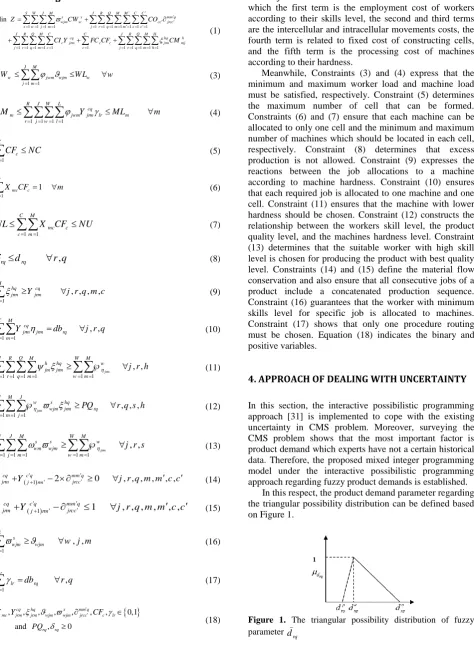
The objective function is minimized for the total costs which the first term is the employment cost of workers according to their skills level, the second and third terms are the intercellular and intracellular movements costs, the fourth term is related to fixed cost of constructing cells, and the fifth term is the processing cost of machines according to their hardness.
Meanwhile, Constraints (3) and (4) express that the minimum and maximum worker load and machine load must be satisfied, respectively. Constraint (5) determines the maximum number of cell that can be formed. Constraints (6) and (7) ensure that each machine can be allocated to only one cell and the minimum and maximum number of machines which should be located in each cell, respectively. Constraint (8) determines that excess production is not allowed. Constraint (9) expresses the reactions between the job allocations to a machine according to machine hardness. Constraint (10) ensures that each required job is allocated to one machine and one cell. Constraint (11) ensures that the machine with lower hardness should be chosen. Constraint (12) constructs the relationship between the workers skill level, the product quality level, and the machines hardness level. Constraint (13) determines that the suitable worker with high skill level is chosen for producing the product with best quality level. Constraints (14) and (15) define the material flow conservation and also ensure that all consecutive jobs of a product include a concatenated production sequence. Constraint (16) guarantees that the worker with minimum skills level for specific job is allocated to machines. Constraint (17) shows that only one procedure routing must be chosen. Equation (18) indicates the binary and positive variables.
4. APPROACH OF DEALING WITH UNCERTAINTY
In this section, the interactive possibilistic programming approach [31] is implemented to cope with the existing uncertainty in CMS problem. Moreover, surveying the CMS problem shows that the most important factor is product demand which experts have not a certain historical data. Therefore, the proposed mixed integer programming model under the interactive possibilistic programming approach regarding fuzzy product demands is established.
In this respect, the product demand parameter regarding the triangular possibility distribution can be defined based on Figure 1.
Figure 1. The triangular possibility distribution of fuzzy parameter
rq
where p rq
d , e rq
d , and o rq
d are defined as the pessimistic value, the possible value, and the optimistic value of
rq
d
which is determined by experts.
Then, the interactive possibilistic mixed integer programming model can be converted to a crisp mixed integer programming model based on the weighted average method [23, 41, 42] which can be utilized for defuzzification procedure and converting the
rq
d
parameter into crisp value. As indicated in Equation (8), the right hand side of this equation is imprecise product demand. Hence, the equivalent auxiliary crisp constraint can be constructed regarding minimum acceptable possibility (
) as follows:,
p e o
rq pdrq edrq odrq r q
(19)where p
e
o
1
, and p, e, and odefine theweight of pessimistic value, the possible value, and the optimistic value of fuzzy product demand. The appropriate values for the weights as well as
are specified subjectively based on knowledge and experience of experts. Therefore, in this study, these weights are defined based on likely values which are defined by Lai andHwang [41] as: 4
6
p ,
1 6
e o , and
0.5.5. NUMERICAL EXPERIMENT
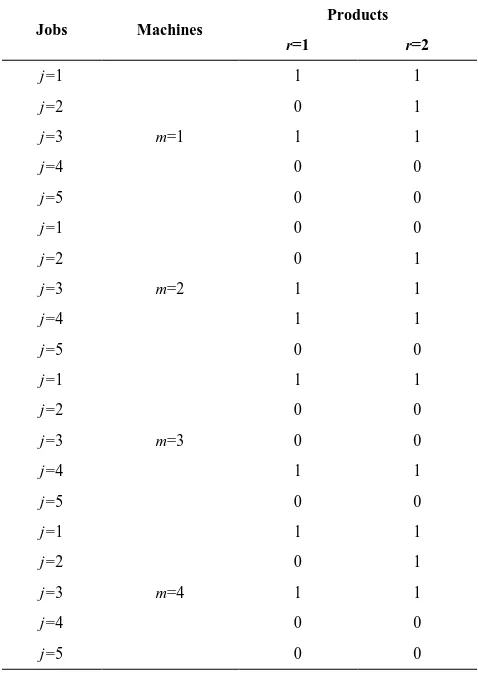
To represent the practically and validity of the proposed interactive possibilistic mixed integer nonlinear programming model, an industrial numerical experiment inspired from a manufacturing company is provided. In this numerical example, two products with three quality level as best, moderate, and worst are produced by three workers with three skills level as expert, semiskilled, and beginner based on four machines with three hardness level as easy, moderate, and hard under five jobs. In this respect, the demand of each product with certain quality is determined based on triangular fuzzy number in Table 2. In addition, the needed jobs for each product regarding each machine are defined in Table 3.
TABLE 2. The demand of each product with specified quality
level (
d
rq)Quality level
Products
r=1 r=2
Best
quality d11( [6,8], [9,10], [13,15])U U U d21( [91,95], [96,100], [101,105])U U U Moderat
e quality d12( [82,86], [88,92], [93,95])U U U d22( [52,57], [58,62], [63,68])U U U Worst
quality d13( [36,38], [39, 40], [43, 48])U U U d23( [14,16], [18, 21], [23, 27])U U U
TABLE 3. The required jobs for each product which could be processed by each machine (jrm)
Jobs Machines Products
r=1 r=2
j=1
m=1
1 1
j=2 0 1
j=3 1 1
j=4 0 0
j=5 0 0
j=1
m=2
0 0
j=2 0 1
j=3 1 1
j=4 1 1
j=5 0 0
j=1
m=3
1 1
j=2 0 0
j=3 0 0
j=4 1 1
j=5 0 0
j=1
m=4
1 1
j=2 0 1
j=3 1 1
j=4 0 0
j=5 0 0
Furthermore, the processing time of each job which is done by workers regarding each machine is shown in Table 4.
However, the proposed model is solved by ILOG CPLEX 10.1 optimization software and all results are obtained on a 3 GHz computer with 4 GB RAM. Thereby, the obtained value of objective function is 369, and the computational time of running the proposed model is 43 seconds. Meanwhile, two cells are constructed and the first and third machines are assigned to second cell. In versus, the second and fourth machines are allocated to first cell. The number of produced products is represented in Table 5.
TABLE 4. Processing time of each job by each worker on each machine per minute (jwm)
Jobs Machines Workers
w=1 w=2 w=3
j=1
m=1
21 16 8
j=2 24 15 14
j=3 16 8 9
j=4
j=5 19 13 9
j=1
m=2
j=2 19 17 8
j=3 16 10 9
j=4 9 11 13
j=5
j=1
m=3
13 9 9
j=2
j=3
j=4 16 19 8
j=5 19 6 11
j=1
m=4
17 5 11
j=2 9 8 9
j=3 9 5 11
j=4
j=5
TABLE 5. Number of produced product with specific quality
level
Quality levels Products
r=1 r=2
Best quality 7 95
Moderate quality 93 59
Worst quality 46 17
Figure 2. The produced procedure of first product with moderate quality level regarding the required jobs on each machine based on worker skills
Figure 3. The produced procedure of second product with best quality level regarding the required jobs on each machine based on worker skills
In this case, the total costs are obtained as 511 which shows that the proposed approach could improve the total costs by 27.8%. These obtained results are approved by experts to verify the proposed approach.
6. CONCLUSIONS AND FUTURE DIRECTIONS
by reducing the total costs by 27.8%. For future researches, considering more parameters based on fuzzy setting information is interested to survey the CMS problem under more aspects. In addition, developing a bi-objective model regarding minimizing the total inaction of machines and workers under the dynamic environment could improve the proposed approach.
7. REFERENCES
1. Wemmerlöv, U. and Hyer, N.L., "Procedures for the part family/machine group identification problem in cellular manufacturing", Journal of Operations Management, Vol. 6, No. 2, (1986), 125-147.
2. Azadeh, A., Pashapour, S. and Abdolhossein Zadeh, S., "Designing a cellular manufacturing system considering decision style, skill and job security by nsga-ii and response surface methodology", International Journal of Production
Research, (2016), 1-23.
3. Aghajani, M., Keramati, A., Moghadam, R.T. and Mirjavadi, S.S., "A mathematical programming model for cellular manufacturing system controlled by kanban with rework consideration", The International Journal of Advanced
Manufacturing Technology, Vol. 83, No. 5-8, (2016),
1377-1394.
4. Rheault, M., Drolet, J.R. and Abdulnour, G., "Physically reconfigurable virtual cells: A dynamic model for a highly dynamic environment", Computers & Industrial Engineering, Vol. 29, No. 1, (1995), 221-225.
5. Aghajani-Delavar, N., Mehdizadeh, E., Torabi, S. and Tavakkoli-Moghaddam, R., "Design of a new mathematical model for integrated dynamic cellular manufacturing systems and production planning", International Journal of
Engineering-Transactions B: Applications, Vol. 28, No. 5,
(2014), 746-751.
6. Lim, Z.Y., Ponnambalam, S. and Izui, K., "Multi-objective hybrid algorithms for layout optimization in multi-robot cellular manufacturing systems", Knowledge-Based Systems, (2017). 7. Deep, K. and Singh, P.K., "Design of robust cellular
manufacturing system for dynamic part population considering multiple processing routes using genetic algorithm", Journal of
Manufacturing Systems, Vol. 35, (2015), 155-163.
8. Aalaei, A. and Davoudpour, H., "A robust optimization model for cellular manufacturing system into supply chain management", International Journal of Production Economics, Vol. 183, (2017), 667-679.
9. Rosenblatt, M.J., "The dynamics of plant layout", Management Science, Vol. 32, No. 1, (1986), 76-86.
10. Mahdavi, I., Aalaei, A., Paydar, M.M. and Solimanpur, M., "Designing a mathematical model for dynamic cellular manufacturing systems considering production planning and worker assignment", Computers & Mathematics with
Applications, Vol. 60, No. 4, (2010), 1014-1025.
11. Saxena, L.K. and Jain, P.K., "Dynamic cellular manufacturing systems design—a comprehensive model", The International
Journal of Advanced Manufacturing Technology, Vol. 53,
No. 1-4, (2011), 11-34.
12. Rabbani, M., Akbari, E. and Dolatkhah, M., "Manpower allocation in a cellular manufacturing system considering the impact of learning, training and combination of learning and training in operator skills", Management Science Letters, Vol. 7, No. 1, (2017), 9-22.
13. Paydar, M.M., Saidi-Mehrabad, M. and Kia, R., "Designing a new integrated model for dynamic cellular manufacturing
systems with production planning and intra-cell layout", International Journal of Applied Decision Sciences, Vol. 6, No. 2, (2013), 117-143.
14. Kia, R., Javadian, N. and Tavakkoli-Moghaddam, R., "A simulated annealing algorithm to determine a group layout and production plan in a dynamic cellular manufacturing system",
Journal of Optimization in Industrial Engineering, Vol. 7, No.
14, (2014), 37-52.
15. Rezazadeh, H. and Khiali-Miab, A., "A two-layer genetic algorithm for the design of reliable cellular manufacturing systems", International Journal of Industrial Engineering
Computations, Vol. 8, No. 3, (2017), 315-332.
16. Sahebjamnia, N., Jolai, F., Torabi, S. and Aghabeiglo, M., "A novel fuzzy stochastic multi-objective linear programming for multi-level capacitated lot-sizing problem: A real case study of a furniture company", The International Journal of Advanced
Manufacturing Technology, Vol. 84, No. 1-4, (2016), 749-767.
17. Norman, B.A., Tharmmaphornphilas, W., Needy, K.L., Bidanda, B. and Warner, R.C., "Worker assignment in cellular manufacturing considering technical and human skills",
International Journal of Production Research, Vol. 40, No. 6,
(2002), 1479-1492.
18. Suksawat, B., Hiraoka, H. and Ihara, T., A new approach manufacturing cell scheduling based on skill-based manufacturing integrated to genetic algorithm, in Towards synthesis of micro-/nano-systems. (2007), Springer.325-326. 19. Duan, F., Tan, J.T.C., Tong, J.G., Kato, R. and Arai, T.,
"Application of the assembly skill transfer system in an actual cellular manufacturing system", Automation Science and
Engineering, IEEE Transactions on, Vol. 9, No. 1, (2012),
31-41.
20. Egilmez, G., Erenay, B. and Süer, G.A., "Stochastic skill-based manpower allocation in a cellular manufacturing system", Journal of Manufacturing Systems, Vol. 33, No. 4, (2014), 578-588.
21. Sahinidis, N.V., "Optimization under uncertainty: State-of-the-art and opportunities", Computers & Chemical Engineering, Vol. 28, No. 6, (2004), 971-983.
22. Mirzapour Al-E-Hashem, S., Malekly, H. and Aryanezhad, M., "A multi-objective robust optimization model for multi-product multi-site aggregate production planning in a supply chain under uncertainty", International Journal of Production Economics, Vol. 134, No. 1, (2011), 28-42.
23. Wang, R.-C. and Liang, T.-F., "Applying possibilistic linear programming to aggregate production planning", International
Journal of Production Economics, Vol. 98, No. 3, (2005),
328-341.
24. Asgharpour, M. and Javadian, N., "Solving a stochastic cellular manufacturing model by using genetic algorithms",
International Journal of Engineering Transactions A, Vol.
17, (2004), 145-156.
25. Sahebjamnia, N., Torabi, A., Mansouri, A. and Salehi, N., "A new multi-objective scenario-based robust stochastic programming for recovery planning problem", (2016). 26. Tavakkoli-Moghaddam, R., Sakhaii, M. and Vatani, B., "A
robust model for a dynamic cellular manufacturing system with production planning", International Journal of Engineering,
Transactions A: Basics, Vol. 27, No. 4, (2014), 587-598.
27. Safaei, N. and Tavakkoli-Moghaddam, R., "An extended fuzzy parametric programming-based approach for designing cellular manufacturing systems under uncertainty and dynamic conditions", International Journal of Computer Integrated
Manufacturing, Vol. 22, No. 6, (2009), 538-548.
route selection and cell reconfiguration", International Journal
of Management Science and Engineering Management, Vol.
6, No. 3, (2011), 219-230.
29. Behret, H. and Satoglu, S.I., Fuzzy logic applications in cellular manufacturing system design, in Computational intelligence systems in industrial engineering. (2012), Springer.505-533. 30. Paydar, M.M. and Saidi-Mehrabad, M., "Revised multi-choice
goal programming for integrated supply chain design and dynamic virtual cell formation with fuzzy parameters",
International Journal of Computer Integrated Manufacturing,
Vol. 28, No. 3, (2014), 251-265.
31. Torabi, S.A. and Hassini, E., "An interactive possibilistic programming approach for multiple objective supply chain master planning", Fuzzy Sets and Systems, Vol. 159, No. 2, (2008), 193-214.
32. Mahdavi, I., Aalaei, A., Paydar, M.M. and Solimanpur, M., "Production planning and cell formation in dynamic virtual cellular manufacturing systems with worker flexibility", in Computers & Industrial Engineering,. CIE. International, IEEE. (2009), 663-667.
33. Solimanpur, M., Saeedi, S. and Mahdavi, I., "Solving cell formation problem in cellular manufacturing using ant-colony-based optimization", The International Journal of Advanced Manufacturing Technology, Vol. 50, No. 9-12, (2010), 1135-1144.
34. Mahdavi, I., Aalaei, A., Paydar, M.M. and Solimanpur, M., "Multi-objective cell formation and production planning in dynamic virtual cellular manufacturing systems", International
Journal of Production Research, Vol. 49, No. 21, (2011),
6517-6537.
35. Torabi, S. and Amiri, A.S., "A possibilistic approach for designing hybrid cellular manufacturing systems", International
Journal of Production Research, Vol. 50, No. 15, (2012),
4090-4104.
36. Kia, R., Baboli, A., Javadian, N., Tavakkoli-Moghaddam, R., Kazemi, M. and Khorrami, J., "Solving a group layout design model of a dynamic cellular manufacturing system with alternative process routings, lot splitting and flexible reconfiguration by simulated annealing", Computers &
Operations Research, Vol. 39, No. 11, (2012), 2642-2658.
37. Chang, C.-C., Wu, T.-H. and Wu, C.-W., "An efficient approach to determine cell formation, cell layout and intracellular machine sequence in cellular manufacturing systems", Computers &
Industrial Engineering, Vol. 66, No. 2, (2013), 438-450.
38. Kia, R., Shirazi, H., Javadian, N. and Tavakkoli-Moghaddam, R., "A multi-objective model for designing a group layout of a dynamic cellular manufacturing system", Journal of Industrial
Engineering International, Vol. 9, No. 1, (2013), 1-14.
39. Shirazi, H., Kia, R., Javadian, N. and Tavakkoli-Moghaddam, R., "An archived multi-objective simulated annealing for a dynamic cellular manufacturing system", Journal of Industrial
Engineering International, Vol. 10, No. 2, (2014), 1-17.
40. Sakhaii, M., Tavakkoli-Moghaddam, R., Bagheri, M. and Vatani, B., "A robust optimization approach for an integrated dynamic cellular manufacturing system and production planning with unreliable machines", Applied Mathematical Modelling, (2015).
41. Lai, Y.-J. and Hwang, C.-L., "A new approach to some possibilistic linear programming problems", Fuzzy Sets and
Systems, Vol. 49, No. 2, (1992), 121-133.
42. Liang, T.-F., "Distribution planning decisions using interactive fuzzy multi-objective linear programming", Fuzzy Sets and
Systems, Vol. 157, No. 10, (2006), 1303-1316.
A Novel Interactive Possibilistic Mixed Integer Nonlinear Model for Cellular
Manufacturing Problem under Uncertainty
A. Hashemoghli*, I. Mahdavi, A. Tajdin
Department of Industrial and Systems Engineering, Mazandaran University of Science and Technology, Babol, Iran
P A P E R I N F O
Paper history:
Received 14 January 2017
Received in revised form 03February 2017 Accepted 09 February 2017
Keywords:
Cellular Manufacturing Problem Possibilistic Approach Interactive Fuzzy Approach Worker Skill and Flexibility
ديكچ ه
هئارا یم بسانم یلولس دیلوت متسیس کی ی رظن رد ،نیاربانب .دیامن لح ار یراتخاس و یتایلمع لئاسم زا یرایسب دناوت
یتخس حطس ،رگراک تراهم حطس :دننام مهم رتکاف دنچ نتفرگ یم لوصحم تیفیک حطس و نیشام
تکرش دناوت رد ار اه
هئارا اب هلاقم نیا .دیامن کمک یلعف یتباقر طیحم هب دیدج یلماعت یناکما طلتخم حیحص ددع یطخریغ درکیور کی ی
هنیزه شهاک یم یلولس دیلوت یحارط یاه
نیشام صیصخت ،تایلمع یلاوت یانبم رب یداهنشیپ درکیور .دزادرپ ،رگراک و
فاطعنا لوصحم تیفیک حطس و رگراک تراهم حطس ،نیشام و رگراک تیفرظ ،نیشام یتخس حطس ،رگراک و ریسم یریذپ
نیا زا .تسا هدش هئارا یعطقریغ تاعلاطا تحت فیرعت یزاف طیحم تحت نآ تیهام هب انب تلاوصحم یاضاقت رتماراپ ،ور
اب دروخرب روظنم هب یلماعت یناکما درکیور ،سپس .تسا هدش ،نایاپ رد .دیدرگ مهارف هلئسم طیحم رد دوجوم تیعطق مدع
یم هتفرگ رظن رد یداهنشیپ درکیور ییاناوت نداد ناشن روظنم هب یددع لاثم کی یداهنشیپ یلماعت یناکما لدم جیاتن .دوش
یم ناشن یم یداهنشیپ رکیور هک دهد تکرش دناوت
هنیزه شهاک روظنم هب ار اه ام بسانم یریگراکب و اه
نیش نارگراک و اه
.دناسر یرای هسیاقم ،هطبار نیا رد
یم ناشن ،هباشم طیارش اب یداهنشیپ درکور زا لصاح هدمآ تسدب جیاتن ی لدم هک دهد
یم یداهنشیپ هنیزه دناوت
ار لک یاه 27.8 شهاک % .دهد