USRP Based Digital Audio Broadcasting Using OFDM in
Virtual and Remote Laboratory
https://doi.org/10.3991/ijoe.v15i13.8761
Nagarjuna Telagam (),
GITAM University, Bangalore, India
Padma Charan Sahu
GIET University, Gunupur, India
Sunita Panda
GITAM University, Bangalore, India
Nehru Kandasamy
Institute of Aeronautical Engineering, Hyderabad, India
Abstract—Digital Audio Broadcasting (DAB) is an amazing technology, achieving its promise of certainly delivering high quality digital audio in the most vindicate mobile and fixed receiver environments. The radio signal pro-cessing capability can be provided by Universal software radio peripheral (USRP) hardware. The received signal frequency can be controlled and trans-mitting the signal through wireless is possible by installing NI USRP utility configuration. The programmable USRP was running the VI snippet program in block diagram panel with radio companion integrated through USB cable on windows 7 64. With the parameters such as IQ rate, transmitter gain, carrier frequency along with device name which is given as ni2901_1 the students can able to tune the radio signal. DAB technology is integrated with USRP device using prominent orthogonal frequency division multiplexing (OFDM) technique for promise delivery of high quality audio signal. DAB works under four trans-mission modes in this paper. In this paper RF0 module is used USRP device is connected with dual band vertical antenna with 2.4 and 5GHz frequency as Tx1. This transmitting VI snippet program will support all file formats such as.wav, mp3, etc. the intention of the paper is to transmit the real time data through long distance using DAB technology in remote laboratory. The proposed system is implemented in virtual lab so that it can be accessed by any user from any-where. This system is successfully tested on institute of aeronautical engineer-ing virtual lab for the purpose of exposengineer-ing the Radio frequency tools and signal processing operations for students.
1
Introduction
2
Implementation
Fig. 1. Proposed System of DAB using NI USRP 2901
Figure 1 shows the implementation steps of Digital audio broadcasting system us-ing USRP 2901. The session was opened usus-ing vi program which is inbuilt. Then we configure the signal with active antenna, gain in dB, carrier frequency of the antenna using NI USRP configure signal utility. We have used input as sound file and con-verted the analog data to digital signal using the icons in the lab view. The QAM uses only ones and zeros as input and then output of signal mapper block is connected to OFDM Transmitter which has nearly 10 blocks in it. OFDM is an amazing technology with many applications and supports orthogonality to avoid the interferences between the signals. QAM mapper converts bits to symbols. The two inputs are given to NI USRP write to data vi with different data types of data. Usually pink color data is coming from configure signal VI and orange color data which is of signal is connect-ed to write to data VI. Finally the verto antenna which supports tri bands is usconnect-ed to transmit the data.
2.1 Experimental set-up with Tri band antenna
Connect ni USRP device to computer using USB cable and AC/DC power supply cable. Configuration of ni USRP devices follows:
• Select Start» All Programs» National Instruments» NI-USRP»NI-USRP Configu-ration Utility to open the NI-USRP ConfiguConfigu-ration Utility.
• Your device should appear in the list on the left side of the tab, similar to the fol-lowing figure.
• If you have multiple devices, verify that you selected the correct device. The de-vice ID of the selected dede-vice displays in the Selected Dede-vice ID textbox.
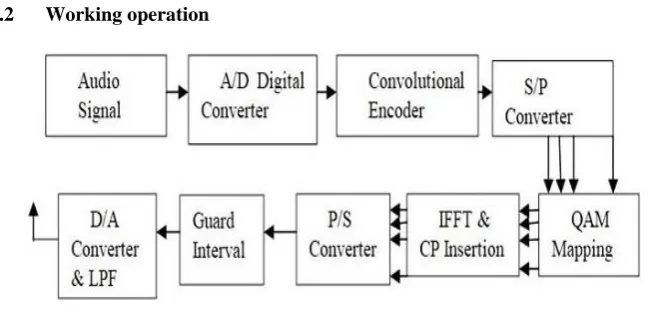
2.2 Working operation
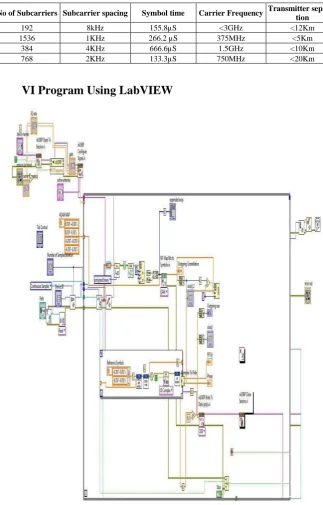
Fig. 3. VI Programs used in LabVIEW
Table 1. Parameters used in VI program i.e.DAB Transmission Modes
No of Subcarriers Subcarrier spacing Symbol time Carrier Frequency Transmitter separa-tion
192 8kHz 155.8µS <3GHz <12Km
1536 1KHz 266.2 µS 375MHz <5Km
384 4KHz 666.6µS 1.5GHz <10Km
768 2KHz 133.3µS 750MHz <20Km
The figure 4 shows the sound file is taken as input with the help of path. The icons such as sound read, sound write is used. The device ID is used and we have config-ured the signal. We have converted the analog signal to digital signal using dynamic data type icon along with analog to digital. VI, and given to array subset. We have checked the data using appended array and confirmed the output which has only ones and zeros. 4-QAM mapping is used and we have converted the serial data to parallel data with the help of arrays. This parallel data is given to IFFT.VI, which converts frequency domain representation to time domain representation. We have plotted the response in both phase plot and magnitude plot with the help of graph palate the stu-dents can able to analyze the different parallel data as shown in figure 7. We have connected the output of IFFT along with guard band interval to Ni usrp write to poly.VI which transmits the audio signal through Verito tri band antenna.
4
Results and Discussions
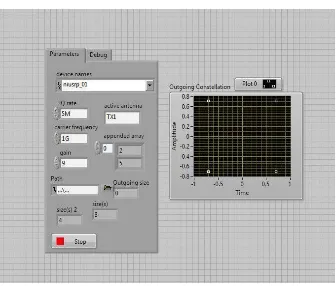
Fig. 6. Screen shot of Results in Front panel.
Figure 5 & 6 shows the screen shots of front panel. In Figure 8 the one on the top left is QAM mapping with 4 reference symbols. The I/Q mapping block takes each symbol sk and maps it to a corresponding complex baseband value Ck in the complex
plane. These values are usually chosen to be as different (or far apart) as possible so that at the receiver we can discern as clearly as possible what was transmitted. A nice way to represent the mapping of symbols to complex baseband I/Q values is with a constellation diagram. The second on the top right corner is FFT(x) signal and third one to the left below is the phase response of the signal. The last one is IFFT(x) which gives the digital audio signal in time domain.
5
Conclusion
has been increasing dramatically over the last decade. OFDM, which is the most emerging multi-carrier modulation technology of this era, can solve this problem significantly. This paper has provided an analysis of OFDM behaviors, principles and analyzed different techniques error reduction and frequency offset estimation that improve performance of OFDM for wireless communications Lastly the simulation results found with the help of working setup of OFDM system implementation using LabVIEW software and USRP hardware which conclude the successful transmission and reception of information bit using 4 QAM techniques with equalized data and amplitude after OFDM receiver.
6
References
[1]Heradio, Ruben, Luis de la Torre, Daniel Galan, Francisco Javier Cabrerizo, Enrique Her-rera-Viedma, and Sebastian Dormido. (2016). Virtual and remote labs in education: A bib-liometric analysis. Computers & Education, 98: 14-38. https://doi.org/10.10 16/j.compedu.2016.03.010
[2]Di, Na, PengGao, Ge Wan, Jilong Li, and Jinwen Li. (2010). A common SDR platform for digital audio broadcasting system. In Image and Signal Processing (CISP), 3rd Internation-al Congress on, 8: 3708-3711. https://doi.org/10.1109/cisp.2010.5647099
[3]Mitola, Joseph, and Gerald Q. Maguire. (1999). Cognitive radio: making software radios more personal. IEEE personal communications 6, 4: 13-18.
https://doi.org/10.1109/98.788210
[4]Nychis, George, ThibaudHottelier, Zhuocheng Yang, SrinivasanSeshan, and Peter Steen-kiste.(2009). Enabling MAC Protocol Implementations on Software-Defined Radios. In NSDI, 9:91-105.
[5]Abidi, Asad A. (2007). The path to the software-defined radio receiver. IEEE Journal of Solid-State Circuits, 42, 5: 954-966. https://doi.org/10.1109/jssc.2007.894307
[6]Ting, Pangan, Hui-Ming Wang, and Nan-Sheng Huang.(2006). Software defined radio (SDR) architecture for wireless digital communication systems. U.S. Patent 7,151,925, is-sued.
[7]Kandasamy, N., Telagam, N., VR, S. R., & Arulananth, T. S. (2017). Simulation of Analog Modulation and Demodulation Techniques in Virtual Instrumentation and Remote Lab. International Journal of Online Engineering (iJOE), 13(10): 140-147.
https://doi.org/10.3991/ijoe.v13i10.7575
[8]Nagarjuna, T., S. Lakshmi, and K. Nehru.(2019), USRP 2901-based SISO-GFDM trans-ceiver design experiment in virtual and remote laboratory. The International Journal of Electrical Engineering & Education (2019): 0020720919857620.
https://doi.org/10.1177/0020720919857620
[9]Somanaidu, U., Nagarjuna Telagam, K. Nehru, and N. Menakadevi.(2018) USRP 2901 Based FM Transceiver with Large File Capabilities in Virtual and Remote Laboratory. In-ternational Journal of Online Engineering (iJOE), 14, (10): 193-200. https://doi.org/10.3 991/ijoe.v14i10.8283
[10]https://www.nmc.org/horizon_topic/virtual-and-remote-laboratories/
7
Acknowledgement
The corresponding author would like to thank institute of aeronautical engineering, Hyderabad for establishing virtual instrumentation lab in the college. He would like to thank his personage, dignitary nd for the best wishes.
8
Authors
Nagarjuna Telagam is currently working in ECE Department, GITAM Universi-ty, Bangalore, India. His topics of interest are OFDM, GFDM and wireless sensor networks. He published 25 papers in Scopus indexed Journals and 4 SCIE journals. He got CLAD certification from National Instruments.Currently he is Ph.D. Research Scholar in Sathyabama University Chennai. He was awarded Anna University rank holder (20) for M.E degree in 2014. He has nearly 6 years of experience in teaching and research.
Padma Charan Sahu is currently working as assistant professor in kalam institute of technology since 2010. He is currently pursuing Ph.D. in GIET University, Gunupur. He can be reached at [email protected]
Sunita Panda is with Electronics and Telecommunication Engineering depart-ment, GITAM University, Bangalore campus. Currently she is Assistant Professor, Her areas of interest are soft computing, channel equalization, Digital Signal pro-cessing. She can be reached at [email protected]
Nehru Kandasamy is with Electronics and Communication Engineering, Institute of Aeronatuical Engineering, Hyderabad, India. He can be reached at [email protected]