Using Factored Word Representation
in Neural Network Language Models
Jan Niehues, Thanh-Le Ha, Eunah Cho and Alex Waibel Institute for Anthropomatics
Karlsruhe Institute of Technology, Germany [email protected]
Abstract
Neural network language and translation models have recently shown their great po-tentials in improving the performance of phrase-based machine translation. At the same time, word representations using dif-ferent word factors have been translation quality and are part of many state-of-the-art machine translation systems. used in many state-of-the-art machine translation systems, in order to support better transla-tion quality.
In this work, we combined these two ideas by investigating the combination of both techniques. By representing words in neu-ral network language models using differ-ent factors, we were able to improve the models themselves as well as their impact on the overall machine translation perfor-mance. This is especially helpful for mor-phologically rich languages due to their large vocabulary size. Furthermore, it is easy to add additional knowledge, such as source side information, to the model. Using this model we improved the trans-lation quality of a state-of-the-art phrase-based machine translation system by 0.7 BLEU points. We performed experiments on three language pairs for the news trans-lation task of the WMT 2016 evaluation.
1 Introduction
Recently, neural network models are deployed ex-tensively for better translation quality of statisti-cal machine translation (Le et al., 2011; Devlin et al., 2014). For the language model as well as for the translation model, neural network-based mod-els showed improvements when used during de-coding as well as when used in re-scoring.
In phrase-based machine translation (PBMT), word representation using different factors (Koehn and Hoang, 2007) are commonly used in state-of-the-art systems. Using Part-of-Speech (POS) information or automatic word clusters is es-pecially important for morphologically rich lan-guages which often have a large vocabulary size. Language models based on these factors are able to consider longer context and therefore improve the modelling of the overall structure. Further-more, the POS information can be used to improve the modelling of word agreement, which is often a difficult task when handling morphologically rich languages.
Until now, word factors have been used rela-tively limited in neural network models. Auto-matic word classes have been used to structure the output layer (Le et al., 2011) and as input in feed forward neural network language models (Niehues and Waibel, 2012).
In this work, we propose a multi-factor recur-rent neural network (RNN)-based language model that is able to facilitate all available information about the word in the input as well as in the out-put. We evaluated the technique using the surface form, POS-tag and automatic word clusters using different cluster sizes.
Using this model, it is also possible to integrate source side information into the model. By using the model as a bilingual model, the probability of the translation can be modelled and not only the one of target sentence. As for the target side, we use a factored representation for the words on the source side.
The remaining of the paper is structured as fol-lowing: In the following section, we first review the related work. Afterwards, we will shortly de-scribe the RNN-based language model used in our experiments. In Section 4, we will introduce the factored RNN-based language model. In the next
section, we will describe the experiments on the WMT 2016 data. Finally, we will end the paper with a conclusion of the work.
2 Related Work
Additional information about words, encoded as word factors, e.g. the lemma of word, POS tags, etc., is employed in state-of-the-art phrase-based systems. (Koehn and Hoang, 2007) decom-poses the translation of factored representations to smaller mapping steps, which are modelled by translation probabilities from input factor to out-put factor or by generating probabilities of addi-tional output factors from existing output factors. Then those pre-computed probabilities are jointly combined in the decoding process as a standard translation feature scores. In addition, language models using these word factors have shown to be very helpful to improve the translation qual-ity. In particular, the aligned-words, POS or word classes are used in the framework of modern lan-guage models (Mediani et al., 2011; Wuebker et al., 2013).
Recently, neural network language models have been considered to perform better than standard
n-gram language models (Schwenk, 2007; Le et
al., 2011). Especially the neural language models constructed in recurrent architectures have shown a great performance by allowing them to take a longer context into account (Mikolov et al., 2010; Sundermeyer et al., 2013).
In a different direction, there has been a great deal of research on bringing not only target words but also source words into the prediction process, instead of predicting the next target word based on the previous target words (Le et al., 2012; Devlin et al., 2014; Ha et al., 2014).
However, to the best of our knowledge, word factors have been exploited in a relatively limited scope of neural network research. (Le et al., 2011; Le et al., 2012) use word classes to reduce the output layer’s complexity of such networks, both in language and translation models. In the work of (Niehues and Waibel, 2012), their Restricted Boltzmann Machines language models also en-code word classes as an additional input feature in predicting the next target word. (Tran et al., 2014) use two separate feed forward networks to predict the target word and its corresponding suffixes with the source words and target stem as input features. Our work exhibits several essential differences
from theirs. Firstly, we leverage not only the target morphological information but also word factors from both source and target sides in our models. Furthermore, we could use as many types of word factors as we can provide. Thus, we are able to make the most of the information encoded in those factors for more accurate prediction.
3 Recurrent Neural Network-based Language Models
In contrast to feed forward neural network-based language models, recurrent neural network-based language models are able to store arbitrary long word sequences. Thereby, they are able to directly modelP(w|h)and no approximations by limiting
the history size are necessary. Recently, several authors showed that RNN-based language models could perform very well in phrase-based machine translation. (Mikolov et al., 2010; Sundermeyer et al., 2013)
In this work, we used the torch71 implementa-tion of an RNN-based language model (L´eonard et al., 2015). First, the words were mapped to their word embeddings. We used an input embed-ding size of100. Afterwards, we used two
LSTM-based layers. The first has the size of the word embeddings and for the second we used a hidden size of200. Finally, the word probabilities were
calculated using a softmax layer.
The models were trained using stochastic gra-dient descent. The weights were updated using mini-batches with a batch size of 128. We used
a maximum epoch size of1million examples and
selected the model with the lowest perplexity on the development data.
4 Factored Language Model
When using factored representation of words, words are no longer represented as indices in the neural network. Instead, they are represented a tu-ples of indicesw = (f1, . . . , fD), whereDis the
number of different factors used to describe the word. These factors can be the word itself, as well as the POS, automatic learned classes (Och, 1999) or other information about the word. Furthermore, we can use different types of factors for the input and the output of the neural network.
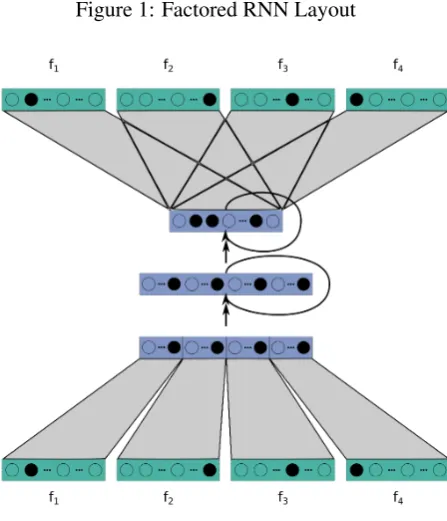
Figure 1: Factored RNN Layout
4.1 Input Representation
In a first step, we obtained a factored representa-tion for the input of the neural network. In the experiments, we represented a word by its surface form, POS-tags and automatic word class, but the framework can be used for any number of word factors. Although there are factored approaches for n-gram based language models (Bilmes and Kirchhoff, 2003), most n-gram language models
only use one factor. In contrast, in neural network based language models, it is very easy to add ad-ditional information as word factors. We can learn different embeddings for each factor and represent the word by concatenating the embeddings of sev-eral factors. As shown in the bottom of Figure 1, we first project the different factors to the contin-uous factor embeddings. Afterwards, we concate-nate these embeddings into a word embedding.
The advantage of using several word factors is that we can use different knowledge sources to represent a word. When a word occurs very rarely, the learned embedding from its surface form might not be helpful. The additional POS information, however, is very helpful. While using POS-based language models in PBMT may lead to losing the information about high frequent words, in this ap-proach we can have access to all information by concatenating the factor embeddings.
4.2 Output Representation
In addition to use different factors in the input of the neural network, we can also use different fac-tors on the output. In phrase-based machine trans-lation, n-gram language models based on
POS-tags have been shown to be very successful for morphologically rich languages.
Porting this idea to neural network lan-guage models, we can not only train a model to predict the original word f1 given the previous words in factor representation
h = (f1,1, . . . , f1,D), . . . ,(fi,1, . . . , fi,D), but
also train a model to predict he POS-tags (e.g.f2) given the historyh.
In a first step, we proposed to train individual models for all factors1, . . . , D generating
proba-bilitiesP1, . . . , PDfor every sentence. Then these
probabilities can be used as features for example in re-scoring of the phrase-based MT system.
Considering that it can be helpful to consider all factors of the word in the input, it can be also helpful to jointly train the models for predicting the different output factors. This is motivated by the fact that multi-task learning has shown to be beneficial in several NLP tasks (Collobert et al., 2011). Predicting all output features jointly re-quires a modification of the output layer of the RNN model. As shown in Figure 1, we replace the single mapping from the LSTM-layer to the soft-max layer, by D mappings. Each mapping then
learns to project the LSTM-layer output to the fac-tored output probabilities. In the last layer, we use
Ddifferent softmax units. In a similar way as the
conventional network, the error between the out-put of the network and the reference is calculated during training.
Using this network, we will no longer pre-dict the probability of one word factor Pd, d ∈
{1, . . . D}, but D different probability
distribu-tionsP1, . . . , PD. In order to integrate this model
into the machine translation system we explored two different probabilities. First, we used only the joint probabilityP =QDd=1Pdas a feature in the
log-linear combination. In addition, we also used the joint probability as well as all individual prob-abilitiesPdas features.
4.3 Bilingual Model
Figure 2: Bilingual Model
the model as a bilingual model (BM). Instead of using only monolingual information by consider-ing the previous target factors as input, we used source factors additionally. Thereby, we can now model the probability of a word given the previ-ous target words and information about the source sentence. So in this case we model the transla-tion probability and no longer the language model probability.
When predicting the target word wi+1 with its factors fi+1,1, . . . , fi+1,D, the input to the RNN
is the previous target word wi = fi,1, . . . , fi,D.
Using the alignment, we can find the source word
sa(i+1), which is aligned to the target wordwi+1. When we add the features of source word
sa(i+1) = (fas(i+1),1, . . . , fas(i+1),Ds)
to the ones of the target wordwi and create a new
bilingual token
bi = (fi+1,1, . . . , fi+1,D, fas(i+1),1, . . . , fas(i+1),Ds)
, we now can predict the target word given the pre-vious target word and the aligned source word.
In the example in Figure 2, we would insert (completed,VVD,87,ein,ART) to predict (a,DT,37).
In this case the number of input factors and out-put factors are no longer the same. In the inout-put, we haveD+Dsinput factors, while we have only Dfactors on the output of the network.
5 Experiments
We evaluated the factored RNNLM on three dif-ferent language pairs of the WMT 2016 News Translation Task. In each language pair, we cre-ated ann-best list using our phrase-based MT
sys-tem and used the factored RNNLM as an addi-tional feature in rescoring. It is worth noting that
the POS and word class information are already present during decoding of the baseline system by
n-gram-based language models based on each of
these factors. First, we performed a detailed analy-sis on the English-Romanian task. In addition, we used the model in a German-English and English-German translation system. In all tasks, we used the model in re-scoring of a PBMT system.
5.1 System Description
The baseline system is an in-house implementa-tion of the phrase-based approach. The system used to generaten-best lists for the news tasks is
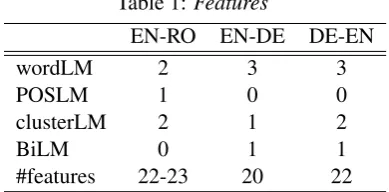
[image:4.595.320.515.494.590.2]trained on all the available training corpora of the WMT 2015 Shared Translation task. The system uses a pre-reordering technique (Rottmann and Vogel, 2007; Niehues and Kolss, 2009; Herrmann et al., 2013) and facilitates several translation and language models. As shown in Table 1, we use two to three word-based language models and one to two cluster-based models using 50, 100 or 1,000 clusters. The custers were trained as described in (Och, 1999). In addition, we used a POS-based language model in the English-Romainian system and a bilingual language model (Niehues et al., 2011) in English to German and German to English systems. The POS tags for English-Romanian were generated by the tagger described in (Ion et al., 2012) and the ones for German by RFTagger (Schmid and Laws, 2008).
Table 1:Features
EN-RO EN-DE DE-EN
wordLM 2 3 3
POSLM 1 0 0
clusterLM 2 1 2
BiLM 0 1 1
#features 22-23 20 22
In addition, we used discriminative word lex-ica (Niehues and Waibel, 2013) during decoding and source discriminative word lexica in rescoring (Herrman et al., 2015).
A full system description can be found in (Ha et al., 2016).
The German to English baseline system uses 20 features and the English to German systems uses 22 features.
sentences from the SETimes corpus. This part of the corpus was of course excluded for training the model. The system was tested on the second half of news-dev2016.
The English-German and German-English sys-tems were optimized on news-test2014 and also the re-scoring was optimized on this data. We tested the system on news-test2015.
For English to Romanian and English to Ger-man we used an n-best List of 300 entries and
for German to English we used ann-best list with
3,000 entries.
For decoding, for all language directions, the weights of the system were optimized using mini-mum error rate training (Och, 2003). The weights in the rescoring were optimized using the List-Net algorithm (Cao et al., 2007) as described in (Niehues et al., 2015).
The RNN-based language models for English to Romanian and German to English were trained on the target side of the parallel training data. For En-glish to German, we trained the model and the Eu-roparl corpus and the News commentary corpus.
5.2 English - Romanian
In the first experiment on the English to Roma-nian task, we only used the scores of the RNN lan-guage models. The baseline system has a BLEU score (Papineni et al., 2002) of 29.67. Using only the language model instead of the 22 features, of course, leads to a lower performance, but we can see clear difference between the different language models. All systems use a word vocabulary of 5K words and we used four different factors. We used the word surface form, the POS tags and word clusters using 100 and 1,000 classes.
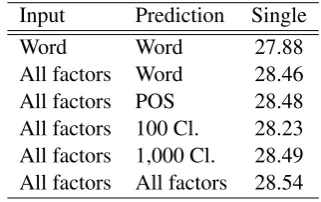
The baseline model using words as input and words as output reaches a BLEU score of 27.88. If we instead represent the input words by factors, we select entries from the n-best list that
gener-ates a BLEU score of 28.46. As done with the
n-gram language models, we can also predict the
[image:5.595.336.497.88.189.2]other factors instead of the words themselves. In all cases, we use all four factors as input factors. As shown in Table 2, all models except for the one with 100 classes perform similarly, reaching up between 28.46 and 28.49. The language model predicting only 100 classes only reaches a BLEU score of 28.23. It suggests that this number of classes is too low to disambiguate the entries in then-best list.
Table 2:English - Romanian Single Score
Input Prediction Single
Word Word 27.88
All factors Word 28.46
All factors POS 28.48
All factors 100 Cl. 28.23 All factors 1,000 Cl. 28.49 All factors All factors 28.54
If we predict all factors together and use then the joint probability, we can reach the best BLEU score of 28.54 as shown in the last line of the ta-ble. This is 0.7 BLEU points better than the initial word based model.
After evaluating the model as the only knowl-edge source, we also performed experiments using the model in combination with the other models. We evaluated the baseline and the best model in three different configuration in Table 3 using only the joint probability. The three baseline configu-ration differ in the models used during decoding. Thereby, we are able to generate different n-best
lists and test the models on different conditions.
Table 3:English - Romanian Language Models
Model Conf1 Conf2 Conf3
Baseline 29.86 30.00 29.75
LM 5K 29.79 29.84 29.73
LM 50K 29.64 29.84 29.83
Factored LM 5K 29.94 30.01 30.01
Factored LM 50K 30.05 30.27 30.29
In Table 3, we tested the word-based and the factored language model using a vocabulary of 5K and 50K words. Features from each model are used in addition to the features of the baseline sys-tem. As shown in the table, the word-based RNN language models perform similarly, but both could not improve over the baseline system. One possi-ble reason for this is that we already use several language models in the baseline model and they are partly trained on much larger data. While the RNN models are trained using only the target lan-guage model, one word-based lanlan-guage model is trained on the Romanian common crawl corpus. Furthermore, the POS-based and word cluster lan-guage models use a 9-gram history and therefore, can already model quite long dependencies.
[image:5.595.313.522.433.520.2]able to improve over the baseline system. Using the additional information of the other word fac-tors, we are able to improve the bilingual model in all situations. The model using a surface word vo-cabulary of 5,000 words can improve by 0.1 to 0.3 BLEU points. The model using a 50K vocabulary can even improve by up to 0.6 BLEU points.
Table 4:English - Romanian Bilingual Models
Model Dev Test
Baseline 40.12 29.75
+ Factored LM 50K 40.87 30.17 + Factored BM 5K 41.11 30.44 + Factored BM 50K 41.16 30.57
After analyzing the different language models, we also evaluate how we can use the factored representation to include source side information. The results are summarized in Table 4. In these experiments, we used not only the the joint proba-bility, but also the four individual probabilities as features. Therefore, we will add five scores for every model, since each model is added to its pre-vious configuration in this experiment.
Exploiting all five probabilities of the lan-guage model brought us the similar improvement we achieved using the joint probability from the model. On the test set, the improvements are slightly worse. When adding the model using source side information based on a vocabulary of 5K and 50K words, however, we get additional im-provements. Adopting the both bilingual models (BM) along with a factored LM, we improved the BLEU score further leading up to the best score of 30.57 for the test set.
5.3 English - German
In addition to the experiments on English to Ro-manian, we also evaluated the models on the task of translating English News to German. For the English to German system, we use three factors on the source side and four factors on the tar-get side. In English, we used the surface forms as well as automatic word cluster based on 100 and 1,000 classes. On the target side, we used fine-graind POS-tags generated by the RFTagger (Schmid and Laws, 2008), in addition to the fac-tors for the source side.
[image:6.595.90.271.194.267.2]The experiments using only the scores of the model are summarized in Table 5. In this exper-iment, we analyzed a word based- and a factored
Table 5:English - German Single Score
Model Single
LM 5K 20.92
Factored LM 5K 21.69
BM 5K 21.33
Factored BM 5K 21.92
language models as well as bilingual models. As described in section 4.3, the difference between the language model and the bilingual model is that the latter uses the source side information as addi-tional factor.
Using only the word-based language model we achieved a BLEU score of 20.92. Deploying a fac-tored language model instead, we can improve the BLEU score by 0.7 BLEU points to 21.69. While we achieved a score of 21.33 BLEU points by us-ing a proposed bilus-ingual model, we improved the score up to 21.92 BLEU points by adopting all fac-tors for the bilingual model.
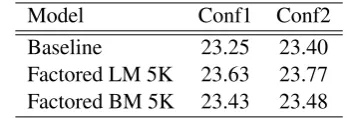
Table 6:English-German Language Model
Model Conf1 Conf2
Baseline 23.25 23.40
Factored LM 5K 23.63 23.77 Factored BM 5K 23.43 23.48
In addition to the analysis on the single model, we also evaluated the model’s influence by com-bining the model with the baseline features. We tested the language model as well as the bilingual model on two different configurations. Adopting the factored language model on top of the base-line features improved the translation quality by around 0.4 BLEU points for both configurations, as shown in Table 6. Although the bilingual model could also improve the translation quality, it could not outperform the factored language model. The combination of the two models, LM and BM, did not lead to further improvements. In summary, the factored language model improved the BLEU score by 0.4 points.
5.4 German - English
[image:6.595.328.502.395.454.2]based on 100 and 1,000 word classes respectively. First, we will evaluate the performance of the sys-tem using only this model in rescoring. The results are summarized in Table 7.
Table 7:German - English Single Score
Model Single
LM 5K 26.11
Factored LM 5K 26.96
BM 5K 26.77
Factored BM 5K 26.81
The word based language model achieves a BLEU score 26.11. Extending the model to in-clude factors improves the BLEU score by 0.8 BLEU points to 26.96. If we use a bilingual model, a word based model achieves a BLEU score of 26.77 and the factored one a BLEU score of 26.81. Although the factored model performed better than the word-based models, in this case the bilingual model cannot outperform the language model.
Table 8:German - English Language Model
Model Single
Baseline 29.33
+ Factored BM 5K 29.51 + Factored LM 5K 29.66
In a last series of experiments, we used the scores combined with the baseline scores. The re-sults are shown in Table 8. In this language pair, we can improve over the baseline system by using both models. The final BLEU score is 0.3 BLEU points better than the initial system.
6 Conclusion
In this paper, we presented a new approach to integrate additional word information into a neu-ral network language model. This model is es-pecially promising for morphologically rich lan-guages. Due to their large vocabulary size, addi-tional information such as POS-tags are expected to model rare words effectively.
Representing words using factors has been suc-cessfully deployed in many phrase-based machine translation systems. Inspired by this, we repre-sented each word in our neural network language model using factors, facilitating all available in-formation of the word. We showed that using the
factored neural network language models can im-prove the quality of a phrase-based machine trans-lation system, which already uses several factored language models.
In addition, the presented framework allows an easy integration of source side information. By incorporating the alignment information to the source side, we were able to model the translation process. In this model, the source words as well as the target words can be represented by word fac-tors.
Using these techniques, we are able to im-prove the translation system on three different lan-guage pairs of the WMT 2016 evaluation. We performed experiments on the English-Romanian, English-German and German-English translation task. The suggested technique yielded up to 0.7 BLEU points of improvement on all three tasks.
Acknowledgments
The project leading to this application has received funding from the European Union’s Horizon 2020 research and innovation programme under grant agreement n◦ 645452. The research by Thanh-Le Ha was supported by Ministry of Science, Re-search and the Arts Baden-W¨urttemberg.
References
Jeff A. Bilmes and Katrin Kirchhoff. 2003. Factored language models and generalized parallel backoff. InProceedings of the 2003 Conference of the North American Chapter of the Association for Compu-tational Linguistics on Human Language Technol-ogy: Companion Volume of the Proceedings of HLT-NAACL 2003–short Papers - Volume 2, NAACL-Short ’03, pages 4–6, Stroudsburg, PA, USA. As-sociation for Computational Linguistics.
Z. Cao, T. Qin, T.-Y. Liu, M.-F. Tsai, and H. Li. 2007. Learning to rank: from pairwise approach to listwise approach. InProceedings of the 24th international conference on Machine learning, Icml ˆa07, pages 129–136, New York, NY, USA. Acm.
Ronan Collobert, Jason Weston, L´eon Bottou, Michael Karlen, Koray Kavukcuoglu, and Pavel P. Kuksa. 2011. Natural language processing (almost) from scratch. CoRR, abs/1103.0398.
Thanh-Le Ha, Jan Niehues, and Alex Waibel. 2014. Lexical Translation Model Using a Deep Neural Network Architecture. In Proceedings of the 11th International Workshop on Spoken Language Trans-lation (IWSLT14), Lake Tahoe, CA, USA.
Thanh-Le Ha, Eunah Cho, Jan Niehues, Mohammed Mediani, Matthias Sperber, Alexandre Allauzen, and yAlex Waibel. 2016. The karlsruhe institute of technology systems for the news translation task in wmt 2016. InProceedings of the ACL 2016 First Conference on Machine Translation (WMT2016).
Teresa Herrman, Jan Niehues, and Alex Waibel. 2015. Source Discriminative Word Lexicon for Transla-tion DisambiguaTransla-tion. InProceedings of the 12th In-ternational Workshop on Spoken Language Transla-tion (IWSLT15), Danang, Vietnam.
Teresa Herrmann, Jan Niehues, and Alex Waibel. 2013. Combining Word Reordering Methods on different Linguistic Abstraction Levels for Statisti-cal Machine Translation. InProceedings of the Sev-enth Workshop on Syntax, Semantics and Structure in Statistical Translation, Altanta, Georgia, USA.
Radu Ion, Elena Irimia, Dan Stefanescu, and Dan Tufis. 2012. Rombac: The romanian balanced annotated corpus. In Nicoletta Calzolari (Conference Chair), Khalid Choukri, Thierry Declerck, Mehmet U?ur Do?an, Bente Maegaard, Joseph Mariani, Asun-cion Moreno, Jan Odijk, and Stelios Piperidis, ed-itors, Proceedings of the Eight International Con-ference on Language Resources and Evaluation (LREC’12), Istanbul, Turkey, may. European Lan-guage Resources Association (ELRA).
Philipp Koehn and Hieu Hoang. 2007. Factored trans-lation models. InIn Proceedings of the 2007 Joint Conference on Empirical Methods in Natural guage Processing and Computational Natural Lan-guage Learning (EMNLP-CoNLL, pages 868–876.
Hai-Son Le, Ilya Oparin, Alexandre Allauzen, Jean-Luc Gauvain, and Franc¸ois Yvon. 2011. Structured output layer neural network language model. In Pro-ceedings of the International Conference on Audio, Speech and Signal Processing, pages 5524–5527.
Hai-Son Le, Alexandre Allauzen, and Franc¸ois Yvon. 2012. Continuous Space Translation Models with Neural Networks. InProceedings of the 2012 con-ference of the north american chapter of the asso-ciation for computational linguistics: Human lan-guage technologies (NAACL), pages 39–48. Associ-ation for ComputAssoci-ational Linguistics.
Nicholas L´eonard, Sagar Waghmare, Yang Wang, and Jin-Hwa Kim. 2015. rnn : Recurrent library for torch. CoRR, abs/1511.07889.
Mohammed Mediani, Eunah Cho, Jan Niehues, Teresa Herrmann, and Alex Waibel. 2011. The KIT english-french translation systems for IWSLT 2011.
In 2011 International Workshop on Spoken Lan-guage Translation, IWSLT 2011, San Francisco, CA, USA, December 8-9, 2011, pages 73–78.
Tomas Mikolov, Martin Karafi´at, Lukas Burget, Jan Cernock`y, and Sanjeev Khudanpur. 2010. Recur-rent neural network based language model. In IN-TERSPEECH, volume 2, page 3.
Jan Niehues and Muntsin Kolss. 2009. A POS-Based Model for Long-Range Reorderings in SMT. In Proceedings of the Fourth Workshop on Statistical Machine Translation (WMT 2009), Athens, Greece.
J. Niehues and A. Waibel. 2012. Continuous space language models using restricted boltzmann ma-chines. In Proceedings of the Ninth International Workshop on Spoken Language Translation (IWSLT 2012), Hong Kong.
Jan Niehues and Alex Waibel. 2013. An MT Error-Driven Discriminative Word Lexicon using Sen-tence Structure Features. In Proceedings of the Eighth Workshop on Statistical Machine Transla-tion, Sofia, Bulgaria.
Jan Niehues, Teresa Herrmann, Stephan Vogel, and Alex Waibel. 2011. Wider Context by Using Bilin-gual Language Models in Machine Translation. In Sixth Workshop on Statistical Machine Translation (WMT 2011), Edinburgh, Scotland, United King-dom.
Jan Niehues, Quoc Khanh Do, Alexandre Allauzen, and Alex Waibel. 2015. Listnet-based MT Rescor-ing.EMNLP 2015, page 248.
Franz Josef Och. 1999. An Efficient Method for Deter-mining Bilingual Word Classes. InProceedings of the Ninth Conference of the European Chapter of the Association for Computational Linguistics (EACL 1999), Bergen, Norway.
F.J. Och. 2003. Minimum error rate training in sta-tistical machine translation. In Proceedings of the 41th Annual Meeting of the Association for Compu-tational Linguistics (ACL 2003), Sapporo, Japa. K. Papineni, S. Roukos, T. Ward, and W.-jing Zhu.
2002. Bleu: a method for automatic evaluation of machine translation. InProceedings of the 40th An-nual Meeting of the Association for Computational Linguistics (ACL 2002), pages 311–318, Philadel-phia, Pennsylvania.
Kay Rottmann and Stephan Vogel. 2007. Word Re-ordering in Statistical Machine Translation with a POS-Based Distortion Model. InProceedings of the 11th International Conference on Theoretical and Methodological Issues in Machine Translation (TMI 2007), Sk¨ovde, Sweden.
on Computational Linguistics, Manchester, United Kingdom.
Holger Schwenk. 2007. Continuous space language models. Computer Speech & Language, 21(3):492– 518.
Martin Sundermeyer, Ilya Oparin, Jean-Luc Gauvain, Ben Freiberg, Ralf Schluter, and Hermann Ney. 2013. Comparison of feedforward and recur-rent neural network language models. In Acous-tics, Speech and Signal Processing (ICASSP), 2013 IEEE International Conference on, pages 8430– 8434. IEEE.
Ke Tran, Arianna Bisazza, Christof Monz, et al. 2014. Word translation prediction for morphologically rich languages with bilingual neural networks. Associa-tion for ComputaAssocia-tional Linguistics.