Exploiting Linguistic Resources for Neural Machine Translation
Using Multi-task Learning
Jan Niehues and Eunah Cho Institute for Anthropomatics and Robotics KIT - Karlsruhe Institute of Technology, Germany
Abstract
Linguistic resources such as part-of-speech (POS) tags have been extensively used in statistical machine translation (SMT) frameworks and have yielded bet-ter performances. However, usage of such linguistic annotations in neural machine translation (NMT) systems has been left under-explored.
In this work, we show that multi-task learning is a successful and a easy ap-proach to introduce an additional knowl-edge into an end-to-end neural attentional model. By jointly training several natu-ral language processing (NLP) tasks in one system, we are able to leverage common information and improve the performance of the individual task.
We analyze the impact of three design de-cisions in multi-task learning: the tasks used in training, the training schedule, and the degree of parameter sharing across the tasks, which is defined by the network ar-chitecture. The experiments are conducted for an German to English translation task. As additional linguistic resources, we ex-ploit POS information and named-entities (NE). Experiments show that the transla-tion quality can be improved by up to 1.5 BLEU points under the low-resource con-dition. The performance of the POS tag-ger is also improved using the multi-task learning scheme.
1 Introduction
Recently, there has been a dramatic change in the state-of-the-art techniques for machine translation (MT). In a traditional method, often the best
per-formance is achieved by using a complicated com-bination of several statistical models, which are in-dividually trained. For example, POS information was shown to be very helpful to model word re-ordering between languages, as shown inNiehues and Kolss(2009). While the recent development of end-to-end trained neural models (Bahdanau et al.,2014) showed significant gains over tradi-tional approaches, they are often trained only on the parallel data in an end-to-end fashion. In most cases, therefore, they do not facilitate other knowl-edge sources.
When parallel data is sparse, exploiting other knowledge sources can be crucial for perfor-mance. Two techniques to integrate the additional resources are well studied. In one technique, we train a tool on the additional resources (e.g. POS tagger) and then annotate the parallel data using this tool. This technique has been applied exten-sively in SMT systems (e.g. Niehues and Kolss
(2009)) as well as in some NMT systems (e.g.
Sennrich and Haddow(2016)). The second tech-nique would be to use the annotated data directly to train the model.
The goal of this work is to integrate the ad-ditional linguistic resources directly into neural models, in order to achieve better performance. To do so, we build a multi-task model and train sev-eral NLP tasks jointly.
We use an attention-based sequence-to-sequence model for all tasks. Experiments show that we are able to improve the performance on the German to English machine translation task measured in BLEU, BEER and CharacTER. Fur-thermore, we analyze three important decisions when designing multi-task models. First, we in-vestigated the influence of secondary tasks. Also, we analyze the influence of training schedule, e.g. whether we need to adjust it in order to get the best performance on the target task. And finally,
we evaluated the amount of parameter sharing enforced by different model architectures.
The main contributions of this paper are (1) that we show multi-task learning is possi-ble within attention-based sequence-to-sequence models, which are state-of-the-art in machine translation and (2) that we analyze the influence of three main design decisions.
2 Related Work
Motivated by the success of using features learned from linguistic resources in various NLP tasks, there have been several approaches including ex-ternal information into neural network-based sys-tems.
The POS-based information has been integrated for language models inWu et al.(2012);Niehues et al. (2016). In the neural machine translation, using additional word factors like POS-tags has shown to be beneficial (Sennrich and Haddow,
2016).
The initial approach for multi-task learning for neural networks was presented inCollobert et al.
(2011). The authors used convolutional and feed forward networks for several tasks such as seman-tic parsing and POS tagging. This idea was ex-tended to sequence to sequence models inLuong et al.(2015).
A special case of multi-task learning for atten-tion based models has been explored. In multi-lingual machine translation, for example, the tasks are still machine translation tasks but they need to consider different language pairs. In this case, a system with an individual encoder and decoder (Firat et al., 2016b) as well as a system with a shared encoder-decoder (Ha et al.,2016;Johnson et al.,2016) has been proposed.
2.1 Attention Models
Recently, state-of-the art performance in machine translation was significantly improved by using neural machine translation. In this approach, a recurrent neural network (RNN)-based encoder-decoder architecture is used to transform the source sentence into the target sentence.
In the encoder, an RNN is used to encode the source sentence into a fixed size of continu-ous space representation by inserting the source sentence word-by-word into the network. First, source words are encoded into a one-hot encoding. Then a linear transformation of this into a
con-tinuous space, referred to as word embeddings, is learned. An RNN model will learn the source sen-tence representation over these word embeddings. In a second step, the decoder is initialized by the representation of the source sentence and is then generating the target sequence one word after the other using the last generated word as input for the RNN. In order to get the output probability at each target position, a softmax layer that get the hidden state of the RNN as input is used (Sutskever et al.,
2014).
The main drawback of this approach is that the whole source sentence has to be stored in a fixed-size context vector. To overcome this problem,
Bahdanau et al. (2014) introduced the soft atten-tion mechanism. Instead of only considering the last state of the encoder RNN, they use a weighted sum of all hidden states. Using these weights, the model is able to put attention on different parts of the source sentence depending on the current sta-tus of the decoder RNN. In addition, they extended the encoder RNN to a bi-directional one to be able to get information from the whole sentence at ev-ery position of the encoder RNN. A detailed de-scription of the NMT framework can be found in
Bahdanau et al.(2014).
3 Multi-task Learning
In a traditional NLP pipeline, a named entity recognition or machine translation system employ POS information by using the POS tags as addi-tional features. For example, the system will learn that the probability of a word being a named en-tity is higher if the word is marked as a noun. First, a POS tagger is used to annotate the input data. Combining the statistical models used for POS tagging and named entity recognition might not be straightforward.
Recent advances in deep learning approaches, e.g. CNN or RNN-based models (Labeau and L¨oser K., 2015), made it straightforward to use very similar techniques throughout different NLP tasks. Therefore, there are new methods to com-bine the tasks. Instead of using the output of a model as input for another one, for example, we can build one model for all tasks. The model is then automatically able to learn to share as much information across the tasks as necessary.
ma-chine translation systems. The two non-MT tasks can also be modeled by converting them into a translation problem. Instead of translating the source words into the target language, we trans-latethe words into labels, either POS-tags or NE-labels.
In this work, we study several crucial design aspects when applying attention-based encoder-decoder model for a multi-task learning scenario. First, we consider different architectures of the network in order to assess how much parameter sharing is useful between the tasks. In general, sharing more information across the tasks is pre-ferred. However, if the tasks differ from each other greatly, it might be helpful to restrict the degree of sharing. In addition, the training schedule of each task has to be addressed. While all three tasks are handled as a form of translation, certain distinc-tions and special processes needed to be asserted. In Section3.3we address this issue.
3.1 Architecture
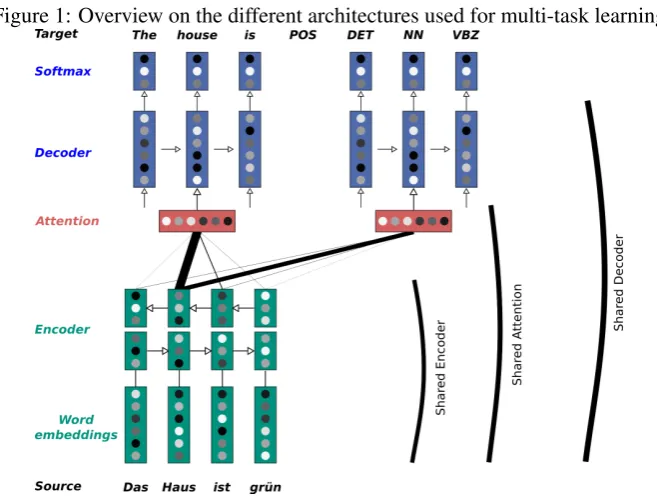
The general attentional encoder-decoder model consists of three main parts: the encoder E, the
attention model A and the decoder D. Figure1
gives an overview of this layout.
Our baseline considers the scenario where we have separate models for each task. Therefore, all three parts (encoder, attention model, and de-coder) stand separately for each task. We will have nine componentsEM T,EP OS,EN E,AM T,
AP OS,AN E,DM T,DP OS,DN Ein total. The one main design decision for a multi-task learning architecture is the degree of sharing across the tasks. Motivated by architectures pro-posed for multi-lingual machine translation (Dong et al.,2015;Firat et al.,2016a;Ha et al.,2016), we analyze the impact of different degrees of sharing in the output quality. When sharing more parame-ters between the tasks, the models are able to learn more from the training data of other tasks. If the tasks are very distant, on the other hand, it might be harmful to share the parameters.
Shared encoder(shrd Enc) One promising way is to share components that handle the same type of data. Since all our tasks share English as input here is the encoder.
In this architecture, we therefore use one en-coder for all tasks. This is the minimal degree of sharing we consider in our experiments. A com-mon encoderEALLis used for all tasks, but
sepa-rate attention modelsAM T,AP OS,AN E and de-codersDM T,DP OS,DN Eare used.
Shared attention (shrd Att) The next compo-nent is the attention model which connects the en-coder and deen-coder. While the output should be different for the addressed tasks, the type of input is the same. Therefore, it might be helpful to share more information between the models.
In a second architecture, we also share the at-tention model in addition to the encoder. So in this setup, we have one encoderEALL, one atten-tion modelAALLand three decoderDM T,DP OS,
DN E.
Shared decoder(shrd Dec) Finally, we explore whether it is possible to share all information across the tasks and let the model learn how to rep-resent the different tasks. Thus, in this scheme, we aim to share the decoder partially. The only thing that is not shared is the final softmax layer.
In this architecture, the decoder RNN has to model the generation of target words as well as that of labels. Therefore, we have only one en-coder EALL, one attention modelAALL and one decoderDALL. In the decoder, however, we have separated output layers for each task.
Figure 1 depicts which layers are shared de-pending on the architecture.
3.2 Training Schedule
In this section, we discuss the influence of the training schedule on the quality of the model.
Throughout our experiments we used a mini-batch size of 512 tokens. The weight updates were determined using the Adam algorithm.
Figure 1: Overview on the different architectures used for multi-task learning
This challenge is strongly related with the prob-lem of domain adaptation in machine translation, where a large out-of-domain data is available but only a small amount of in-domain data. For this scenario, first training on all data and then fine-tuning on the in-domain data was very successful (Lavergne et al.,2011;Cho et al.,2016). There-fore, we adapt this approach to the multi-task sce-nario. In this case, we first trained the model on all tasks and then continued training only on the main task. We will refer to this training schedule as adapted.
3.3 Target Length
While all tasks are modeled as a translation prob-lem in this work, the nature of each task is largely different. One main difference between the trans-lation task and the other two tasks is the length of the target sequence. While it is unknown in the translation task, it is known and fixed for the other two cases. During training this does not matter as the target sequence is given. For testing the sys-tem, however, this issue is crucial to address.
In our initial experiment, it was shown that the POS tagger was able to learn the correct tar-get length in most of the cases. For some sen-tences, however, the estimated target length was not correct. Therefore, the prior knowledge of se-quence length is used during decoding so that la-bel sequences are generated with the correct tar-get length. It is worth to mention that the desired
length of the labels is not exactly the length of the input to the model itself. Our model uses inputs with subwords units generated by byte-pair encod-ing (Sennrich et al.,2016).
4 Experimental Setup
We conduct experiments using the multi-task ap-proach on three different tasks: machine trans-lation from German to English, German fine-grained POS tagging and German NE tagging. As briefly mentioned in Section1, multi-task ap-proach can be helpful when data is sparse. In or-der to simulate this, we deploy only German to English TED data for the translation task.
4.1 Data
For the translation task, we used 4M tokens of the WIT corpus (Cettolo et al., 2012) for German to English as training data. We useddev2010for val-idation and tst2013 and tst2014 for testing, pro-vided by the IWSLT. We only used training exam-ples shorter than 60 words per sentence.
The POS tagger was trained on 720K tokens the Tiger Corpus (Brants et al., 2004). This corpus contains German newspaper text. Consequently, it is out-of-domain data for the machine translation task. The development and the test data are also from this corpus. The POS tag set consists of 54 tags and the fine-grained POS tags with morpho-logical annotations has 774 labels.
tagger on 450K tokens of the GermEval 2014 NER Shared Task data (Benikova et al.,2014). The cor-pus is extracted from Wikipedia and the training data consists of 24K sentences.
We preprocess the parallel data by tokenizing and true-casing. In addition, we trained a byte-pair encoding (Sennrich et al., 2016) with 40K sub-words on the source and target side of the TED corpus jointly. We then applied the subwords to all German and English corpora.
4.2 System Architecture
For all our experiments, we use an attentional encoder-decoder model. The baseline systems use this architecture as well. The encoder uses word embeddings of size 256 and a bidirectional LSTM (Hochreiter and Schmidhuber,1997;Schuster and Paliwal,1997) with 256 hidden layers for each di-rection. For the attention, we use a multi-layer perceptron with 512 hidden units and tanh activa-tion funcactiva-tion. The decoder uses condiactiva-tional GRU units with 512 hidden units. The models are all trained with Adam, where we restarted the algo-rithm twice and early stopping is applied using log-likelihood of the concatenated validation sets from the considered tasks. For the adapted sched-ule, Adam is started once again when training only on the target task. The model is implemented in lamtram (Neubig,2015)1.
4.3 Evaluation
The machine translation output is evaluated with BLEU (Papineni et al.,2002), BEER (Stanojevic and Sima’an,2014) and CharacTER (Wang et al.,
2016). For the POS tags, we report error rates on the small label set as well as on the large label set.
5 Results
In this section, we present the results from our ex-periments and analysis.
5.1 Initial experiments on the architecture
The results of the initial experiments on the ma-chine translation tasks are shown in Table1. The table displays the performance on the validation set and on both test sets. For all experiments, we first show the BLEU score, then the BEER score and finally the characTER.
1The extension to handle multi-task training can be down-loadedhttps://github.com/isl-mt/lamtram
First, we show the results of the baseline neu-ral MT system trained on the paneu-rallel data (single task). As mentioned in the beginning, we sim-ulated a low-resource condition in these experi-ments by only using the data from TED, which are roughly 185K sentences.
We evaluated models that are trained both on the translation and POS tagging task. Although the POS data is out-of-domain and significantly smaller than the parallel training data for the trans-lation task (ca. 20% of the size), we see improve-ments for all three architectures consistently in three metrics. The BLEU scores is improved by more than 1 point and the characTER is reduced by more than 1.5 points. The BEER metric score is improved by more than a half point on both sets. In a more detailed look at this task, we see that the model sharing the most (shrd Dec) performs better than the baseline, but worse than the other two. Therefore, we can conclude that it is helpful to separate the tasks when the components work on different types of data. Whether it is helpful to share the attention layer (shrd Att) or not (shrd Enc) is not clear from this experiment. Therefore, we concentrate on these two architectures in the following experiments.
5.2 Impact of design decisions
Following the initial experiment, we address the following three design questions:
• What kind of influence does the secondary
task have?
• How do the different architectures perform?
• Do we need to adapt the training schedule?
In order to clarify the impact of the three hyper-parameters (the architectures, the tasks and the training) we performed experiments based on pos-sible combinations. We used two most promising architectures,shrd Enc andshrd Att as discussed in Section 5.1. We use three task combinations, POS+MT,NE+MTandNE+POS+MT. Two train-ing strategies are applied with and without adapta-tion as described in Secadapta-tion3.2. These 12 systems are evaluated on the two test sets using three dif-ferent metrics. Consequently, in total we have 72 measurements for the 12 systems.
Task(s) Arch. Valid Test
dev 2010 tst2013 tst2014
MT - 29.91/62.16/51.06 30.85/62.27/51.16 26.12/58.73/55.17
POS + MT shrd Enc 30.62/62.77/48.35 31.97/62.72/49.69 27.08/58.99/54.50shrd Att 30.51/62.27/49.09 31.76/62.68/49.59 26.86/58.84/53.88 shrd Dec 30.36/62.34/49.28 31.26/62.31/50.35 26.52/58.48/54.00 Adapted NE + POS + MT shrd Enc 30.70/62.96/48.60 32.30/63.25/49.22 27.78/59.74/53.49
Table 1: Results of multi-task learning architectures on the machine translation task (BLEU/BEER/characTER)
over several configurations. First, we analyze the influence of adapting the training schedule by fine-tuning on the MT task. Out of the 12 systems, six systems used an adapted training schedule.
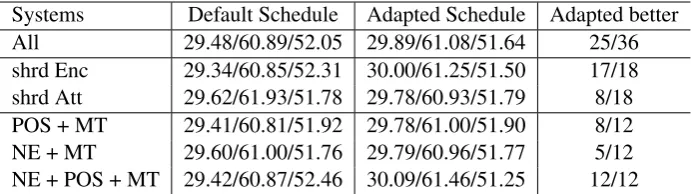
As shown in the first line of Table2(All), when averaging over the six systems using the adapted training schedule and tested both test sets, we see improvements in all considered metrics compare to the systems using the default training schedule. The BLEU score improved by 0.4 BLEU points, BEER by 0.2 and characTER by 0.4. Further-more, we compared each of the 36 measurements using the adapted schedule with the correspond-ing measurement uscorrespond-ing the default traincorrespond-ing sched-ule. Thus, the scores are calculated on same test set, based on the same metric. The model differs whether it is trained using the default or adapted training schedule. How often the system with an adapted schedule performs better is shown in the last column of Table2. When directly comparing these systems, in 25 out of 36 cases the ones with the adapted schedule perform better.
We analyzed the influence of the architecture as well as tasks considered in training in the same way. The influence of both aspects, however, was not as clear as the one from the training schedule. In order to get a deeper understanding, we ana-lyzed in which cases it is more helpful to adapt the training schedule. As a first step, we looked at the correlation between the training schedule and the two different architectures. The results are shown in the next lines of Table2.
Compared to the systems using the shrd Enc layout, we observe even bigger improvements when applying the adapted schedule. The av-eraged BLEU score is improved by 0.7 BLEU points. Furthermore, the system with the adapted training schedule performs better, in almost all cases. For theshrd Attmodel, in contrast, we gain nearly no improvements from the adapted
sched-ule. We also observed that the system with the default schedule performs better in 10 out of 18 cases.
One reason for this can be that the default train-ing schedule may not perform as well any more when only a few parameters are observed in every batch. In this case, continuing and concentrating on one task seems to be very important.
In addition, we evaluate the correlation between the tasks involved and the training schedule. The results are shown in the same table. The adapted training schedule has no effect when training on named entities and machine translation. The ef-fect when training on POS tagging and MT is also relatively small. When training the three tasks together, however, the system with an adapted schedule performs always better than the system with the default one. The average BLEU is im-proved by 0.7. The BEER score and characTER are also improved by 0.5 and 1.2 points.
Inspired by the results, we build the adapted shrd Encmodel trained on all three tasks, as shown in Table1. This model improved the performance by 1.5 BLEU points over the baseline system. Also the BEER score is improved by 1 and the characTER score reduced by 1.8 to 2 points.
5.3 POS Tagging Performance
In addition to the results on the task of translation, we also evaluated the performance on the task of POS tagging. The results are shown in Table3.
For the validation and test data, we show the error rate on the small tag sets as well as the error rate on the morpho-syntactic tag set. In the table, we always first show the results for the small test set.
Systems Default Schedule Adapted Schedule Adapted better
All 29.48/60.89/52.05 29.89/61.08/51.64 25/36
shrd Enc 29.34/60.85/52.31 30.00/61.25/51.50 17/18
shrd Att 29.62/61.93/51.78 29.78/60.93/51.79 8/18
POS + MT 29.41/60.81/51.92 29.78/61.00/51.90 8/12
NE + MT 29.60/61.00/51.76 29.79/60.96/51.77 5/12
[image:7.595.126.472.62.159.2]NE + POS + MT 29.42/60.87/52.46 30.09/61.46/51.25 12/12
Table 2: Impact of the training schedule in the machine translation task (BLEU/BEER/characTER)
Task(s) Model Default schedule Adaptation schedule
Valid Test Valid Test
POS - 5.49/11.36 10.13/17.27 -
-POS + MT shrd Encshrd Att 3.99/9.983.86/9.55 7.55/14.986.98/14.17 3.57/8.82 6.24/13.243.16/8.23 5.52/12.25 shrd Dec 3.57/9.28 7.40/14.62 3.53/8.94 5.81/12.56 NE + POS + MT shrd Encshrd Att 3.42/9.003.08/8.45 5.86/12.876.23/13.28 3.00/8.00 5.06/11.622.78/7.87 5.49/12.10
Table 3: Results of different multi-task architectures on the POS task
performance on the test data is 10.13 and 17.27 for both tag sets. In all systems we used one sys-tem the generate the both tag sets. The small tags were evaluated by removing the morhpo-syntactic information from the output
It is clear that all models outperform the base-line. It seems to be very helpful for the POS task to jointly train the model along with the translation task. The MT data is significantly larger than the POS data, which is beneficial for this task.
A more detailed look shows that model adap-tation is beneficial for a good performance. In all cases the performance is improved by adapting the model to the POS task. Therefore, when the data of the main task is small compared to the overall training data, adapting on the main task is even more important.
Furthermore, we see improvements when using a third task in all cases. Facilitating this combina-tion of tasks is also helpful for POS tagging.
As we observed in the MT task, the impact and differences brought from each architecture are not huge. The architectures considered in this work perform similar. Even the system sharing all com-ponents achieves a comparable performance on this task.
The best performing model, however, is the shred Enc model, trained on all three tasks and adapted to the task. This model achieved an er-ror of 5.06 on the small tag set. Compared to the
baseline performance of 10.13, we can see that the error rate is halved. On the fine-grained tag set, we see an improvement from 17.27 to 11.62, which is a more than 30% reduction in error rate.
5.4 Analysis and Examples
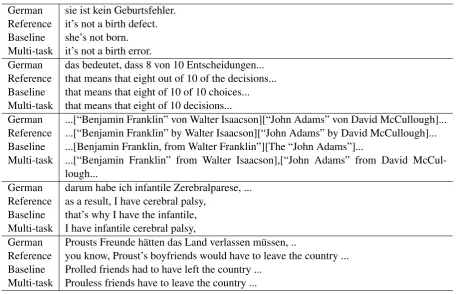
In order to show the influence of the other tasks, we show translation examples in Table4. For the examples we use the multi-task system trained on all three tasks with theshrd Encarchitecture.
A common problem of many neural MT sys-tems is that they do not translate parts of the source sentence, or that parts of the source sentence are translated twice. The baseline system suffers from this, as shown in the first two examples. The trans-lation of the multi-task system is improved com-pared to the baseline in several aspects. In the first example, the baseline system is not translating the German compoundGeburtsfehlerintobirth defect correctly, but into birth. Although the multi-task system does not generate the translation that ex-actly matches the reference the translation is un-derstandable. In the second example, the phraseof 10is not repeated. One explanation for this could be that the additional information from the POS data leads to a better encoding of the structure of the source sentence.
enti-German sie ist kein Geburtsfehler. Reference it’s not a birth defect. Baseline she’s not born. Multi-task it’s not a birth error.
German das bedeutet, dass 8 von 10 Entscheidungen... Reference that means that eight out of 10 of the decisions... Baseline that means that eight of 10 of 10 choices... Multi-task that means that eight of 10 decisions...
German ...[“Benjamin Franklin” von Walter Isaacson][“John Adams” von David McCullough]... Reference ...[“Benjamin Franklin” by Walter Isaacson][“John Adams” by David McCullough]... Baseline ...[Benjamin Franklin, from Walter Franklin”][The “John Adams”]...
Multi-task ...[“Benjamin Franklin” from Walter Isaacson],[“John Adams” from David McCul-lough...
German darum habe ich infantile Zerebralparese, ... Reference as a result, I have cerebral palsy,
Baseline that’s why I have the infantile, Multi-task I have infantile cerebral palsy,
German Prousts Freunde h¨atten das Land verlassen m¨ussen, ..
Reference you know, Proust’s boyfriends would have to leave the country ... Baseline Prolled friends had to have left the country ...
[image:8.595.71.528.59.353.2]Multi-task Prouless friends have to leave the country ...
Table 4: Translation examples
ties better. As shown in the third and fourth exam-ple, the NMT system is not able to copy a named entity from the source to the target, nor to translate rare words. In the third example, the baseline sys-tem is not able to generate the correct last name of the first authorIsaacson, but is generating the last name from the book title. In the second part of the example, the baseline system completely deletes the author. In contrast, the multi-task system is able to generate the correct sequence. In the fourth example the multi-task example is able to translate Zerebralparese (cerebral palsy), while the base-line system is not able to do it.
We would like to note that as shown in the last example, there are also several cases where the NMT system is not able to translate names or rare words correctly.
6 Conclusion
In this paper we proposed the use of multi-task learning for attention-based encoder-decoder models in order to exploit linguistic resourced for NMT. By training the models not only on the machine translation task, but also on other NLP tasks, we yielded clear improvements on the trans-lation performance. Results show that multi-task learning improves the translation up to 1.5 BLEU
points and 2 characTER points. As a by product, we were also able to improved the performance of the POS tagging by 30% to 50% relatively. This is especially helpful since data annotation for many NLP tasks is very time-consuming and expensive. It suggests that multi-task learning is a promising approach to exploit any linguistic annotated data, which is especially important if we have a low-resource condition.
achieved with a model sharing only the encoder between the tasks.
In this work, the performance of machine trans-lation task was improved by adopting multi-task training with other source language NLP tasks. In future work, we will also investigate methods to include target-language NLP tasks into the joint framework.
Acknowledgments
The project leading to this application has received funding from the European Union’s Horizon 2020 research and innovation programme under grant agreement n◦ 645452. This work was supported by the Carl-Zeiss-Stiftung.
References
D. Bahdanau, K. Cho, and Y. Bengio. 2014. Neural machine translation by jointly learning to align and
translate. CoRRabs/1409.0473.
D. Benikova, C. Biemann, M. Kisselew, and S. Pado. 2014. Germeval 2014 named entity recognition
shared task: Companion paper. In Proceedings
of the KONVENS GermEval workshop. Hildesheim, Germany, pages 104–112.
S. Brants, S. Dipper, P. Eisenberg, S. Hansen-Schirra, E. K¨onig, W. Lezius, C. Rohrer, G. Smith,
and H. Uszkoreit. 2004. Tiger:
Linguis-tic interpretation of a german corpus. Re-search on Language and Computation 2(4):597– 620. https://doi.org/10.1007/s11168-004-7431-3.
M. Cettolo, C. Girardi, and M. Federico. 2012. Wit: Web inventory of transcribed and translated talks. InProceedings of the 16th Conference of the Euro-pean Association for Machine Translation (EAMT). Trento, Italy, pages 261–268.
E. Cho, J. Niehues, T-L Ha, M. Sperber, M. Medi-ani, and A. Waibel. 2016. Adaptation and combina-tion of nmt systems: The kit translacombina-tion systems for iwslt 2016. InProceedings of the 13th International Workshop on Spoken Language Translation (IWSLT 2016). Seattle, USA.
R. Collobert, J. Weston, L. Bottou, M. Karlen, K. Kavukcuoglu, and P. Kuksa. 2011. Natural
lan-guage processing (almost) from scratch. J. Mach.
Learn. Res.12:2493–2537.
D. Dong, H. Wu, W. He, D. Yu, and H. Wang. 2015. Multi-task learning for multiple language
transla-tion. InProceedings of the 53st Annual Meeting of
the Association for Computational Linguistics (ACL 2015). Beijing, China.
O. Firat, K. Cho, and Y. Bengio. 2016a.
Multi-way, multilingual neural machine translation with a
shared attention mechanism. InProceedings of the
2012 Conference of the North American Chapter of the Association for Computational Linguistics: Hu-man Language Technologies (NAACL-HLT 2016). San Diego, California, USA, pages 866–875.
O. Firat, B. Sankaran, Y. Al-Onaizan, F. T. Yarman-Vural, and K. Cho. 2016b. Zero-resource trans-lation with multi-lingual neural machine transla-tion. InProceedings of the Conference on Empirical Methods in Natural Language Processing (EMNLP 2016). Austin, USA, pages 268–277.
T-L Ha, J. Niehues, and A. Waibel. 2016. Toward mul-tilingual neural machine translation with universal encoder and decoder. InProceedings of the 13th In-ternational Workshop on Spoken Language Transla-tion (IWSLT 2016). Seattle, USA.
S. Hochreiter and J. Schmidhuber. 1997. Long
short-term memory. Neural Comput. 9(8):1735–1780.
https://doi.org/10.1162/neco.1997.9.8.1735.
M. Johnson, M. Schuster, Q. V. Le, M. Krikun, Y. Wu, Z. Chen, N. Thorat, F. B. Viegas, M. Wat-tenberg, G. Corrado, M. Hughes, and J. Dean. 2016. Google’s multilingual neural machine trans-lation system: Enabling zero-shot transtrans-lation. CoRR
abs/1611.04558.
M. Labeau and Allauzen L¨oser K. 2015.
Non-lexical neural architecture for fine-grained pos
tag-ging. In Proceedings of the Conference on
Em-pirical Methods in Natural Language Processing (EMNLP 2015). Lisbonne, Portugal, page 6.
T. Lavergne, H-S Le, A. Allauzen, and F. Yvon. 2011. Limsi’s experiments in domain adaptation for iwslt11. In M-Y Hwang and S. St??ker, editors,
Proceedings of the Eights International Workshop on Spoken Language Translation (IWSLT 2011). San Francisco, CA, pages 62–67.
M-T Luong, Q. V. Le, I. Sutskever, O. Vinyals, and L. Kaiser. 2015. Multi-task sequence to sequence
learning.CoRRabs/1511.06114.
G. Neubig. 2015. lamtram: A toolkit for language and translation modeling using neural networks.
J. Niehues, T-L Ha, E. Cho, and A. Waibel. 2016. Us-ing factored word representation in neural network
language models. InProceedings of the First
Con-ference on Statistical Machine Translation (WMT 2016). Berlin, Germany.
J. Niehues and M. Kolss. 2009. A pos-based model for long-range reorderings in smt. InProceedings of the Fourth Workshop on Statistical Machine Translation (WMT 2009). Athens, Greece.
K. Papineni, S. Roukos, T. Ward, and W-J Zhu. 2002.
translation. InProceedings of the 40th Annual Meet-ing of the Association for Computational LMeet-inguistics (ACL 2002). Philadelphia, Pennsylvania, pages 311– 318. https://doi.org/10.3115/1073083.1073135.
M. Schuster and K. K. Paliwal. 1997. Bidirectional
re-current neural networks. IEEE Transactions on
Sig-nal Processing45(11):2673–2681.
R. Sennrich and B. Haddow. 2016. Linguistic input features improve neural machine translation. In Pro-ceedings of the First Conference on Statistical Ma-chine Translation (WMT 2016). Berline, Germany, pages 83–91.
R. Sennrich, B. Haddow, and A. Birch. 2016. Neu-ral machine translation of rare words with subword units. InProceedings of the 54st Annual Meeting of the Association for Computational Linguistics (ACL 2016). Berlin, Germany.
M. Stanojevic and K. Sima’an. 2014. Fitting sentence level translation evaluation with many dense
fea-tures. In Proceedings of the 2014 Conference on
Empirical Methods in Natural Language Processing (EMNLP). Doha, Qatar, pages 202–206.
I. Sutskever, O. Vinyals, and Q. V. Le. 2014. Se-quence to seSe-quence learning with neural networks. InAdvances in Neural Information Processing Sys-tems 27: Annual Conference on Neural Information Processing Systems 2014. Quebec, Canada, pages 3104–3112.
W. Wang, J-T Peter, H. Rosendahl, and H. Ney. 2016. Character: Translation edit rate on character level. In Proceedings of the First Conference on Statisti-cal Machine Translation (WMT 2016). Berlin, Ger-many, pages 505–510.
Y. Wu, X. Lu, H. Yamamoto, S. Matsuda, C. Hori, and H. Kashioka. 2012. Factored language model
based on recurrent neural network. InProceedings