Making the most of limited training data using distant supervision
Roland Roller and Mark Stevenson
Department of Computer Science University of Sheffield Regent Court, 211 Portobello
S1 4DP Sheffield, England
roland.roller,[email protected]
Abstract
Automatic recognition of relationships be-tween key entities in text is an impor-tant problem which has many applications. Supervised machine learning techniques have proved to be the most effective ap-proach to this problem. However, they re-quire labelled training data which may not be available in sufficient quantity (or at all) and is expensive to produce. This paper proposes a technique that can be applied when only limited training data is avail-able. The approach uses a form of distant supervision but does not require an exter-nal knowledge base. Instead, it uses in-formation from the training set to acquire new labelled data and combines it with manually labelled data. The approach was tested on an adverse drug data set using a limited amount of manually labelled train-ing data and shown to outperform a super-vised approach.
1 Introduction
Relation extraction is a widely explored prob-lem that has been applied to a range of do-mains (Craven and Kumlien, 1999; Agichtein and Gravano, 2000; Xu et al., 2007) using a vari-ety of techniques (Yangarber, 2003; Bunescu and Mooney, 2006; Neumann and Schmeier, 2012). In the biomedical domain relation extraction has been used to identify a wide range of types of relation, including adverse drug effects (ADE), gene regulations and drug-drug interactions. Com-munity evaluation exercises, such as the BioNLP Shared Task (Kim et al., 2011; N´edellec et al., 2013) or the Drug-Drug Interaction (DDI) chal-lenge (Segura-Bedmar et al., 2013), have shown that supervised learning techniques normally pro-duce better results than other approaches.
Supervised learning techniques rely on labeled training data but these are not available for all relations of interest and are also difficult and time-consuming to create. Other approaches may be more appropriate in situations where training data is limited or unavailable. Minimally super-vised approaches, such as seed and bootstrapping techniques (Brin, 1999; Riloff and Jones, 1999; Agichtein and Gravano, 2000), are provided with a small set of seed instances (examples of related information) or patterns and acquire further exam-ples from a large corpus by applying an iterative process. While these approaches do not require la-belled training data they often suffer from low pre-cision or semantic drift (Mintz et al., 2009). Dis-tant supervision combines the advantages of mini-mally supervised and supervised approaches to re-lation extraction.
Distant supervision makes use of an external knowledge source that provides information about pairs of entities which are related. Sentences con-taining both entities in a pair are identified from a corpus and used in place of labeled training ex-amples. For example, knowledge thathair lossis a drug-related adverse effect ofparoxetine would allow further positive examples to be identified by searching for other sentences containing the same drug and side-effect. Many knowledge sources only contain positive entity pairs. Therefore nega-tive examples are often generated using a closed-world assumption. Given the known positive en-tity pairs, negative enen-tity pairs are generated by producing new combinations of entities. Negative example sentences are generated by selecting sen-tences containing these negative entity pairs.
The example in figure 1 shows the limitations of distant supervision since related entities might express a different relation. This can lead to ex-amples being falsely labelled as positive exex-amples of a relation. Classifiers trained using data gen-erated using distant supervision do not generally
perform as well as those trained using manually labelled data. However, distant supervision allows large data sets to be generated at low cost.
There are a few case reports on
[CONDITION:hair loss] associated
with tricyclic antidepressants and serotonin selective reuptake inhibitors (SSRIs), but none deal specifically with
[DRUG:paroxetine].
Figure 1: Generation of false positives by using automatically labelled data, PMID=10442258
The majority of distant supervision approaches use structured knowledge sources such as Wikipedia (Hoffmann et al., 2010) or Freebase (Mintz et al., 2009; Riedel et al., 2010; Ritter et al., 2013; Augenstein et al., 2014). However there may not be a suitable knowledge base available for a particular relation of interest. This paper addresses the problem of developing relation extraction systems in situations where only a small amount of training data is available.
We introduce a method for relation extraction that can be used when only limited amounts of training data are available. The approach is based on distant supervisionbut, rather than relying on a knowledge base, seed pairs are extracted from Medline articles. Sentences from the Medline Baseline Repository containing these seed pairs are extracted to generate a large distantly labelled training data set. Using this data manually labelled data can be extended and combined to a hybrid mixture modelwhich outperforms both the super-vised and the distantly supersuper-vised models.
This paper makes the following contributions: 1) introduces a method which can be used to train a relational classifier when only a small set of labelled training data is available, 2) provides a method for combining distant supervision with su-pervised learning methods and 3) presents distant supervision without the need of a knowledge base. The remainder of the paper is structured as fol-lows. The next section presents the background on relation extraction from biomedical documents. Section 3 introduces the data set which is used for the experiments. The techniques for generat-ing the distantly supervised traingenerat-ing data and rela-tional classifier are described in sections 4 and 5. Section 6 describes the experiment and the results. Conclusions are presented in section 7.
2 Related Work
Supervised learning techniques are popular and ef-ficient approaches to detecting relations between entities in natural language. Results using super-vised learning methods tend to improve as more training data is available. However the genera-tion of labelled data is cumbersome, expensive and time-consuming. It often requires expert knowl-edge in restricted domains, such as biomedicine. A new labelled data set is required for each target relation.
In recent years, distant supervision has become very popular. Rather than using manually an-notated data, distant supervision uses knowledge about which entity pairs are instances of the tar-get relation to generate automatically labelled data which is used to train a relational classifier. Craven and Kumlien (1999) introduced distant supervi-sion for relation extraction. The authors used the Yeast Protein Database (YPD) as source of knowl-edge and mapped this information to PubMed arti-cles to generate training examples. The technique has been widely applied particularly outside the medical domain. Many approaches such as (Mintz et al., 2009; Sun et al., 2011; Hoffmann et al., 2011; Krause et al., 2012; Xu et al., 2013) focus on approaches using Freebase as knowledge source to generate automatically labelled data. In recent years distant supervision has also become more popular in the biomedical domain beeing used to detect protein-protein interactions using IntAct (Thomas et al., 2011), protein-residue associations with PDB (Ravikumar et al., 2012) or relation-ships of the National Drug File-Reference Termi-nology (NDF-RT) using the UMLS Metathesaurus (Roller and Stevenson, 2014). Liu et al. (2014) fo-cus on the detection of genes in brain regions from literature using the UMLS Semantic Network and Ellendorff et al. (2014) uses the Comparative Toxi-cogenomics Database (CTD) to detect interactions between genes and chemicals.
Both approaches show that a combination of a large set of distantly supervised (noisy) data with manually labelled examples can improve the clas-sification results. The combination of noisy data and hand-selected training examples is also used in this paper.
3 Data
The experiments in this work uses the ADE data set (Gurulingappa et al., 2012b) which contains examples of adverse drug effects (ADE). An ADE is a response of a drug which is noxious and unin-tended, and which occurs at doses normally used in humans for the prophylaxis, diagnosis, therapy of disease, or for the modification of physiologi-cal function1(Gurulingappa et al., 2012b). ADEs
contribute to one of the most common causes of death in industrialised nations and are the fourth leading cause of death in the U.S. (Giacomini et al., 2007). To reduce this risk the side-effects of drugs need to be detected and made publicly avail-able as quickly as possible.
The ADE data set consists of Medline case re-ports examined by three human annotators. Sen-tences in these case reports containing adverse ef-fects betweendrugsandconditionswere extracted and entities annotated to generate the data set. An example relation between a drug and a condition from this data set is shown in figure 2. Accord-ing to the given sentence the condition pseudopor-phyria is caused by the two drugs naproxen and oxaprozin.
METHODS: We report two cases of
[CONDITION:pseudoporphyria] caused by
[DRUG:naproxen] and [DRUG:oxaprozin].
Figure 2: Example of a drug-related adverse effect taken from PMID=10082597
The ADE corpus only contains examples of positive relations. Negative examples are also re-quired to set-up a meaningful ADE prediction task and to train a supervised ADE classifier. A set of negative examples were generated using the fol-lowing process.
Named entity recognition is applied to detect drugs and conditions. MetaMap2 (Aronson and
Lang, 2010) was run on the unannotated
sen-1World Health Organization (WHO) glossary of terms used in Pharmacovigilance.
2http://metamap.nlm.nih.gov/, MetaMap version 13 with UMLS 2013AA
tences in the ADE corpus to detect biomedical concepts from the UMLS. MetaMap provides dif-ferent possible UMLS concept mappings and we select the best (highest ranked) mapping. Each biomedical concept detected by MetaMap now refers to a unique UMLS CUI thereby allow-ing identical concepts to be merged and assigned semantic types. Using the same approach as Kang et al. (2014), sentences containing con-cepts with semantic types which belong to the two groups “Chemicals & Drugs” and “Disorders” are extracted and considered as negative examples. Nested relations are not included in our data set.
Training and evaluation sets were then gener-ated. The set of utilised ADE abstracts consists of 1644 publications. 200 abstracts were removed to be used to create training data and the remainder used to form the evaluation set. The training data is created by extracting all positive and negative labelled sentences from the 200 abstracts. In order to provide reliable results we run the same exper-iment 5 times. Each time we randomly choose a different selection of 200 training and 1444 test abstracts.
4 Automatic Generation of Annotated Training Data
Many of the previous approaches to distant su-pervision use information about related instances (e.g. drugs and known adverse effects) to auto-matically generate training data. In the major-ity of cases this information is obtained from a knowledge base. We employ an alternative ap-proach and make use of information from a small set of abstracts. For example, the sentence shown in figure 2 suggests that there are cases when the drugs oxaprozin and naproxen cause pseudopor-phyria. Consequently sentences containing these two drug-condition entity pairs (i.e. oxaprozin -pseudoporphyriaandnaproxen-pseudoporphyria) are extracted and treated as positive examples.
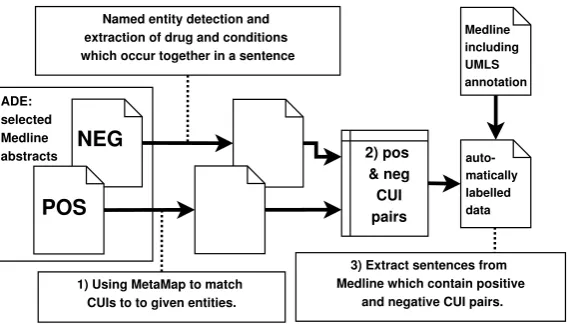
The data is generated by applying a three stage process (see Figure 3).
POS NEG
Named entity detection and extraction of drug and conditions which occur together in a sentence
1) Using MetaMap to match CUIs to to given entities. ADE:
selected Medline
abstracts 2) pos
& neg CUI pairs
Medline including UMLS annotation
auto-matically labelled data
3) Extract sentences from Medline which contain positive
[image:4.595.158.442.60.222.2]and negative CUI pairs.
Figure 3: Automatic generation of training data for ADE relations
CUI,C0027396. We run MetaMap with the same configuration on the sentences containing positive examples. In many cases it is possible to assign a MetaMap annotation to the existing related enti-ties.
We only assign a CUI to an entity if MetaMap identifies a CUI that can be mapped to the entity in its full length (not only a substring). Negative training examples already include CUI informa-tion for each entity (see secinforma-tion 3).
2)Extract a set of positive and negative seed in-stance pairs. In the next step, we extract all CUI pairs from the positive ADE examples and add them to a set of positive instance pairsP. We also extract CUI pairs of negative ADE examples and add them to a negative instance pair setN. Each CUI pair which occurs in both sets (P andN), is removed from N. Considering the 200 training abstracts of the first setup (of five) it is possible to extract 310 different positive CUIs pairs and 869 negative CUI pairs. 12 CUI pairs occur in both sets. Therefore the number of different CUI pairs inN is reduced to 857.
3) Extract sentences containing positive and negative seed instances from abstracts. The dis-tantly labelled training data is generated using the Medline Baseline Repository (MBR)3, a large
col-lection of biomedical abstracts annotated using MetaMap4. We use 3,000,000 abstracts published
between 1997-2003. Then sentences from this subset containing positive and negative CUI pairs are extracted and labelled as positive and negative examples.
3http://mbr.nlm.nih.gov/
4MetaMap annotations use UMLS release 2011AB,
http://mbr.nlm.nih.gov/Download/ MetaMapped\_Medline/2012/
Regarding the the 200 training abstracts of the first setup a total of 7868 sentence containing pos-itive instance pairs and 14,4315 sentence contain-ing negative instance pairs were identified and ex-tracted. Although 310 different positive and 857 different negative CUI pairs were extracted from the 200 abstracts (see above), only 290 different positive and 441 different negative CUI pair com-binations were detected within the portion of MBR used for this experiment. It is also interesting to note that only 13 positive CUI pairs occur more than 100 times within the 7868 positive examples. The most frequent positive CUI pairs are listed in table 1. 213 of the positive CUI pairs occur fewer than 10 times.
The automatically generated data has a strong bias. To generate an automatically labelled train-ing data with a similar bias as the test set we re-duce the amount of negative examples to the same ratio as the manually labelled examples.
5 Relation Extraction
We use the Java Simple Relation Extraction5
(jSRE) (Giuliano et al., 2006) which is based on LibSVM (Chang and Lin, 2011). jSRE includes an implementation of the shallow linguistic kernel which provides reliable classification results and has been used also for other experiments on the ADE data set (Gurulingappa et al., 2012a; Kang et al., 2014).
The shallow linguistic kernel is a combination of the global context kernel and the local con-text kernel. The global context kernel considers n-grams of the words (and other information such as stemmed words and part of speech tags) between
frequency drug condition
#1352 C0019134=‘Heparin’ C0272285=‘Heparin-induced thrombocytopenia’ #1199 C0026549=‘Morphine’ C0030193=‘Pain’
[image:5.595.98.502.61.132.2]#980 C0023175=‘Lead’ C0020538=‘Hypertensive disease’ #396 C0031507=‘Phenytoin’ C0036572=‘Seizure’
Table 1: Most frequent positive CUI pairs found in the automatically labelled data set
the two entities. The local context kernel consid-ers only a limited amount of information around each entity.
Sentences from the training and test data are parsed using the Charniak-Johnson Parser (Char-niak and Johnson, 2005) to generate part of speech tags. Next, words are reduced to their stem using the Porter Stemmer (Porter, 1997).
We use three different methods within the ex-periments: supervised relation extraction, dis-tantly supervised relation extraction and a rela-tion extracrela-tion using a mixture-model. The su-pervised model uses a set of abstracts (1-200) from the training data as input. The distantly su-pervised model takes the automatically generated data based on the MetaMap annotated Medline Baseline Repository as input. The mixture-model merges the automatically generated and manually labelled training data to form a combined training set.
6 Experiment
In this experiment we examine different sizes of manually labelled training data. Starting with a single abstract for training we slowly increase the number of seed abstracts to 200. In parallel we generate for each training set a different distantly labelled data set using the given ADE seed facts of the training data. The more information the manually labelled data contains, the more different seeds can be extracted which increases the size of the distantly labelled data. Thereafter we combine in each step both data sets to a mixture-model.
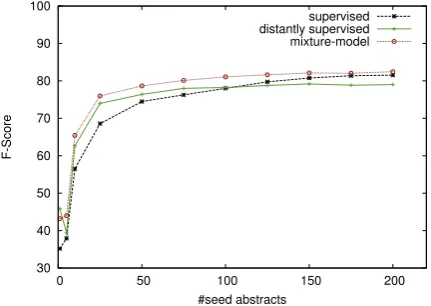
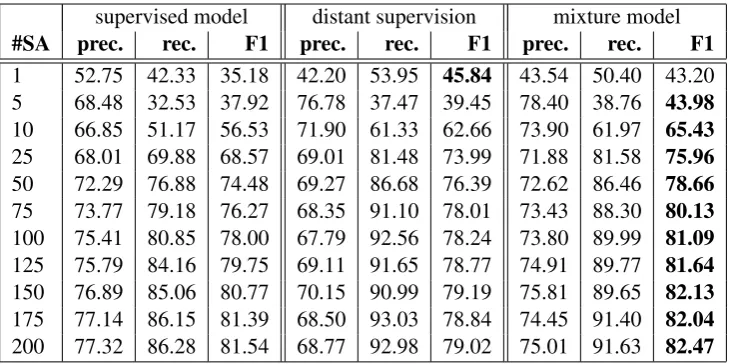
In order to provide reliable results we repeat this experiment five times (five evaluation rounds) with a different selection of abstracts for training and test. In each evaluation round the abstracts utilised for training are chosen randomly. The remaining abstracts are used for evaluation. During a specific evaluation round (increasing training data) the test set remains unchanged. The results of the exper-iments are presented in table 2 and figure 4. The results represent the mean of all five different
eval-uation rounds.
The results show that the performance for all models improves as the amount of data increases. Performance of the supervised classifier increases sharply as the number of abstracts is increased from 1 to 10 abstracts. Increasing the size of the training data to 50 abstracts produces a further im-provement of approximately 30%. These results demonstrate that even small amounts of training data are sufficient to provide reasonable results on the ADE data set.
30 40 50 60 70 80 90 100
0 50 100 150 200
F-Score
#seed abstracts
supervised distantly supervised mixture-model
Figure 4: Effect of varying number of seed ab-stracts
[image:5.595.309.525.342.495.2]ex-supervised model distant supervision mixture model #SA prec. rec. F1 prec. rec. F1 prec. rec. F1 1 52.75 42.33 35.18 42.20 53.95 45.84 43.54 50.40 43.20 5 68.48 32.53 37.92 76.78 37.47 39.45 78.40 38.76 43.98 10 66.85 51.17 56.53 71.90 61.33 62.66 73.90 61.97 65.43 25 68.01 69.88 68.57 69.01 81.48 73.99 71.88 81.58 75.96 50 72.29 76.88 74.48 69.27 86.68 76.39 72.62 86.46 78.66 75 73.77 79.18 76.27 68.35 91.10 78.01 73.43 88.30 80.13 100 75.41 80.85 78.00 67.79 92.56 78.24 73.80 89.99 81.09 125 75.79 84.16 79.75 69.11 91.65 78.77 74.91 89.77 81.64 150 76.89 85.06 80.77 70.15 90.99 79.19 75.81 89.65 82.13 175 77.14 86.15 81.39 68.50 93.03 78.84 74.45 91.40 82.04 200 77.32 86.28 81.54 68.77 92.98 79.02 75.01 91.63 82.47
Table 2: Effect of varying size of training data set
traction system. The distantly supervised classifier still has access to more data but it is not as accu-rate.
manual lab. distantly lab. seeds #SA pos neg pos neg pos neg
10 67 121 510 891 15 54
25 180 232 1048 1404 38 103 50 388 485 2026 2580 81 213 75 590 756 2643 3398 123 330 100 804 1024 3818 4851 172 448 150 1200 1447 5663 6863 248 636 200 1632 1900 8289 9607 336 834
Table 3: ADE training data size (mean across five runs)
The mixture model produces the best results of all approaches when 5 or more abstracts are used. This result is interesting since the manually la-belled data is simply extended using a simple form of distant supervision that is straightforward to ap-ply. The mixture model tends to achieve higher precision but lower recall than the distantly super-vised approach, possibly because the training data used by the mixture model is more accurate and contains fewer ”false positive” examples. On the other hand the precision and recall of the mixture model are often higher than the supervised model. The increase in recall is presumably caused by having access to additional training data and the precision scores suggest that the classifier is not harmed by some of these containing noisy labels.
The difference in performance between the su-pervised and the mixture-models gets smaller as
[image:6.595.72.296.340.468.2]the number of seed abstracts increases.
Table 3 shows the mean size of the different sets of training data. The amount of distantly labelled data is much larger than the manually labelled data at each classification step. Larger amounts of man-ually labelled data increase the number of ADE seed instances that can be extracted which leads to more distantly supervised examples.
7 Discussion and Conclusion
This paper introduced a new distantly supervised method for relation extraction that was applied to the identification of ADE relations from biomed-ical documents. The approach is able to use in-formation from an existing training data set to au-tomatically acquire new training data. Using this data, a relational classifier can be trained to de-tect and extract similar information in natural lan-guage. The classifier is able to provide compara-ble results to a supervised classifier using a small gold standard as input. Furthermore we presented a mixture model using manually labelled and dis-tantly labelled data which is able to outperform a classifier using only (a small set of) gold standard data. This result is notable since distantly super-vised data tends to be much noisier than manually labelled data and therefore produce less accurate classifiers.
We plan to extend the work described in this paper in various ways. Firstly we would like to experiment with alternative classifiers such as ap-plying dependency features and stacking or merg-ing to combine different kernel models. We would also like to explore different techniques for com-bining the supervised and the distantly supervised model.
Acknowledgements
The authors are grateful to the Engineering and Physical Sciences Research Council for supporting the work described in this paper (EP/J008427/1).
References
Eugene Agichtein and Luis Gravano. 2000. Snowball: extracting relations from large plain-text collections. InProceedings of the fifth ACM conference on Dig-ital libraries, DL ’00, pages 85–94, New York, NY, USA. ACM.
A. Aronson and F. Lang. 2010. An overview of MetaMap: historical perspective and recent
ad-vances. Journal of the American Medical
Associ-ation, 17(3):229–236.
Isabelle Augenstein, Diana Maynard, and Fabio Ciravegna. 2014. Relation extraction from the web
using distant supervision. In Proceedings of the
19th International Conference on Knowledge Engi-neering and Knowledge Management (EKAW 2014), Link¨oping, Sweden, November.
Sergey Brin. 1999. Extracting patterns and relations
from the world wide web. InSelected papers from
the International Workshop on The World Wide Web and Databases, WebDB ’98, pages 172–183, Lon-don, UK, UK. Springer-Verlag.
Razvan Bunescu and Raymond J. Mooney. 2006. Sub-sequence kernels for relation extraction. In Submit-ted to the Ninth Conference on Natural Language Learning (CoNLL-2005), Ann Arbor, MI, July. Chih-Chung Chang and Chih-Jen Lin. 2011.
LIB-SVM: A library for support vector machines. ACM
Transactions on Intelligent Systems and Technology, 2:27:1–27:27.
Eugene Charniak and Mark Johnson. 2005. Coarse-to-fine n-best parsing and maxent discriminative
reranking. InProceedings of the 43rd Annual
Meet-ing on Association for Computational LMeet-inguistics, ACL ’05, pages 173–180, Stroudsburg, PA, USA. Association for Computational Linguistics.
Mark Craven and Johan Kumlien. 1999. Constructing biological knowledge bases by extracting informa-tion from text sources. InIn Proceedings of the Sev-enth International Conference on Intelligent Systems
for Molecular Biology (ISMB), pages 77–86. AAAI Press.
Tilia Ellendorff, Fabio Rinaldi, and Simon Clematide. 2014. Using large biomedical databases as gold annotations for automatic relation extraction. In
Proceedings of the Ninth International Conference on Language Resources and Evaluation (LREC’14), Reykjavik, Iceland.
Kathleen M. Giacomini, Ronald M. Krauss, Dan M. Roden, Michel Eichelbaum, Michael R. Hayden, and Yusuke Nakamura. 2007. When good drugs go bad. InNature, 466(7139), pages 975–977.
Claudio Giuliano, Alberto Lavelli, and Lorenza Ro-mano. 2006. Exploiting shallow linguistic infor-mation for relation extraction from biomedical liter-ature. InProceedings of the 11th Conference of the European Chapter of the Association for Computa-tional Linguistics (EACL 2006), Trento, Italy.
Harsha Gurulingappa, Abdul MateenRajput, and Luca Toldo. 2012a. Extraction of potential adverse
drug events from medical case reports. Journal of
Biomedical Semantics, 3(1):15.
Harsha Gurulingappa, Abdul Mateen Rajput, Angus Roberts, Juliane Fluck, Martin Hofmann-Apitius,
and Luca Toldo. 2012b. Development of a
benchmark corpus to support the automatic extrac-tion of drug-related adverse effects from medical
case reports. Journal of Biomedical Informatics,
45(5):885–892. Text Mining and Natural Language Processing in Pharmacogenomics.
Raphael Hoffmann, Congle Zhang, and Daniel S. Weld. 2010. Learning 5000 relational extractors. In
Proceedings of the 48th Annual Meeting of the As-sociation for Computational Linguistics, ACL ’10, pages 286–295, Stroudsburg, PA, USA. Association for Computational Linguistics.
Raphael Hoffmann, Congle Zhang, Xiao Ling,
Luke Zettlemoyer, and Daniel S. Weld. 2011.
Knowledge-based weak supervision for information extraction of overlapping relations. InProceedings of the 49th Annual Meeting of the Association for Computational Linguistics, ACL ’11, pages 541– 550.
Ning Kang, Bharat Singh, Chinh Bui, Zubair Afzal, Erik van Mulligen, and Jan Kors. 2014. Knowledge-based extraction of adverse drug events
from biomedical text. BMC Bioinformatics,
15(1):64.
Jin-Dong Kim, Sampo Pyysalo, Tomoko Ohta, Robert Bossy, Ngan Nguyen, and Jun’ichi Tsujii. 2011.
Overview of bionlp shared task 2011. In
Sebastian Krause, Hong Li, Hans Uszkoreit, and Feiyu
Xu. 2012. Large-scale learning of
relation-extraction rules with distant supervision from the web. In Proceedings of the 11th International Conference on The Semantic Web - Volume Part
I, ISWC’12, pages 263–278, Berlin, Heidelberg.
Springer-Verlag.
Mengwen Liu, Yuan Ling, Yuan An, Xiaohua Hu, Alan Yagoda, and Rick Misra. 2014. Relation extraction from biomedical literature with minimal
supervision and grouping strategy. In
Proceed-ings of IEEE Conference on Bioinformatics and Biomedicine (BIBM14), pages 444–449.
Mike Mintz, Steven Bills, Rion Snow, and Dan Ju-rafsky. 2009. Distant supervision for relation ex-traction without labeled data. InProceedings of the Joint Conference of the 47th Annual Meeting of the ACL and the 4th International Joint Conference on Natural Language Processing of the AFNLP: Vol-ume 2 - VolVol-ume 2, ACL ’09, pages 1003–1011, Stroudsburg, PA, USA. Association for Computa-tional Linguistics.
Claire N´edellec, Robert Bossy, Jin-Dong Kim, Jung-Jae Kim, Tomoko Ohta, Sampo Pyysalo, and Pierre Zweigenbaum. 2013. Overview of bionlp shared
task 2013. In Proceedings of the BioNLP Shared
Task 2013 Workshop, pages 1–7, Sofia, Bulgaria, August. Association for Computational Linguistics.
G¨unter Neumann and Sven Schmeier. 2012. Ex-ploratory search on the mobile web. InIn 4th Inter-national Conference on Agents and Artificial Intelli-gence (ICAART 2012), pages 110–119, Vilamoura, Algarve, Portugal.
Truc-Vien T. Nguyen and Alessandro Moschitti. 2011. Joint distant and direct supervision for relation
ex-traction. In Proceedings of The 5th International
Joint Conference on Natural Language Processing (IJCNLP’11), pages 732–740. Association for Com-putational Linguistics.
Maria Pershina, Bonan Min, Wei Xu, and Ralph Gr-ishman. 2014. Infusion of labeled data into dis-tant supervision for relation extraction. In Proceed-ings of the 52nd Annual Meeting of the Association for Computational Linguistics (Volume 2: Short Pa-pers), pages 732–738, Baltimore, Maryland, June. Association for Computational Linguistics.
M. F. Porter. 1997. Readings in information retrieval. chapter An Algorithm for Suffix Stripping, pages 313–316. Morgan Kaufmann Publishers Inc., San Francisco, CA, USA.
KE Ravikumar, Haibin Liu, Judith Cohn, Michael Wall, and Karin Verspoor. 2012. Literature min-ing of protein-residue associations with graph rules
learned through distant supervision. Journal of
Biomedical Semantics, 3(Suppl 3):S2.
Sebastian Riedel, Limin Yao, and Andrew McCallum. 2010. Modeling relations and their mentions
with-out labeled text. In Proceedings of the European
Conference on Machine Learning and Knowledge Discovery in Databases (ECML PKDD ’10). Ellen Riloff and Rosie Jones. 1999. Learning
dic-tionaries for information extraction by multi-level
bootstrapping. InProceedings of the Sixteenth
Na-tional Conference on Artificial Intelligence and the Eleventh Innovative Applications of Artificial Intel-ligence Conference Innovative Applications of Arti-ficial Intelligence, AAAI ’99/IAAI ’99, pages 474– 479, Menlo Park, CA, USA. American Association for Artificial Intelligence.
Alan Ritter, Luke Zettlemoyer, Mausam, and Oren Et-zioni. 2013. Modeling missing data in distant su-pervision for information extraction. InAssociation for Computational Linguistics Vol. 1 (TACL). Roland Roller and Mark Stevenson. 2014. Applying
umls for distantly supervised relation detection. In
Proceedings of the Fifth International Workshop on Health Text Mining and Information Analysis (Louhi 2014), Gothenburg, Sweden.
Isabel Segura-Bedmar, Paloma Mart´ınez, and Mar´ıa Herrero Zazo. 2013. Semeval-2013 task 9 : Extrac-tion of drug-drug interacExtrac-tions from biomedical texts
(ddiextraction 2013). In Second Joint Conference
on Lexical and Computational Semantics (*SEM), Volume 2: Proceedings of the Seventh International Workshop on Semantic Evaluation (SemEval 2013), pages 341–350, Atlanta, Georgia, USA, June. Asso-ciation for Computational Linguistics.
Ang Sun, Ralph Grishman, and Satoshi Sekine. 2011. Semi-supervised relation extraction with large-scale
word clustering. In Proceedings of the 49th
An-nual Meeting of the Association for Computational Linguistics: Human Language Technologies, pages 521–529, Portland, Oregon, USA, June. Association for Computational Linguistics.
Philippe Thomas, Ill´es Solt, Roman Klinger, and Ulf Leser. 2011. Learning protein protein interaction extraction using distant supervision. InProceedings of Robust Unsupervised and Semi-Supervised Meth-ods in Natural Language Processing, pages 34–41. Feiyu Xu, Hans Uszkoreit, and Hong Li. 2007. A
seed-driven bottom-up machine learning framework for extracting relations of various complexity. In
Proceedings of the 45th Annual Meeting of the As-sociation of Computational Linguistics, pages 584– 591, Prague, Czech Republic, June. Association for Computational Linguistics.