Fast and Robust Multilingual Dependency Parsing
with a Generative Latent Variable Model
Ivan Titov University of Geneva 24, rue G´en´eral Dufour CH-1211 Gen`eve 4, Switzerland
James Henderson University of Edinburgh
2 Buccleuch Place
Edinburgh EH8 9LW, United Kingdom
Abstract
We use a generative history-based model to predict the most likely derivation of a de-pendency parse. Our probabilistic model is based on Incremental Sigmoid Belief Net-works, a recently proposed class of la-tent variable models for structure predic-tion. Their ability to automatically in-duce features results in multilingual pars-ing which is robust enough to achieve accu-racy well above the average for each indi-vidual language in the multilingual track of the CoNLL-2007 shared task. This robust-ness led to the third best overall average la-beled attachment score in the task, despite using no discriminative methods. We also demonstrate that the parser is quite fast, and can provide even faster parsing times with-out much loss of accuracy.
1 Introduction
The multilingual track of the CoNLL-2007 shared task (Nivre et al., 2007) considers dependency pars-ing of texts written in different languages. It re-quires use of a single dependency parsing model for the entire set of languages; model parameters are estimated individually for each language on the basis of provided training sets. We use a recently proposed dependency parser (Titov and Hender-son, 2007b)1 which has demonstrated state-of-the-art performance on a selection of languages from the
1
The ISBN parser will be soon made downloadable from the authors’ web-page.
CoNLL-X shared task (Buchholz and Marsi, 2006). This parser employs a latent variable model, Incre-mental Sigmoid Belief Networks (ISBNs), to de-fine a generative history-based model of projective parsing. We used the pseudo-projective transforma-tion introduced in (Nivre and Nilsson, 2005) to cast non-projective parsing tasks as projective. Follow-ing (Nivre et al., 2006), the encodFollow-ing scheme called
HEAD in (Nivre and Nilsson, 2005) was used to
en-code the original non-projective dependencies in the labels of the projectivized dependency tree. In the following sections we will briefly discuss our modi-fications to the ISBN parser, experimental setup, and achieved results.
2 The Probability Model
Our probability model uses the parsing order pro-posed in (Nivre et al., 2004), but instead of perform-ing deterministic parsperform-ing as in (Nivre et al., 2004), this ordering is used to define a generative history-based model, by adding word prediction to the Shift parser action. We also decomposed some parser ac-tions into sub-sequences of decisions. We split arc prediction decisions (Left-Arcrand Right-Arcr) each
into two elementary decisions: first the parser cre-ates the corresponding arc, then it assigns a relation
r to the arc. Similarly, we decompose the decision
to shift a word into a decision to shift and a pre-diction of the word. We used part-of-speech tags and fine-grain word features, which are given in the data, to further decompose word predictions. First we predict the fine-grain part-of-speech tag for the word, then the set of word features (treating each set as an atomic value), and only then the
lar word form. This approach allows us to both de-crease the effect of sparsity and to avoid normaliza-tion across all the words in the vocabulary, signifi-cantly reducing the computational expense of word prediction. When conditioning on words, we treated each word feature individually, as this proved to be useful in (Titov and Henderson, 2007b).
The probability of each parser decision, condi-tioned on the complete parse history, is modeled using a form a graphical model called Incremental Sigmoid Belief Networks. ISBNs, originally pro-posed for constituent parsing in (Titov and Hender-son, 2007a), use vectors of binary latent variables to encode information about the parse history. These history variables are similar to the hidden state of a Hidden Markov Model. But unlike the graphi-cal model for an HMM, which would specify con-ditional dependency edges only between adjacent states in the parse history, the ISBN graphical model can specify conditional dependency edges between latent variables which are arbitrarily far apart in the parse history. The source state of such an edge is determined by the partial parse structure built at the time of the destination state, thereby allowing the conditional dependency edges to be appropriate for the structural nature of the parsing problem. In par-ticular, they allow conditional dependencies to be local in the parse structure, not just local in the his-tory sequence. In this they are similar to the class of neural networks proposed in (Henderson, 2003) for constituent parsing. In fact, in (Titov and Hen-derson, 2007a) it was shown that this neural network can be viewed as a coarse approximation to the cor-responding ISBN model.
Traditional statistical parsing models also condi-tion on features which are local in the parse struc-ture, but these features need to be explicitly defined before learning, and require careful feature selec-tion. This is especially difficult for languages un-known to the parser developer, since the number of possible features grows exponentially with the struc-tural distance considered.
The ISBN model uses an alternative approach, where latent variables are used to induce features during learning. The most important problem in de-signing an ISBN is to define an appropriate struc-tural locality for each parser decision. This is done by choosing a fixed set of relationships between
parser states, where the information which is needed to make the decision at the earlier state is also use-ful in making the decision at the later state. The la-tent variables for these related states are then con-nected with conditional dependency edges in the ISBN graphical model. Longer conditional depen-dencies are then possible through chains of these im-mediate conditional dependencies, but there is an in-ductive bias toward shorter chains. This bias makes it important that the set of chosen relationships de-fines an appropriate notion of locality. However, as long as there exists some chain of relationships between any two states, then any statistical depen-dency which is clearly manifested in the data can be learned, even if it was not foreseen by the designer. This provides a potentially powerful form of feature induction, which is nonetheless biased toward a no-tion of locality appropriate for the nature of the prob-lem.
In our experiments we use the same definition of structural locality as was proposed for the ISBN de-pendency parser in (Titov and Henderson, 2007b). The current state is connected to previous states us-ing a set of 7 distinct relationships defined in terms of each state’s parser configuration, which includes of a stack and a queue. Specifically, the current state is related to the last previous state whose parser con-figuration has: the same queue, the same stack, a stack top which is the rightmost right child of the current stack top, a stack top which is the leftmost left child of the current stack top, a front of the queue which is the leftmost child of the front of the cur-rent queue, a stack top which is the head word of the current stack top, a front of the queue which is the current stack top. Different model parameters are trained for each of these 7 types of relationship, but the same parameters are used everywhere in the graphical model where the relationship holds.
shared task by (Nivre et al., 2006), and for Turkish we used again the base feature model but extended it with a single feature: the part-of-speech tag of the token preceding the current top of the stack.
3 Parsing
Exact inference in ISBN models is not tractable, but effective approximations were proposed in (Titov and Henderson, 2007a). Unlike (Titov and Hender-son, 2007b), in the shared task we used only the simplest feed-forward approximation, which repli-cates the computation of a neural network of the type proposed in (Henderson, 2003). We would expect better performance with the more accurate approxi-mation based on variational inference proposed and evaluated in (Titov and Henderson, 2007a). We did not try this because, on larger treebanks it would have taken too long to tune the model with this bet-ter approximation, and using different approxima-tion methods for different languages would not be compatible with the shared task rules.
To search for the most probable parse, we use the heuristic search algorithm described in (Titov and Henderson, 2007b), which is a form of beam search. In section 4 we show that this search leads to quite efficient parsing.
To overcome a minor shortcoming of the pars-ing algorithm of (Nivre et al., 2004) we introduce a simple language independent post-processing step. Nivre’s parsing algorithm allows unattached nodes to stay on the stack at the end of parsing, which is reasonable for treebanks with unlabeled attachment to root. However, this sometimes happens with lan-guages where only labeled attachment to root is al-lowed. In these cases (only 35 tokens in Greek, 17 in Czech, 1 in Arabic, on the final testing set) we attached them using a simple rule: if there are no tokens in the sentence attached to root, then the con-sidered token is attached to root with the most fre-quent root-attachment relation used for its part-of-speech tag. If there are other root-attached tokens in the sentence, it is attached to the next root-attached token with the most frequent relation. Preference is given to the most frequent attachment direction for its part-of-speech tag. This rule guarantees that no loops are introduced by the post-processing.
4 Experiments
We evaluated the ISBN parser on all the languages considered in the shared task (Hajiˇc et al., 2004; Aduriz et al., 2003; Mart´ı et al., 2007; Chen et al., 2003; B ¨ohmov´a et al., 2003; Marcus et al., 1993; Johansson and Nugues, 2007; Prokopidis et al., 2005; Csendes et al., 2005; Montemagni et al., 2003; Oflazer et al., 2003). ISBN models were trained using a small development set taken out from the training set, which was used for tuning learn-ing and decodlearn-ing parameters, for early stopplearn-ing and very coarse feature engineering.2 The sizes of the development sets were different: starting from less than 2,000 tokens for smaller treebanks to 5,000 to-kens for the largest one. The relatively small sizes of the development sets limited our ability to per-form careful feature selection, but this should not have significantly affected the model performance, as discussed in section 2.3 We used frequency cut-offs: we ignored any property (word form, lemma, feature) which occurs in the training set less than a given threshold. We used a threshold of 20 for Greek and Chinese and a threshold of 5 for the rest. Because cardinalities of each of these sets (sets of word forms, lemmas and features) effect the model efficiency, we selected the larger threshold when val-idation results with the smaller threshold were com-parable. For the ISBN latent variables, we used vec-tors of length 80, based on our previous experience. Results on the final testing set are presented in ta-ble 1. The model achieves relatively high scores on each individual language, significantly better than each average result in the shared task. This leads to the third best overall average results in the shared task, both in average labeled attachment score and in average unlabeled attachment score. The absolute error increase in labeled attachment score over the best system is only 0.4%. We attribute ISBN’s suc-cess mainly to its ability to automatically induce fea-tures, as this significantly reduces the risk of omit-ting any important highly predictive features. This makes an ISBN parser a particularly good baseline when considering a new treebank or language,
be-2
We plan to make all the learning and decoding parameters available on our web-page.
3
Ara Bas Cat Chi Cze Eng Gre Hun Ita Tur Ave
LAS 74.1 75.5 87.4 82.1 77.9 88.4 73.5 77.9 82.3 79.8 79.90
[image:4.612.115.498.62.104.2]UAS 83.2 81.9 93.4 87.9 84.2 89.7 81.2 82.2 86.3 86.2 85.62
Table 1: Labeled attachment score (LAS) and unlabeled attachment score (UAS) on the final testing sets
78.5 79 79.5 80 80.5 81
0 20 40 60 80 100 120 140
Average LAS
Parsing Time per Token, ms
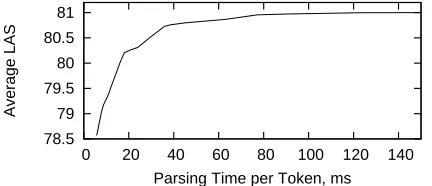
Figure 1: Average labeled attachment score on Basque, Chinese, English, and Turkish development sets as a function of parsing time per token
cause it does not require much effort in feature en-gineering. As was demonstrated in (Titov and Hen-derson, 2007b), even a minimal set of local explicit features achieves results which are non-significantly different from a carefully chosen set of explicit fea-tures, given the language independent definition of locality described in section 2.
It is also important to note that the model is quite efficient. Figure 1 shows the tradeoff be-tween accuracy and parsing time as the width of the search beam is varied, on the development set. This curve plots the average labeled attachment score over Basque, Chinese, English, and Turkish as a function of parsing time per token.4 Accuracy of only 1% below the maximum can be achieved with average processing time of 17 ms per token, or 60 tokens per second.5
We also refer the reader to (Titov and Henderson, 2007b) for more detailed analysis of the ISBN de-pendency parser results, where, among other things, it was shown that the ISBN model is especially ac-curate at modeling long dependencies.
4A piecewise-linear approximation for each individual
lan-guage was used to compute the average. Experiments were run on a standard 2.4 GHz desktop PC.
5For Basque, Chinese, and Turkish this time is below 7 ms,
but for English it is 38 ms. English, along with Catalan, required the largest beam across all 10 languages. Note that accuracy in the lowest part of the curve can probably be improved by vary-ing latent vector size and frequency cut-offs. Also, efficiency was not the main goal during the implementation of the parser, and it is likely that a much faster implementation is possible.
5 Conclusion
We evaluated the ISBN dependency parser in the multilingual shared task setup and achieved com-petitive accuracy on every language, and the third best average score overall. The proposed model re-quires minimal design effort because it relies mostly on automatic feature induction, which is highly de-sirable when using new treebanks or languages. The parsing time needed to achieve high accuracy is also quite small, making this model a good candidate for use in practical applications.
The fact that our model defines a probability model over parse trees, unlike the previous state-of-the-art methods (Nivre et al., 2006; McDonald et al., 2006), makes it easier to use this model in ap-plications which require probability estimates, such as in language processing pipelines or for language modeling. Also, as with any generative model, it should be easy to improve the parser’s accu-racy with discriminative reranking, such as discrim-inative retraining techniques (Henderson, 2004) or data-defined kernels (Henderson and Titov, 2005), with or even without the introduction of any addi-tional linguistic features.
Acknowledgments
This work was funded by Swiss NSF grant 200020-109685, UK EPSRC grant EP/E019501/1, and EU FP6 grant 507802 for project TALK.
References
A. Abeill´e, editor. 2003. Treebanks: Building and Using Parsed Corpora. Kluwer.
I. Aduriz, M. J. Aranzabe, J. M. Arriola, A. Atutxa, A. Diaz de Ilarraza, A. Garmendia, and M. Oronoz. 2003. Construction of a Basque dependency treebank. In Proc. of the 2nd Workshop on Treebanks and Lin-guistic Theories (TLT), pages 201–204.
[image:4.612.75.291.149.242.2]Sabine Buchholz and Erwin Marsi. 2006. CoNLL-X shared task on multilingual dependency parsing. In Proc. of the Tenth Conference on Computational Nat-ural Language Learning, New York, USA.
K. Chen, C. Luo, M. Chang, F. Chen, C. Chen, C. Huang, and Z. Gao. 2003. Sinica treebank: Design criteria, representational issues and implementation. In Abeill´e (Abeill´e, 2003), chapter 13, pages 231–248.
D. Csendes, J. Csirik, T. Gyim ´othy, and A. Kocsor. 2005. The Szeged Treebank. Springer.
J. Hajiˇc, O. Smrˇz, P. Zem´anek, J. ˇSnaidauf, and E. Beˇska. 2004. Prague Arabic dependency treebank: Develop-ment in data and tools. In Proc. of the NEMLAR In-tern. Conf. on Arabic Language Resources and Tools, pages 110–117.
James Henderson and Ivan Titov. 2005. Data-defined kernels for parse reranking derived from probabilis-tic models. In Proc. 43rd Meeting of Association for Computational Linguistics, Ann Arbor, MI.
James Henderson. 2003. Inducing history representa-tions for broad coverage statistical parsing. In Proc. joint meeting of North American Chapter of the Asso-ciation for Computational Linguistics and the Human Language Technology Conf., pages 103–110, Edmon-ton, Canada.
James Henderson. 2004. Discriminative training of a neural network statistical parser. In Proc. 42nd Meeting of Association for Computational Linguistics, Barcelona, Spain.
R. Johansson and P. Nugues. 2007. Extended constituent-to-dependency conversion for English. In Proc. of the 16th Nordic Conference on Computational Linguistics (NODALIDA).
M. Marcus, B. Santorini, and M. Marcinkiewicz. 1993. Building a large annotated corpus of English: the Penn Treebank. Computational Linguistics, 19(2):313–330.
M. A. Mart´ı, M. Taul´e, L. M`arquez, and M. Bertran. 2007. CESS-ECE: A multilingual and multilevel annotated corpus. Available for download from: http://www.lsi.upc.edu/∼mbertran/cess-ece/.
Ryan McDonald, Kevin Lerman, and Fernando Pereira. 2006. Multilingual dependency analysis with a two-stage discriminative parser. In Proc. of the Tenth Con-ference on Computational Natural Language Learn-ing, New York, USA.
S. Montemagni, F. Barsotti, M. Battista, N. Calzolari, O. Corazzari, A. Lenci, A. Zampolli, F. Fanciulli, M. Massetani, R. Raffaelli, R. Basili, M. T. Pazienza, D. Saracino, F. Zanzotto, N. Nana, F. Pianesi, and
R. Delmonte. 2003. Building the Italian Syntactic-Semantic Treebank. In Abeill´e (Abeill´e, 2003), chap-ter 11, pages 189–210.
Joakim Nivre and Jens Nilsson. 2005. Pseudo-projective dependency parsing. In Proc. 43rd Meeting of Asso-ciation for Computational Linguistics, pages 99–106, Ann Arbor, MI.
Joakim Nivre, Johan Hall, and Jens Nilsson. 2004. Memory-based dependency parsing. In Proc. of the Eighth Conference on Computational Natural Lan-guage Learning, pages 49–56, Boston, USA.
Joakim Nivre, Johan Hall, Jens Nilsson, Gulsen Eryigit, and Svetoslav Marinov. 2006. Pseudo-projective de-pendency parsing with support vector machines. In Proc. of the Tenth Conference on Computational Nat-ural Language Learning, pages 221–225, New York, USA.
J. Nivre, J. Hall, S. K ¨ubler, R. McDonald, J. Nils-son, S. Riedel, and D. Yuret. 2007. The CoNLL 2007 shared task on dependency parsing. In Proc. of the CoNLL 2007 Shared Task. Joint Conf. on Em-pirical Methods in Natural Language Processing and Computational Natural Language Learning (EMNLP-CoNLL).
K. Oflazer, B. Say, D. Zeynep Hakkani-T ¨ur, and G. T¨ur. 2003. Building a Turkish treebank. In Abeill´e (Abeill´e, 2003), chapter 15, pages 261–277.
P. Prokopidis, E. Desypri, M. Koutsombogera, H. Papa-georgiou, and S. Piperidis. 2005. Theoretical and practical issues in the construction of a Greek depen-dency treebank. In Proc. of the 4th Workshop on Tree-banks and Linguistic Theories (TLT), pages 149–160.
Ivan Titov and James Henderson. 2007a. Constituent parsing with incremental sigmoid belief networks. In Proc. 45th Meeting of Association for Computational Linguistics (ACL), Prague, Czech Republic.