Abstract— In this paper, we attempt to develop image watermarking algorithms which are portable to a variety of applications such as copyright protection, fingerprinting and identification. Therefore, we require that the watermark be binary and be not only detectable but also extractable. The embedding technique is based on the parent-child structure of the multiwavelet transform called “triple tree” and this technique does not require the original image in the watermark extraction. The experimental results show that the watermark survives to most of the attacks which were included in this study.
Index Terms— Multiwavelet, Multiwavelet tree,Watermarking.
I.
I
NTRODUCTIONDigital watermarking offers a means for protecting intellectual property of digital multimedia contents that have been explosively exchanged in the digital world. This technique is based on embedding information data (called watermark) into the digital contents. The main requirements of digital watermarking are invisibility, robustness and data capacity. These requirements are mutually conflicting, and thus, in the design of a watermarking system, the trade off has to be made [1].
According to the need of original data during watermark detection process, watermarking algorithms are classified into private algorithm and public or blind one [2]. Private method needs the original signal during detection. In some cases, when the original data is not easy to obtain, or when we do not know which copy is the original one, it is necessary to used blind watermarking for resolving rightful ownership.
In recent years, some multiwavelet-based image watermarking algorithms have been proposed. Kwon and Tewfik [3] proposed an adaptive image watermarking scheme in the discrete multiwavelet transform (DMT) domain using successive subband quantization and a perceptual modeling. The watermark is Gaussian random sequence with unit variance and the original image is needed for watermark detection.
Manuscript received March 5, 2007. This work was supported by Suranaree University of Technology, Nakhon Ratchasima, THAILAND.
P. Kumsawat is with the School of Telecommunication Engineering, Institute of Engineering, Suranaree University of Technology, Nakhon Ratchasima, 30000, THAILAND (e-mail: [email protected]).
K. Attakitmongcol is with the School of Electrical Engineering, Institute of Engineering, Suranaree University of Technology, Nakhon Ratchasima, 30000, THAILAND (e-mail: [email protected]).
A. Srikaew is with the School of Electrical Engineering, Institute of Engineering, Suranaree University of Technology, Nakhon Ratchasima, 30000, THAILAND (e-mail: [email protected]).
In [4], Zhang et al. proposed a novel watermarking scheme for an image, in which a logo watermark is embedded into the multiwavelet domain of image using back-propagation neural network (BPN). Due to the learning and adaptive capabilities of BPN, their scheme can gain good robustness. In [5], Kumsawat et al. proposed an image watermarking algorithm using the DMT and Genetic Algorithm is applied to search for optimal watermarking parameters to improve the quality of the watermarked image and the robustness of the watermark. Ghouti et al. [6] introduced a robust watermarking algorithm using balanced multiwavelet transform. The watermark embedding scheme is based on the principles of spread-spectrum communications to achieve higher watermark robustness. Wang and Lin [7] proposed a wavelet tree quantization for copyright protection watermarking. The wavelet coefficients are grouped into a predefined structure called supertree. Watermark bits are also embedded by quantizing supertree and the resulting difference between quantized and unquantized trees will later be used for watermark extraction.
In our algorithm, the watermark is embedded into the DMT coefficients using multiwavelet tree techniques. The proposed watermarking technique is resistant against various image processing attacks as will be demonstrated in the examples. Finally, we have compared our experimental results with the results of previous work.
II.
P
RELIMINARIESA. Multiwavelet Transform
In recent years, multiwavelet transformation has gained a lot of attention in signal processing applications. The main motivation of using multiwavelet is that it is possible to construct multiwavelets that simultaneously possess desirable properties such as orthogonality, symmetry and compact support with a given approximation order. These properties are not possible in any scalar wavelet. Next, we give a brief overview of the multiwavelet transform.
Let Φ denote a compactly supported orthogonal scaling vector Φ=(φ1,φ2,...,φr)T where r is the number of scalar scaling functions. Then Φ(t) is satisfy a two-scale dilation equation of the form
∑ Φ −
= Φ
n
n t n h
t) 2 ( ) (2 )
( (1)
A Robust Image Watermarking Scheme
Using Multiwavelet Tree
for some finite sequence h of r×r matrices. Furthermore, the integer shifts of the components of Φ form an orthonormal system, that is
. )
' ( ),
( l' l,l' n,n'
l n φ n δ δ
φ ⋅− ⋅− >=
< (2)
Let V0 denote the closed span of
} ,..., 2 , 1 , | ) (
{φl ⋅−n n∈Z l= r and define
} | ) 2 (
{f f V0
V
j
j ∈
⋅
= . Then (Vj)j∈Z is a multiresolution analysis of L2(R) [7]. Note that we choose the decreasing convention .Vj+1⊂Vj
Let Wj denote the orthogonal complement of Vj in Vj−1
Then there exists an orthogonal multiwavelet
T r
) ,..., , (ψ1ψ2 ψ
=
Ψ such that {ψl(⋅−n)|l=1,2,...,r and }
Z
n∈ form an orthonormal basis of W0. Since W0⊂V−1, there exists a sequence g of r×r matrices such that
. ) 2 ( ) ( 2 )
( = ∑ Φ −
Ψ
n
n t n g
t (3) Let f ∈V0, then f can be written as a linear combination of the basis in V0:
=∑ Φ −
n
T t k
k c t
f() 0( ) ( ) (4)
for some sequence c0∈l2(Z)r. Since V0=V1⊕W1, f can also be expressed as
∑ Φ −
=
∈Z k
T
k t k c t
f )
2 ( ) ( 2 1 )
( 1
∑ −
+
∈Z k
T t k
k
d ). 2 ( ) ( 2 1
1 ψ (5)
The coefficients c1 and d1 are related to c0 via the following decomposition and reconstruction algorithm:
∑ +
=
n
n k c n h k
c1( ) ( ) 0(2 ) (6)
∑ +
=
n
n k c n g k
d1( ) ( ) 0(2 ) (7)
=∑ −
n
Tc n
n k h k
c0( ) ( 2 ) 1( )
+∑ −
n
Td n
n k
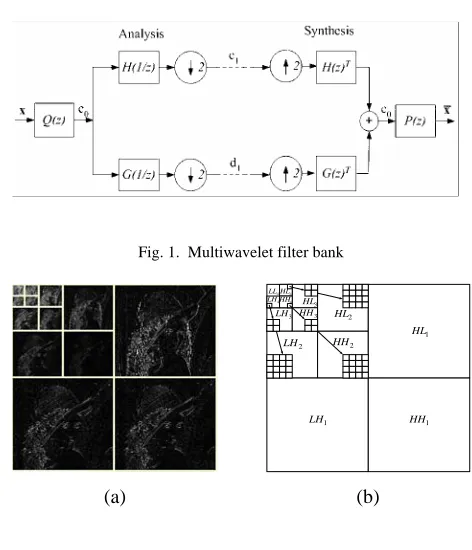
g( 2 ) 1( ). (8) Unlike scalar wavelet, even though the multiwavelet is designed to have approximation order p , the filter bank associated with the multiwavelet basis does not inherit this property. Thus, in applications, one must associate a given discrete signal into a sequence of length−r vectors without losing some certain properties of the underlying multiwavelet. Such a process is referred to as prefiltering. The block diagram
[image:2.612.318.554.125.400.2]of a multiwavelet with prefilter Q(z) and postfilter P(z) is shown in Fig. 1. H(z)andG(z) are the z transform of h(n) and )g(n , respectively. Figure 2(a) show a four-level multiwavelet decomposition using the DGHM multiwavelet with optimal orthogonal prefilter [8].
Fig. 1. Multiwavelet filter bank
1
LL1
HL
4
LLHL4 4
LHHH4
3
HH HL2
3
LH
1 HL
1 HH 2
LH HH2
1 LH
3
HL
(a) (b)
Fig. 2. (a) Four-level multiwavelet decomposition of image having size of 512×512 pixels and (b) the parent-child dependencies of multiwavelet tree.
B. Multiwavelet Tree
Multiwavelet transform coefficients have the property that the related coefficients in different scales are located at the same orientation and location in the multiwavelet hierarchical decomposition. With the exception of the highest frequency subbands, every coefficient at a given scale can be related to a set of coefficients at the next finer scale of similar orientation. The coefficient at the coarse scale is called the parent, and all coefficients corresponding to the same spatial location at the next finer scale of similar orientation are called children. For the multiwavelet hierarchical subband decomposition, the parent-child dependencies are shown in Fig. 2(b). For a given parent, the set of all coefficients at all finer scales of similar orientation corresponding to the same location are called descendants. A multiwavelet tree descending from a single coefficient in the subband HL4 is shown in Fig. 2(b).
(a) (b)
Fig. 3. (a) A group of multiwavelet coefficients in each tree and (b) the example of triple tree.
In other subbands, we group the coefficients corresponding to the same spatial location together. Figure 3(a) shows an example of a group with one coefficient from HL4 , 4 coefficients fromHL3, and 16 coefficients fromHL2 . The coefficients of the same group correspond to various frequency bands of the same spatial location and the same orientation. The total number of groups is equal to the sum of the number of coefficient inLH4, HL4andHH4, each of which has 32×32 coefficients. There are a total of 3×32×32 = 3072 groups. We denote each group of multiwavelet tree by Tgm , where
3072 ,..., 2 , 1
=
m .
III.
P
ROPOSEDM
ETHODIn this section, we first give a brief overview of the watermark embedding and watermark extracting processes in the DMT domain based on the concept of multiwavelet tree. We then describe the detection analysis of our proposed method.
A. Watermark Embedding Algorithm
The watermark embedding algorithm is as follows:
1. Generate a random watermark W using the secret key, where W is a binary pseudo-random noise sequence of watermark bits, and W ={wi}fori=1,2,...,Nw, where Nw is the length of watermark.
2. Transform the original image into four level decomposition using the DMT. Then, we create multiwavelet trees and rearrange them into 3072 groups.
3. Quantize each group by using JPEG quantization matrix [9] in order to gain the robustness to JPEG compression attack. 4. To increase the watermarking security, we order the groups
m
Tg in a pseudorandom manner. The random numbers can be generated using the secret key. We further combine the coefficients of every three groups together to form “a triple tree: Ttn ”, for n=1,2,...,1024 . Each watermark bit is embedded into one triple tree. An example of a triple tree is shown in Fig. 3(b).
5. For watermark embedding, we select Nw triple trees
i
Tt fori=1,2,...,Nw. Then, we modify the coefficients in triple trees in the watermark embedding process as follows:
⎩ ⎨ ⎧
−
= −
+ =
otherwise Tt
Tt
w if Tt
Tt Ttw
i i
i i
i
i mod2
1 1
2 mod
(9)
where Ttwi is a triple tree that contains watermark information and “mod” is the modulo operator.
6. Perform inverse quantization in each group of all triple trees and pass the modified DMT coefficients through the inverse DMT to obtain the watermarked image. The watermark embedding process is shown in Fig. 4.
Fig. 4. Watermark embedding process
B. Watermark Extracting Algorithm
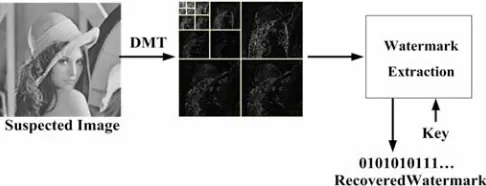
1. Transform the watermarked image into four level decomposition using the DMT. Then, create the multiwavelet trees and rearrange them into 3072 groups.
2. We apply JPEG quantization matrix to each group of multiwavelet tree. Then, order the groups in a pseudorandom manner using the secret key. We further combine every 3 groups to form a triple tree Ttn, forn=1,2,...,1024.
3. To extract the embedded watermark, we select Nw triple trees Ttifrom all triple trees and count the even and odd number of the coefficients in triple tree based on
2 mod
i
Tt computation. The embedded bit can now be recovered from a triple tree as follow:
⎩ ⎨ ⎧ −
≥ =
otherwise even odd if wi
1 1
~ (10)
4. After extracting the watermark, we used normalized correlation coefficients to quantify the correlation between the original watermark and the extracted one. A normalized
correlation between W and W~ is defined as [7]:
∑ ∑
∑ =
= =
w w
N
i i i i
i i N
i
w w
w w W
W
1
2 2 1
~ ~
) ~ , (
ρ (11)
Fig. 5. Watermark extracting process
C. Watermark Detection Analysis
For application of copyright protection, the watermark detection aims at verifying whether a given watermark is embedded in the test image or not. Thus, the detection of a watermark is formulated as a binary hypothesis testing problem. The two hypotheses denoted H0 and H1 are
0
H : The test image does not contain the watermark, or it contains a different watermark than the one under investigation.
1
H : The test image contains the watermark.
For a given thresholdT, the system performance can be measured in term of the probability of false alarm Pfa(T) (i.e., the probability to detect a watermark in an image that is not watermarked or, is watermarked with a different watermark) and the probability of false rejection Pfr(T) (i.e., failure to detect an existing watermark):
Pfa(T)=Prob{ρ(W,W~)≥T|H0} (12) }
| ) ~ , ( { Prob )
(T W W T H1
Pfr = ρ < (13) whereProb{A|B}is the probability of event A given event B. Depending on application, these two types of error probabilities might have different significant. For copyright protection application, it is more important to have low or zero false alarm rates.
In order to decide the valid hypothesis, the correlation
) ~ , (W W
ρ is compared with threshold T. The Neyman-Pearson criterion can be used to obtain threshold Tin such a way that the false rejection probability is minimized, subject to a fixed false alarm probability [10]. The final step for watermark detection for the binary hypothesis case is to make following comparison.
If ρ(W,W~)≥T, the watermark W is detected. If ρ(W,W~)<T, the watermark W is not detected.
From (12), the normalized correlation coefficient is bounded
by −1≤ρ(W,W~)≤1. Since the watermark is a binary sequence of ±1, we have
Nw w
i i
N
i i
N w w
w
= ∑ = ∑
= = 1
2
1
2 (~ ) . (14)
Let PE be the probability of bit error during extraction and defined asPE =Prob(wm≠w~m). If we let bi =wiw~i, for
w
N
m=1,2,..., , then bi =−1 indicates a bit error and 1
=
i
b indicates no error. The normalized correlation coefficient can also be written as
w i
w
i i i
N b N
w w W
W = ∑
∑ =
~
) ~ , (
ρ (15)
And
Pfa(T)=Prob{∑bi ≥NwT|H0}. (16) Using this expression, the probability of false alarm can be computed by [11],
w EN k E k
N
N T k
fa P P
k N
P w w
w
) 1 ( )
2 / ) 1 ((
− ⎟⎟
⎠ ⎞ ⎜⎜ ⎝ ⎛ ∑
= −
+
= , (17)
where
! ) ( !
!
k N k
N k
N
w w w
− =
⎟⎟ ⎠ ⎞ ⎜⎜ ⎝ ⎛
. The false alarm probability
depends onPE,Nw andT . In the case that the underlying image is not a watermarked copy, it is reasonable to assume
E
P = 0.5. We choose the threshold T=0.4that has an associated probability of false alarm less than 2.02 × 10⁻²⁰ for a 512 bit watermark.
IV.
E
XPERIMENTAL RESULTSAND DISCUSSIONSTo evaluate the performance of the proposed watermarking scheme, experiments have been conducted in which a DGHM multiwavelet was used to decompose the original image. The original image is a 256 gray-level image with the size of 512×512 pixels and the watermark length Nw= 512. The PSNR for the watermarked version of the Lena image is 38.37 dB.
The watermarked images are attacked by various image compression and manipulations. Then, we perform the watermark extraction process and compute the normalized correlation coefficient. Since our system is a multi-bit watermarking system, the bit error rate (BER) is a very useful measure of performance. In this case, the bit error rate is calculated as the number of incorrectly decoded bits divided by the total number of embedded bits in the watermarked image.
[image:4.612.54.297.51.144.2]high as 30. This demonstrates that the scheme is very robust to JPEG compression.
Next, we test the robustness with respected to JPEG2000 compression. The experiment results are shown in Fig. 6(b) and 7(b). In this case, the detector behaves significantly better than in the JPEG case. This could be explained by the fact that the image quality obtained by JPEG2000 is higher than that obtained by JPEG at the same compression ratio. Therefore, the watermark signal is better preserved by JPEG2000. Furthermore, we evaluate the robustness against cropping. We attack the watermarked images by cropping 10%, 20%, 30%, 40% and 50% of its surroundings. The results in Fig. 6(c) and 7(c) show that the watermarks can survive very well.
Finally, the results obtained from our proposed method which is called DMT-Tree are compared with the method based on wavelet-tree quantization in [7], which is called Method 1. For a fair comparison, the quality of the watermarked Lena image (PSNR around 38 dB) and embedding capacity (watermark 512 bits) for both schemes must be the same. The comparison results are listed in Table I to Table III.
According to these results, the proposed watermarking technique is significantly more robust than the Method 1. This
is due to the predefined structure of multiwavelet tree called “triple tree” of the proposed algorithm. The watermark bits spread over all groups of multiwavelet trees. As a result, the watermark is robust against watermark attacks. In addition, the proposed technique utilizes the quantization-based embedding strategy. Hence, it gains the watermark robustness to JPEG compression attack.
V.
C
ONCLUSIONSThis paper proposed a new digital image watermarking algorithm in the multiwavelet transform domain. The embedding technique is based on the parent-child structure of the transform coefficient called the triple tree. By use of Neyman-Pearson criterion, a decision threshold is explicitly derived without referring to the original image. The experimental results show that the watermark survives to most of the attacks which were included in this study. Further research can be concentrated on the development of our proposed method by using the characteristics of the human visual system.
5 10 15 20 25 30
0.4 0.5 0.6 0.7 0.8 0.9 1
N
o
rm
a
li
z
e
d
C
o
rre
la
ti
o
n
Compression Ratio
5 10 15 20 25 30
0.4 0.5 0.6 0.7 0.8 0.9 1
N
o
rm
a
li
z
e
d
C
o
rre
la
ti
o
n
Compression Ratio
10 15 20 25 30 35 40 45 50
0.4 0.5 0.6 0.7 0.8 0.9 1
N
or
m
al
iz
ed
Co
rr
el
at
io
n
Cropping Area (%)
(a) (b) (c)
Fig. 6. Normalized correlation coefficient from different types of attacks using Lena image, (a) JPEG compression, (b) JPEG2000 compression and (c) cropping.
5 10 15 20 25 30
0 5 10 15 20 25 30
B
it
E
rro
r R
a
te
(%
)
Compression Ratio
5 10 15 20 25 30
0 5 10 15 20 25 30
B
it
E
rro
r Ra
te
(%
)
Compression Ratio
10 15 20 25 30 35 40 45 50
0 5 10 15 20 25 30
B
it
E
rro
r R
a
te
(%
)
Cropping Area (%)
(a) (b) (c)
TABLE I
N
ORMALIZEDC
ORRELATIONF
ROMJ
PEGC
OMPRESSIONNormalized Correlation JPEG Quality factor
(%) DMT-Tree Method 1
30 0.5391 0.1500
40 0.7227 0.2300
50 0.9023 0.2600
70 0.9844 0.5700
90 1.0000 1.0000
TABLE II
N
ORMALIZEDC
ORRELATIONF
ROMS
PIHT [12]C
OMPRESSIONNormalized Correlation Bit rate
(bpp) DMT-Tree Method 1
0.3 0.5703 0.2100
0.4 0.7813 0.4100
0.5 0.9102 0.8500
0.6 0.9453 0.8300
0.7 0.9570 0.8500
TABLE III
N
ORMALIZEDC
ORRELATONF
ROMS
IGNALP
ROCESSIGA
TTACKSNormalized Correlation Attack
DMT-Tree Method 1
2x2 Median filtering
0.4648 0.3800
3x3 Median filtering
0.6445 0.5100
4x4 Median filtering
0.4492 0.2300
3x3 Gaussian filtering
0.6680 0.6400
Rotation 0.25 0.6484 0.3700
Rotation 0.5 0.4570 0.2900
Rotation 0.75 0.4375 0.2600
Rotation 1.0 0.4219 0.2400
Rotation -0.25 0.6523 0.3200
Rotation -0.5 0.4609 0.2300
Rotation -0.75 0.4375 0.2400
Rotation -1.0 0.4180 0.1600
REFERENCES
[1] F. Hartung and M. Kutter, “Multimedia watermarking techniques,” Proc. IEEE, vol. 87, no. 7, pp. 1079-1107, July 1999.
[2] S. -J. Lee and S. -H. Jung, “A survey of watermarking techniques applied to multimedia,” Proc. IEEE ISIE, vol. 1, pp. 272-277, June 2001. [3] K. -R. Kwon and A. H. Tewfik, “Adaptive watermarking using
successive subband quantization and perceptual model based on multiwavelet transform,” Proc. SPIE- Security and Watermarking of Multimedia Contents IV, vol. 4675, p. 334-348, Apr. 2002.
[4] [4] J. Zhang, N. Wang and F. Xiong, “Hiding a logo watermark into the multiwavelet domain using neural networks,” Proc. IEEE ICTAI 2002, pp. 477-482, 2002.
[5] [5] P. Kumsawat, K. Attakitmongcol and A. Srikaew, “A new approach for optimization in image watermarking by using genetic algorithms ,”
IEEE Transactions on Signal Processing, Vol. 53, pp. 4707-4719, Dec. 2005.
[6] [6] L. Ghouti, A. Bouridane, M. K. Ibrahim and S. Boussakta, “Digital image watermarking using balanced multiwavelets,” IEEE Transactions on Signal Processing, Vol. 54, pp. 1519-1536, Apr. 2006.
[7] [7] S. -H. Wang and Y. -P. Lin, “Wavelet tree quantization for copyright protection watermarking,” IEEE Trans. on Image Processing, vol. 13, pp. 154-165, Feb. 2004.
[8] [8] K. Attakitmongcol, D. P. Hardin and D. M. Wilkes, “Multiwavelet prefilters II: Optimal orthogonal prefilters”, IEEE Trans. on Image Processing, vol. 10, pp. 1476–1487, Oct. 2001.
[9] [9] P. B. William, M. L. Joan, “JPEG still image data compression standard”, Van Nostrand Reinhold, New York, 1993.
[10] [10] M. Barni, F. Bartolini and A. Piva, “Improved wavelet-based watermarking through pixel-wise masking,” IEEE Trans. on Image Processing, vol. 10, pp. 783 -791, May 2001.
[11] [11] D. Kundur and D. Hatzinakos, “Digital watermarking using multiresolution wavelet decomposition,” Proc. IEEE ICASSP, vol. 5, pp. 2969-2972, 1998.