Static and Dynamic Analysis of Regular and
Irregular Composite Building
Anooja S
1, Rajalakshmi U
21M-Tech student, Sri Vellapally Natesan College of Engineering, Kattachira,Kerala
2Assistant Professor, Department of Civil Engineering, Sri Vellapally Natesan College of Engineering, Kattachira,Kerala
Abstract: In India concrete is very popular material of construction especially in case of medium and low-rise buildings. And in case of high-rise buildings steel is generally used and the composite construction is not such popular but it is possible that composite construction can be more beneficial in case of medium and high-rise buildings. Steel-concrete composite construction can be built in place of RCC structures to get maximum advantage of steel and concrete and to produce efficient and economic structures. This paper shows simple geometry attracts less force and perform well during the effect of earthquake. It is inevitable to omit complex geometries but complex shapes can be reduced to the simple ones and adopted from the planning stage.
Keywords:Composite beam, Composite column, deck slab, base shear, Storey Drift
I. INTRODUCTION
Structural analysis is mainly concerned with finding out the behavior of a structure when subjected to some action. This action can be in the form of load due to weight of things such as people, furniture, snow etc. or some other kind of excitation such as earthquake, shaking of the ground due to a blast nearby etc. Among these loads earthquake load is the most drastic one. A disruptive disturbance, that causes shaking of the surface of the earth due to underground movement along a fault plane or from volcanic activity is called earthquake. It is a natural calamity that has taken millions of lives through the ages. The earthquake ranks as one of the most destructive events recorded so far in India in terms of death toll & damage to infrastructure. In the past, for the design of a building, the choice was normally between a concrete structure and a masonry structure. The failure of many multi-storied and low- rise RCC and masonry buildings due to earthquake has forced the structural engineers to look for the alternative method of construction having lesser depth which saves the material cost. Use of composite or hybrid material is of particular interest, due to its significant potential in improving the overall performance through rather modest changes in manufacturing and constructional technologies. In composite construction the two different materials are tied together by use of shear studs at their interface. The reason why composite construction is often so good can be expressed in one simple way concrete is good in compression and steel is good in tension.
In the present work Comparative study of regular and irregular composite building in various seismic zones and various soil profile are included. The comparative study includes storey drifts, displacement base shear of composite members, seismic forces and behaviour of the building under seismic condition in composite members.
Composite beam: A steel concrete composite beam consists of a steel beam, over which a reinforced concrete slab is cast with shear connectors. The composite action reduces the beam depth. Rolled steel sections themselves are found adequate frequently for buildings and built up girders are generally unnecessary. The composite beam can also be constructed with profiled sheeting with concrete topping or with cast in place or precast reinforced concrete slab.
1) Composite Column: A steel – concrete composite column is conventionally a compression member in which the steel element is a structural steel section. There are three types of composite columns used in practice which are Concrete Encased, Concrete filled, Battered Section.
Fig 2: Concrete encased steel column
II. NEED FOR THE STUDY
A need to study the composite design of the multi-story buildings keeping in view of the rapid development in this field. In India, it is comparatively new and no updated design codes are available for the same. The main reason for this preference is that the composite sections and members are best suited to resist repeated earthquake loadings, which require a high amount of resistance and ductility.
III. SCOPE AND OBJECTIVES
The scope of the present study is to perform linear dynamic response spectrum analysis of a regular building and mass irregular building with and without damper at different location using ETABS.
The objectives are
A. To conduct static analysis of regular and irregular composite building.
B. To conduct response spectrum analysis of regular and irregular composite building. C. To compare the storey shear, storey drift and displacement values.
IV. METHODOLOGY
This project deals with comparative study of seismic behaviour of high-rise composite structure building frames static analysis. A comparison of analysis results in terms of Maximum displacements, wind forces, Maximum bending moments has been carried out. A 10-storied building which is situated in seismic zone III is considered for the analysis. The analysis is conducted on 3D frame models using ETABS. The height of each storey provided was 3.2 m. The materials selected in this study are M25 and M30 concrete and Fe415 steel.
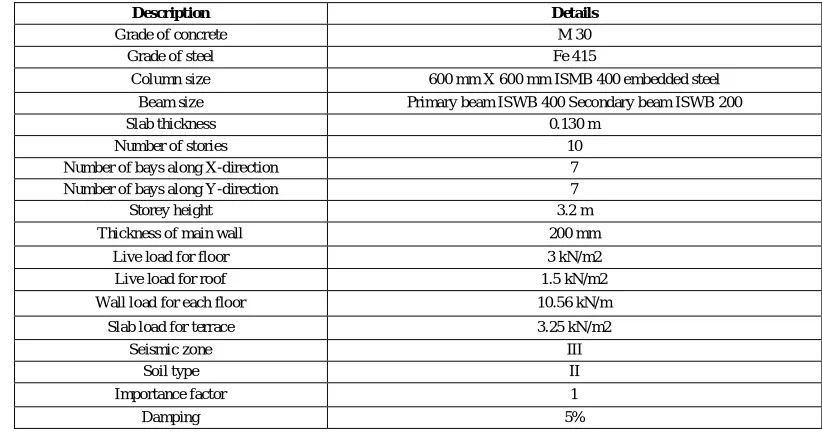
Table 1: Data of the building considered for modelling
Description Details
Grade of concrete M 30
Grade of steel Fe 415
Column size 600 mm X 600 mm ISMB 400 embedded steel
Beam size Primary beam ISWB 400 Secondary beam ISWB 200
Slab thickness 0.130 m
Number of stories 10
Number of bays along X-direction 7
Number of bays along Y-direction 7
Storey height 3.2 m
Thickness of main wall 200 mm
Live load for floor 3 kN/m2
Live load for roof 1.5 kN/m2
Wall load for each floor 10.56 kN/m
Slab load for terrace 3.25 kN/m2
Seismic zone III
Soil type II
Importance factor 1
[image:2.595.89.500.539.760.2]A. Load Cases
The different loads assigned are dead load (IS 875 part 1-1987), live load (IS 875 part 2- 1987) and seismic loads (IS 1893-2002). Gravity loads on structures include the weight of beams, slabs, column and walls. The wall loads have been calculated and assigned as uniformly distributed loads on beams. Live load on the floor is 3kN/m2 and live load on roof is 1.5kN/m. The load combinations considered for the analysis and design is as per IS:1893-2002. The different load cases considered are given below.
1) 1.5(DL+IL) 2) 1.2(DL+IL±EL) 3) 1.5(DL±EL) 4) 0.9DL±1.5EL
B. Analysis of structure
[image:3.595.198.397.297.486.2]Linear response spectrum analysis and linear static analysis has been done for different models. ETABS software is used for the entire analysis. Dead load, live load, and seismic load were mainly considered for the analysis. From response spectrum analysis and static analysis storey displacement, storey shear, base shear can be determined.
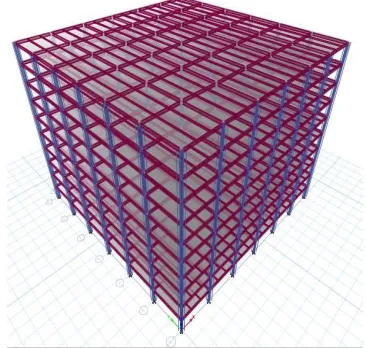
Fig 3: 3D view of the regular building in ETABS
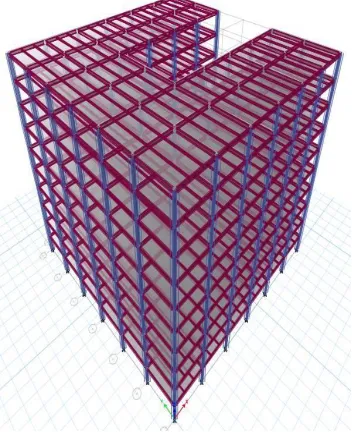
[image:3.595.210.388.518.734.2]Fig 5: 3D view of the L-shape building in ETABS
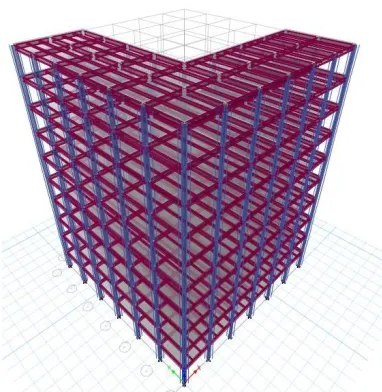
Fig 6: 3D view of the T-shape building in ETABS
[image:4.595.208.388.554.737.2]Fig 8: 3D view of the mass irregular building in ETABS
Fig 9: 3D view of the stiffness irregular building in ETABS
V. RESULTS AND DISCUSSION A. Comparison Of Base Shear
The base shear for regular, C-shape, L-shape, T-shape, diaphragm irregular, mass irregular, stiffness irregular building are compared.
Table 2: Comparison of base shear
Building Base Shear (kN) RCC 19681.99
Composite Regular 16041.421
Composite C- shape 8115.232
Composite L-shape 4646.021
Composite T-shape 4638.283
Composite Diaphragm 8115.308
Composite Mass-irregular 22566.908
[image:5.595.189.405.319.517.2]Fig. 10 Comparison of base shear from response spectrum analysis
[image:6.595.126.468.317.598.2]B. Maximum Storey Displacement
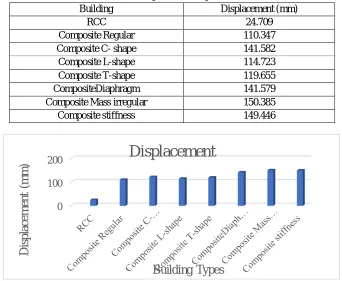
Table 3: Comparison of displacement
Building Displacement (mm)
RCC 24.709
Composite Regular 110.347
Composite C- shape 141.582
Composite L-shape 114.723
Composite T-shape 119.655
CompositeDiaphragm 141.579
Composite Mass irregular 150.385
Composite stiffness 149.446
[image:6.595.93.493.623.754.2]Fig. 11: Comparison of displacement from response spectrum analysis
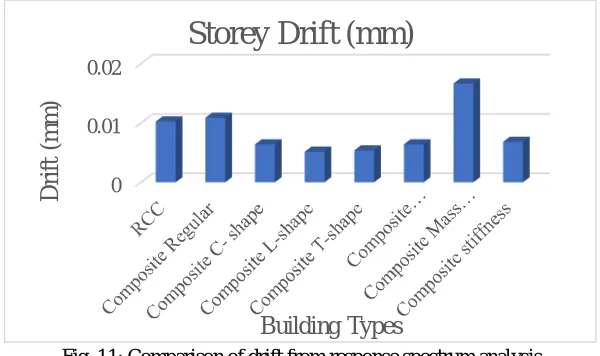
Table 4: Comparison of drift
Building Storey Drift (mm)
RCC 0.001013
Composite Regular 0.010892
Composite C- shape 0.005152
Composite L-shape 0.005375
Composite T-shape 0.006399
Composite Diaphragm 0.006399
Composite Mass irregular 0.006797
Composite stiffness 0.006831
Fig. 11: Comparison of drift from response spectrum analysis
VI. CONCLUSION
This paper shows simple geometry attracts less force and perform well during the effect of earthquake. Base Shear for RCC frame is maximum than that of composite frame because the weight of the RCC frame is more. In composite structure the self-weight of the frame is less and therefore substantial reduction in cost of the foundation. Under earthquake considerations because of the inherent ductility characteristics, Steel-Concrete structure will perform better than a conventional R.C.C. structure. It is inevitable to omit complex geometries but complex shapes can be reduced to the simple ones and adopted from the planning stage.
VII. ACKNOWLEDGMENT
We are really thankful to all the teaching and non-teaching staff of Sri Vellapally Natesan College of Engineering for supporting us throughout this work.
REFERENCES
[1] Ahmed Abdelraheem Farghaly, (2013), Parametric study on equivalent damping ratio of different composite structural building systems Steel and Composite Structures, 14, 349-365.
[2] Anirudh Gottala Kintali, Sai Nanda Kishore and Shaik Yajdhani A, (2015), Comparative Study of Static and Dynamic Seismic Analysis of a Multistoried Building, IJSTE - International Journal of Science Technology & Engineering, 01,2349-784.
[3] Arvind Reddy and R.J.Fernandes, (2015), Seismic analysis of RC regular and irregular frame structures, International Research Journal of Engineering and Technology (IRJET), 05, 2395 – 0072.
[4] B. S. Yashaswini and A. B. S. Dadapeer, (2017), Comparative Study on Static and Dynamic Analysis of Multistoried Building Using ETABS, IJSRST , 6, 463- 469.
[5] Bahador Bagheri, Ehsan Salimi Firoozabad and Mohammadreza Yahyaei, (2011), Comparative Study of the Static and Dynamic Analysis of Multi-Storey Irregular Building, World Academy of Science, Engineering and Technology International Journal of Civil and Environmental Engineering Vol:6, 11-57. [6] D. R. Panchal and P. M. Marathe, (2011), Comparative Study of R.C.C, Steel and Composite (G+30 Storey) Building, institute of technology, nirma university,
Ahmedabad – 03, 382 481.
[7] Deepak M Jirage, Prof . V.G. Sayagavi and Prof. N.G. Gore, (2015), Comparative Study of RCC and Composite Multi-storeyed Building, International Journal of Scientific Engineering and Applied Science (IJSEAS), 6, 2395-347.
[8] Geethu Girija Das and Dr. Praseeda K, (2016), Comparison of Conventional and Construction Stage Analysis of a RCC Building, International Journal of Science Technology & E
[9] I A. E. Hassaballa, Fathelrahman M. Adam., and M. A. Ismaeil, (2013), Seismic Analysis of a Reinforced Concrete Building by Response Spectrum Method, OSR Journal of Engineering (IOSRJEN), 9, 01-09.
[10] Jamandla Ramakrishna, S Sunil Pratap Reddy and Syed Riyaz, (2017), An Experimental Study On Seismic Analysis Of Multy Storey Building Using Equivalent Static Method, JETIR, 11, 2349-5162
[11] K.Upendra Reddy and E.Arunakanthi, (2017), Dynamic Analysis Of Multi Storey Structure For Different Shapes, International Journal of Technical Innovation in Modern Engineering & Science (IJTIMES), 12, 2455-2585
[12] Mahesh N. Patil and Yogesh N. Sonawane “Seismic Analysis of Multistoried Building”, International Journal of Engineering and Innovative Technology (IJEIT), 9, 15-26