Dendogram-based SVM
for Multi-Class Classi
fi
cation
Khalid Benabdeslem
1and Youn`es Bennani
2 1University of Lyon 1 – PRISMa Lab, Villeurbanne Cedex, France 2University of Paris 13 – LIPN/CNRS Lab, Villetaneuse, FranceThis paper presents a new approach called dendogram-based support vector machines(DSVM), to treat multi-class problems. First, the method consists to build a taxonomy of classes in an ascendant manner done by ascendant hierarchical clustering method (AHC). Second, SVM is injected at each internal node of the taxonomy in order to separate the two subsets of the current node. Finally, for classifying a pattern query, we present it to the “root” SVM, and then, according to the output, the pattern is presented to one of the two SVMs of the subsets, and so on through the “leaf” nodes. Therefore, the classification procedure is done in a descendant way in the taxonomy from the root through the end level which represents the classes. The pattern is thus associated to one of the last SVMs associated class. AHC decomposition uses distance measures to investigate the class grouping in binary form at each level in the hierarchy. SVM method requires little tuning and yields both high accuracy levels and good generalization for binary classification. Therefore, DSVM method gives good results for multi-class problems by both, training an optimal number of SVMs and by rapidly classifying patterns in a descendant way by selecting an optimal set of SVMs which participate to the final decision. The proposed method is compared to other multi-class SVM methods over several complex problems.
Keywords: AHC, SVM, multi-class problems.
1. Introduction
Achieving both high accuracy and good gen-eralization for complex problems of classifica-tion is a challenging problem, especially when data distribution is not linear and the number of classes is large. In this context, support vector machines have demonstrated superior perfor-mance [2]. However, SVM was originally de-signed for binary classification and its extension for multi-class classification is still an on-going research issue[3].
Actually, we distinguish two types of multi-class SVM approaches: one by directly consid-ering all data in one optimization formulation
[11] and the other by building and combining several binary classifiers [12,13]. In general, it is computationally more expensive to solve a multi-class problem than a binary problem with the same number of data. This work is devoted to the second approach, i.e. it solves a multi-class problem by decomposing it to sev-eral binary problems in a hierarchical way. The popular methods which decompose multi-class problems into many binary multi-class problems are “one-against-all” and “one-against-one” ap-proaches[14].
The “one-against-all” approach is a simple and effective method for multi-class classification. Suppose there are K classes in the problem. We partition these K classes into two-class prob-lems: one class contains patterns in one “true” class and the “others” class combines all other classes. A two-class classifier is trained for this two-class problem. We then partition the K classes into another original class, and the ‘oth-ers’ class contains the rest. Another two way classifier is trained. This procedure is repeated for each of the K classes, leading to K two-way trained classifiers.
the query pattern to a unique class. In prac-tice, however, many patterns show positive on more than one class, leading to ambiguous clas-sification results, the so-called ‘False positive’ problem. One of the main reasons for the false positive problem is that the decision boundary between one ‘true’ class and its complementary ‘others’ class cannot be drawn cleanly, due to the complexity of the ‘others’ class and close parameter proximity of some patterns.
In the “one-against-one” method, we train two-way classifiers between all possible pairs of classes; there are K(K−1)/2 of them. A new query pattern is then tested against these K(K−1)/2 classifiers and K(K−1)/2 scores
(votes) are obtained. In a perfect case, the correct class will get the maximum possible votes, which is (K−1)for all class-class pairs; and votes for other (K−1) classes would be randomly distributed, leading to [K(K−1)/2
−K−1]/(K−1) = (K−2)/2 per class on av-erage.
Subsequently, a K-class problem needs K(K− 1)/2 binary SVMs with “one-against-one” ap-proach and K SVMs for the “one-against-all” approach. Although the “one-against-one” ap-proach demonstrates superior performance, it may require prohibitively expensive comput-ing resources for many real world problems. The “one-against-all” approach shows some-what less accuracy, but still demands heavy computing resources, especially for real time applications.
The new method proposed in this paper pro-vides an alternative to the two presented meth-ods. The proposed DSVM takes advantage of both the efficient computation of the ascendant hierarchical clustering of classes and the high classification accuracy of SVM for binary clas-sification. Although DSVM needs(K-1)SVMs for K-class problem in the training phase, for the testing phase DSVM requires an optimal set of SVMs selected in a descendant way from the root of the taxonomy through the selected class among the “leaf” nodes.
In Section 2, we present the basic concept of SVM for linear and non linear problems. In Section 3 we describe the concept of our DSVM method. Finally, Section 4 shows our results ob-tained by comparing the proposed method with other ones over several problems.
2. Support Vector Machines and Binary Classification
The support vector machine is originally a bi-nary classification method developed by Vapnik and colleagues at Bell laboratories[5, 6], with algorithm improvements by others[7, 9]. SVM consists of projecting the input vectors into a high dimensional feature space, then searches for the linear decision boundary that maximizes the minimum distance between two class groups
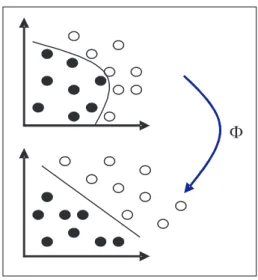
(Figure 1).
Fig. 1.General principle of SVM: projection of data in an optimal dimensional space.
In Figure 1 we can see that data are not lin-early separable in the initial space a) and after projection(by function: Φ) they become sep-arable in the high dimensional space b). SVM then consists of finding the optimal boundary for separating the positive class (dark circles)
from the negative one(white circles).
SVM separate between these two classes via a hyperplane that is maximally distant from the positive samples and from the negative ones
(Figure 1), then ‘plot’ the test data at the high dimensional space, distinguish whether it be-longs to positive or negative according to the optimal hyperplane.
For a binary classification problem with input space X and binary class labels Y :
Giving training samples(y1,x1), ....,(yl,xl).
yi∈ {−1, 1} (1)
the goal of SVM is to search for the optimal hyperplane
w·x+b=0 (2)
with variableswandbthat satisfy the following inequality
yi(w·xi+b) ≥1, i=1, . . . ,l, (3)
defining the minimum distance between two class groups in the new projection.
d(w,b) = min
x/y=+1
xT.w
||w|| −x/maxy=−1
xT.w
||w|| (4)
From e.q.(3), min
{x:y=1}x.w=1 and max{x:y=−1}x.w=−1.
Substituting back into e.q.(4), yields
d(w0,b0) = ||w2 0|| =
2
√w
0w0.
For a given training set w, b that maximizes
d(w0,b0) solves the following quadratic
opti-mization problem:
min
w
1 2w.w
s.t. yi(w.xi+b)≥1 i=1, . . . ,l.
(5)
If the given training sample set is linearly sepa-rable, the optimization problem(5)has feasible solutions. The optimal solution w, and b forms the best hyperplane that maximizes the margin between two different classes in the new pro-jection. Because SVM search for the best sep-aration hyperplane instead of the highest train-ing sample accuracy, they never over-train on a sample data set. If the parameters are properly selected, SVM typically produce both excellent classification results and good generalization if parameters are properly selected. Not every problem is guaranteed to be linearly separable, so a soft margin hyperplane SVM was devel-oped to separate the training set with a minimal number of errors[5].
A number of candidate kernel functions have been used in SVM, including polynomial
K(x,y) = (1+x.y)d,
exponential RBF
K(x,y) =exp
−||x2−σ2y||
and Gaussian RBF
K(x,y) =exp
−||x2−σy2||2
.
3. Dendogram-based SVM
The DSVM method that we propose consists of two major steps: (1)computing a clustering of the known classes and(2)associating a SVM at each node of the taxonomy obtained by(1). Let’s take a set of samplesx1,x2, . . . ,xnlabeled
each one byyi∈ {c1,c2, . . . ,ck},kis the
num-ber of classes(k≤n).
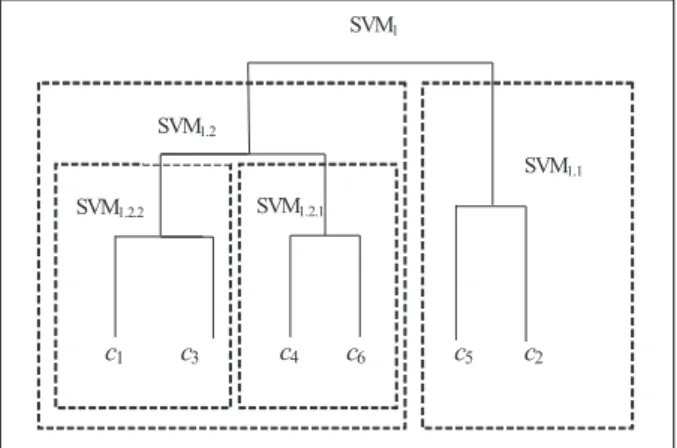
The first step of DSVM method consists of calculating k gravity centers for the k known classes. Then AHC clustering is applied over thesekcenters(Figure 2).
SVM1.2.2 SVM1.2.1
c1 c3 c4 c5 c2
SVM1
SVM1.2
SVM1.1
c6
Fig. 2.Grouping classes in hierarchical way by AHC method.
Figure 2 shows an example of a taxonomy done by AHC[16]algorithm over thekclasses. In the second step, each SVM is associated to a node and trained with the elements of the two subsets of this node. For example, in Figure 2 which illustrates clustering of 6 classes SVM1
is trained by considering elements of {c5,c2}
negatives; SVM1.2is trained by considering
el-ements of{c4,c6}as positives and elements of
{c1,c3} as negatives. The concept is repeated
for each SVM associated to a node in the tax-onomy. In final, we will train(k−1)SVM for
k-class problem.
The advantage of training in DSVM is to a priori separate the classes in a hierarchical way. That facilitates the class separation for the SVM. In fact, SVM1 found easily boundary separation
between{c5,c2}and{c1,c3,c4,c6}. The level
of difficulty for boundary separation increases from the root through the leaves. The idea of DSVM is that it is preferable to solve many small problems in a hierarchical way than to solve a complex great problem. For classifying a pattern query, DSVM presents it to the “root” SVM which provides an output for right or left on the taxonomy. The procedure is repeated for each selected node in the “way” of the classifi-cation(Figure 3)until arriving to a leaf which finally represents the associated class for our pattern query.
x Classification
SVM1.2.1
c1 c3 c4 c6 c5 c2
SVM1
SVM1.2
SVM1.1 SVM1.2.2
Clustering
Fig. 3.Classification way by DSVM.
In Figure 3 we show the classification way of a given pattern: xvia DSVM.xis presented to SVM1 (root), then output of SVM1 is : x ∈
{c1,c3,c4,c6}. Next,xis presented to SVM1.2,
the output decision is x ∈{c1,c3}. Finally,xis
presented to SVM1.2.2when the output is: x ∈
{c3}. DSVM provides a trace of classification
of x which is SVM1 →SVM1.2 → SVM1.2.2.
We can see that classification procedure is more optimal with DSVM than with the other multi class SVM and it provides a unique solution for the pattern x. In fact, in our example, the sys-tem requires 3 among the 5 trained SVMs for making the decision.
a) Iris
4. Experiment Results
4.1. Data for Validation
We have performed several experiments on three known problems from the UCI Repository of machine learning databases [15]. The chosen databases are: “Iris”, “Glass” and “Letter”. We give the problem statistics in Table 1.
problem #trainingdata #testingdata #class #attributes
Iris 100 50 3 4
Glass 142 72 6 9
Letter 10000 5000 26 16
Table 1.Problem statistics
In Table 1 we can see that for each problem we have used 2/3 of data for training and 1/3 for testing, and that the 3 problems differ in dimen-sional input space, in size of database and in the number of classes.
4.2. Accuracy Measures
The goal of these experiments is to evaluate our method vs. one”, “one-against-the o“one-against-ther” and MLP (Multi layer perceptron)
methods. The most important criterion in eval-uating the performance of these methods is their accuracy rate. In addition, we will present the time of training of each method and the number of trained SVMs for multi class SVM methods. Accuracy of the results obtained with discrim-inative methods is commonly measured by the quantity of true positives (TP), true negatives
(TN), false positives (FP) and false negatives
(FN). In addition to these quantities, standard sensitivity and specificity measures defined by: Sensitivity=TP/(TP+FN),
Specificity=TN/(TN+FP),
are also useful in assigning the classification ac-curacy. All these quantities are used in the eval-uation of classification methods in this work.
4.3. Results
Experiments were performed using “one-against-one”, “one-against-all”, Multi Layer perceptron
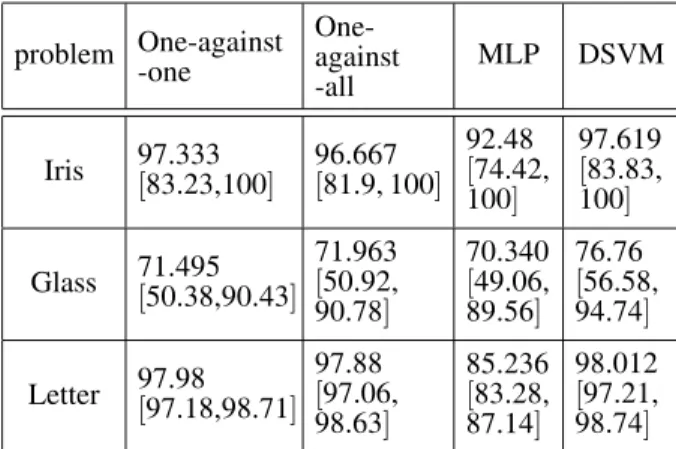
(MLP)and the proposed DSVM methods. Av-erage classification accuracies for test data of each problem conducted with each classifier are listed in Table 2.
problem One-against-one One-against
-all MLP DSVM
Iris 97.333[83.23,100] 96.667[81.9, 100] 92.48[74.42, 100]
97.619
[83.83, 100]
Glass 71.495[50.38,90.43] 71.963[50.92, 90.78]
70.340
[49.06, 89.56]
76.76
[56.58, 94.74]
Letter 97.98[97.18,98.71] 97.88[97.06, 98.63]
85.236
[83.28, 87.14]
98.012
[97.21, 98.74]
Table 2.Accuracy comparison between methods.
Table 2 presents the result of comparing the four methods. For SVM-based methods, Gaus-sian RBF kernel is used in the training phase. MLP is trained with different number of hidden neurons for each problem, and optimal numbers given best MLP’s accuracy are selected.
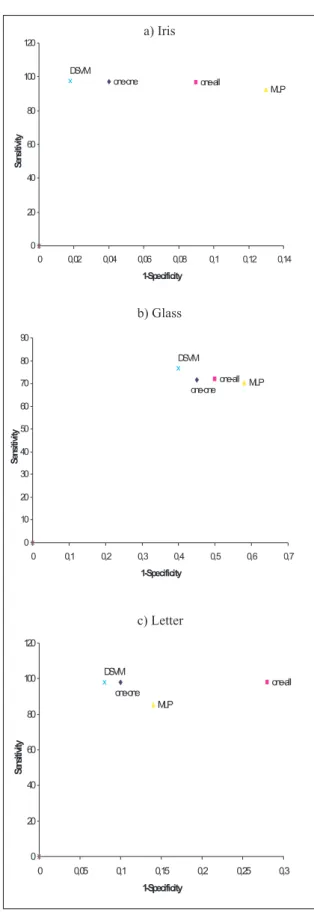
The values between brackets represent the con-fidence intervals for 95% concon-fidence level, com-puted as described in [1]. In Figure 4, the ROC(Receiver operating characteristics)space shows that DSVM approach gives better total result in both sensitivity and specificity than the other methods. In Table 3 we also report the training time and the number of trained SVMs.
problem One-against -one Time/
#svm
One-against -all Time/
#svm
MLP
Time
DSVM Time/
#svm
Iris 0.04/3 0.10/3 0.047 0.03/2 Glass 2.42/15 10/6 140 0.09/5 Letter 298.08/325 1831/26 4500 140/25
Table 3.Training time(in sec)and #SVMs.
DSVM learning method. In addition, the classi-fication time is also low because of the optimal set of SVMs selected in a descendant way in the
problem Classes Sensitivity(%) Specificity(%)
Iris Class1 100 100
Class2 92.87 100
Class3 100 94
Glass Class1 84 68
Class2 86 84
Class3 0 0
Class4 93.56 100
Class5 100 100
Class6 97 82
Letter Class1 98 100
Class2 100 92
Class3 96 93
Class4 98 97
Class5 100 93
Class6 96 92
Class7 97 99
Class8 100 88
Class9 97 87
Class10 99 91
Class11 100 92
Class12 98 94
Class13 99 91
Class14 97 100
Class15 97 93
Class16 98 97
Class17 94 98
Class18 100 94
Class19 98 88
Class20 97 92
Class21 100 78
Class22 99 96
Class23 98 100
Class24 97 96
Class25 97 75
Class26 98 88
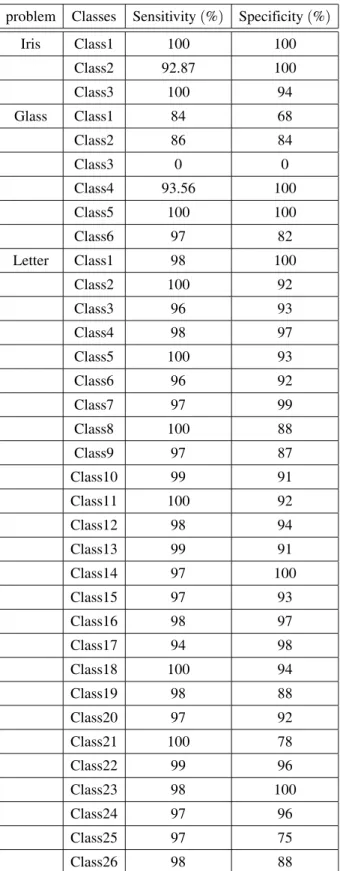
Table 4.Detailed test results for different classes of the three problems with DSVM.
taxonomy.
The results of the classification of DSVM for each class are given in detail for each problem in Table 4.
The sensitivity and specificity are the range of 92-100 % and 94-100%, respectively, for “Iris” problem, 94-100% and 75-100% for “Letter” problem. For “Glass” problem, globally the accuracy is good for all classes except class 3, because the samples of this class are “very” non-linearly distributed in the input space and they are generally recognized in class 1. That results in confusion between the two classes.
5. Conclusion and Future Works
A new hierarchical support vector machines
(DSVM) approach has been developed. This method utilizes a taxonomy of classes and de-composes a multi-class problem to a descendant set of binary-class problems. AHC method is used to group all classes in an ascendant hi-erarchy. This clustering allows us to sepa-rate the classes and to build different subsets from database for different sub-problems. Then SVM classifier is applied at each internal node to construct the best discriminant function of a binary-class problem.
In this paper, DSVM was evaluated using a se-ries of experiments. Compared with the two famous multi-class SVM methods and a MLP-based neural networks DSVM consistently achieves both high classification accuracy and good generalization. DSVM takes its advantage from two good methods: (1) AHC clustering, which uses distance measures to investigate the natural class grouping in hierarchical way and
(2)original binary SVM classifiers to separate the different classes because of their solid math-ematical foundations. Combining these two methods, DSVM extends binary-SVM to a fast multi-class classifier.
References
[1] Y. BENNANI, Multi-expert and hybrid
connection-nist approach for pattern recognition : speaker identification task .International Journal of Neural Systems, Vol. 5, No. 3,(1994)pp. 207–216.
[2] B. E. BOSER, I. GUYON,ANDV. VAPNIK, A Training
Algorithm for Optimal Margin Classifiers, in Com-putational Learning Theory, 1992, pp. 144–152.
[3] C.-W. HSU ANDC.-J. LIN, A comparison of meth-ods for multi-class support vector machines,IEEE Transactions on Neural Networks, 2002., vol. 13, pp. 415–425.
[4] S. KUMAR, J. GHOSH,ANDM. CRAWFORD,
Hierar-chical Fusion of Multiple Classifiers for Hyperspec-tral Data Analysis,International J. Pattern Analysis and Applications, 2002., vol. 5, no. 2, pp. 210–220.
[5] V. N. VAPNIK, The Nature of Statistical Learning
Theory, second ed., Springer, New York, 1999.
[6] C. J. C. BURGES,A tutorial on support vector ma-chine for pattern recognition, Data Min. Knowl. Disc. 2(1998)121.
[7] E. OSUNA, R. FREUND ANDF. GIROSI, An improved
training algorithm for support vector machines. Neu-ral networks for Signal Processing VII – proceeding of 1997 IEEE Workshop, pp. 276–285.
[8] Z. Y. LI, S. W. TANG, S. C. YAN,Multi-class SVM
classifier based on pairwise coupling, Lect. Notes Comput. Sci. 2388(2002)321.
[9] T. JOACHIMS, Making large scale SVM learning
practical. In scholkopf, B Bruges C and Smola A
(eds),Advances in kernel methods-support vector learning. MIT Press, Cambridge, MA. 1998.
[10] N. CRISTIANINI, J. SHAWE-TAYLOR, An Introduction
to Support Vector Machines, Cambridge University, Cambridge, 2000.
[11] Y. GUERMEUR, A. ELISSEEFF AND H. PAUGAM
-MOISY. A new multi-class SVM based on a uniform
convergence result.IJCNN2000, Come, Vol. IV, pp. 183–188.
[12] E. J. BREDENSTEINER AND K. P. BENNETT,
Mul-ticategory classification by support vector ma-chines. Computational optimizations and applica-tions, 1999., pp. 53–79.
[13] Y. CHEN, M. M. CRAWFORD AND J. GHOSH,
In-tegrating support vector machines in a hierar-chical outputs space decomposition framework.
http://studentweb.engr.utexas.edu/Chen2 /yangchi04hierarchical.pdf
[14] M. P. S. BROWN, W. N. GRUNDY, D. LIN, N. CRIS -TIANINI, C. SUGNET, M. J. R. ARES ANDD. HAUS -SLER, Knowledge-based analysis of microarray gene
expression data by using support vector machines. Proc Natl Acad Sci, USA 97, pp. 262–267.
[15] C. L. BLAKE ANDC. J. MERZ, UCI repository of
machine learning databases.Technical report. Uni-versity of California, Department of information and Computer science, Irvine, CA, 1998. available at: ftp://ftp.ics.uci.edu/pub/machine-learning-databases/
[16] J-M. BOUROCHE, G. SAPORTA, L’analyse des
donn´ees. Presse universitaire de France 1994.
Received:June, 2006
Accepted:September, 2006
Contact addresses:
Khalid Benabdeslem University of Lyon1 – PRISMa Lab 8 Boulevard Niels Bohr 69622 Villeurbanne Cedex France
Youn`es Bennani University of Paris13 – LIPN/CNRS Lab 99 Avenue J.Baptiste Cl´ement 93430 Villetaneuse France
DR. KHALIDBENABDESLEMgraduated from USTO University where
he received his engineer diploma in 1998. Thereafter, he gained an MSC(DEA)in Artificial Intelligence from the Paris 13 University in 2000. In 2003, he received his PhD degree in Computer Science from the University of Paris 13. After two Postdoctoral Fellowships(CNRS and INRIA)he is currently associate Professor at the University of Lyon 1 and a member of Learning and Knowledge Discovery(LKD)team, PRISMa Lab. His main researches are centred on machine learning (Connectionist, Probabilistic and Statistic)