© 2019 by the Serbian Biological Society How to cite this article: Ćuk M, Ilić M, Igić R, Šikuljak T, Vukov D, Čarni A. 647 Classification and diversity of perennial sand-dune vegetation in Serbia. Arch Biol Sci. 2019;71(4):647-53.
Classification and diversity of perennial sand-dune vegetation in Serbia
Mirjana Ćuk1,*, Miloš Ilić1, Ružica Igić1, Tijana Šikuljak1, Dragana Vukov1 and Andraž Čarni2
1Department of Biology and Ecology, Faculty of Science, University of Novi Sad, Novi Sad, Serbia
2Institute of Biology, Scientific Research Centre of the Slovenian Academy of Sciences and Arts, Ljubljana, Slovenia
*Corresponding author: [email protected]
Received: July 17, 2019; Revised: August 3, 2019; Accepted: August 9, 2019; Published online: August 27, 2019
Abstract: Sand dunes are one of the critically endangered habitats in Europe. This vegetation type is under a strong
anthropogenic influence. Its natural value is very high since many plant species with a narrow distribution are found there. The classification of Serbian sand-dune vegetation and the status of the described associations has not been validated by numerical analyses. This research presents an evaluation of sand-dune vegetation in Serbia on the basis of literature data, as well as new relevés. Psammophytic vegetation in Serbia was classified into two alliances, annual and ruderal Bassio laniflorae-Bromion tectori andperennial Festucion vaginate. The aim of this research was the classification of the alliance Festucion vaginatae, perennial, drought-tolerant, tussock-forming vegetation on sand. As proposed by OptimClass, Jaccard distance and flexible beta data (β=-0.25) were used for the classification. Classification results were confirmed by detrended correspondence analysis (DCA) ordination. The result of the classification established that only two associations, Alysso gmelini-Festucetum vaginatae and Festucetum vaginatae, are present in Serbia. These associations are divided into groups that mostly correspond to traditional subassociations.
Keywords: sandy vegetation; Festucion vaginate; PC-ORD; DCA; vegetation classification
INTRODUCTION
Vegetation on sand is a unique phenomenon in all stages of its successional development, from pioneer stadia to closed grasslands. Sandy soils are mostly al-luvial deposits that are further shaped by aeolian ero-sion. Sandy substrates can vary in the dimensions of sandy granulations, and soil reactions, but they are al-ways nutrient poor, dry and with extreme variations of temperature. All continental sandy habitats in Europe are strictly protected by Annex I of the European Habi-tats Directive and represent a significant Natura 2000 habitat type (Council Directive 92/43/EEC). Continen-tal sand vegetation requires intense study and active protection programs that will ensure its survival [1].
In Serbia, sand dunes are distributed along the Danube River. In general, the sandy habitats of Ser-bia appear in three distinct areas. They include the Subotica-Horgoš Sands, the Deliblato Sands, two pro-tected natural areas, and the third group of sands on the right bank of the Danube river in eastern Serbia
(from Ram to Kladovo, and further to the east, along the Danube until its exit from Serbia [2] (Supplemen-tary Fig. S1). All sand dunes in Serbia are character-ized by different microclimatic, hydrological and pedological conditions. In addition, geomorphological forms (dunes) are not identical in all sandy habitats and the vegetation of sandy habitats also differs [2].
In Serbia, only basophilic carbonate sands are pre-sent. The vegetation in these habitats and surrounding area is most often syntaxonomically classified in one class – Festucetea vaginatae Soó 1968 [3-6], while in re-cent overviews [7,8] this vegetation has been classified within the class Koelerio glaucae-Corynephoretea canes-centis Klika in Klika et Novák 1941, order Festucetalia vaginatae Soó 1968 or Festuco-Sedetalia acris Tx. 1951, and alliance Festucion vaginatae Soó 1929. This clas-sification correlates with the most recent reviews of the vegetation of the surrounding area and Europe [9,10].
vegetation on sands belonging to the alliance Bassio laniflorae-Bromion tectorum [11,12,5] with the associa-tion Brometum tectorum Soó 1938. This vegetaassocia-tion type predominantly consists of therophytes and annuals, and the average plant cover in this open community is very low (up to 50%) [5]. This vegetation type implies an initial stage, but also different degradation stages when sand surfaces reopen, most often under the influence of excessive grazing or exploitation of the sand mass.
The central aim of this study was to provide a de-tailed classification and overview of grasslands domi-nated by drought-tolerant, tussock-forming perennial grasses such as Festuca vaginata.
MATERIALS AND METHODS Dataset
In the process of data selection and sandy vegetation classification, our data set was compared with relevés from the entire Pannonian plain. In this comparison it was confirmed that psammophytic vegetation in Serbia can be divided into two alliances – Bassio lani-florae-Bromion tectorum and Festucion vaginatae. The pioneer association Corispermo nitidi-Polygonetum arenariae on sands was described in Serbia and classi-fied within the alliance Festucion vaginatae [12]. How-ever, this communitiy is heterogeneous and during selection of data its relevés were divided between two alliances – Festucion vaginatae and Bassio laniflorae-Bromion tectorum. Relevés of this association with a low plant cover and a large share of therophytes/an-nuals were not taken into consideration. This initial community on sandy habitats, dominated by Corisp-ermum nitidum, is described by Stjepanović-Veseličić [12], and is represented by a small number of relevés in the dataset (a total of 11). The author [12] considers it as non-homogeneous association, with a significant ratio of steppe and ruderal species or taxa of other successive vegetation types. Soó [14] in the review of psammophytic communities in the Pannonian-Carpathian basin, identified the autumn aspect of the community Corispermo nitidi-Polygonetum arenariae as a Brometum tectorum Soó 1938 – geographical race deliblaticum. According to this author [14], this com-munity actually belong to a subassociation of cyno-dontetosum of the association Brometum tectorum. On the other hand, some relevés have floristic similarities
with other Festucion vaginatae communities. Also, in selecting the perennial sandy grasslands Festucion vag-inatae for this research, the lectotype [5] of association Corispermo nitidi-Polygonetum arenariae remained within Festucion vaginatae Thus, 5 relevés of this as-sociation were retained for further classification.
In this research, literature data as well as vegeta-tion relevés collected in the period 2012-2018 were used. The total number of analyzed relevés was 130 from different sources [11-13,15] and 106 are new phytocoenological relevés. The entire data set con-tained 225 taxa. The taxonomy and nomenclature of plants were checked and harmonized following [16] for vascular plants, [17], for lichens and [18,19] for mosses. Taxa with inconsistent or frequently doubtful determination were combined into aggregates (Sup-plementary Table S1).
Additional data
Borhidi indicator values (BIV) for light, soil mois-ture, temperamois-ture, soil reaction and continentality were used for ecological interpretation of the vegeta-tion patterns [20]. For each relevé, we calculated the unweighted mean of species indicator values using JUICE software [21], which gives a rough approxima-tion of the local site condiapproxima-tions.
Classification
5.0. For each group, diagnostic species were defined according to the values of the phi coefficient (fidelity measure) ≥0.20 [24]. Species with a frequency ≥20% were defined as constant. Species with cover value ≥25% were defined as dominant. The classification al-lowed for nomenclature validation and revision of the associations and subassociations within the alliance Festucion vaginatae in accordance with the Interna-tional Code of Phytosociological Nomenclature [25].
Ordination and ecological analyses of data
In order to explain the floristic differentiation within Serbian sand dunes and to explore the possibilities of separation of vegetation at the association level, the relationship between the ordination of relevés and bioindicator values was analyzed. According to the longest gradient length (6.4 SD), as an adequate tech-nique for ordination of data DCA was selected [26]. DCA was performed using the R (vegan) package used with JUICE software [21]. Differences of established groups and environmental conditions were also shown on the box-whiskers plots using BIV [20].
RESULTS
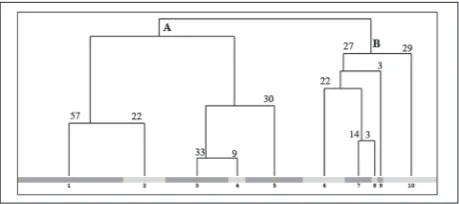
An optimal number of clusters was selected using the OptimClass method. Hierarchical classification is presented on the dendrogram in Fig. 1, where two hierarchical groups, associations (A and B), are clearly separated. The associations are further divided into clusters, which mainly correspond to traditional sub-associations. Descriptions of groups 1-10 are given in Supplementary Table S2. Perennial sandy vegetation in Serbia is classified into two associations and sub-associations (Table 1). The results of the hierarchical classification in this research is presented in Table 1 and Supplementary Table S2.
Group A represents the relevés of the association Alysso gmelini-Festucetum vaginatae Stjepanović-Veseličić 1956. This association was first described on the Deliblato Sands as Festucetum vaginatae in the geographical variant deliblaticum. The same author in 1956 [11] described the Alysso gmelini-Festucetum vaginatae on sands in eastern Serbia, in two geo-graphical variants, kladovense and ramo-požežense. Stjepanović-Veseličić [11] mentioned the possibility
that all communities of sandy vegetation in south-eastern Vojvodina and south-eastern Serbia are actually one association, and this view was accepted by [7]. Numerical classification in this research confirmed the floristic connection of the communities on the Deliblato Sands and the sands from Ram to Kladovo. These communities are unique and classified as one association (Supplementary Fig. S2A).
Diagnostic species are as follows: Artemisia camp-estris, Carex liparocarpos, Centaurea arenaria, Corisp-ermum nitidum, Echinops ritro subsp. ruthenicus, Fes-tuca wagneri, Odontarrhena tortuosa, Peucedanum arenarium, Polygonum arenarium, Sedum urvillei, Stipa borysthenica, Syntrichia ruralis, Tragopogon floccosus.
Constant species are as follows: Alyssum gmelinii, Artemisia campestris, Centaurea arenaria, Euphorbia seguieriana, Festuca vaginata, Koeleria glauca, Odon-tarrhena tortuosa, Polygonum arenarium, Stipa bo-rysthenica.
Dominant species are as follows: Alyssum gmelinii, Artemisia campestris, Carex liparocarpos, Euphorbia seguieriana, Festuca vaginata, Fumana procumbens, Minuartia glomerata, Odontarrhena tortuosa, Polyg-onum arenarium, Silene otites, Sedum urvillei, Stipa borysthenica, Syntrichia ruralis, Tortella tortuosa.
Group B represents the association Festucetum vaginatae (Rapaics ex Soó 1929) Borhidi 1996 (Sup-plementary Fig. S2B). The data in this cluster are from the Subotica-Horgoš Sands, published by Gajić et al. [15] and Parabućski et al. [11]. Gajić [15] described
Fig. 1. Dendrogram of the hierarchical classification. A –
associa-tion Alysso gmelini-Festucetum vaginatae Stjepanović-Veseličić
1956; B – association Festucetum vaginatae (Rapaics ex Soó 1929)
this association as a mixture of different successive stands and named it Festucetum vaginatae mixtum Gajic 1986. Parabućski et al. [13] noted that this as-sociation is the same as that in Hungary, Fesucetum vaginatae danubiale Soó 1929, which is an ecological and geographical variant of sand vegetation between the Tisza and Danube rivers [14].
Diagnostic species are as follows: Alkanna tinc-toria, Alyssum alyssoides, Apera spica-venti, Arenaria serpyllifolia, Calamagrostis epigejos, Camelina sativa aggr., Cladonia foliacea, Cynoglossum officinale, Dian-thus pontederae, Equisetum ramosissimum, Eryngium campestre, Erysimum canum, Erysimum diffusum, Koeleria macrantha, Melica transsilvanica, Noccaea perfoliata, Salix repens subsp. rosmarinifolia, Scirpoides holoschoenus, Secale sylvestre, Silene conica, Stipa pen-nata, Tragopogon pratensis, Viola arvensis.
Constant species are as follows: Achillea millefo-lium aggr., Arenaria serpyllifolia, Asperula cynanchica, Calamagrostis epigejos, Centaurea stoebe s.l., Eryngium campestre, Euphorbia seguieriana, Festuca vaginata, Koeleria glauca, Potentilla incana, Salix repens subsp.
rosmarinifolia, Silene otites, Stipa borysthenica, Ver-bascum lychnitis, Tortella tortuosa.
Dominant species are as follows: Cladonia folia-cea, Elytrigia repens, Euphorbia seguieriana, Festuca vaginata, Fumana procumbens, Koeleria glauca, Melica transsilvanica, Minuartia verna, Phleum phleoides, Potentilla incana, Salix repens subsp. rosmarinifolia, Secale sylvestre, Stipa borysthenica, Stipa pennata.
Ordination and ecological analyses of data
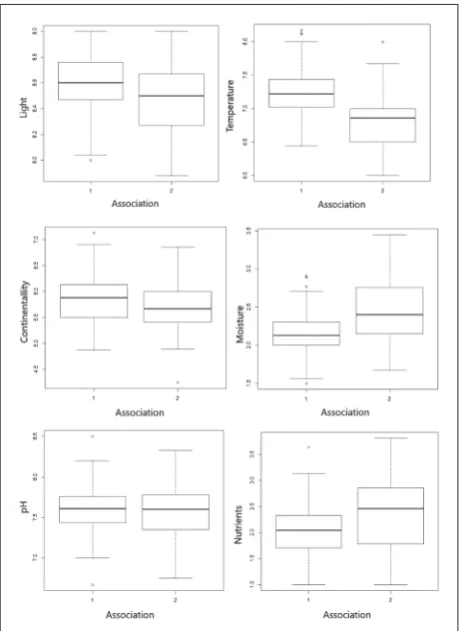
The results of the ordination analyses follow the re-sults of the classification analysis, which are shown in Fig. 2. Two main groups of cluster analysis are recog-nized. The pattern of floristic differentiation between two associations reflect the environmental and floris-tic differences (Fig. 3).
The position of clusters 5 and 9 (Fig. 2) is not clear. Cluster 5 is a group of relevés with a high percentage of widespread species such as Cynodon dactylon, Botri-ochloa ischaemum, Medicago minima, Tragus racemosus and Setaria viridis occurring in degraded sandy habitats
Table 1. Syntaxonomic scheme of sandy vegetation in Serbia.
Cl
ass CORCorynephoretea canescentis Koelerio glaucae- Klika in Klika et Novák 1941
O
rd
er COR01 Festucetalia vaginatae Soó 1968
Al
lia
nc
es COR01A Bassio laniflorae-Bromion
tectorum (Soó 1957) Borhidi 1996 COR01B Festucion vaginatae Soó 1929
Ass
oci
at
io
ns COR01A.1 Brometum tectorum Soó
1938 COR01B.1 Stjepanović-Veseličić 1956Alysso gmelini-Festucetum vaginatae (syn. Festucetum vaginatae deliblaticum Stjepanović-Veseličić 1953)
COR1B.2 Festucetum vaginatae (Rapaics ex Soó 1929) Borhidi 1996. (syn. Festucetum vaginatae danubiale Soó 1929; Festucetum vaginatae mixtum Gajić 1986)
Su
bass
oci
at
io
ns
1- subass. stipetosum borysthenicae (Stjepanović-Veseličić 1953) Butorac&Panjković 2013 nom. mut. prop. (syn.: stipetosum joannis Stjepanović-Veseličić 1953; stipetosum capillatae Stjepanović-Veseličić 1956) 2- Typus: Stjepanović-Veseličić 1953, Tab. 2, rel. 35, p:24/25 – lectotypus hoc locosubass. sytrichietosum ruralis subass. nov. hoc loco(syn.: muscetosum, Stjepanović-Veseličić 1979 nom. inval. [Art. 5, 8]).
Typus: Stjepanović-Veseličić 1979, Tab. 2, rel. 25, p:40/41 – holototypus hoc loco
3- subass. typicum
4- subass. fumanetosum procumbenti Stjepanović-Veseličić 1953 Butorac&Panjković 2013 nom. corr. hoc loco Typus: Stjepanović-Veseličić 1953, tab. 2, rel. 4, p:24/25 – lectotypus hoc loco (initial group with relevés from Corispermo nitidi-Polygonetum arenariae)
1- subass. stipetosum borysthenicae Soó 1957 nom. mut. prop. [Art. 45]); (syn.: stipetosum joannis Soó 1929 subass. muscetosum Gajić 1986; including subass. fumanetosum (Magyar 1933) Soó 1939 sensu Gajić 1986). Typus: Gajić 1986, Tab. 8, rel., 23, p:336 – lectotypus hoc loco
2- subass. typicum
(syn. festucetosum vaginatae (Magyar 1933) Soó 1955 typicum Gajić 1986; including subass. calamagrostietosum Soó 1955 sensu Gajić 1986)
3- subass. salicetosum rosmarinifoliae Hagitai 1940. Typus: Gajić 1986, Tab. 8, rel., 30, p:336 – lectotypus hoc loco
and can be identified as a transitional group to the as-sociation Tribulo-Tragetum racemosi Soó & Timár in Timár [27,28]; it is obvious that this can appear in all sand dunes in Serbia. Cluster 9 represents three rel-evés dominated by Cladonia foliacea. These relrel-evés were observed only on the Subotica-Horgoš Sands. In the relevés there are only one or two species. They are de-fined as a special subassociation of cladonietosum Gajić 1986. These two problematic groups together contain 15 relevés and were removed from further analysis.
DISCUSSION
The result of the classification shows that within the alliance Festucion vaginate, only two associations were present: Alysso gmelini-Festucetum vaginatae and Fes-tucetum vaginatae. Relevés originally attributed to the more developed stages of the pioneer association of sandy habitats (Corispermo nitidi-Polygonetum are-nariae) were not classified as a separate association but were unified with the initial stages of the community Alysso gmelini-Festucetum vaginatae.
A species that defines the contested community, Corispermum nitidum, has a very limited distribution on the Deliblato Sands, since the areas of semi-open and open sands are reduced to small local areas. These stands always appeared after fires [29] but were
quick-ly replaced by the successive stages of vegetation, i.e. communities dominated by Festuca vaginata. Accord-ing to field observations, the classification is justified. Comparison of phytosociological data from three different sandy areas in Serbia with non-metrical mul-tidimensional scaling (NMDS), showed that the floris-tic composition of sandy vegetation on the Deliblato Sands and sandy areas from eastern Serbia, from Ram to Kladovo, made one association, which is different from the sandy association of the Subotica-Horgoš Sands. Box-whiskers plots (Fig. 3) for each of the eco-logical indicators showed that the association Alysso gmelini-Festucetum vaginatae prefers open and dry habitats. According to all parameters, the community from the Subotica-Horgoš Sands, Festucetum vagina-tae, occurs in more closed, moister and richer habitats. Considering the specificity of the high dunes on the Deliblato Sands, the results of the ecological analysis
Fig. 2. Ordination (DCA) of two associations of alliance Festucion vaginatae Soó 1929 in Serbia. Green (or A in the classification results) – sandy vegetation on Deliblato Sands and sandy
habi-tat from Ram to Kladovo; red (or B in the classification results)
– sandy vegetation on Subotica-Horgoš Sands; black – subass.
cladonietosum (9)and Tribulo-Tragetum racemosi (5).
Fig. 3. Analysis of average bioindicator values of each relevé in two associations of sandy vegetation of Serbia (for light, temperature, continuity, humidity and amount of nutrients in the substrate, as
well as pH substrates): 1 – Ass. Alysso gmelini-Festucetum
of the classification groups confirmed the previously proposed explanations of differentiation of Serbian sandy vegetation [2,5,12,31].
Differentiation between two sandy associations of the alliance Festucion vaginatae is reflected in their floristic composition and different microecological conditions. Subotica-Horgoš sand dunes are 137 m high [15] and the groundwater is close to the surface. These characteristics have a greater resemblance to the sands of southern Hungary than to the sandy habitats of Deliblato and Ram-Kladovo.
In order to compare the sandy associations in Ser-bia and their equivalents in neighboring Hungary, the floristic compositions of these three groups of relevés were analyzed. We compared 221 relevés from Serbia (initial dataset, without outlaying groups 5 and 9) and 209 relevés from Hungary. The similarity of the com-munity Festucetum vaginatae on the Subotica-Horgoš Sands to Hungarian sands’ vegetation is clear and logical in view of the geographical proximity [11-13,15,31-33].
If we compare the floristic inventory on all three sandy areas in Serbia and Hungary, we can find the following only on Deliblato and Ram-Kladovo sands: Peucedanum arenarium, Astragalus dasyanthus, Fes-tuca wagneri, Silene subconica, Echinops banaticus (the species Echinops ritro subsp. ruthenicus [34]). Onosma viridis and O. pseudoarenaria, which were not found on the both analyzed localities, but were recorded in the relevés of these sandy habitats.
The species characteristic for the Subotica-Horgoš perennial sandy grassland are: Stipa pennata, Scirpoides holoschoenus and Salix repens subsp. ros-marinifolia. The taxonomic status of Stipa pennata in the relevés is doubtful and it is probably Stipa borys-thenica, which is found on all sands of the Pannonian Plain. On the other hand, Gajić [15] within Festucetum vaginatae distinguished the subassociation salicetosum rosmarinifoliae, while on the sands in Hungary [6,35] and on the Deliblato Sands [12] Salix repens subsp. rosmarinifolia built separate associations. The same is also valid for Scirpoides holoschoenus that occurs in the association Salicetum rosmarinifoliae and can also be a part of separate communities [6,15].
Species that occur on perennial sandy grasslands in Hungary, but not in Serbia, are: Achillea ochroleuca and Ephedra distachya, as well as Astragalus varius
and Gypsophila fastigiata (typical subsp. and subsp. arenaria), although for the last two there are some sporadic localities on the Subotica-Horgoš Sands. The same also applies to Helichrysum arenarium, for which there exist floristic localities on Serbian sands, but which is not recorded in phytocoenological relevés.
Species thriving on the Subotica-Horgoš and Hungarian sands but not on other sands in Serbia are Alkanna tinctoria, Dianthus serotinus, Secale sylvestre and Onosma arenaria. There is floristic differentia-tion between Alysso gmelini-Festucetum vaginatae and Festucetum vaginatae as some species appear only on the Subotica-Horgoš Sands, such as Astragalus varius, Gypsophila fastigiata subsp. arenaria, Iris humilis and Inula sabuletorum, although these species have not been recorded in relevés.
Funding: This research was supported by the Ministry of Edu-cation, Science and Technological Development of the Republic
of Serbia, Project No. III43002, Biosensing technology and global
systems for continuous research and integrated management of ecosystems.
Author contributions: Mirjana Ćuk contributed with original data, provided the study design, data organization and analyses, field research, plant material collection and determination and manuscript writing. Miloš Ilić participated in field research and manuscript writing. Ružica Igić supervised the activities and re-viewed several drafts of the manuscript. Tijana Šikuljak pated in field research and data collection. Dragana Vukov partici-pated in field research and data analysis. Andraž Čarni supervised the activities and reviewed the manuscript. The publication of this article was approved by all authors.
Conflict of interest disclosure: The authors have no financial interests or potential conflicts of interests to declare.
REFERENCES
1. Janssen J, Rodwell J, García Criado M, Gubbay S, Haynes T, Nieto A, Sanders N, Landucci F, Loidi J, Ssymank A, Tahva-nainen T, Valderrabano M, Acosta A, Aronsson M, Arts G, Attorre F, Bergmeier E, Bijlsma RJ, Bioret F, Biţă-Nicolae C, Biurrun I, Calix M, Capelo J, Čarni A, Chytrý M, Dengler J, Dimopoulos P, Essl F, Gardfjell H, Gigante D, Giusso del Galdo G, Hájek M, Jansen F, Jansen J, Kapfer J, Mickolajczak A, Molina J A, Molnár Z, Paternoster D, Piernik A, Poulin B, Renaux B, Schaminée J, Šumberová K, Toivonen H, Tonteri T, Tsiripidis I, Tzonev R, Valachovič M. European Red List of Habitats – Part 2. Terrestrial and freshwater habitats. Luxem-bourg: Publications Office of the European Union; 2016. 38p. 2. Butorac B, Habijan-Mikeš V, Vider V. Opstanak peščara u
3. Parabućski S, Stojanović S, Butorac B, Pekanović V. Pro-dromus vegetacije Vojvodine. Zbornik Matice srpske za prirodne nauke. 1986;71:5-40. Serbian.
4. Kojić M, Popović R, Karadžić B. Sintaksonomski pregled vegetacije Srbije. Belgrade: Institute for Biological Research “Siniša Stanković”; 1998. 218p. Serbian
5. Butorac B, Panjković B. Edicija Vegetacija Vojvodine. Knj 1. Peščarska vegetacija u Vojvodini. Novi Sad: Pokrajinski zavod za zaštitu prirode; 2013. 159p. Serbain.
6. Borhidi A, Kevey B, Lendvai G. Plant communities of Hun-gary. Budapest: Akademia Kiadó; 2012. 526 p.
7. Aćić S, Šilc U, Jovanović S, Kabaš E, Lakušić D, Vukojčić S, Dajić-Stevanović Z. Nomenclatural revision of dry grassland syntaxa of the Central Balkan. Tuexenia. 2014;34:355-90. 8. Aćić S, Šilc U, Petrović M, Tomović G, Dajić-Stevanović Z.
Classification, ecology and biodiversity of Central Balkan dry grasslands. Tuexenia. 2015;35:329-53.
9. Mucina L, Bültmann H, Dierßen K, Theurillat JP, Raus T, Čarni A, Šumberová K, Willner W, Dengler J, Gavilán R, Chytrý M, Hájek M, Di Pietro R, Pallas J, Daniëls F, Berg-meier E, Guerra A, Ermakov N, Valachovič M, Schaminée J, Lysenko T, Didukh Y, Pignatti S, Rodwell J, Capelo J, Weber H, Dimopoulos P, Aguiar C, Hennekens S, Tichý L. Vegeta-tion of Europe: hierarchical floristic classificaVegeta-tion system of vascular plant, bryophyte, lichen, and algal communities. Appl Veg Sci. 2016;19:3-264.
10. Škvorc Ž, Jasprica N, Alegro A, Kovačić S, Franjić J, Krstonošić D, Vraneša A, Čarni A. Vegetation of Croatia: Phytosociological classification of the high-rank syntaxa. Act Bot Croat. 2017;76:2.
11. Stjepanović-Veseličić L. Psamofitska vegetacija živih peskova Srbije. Srpska akademija nauka. Institut za ekologiju i bioge-ografiju. Zbornik radova. 1956;.7(2):3-27.
12. Stjepanović-Veseličić, L. Vegetacija Deliblatske peščare. Srp-ska akademija nauka, Monografije 216, Institut za ekologiju i biogeografiju 4. Beograd. 1953:1-113.
13. Parabućski S, Stojanović S, Vučković M. Zajednica
Festuce-tum vaginatae danubiale Soó 1929 na Subotičko-Horgoškoj peščari. Matica srpska J Nat Sci. 1986;70:129-34. Serbian. 14. Soó R. Conspectus des groupemens vegetaux dans les
Bas-sins Carpatiques II Les associations psammophiles et leur genetique. Act Bot Hung. 1957;3:45-64. French.
15. Gajić M. Flora i vegetacija Subotičko-Horgoške peščare. Beograd: Šumarski fakultet; 1986. 495 p.
16. Euro+Med PlantBase - the information resource for Euro-Mediterranean plant diversity. [Internet]. Berlin-Dahlem: The Botanical Garden and Botanical Museum. 2006- [cited 2018, December 29]. Avaible from: http://ww2.bgbm.org/ EuroPlusMed/
17. LIAS names – A Database with Names of Lichens, Lichenic-olous Fungi and Non-Lichenized Ascomycetes [Internet]. München: Botanische Staatssammlung. 1996- [cited 2018, December 29]. Avaible from: http://www.liasnames.lias.net 18. Ros RM, Mazimpaka V, Abou-Salama U, Aleffi M, Blockeel TL, Brugués M, Cano MJ, Cros RM, Dia MG, Dirkse GM, El Saadawi W, Erdağ A, Ganeva A, González-Mancebo JM, Herrnstadt I, Khalil K, Kürschner H, Lanfranco E, Losada-Lima A, Refai MS, Rodríguez-Nuñez S, Sabovljević M, Sér-gio C, Shabbara H, Sim-Sim M, Söderström L. Hepatics and
Anthocerotes of the Mediterranean, an annotated checklist. Cryptogamie, Bryologie. 2007;28(4):351-437.
19. Ros RM, Mazimpaka V, Abou-Salama U, Aleffi M, Block-eel TL, Brugués M, Cros RM, Dia MG, Dirkse GM, Draper I, El-Saadawi W, Erdağ A, Ganeva A, Gabriel R, González Mancebo JM, Grange C, Herrnstadt I, Hugonnot V, Khalil K, Kürschner H, LosadaLima A, Luís L, Mifsud S, Privit-era M, Puglisi M, Sabovljević M, Sérgio C, Shabbara HM, Sim-Sim M, Sotiaux A, Tacchi R, Vanderpoorten A, Werner O. Mosses of the Mediterranean, an Annotated Checklist. Cryptogamie, Bryologie. 2013;34:99-283.
20. Borhidi A. Social behaviour types, the naturalness and rela-tive ecological indicator values of the higher plants in the Hungarian Flora. Act Bot Hung. 1995;39(1-2):97-181. 21. Tichý L. JUICE, software for vegetation classification. J Veg
Sci. 2002;13:451-3.
22. Tichý L, Chytrý M, Hájek M, Talbot SS, Botta-Dukát Z. OptimClass: Using species-to-cluster fidelity to determine the optimal partition in classification of ecological commu-nities. J Veg Sci. 2010;21:287-99.
23. Braun-Blanquet J. Pflanzensoziologie, Grundzügeder Veg-etationskunde. Wien: Springer Verlag; 1964.
24. Chytrý M, Tichý L, Holt J. Determination of diagnostic spe-cies with statistical fidelity measures. J Veg Sci. 2002;13:79-90. 25. Weber HE, Moravec J, Theurillat JP. International code
of phytosociological nomenclature. 3rd edition. J Veg Sci. 200;11:739-68.
26. Lepš J, Šmilauer P. Multivariate Analysis of Ecological data using CANOCO. Cambridge: Cambridge University Press;. 2003. 294 p.
27. Eliáš P. Tribulo-Tragetum a Hibisco-Eragrostietum na
Slov-ensku. Biológia. 1982;37:99-101.
28. Němec R, Lososová Z, Dřevojan P, Žáková K. Synanthropic
vegetation of the Eragrostion cilianensi-minoris alliance in
the Czech Republic. Biologia. 2011;66(6):1019-26.
29. Stojšić V, Dinić A. Dynamics and distribution of plant species in succession of sand vegetation on burnt area at the Deliblato sands (Serbia). Zaštita prirode. 2009;60(1-2):305-12. 30. Butorac B, Habijan-Mikeš V. Peščarska područja Srbije.
Beo-grad: Zavod za zaštitu prirode. 1997; 71 p. Serbian. 31. Zsolt J. A Szent-Endrei Sziget növénytakarója. (The vegetation
of Szentendre Island). Ind Hor Bot Univ Bud. 1943;6:1-19.
32. Kárpáti I, Kárpáti V. The aspects of the calciphilous turf (
Fes-tucetum vaginatae danubiale) in the environs of Vácrátót in 1952. Act Bot Hung 1954;1:129-57.
33. Fekete G. A cönológiai szukcesszió kérdései. (About coeno-logical succession). Budapest: Akadémiai Kiadó; 1985. 216 p. 34. Diklić N, Obratov-Petković D. Morfološke odlike i
raspros-tranjenje vrste Echinops banaticus Rochel (Asteraceae) u flori
Srbije. Bull Fac Forest. 2002;85:51-7.
35. Borhidi A. Critical revision of the Hungarian Plnt Commu-nities. Pecs: Janus Pannonius University: 1996.
Supplementary Material