THE CLASSIFICATION OF
AUTOMORPHISM GROUPS OF
RATIONAL ELLIPTIC SURFACES
WITH SECTION
Tolga Karayayla
A DISSERTATION
in
MATHEMATICS
Presented to the Faculties of the University of Pennsylvania
in
Partial Fulfillment of the Requirements for the
Degree of Doctor of Philosophy
2011
Supervisor of Dissertation
Graduate Group Chairperson
Ron Donagi
Jonathan Block
Professor of Mathematics
Professor of Mathematics
Dissertation Committee
Tony Pantev
James Haglund
ABSTRACT
THE CLASSIFICATION OF AUTOMORPHISM GROUPS OF RATIONAL ELLIPTIC SURFACES WITH SECTION
Tolga Karayayla
Supervisor: Ron Donagi
In this dissertation, we give a classification of (regular) automorphism groups of relatively minimal rational elliptic surfaces with section over the fieldCwhich have non-constant J-maps. The automorphism group Aut(B) of such a sur-face B is the semi-direct product of its Mordell-Weil group M W(B) and the subgroupAutσ(B) of the automorphisms preserving the zero section σ of the
rational elliptic surfaceB. The configuration of singular fibers on the surface determines the Mordell-Weil group as has been shown by Oguiso and Shioda, and Autσ(B) also depends on the singular fibers. The classification of
auto-morphism groups in this dissertation gives the groupAutσ(B) in terms of the
configuration of singular fibers on the surface. In general,Autσ(B) is a finite
group of order less than or equal to 24 which is aZ/2Zextension of eitherZ/nZ, Z/2Z×Z/2Z,Dn(the Dihedral group of order 2n) orA4(the Alternating group
of order 12). The configuration of singular fibers does not determine the group Autσ(B) uniquely; however we list explicitly all the possible groups Autσ(B)
Contents
1 Introduction 1
2 Preliminaries 3
3 Automorphisms of Rational Elliptic Surfaces 7
4 Induced Automorphisms on P1 10
4.1 Orders of induced automorphisms . . . 10
4.1.1 Examples . . . 14
4.2 AutB(P1): the group of induced automorphisms . . . 17
5 Autσ(B): Automorphisms Preserving the Zero Section 23 5.1 Construction 1 . . . 24
5.1.1 Examples . . . 27
5.2 Construction 2 . . . 32
5.2.1 General construction . . . 35
5.2.2 Trisections for Γ2: . . . 39
5.2.3 Trisections for ∆2 . . . 47
5.3 The non-cyclicAutB(P1) case . . . 49
5.3.1 AutB(P1) =Z/2Z×Z/2Zcase . . . 49
5.3.2 AutB(P1) =D3 case . . . 52
5.3.3 AutB(P1) =D4 case . . . 54
5.3.4 AutB(P1) =D6 case . . . 56
5.3.5 AutB(P1) =A4 case . . . 58
6 Results 60
List of Tables
1 Configurations of singular fibers . . . 6
2 Possible orders of induced automorphisms . . . 12
3 Configurations with trivial action onP1 . . . . 13
4 Multiplicities of theJ-map . . . 14
5 Transformation of singular fibers in the pull-back process . . . . 26
6 Configurations obtained by a pull-back . . . 30
7 Configurations which cannot be obtained by a pull-back . . . 30
8 The groupsBz]0 andBz]/B]z0. . . 33
9 Results of Construction 2 . . . 35
10 Simple curve singularities for curves on surfaces. . . 37
1
Introduction
The goal of this study is to give a description of the automorphisms, and the structure of the automorphism groups, of relatively minimal rational elliptic surfaces with section over the fieldC. For such a surface B, Aut(B) denotes the group of regular isomorphisms on B, or equivalently the group of biholo-morphic maps on the complex surfaceB. Note that byAut(B) we do not mean the birational automorphism group ofB.
The motivation for this study comes from the work of Bouchard and Donagi [2],On a Class of Non-simply Connected Calabi-Yau 3folds. In that paper, they obtain non-simply connected Calabi-Yau threefolds as the quotients of Schoen threefolds (which are the fibered products of two rational elliptic surfaces) by free actions of finite abelian groups. This is done by studying pairs of auto-morphisms of rational elliptic surfaces that induce a free action on the fibered product of the elliptic surfaces. The classification of such pairs of automorphisms is given in their paper, and the general question of classifying all automorphisms of rational elliptic surfaces is asked. Achieving this more general classification can extend the results to non-simply connected Calabi-Yau threefolds with finite non-abelian fundamental groups. Non-simply connected Calabi-Yau threefolds have a significance in string theory, particularly in the study of finding low en-ergy limits of the theory.
Given a relatively minimal rational elliptic surfaceβ : B →P1with section, the generic fiber is an elliptic curve, and there are singular fibers which are of one of the Kodaira types In (n > 0), In∗ (n ≥ 0), II, III, IV, II∗, III∗ or
IV∗(described in the next section). These singular fibers play an important role in determining the automorphism groupAut(B) of the surfaceB. To study howAut(B) is affected by the singular fibers ofB, we use the work of Persson [10] and Miranda [6] where they produce the list of all possible configurations of singular fibers on relatively minimal rational elliptic surfaces with section. The Mordell-Weil groupM W(B) of an elliptic surfaceB with section is the group of sections of the elliptic surface, and it can be identified with a subgroup of Aut(B) by defining the action of a section as follows: If ζ is a section of B, then lettζ ∈ Aut(B) be the automorphism of B which acts on every smooth
fiberF as the translation byζ∩F determined by the group law on the elliptic curveF. Oguiso and Shioda [9] have shown thatM W(B) is determined by the configuration of singular fibers on B for a relatively minimal rational elliptic surface with section, and they have calculatedM W(B) for each configuration of singular fibers. M W(B) is a finitely generated abelian group of rank at most 8, and the order of its torsion subgroup is at most 9.
In this work, it is proved thatAut(B) is the semi-direct productM W(B)o Autσ(B) of the Mordell-Weil group of B and the subgroup Autσ(B) of the
fol-lowing theorem gives the classification of Aut(B) for surfaces B which have non-constantJ-maps.
Theorem 6.0.1: Let B be a relatively minimal rational elliptic surface with section over the field C. If the J-map of B is not constant, then Table 11 lists
all the groups Autσ(B) and all the possible configurations of singular fibers of
B corresponding to each group.
In general,|Autσ(B)|=|Aut(B) :M W(B)| ≤24 if theJ-map of the surface
B is not constant. For the constantJ-map case, this order is unbounded. The outline of this work is as follows. After giving some basic information about elliptic surfaces in Section 2, we define the subgroupAutσ(B) of
automor-phisms preserving the zero sectionσof the elliptic surfaceβ:B 7→P1in Section 3, and give the homomorphismsφ:Aut(B)7→Aut(P1) which gives the induced automorphisms groupAutB(P1) as its image; andψ:Aut(B)7→Autσ(B) which
maps every automorphism to an automorphism preserving the zero section by composing with a translation by a section. We prove in Theorem 3.0.1 that Aut(B) =M W(B)oAutσ(B).
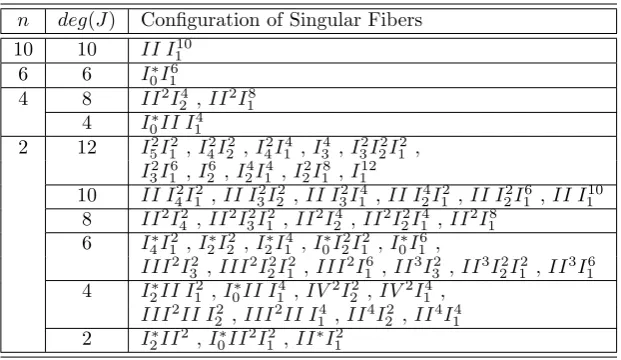
In Section 4, we first study the orders of induced automorphisms for an ellip-tic surface with a given configuration of singular fibers. Table 2 and 3 show the possible values of orders of induced automorphisms in terms of configurations of singular fibers (here, all the values shown in the tables may not occur). Also, we prove in Proposition 4.2.3 that if theJ-map is not constant, AutB(P1) can be one of the groupsZ/nZ(1 ≤n≤12, n = 11),6 Z/2Z×Z/2Z, D3, D4, D6 orA4; and give the list of the configurations of singular fibers for which these groups may arise (again this is not an existence result).
2
Preliminaries
In this section, we give some basic information about elliptic surfaces rel-evant to the following sections. The reader can consult the book [8] for more details.
An elliptic surface is a smooth algebraic surface B together with a map β : B → C to a smooth algebraic curve C such that the generic fiber is a smooth genus 1 curve. If there is a section of the mapβ, then every smooth genus 1 fiber has a marked point, hence it is an elliptic curve. An elliptic sur-face isrelatively minimal if it has no smooth rational (−1) curves in the fibers. By blowing down such (−1) curves, every elliptic surface can be transformed to a birational relatively minimal elliptic surface. A rational elliptic surface is an elliptic surface birational to P2. A rational elliptic surface with section is necessarily fibered over the base curveC =P1. A relatively minimal rational elliptic surface with section is the blow-up ofP2at the 9 base points of a pencil of generically smooth cubics.
Singular Fibers of Elliptic Surfaces : While the generic fiber is a smooth genus 1 curve, elliptic surfaces usually have singular fibers. Kodaira [5] has shown that fibers of a relatively minimal elliptic surface are of one of the fol-lowing types:
Name Description
I0 Smooth genus 1 curve
I1 Nodal rational curve
I2 2 copies ofP1 meeting at 2 distinct points transversally I3 3 copies ofP1 meeting at 3 distinct points with dual graph ¯A2 In , (n≥4) ncopies ofP1 meeting in a cycle,
i.e. meeting with dual graph ¯An−1
mIn , (n≥0) Multiple fiber,In with multiplicitym
In∗ ,n≥0 n+ 5 copies ofP1 meeting with dual graph ¯D
n+4 II Cuspidal rational curve
III 2 copies ofP1 meeting at a single point to order 2 IV 3 copies ofP1 all meeting at a single point II∗ 9 copies ofP1 meeting with dual graph ¯E8 III∗ 8 copies ofP1 meeting with dual graph ¯E7 IV∗ 7 copies ofP1 meeting with dual graph ¯E6
to the graphs below.
Note that if an elliptic surface has a section, then the intersection number of the section with each fiber is 1, hence elliptic surfaces with section do not have singular fibers of type mIn form >1.
Name Graph Multiplicities
¯
An−1 A cycle ofnvertices 1 for each vertex ¯
Dn ◦◦>◦ − ◦ − · · · − ◦<◦◦n+ 1 vertices 11>2−2− · · · −2< 1 1 ¯
E6 ◦−◦◦−◦>◦ − ◦ − ◦ 11−−22>3−2−1 ¯
E7 ◦ − ◦ − ◦ − ◦
|
◦
− ◦ − ◦ − ◦ 1−2−3−4
|
2
−3−2−1 ¯
E8 ◦ − ◦ − ◦
|
◦
− ◦ − ◦ − ◦ − ◦ − ◦ 2−4−6
|
3
−5−4−3−2−1
Configurations of Singular Fibers : Since the Euler characteristic of a genus 1 curve is zero, an Euler characteristic argument shows that for any elliptic surfaceB
X
Ssingular fiber
χ(S) =χ(B)
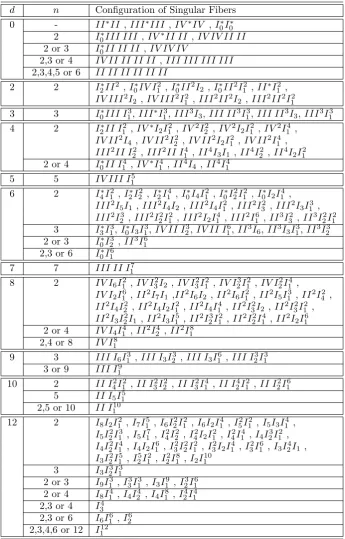
But this equation does not suffice to determine the configurations of singular fibers of elliptic surfaces. Persson [10] and Miranda [6] have shown that ifB is a relatively minimal rational elliptic surface with section, then the configuration of singular fibers ofB is one of those shown in Table 1 below.
Notation and Ordering : The notationIV II2I
2I12indicates that there is one singular fiber of typeIV, one of typeI2, two of typeII and two of typeI1. The exponents in the notation are the numbers of each type of singular fiber in the configuration. When writing configurations and ordering them in the lists and tables below, a decreasing lexicographic order is followed according to the following:
Sn+1> Snfor any fiber S, and T > Sn if T > S and
In∗+1> In∗> IV∗> III∗> II∗> IV > III > II > In+1> In.
D and E of the line bundles OP1(4H) and OP1(6H), respectively (where H is
the hyperplane), such thatB0is a divisor on theP2bundleP(OP1⊕OP1(−2H)⊕
OP1(−3H)) given by theWeierstrass equation
Y2=X3+DX+E. Then
J = 4D
3
4D3+ 27E2. defines a meromorphic map onP1. If the fiber overz ∈
P1 is a smooth elliptic curve, thenJ(z) is thej-invariant of that elliptic curve. Note that there is a sin-gular fiber overzif the section 4D3+ 27E2vanishes atz. Since this is a section of a line bundle with degree 12, there are at most 12 singular fibers. The type of the singular fiber ofB can be determined by the orders of vanishing of the sec-tionsD,Eand ∆ = 4D3+27E2, which is known as Tat’s algorithm (p.41 in [8]).
Double Cover of F2 : If the Weierstrass fibration B0 is given by Y2 = X3+DX+E in theP2bundle overP1as above, then (X, Y)7→Xis an involu-tion onB0, which maps it to the rational ruled surfaceP(OP1⊕OP1(−2H)) =F2
as a double cover branched over the minimal section of theF2 and a trisection T given by the equationX3+DX+E= 0 inF2.
Mordell-Weil Group : The set of sections of an elliptic surface B with section is a group called the Mordell-Weil group ofB, and denoted byM W(B). Ifζ1 and ζ2 are two sections, using the group law on each smooth fiber, which is an elliptic curve, one can defineζ1+ζ2 over the open set of the base curve corresponding to smooth fibers. Then by taking the closure inB, this can be extended uniquely to a section ofB. For a relatively minimal rational elliptic surfaceB with section, Oguiso and Shioda [9] have shown thatM W(B) (even its lattice structure) is determined by the configuration of singular fibers on the surface, and they have listed the lattice structure ofM W(B) corresponding to each possible configuration. Their results show thatM W(B) is a finitely gen-erated abelian group of rank at most 8 and torsion group of size at most 9.
deg(J) Configuration of Singular Fibers 0 I0∗I0∗ ,I0∗IV II ,I0∗III2,I∗
0II3,IV∗IV ,IV∗II2 ,III∗III , II∗II ,IV3 ,IV2II2 ,IV II4 ,III4 ,II6
1 I1∗III II ,I0∗III II I1, IV∗III I1 ,III∗II I1 2 I2∗II2,I∗
1IV I1 ,I1∗II2I1,I0∗IV I12,I0∗II2I2, I0∗II2I12 ,IV∗II I2 , IV∗II I2
1 , II∗I12,IV III2I2, IV III2I12 ,III2II2I2 ,III2II2I12 3 I2∗III I1 ,I1∗III I2, I1∗III I12 ,I0∗III I2I1 ,I0∗III I13 ,III∗I2I1,
III∗I3
1 ,IV III II I3 ,IV III II I2I1,IV III II I13 ,III3I3, III3I
deg(J) Configuration of Singular Fibers 4 I3∗II I1 ,I2∗II I2
1 ,I1∗II I3 ,I1∗II I2I1 ,I1∗II I13 ,I0∗II I3I1 , I0∗II I2I2
1 ,I0∗II I14 ,IV∗I3I1 ,IV∗I2I12, IV∗I14 ,IV2I22 , IV2I2I2
1 ,IV2I14 ,IV II2I4 ,IV II2I3I1 ,IV II2I22, IV II2I2I2
1 ,IV II2I14 ,III2II I4 ,III2II I3I1,III2II I22, III2II I2I2
1 ,III2II I14,II4I4 ,II4I3I1 ,II4I22, II4I2I12, II4I14 5 IV III I4I1,IV III I3I2,IV III I3I12, IV III I22I1 ,
IV III I2I13 ,IV III I15, III II2I5 ,III II2I4I1 , III II2I
3I2 ,III II2I3I12,III II2I22I1 ,III II2I2I13, III II2I15 6 I4∗I12 ,I3∗I13 ,I2∗I22 ,I2∗I2I12,I2∗I14, I1∗I4I1 ,I1∗I3I12,I1∗I22I1 ,
I1∗I2I13 ,I1∗I15 ,I0∗I4I12, I0∗I3I13 ,I0∗I23 ,I0∗I22I12 ,I0∗I2I14 , I0∗I16 ,IV II I5I1 ,IV II I4I2 ,IV II I4I12, IV II I3I2I1 ,
IV II I3I13 ,IV II I23 ,IV II I22I12 ,IV II I2I14 ,IV II I16 ,III2I5I1 , III2I
4I2 ,III2I4I12 ,III2I32,III2I3I2I1 ,III2I3I13 ,III2I23, III2I2
2I12,III2I2I14 ,III2I16 ,II3I6 ,II3I5I1 ,II3I4I2 ,II3I4I12 , II3I2
3 ,II3I3I2I1,II3I3I13,II3I23 ,II3I22I12,II3I2I14,II3I16 7 III II I6I1, III II I5I2, III II I5I2
1 ,III II I4I3 , III II I4I2I1 ,III II I4I3
1 ,III II I32I1 ,III II I3I22, III II I3I2I12 ,III II I3I14 ,III II I23I1,
III II I22I13 ,III II I2I15 ,III II I17
8 IV I6I12 ,IV I5I2I1 ,IV I5I13,IV I4I2I12,IV I4I14 ,IV I32I2, IV I2
3I12 ,IV I3I22I1 ,IV I3I2I13 ,IV I3I15 ,IV I23I12,IV I22I14 , IV I2I6
1 ,IV I18,II2I7I1 ,II2I6I2 ,II2I6I12 ,II2I5I2I1 , II2I5I3
1 , II2I42 ,II2I4I3I1,II2I4I22,II2I4I2I12 , II2I4I4
1 , II2I32I2, II2I32I12 ,II2I3I22I1 ,II2I3I2I13 ,II2I3I15, II2I4
2 ,II2I23I12,II2I22I14, II2I2I16 ,II2I18
9 III I7I12 ,III I6I2I1,III I6I13 ,III I5I3I1 ,III I5I2I12 ,III I5I14 , III I4I3I2 ,III I4I3I12, III I4I22I1 ,III I4I2I13 ,III I4I15 ,
III I2
3I2I1 ,III I32I13 ,III I3I23 ,III I3I22I12 ,III I3I2I14, III I3I16 ,III I24I1 ,III I23I13 ,III I22I15,III I2I17 ,III I19 10 II I8I12 ,II I7I2I1 ,II I7I13, II I6I2I12,II I6I14 ,II I5I4I1 ,
II I5I3I2 ,II I5I3I12 ,II I5I22I1 ,II I5I2I13 ,II I5I15, II I42I12, II I4I3I2I1, II I4I3I13,II I4I22I12,II I4I2I14,
II I4I16 ,II I32I2I1 ,II I32I13 ,II I3I23I1 ,II I3I22I13 ,II I3I2I15 , II I3I17 ,II I24I12 ,II I23I14 ,II I22I16, II I2I18 ,II I110
12 I9I3
1 ,I8I2I12,I8I14 ,I7I2I13,I7I15 ,I6I3I2I1,I6I3I13, I6I2
2I12 ,I6I2I14 ,I6I16 ,I52I12 ,I5I4I13 ,I5I3I2I12 ,I5I3I14 ,I5I22I13, I5I2I5
1 , I5I17,I42I22,I42I2I12 ,I42I14 ,I4I3I22I1 ,I4I3I2I13, I4I3I15, I4I24,I4I23I12 ,I4I22I14 ,I4I2I16 ,I4I18 ,I34,I33I2I1, I33I13,I32I22I12 ,I32I2I14 ,I32I16 ,I3I24I1,I3I23I13, I3I22I15 ,I3I2I17 , I3I19,I26 ,I25I12 ,I24I14 ,I23I16 ,I22I18 ,I2I110 ,I112
3
Automorphisms of Rational Elliptic Surfaces
In this section, we examine the structure of the groupAut(B) of the auto-morphisms of the relatively minimal rational elliptic surfaceBwith section. The groupsAutB(P1) of induced automorphisms on the base curveP1and the group Autσ(B) of the automorphisms preserving the zero section ofB are defined
to-gether with the group homomorphismsφandψfromAut(B) onto each of these groups, respectively. Theorem 3.0.1 shows thatAut(B) =M W(B)oAutσ(B).
Letβ :B→P1be a relatively minimal rational elliptic surface with section andτ :B →B be an automorphism of B (a biholomorphic map). The canon-ical divisor classKB ofB is preserved by every automorphism. The canonical
class formula for elliptic surfaces givesKB =−F where F is the class of the
fiber of the mapβ forrationalelliptic surfacesB. Furthermore,|F|is a pencil, henceτ maps every fiber ofβ to a fiber. This shows that every automorphismτ ofBinduces an automorphismτBonP1making the following diagram commute:
B −−−−→τ B
β y
yβ
P1 −−−−→τ
P1
P1
This gives a group homomorphism:
φ : Aut(B)→Aut(P1), τ 7→τP1. (1) We denote the group of induced automorphisms onP1 by
AutB(P1) =φ(Aut(B)). (2) The sections of the map β : B → P1 form an abelian group called the Mordell-Weil group ofB, and denoted byM W(B). Ifσ1andσ2are two sections σ1+σ2 in M W(B) is obtained by performing the group law in every smooth fiber ofβ, which is an elliptic curve. The intersection ofσ1+σ2 with singular fibers is determined by taking the closure of what is obtained in smooth fibers. Each elementζ of M W(B) can be identified with an automorphismtζ of B,
namely the translation by the section ζ, which acts on every smooth fiber as the translation in the elliptic curve by the intersection of the section with the elliptic curve. With this identification the Mordell-Weil group of B embeds in the automorphism group ofB as the group of translations by sections. We will seeM W(B) as a subgroup ofAut(B).
M W(B),→Aut(B), ζ7→tζ. (3)
tζ induces the identityIP1 onP1.
For every rational elliptic surfaceB with section, there is an automorphism
−I ∈ Aut(B) which acts on every smooth fiber as the inversion of the group law. This automorphism also induces the identity onP1.
φ(−I) =IP1. (5)
−Iis an involution.
(−I)2= (−I)◦(−I) =I (6) whereIdenotes the identity map onB.
We define a subgroup ofAut(B) by:
Autσ(B) ={τ ∈Aut(B)|τ(σ) =σ} (7)
whereσis the zero section ofB, the zero ofM W(B). Autσ(B) is the group of
automorphisms preserving the zero section ofB. We can define a map ψ : Aut(B)→Autσ(B)
τ 7→α=t−τ(σ)◦τ
. (8)
Composingτ with the translation by the inverse of the section τ(σ) gives an automorphism which maps the zero section σ to itself as a set. α = ψ(τ) is called thelinearization ofτ.
α = ψ(τ) preserves the zero section σ, thus when restricted to a smooth fiber it maps the zero of this elliptic curve to the zero of another elliptic curve, hence is a group isomorphism between the elliptic curves. Then for any section ζwe have;
α◦tζ =tα(ζ)◦α. (9) Using this we can show thatψis a group homomorphism since
ψ(τ1)◦ψ(τ2) =ψ(τ1)◦t−τ2(σ)◦τ2=t−ψ(τ1)(τ2(σ))◦ψ(τ1)◦τ2
=t−(−τ1(σ)+τ1(τ2(σ)))◦t−τ1(σ)◦τ1◦τ2=t−τ1(τ2(σ))◦τ1◦τ2
=ψ(τ1◦τ2).
(10) The kernel of this group homomorphismψconsists of the automorphismsτ such thatψ(τ) =t−τ(σ)◦τ=I, thusτ=tτ(σ). Then the kernel is the group of translations by sections
Ker(ψ) =M W(B). (11)
This gives the following short exact sequence
Theorem 3.0.1. The automorphism group of a relatively minimal rational el-liptic surface B with section is isomorphic to the semi-direct product of the Mordell-Weil group of B and the subgroup of automorphisms preserving the zero section.
Aut(B) =M W(B)oAutσ(B).
The action ofAutσ(B)on MW(B) is given by:
α·tζ =tα(ζ)for allα∈Autσ(B), ζ∈M W(B)
so that the group operation in the semi-direct product is:
(tζ1◦α1)(tζ2◦α2) = ((tζ1◦(α1·tζ2))◦(α1◦α2))
= (tζ1+α1(ζ2)◦(α1◦α2)).
Proof. Both M W(B) andAutσ(B) are subgroups of Aut(B), hence the short
exact sequence above gives the semi-direct product statement. For the action we have
α·tζ =α◦tζ◦α−1=tα(ζ)◦α◦α−1=tα(ζ).
The Mordell-Weil groups of relatively minimal rational elliptic surfaces with section have been completely classified in terms of the configurations of singular fibers on the surfaces by Oguiso and Shioda [9]. Our aim in this dissertation is to give the other component of the semi-direct product structure ofAut(B), namely the subgroupAutσ(B).
4
Induced Automorphisms on
P
1In this section, we first study the orders of automorphisms induced on the base curve P1 by the automorphisms of the rational elliptic surface B. The points onP1 corresponding to the singular fibers ofB are special points which bring useful combinatorial criteria on possible orders of induced automorphisms. Using these criteria, we present the possible orders of induced automorphisms (without proving existence) for each configuration of singular fibers in Table 2 and 3. In the subsection 4.2, we examine the group AutB(P1). We show in Proposition 4.2.3 that if theJ-map is not constant, AutB(P1) is one of the groupsZ/nZ(n≤12, n6= 11), Z/2Z×Z/2Z,D3,D4, D6 or A4, and we give the lists of the configurations of singular fibers corresponding to the non-cyclic ones.
4.1
Orders of induced automorphisms
Lemma 4.1.1. For every automorphism τ ∈ Aut(B), the following diagram commutes.
B −→τ B
↓β ↓β
P1
τ
P1
−−→ P1
yJ J.
P1
Proof. As discussed before, τ maps the fibers of β to fibers. τ has an inverse. When restricted to a fiber, τ becomes an invertible map between two fibers. Then the singular fibers map to singular fibers of the same type (II maps to a II fiber,Inmaps to anInetc.) since each type has a different homeomorphism
class. On smooth fibersτ is biholomorphic, hence the J-values of the elliptic curves permuted byτ are the same. There is only oneJ-value that a singular fiber a given type can take except for the singular fiber typeI0∗ which can take any J-value. But B can have at most twoI0∗ fibers, in which case theJ-map is constant. In any case, theJ-values of the fibers which are mapped to each other byτ are the same.
Proposition 4.1.2. If τP1 = φ(τ) is the automorphism induced on P1 by
τ∈Aut(B),n=ord(τP1)and d=deg(J)>0, then nis finite andn|d. Proof. τP1 permutes the points inJ−1(x) for all xby the commutativity of the
above diagram. Pick three distinct pointsx. Some finite power ofτP1 will fix
every point inJ−1(x) for these three values of x, hence will fix at least three points inP1, then it is the identity. Therefore, n=ord(τP1) is finite. Then τP1 fixes two points ofP1 and all other orbits havenpoints. For genericx,J−1(x) consists ofddistinct points and the permutation of thesedpoints byτP1 is by
If we know the configuration of singular fibers on B, then using the above lemma and proposition, we can list the possible values ofn=ord(τP1). Below,
we give a table of the configurations of singular fibers and the possible values of nwhich is the order of an automorphism induced onP1by an automorphism of an elliptic surfaceB with this configuration of singular fibers. The criteria we use for determining these possible values ofnare as follows:
• The singular fibers of the same type are permuted by τ, so the points in P1corresponding to those singular fibers are permuted by τP1.
• If ik and i∗k are the numbers of the Ik and Ik∗ fibers on B, then deg(J) =
d= Σk(ik+i∗k) andn|d.
• If n > 1 then there are 2 fixed points of τP1. Then after a change of
co-ordinates,τP1 is the rotation of ordernon P1, so all the orbits except for the
fixed points must havenpoints.
•The multiplicity of theJ-map is the same on xandτP1(x) for allx.
• If there are three distinct singular fiber types each appearing only once in the configuration of singular fibers of the surfaceB, then n= 1 since an auto-morphism ofP1 fixing three points must be the identity. For suchB, we have AutB(P1) = 0.
Note that all possible configurations of singular fibers have been classified by Persson [10] and Miranda [6]. In Table 2 below, we only include the config-urations for whichn > 1 is possible subject to the above criteria. This table does not give theexisting values ofn, but just the candidate values ofn. Those are the numbers we get by applying only the criteria described above.
d n Configuration of Singular Fibers 0 - II∗II ,III∗III ,IV∗IV ,I0∗I0∗
2 I0∗III III ,IV∗II II ,IV IV II II 2 or 3 I0∗II II II , IV IV IV
2,3 or 4 IV II II II II, III III III III 2,3,4,5 or 6 II II II II II II
2 2 I2∗II2 ,I0∗IV I12 ,I0∗II2I2 ,I0∗II2I12 ,II∗I12 , IV III2I
2 ,IV III2I12 ,III2II2I2 ,III2II2I12
3 3 I0∗III I13, III∗I13,III3I3, III II3I13,III II3I3,III3I13 4 2 I2∗II I12 ,IV∗I2I12 ,IV2I22 ,IV2I2I12, IV2I14 ,
IV II2I4 ,IV II2I22 ,IV II2I2I12,IV II2I14 , III2II I22 ,III2II I14,II4I3I1 ,II4I22 ,II4I2I12 2 or 4 I∗
0II I14 ,IV∗I14 ,II4I4, II4I14 5 5 IV III I15
6 2 I4∗I12 ,I2∗I22 ,I2∗I14 ,I0∗I4I12 ,I0∗I22I12,I0∗I2I14 , III2I5I1,III2I4I2 ,III2I4I12 ,III2I32 ,III2I3I13 , III2I23 ,III2I22I12 ,III2I2I14 ,III2I16,II3I32 ,II3I22I12 3 I3∗I13,I0∗I3I13,IV II I23, IV II I16,II3I6,II3I3I13,II3I23 2 or 3 I∗
0I23 ,II3I16 2,3 or 6 I0∗I6
1 7 7 III II I17
8 2 IV I6I12,IV I32I2 ,IV I32I12 ,IV I23I12, IV I22I14, IV I2I16,II2I7I1 ,II2I6I2 ,II2I6I12 ,II2I5I13 ,II2I42 , II2I
4I22 ,II2I4I2I12 ,II2I4I14 ,II2I32I2 ,II2I32I12, II2I
3I22I1 ,II2I3I15 ,II2I23I12 ,II2I22I14,II2I2I16 2 or 4 IV I4I14,II2I24 ,II2I18
2,4 or 8 IV I8 1
9 3 III I6I13 ,III I3I23, III I3I16 ,III I23I13 3 or 9 III I9
1
10 2 II I2
4I12, II I32I22,II I32I14 ,II I24I12 ,II I22I16 5 II I5I15
2,5 or 10 II I10 1
12 2 I8I2I12 ,I7I15 ,I6I22I12 ,I6I2I14 ,I52I12 ,I5I3I14 , I5I22I13 ,I5I17 ,I42I22 ,I42I2I12 ,I42I14 ,I4I23I12, I4I22I14 ,I4I2I16 ,I32I22I12, I32I2I14 ,I32I16 ,I3I24I1 , I3I22I15 ,I25I12 ,I22I18 ,I2I110
3 I3I23I13 2 or 3 I9I3
1 , I33I13 ,I3I19,I23I16 2 or 4 I8I4
1 , I4I24,I4I18 ,I24I14 2,3 or 4 I4
3 2,3 or 6 I6I6
1 , I26 2,3,4,6 or 12 I12
1
d Configuration of Singular Fibers
1 I1∗III II ,I0∗III II I1 ,IV∗III I1,III∗II I1 2 I1∗IV I1,I1∗II2I1 ,IV∗II I2,IV∗II I12 3 I2∗III I1 ,I1∗III I2 ,I1∗III I2
1 ,I0∗III I2I1 ,III∗I2I1 ,IV III II I3, IV III II I2I1,IV III II I3
1 ,III3I2I1 ,III II2I2I1 4 I3∗II I1,I1∗II I3 ,I1∗II I2I1,I1∗II I3
1 ,I0∗II I2I12, IV∗I3I1 , IV II2I3I1,III2II I4,III2II I3I1 ,III2II I2I2
1 5 IV III I4I1 ,IV III I3I2 ,IV III I3I2
1 ,IV III I22I1 , IV III I2I3
1 ,III II2I5 ,III II2I4I1,III II2I3I2 , III II2I3I2
1 ,III II2I22I1 ,III II2I2I13,III II2I15 6 I1∗I4I1 ,I1∗I3I2
1 ,I1∗I2I13 ,I1∗I15 ,IV II I5I1 ,IV II I4I2, IV II I4I2
1 ,IV II I3I2I1, IV II I3I13 ,IV II I22I12 ,IV II I2I14 , III2I3I2I1, II3I5I1,II3I4I2 ,II3I4I2
1 ,II3I3I2I1,II3I2I14 7 III II I6I1 ,III II I5I2 ,III II I5I2
1 ,III II I4I3 ,III II I4I2I1 , III II I4I3
1 ,III II I32I1 ,III II I3I22 ,III II I3I2I12 , III II I3I4
1 ,III II I23I1 ,III II I22I13,III II I2I15 8 IV I5I2I1,IV I5I3
1 ,IV I4I2I12 ,IV I3I22I1 ,IV I3I2I13 , IV I3I5
1 ,II2I5I2I1,II2I4I3I1, II2I4I2I12 ,II2I3I2I13 9 III I7I2
1 ,III I6I2I1, III I5I3I1 ,III I5I2I12 ,III I5I14 ,III I4I3I2, III I4I3I2
1 ,III I4I22I1 ,III I4I2I13 ,III I4I15 ,III I32I2I1 , III I2
3I13 ,III I3I22I12 ,III I3I2I14 ,III I24I1 ,III I22I15 ,III I2I17 10 II I8I2
1 ,II I7I2I1 ,II I7I13 ,II I6I2I12, II I6I14 ,II I5I4I1 , II I5I3I2,II I5I3I2
1 ,II I5I22I1 ,II I5I2I13 ,II I4I3I2I1 , II I4I3I3
1 , II I4I22I12 ,II I4I2I14, II I4I16 ,II I32I2I12 , II I3I23I1, II I3I22I13 ,II I3I2I15, II I3I17 ,II I23I14 ,II I2I18 12 I7I2I3
1 ,I6I3I2I1 ,I6I3I13 ,I5I4I13 ,I5I3I2I12, I5I2I15 ,I4I3I22I1 , I4I3I2I3
1 ,I4I3I15 ,I33I2I1 ,I3I2I17
Table 3: Configurations for whichn= 1 subject to Lemma 4.1.1 and Proposition 4.1.2.
Fiber type overx∈P1 J(x) Multiplicity of theJ-map atx
In or In∗ (n≥1) ∞ n
III or III∗ 1 1 mod 2
II or IV∗ 0 1 mod 3
IV or II∗ 0 2 mod 3
I0or I∗0 0 0 mod 3
1 0 mod 2
6
= 0,1,∞ no restriction
Table 4: The multiplicity and the value of theJ-map on the points correspond-ing to each fiber type.
Using this table, we can determine the possible ramifications of theJ-map at the points ofP1corresponding to each fiber for a given configuration of singular fibers. The total ramification of theJ-map is 2·deg(J)−2 by the Hurwitz’s Formula. The multiplicities of theJ-map at the points with the sameJ-value add up todeg(J).
4.1.1 Examples
1) IV I3I2I3
1: The singular fibersIV, I3 andI2 appear once in the configura-tion. Then the points onP1corresponding to these three fibers must be fixed by any induced automorphism, hence every induced automorphism is the identity. Thus,n= 1.
2) IV∗II I12 : The degree of the J-map is 2. There must be I0 fibers over J = 1 (I0 fibers with J-value 1) since there are no III , III∗ or I0∗ fibers in the configuration, and these are the only fibers which can haveJ-value 1. Mul-tiplicities of theJ-map at the points corresponding to theI0 fibers overJ = 1 are congruent to 0 mod 2 from Table 4. These multiplicities should add up to the degree of theJ-map, which is 2. Then, there is only one I0 with J-value 1, and the multiplicity of the J-map is 2 at the point corresponding to this I0. An induced automorphism must fix that point since there is only one fiber withJ-value 1, and induced automorphisms permute the points corresponding to the fibers with the sameJ-value. Induced automorphisms also fix the points corresponding to theIV∗ and II fibers since these fibers appear only once in the configuration. Hence, there are already three fixed points. Thus,n= 1.
3) I4I3I15 : The points corresponding toI4 andI3 are fixed. The points corre-sponding to the fiveI1 fibers are then permuted byn-cycles. The degree of the J-map is d= 12. Son|d= 12 andn|5. Thenn= 1.
4) III2II I
(the points corresponding to)III andII must be 1. Together with the (points corresponding to) I4 and II, (the points corresponding to) these two I0 with J-values 0 and 1 must be fixed. There are already four fixed points. n= 1.
5)III2II I22 : d = 4, the total ramification is 6. II is fixed (i.e. the point corresponding to the fiber II is fixed by every induced automorphism. From this point on, we will write so for short). OverJ = 1, we either have two III fibers with the multiplicities ofJ 3 and 1; or twoIII fibers and anI0 with the multiplicities ofJ 1,1,2. In the former case, both of theIII are fixed since the multiplicities ofJ are different, so they cannot be permuted. Then we get three fixed points and n = 1. In the latter case, I0 is fixed. Over J = 0 we may have aII with the multiplicity ofJ 4; or we may have a II and anI0 with the multiplicities ofJ 1 and 3. In the latter case, together with the I0 overJ = 1, theII and I0 over J = 0 are fixed and n = 1. In the former case, the total ramification is already 6 with the ramifications at the I0 over J = 1, II and the twoI2. So there is no more ramification. There are four I0 fibers over any J-value except 0,1 and∞. TheI0overJ = 1 andII are fixed and all the other fibers can be permuted by 2-cycles. Hence,n= 2 is possible.
6) I∗
0II I14 : d = 4, the total ramification of J is 6. n can be 1,2 or 4. If we haveI∗
0 overJ = 1 with the multiplicity ofJ 4, andII with the multiplicity of J 4, then there is no other ramification except for the I0∗ and II. There are fourI0 fibers over eachJ 6= 1,0,∞. FixingI0∗ and II, and permuting the other fibers by 4-cycles is possible. n= 4 is possible. Then, ifτ is an induced automorphism of ordern= 4,τ2has order 2. n= 2 is also possible. (Generally, ifn=kis possible and m|k, thenn=mis also possible.). n= 2 or 4.
7) I0∗I3
2 : d = 6, the total ramification is 10. n may be 2, 3 or 6. 6 is not possible since there are threeI2 fibers which must be permuted. We may have threeI0 fibers overJ = 1 with the multiplicity ofJ 2 at each, and oneI0∗ and anI0 overJ = 0 with the multiplicity ofJ 3 at each. These numbers complete the total ramification to 10 with the ramifications of theI2fibers. Fixing theI0 andI0∗ overJ= 0 and permuting the other fibers by 3-cycles is possible. n= 3 is possible. Or, we may have two I0 over J = 0 and one I0∗ and two I0 over J = 1. In this case,I∗
0 andI2can be fixed and the other fibers can be permuted by 2-cycles. So,n= 2 or 3.
8) II3I
fixed point in order to getn= 2. We again have 3 fixed points and son= 1.
9) II3I3I13 : d = 6, the total ramification is 10. I3 is fixed. Since there are threeII and threeI1fibers,n= 6 andn= 2 are not possible. We may have threeII and oneI0overJ = 0 with the multiplicities ofJ 1,1,1,3; threeI0over J = 1 and anotherJ 6= 1,0,∞with the multiplicities ofJ 2,2,2. Fixing theI0 overJ = 0 together withI3 and permuting the others by 3-cycles is possible. n= 3 is possible.
10) II3I6
1 : d = 6, the total ramification is 10. Since there are three II fibers, n = 6 is not possible. We can have n = 3 if there are three II and one I0 overJ = 0 with the multiplicities of J 1,1,1,3; oneI0 over J = 1 with the multiplicity ofJ 6; and three I0 over a J 6= 0,1,∞ with the multiplicities ofJ 2,2,2. Here, theI0 fibers over J = 0,1 are fixed and the other fibers are permuted in 3-cycles. To haven= 2 possible, we may have threeII fibers over J = 0 with the multiplicities ofJ 1,1,4; oneI0 overJ = 1 with the multiplicity ofJ 6; and fourI0 fibers over aJ6= 0,1,∞with the multiplicities ofJ 1,1,2,2. Here, theI0 overJ= 1 and theII with the multiplicity ofJ 4 is fixed and the others are permuted by 2 cycles. n= 2 or 3 is possible.
11) I3
2I16 : d= 12, the total ramification is 22. Since there are threeI2 fibers, n= 4,6,12 are not possible. We can have n= 3 if there is oneI0 overJ = 1 with the multiplicity ofJ 12, and four I0 overJ = 0 with the multiplicity ofJ 3 for each. Here, theI0 overJ = 1 and one of the fourI0 fibers overJ = 0 are fixed while the others are permuted by 3-cycles. We can haven= 2 if there are three I0 fibers over J = 1 with the multiplicities of J 4,4,4 , and two I0 over J = 0 with the multiplicities ofJ 6,6. Here, one of theI0 overJ = 1 and one of theI2are fixed while the others are permuted by 2-cycles. n= 2 or 3 is possible.
12)I4
4.2
Aut
B(
P
1)
: the group of induced automorphisms
After discussing orders of induced automorphisms, we now turn to discuss the group AutB(P1). The elements in the orbits of AutB(P1) have the same J-value by Lemma 4.1.1. For a relatively minimal rational elliptic surface with section, the degree of theJ-map can be at most 12. Then the maximum orbit size ofAutB(P1) is 12.
Lemma 4.2.1. If deg(J) > 0 and if there is a point of P1 which is fixed by
every element inAutB(P1)(in particular, if there is only one singular fiber of a
particular type in the configuration of singular fibers of B), then there is another point which is also fixed by every element ofAutB(P1), andAutB(P1)is a cyclic
group.
Proof. Assume xis fixed by every element, and y and z (y 6=z) are fixed by two distinct non-identity elements γ1 and γ2. Note that a non-identity auto-morphism of P1 has exactly two fixed points. We may choose coordinates on P1 so that x=∞and y = 0. By taking powers if necessary, we may assume that the orders ofγi are the primespi. γ1is the rotation around 0 of order p1, andγ2 is the rotation around z 6= 0 of order p2. We are only concerned with pi < 12, hence with 2, 3, 5 or 7 (we do not have 11 here since the degree of
theJ-map is never 11 for a rational elliptic surface). It is easy to see that in every case, the orbit of z will have infinitely many elements, contradicting the maximum orbit size being 12. Theny=z, i.e. the second fixed point of all the non-identity elements ofAutB(P1) isy. The orders of elements ofAutB(P1) are restricted by 12 (the orbit size is less than or equal to 12). Pick one element with highest order in that group, it will generate the whole group, henceAutB(P1) is cyclic.
Lemma 4.2.2. The subgroups ofAut(P1) with orbit size less than or equal to
12 areZ/nZn≤12,Z/2Z×Z/2Z, D3,D4,D5, D6 and A4, where Dk is the
dihedral group of2kelements and A4 is the alternating group.
Proof. IfGis such a subgroup ofAut(P1), then ifγ∈Gis a non-identity auto-morphism fixingxandy inP1, all the automorphisms in Gfixingxmust also fixy, otherwise the orbit ofywill be infinite as in the proof of the above lemma. Then, the stabilizer ofxin Gis finite since automorphisms of order at most 12 which fix xand y can form only cyclic subgroups of order at most 12. Since the orbit of xalso has at most 12 elements, G is finite. Then, there are only finitely many points which can be fixed by a non-identity element of G since each such automorphism has exactly 2 fixed points. Then, a generic point of P1 has a stabilizer consisting of just the identity. Then,|G| is at mostdeg(J), hence|G| ≤12. If we take the Moebius transformationz 7→µnz, whereµn is
a primitive n-th root of unity, this automorphism of P1 generates a subgroup ofAut(P1) isomorphic toZ/nZ, and the subgroup of automorphisms generated by the two Moebius transformations z 7→ 1/z and z 7→ µnz (n = 2,3,4,5,6),
P1 as the sphere, the orientation preserving transformations of a regular tetra-hedron inside the sphere induces an automorphism subgroup ofP1 isomorphic toA4. This proves the existence of the listed groups. Note that this last group A4is generated by a rotation of order 3, fixing a vertex of the tetrahedron and rotating the opposite face, and two rotations of order 2, each interchanging two pairs of vertices of the tetrahedron and mapping the faces accordingly.
It is a well-known fact that the only finite subgroups of the automorphism group of P1 are cyclic groups, dihedral groups or the groups of rotations of a regular tetrahedron, octahedron or dodecahedron (p.184 in [1]). The only groups of order less than or equal to 12 in that list are the groups listed in the lemma. This completes the proof.
Proposition 4.2.3. The only configurations of singular fibers which may allow a non-cyclic AutB(P1) and the corresponding non-cyclic groups AutB(P1) are
as listed below:
∗ Z/2Z×Z/2Z : IV2I22, IV2I14, II4I22, II4I14, II2I42, II2I32I12, II2I24, II2I22I14,II2I18,I52I12,I42I22,I42I14,I34,I32I16,I26,I24I14,I22I18,I112.
∗ D3 : I33I13,I23I16,I26,I112.
∗ D4 : II2I24,II2I18.
∗ D6 : I26,I112.
∗ A4 : I4 3,I112.
IfAutB(P1) =Z/nZ, thenn|deg(J). In particular,n≤12 andn6= 11.
Proof. The last statement about the order of a cyclic AutB(P1) group follows directly from Lemma 4.1.1 and the fact thatdeg(J)≤12 anddeg(J)6= 11 for rational elliptic surfaces. By Lemma 4.2.1, we should consider only those con-figurations of singular fibers for which singular fiber types appear at least twice. The proof of Lemma 4.2.2 gives the generators of the possible groups which can arise as AutB(P1) and the relative positions of their fixed points. Using this, we can look at the orbits of each possible group onP1. From now on, we will denote a Moebius transformation by its formula alone.
these criteria to the actual orbit sizes of the group actions onP1under question, and eliminate the configurations for which the orbit sizes are not compatible.
The group Z/2Z×Z/2Z consists of the transformations z, −z, 1/z and
−1/z, where{0,∞},{1,−1} and{i,−i}are the only 2-element orbits. All the other orbits have 4 elements. Then, ifAutB(P1) =Z/2Z×Z/2Z, then 4|deg(J) since the generic orbit has 4 elements,J−1(x) consists ofdeg(J) elements for a genericx, and every element in the same orbit must have the sameJ-value.
If deg(J) = 4, the only configurations where every singular fiber type ap-pears at least twice areIV2I2
2,IV2I14, II4I22 andII4I14. ForIV2I22, there are twoI0 over J = 1, and over any J 6= 0,1,∞ there are fourI0 fibers. The two I0 over J = 1, the two IV and the two I2 can form the three orbits of size 2; and the four I0 over any J 6= 0,1,∞ can form the orbits of size 4. Thus, AutB(P1) = Z/2Z×Z/2Z can occur for IV2I22. Similarly, we can give the ramifications of the J-map for the other configurations which are appropriate to haveAutB(P1) =Z/2Z×Z/2Zas follows:
•IV2I14: twoI0fibers overJ = 1 and someJ =j06= 0,1,∞, which form three orbits of size 2 together with the twoIV fibers. The other orbits all have four elements, which are the four fibers over anyJ 6= 0,1, j0 explicitly.
•II4I2
2 : TwoI0overJ = 1 and someJ =j06= 0,1,∞.
•II4I4
1 : TwoI0overJ = 1, and two other values of J6= 0,1,∞
Ifdeg(J) = 8, the configurations and the ramifications of theJ-map allow-ing three orbits of size 2 while all the other orbits have size 4 are as follows:
•II2I2
4 : FourI0overJ = 1 and twoI0overJ = 0, eightI0over anyJ 6= 0,1,∞.
•II2I2
3I12 : FourI0overJ = 1.
• II2I4
2 : TwoI0 over J = 1 with the multiplicity ofJ 4 at each, and twoI0 overJ = 0.
•II2I2
2I14 : Two I0 overJ = 1 with the multiplicity ofJ 4 at each.
•II2I18 : FourI0 overJ = 1, twoI0overJ = 0, and twoI0 over aJ 6= 0,1,∞
with the multiplicity ofJ 4 at each.
Fordeg(J) = 8, there is one more configuration,II2I23I12, where each singu-lar fiber type appears at least twice. But for this configuration we cannot have three orbits of size 2 while the other orbits have size 4 since there are threeI2 fibers which have to be permuted by the action. These cannot form an orbit of size 4, and if two of them are in one orbit, then the other has to form a singleton orbit, which is not allowed. Then,AutB(P1) =Z/2Z×Z/2Zis not possible for II2I3
2I12.
Ifdeg(J) = 12, the configurations and the ramifications of theJ-map allow-ing three orbits of size 2 while all the other orbits have size 4 are as follows:
• I2
second configuration.
•I42I14 : SixI0 over J = 1, and twoI0 overJ = 0 with the multiplicity of J 6 at both. Together with the twoI4and the twoI0 overJ = 0, the third orbit of size 2 consists of the two of the sixI0overJ = 1.
• I32I16 : Two I0 over J = 1 with the multiplicity of J 6 at each, four I0 over J = 0. Two of the six I1, the two I3 and the twoI0 over J = 1 are the three orbits of size 2.
•I2
2I18 : TwoI0 overJ = 1 andJ = 0 with the multiplicity ofJ 6 at each.
• I4
2I14 : Four I0 over J = 1 with multiplicities ofJ 2,2,4,4; and two I0 over J = 0 with the multiplicity ofJ 6 at each. These sixI0form three orbits of size 2.
•I4
3 : Six I0 overJ = 1 and fourI0 overJ = 0. The sixI0 overJ = 1 give the three orbits of size 2.
•I6
2 : SixI0 overJ = 1; and two I0 overJ = 0 with the multiplicity ofJ 6 at each. Two of the sixI2, two of the sixI0 overJ = 1 and the twoI0overJ = 0 give the three orbits of size 2.
• I112 : Six I0 overJ = 1, fourI0 over J = 0, and four I0 over a J 6= 0,1,∞
with multiplicities ofJ 1,1,5,5. These last four I0 and two of the six I0 over J = 1 give the three orbits of size 2.
For the configurationsI5
2I12,I33I13andI23I16, the singular fibers which appear an odd number of times in the configuration do not allow orbits of size 2 or 4. For the configurationI2
3I22I12, we already have three orbits of size 2 coming from the singular fibers, but overJ = 1, we cannot have four or eightI0 to get orbits of size 4. EightI0 is impossible since multiplicity ofJ is congruent to 0 mod 2 for suchI0. If there are four I0, the multiplicities ofJ cannot be the same for all four. Thus, they cannot be in the same orbit. For these four configurations, AutB(P1) =Z/2Z×Z/2Zis not possible.
D3 is generated by 1/z and µ3z where all elements of the group are µj3z, µk3/z, 0≤j, k≤2. The orbits {0,∞}, {1, µ3, µ23} and {−1,−µ3,−µ23} are the only ones which have fewer than six elements. All the other orbits have size 6. IfAutB(P1) =D3, then 6|deg(J), and there are two orbits of size 3, one orbit of size 2 and all the other orbits have size 6.
For the casedeg(J) = 6, the only configuration which can admit both order 2 and order 3 induced automorphisms, and for which all the singular fiber types in the configuration appear at least twice, isII3I6
1 (evident from Table 2). For this configuration to admit an order 3 induced automorphism, overJ = 0, there must be oneI0 fiber with the multiplicity ofJ 3. Otherwise, the threeII can-not be permuted by an order 3 automorphism since the multiplicities ofJ are different. Then, thisI0 will also be fixed by any induced automorphism, hence AutB(P1) is cyclic by Lemma 4.2.1. D3is not possible.
twice, are as follows. For each, we determine if having two orbits of size 3 and one orbit of size 2 is possible under the action of two induced automorphisms of orders 2 and 3 , while the generic orbit has size 6.
•I33I13 : D3 is possible. We may have sixI0 overJ = 1, and twoI0 overJ = 0 with the multiplicity ofJ 6 for each. The order 3 generator of D3 should fix the twoI0 overJ = 0, and the order 2 generator of D3 should fix one of the threeI3 and one of the threeI1. This way, the twoI0overJ = 0 form an orbit of size 2, and theI3 and the I1 fibers form two orbits of size 3. All the other orbits will have size 6.
•I3
2I16 : D3 is possible. We may have threeI0overJ = 1 with the multiplicity ofJ 4 at each, and twoI0overJ = 0 with the multiplicity ofJ 6 at each. If the order 3 generator ofD3 fixes the twoI0 overJ = 0, and the order 2 generator ofD3fixes one of the threeI0 overJ = 1 and one of the threeI2, then we have the orbit sizes as desired. The twoI0 overJ = 0; the threeI0 over J = 1 and the threeI2 form orbits of sizes 2,3,3. All the other orbits have size 6.
•I34 : D3 is not possible. The fourI3 should split into orbits. We cannot have a partition of 4 using 2,3,3.
• I26 : D3 is possible. We can have twoI0 overJ = 0 with the multiplicity of J 6 at each, and six I0 overJ = 1. The order 3 generator ofD3 should fix the twoI0 overJ = 0. This will divide the six I2 into two 3-cycles. If we pick one I2from each 3-cycle and have the order 2 generator ofD3fix these twoI2, then the two 3-cycles described will form two orbits of size 3. The twoI0overJ = 0 is also an orbit, of size 2. All the other orbits will have size 6.
•I12
1 : D3 is possible. We may have twoI0 overJ = 0 with the multiplicity of J 6 at each, threeI0 overJ = 1 with the multiplicity ofJ 4 at each, and nine I0 over aJ 6= 0,1,∞where multiplicity ofJ is 1 at six of them, and is 2 at the remaining three. The order 3 generator ofD3should fix the twoI0overJ = 0, and the order 2 generator should fix one of the threeI0 overJ = 1 and one of the threeI0 over the specified J 6= 0,1,∞with the multiplicity of J 2. These last threeI0; the threeI0 overJ = 1 and the twoI0 overJ = 0 form orbits of sizes 3,3,2. All the other orbits have size 6.
D4 is generated by 1/z and iz. The group consists of ±z, ±iz, ±1/z and
±i/z. The orbits {0,∞}, {±1,±i} and {±µ8,±µ38} are the only ones which have size less than 8. All the other orbits have size 8. Thus, ifAutB(P1) =D4 then 8|deg(J) and the action has one orbit of size 2 and two orbits of size 4 while all the other orbits have size 8. The only configurations withdeg(J) = 8 which can admit order 4 induced automorphisms, and for which every singular fiber type appears at least twice, areII2I4
2 and II2I18 (evident from Table 2). AutB(P1) =D4 is possible for both:
•II2I4
2 : We can have fourI0 overJ = 1. If the order 4 generator ofD4fixes the twoII, and the order 2 generator fixes two of the fourI2, then we have the fourI0 overJ = 1; the four I2 and the two II as orbits of sizes 4,4,2. All the other orbits have size 8.
• II2I8
To haveAutB(P1) =D5, we must have 10|deg(J), hencedeg(J) = 10. The only such configuration which can have both an order 2 and an order 5 induced automorphism isII I110 (From Table 2). But,II is fixed by every induced au-tomorphism since it appears once in the configuration. Then by Lemma 4.2.1, AutB(P1) is cyclic, it cannot beD5.
Similarly as above, ifAutB(P1) =D6, there are two orbits of size 6 and one orbit of size 2 while all the other orbits have size 12. Then 12|deg(J). The con-figurations withdeg(J) = 12 which can have order 6 induced automorphisms, and for which every singular fiber in the configuration appears at least twice, areI6
2 andI112. AutB(P1) =D6 is possible for both:
• I6
2 : We may have six I0 over J = 1, and twoI0 over J = 0 with the multi-plicity ofJ 6 at both. Then, if the order 6 generator ofD6fixes the twoI0over J = 0, and the order 2 generator fixes two of the sixI2, then we have orbits of sizes 2,6,6 which are the fibers overJ = 0,J = 1 andJ =∞, respectively. All the other orbits have size 12.
•I112 : We may have six I0 over J = 1 and another J 6= 0,1,∞with the mul-tiplicity of J 2 at each; and twoI0 overJ = 0 with the multiplicity of J 6 at each, then as in the above case, we get orbits of sizes 6,6,2. All the other orbits have size 12.
For the action of A4 on P1, if we think about the orientation preserving transformations of the regular tetrahedron inside the sphere, order 3 rotations fix a vertex of the tetrahedron and the opposite point on the sphere to that vertex. A vertex can be mapped to any vertex by an element ofA4. The four vertices form an orbit and the opposite points of the vertices also form an orbit of size 4. The fixed points of the three order 2 elements of A4 also form an orbit of size 6. All the other orbits have size 12. If we look at deg(J) = 12 configurations which can induce order 2 and 3 automorphisms onP1, the only configurations which allow two orbits of size 4, one orbit of size 6 and generic orbits of size 12 areI34 andI112.
•I34 : There are sixI0 overJ = 1 and fourI0overJ = 8.
•I112 : If there are fourI0 overJ = 0 and anotherJ 6= 0,1,∞with the multi-plicity ofJ 3 at each; and sixI0 over J = 1, these can form the orbits of sizes 4,4,6.
A4 is not possible for the configurationsI33I13 andI23I16because of the fibers which appear three times. A4 is not possible forI26, either. Otherwise, the six I2 will be an orbit, but over J = 1, we cannot have sixI0 since they will then form another orbit of size 6. Then, to have an order 3 induced automorphism, there should be four I0 with multiplicities of J 2,2,2,6. But then, the I0 with the multiplicity ofJ 6 must be fixed by every induced automorphism. Thus,A4 cannot occur forI6
5
Aut
σ(
B
)
: Automorphisms Preserving the Zero
Section
Our aim in this dissertation is to give Autσ(B) for each configuration of
singular fibers. In this section, we show that if theJ-map is not constant, then Autσ(B) is an extension of the groupAutB(P1) byZ/2Z(Lemma 5.0.4). Then, if the order of the induced automorphismφ(α) ofα∈Autσ(B) is n, the order
ofαis eithernor 2n. These two cases are studied in the subsections “Construc-tion 1” and “Construc“Construc-tion 2”, and the existence of all such automorphisms is proved. The configurations of singular fibers which have such automorphisms with specified orders are listed in Tables 5 and 8. In the subsection 5.3, we prove the existence of non-cyclicAutB(P1) groups (which were predicted in Proposi-tion 4.2.3) and show what the groupAutσ(B) is for each such non-cyclic group
and corresponding configurations of singular fibers.
Lemma 5.0.4. If the J-map of the relatively minimal rational elliptic surface
B with section is not constant (deg(J)>0), then
Ker(φ|Autσ(B)) =Z/2Z=h−Ii.
Proof. An automorphism ofBwhich induces the identity onP1, and which also preserves the zero section, must act on each smooth fiber as the identity or the inversion since it fixes the zero of each elliptic curve. The complex multiplica-tions of orders 3,4 or 6 are not possible since theJ-map is not constant, hence there are only finitely many elliptic curves among the fibers which admit such complex multiplications. If the automorphism acts as the inversion on a fiber, then it acts as the inversion on every smooth fiber. Thus, it is the map−Ior it is the identity onB.
We get the short exact sequence of groups
1→Z/2Z→Autσ(B) φ
−→AutB(P1)→1. (13) Autσ(B) is an extension of the groupAutB(P1) byZ/2Z.
Lemma 5.0.5. If AutB(P1) =Z/nZ, then Autσ(B) =Z/2nZ, or Autσ(B) =
Z/2Z×Z/nZ.
Proof. Ifαinduces an ordernautomorphism onP1, thenαkinduces the identity onP1 iff n|k. αn is either I or −I. In the latter case, we have ord(α) = 2n. In the former case, α and −I generate Autσ(B). They have orders n and 2,
respectively, and they commute (restricted to smooth fibers, α is an elliptic curve isomorphism, and −I is the inversion of the group law of the elliptic curve). This givesZ/2Z×Z/nZ.
5.1
Construction 1
By Lemma 5.0.4, if theJ-map is not constant, then the order of an automor-phismα∈Autσ(B) is equal to either the order of the induced automorphism
φ(α) ∈ AutB(P1), or twice the order of φ(α). In this subsection, we study the former case and give the construction of all such automorphisms α using a process called pull-back described below. Such an automorphism exists ifB can be obtained by pulling back another rational elliptic surface by the degree n map z 7→ zn on
P1, and reducing to the minimal model (Theorem 5.1.1). Table 6 shows all configurations of singular fibers for which such an α exists together with the configurations of singular fibers of the surfaces from whichB is obtained by a pull-back. Table 7 lists the configurations for which such an αdoes not exist although Table 2 predicts a non-trivial induced automorphism for these configurations. Some examples are given to illustrate how the results in the tables are obtained.
Assume thatB is a relatively minimal rational elliptic surface with section andαis an automorphism preserving the zero section, i.e. α∈Autσ(B).
As-sume further that the order of αand the order of the induced automorphism τP1=φ(α) are equal.
ord(α) =ord(τP1) =n. (14)
Consider the action of the cyclic grouphαigenerated byαon the surfaceB, and let the quotient of this action be the surface ˜B (which may have singulari-ties). Ifπ:B→B˜ is the projection of this quotient, and
gn :P1→P1, z7→zn, (15) then the following diagram commutes if we choose coordinates onP1such that the fixed points ofτP1 are 0 and∞:
B −−−−→π B˜
β y
y
˜
β
P1 −−−−→
gn P
1
Note here that since α maps the fibers of β to fibers, β induces the map ˜
β: ˜B→P1 above. The base curve is again
P1since the induced map on P1by αis the mapz7→µnzwhereµnis the primitiven-th root of 1, and the quotient
ofP1 under the action of this map is again P1 with the projection map of the quotientgn.
byα. Taking the quotient by the action ofαidentifiesnelliptic curves onB to one elliptic curve on ˜B, hence the generic fiber of ˜β: ˜B→P1is an elliptic curve. However, ˜Bmay not be smooth; there may be singularities over 0 and∞. LetB˜˜ be the Kodaira Model of ˜B, which is obtained by first resolving the singularities of ˜B, and then blowing down all the (-1)-curves in the fibers. Then, B˜˜ is a relatively minimal rational elliptic surface with section. It is rational since it is birational to a quotient of a rational surface.
Starting with the pair (B, α), we obtained a relatively minimal rational elliptic surfaceB. This process can be reversed to obtain (B, α) back as follows.˜˜ Let ˆB be the fibered productP1×P1
˜ ˜
B ofgn:P1→P1 withβ˜˜:B˜˜→P1. Then, ˆ
Bis birational toBand by the uniqueness of Kodaira Models, we can obtainB from ˆB by resolving its singularities and then blowing down the (-1)-curves in the fibers. To obtainα, first note that the mapfn given byz7→µnzis a deck
transformation for the map gn (gn◦fn =gn), and together with the identity
map on B,˜˜ fn induces an automorphism on the fibered product ˆB, and this
automorphism in turn gives an automorphism on the Kodaira ModelB. Since fn has order n, this automorphism also has ordern, and it preserves the zero
section ofB. If we start with (B, α) and obtainB, and apply the last process,˜˜ then we recover (B, α) [2].
The above arguments prove the following:
Theorem 5.1.1. A relatively minimal rational elliptic surface B with section has an automorphism α∈Autσ(B) with ord(α) = ord(τP1) = n , where τP1 is
the automorphism induced onP1 byα, if and only if B is the Kodaira Model of
the fibered productP1×
P1B0 of a relatively minimal rational elliptic surfaceB0
with section and the mapgn :P1→P1 given by z7→zn(0 and ∞are the fixed
points of the induced automorphismτP1).
In such a case, B is said to be obtained from the pull-back ofB0 by gn.
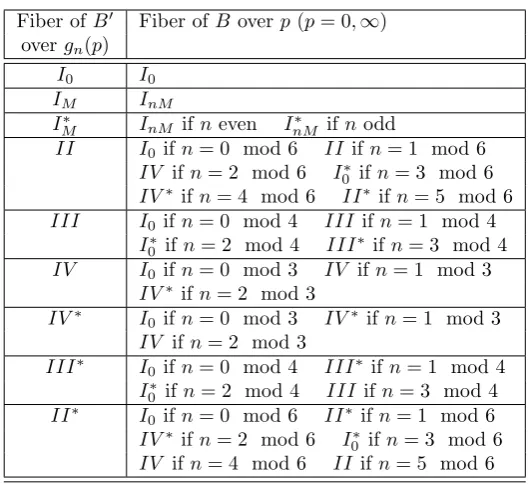
Now, we have a characterization of the rational elliptic surfaces which have automorphismsα∈Autσ(B) inducing automorphisms of the same order onP1. Since we are particularly interested in the configurations of singular fibers, we should know the relationship between the singular fibers ofB andB0. Ifp∈P1 is not 0 or∞, thengn is not ramified atp, so the fiber ofB overpand the fiber
of B0 overgn(p) are the same. If pis 0 or ∞, then gn is ramified of order n,
and in this case, Table 5 gives the fibers ofBoverpin terms ofnand the fibers ofB0 over gn(p). For detailed information how this table is computed, see [7]
Fiber ofB0 Fiber ofB overp(p= 0,∞) overgn(p)
I0 I0
IM InM
IM∗ InM ifneven InM∗ ifnodd
II I0 ifn= 0 mod 6 II ifn= 1 mod 6 IV ifn= 2 mod 6 I0∗ ifn= 3 mod 6 IV∗ifn= 4 mod 6 II∗ ifn= 5 mod 6
III I0 ifn= 0 mod 4 III ifn= 1 mod 4 I0∗ifn= 2 mod 4 III∗ ifn= 3 mod 4 IV I0 ifn= 0 mod 3 IV ifn= 1 mod 3
IV∗ifn= 2 mod 3
IV∗ I0 ifn= 0 mod 3 IV∗ ifn= 1 mod 3 IV ifn= 2 mod 3
III∗ I
0 ifn= 0 mod 4 III∗ ifn= 1 mod 4 I0∗ifn= 2 mod 4 III ifn= 3 mod 4 II∗ I0 ifn= 0 mod 6 II∗ifn= 1 mod 6 IV∗ifn= 2 mod 6 I0∗ ifn= 3 mod 6 IV ifn= 4 mod 6 II ifn= 5 mod 6
Table 5: Transformation of the fibers over the ramified points in the pull-back process.
If we pull-back a relatively minimal rational elliptic surfaceB0by the mapg
n
and get the relatively minimal elliptic surfaceB, B is not necessarily rational. There is a simple criterion for determining the rationality ofB:
X
Ssingular fiber
χ(S) = 12 =χ(B). (16)
IfB is rational, the sum of the Euler characteristics of the singular fibers ofB should be 12, which is the Euler characteristic ofB. This comes from the fact thatBis an elliptic curve fibration andχ(E) = 0 for any elliptic curveE. This criterion suffices for the rationality of B since any relatively minimal elliptic surface with section which is fibered overP1is rational if its Euler characteris-tic is 12.
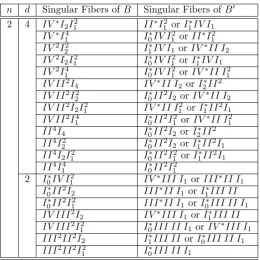
Table 6 gives the configurations of singular fibers of all relatively minimal rational elliptic surfacesB and B0, where B is obtained from the pull-back of B0 by some gn. By Theorem 5.1.1, we can say that the B column of Table 6
lists all possible configurations of singular fibers of rational elliptic surfacesB which admit an automorphismα∈Autσ(B) such that ord(α) =ord(τP1) =n.
transform under the pull-back process by the mapgn. To check for a specific
configuration of singular fibers and the corresponding value ofnfrom Table 2, we need to find another configuration of singular fibers which transforms to the desired configuration of singular fibers after the pull-back bygn. Note that if
JB andJB0 are the J-maps of the two surfaces, where B is obtained from the
pull-back ofB0 byg
n, then:
deg(JB) =n·deg(JB0). (17)
Table 7 shows the configurations for which n=ord(τP1)>1 was predicted
in Table 2, but which cannot be obtained after a pull-back by agn from any
other rational elliptic surface.
5.1.1 Examples
1) For the casesn=deg(JB), we get deg(JB0) = 1. So B is obtained from a
pull-back of one ofI∗
0III II I1,IV∗III I1, III∗II I1 or I1∗III II by the map gdeg(JB). The fibers ofB
0over 0 or∞transform as shown in Table 5, and we get
n=deg(JB) copies of other fibers. Taken= 7; the only candidate configuration
which can have n= 7 is III II I7
1 from Table 2. If we have the III∗ and II fibers of the configurationIII∗II I1over 0 and∞, then these transform toIII andII (from Table 5, n=7), and theI1 gives 7 copies ofI1 after the pull-back byg7. Hence, III II I7
1 is obtained from a pull-back of III∗II I1 byg7. None of the otherdeg(J) = 1 configurations can give III II I7
1 after a pull-back by g7, as can be checked easily.
2)Ifn= 2, none of the fibers over 0 or ∞transforms to aII fiber. In Table 2, alldeg(J) = 10 configurations for whichn= 2 is predicted have aIIfiber which appears once. Thus, none of such configurations can arise from a pull-back byg2.
3) If n = 4 and deg(JB) = 8, then deg(JB0) = 2. The candidates for
con-figurations of singular fibers of B are IV I4I14, IV I18, II2I24 and II2I18 from Table 2 (These are the only configurations for whichn= 4 is possible accord-ing to the criteria discussed before Table 2). None of the fibers over 0 or ∞
is transformed to a II fiber by g4, and four copies of each fiber over a point different from 0 and ∞ are obtained after a pull-back by g4. Therefore, the last 2 configurations including two II fibers cannot arise from a pull-back by g4. Since the fibers IV and II∗ are the only fibers which can give a IV fiber after a pull-back byg4, we should look atdeg(J) = 2 configurations including only oneIV or II∗ fiber in order to obtain IV I4I4
1 or IV I16 after a pull-back byg4. IV I4I14is obtained from a pull back ofI1∗IV I1byg4if fibers over 0 and
n d Singular Fibers ofB Singular Fibers ofB0 12 12 I12
1 III∗II I1 orIV∗III I1
9 9 III I19 IV∗III I1
8 8 IV I8
1 IV∗III I1 orIII∗II I1
7 7 III II I17 III∗II I1
6 12 I6I16 II∗I12or I1∗IV I1 I6
2 IV∗II I2
I12
1 I0∗IV I12 ,II∗I12or IV∗II I12 6 I0∗I6
1 IV∗III I1 orIII∗II I1
5 10 II I5I15 ,II I110 II∗I12 5 IV III I5
1 IV∗III I1
4 12 I8I4
1 III∗I2I1or I2∗III I1
I4I4
2 III∗I2I1or I1∗III I2
I4I8
1 III∗I13or I1∗III I12 I4
2I14 I0∗III I2I1or III∗I2I1 I112 I0∗III I13or III∗I13 8 IV I4I14 I1∗IV I1or II∗I12
IV I18 I0∗IV I12 orII∗I12 4 IV∗I14 IV∗III I1 orIII∗II I1
II4I
4 I1∗III II or III∗II I1 II4I4
1 I0∗III II I1 orIII∗II I1 3 12 I9I3
1 ,I34, I33I13 IV∗I3I1 I6I6
1 ,I3I23I13 IV∗I2I12
I3I19 IV∗I14
I26 IV2I22
I23I16 IV∗I2I12 orIV2I2I12 I112 IV2I14 orIV∗I14 9 III I6I13, III I3I23 ,III I23I13 III∗I2I1
III I3I16, III I19 III∗I13 6 I∗
3I13 I1∗IV I1 I0∗I3I13 II∗I12 I0∗I3
2 ,II3I6 ,II3I23 IV∗II I2 I0∗I6
1 I0∗IV I12 ,II∗I12or IV∗II I12 II3I3I3
1 ,II3I16 IV∗II I12 3 III∗I3
1 ,III3I3 ,III3I13 IV∗III I1 I0∗III I3
1 ,III II3I3 ,III II3I13 III∗II I1 2 12 I8I2I12 I4∗I12 orI1∗I4I1
I8I14 I0∗I4I12 orI4∗I12 I6I2I14 I3∗I13 orI1∗I3I12 I6I16 I3∗I13 orI0∗I3I13 I2
4I22 I1∗I4I1 orI2∗I22 I2
4I2I12 I0∗I4I12 orI1∗I4I1 I2
4I14 I0∗I4I12 orI2∗I2I12 I4I4
2 I0∗I23 orI2∗I22 I4I3
n d Singular Fibers ofB Singular Fibers ofB0 2 12 I4I2
2I14 I0∗I22I12 orI2∗I2I12 I4I2I6
1 I2∗I14or I1∗I2I13 I4I8
1 I0∗I2I14 orI2∗I14 I2
3I22I12 I1∗I3I12 I2
3I2I14 I1∗I3I12 orI0∗I3I13 I32I16 I0∗I3I13
I26 I0∗I23or I1∗I22I1 I25I12 I0∗I22I12 orI1∗I22I1 I24I14 I0∗I22I12 orI1∗I2I13 I3
2I16 I0∗I2I14 orI1∗I2I13 I2
2I18 I0∗I2I14 orI1∗I15 I2I110 I0∗I16or I1∗I15 I12
1 I0∗I16
8 IV I6I12 IV∗I3I1 orI3∗II I1 IV I4I14 IV∗I2I12 orI2∗II I12 IV I2
3I2 IV∗I3I1 orI1∗II I3 IV I2
3I12 I0∗II I3I1or IV∗I3I1 IV I3
2I12 IV∗I2I12 orI1∗II I2I1 IV I2
2I14 IV∗I2I12 orI0∗II I2I12 IV I2I6
1 IV∗I14or I1∗II I13 IV I18 I0∗II I14or IV∗I14 II2I6I2 I3∗II I1 orI1∗II I3 II2I6I12 I3∗II I1 orI0∗II I3I1 II2I4I2I12 I2∗II I12or I1∗II I2I1 II2I
4I14 I2∗II I12or I0∗II I2I12 II2I2
3I2 I0∗II I3I1or I1∗II I3 II2I2
3I12 I0∗II I3I1 II2I4
2 I1∗II I2I1 II2I3
2I12 I0∗II I2I12 orI1∗II I2I1 II2I2
2I14 I0∗II I2I12 orI1∗II I13 II2I2I6
1 I0∗II I14or I1∗II I13 II2I8
1 I0∗II I14 6 I0∗I4I2
1 III∗I2I1 orI2∗III I1 I0∗I3
2 III∗I2I1 orI1∗III I2 I0∗I2
2I12 I0∗III I2I1 orIII∗I2I1 I0∗I2I14 III∗I13 orI1∗III I12 I0∗I16 I0∗III I13 orIII∗I13 III2I4I2 I2∗III I1 orI1∗III I2 III2I4I12 I0∗III I2I1 orI2∗III I1 III2I3
2 I0∗III I2I1 orI1∗III I2 III2I2
2I12 I0∗III I2I1 orI1∗III I12 III2I
2I14 I0∗III I13 orI1∗III I12 III2I6
n d Singular Fibers ofB Singular Fibers ofB0 2 4 IV∗I2I2
1 II∗I12 orI1∗IV I1 IV∗I4
1 I0∗IV I12 orII∗I12 IV2I2
2 I1∗IV I1 orIV∗II I2 IV2I2I2
1 I0∗IV I12 orI1∗IV I1 IV2I4
1 I0∗IV I12 orIV∗II I12 IV II2I4 IV∗II I2 orI2∗II2 IV II2I22 I0∗II2I2or IV∗II I2 IV II2I2I12 IV∗II I12 orI1∗II2I1 IV II2I14 I0∗II2I12or IV∗II I12 II4I
4 I0∗II2I2or I2∗II2 II4I2
2 I0∗II2I2or I1∗II2I1 II4I
2I12 I0∗II2I12or I1∗II2I1 II4I4
1 I0∗II2I12 2 I0∗IV I2
1 IV∗III I1 orIII∗II I1 I0∗II2I
2 III∗II I1or I1∗III II I0∗II2I2
1 III∗II I1or I0∗III II I1 IV III2I2 IV∗III I1 orI∗
1III II IV III2I2
1 I0∗III II I1or IV∗III I1 III2II2I2 I∗
1III II orI0∗III II I1 III2II2I2
1 I0∗III II I1
Table 6: Configurations of singular fibers of relatively minimal rational elliptic surfacesB which can be obtained by a pull-back of another relatively minimal rational elliptic surfaceB0.
n d=deg(J) Configuration of singular fibers
10 10 II I110
4 12 I4
3
8 II2I4
2 ,II2I18 4 I0∗II I4
1
3 6 IV II I3
2 ,IV II I16
2 12 I9I3
1 , I7I15,I6I22I12, I52I12, I5I3I14 ,I5I22I13 ,I5I17 I4
3 ,I33I13 ,I3I24I1,I3I22I15, I3I19
10 II I2
4I12,II I32I22 ,II I32I14 ,II I24I12 ,II I22I16 ,II I110 8 II2I7I1, II2I5I13, II2I42 ,II2I4I22 ,II2I3I22I1, II2I3I15 6 I4∗I12 ,I2∗I22 ,I2∗I14 ,III2I5I1 ,III2I32 ,III2I3I13
II3I32,II3I22I12, II3I16
4 I2∗II I12 ,I0∗II I14, III2II I22 ,III2II I14 ,II4I3I1 2 I2∗II2, II∗I12
![Table 1: Persson’s list of configurations of singular fibers for relatively minimalrational elliptic surfaces with section [6].](https://thumb-us.123doks.com/thumbv2/123dok_us/9679248.1495819/11.595.134.486.122.620/persson-congurations-singular-bers-relatively-minimalrational-elliptic-surfaces.webp)