Original Research Article
Knowledge, attitude and practice regarding menstrual hygiene among
adolescent girls in a rural private school
Miti Dwijen Bhatt
1, Deepali Mohan Kadam
2*
INTRODUCTION
Menstruation is a normal physiological process indicating beginning of reproductive life but sometimes it is considered as unclean phenomenon in society. India is a country of contrasts, with extreme wealth and poverty and gender related disparities, resulting in significant variation in health and social indicators among girls and women.
Menstrual hygiene depends upon socioeconomic, educational and cultural status of families. Unhygienic sanitary practice has a great impact on women’s health, increasing their susceptibility to reproductive tract infections (RTI), urinary tract infections (UTI) and may also leave women vulnerable to infertility. Disposal of absorbents in urban settings is mainly through routine waste while in rural places throwing away in public places and burying, burning is also common.
ABSTRACT
Background: Being a developing country, India is faced with many health problems which can be averted by education and implementation of basic guidelines. Menstrual hygiene is one such topics which is rarely brought to attention but forms an integral part of a women’s life. This topic has been neglected not only in rural areas but in the poor socioeconomic corners of metropolitan cities. This ignorance has taken a great toll on the quality of life of women. Poor hygiene predisposes them to reproductive tract infections which may lead to increased incidence of infertility and mortality. Misconceptions regarding this have also prevented women to seek out professional help. Keeping this in mind the study was undertaken to spread awareness and eliminate the taboo this topic is regarded with.
Methods: A cross sectional study was conducted amongst adolescent girls in a private school located in Angaon village, Bhiwandi Taluka, Mumbai. A self-administered questionnaire was given to the adolescent girls to assess their knowledge, attitude and practices regarding menstrual cycle. Percentages were used for statistical analysis.
Results: 83 girls (96.51%) were aware of menstrual cycle. 49 (56.98%) girls perceived that menstrual blood is dirty. 72 (83.72%) knew that it is a physiological process. 85 (98.84%) were also aware about menstrual hygiene. 85 (98.4%) felt that girls should be addressed regarding menstrual cycle, hygiene before achieving menarche. 50 (58.14%) girls followed restrictions during menstruation.
Conclusions: The findings of the present study emphasize the need to address physiology about menstrual cycle as well as the myths and misconceptions associated with it.
Keywords: Menstrual hygiene, Knowledge, Attitude, Practices
2Department of Community Medicine, 1,2K.J. Somaiya Medical College and Research Centre, Sion, Mumbai,
Maharashtra, India
Received: 13 November 2019
Revised: 12 December 2019
Accepted: 13 December 2019
*Correspondence:
Dr. Deepali Mohan Kadam, E-mail: [email protected]
Copyright: © the author(s), publisher and licensee Medip Academy. This is an open-access article distributed under the terms of the Creative Commons Attribution Non-Commercial License, which permits unrestricted non-commercial use, distribution, and reproduction in any medium, provided the original work is properly cited.
Poor water, sanitation, hygiene facilities in school, lack of menstrual hygiene management items and inadequate puberty education cause girls to experience menstruation as shameful and uncomfortable. Cultural taboos prevent them from seeking help.
Therefore, this study was carried out to assess the knowledge, attitude and practices regarding menstrual hygiene among adolescent girls in rural setting.
The primary objectives of the study were to study awareness of knowledge regarding menstrual hygiene, to study attitude regarding menstrual hygiene and to study the prevailing practices regarding menstrual hygiene. The secondary objective of the study was to spread awareness regarding menstrual hygiene among rural adolescent girls. The adolescent girls were motivated to spread the knowledge gained regarding menstrual hygiene to their peers.
METHODS
The study was a cross-sectional study conducted in Lahoti School which is a private school located in Angaon village belonging to Bhiwandi Taluka of Thane district during January 2019 to July 2019.
Target population
Adolescent girls from 8th, 9th and 10th standard of Lahti School, Angaon, Bhiwandi Taluka, Thane District. This cross-sectional study was conducted in the rural field practice area of the Community Medicine Department of K.J. Somaiya Medical College and Research Centre. The Department has Rural Health Training Centre (RHTC) in the Primary Health Care Centre of Angaon. Hence as a matter of convenience and gathering a group of adolescent girls in a given area to impart health education, Lahoti School was chosen.
The nature and procedure of the research was explained to the principal and the permission for conducting the study was obtained. After being granted permission, roll call was obtained from the Principal for the purpose of sampling.
Sample size calculation
Sample size of 119 was calculated using the formula 4pq/L2 where p=48, q=52 and allowable error L=20% of p. n=108.33.1 A systematic review and meta-analysis conducted by Anna Maria van Eijk in the year 2016 regarding menstrual hygiene management among adolescent girls in India found that 48% of adolescent girls were aware regarding menstrual hygiene.2 To account for non-response, additional 10% was taken into consideration. Thus, the required minimum sample size was 118.8=119.
Inclusion criteria
Adolescent girls who had achieved menarche, given assent and whose parents had given consent.
Exclusion criteria
Adolescent girls who had not achieved menarche, those who were mentally challenged and those who were unwilling to participate.
Sampling technique
Stratified sampling was used to ensure uniform representation of the girls belonging to different standards. The roll call of the 8th, 9th, 10th standard girls was obtained from the principal for preparing the sampling frame. Using random sampling in excel, random roll numbers were picked from each stratum. The purpose of the study was also explained to the class teachers. The class teachers were given the assent and consent forms in local language to be given to the girls. Written informed assent from the adolescent girls and consent from the parents in the local language was obtained.
A day was fixed with the school principal for data collection. The girls were given a self-administered semi structured pretested questionnaire in local language to obtain details regarding their age, mothers education, and their own knowledge, attitude, practices followed by them regarding menstrual hygiene. The adolescent girls were assured about the confidentiality of their responses. At the end of collection of the questionnaires, the girls were shown a video clipping in local language Marathi titled “Mythri” prepared by Sinu Joseph and Vyjayanthi. K. Mythri.3 After this health education session, doubts of the study subjects were addressed. The girls were requested to pass on the information they acquired from the health education session to two other females they were acquainted with.
The girls who were absent on the particular day of data collection were approached later and administered the questionnaire. The data collected was entered in an excel sheet. The statistical tests were frequencies and percentages.
RESULTS
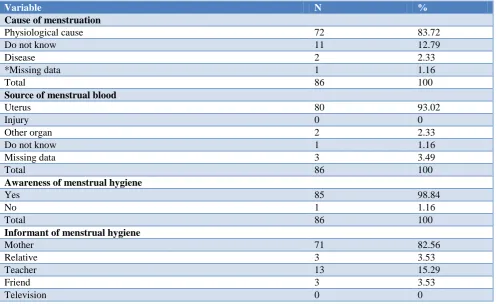
Total 86 adolescent girls filled the questionnaire. The response rate was 72.27 %. The baseline characteristics of the participants are given in Table 1. 83 girls (96.51%) were aware of menstrual cycle. Majority of them had received information from their mothers (Table 2). Table 3 shows the distribution of study participants according to their knowledge regarding menstrual hygiene.
Table 1: Characteristics of the study participants.
Variable N %
Standard
8th 20 23.25
9th 35 40.69
10th 31 30.04
Mean age in years 14.67 -
Mean age at menarche in years 12.94 -
Education regarding reproductive system received in school
Yes 69 80.23
No 16 18.60
Missing 1 1.16
Table 2: Distribution of study participants according to awareness of menstrual cycle and sources of information.
Variable N %
Awareness of menstrual cycle
Yes 83 96.51
No 3 3.49
Total 86 100
Source of information
Mother 63 75.90
Relative 3 1.20
Teacher 21 25.30
Friend 6 7.22
Television 0 0
Magazines 1 1.20
Total 83 100
Table 3: Distribution of study participants according to knowledge of menstrual cycle.
Variable N %
Cause of menstruation
Physiological cause 72 83.72
Do not know 11 12.79
Disease 2 2.33
*Missing data 1 1.16
Total 86 100
Source of menstrual blood
Uterus 80 93.02
Injury 0 0
Other organ 2 2.33
Do not know 1 1.16
Missing data 3 3.49
Total 86 100
Awareness of menstrual hygiene
Yes 85 98.84
No 1 1.16
Total 86 100
Informant of menstrual hygiene
Mother 71 82.56
Relative 3 3.53
Teacher 13 15.29
Friend 3 3.53
Television 0 0
Variable N %
Magazines 1 1.18
Learnt by self 1 1.18
Total 85 100
Table 4: Distribution of study participants according to their attitude towards menstrual cycle.
Variable N %
Menstruating girls should be treated differently
Yes 14 16.28
No 67 77.91
Do not know 4 4.65
Missing 1 1.16
Total 86 100
Restrictions should be practiced during menstruation
Yes 27 31.40
No 59 68.60
Total 86 100
Reaction to your first menstrual cycle
Normal 20 23.26
Scared 26 30.23
Discomfort 36 41.86
Embarrassed 4 4.65
Total 86 100
Menstrual blood is dirty
Yes 49 56.98
No 36 41.86
Missing 1 1.16
Total 86 100
Girls should be addressed about menstrual cycle and hygiene before achieving menarche
Yes 85 98.84
No 0 0
Missing 1 1.16
Total 86 100
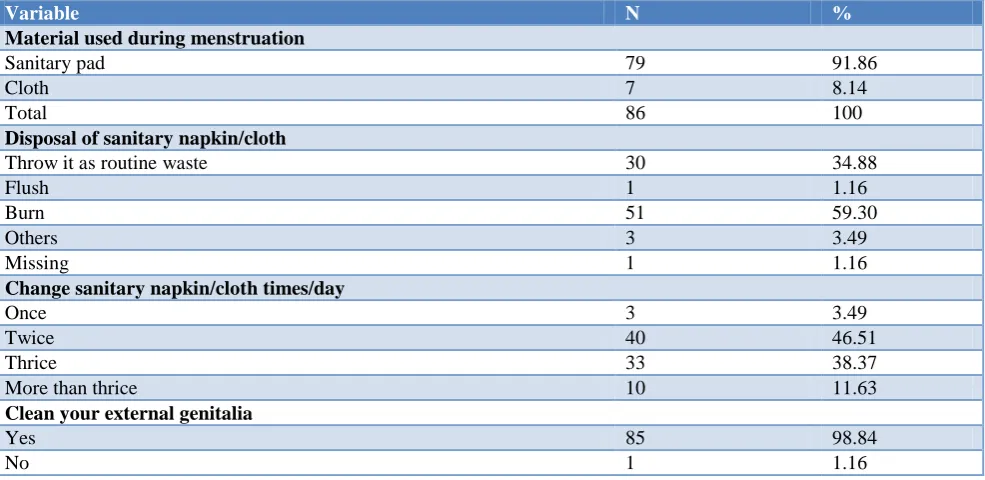
Table 5: Distribution of study participants according to the practices followed by them during menstrual cycle.
Variable N %
Material used during menstruation
Sanitary pad 79 91.86
Cloth 7 8.14
Total 86 100
Disposal of sanitary napkin/cloth
Throw it as routine waste 30 34.88
Flush 1 1.16
Burn 51 59.30
Others 3 3.49
Missing 1 1.16
Change sanitary napkin/cloth times/day
Once 3 3.49
Twice 40 46.51
Thrice 33 38.37
More than thrice 10 11.63
Clean your external genitalia
Yes 85 98.84
No 1 1.16
Variable N % Cleaning external genitalia with soap and water/ only water/ piece of cloth
Soap and water 46 53.49
Only water 38 44.19
Piece of cloth 0 0
Missing 2 2.33
Total 86 100
Cleaning external genitalia when not menstruating
Not at all 1 1.16
Less than 2 times 12 13.95
More than 2 times 58 67.44
As per convenience and privacy 15 17.44
Total 86 100
Cleaning external genitalia when menstruating
Not at all 1 1.16
Less than 2 times 10 11.63
More than 2 times 59 68.60
As per convenience and privacy 15 17.44
Missing 1 1.16
Total 86 100
Restrictions followed during menstruation
Yes 50 58.14
No 36 41.86
Total 86 100
Figure 1: Distribution of study participants according to their attitude regarding restrictions to be followed during menstrual cycle.
7 (8.14%) used cloth during menstruation as absorbent material (Table 5). Out of these, 2 girls reported that they reuse the cloth. All these 7 adolescent girls reported that they clean the cloth by washing it with water only. They do not use soap. Out of these 7 girls only 2 said that they keep the cloth for drying on the clothesline in the sun whereas 3 kept it for drying in the bathroom and the rest 2 girls reported that they keep the cloth for drying in a part of the house where no one can see it. None of these girls
shared the cloth used during menstruation among the other female family members.
8 (9.30%) reported that they were treated differently at home/ school during menstruation. When asked to the respondents what do they do in case they experience any complaints during menstrual cycle, 64 (74.42%) reported that they confided in their mother or relative regarding complaints during menstruation. 14 (16.28%) said that
4 (8.7%)
35 (76.09%)
0 1(2.17%) 2 (4.35%) 0
6 (13.04%)
0 5 10 15 20 25 30 35 40
Should not attend religious
functions
Should not visit temple
Should not go to school
Should not play/ exercise
Should avoid sour food
Should not take a bath everyday
Should not touch pickle when it is being
made
No
o
f
re
sp
o
n
se
s
they go to a doctor. When asked “What would you do if you had your period in school and you were not prepared or didn’t have supplies?” 6 (6.98%) said they would go home, 24 (27.91%) they would borrow a cloth/ sanitary
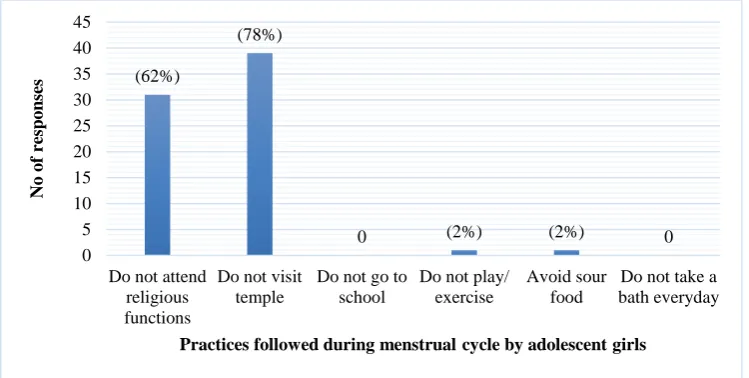
napkin from a friend, 55 (63.95%) borrow a cloth/ sanitary napkin from a teacher. Figure 2 shows the restrictions actually followed by the girls during menstruation.
Figure 2: Distribution of study participants according to their practices actually followed during menstrual cycle.
DISCUSSION
The sample size was 119. Only 86 (72.27%) girls filled the self-administered questionnaire. 34 girls (27.73%) refused to participate in the study. The parents did not give consent. These girls were approached in subsequent visit to know why they did not want to participate in the study. The reason for not filling the self-administered form was non-approval from their parents. To increase the response rate, the need of meeting the parents was expressed to these girls. But the girls objected to this too. This reflects the conservative attitude of the parents towards the normal physiological process of menstrual cycle as well as hesitancy amongst the girls to discuss about study regarding menstrual hygiene with their parents. In this study aimed to find out knowledge, attitude and practices adopted, the response rate of 72.27% is acceptable since the topic is a sensitive one.4 83 (96.51%) were aware about menstrual cycle (Table 2). 72 (83.72%) knew that it is a physiological process. 98.84% were also aware about menstrual hygiene (Table 3).
26 (30.23%), 4 (4.65%), 36 (41.86%) were scared, experienced discomfort and embarrassment respectively during their first menstrual cycle (Table 4). According to a cross sectional study done in the rural area of Wardha District, 43.67% felt scared, 21.67% felt usual, 14.33% felt irritated or disgusted 9.67% had a different reaction besides the above.5
7 (8.14%) used cloth during menstruation as absorbent material and 79 (91.86%) used sanitary napkins (Table 5) as compared to 89.5% girls who used sanitary pads and 10.5% who used cloth during menstruation as reported by
Kanotra et al.6 According to NFHS-4, from a sample size of 166,100 rural women of the age 15-24 years, 71.4% use cloth, 14.8% use locally prepared napkins, 33.6% use sanitary napkins, 1.9% use tampons, 0.1% use other means whereas 0.6% use nothing with percentage of usage by hygienic method being 48.2%.7
30 (34.88%) throw the sanitary pad in the routine waste, 51 (59.30%) burn it, 1 (1.16%) flushes it and 3 (3.49%) employ other methods of disposal (Table 5). Thakre et al has reported that 12.3% throws the sanitary napkin, 60.9% burns it, 22.6% employ other methods of disposal in rural Nagpur.8
The study findings revealed that 67 (77.91%) girls felt that they should not be treated differently and 59 (68.60 %) felt that restrictions should not be followed (Figure 1). This is in contrast to the actual practices regarding restrictions followed. The data showed that 50 (58.14%) girls followed restrictions (Figure 2). The study revealed 4 (8.7%) did not attend religious functions, 35 (76.09%) did not visit temples, 1 (2.17%) avoided physical activities like playing and exercises, 2 (4.35%) avoided sour food and 6 (13.04%) did not touch pickle when it was being made. This reflects the persistence of deep-rooted beliefs; customs prevailing in the society and being followed. There were no restrictions observed towards going to school and having bath every day during menstruation. According to a cross sectional study done in the rural area of Wardha District, 87% did not attend religious occasions during menstruation, 18.67% avoided physical activities, 12.67% avoided school, 14.33% avoided family functions, 6.33% avoided regular bath and 17% observed no restrictions at all.5
(62%)
(78%)
0 (2%) (2%) 0
0 5 10 15 20 25 30 35 40 45
Do not attend religious functions
Do not visit temple
Do not go to school
Do not play/ exercise
Avoid sour food
Do not take a bath everyday
No
o
f
re
sp
o
n
se
s
The study revealed that 38 (44.19%) of the girls make use of only water to clean their external genitalia (Table 5). 49 (56.98%) perceived menstrual blood as dirty despite the fact that the majority of the girls had received education regarding the reproductive system. This highlights the need to address the myths and misconceptions regarding menstrual cycle and not just informing about the anatomy of the reproductive system. 85 (98.4%) felt that girls should be addressed regarding menstrual cycle, hygiene before achieving menarche (Table 4).
CONCLUSION
The findings of the present study emphasize the need to address physiology about menstrual cycle as well as the myths and misconceptions associated with it. The importance of menstrual hygiene needs to be stressed, especially about the use of soap and water and not just water to clean the external genitalia.
Recommendations
Health education regarding the anatomy of the reproductive system along with physiology of menstrual cycle before achieving menarche so as to allay the anxiety and stress.
Addressing myths and misconceptions through interactive sessions. Methodologies like use of agree and disagree statements, case scenarios can be used as icebreakers to initiate the topic and address these misconceptions. These can be done by involving preidentified female teachers. Female medical interns can also be trained and can impart health education under the supervision of faculty.
Students and faculty alike should be urged to take up activities and skits to educate men and women of the village regarding menstrual hygiene. This can be taken up in phases where mothers are initially educated and later it can be expanded to involve the male members of the community as well. This will help to bridge the communication gap between adolescent girls and their parents with regards to physiology of the reproductive system.
ACKNOWLEDGEMENTS
We express our gratitude to the Principal and Vice Principal of Lahoti School, Angaon for giving us the permission and support for conducting the study. We are
thankful to the adolescent girls who participated in this study. We are grateful to Dr. Ashima Bhaumik (Assistant Professor Incharge Rural Health Training Centre, Department of Community Medicine) for her constant support and Ms. Janhawi Bhandarkar (III M.B.B.S. student, K. J. Somaiya Medical College and Research Centre) for her help in translation of the questionnaire.
Funding: No funding sources Conflict of interest: None declared
Ethical approval: The study was approved by the Institutional Ethics Committee
REFERENCES
1. Mahajan BK. Sampling. In: B K Mahajan Textbook of Biostatistics. Methods in Biostatistics for Medical Students and Research Workers. 6th edition. Jaypee brothers Medical Pub Ltd; 1997: 92-94.
2. Van Eijk AM, Sivakami M, Thakkar MB, Bauman A, Laserson K, Coates S, et al. Menstrual hygiene management among adolescent girls in India: a systematic review and metaanalysis. BMJ Open. 2016;6:e010290.
3. Mythri Speaks. Mythri (Marathi), 2015. Available at https://mythrispeaks.wordpress.com/video/mythri-marathi/. Accessed 24 October 2019.
4. Mundy D. Solution Corner. A question of response rate. Science Editor. 2002;25(1): 25-6.
5. Mudey A, Kesharwani N, Mudey G, Goyal R. Cross-sectional Study Regarding Safe and Hygienic Practices amongst School Going Adolescent Girls in Rural Area in Wardha District, India. Global J Health Sci. 2010;2(2):225-31.
6. Kanotra K, Bangal V, Bhavthankar D. Menstrual Pattern and Problems Among Rural Adolescent Girls. International J Biomedical Advance Res. 2013;4(8):552-4.
7. International Institute for Population Sciences (IIPS) and ICF. 2017. National Family Health Survey (NFHS-4), 2015-16: India. Mumbai: IIPS.
8. Thakre S, Thakre SS, Ughade S, Thakre A. Urban- Rural differences in Menstrual Problems and Practices of Girl Students In Nagpur. Indian Pediatrics. 2012;49(16):733-6.
Cite this article as: Bhatt MD, Kadam DM.