R E V I E W
Open Access
Proposed guidelines to evaluate scientific
validity and evidence for genotype-based
dietary advice
Keith A. Grimaldi
1, Ben van Ommen
2, Jose M. Ordovas
3,4, Laurence D. Parnell
5, John C. Mathers
6, Igor Bendik
7,
Lorraine Brennan
8, Carlos Celis-Morales
6,9, Elisa Cirillo
2, Hannelore Daniel
10, Brenda de Kok
2, Ahmed El-Sohemy
11,
Susan J. Fairweather-Tait
12, Rosalind Fallaize
13, Michael Fenech
14, Lynnette R. Ferguson
15, Eileen R. Gibney
8,
Mike Gibney
8, Ingrid M. F. Gjelstad
16, Jim Kaput
17, Anette S. Karlsen
16, Silvia Kolossa
10, Julie Lovegrove
13,
Anna L. Macready
13, Cyril F. M. Marsaux
18, J. Alfredo Martinez
4,19,20, Fermin Milagro
19,20,
Santiago Navas-Carretero
19,20, Helen M. Roche
21, Wim H. M. Saris
18, Iwona Traczyk
22, Henk van Kranen
23,
Lars Verschuren
2, Fabio Virgili
24, Peter Weber
7and Jildau Bouwman
2*Abstract
Nutrigenetic research examines the effects of inter-individual differences in genotype on responses to nutrients and other
food components, in the context of health and of nutrient requirements. A practical application of nutrigenetics is the use of
personal genetic information to guide recommendations for dietary choices that are more efficacious at the individual or
genetic subgroup level relative to generic dietary advice. Nutrigenetics is unregulated, with no defined standards, beyond
some commercially adopted codes of practice. Only a few official nutrition-related professional bodies have embraced the
subject, and, consequently, there is a lack of educational resources or guidance for implementation of the outcomes of
nutrigenetic research. To avoid misuse and to protect the public, personalised nutrigenetic advice and information should
be based on clear evidence of validity grounded in a careful and defensible interpretation of outcomes from nutrigenetic
research studies. Evidence requirements are clearly stated and assessed within the context of state-of-the-art
‘
evidence-based
nutrition
’
. We have developed and present here a draft framework that can be used to assess the strength of the evidence
for scientific validity of nutrigenetic knowledge and whether
‘
actionable
’
. In addition, we propose that this framework be
used as the basis for developing transparent and scientifically sound advice to the public based on nutrigenetic tests. We
feel that although this area is still in its infancy, minimal guidelines are required. Though these guidelines are based on
semi-quantitative data, they should stimulate debate on their utility. This framework will be revised biennially, as knowledge on
the subject increases.
Keywords:
Genotype, Dietary advice, Gene-environment interaction, Nutrigenetics, Personalised nutrition, Framework,
Genetic variants, Health
* Correspondence:[email protected] 2TNO, Utrechtseweg 48, Zeist, The Netherlands
Full list of author information is available at the end of the article
Background
Personalised nutrition (PN), based on an individual
’
s
geno-type, is not new. Individuals with rare genetic disorders such
as phenylketonuria, galactosemia and hereditary fructose
intolerance [1
–
3]) as well as more common disorders (e.g.
lactose intolerance, coeliac disease [4, 5]) tailor food intake
to bypass the metabolic deficiency. In each case, specific
dietary recommendations have been defined, validated and
are in use clinically. A key question for the clinical and
nutri-tion community is whether matching nutrient intake and
physical activity to individual gene variants, that usually
pro-duce weaker metabolic effects compared to those mentioned
above, would have noticeable impacts on health status.
Many sectors of modern society increasingly focus on
personalising services or products to enable individuals
to control more aspects of their lives. Public interest in
personalised health has spurred growth in nutrigenetic
testing services not only for disease susceptibilities but,
especially, for optimising nutrition. Genetic testing is a
largely unregulated market with many unsupported
claims and inadequate explanations of the results and
implications [6
–
11]. It is important to be aware that the
effects of common variants will be mostly small in the
overall phenotype and which will depend on several
variants, gene-gene and gene-protein interactions. A
common weakness in the commercial area (for all of
nutrition) is to provide simple
“
answers
”
to a complex
question. Hence, the aim of this paper is to provide a
draft framework for assessing the validity of genetic
information for the development of precise personalised
dietary advice that does not go beyond the evidence.
The general objective of PN is to maintain or improve
health by using genetic, phenotypic, clinical, dietary and
other information to provide more precise and more
efficacious personalised healthy eating advice and to
motivate appropriate dietary changes. For example,
about 15 years ago, it was proposed that:
“
With the identification of polymorphisms, or
common mutations, in vitamin metabolism, large
percentages of the population may have higher
requirements for specific vitamins ([12]).
”
Research since then has resulted in significant progress
and has identified some well-defined gene × diet
interac-tions supporting the concept that diets tailored to the
individual
’
s genotype might result in long-term health
bene-fits [9, 13, 14]. Personalised advice should be more precise
and more efficacious than generic advice. To facilitate
acceptance by the public and other stakeholders, it is
important that the development of genotype-dependent
advice is based on sound evidence. The debate about direct
to consumer (DTC) sales of genetic testing and the
regula-tion of this market ([10, 15
–
18]), are beyond the scope of
this article. DTC is a reality that makes it important that
information about links between genetic variants, nutrition,
and health and reliable interpretation of that information
are accessible to all stakeholders including healthcare
professionals, regulators, companies and the public.
The development of the framework described herein is
part of a larger project within the EU FP7 project
Food4Me (www.food4me.org), which was initiated to
examine several aspects of PN including business models,
market readiness, ethics and public perceptions, and to
perform a Europe-wide proof of principle intervention
study on the effectiveness of PN approaches [19, 20]. A
specific goal within the Food4Me project was the creation
of a publicly available resource listing gene × diet
interac-tions [21]. PN may contribute to improved eating patterns
and help reduce the burden of many common health
problems including obesity, age-related diseases such as
type 2 diabetes (T2D), cardiovascular disease (CVD),
dementia, musculoskeletal problems and some cancers
[22]. Therefore, when validated, scientific evidence of
potential benefit should be communicated to healthcare
professionals and to the public in an objective and
trans-parent manner [9]. In this paper, we propose a set of
minimum standards of evidence required for the
evalu-ation of the scientific validity of genotype-based
persona-lised dietary advice.
Review
The context of nutrigenetics
use of information on genetic variation in the context of
general dietary advice are lacking.
Genotype is one class of information [28, 29] that can be
used to personalise dietary advice and should be used in
combination with other relevant information (e.g. sex, age,
anthropometrics, health status, family history or dietary
preferences) and never in isolation. In this regard, the
appropriate level of evidence for nutrigenetic-based advice
is similar to that used in development of conventional
nutritional guidelines. However, despite being based on a
similar scientific evidence base, such guidelines often differ
between countries. This is because, in formulating
nutri-tional guidelines, expert committees make decisions based
on the best evidence available, while acknowledging
knowledge gaps, and taking into account country-specific
issues [25].
Methodology
A
‘
Global Nutrigenetics Knowledge Network
’
was
estab-lished (starting in the Food4Me EU project), involving
experts in different areas of PN, to collate all relevant
infor-mation on genetic variations involved in the nutrient-health
relationships and deliver guidelines for the evaluation of
evidence for diet-gene interactions. The aims are:
1. To provide a draft framework for assessing the
evidence for scientific validity of:
a. Personalised dietary advice based on a specific
gene variant
b. Personalised dietary advice based on a specific
gene variant that is already available in
commercial nutrigenetic tests
2. To create a series of Nutritional GeneCards
––
based
on this draft framework
––
each of which assesses
the evidence for a particular gene-diet/lifestyle
interaction.
The Global Nutrigenetics Knowledge Network reviewed
guidelines for genetics, medical genetic tests and nutritional
recommendations (Evaluation of Genomic Applications in
Practice and Prevention (EGAPP), Strengthening the
Reporting of Genetic Association Studies (STREGA),
Grading of Recommendations Assessment, Development
and Evaluation (GRADE), European Food Safety Authority
(EFSA) [30
–
34]) and concluded that these did not fully
cover the needs for assessing the evidence for
genetics-based personalised dietary advice. EGAPP assesses the
clinical utility of a gene, or genes, in conjunction with their
variants as predictors of disease, and EFSA assesses the
evidence for the potential nutritional or health benefits of
specific foods or food components. However, none of these
guidelines addresses the evidence from studies that
investi-gate the combined effect of genotype plus diet on health
outcomes, which is essential for establishing
evidence-based nutrigenetic advice.
The
Clinical
Pharmacogenetics
Implementation
Consortium (CPIC) guidelines for pharmacogenetics
(gene-drug interactions) have some relevance to
nutri-genetics, and we agree with their aim
‘
to provide
guidance to clinicians as to how available genetic test
results should be interpreted to ultimately improve
drug therapy, rather than to provide guidance as to
whether a genetic test should or should not be ordered
’
.
[35, 36] The CPIC evidence assessment is simpler, relative
to nutrigenetics, because (usually) the drug is metabolised
by the gene product and has effects over a short time. On
the other hand, the risk/benefits equation is such that the
evidence would need a higher standard than that applied
to nutrition and nutrigenetics.
The ACCE model (Analytical and Clinical Validity,
Clinical Utility and Ethics, [37]) for evaluating genetic
tests in general was considered an appropriate starting
point for genotypic assessment but, in the present
context, required modification to recognise that
geno-typic information will be used in developing PN advice
for the public rather than for medical diagnostics.
According to ACCE, a medical genetic test should fulfil
requirements regarding:
i. Analytical validity
––
a measure of the accuracy of
the genotyping.
ii. Scientific validity
––
concerns the strength of the
evidence linking a genetic variant with a specific
outcome
iii. Clinical utility
––
the measure of the likelihood that
the recommended advice or therapy will lead to a
beneficial outcome beyond the current state of the
art.
iv. Ethical, legal and social implications that may arise
in the context of using the test.
measure of the utility of each nutrigenetic test. A caveat
is that defining an
‘
improved health outcome
’
due to
nutrigenetic advice in a generally healthy person is very
hard to do. Therefore, the present document will
concentrate on the development of a draft framework
for the assessment of scientific validity, and it will not
directly address claims about clinical utility or
‘
personal
benefit
’
, see Table 1.
Proposed framework for scientific evidence
assessment
The components relevant to this assessment are
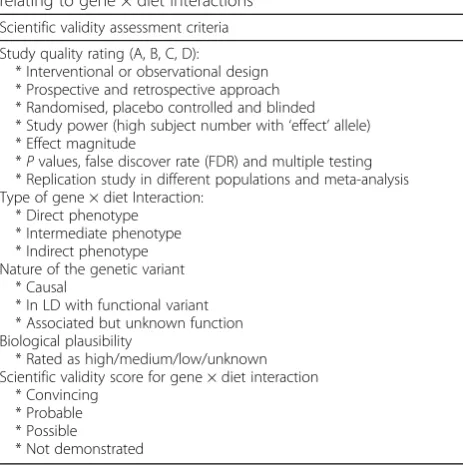
sum-marised in Table 2. This draft framework will be used in
‘
nutrition gene cards
’
that assess the evidence supporting
specific gene × diet interactions and its relation to a
specific health outcome (see below). In the framework, we
implement components used in systematic reviews [42],
including the development of the search strategy and the
assessment of the study quality.
Scientific validity may be graded as (the percentages
are based on the Guidance on Uncertainty in EFSA
Scientific Assessment [43]):
Probability term Subjective probability range (%)
A. Convincing > 90
B. Probable 66–90
C. Possible 33–66
D. Insufficient < 33
“
Convincing
”
should be based on several (at least three)
strong studies with high subject numbers, showing the
relation and/or mechanistic knowledge,
“
probable
”
based
on several studies showing the relation and/or some
mechanistic understanding and
“
possible
”
based on a few
studies showing the relation. See below in the text for a
fuller explanation.
Scientific validation determines the strength of the
evidence for an interaction between a specific genetic
marker or set of markers and a dietary component or
pattern on a health outcome of interest (such as disease
or risk factors for disease). The scientific validity criteria
for genetic-based dietary advice within this proposed
framework include (i) study design and quality and (ii)
biological mechanism including the nature of the genetic
variant(s) and biological plausibility, as discussed below.
The probability term is the overall judgement of the
evidence provided, and in this sense
‘
it is possible for an
evidentiary conclusion based on many papers, each of
which may be relatively weak, to be graded as
‘
moderate
’
[probable] or even
‘
strong
’
[convincing], if there are
multiple small case reports or studies that are all
supportive with no contradictory studies
’
[36].
1. Study design and quality
All studies reporting on genetic interactions should
adhere to the STREGA guidelines [33]. STREGA was
developed with aim of improving the transparency of
reporting involving
‘
population stratification, genotyping
errors, modelling haplotype variation, Hardy-Weinberg
equilibrium, replication, selection of participants,
ration-ale for choice of genes and variants, treatment effects in
studying quantitative traits, statistical methods,
related-ness, reporting of descriptive and outcome data, and the
volume of data issues that are important to consider in
genetic association studies
’
[33].
Only studies that include STREGA guidelines should
be considered when assessing a gene-diet interaction. In
addition to the STREGA guidelines, the intake of the
dietary component of interest should be reported
quan-titatively; for the description on the quantification of diet
intake, see [44].
2. Biological plausibility
‘
a gene
–
environment interaction will only be
accepted if it can be reproduced in two or more
studies and also seems plausible at the biological
level.
’
[45]
Biological plausibility is a judgement based on the
collected evidence of a gene × diet interaction on a
phenotype.
For
example,
smoking
introduces
carcinogens into the body, which could cause DNA
damage, increased mutational events, and consequently
increasing risk of cancer [46]. Thus, a validated gene ×
nutrition interaction such as
GSTM1
× cruciferous
vegetable consumption leading to reduction of DNA
damage ([47, 48]) is consistent with an association
between
GSTM1
× cruciferous and reduced cancer
risk ([49]).
(i) Gene X diet interaction
We identify three broad types of gene × diet interactions:
direct, intermediate and complex.
A
‘
direct
’
interaction is a mechanistic interaction
between the genetic variant and the dietary
component on the health biomarker. This type of
interactions is most similar to metabolism of a drug
Table 1
Why clinical utility is not part of this framework
This framework stops at the assessment of scientific validity. The recommendations provide clear and sufficient detail so that any opinion on health (or clinical) utility can be derived by the user (including the individual, dietician/nutritionist/medical doctor, companies and claim regulation bodies).
Clinical utility is the measure of the likelihood that the recommended therapy or intervention will lead to a beneficial outcome. Clinical utility is the most controversial aspect: it is often difficult to define and must take into consideration many factors including positive or negative psychological or motivational effects on the end user [81]. Others contend that clinical utility can only be thoroughly established through randomised clinical trials (RCT), but these are challenging for the personal genetics environment, includes diet, lifestyle and behavioural changes and has small cumulative effects over decades (see [82,83] for an example of the current debate). A further problem is the precise definition of a clinical benefit. A gene-diet interaction may not be associated directly with disease risk, such as cardiovascular disease, but with intermediate phenotypes, e.g. lipid levels, hypertension and homocysteine, which are independent risk factors for disease. Some commentators require that clinical utility is demonstrated as a reduction in disease incidence. The majority view accepts that lowering of intermediate risk factors is acceptable (as is the case for phytosterols and their cholesterol lowering properties [50,84]).
RCTs
In personalised nutrition research, RCTs with disease incidence as the endpoint are not practically feasible as they will require long-lasting nutritional changes, making compliance difficult and very expensive, at least in terms ofprimaryprevention inhealthypeople––apart from any ethical problems. RCTs that address disease incidence reduction in middle-aged or elderly high-risk subjects, secondary prevention in individuals with disease and/or on effects on intermediate biomarkers or risk factors can be useful, but care is required in drawing conclusions. RCTs in nutrition and genetics are often complex, difficult to design and challenging to conduct in a reasonable time frame. Some examples given below illustrate this and may be helpful when interpreting RCT data for personalised diet and lifestyle evidence advice.
Primary prevention in high-risk groups
Genetics × diet × T2DM (type 2 diabetes mellitus)––The T allele of theTCF7L2rs7903146SNP has been associated repeatedly with an increased risk of T2DM (2-fold in homozygotes [85]). Compared with non-risk allele carriers, individuals who carry the risk allele and who are at high risk
phenotypically (glucose intolerance, pre-diabetes diagnosis) require a longer lasting and a more intense dietary and lifestyle recommendation to divert the trajectory from disease over a period of 12 months and to maintain health gains over a 4-year period [86]. Although useful, these findings have been obtained in clinical trials ofunhealthypeople, who typically were older. Thus, to be precise, it doesnotdemonstrate, and cannot be used to claim, that specific dietary modifications in younger, healthier people will prevent the development of glucose intolerance or T2D in those carrying the risk allele. However, this evidence of gene × diet interactions in pre-diabetics is consistent with the evidence from other types of studies in healthy subjects (epidemiological, cohort, effects on biomarkers) and can provide supporting evidence, but not conclusive evidence, that specific dietary guidelines would be appropriate for healthy carriers of thisTCF7L2risk allele. This example shows how difficult it is to validate a gene-diet interaction but suggests that adjusting the environment will improve the individuals’health.
The sameTCF7L2genetic variant was assessed in the recently published study from the PREDIMED project [14], a large randomised trial in 7018 high-cardiovascular-risk individuals comparing two Mediterranean (Med) diets and a control diet.TCF7L2TT homozygotes at SNP rs7903146 had higher blood glucose levels, total cholesterol, LDL cholesterol and triglycerides but only when adherence to the Med diet was low. Furthermore, incidence of stroke was almost three times higher in TT homozygotes as in the control group, but this increased risk was completely dissolved in the Med diet group (Hazard Ratio, HR = 0.96). Thus, compared to the control diet, both Med diets were effective at reducing both risk biomarkers and disease incidence itself in a genotype specific manner. While this is a strong endorsement of the Mediterranean diet, it is also relevant that the age range was 55 to 80 years. This RCT supports the epidemiological evidence for health benefits of the Med diets for older persons, and those at increased risk of CVD, and can only suggest such benefits for other age groups who carry theTCF7L2TT genotype at rs7903146.
Secondary prevention in subjects with pathology
MTHFR× folate × homocysteine on CVD risk––results of several large homocysteine-lowering clinical trials have been published over the last decade, and none reported any benefit in prevention of secondary CVD by folate supplementation. These results have been used widely to declare that there is no evidence that elevated plasma homocysteine levels are relevant for CVD and that there is no benefit in homocysteine-lowering inprimary
prevention [87–89]. However, these were all short-term trials in older people already suffering from (mainly) CVD and taking several medications, where incidence offurthercardiovascular events was measured. None of the trials were performed in healthy people. Thus, the conclusion from these studies states that over the trial periods there was no apparent benefit in lowering homocysteine in ill people, i.e. as in secondary prevention. However, still lowering homocysteine by using folate may reduce risks of CVD in healthy people with high risk [53,90,91]. For instance, the China Stroke Primary Prevention Trial [13,92], reported on a total of 20,702 adults with hypertension without history of stroke or myocardial infarction who participated in the study. That study compared a single-pill combination containing 10 mg of enalapril and 0.8 mg of folic acid with a tablet containing 10 mg of enalapril only. Among adults with hypertension, the combined use of enalapril and folic acid, compared with enalapril alone, significantly reduced the risk of first stroke (HR = 0.79). Analysis of theMTHFR677 genotype showed further that the TT genotype had the largest risk reduction in the highest folate quartile (HR = 0.24), suggesting that individuals with the TT genotype may have a greater folate requirement.
by the gene encoding the enzyme that directly
metabolises the drug.
An intermediate interaction is a mechanistic
interaction between the genetic variant and the
dietary component on the health biomarker, but
other processes also affect the level of the
biomarker.
An indirect interaction is the case where a
mechanistic interaction between the genetic variant
and the dietary component on a health biomarker,
including disease, is affected to some extent by the
gene × diet interaction but is also influenced by
many other, possibly unknown processes, and it may
take years for symptoms to manifest. This type of
interaction may not be fully explained
physiologically or may be only demonstrated
statistically.
A well-researched example is the case of supplementation
with folate (substrate) and/or riboflavin (cofactor) in
persons who are carriers or non-carriers of the
methylene-tetrahydrofolate reductase (
MTHFR)
C677T polymorphism
(rs1801133) where
‘
T
’
is the allele associated with reduced
enzymatic activity. Examples with the folate-related enzyme
MTHFR are as follows:
Direct: e.g.
MTHFR
× folate
→
levels of homocysteine [
51
]
Intermediate: e.g.
MTHFR
× riboflavin
→
blood
pressure [
52
]
Indirect: e.g.
MTHFR
× folate /riboflavin
→
cardiovascular
disease [
53
]
(ii) Nature of genetic variant
This draft framework considers three major classes of
genetic variants, with differing strengths of evidence.
a) The genetic variant has a demonstrated causal effect
on the function of the gene product, e.g., on enzyme
activity or protein abundance, which provides a
biologically plausible explanation for the gene-diet
interaction.
b) The genotyped variant may not itself affect the
protein of interest but it may be in linkage
disequilibrium (LD) with another relevant functional
variant
––
one SNP is said to
‘
tag
’
the other [
54
,
55
].
Evidence would be required to validate both the LD
score and the putative gene × diet interaction. In
addition, the results also would be applicable only to
the population(s) in which high LD has been
established.
c) The effect of the SNP on function of the gene product
is unknown and is based only on a statistical
association for the gene × diet effect [
54
,
55
].
Examples of these three types of genetic variants are:
–
Causative
: SNP rs1801133 (TT) reduces the activity
of the MTHFR enzyme [
56
]
–
In LD with known causative variant:
the SNP rs4341,
which is in LD with an InDel variant (rs4646994) in
the same gene,
ACE
, that affects the plasma
angiotensin converting enzyme (ACE) levels ([
57
,
58
])
–
Unknown
: e.g. rs7903146 (CT and TT) intron SNP
in the
TCF7L2
gene is linked to type 2 diabetes risk.
An interaction with carbohydrate and diet has been
demonstrated, but the effect of this polymorphism,
if any, on function of the corresponding gene
product has not been characterised. This SNP may
be in LD with a functional SNP or has an as yet
uncharacterised function ([
59
,
60
]).
Scientific validity assessment of a putative gene × diet
interaction
Assessing the validity of a putative gene × diet
interaction is generally complex, and as knowledge
deepens in the area of nutrigenetics, assessment of its
validity will develop. We propose a pragmatic way to
assess the validity by relying initially on semi-quantitative
Table 2
Framework for stepwise assessment of the evidence
relating to gene × diet interactions
Scientific validity assessment criteria
Study quality rating (A, B, C, D):
* Interventional or observational design * Prospective and retrospective approach * Randomised, placebo controlled and blinded * Study power (high subject number with‘effect’allele) * Effect magnitude
*Pvalues, false discover rate (FDR) and multiple testing * Replication study in different populations and meta-analysis Type of gene × diet Interaction:
* Direct phenotype * Intermediate phenotype * Indirect phenotype Nature of the genetic variant
* Causal
* In LD with functional variant * Associated but unknown function Biological plausibility
* Rated as high/medium/low/unknown Scientific validity score for gene × diet interaction
* Convincing * Probable * Possible
* Not demonstrated
*Pvalues must be at least .05 to be significant. ThePvalue must remain within .05 after correcting for multiple testing, e.g. Bonferroni
a
The‘effect magnitude’required depends on the type of study. For example, the effect of folate on high homocysteine in carriers of the effect allele in
MTHFRshould be a return to normal within a few weeks of starting the
measures that can be improved with additional data. The
numbers used below to assess the validity should be
con-sidered an arbitrary but coherent guideline based on
sug-gested power calculations, and precision of measurements
of diet exposure and outcome [45, 61, 62], plus experience
based on successfully repeated gene × diet studies
pub-lished to date.
The assessment should explicitly specify for which
subgroup (e.g. sex, ancestral background and other
relevant subgroups) the evidence is collected.
Convincing
–
Two independent studies that have shown the
relationship between the gene-diet interaction and
the specific health outcome. Together those studies
should include at least 100 subjects carrying the
ef-fect allele (i.e. the presumed functional variant or in
LD with the functional variant) for intervention
studies and at least 500 subjects for observational
studies. Specifically, if the frequency of the effect
allele is 10% that means that a total of at least 1000
and 5000 subjects for intervention and observational
studies, respectively.
–
Biological mechanism fully understood or largely
explained.
–
Biological mechanism partly explained and having
one correlative study that at least includes 50
(intervention) or 250 (observational) subjects
carrying the effect allele.
Probable
–
Two independent studies that have shown the
correlation between the gene-diet and health
outcome (together < 100 (intervention) or 500
(observational) subjects carrying the effect allele)
–
One study that has shown the correlation between
the gene-diet and health outcome including at least
100 (intervention) or 500 (observational) subjects
carrying the effect allele.
–
Biological mechanism partly explained and having
one small correlative study (< 50 (intervention) or
250 (observational) subjects carrying the effect
allele)
Possible
–
One study has shown the correlation between the
gene-diet and health outcome (< 100 (intervention) or
500 (observational) subjects carrying the effect allele)
–
Biological mechanism partly explained and having one
small correlative study (< 50 (intervention) or 250
(observational) subjects carrying the effect allele)
Not demonstrated
–
Any other studies, excluding the abovementioned studies
Based on the factors described above, an overall
assessment of all evidence can be made to arrive at a
combined score on the scientific validity, and our degree
of confidence in that assessment, of the gene × diet
interaction being predictive of the outcome of interest.
Some examples include:
Convincing
––
very high confidence. MTHFR
and
homocysteine concentrations which are influenced
by dietary folate: a large numbers of studies
including randomised trials, very consistent results,
direct effect of the genetic variation on enzyme
activity, and high biological plausibility [
63
,
64
].
Probable
––
high confidence. SOD2
× antioxidants
and prostate and breast cancer risk have been
demonstrated consistently in gene × diets studies.
Some large studies show a reduction in cancer risk
when antioxidant intake is high. The biological
plausibility is high, but all available evidence comes
from prospective or retrospective observation trials
and not randomised trials [
65
–
67
].
Possible
––
BCMO1
× carotenoid and retinal levels.
The
BCMO1
gene product is an enzyme that
converts
β
-carotene to vitamin A (retinal). Certain
BCMO1
alleles are associated with higher plasma
β
-carotene levels, and such allele variants may
re-sult in lower enzyme activity. However, there is
no clear demonstration on the effect of dietary
advice [
68
,
69
].
Not demonstrated. FADS2
× breastfeeding and IQ
––
three published studies, with three conflicting results:
○
In 3269 children, in two cohorts (Britain and
New Zealand), an increase in IQ but only in
breastfed infants who were carriers of the C-allele
for the FADS2 rs174575 SNP which is the major
al-lele intronic tag SNP associated with higher
docosa-hexaenoic acid (DHA) [
70
].
○
Second study examined 5934 British children
––
breastfed children with the GG genotype were
actually associated with higher IQ [
71
].
○
Third study of 1431 Australian children
––
there
were no differences in IQ either for breastfeeding or
genotype at the FADS2 rs174575 SNP [
72
].
Conclusion
scientific validity of reported gene(s) × diet interactions
and to determine the likelihood that the predicted
outcomes will be consistent and reproducible. The
fundamental requirement of a nutrigenetic test, as with
any health-related test, is that the results should clearly
indicate a diet-related recommendation that is beneficial
in relation to a concrete aspect of health or
perform-ance. Any such advice should fulfil all requirements set
out in the framework described here. We have not
ad-dressed the ethical aspects of nutrigenetic testing and
whether professional p and post-test counselling is
re-quired because this has been addressed and discussed
elsewhere ([8, 11, 15
–
18]). The framework described
here is limited to evidence of validity, without which
ad-vice should not be given.
The rapidly developing commercial environment, in
conjunction with the interest of public health bodies in
PN, has created a strong need for formal assessments of
the evidence. A large number of gene × diet interactions
which might affect phenotypes pertinent to commonly
occurring diseases have been reported and this number
will increase as data become available from genome-wide
GxE (Gene
–
environment interaction) studies ([73, 74]).
Furthermore, it is likely that only a proportion of these
reported gene × diet interactions currently could be
judged as valid by the criteria described here and therefore
have a potential benefit in PN.
The nutrigenetics research community organised in the
‘
global personalised nutrigenetics knowledge network
’
can
contribute to the translation of the accumulating knowledge
into practice by using these proposed guidelines. Regular
reviews (e.g. on a bi-annual basis) of current knowledge of
the most studied polymorphisms may generate additional,
scientifically valid associations and hence provide
recom-mendations about which polymorphisms may inform
genotype-based dietary advice. We will also include reviews
of genetic variants that do not meet these standards. The
practical output for this exercise will be the publication of
nutrient-gene cards in this journal Table 3.
Adoption of nutrigenetics and genetic testing has been
slow in the healthcare system, and we hope that these
guidelines accelerate informative genetic testing for
education and practice. In a recent survey of 373
Canadian registered dietitians, 76% responded that they
do not have sufficient knowledge of nutrigenetics. In
spite of this, the majority stated
‘
that genetic testing and
their results have poor accuracy, and that there is a lack
of
scientific
evidence
’
[75].
These
contradictory
responses suggest that there is a lack of impartial
objective material available for educating dietitians,
nutritionists and other healthcare professionals ([75]).
However, the American Dietetic Association recently has
published a position paper on nutritional genomics [76].
One important part of that paper interprets nutrigenetics
differently by stating that
‘
The practical application of
nutritional genomics for complex chronic disease is an
emerging science and the use of nutrigenetic testing to
provide dietary advice is not ready for routine dietetics
practice as most chronic diseases, such as CVD, diabetes,
and cancer are multigenetic and multifactorial and therefore
genetic mutations are only partially predictive of disease risk
’
.
We, however, state that the primary goal of nutrigenetics in
the context of this paper is not to predict risk but to develop
genotype-based (one or more gene) dietary advice
supple-menting the standard guidelines for everyday use in the
framework of a health-promoting nutrition.
A genetic test for disease risk prediction would require
different levels of evidence since disease risk predictions
require the contribution of many SNPs. Determining
risks relies on SNPs identified from genome-wide
associ-ation studies (GWAS), many of which are in introns or
gene deserts and have unknown functions. Since all
GWAS and most nutrigenetic testing is based on (study)
population averages, converting population attributable
risk to personal risk is not possible [77]. A risk
predic-tion could involve gene × diet interacpredic-tions (i.e.
nutrige-netics), but nutrigenetics would not be the primary
source of the risk prediction. For example, MyGeneRank
Table 3
Application of the framework
This framework described here can be used by dietitians, nutritionists, doctors and genetic counsellors (and customers too) to judge the soundness of gene(s)-diet interactions. As such, nutrigenetics may develop to be part of standard of care. Ultimately, the use of evidence-based nutrigenetic tools should be the basis for dietary advice aimed not only to reduce the risk of disease but also as a tool to optimise diet to promote long-term health.
Nutrition gene cards
This framework can be used to assess the specific relation between a gene (genes) and nutrient for publication. For this purpose, the Global Nutrigenetics Knowledge Network also developed the concept of a nutrition gene card, which is a short publication using this framework and assessing a specific gene-diet interaction. These short publications should include all the aspects of Table2.
The nutrition gene cards should adhere to some basic rules:
1. Studies should be identified in a systematic way, and studies that contain proven statistical flaws will be explicitly removed from consideration.
2. The nutrition gene card should be peer reviewed.
3. All guidelines should be publicly available as an online educational resource.
is a mobile app that uses 50+ GWAS SNPs, mostly of
unknown function, in a genetic risk score (GRS) to
pre-dict coronary artery disease risk. In a second part of the
test, it could be useful to use nutrigenetics (using SNPs
and other variants, like InDels) to help with improving
diet, which in turn can reduce the actual risk compared
to the GRS risk value [78].
In the commercial environment, the field of personal
genetics and nutrigenetics are under increasing scrutiny
from regulators. For example, the US Food and Drug
Administration
(FDA)
and
the
Federal
Trade
Commission (FTC) limited the scope of direct to
consumer products and services ([79]). Many companies
would likely prefer to commercialise reputable, useful
products and services, but the absence of clear
regulations
or
guidelines
mitigates
against
such
developments. The lack of educational resources and the
variable quality of tests currently on the market limits
the ability to translate research to utility and reinforces
the need for a framework for assessing validity of gene ×
diet interactions. We have studied and incorporated
recommendations and guidelines from expert groups in
medical genetics and other types of medical tests (e.g.
EGAPP and GRADE [30
–
32]), with some modification for
the specific and different circumstances and requirements of
nutrition.
Our approach has some limitations and strengths. One
limitation is the general heterogeneity and mixed quality
of studies combining both genetic and nutritional
analysis, often making it difficult to compare apparently
similar studies analysing the same genetic variants and
dietary components. Nutrition research in general is
prone to inconsistency because of the high complexity
and the subtle effects of nutrition on long-term health,
the difficulties in accurate dietary assessment, food-food
or nutrient-nutrient interactions, environmental context
which can alter nutrient hosts interactions and
compli-ance to a specific diet. These same issues also restrict
the use of findings from meta-analysis. Inevitably, any
assessment of nutrition and nutrigenetics can be only
semi-quantitative at best. We consider that our approach
has the benefit of creating a formal and generic model
for the assessment of such evidence and will guide more
focussed debates on specific points, which may be
judged in different ways. Moreover, the framework and
associated resources will allow stakeholders such as
dieticians, nutritionists and genetic counsellors to
im-prove their knowledge of nutrigenetics and at the same
time will provide a resource to assess the various tests
that are offered. This framework may encourage a
greater standardisation of research protocols, supporting
other initiatives such as PhenX [80], as well as the
reporting of novel and replicated gene-environment
interactions in other populations.
Abbreviations
ACCE:Analytical and Clinical Validity Clinical Utility and Ethics; ACE: Angiotensin I converting enzyme; BCMO1: Beta-carotene 15,15′ -monooxygenase 1; CVD: Cardiovascular disease; DRV: Dietary reference values; DTC: Direct to consumer; EFSA: European Food Safety Authority; EGAPP: Evaluation of Genomic Applications in Practice and Prevention; FADS2: Fatty acid desaturase 2; FDA: Food and Drug Administration; FTC: Federal Trade Commission; GRADE: Grading of Recommendations Assessment, Development and Evaluation; GxE: Gene–environment interaction; LD: Linkage disequilibrium; LR: Likelihood ratio;
MTHFR: Methylenetetrahydrofolate Reductase; PN: Personalised nutrition; SOD2: Superoxide dismutase 2; STREGA: Strengthening the Reporting of Genetic Association Studies; T2D: Type 2 diabetes; TCF7L2: Transcription factor 7-like 2
Acknowledgements
Mention of trade names or commercial products in this publication is solely for the purpose of providing specific information and does not imply recommendation or endorsement by the US Department of Agriculture. The USDA is an equal opportunity provider and employer.
Funding
The Food4Me study was supported by the European Commission under the Food, Agriculture, Fisheries and Biotechnology Theme of the 7th Framework Programme for Research and Technological Development, grant number 265494.
Availability of data and materials
Not applicable.
Authors’contributions
KAG, BVO, JMO, LDP, JCM and JB were responsible for the conception of the manuscript. All authors contributed to critically revising the manuscript. All authors have read and approved the final manuscript.
Ethics approval and consent to participate
Not applicable.
Consent for publication
Not applicable.
Competing interests
KAG was employed by Sciona, Inc. (a provider of genetic testing services) from 2002 to 2008 and is founder/director of the personal genetics services company Eurogenetica Ltd and is Chief Scientific Officer for DNAFit. BVO, EC, BDK, LV and JB are employees of TNO, an organisation that implements system-based personalised nutrition including genetic variations. IB and PW are employees of DSM Nutritional Products Ltd., a leading manufacturer of vitamins and carotenoids. Both declare to have no competing interests. AE-S holds shares in Nutrigenomix Inc. JK is working for Habit. All other authors declare that they have no competing interests.
Publisher
’
s Note
Springer Nature remains neutral with regard to jurisdictional claims in published maps and institutional affiliations.
Author details
1Eurogenetica Ltd, 7 Salisbury Road, Burnham-on-Sea TA8 1HX, UK.2TNO,
M5S 3E2, Canada.12Norwich Medical School, University of East Anglia, Norwich NR4 7UQ, UK.13Hugh Sinclair Unit of Human Nutrition and Institute for Cardiovascular and Metabolic Research, Department of Food and Nutritional Sciences, University of Reading, Whiteknights, PO Box 226, Reading, Berkshire RG6 6AP, UK.14CSIRO Health and Biosecurity, Gate 13, Kintore Avenue, Adelaide, SA 5000, Australia.15ACSRC and Discipline of Nutrition and Dietetics, Faculty of Medical and Health Sciences, University of Auckland, Private Bag 92019, Auckland 1184, New Zealand.16Department of Nutrition, Universitetet i Oslo, PO Box 1046, Blindern, N-0316 Oslo, Norway. 17Vydiant Inc, 2330 Gold Meadow Way, Gold River 95670, CA, USA. 18Department of Human Biology, NUTRIM School of Nutrition and
Translational Research in Metabolism, Maastricht University Medical Centre + (MUMC+), Maastricht, The Netherlands.19Department of Nutrition, Food Science and Physiology, Centre for Nutrition Research, University of Navarra, Pamplona, Spain.20CIBERobn, Fisiopatología de la Obesidad y Nutrición, Instituto de Salud Carlos III, Madrid, Spain.21Nutrigenomics Research Group, UCD Institute of Food and Health/UCD Conway Institute, University College Dublin, Dublin, Ireland.22Department of Human Nutrition, Faculty on Health Sciences, Medical University of Warsaw, Warsaw, Poland.23Institute for Public Health Genomics (IPHG), Department of Genetics and Cell Biology, Faculty of Health, Medicine & Life Sciences, University of Maastricht, Universiteitssingel 40, 6229, ER, Maastricht, The Netherlands.24Council for Agricultural Research and Economics, Food and Nutrition Research Centre, (CREA - AN), via Ardeatina 546, 00178 Rome, Italy.
Received: 6 March 2017 Accepted: 9 October 2017
References
1. Bouteldja N, Timson DJ. The biochemical basis of hereditary fructose intolerance. J Inherit Metab Dis. 2010;33(2):105–12.
2. de Baulny HO, Abadie V, Feillet F, de Parscau L. Management of phenylketonuria and hyperphenylalaninemia. J. Nutr. 2007;137(6 Suppl 1): 1561S–1563S; Discussion 1573S–1575S.
3. Novelli G, Reichardt JK. Molecular basis of disorders of human galactose metabolism: past, present, and future. Mol Genet Metab. 2000;71(1–2):62–5.
4. Heap GA, van Heel DA. Genetics and pathogenesis of coeliac disease. Semin Immunol. 2009;21(6):346–54.
5. Lactose intolerance: your guide to understanding genetic conditions. [Online]. Available: https://ghr.nlm.nih.gov/condition/lactose-intolerance. Accessed 05 June 2017.
6. Fallaize R, Macready AL, Butler LT, Ellis JA, Lovegrove JA. An insight into the public acceptance of nutrigenomic-based personalised nutrition. Nutr Res Rev. 2013;26(1):39–48.
7. San-Cristobal R, Milagro FI, Martínez JA. Future challenges and present ethical considerations in the use of personalized nutrition based on genetic advice. J Acad Nutr Diet. 2013;113(11):1447–54.
8. Ahlgren J, Nordgren A, Perrudin M, Ronteltap A, Savigny J, van Trijp H, Nordström K, Görman U. Consumers on the internet: ethical and legal aspects of commercialization of personalized nutrition. Genes Nutr. 2013;8(4):349–55.
9. Görman U, Mathers JC, Grimaldi KA, Ahlgren J, Nordström K. Do we know enough? A scientific and ethical analysis of the basis for genetic-based personalized nutrition. Genes Nutr. 2013;8(4):373–81.
10. Saukko PM, Reed M, Britten N, Hogarth S. Negotiating the boundary between medicine and consumer culture: online marketing of nutrigenetic tests. Soc Sci Med. 2010;70(5):744–53.
11. Colaiacovo M, Grimaldi KA. Personal genetics, the European regulations maze and the way out. Per Med. 2012;9(5):515–22.
12. Rozen R. Methylenetetrahydrofolate reductase: a link between folate and riboflavin? Am J Clin Nutr. 2002;76(2):301–2.
13. Huo Y, Li J, Qin X, Huang Y, Wang X, Gottesman RF, Tang G, Wang B, Chen D, He M, Fu J, Cai Y, Shi X, Zhang Y, Cui Y, Sun N, Li X, Cheng X, Wang J, Yang X, Yang T, Xiao C, Zhao G, Dong Q, Zhu D, Wang X, Ge J, Zhao L, Hu D, Liu L, Hou FF. Efficacy of folic acid therapy in primary prevention of stroke among adults with hypertension in China. JAMA. 2015;313(13):1325–35. 14. Corella D, Carrasco P, Sorlí JV, Estruch R, Rico-Sanz J, Martínez-González MÁ,
Salas-Salvadó J, Covas MI, Coltell O, Arós F, Lapetra J, Serra-Majem L, Ruiz-Gutiérrez V, Warnberg J, Fiol M, Pintó X, Ortega-Azorín C, Muñoz MÁ, Martínez JA, Gómez-Gracia E, González JI, Ros E, Ordovás JM. Mediterranean
diet reduces the adverse effect of the TCF7L2-rs7903146 polymorphism on cardiovascular risk factors and stroke incidence: a randomized controlled trial in a high-cardiovascular-risk population. Diab Care. 2013;36(11):3803–11. 15. Grimaldi KA, Look MP, Scioli GA, Clavero JC, Marinos S, Tagaris T. Personal
genetics: regulatory framework in Europe from a service provider’s perspective. Eur J Hum Genet. 2011;19(4):382–8.
16. Brand A. Integrative genomics, personal-genome tests and personalized healthcare: the future is being built today. Eur J Hum Genet. 2009;17(8):977–8. 17. Borry P, van Hellemondt RE, Sprumont D, Jales CFD, Rial-Sebbag E, Spranger
TM, Curren L, Kaye J, Nys H, Howard H. Legislation on direct-to-consumer genetic testing in seven European countries. Eur J Hum Genet. 2012, no. December. 2011. pp. 1–7.
18. Fears R, ter Meulen V. The perspective from EASAC and FEAM on direct-to-consumer genetic testing for health-related purposes. Eur J Hum Genet. 2013;21(7):703–7.
19. Livingstone KM, Celis-Morales C, Navas-Carretero S, San-Cristobal R, Macready AL, Fallaize R, Forster H, Woolhead C, O’Donovan CB, Marsaux CF, Kolossa S, Tsirigoti L, Lambrinou CP, Moschonis G, Godlewska M, Surwiłło A, Drevon CA, Manios Y, Traczyk I, Gibney ER, Brennan L, Walsh MC, Lovegrove JA, Saris WH, Daniel H, Gibney M, Martinez JA, Mathers JC, Food4Me Study. Effect of an Internet-based, personalized nutrition randomized trial on dietary changes associated with the Mediterranean diet: the Food4Me Study. Am. J. Clin. Nutr. 2016;104(2):288–97.
20. Celis-Morales C, Livingstone KM, Marsaux CFM, Macready AL, Fallaize R, O’Donovan CB, Woolhead C, Forster H, Walsh MC, Navas-Carretero S, San-Cristobal R, Tsirigoti L, Lambrinou CP, Mavrogianni C, Moschonis G, Kolossa S, Hallmann J, Godlewska M, Surwiłło A, Traczyk I, Drevon CA, Bouwman J, van Ommen B, Grimaldi K, Parnell LD, Matthews JNS, Manios Y, Daniel H, Martinez JA, Lovegrove JA, Gibney ER, Brennan L, Saris WHM, Gibney M, Mathers JC, and Food4Me Study. Effect of personalized nutrition on health-related behaviour change: evidence from the Food4me European randomized controlled trial. Int J Epidemiol.2016;46(2):578–88
21. Food4Me Gene Diet database. [Online]. Available: http://food4me.tno.nl/ database/. Accessed 05 June 2017.
22. Lim SS, Vos T, Flaxman AD, Danaei G, Shibuya K, Adair-Rohani H, Amann M, Anderson HR, Andrews KG, Aryee M, Atkinson C, Bacchus LJ, Bahalim AN, Balakrishnan K, Balmes J, Barker-Collo S, Baxter A, Bell ML, Blore JD, Blyth F, Bonner C, Borges G, Bourne R, Boussinesq M, Brauer M, Brooks P, Bruce NG, Brunekreef B, Bryan-Hancock C, Bucello C, Buchbinder R, Bull F, Burnett RT, Byers TE, Calabria B, Carapetis J, Carnahan E, Chafe Z, Charlson F, Chen H, Chen JS, Cheng AT-A, Child JC, Cohen A, Colson KE, Cowie BC, Darby S, Darling S, Davis A, Degenhardt L, Dentener F, Des Jarlais DC, Devries K, Dherani M, Ding EL, Dorsey ER, Driscoll T, Edmond K, Ali SE, Engell RE, Erwin PJ, Fahimi S, Falder G, Farzadfar F, Ferrari A, Finucane MM, Flaxman S, Fowkes FGR, Freedman G, Freeman MK, Gakidou E, Ghosh S, Giovannucci E, Gmel G, Graham K, Grainger R, Grant B, Gunnell D, Gutierrez HR, Hall W, Hoek HW, Hogan A, Hosgood HD, Hoy D, Hu H, Hubbell BJ, Hutchings SJ, Ibeanusi SE, Jacklyn GL, Jasrasaria R, Jonas JB, Kan H, Kanis JA, Kassebaum N, Kawakami N, Khang Y-H, Khatibzadeh S, Khoo J-P, Kok C, Laden F, Lalloo R, Lan Q, Lathlean T, Leasher JL, Leigh J, Li Y, Lin JK, Lipshultz SE, London S, Lozano R, Lu Y, Mak J, Malekzadeh R, Mallinger L, Marcenes W, March L, Marks R, Martin R, McGale P, McGrath J, Mehta S, Mensah GA, Merriman TR, Micha R, Michaud C, Mishra V, Mohd Hanafiah K, Mokdad AA, Morawska L, Mozaffarian D, Murphy T, Naghavi M, Neal B, Nelson PK, Nolla JM, Norman R, Olives C, Omer SB, Orchard J, Osborne R, Ostro B, Page A, Pandey KD, Parry CDH, Passmore E, Patra J, Pearce N, Pelizzari PM, Petzold M, Phillips MR, Pope D, Pope CA, Powles J, Rao M, Razavi H, Rehfuess EA, Rehm JT, Ritz B, Rivara FP, Roberts T, Robinson C, Rodriguez-Portales JA, Romieu I, Room R, Rosenfeld LC, Roy A, Rushton L, Salomon JA, Sampson U, Sanchez-Riera L, Sanman E, Sapkota A, Seedat S, Shi P, Shield K, Shivakoti R, Singh GM, Sleet DA, Smith E, Smith KR, Stapelberg NJC, Steenland K, Stöckl H, Stovner LJ, Straif K, Straney L, Thurston GD, Tran JH, Van Dingenen R, van Donkelaar A, Veerman JL, Vijayakumar L, Weintraub R, Weissman MM, White RA, Whiteford H, Wiersma ST, Wilkinson JD, Williams HC, Williams W, Wilson N, Woolf AD, Yip P, Zielinski JM, Lopez AD, Murray CJL, Ezzati M, AlMazroa MA, Memish ZA. A comparative risk assessment of burden of disease and injury attributable to 67 risk factors and risk factor clusters in 21 regions, 1990– 2010: a systematic analysis for the Global Burden of Disease Study 2010. Lancet (London, England). 2012;380(9859):2224–60.
EE, Saris WH, Leszczynska-Golabek I, Kiec-Wilk B, Risérus U, Karlström B, Miranda JL, Roche HM. Gene-nutrient interactions in the metabolic syndrome: single nucleotide polymorphisms in ADIPOQ and ADIPOR1 interact with plasma saturated fatty acids to modulate insulin resistance. Am J Clin Nutr. 2010;91(3):794–801.
24. Atkinson SA. Defining the process of dietary reference intakes: framework for the United States and Canada. Am J Clin Nutr. 2011;94(2):655S–7S. 25. C. L. Taylor. Framework for DRI development: components‘known’and
components‘to be explored.’2008, 2008. [Online]. Available: https://www. nal.usda.gov/sites/default/files/fnic_uploads/Framework_DRI_Development. pdf. Accessed 05 June 2017.
26. Timotijevic L, Brown KA, Lähteenmäki L, de Wit L, Sonne A-M, Ruprich J, Rehůřková I, Jeruszka-Bielak M, Sicinska E, Brito García N, Guzzon A, Jensen BB, Shepherd R, Barnett J, Raats MM. EURRECA––a framework for considering evidence in public health nutrition policy development. Crit Rev Food Sci Nutr. 2013;53(10):1124–34.
27. Claessens M, Contor L, Dhonukshe-Rutten R, De Groot LCPGM, Fairweather-Tait SJ, Gurinovic M, Koletzko B, Van Ommen B, Raats MM, Van’t Veer P. EURRECA––principles and future for deriving micronutrient
recommendations. Crit Rev Food Sci Nutr. 2013;53(10):1135–46. 28. Ordovas JM. Nutrigenetics, plasma lipids, and cardiovascular risk. J Am Diet
Assoc. 2006;106(7):1074–1081; quiz 1083.
29. Ordovas JM. Gender, a significant factor in the cross talk between genes, environment, and health. Gend Med Off J Partnersh Gender-Specific Med Columbia Univ. 2007;(4 Suppl B):S111–22.
30. The Evaluation of Genomic Applications in Practice and Prevention (EGAPP) initiative: methods of the EGAPP Working Group. [Online]. Available: https:// www.cdc.gov/egappreviews/. Accessed 05 June 2017.
31. Schünemann HJ, Schünemann AHJ, Oxman AD, Brozek J, Glasziou P, Jaeschke R, Vist GE, Williams JW, Kunz R, Craig J, Montori VM, Bossuyt P, Guyatt GH. Grading quality of evidence and strength of
recommendations for diagnostic tests and strategies. BMJ. 2008; 336(7653):1106–10.
32. Brozek JL, Akl EA, Jaeschke R, Lang DM, Bossuyt P, Glasziou P, Helfand M, Ueffing E, Alonso-Coello P, Meerpohl J, Phillips B, Horvath AR, Bousquet J, Guyatt GH, Schünemann HJ. Grading quality of evidence and strength of recommendations in clinical practice guidelines: part 2 of 3. The GRADE approach to grading quality of evidence about diagnostic tests and strategies. Allergy. 2009;64(8):1109–16.
33. Little J, Higgins JPT, a Ioannidis JP, Moher D, Gagnon F, von Elm E, Khoury MJ, Cohen B, Davey Smith G, Grimshaw J, Scheet P, Gwinn M, Williamson RE, Zou GY, Hutchings K, Johnson CY, Tait V, Wiens M, Golding J, van Duijn C, McLaughlin J, Paterson A, Wells G, Fortier I, Freedman M, Zecevic M, King R, Infante-Rivard C, Stewart A, Birkett N. STrengthening the REporting of Genetic Association studies (STREGA)––an extension of the STROBE statement. Eur J Clin Invest. 2009;39(4):247–66.
34. N. and A. (NDA) EFSA Panel on Dietetic Products. Scientific Opinion on principles for deriving and applying Dietary Reference Values. EFSA J. 2010; 8(3)1458.
35. M. V Relling and T. E. Klein, CPIC: clinical pharmacogenetics implementation consortium of the pharmacogenomics research network, Clin Pharmacol Ther. 2011;89(3):464-67.
36. Caudle KE, Klein TE, Hoffman JM, Muller DJ, Whirl-Carrillo M, Gong L, McDonagh EM, Sangkuhl K, Thorn CF, Schwab M, Agundez JAG, Freimuth RR, Huser V, Lee MTM, Iwuchukwu OF, Crews KR, Scott SA, Wadelius M, Swen JJ, Tyndale RF, Stein CM, Roden D, Relling MV, Williams MS, Johnson SG. Incorporation of pharmacogenomics into routine clinical practice: the Clinical Pharmacogenetics Implementation Consortium (CPIC) guideline development process. Curr Drug Metab. 2014;15(2):209-17.
37. CDC––Public Health Genomics|Genetic Testing|ACCE. 2010. [Online]. Available: http://www.cdc.gov/genomics/gtesting/ACCE/index.htm. Accessed 06 May 2017.
38. EuroGentest: genetic laboratories. [Online]. Available: http://www. eurogentest.org/index.php?id=139. Accessed 06 May 2017.
39. ACMG Board of Directors1. Clinical utility of genetic and genomic services: a position statement of the American College of Medical Genetics and Genomics. Genet Med. 2015;17(6):505–507.
40. Grimes DA, Schulz KF. Refining clinical diagnosis with likelihood ratios. Lancet. 2005;365(9469):1500–5.
41. Likelihood ratios––CEBM. [Online]. Available: http://www.cebm.net/ likelihood-ratios/. Accessed 05 June 2017.
42. Uman LS. Systematic reviews and meta-analyses. J Can Acad Child Adolesc Psychiatry = J l’Académie Can Psychiatr l'enfant l'adolescent. 2011;20(1):57–9. 43. Uncertainty assessment|European Food Safety Authority. [Online]. Available:
https://www.efsa.europa.eu/en/topics/topic/uncertainty-assessment. Accessed 05 June 2017.
44. Tucker KL, Smith CE, Lai CQ, Ordovas JM. Quantifying diet for nutrigenomic studies. Annu Rev Nutr. 2013;33(1):349–71.
45. Hunter DJ. Gene-environment interactions in human diseases. Nat Rev Genet. 2005;6(4):287–98.
46. Alexandrov LB, Ju YS, Haase K, Van Loo P, Martincorena I, Nik-Zainal S, Totoki Y, Fujimoto A, Nakagawa H, Shibata T, Campbell PJ, Vineis P, Phillips DH, Stratton MR. Mutational signatures associated with tobacco smoking in human cancer. Science. 2016;354(6312):618-22.
47. Palli D, Masala G, Peluso M, Gaspari L, Krogh V, Munnia A, Panico S, Saieva C, Tumino R, Vineis P, Garte S. The effects of diet on DNA bulky adduct levels are strongly modified by GSTM1 genotype: a study on 634 subjects. Carcinogenesis. 2004;25(4):577–84.
48. Lam TK, Gallicchio L, Lindsley K, Shiels M, Hammond E, Tao XG, Chen L, Robinson K a, Caulfield LE, Herman JG, Guallar E, Alberg AJ. Cruciferous vegetable consumption and lung cancer risk: a systematic review. Cancer Epidemiol Biomark Prev. 2009;18(1):184–95.
49. Brennan P, Hsu CC, Moullan N, Szeszenia-Dabrowska N, Lissowska J, Zaridze D, Rudnai P, Fabianova E, Mates D, Bencko V, Foretova L, Janout V, Gemignani F, Chabrier A, Hall J, Hung RJ, Boffetta P, Canzian F. Effect of cruciferous vegetables on lung cancer in patients stratified by genetic status: a mendelian randomisation approach. Lancet. 2005;366(9496):1558–60. 50. Smith CE, Ordovás JM. Fatty acid interactions with genetic polymorphisms for
cardiovascular disease. Curr Opin Clin Nutr Metab Care. 2010;13(2):139–44. 51. P. a. L. Ashfield-Watt, CH Pullin, JM Whiting, ZE Clark, SJ Moat, RG Newcombe,
ML Burr, MJ Lewis, HJ Powers, IFW McDowell. Methylenetetrahydrofolate reductase 677C→T genotype modulates homocysteine responses to a folate-rich diet or a low-dose folic acid supplement: a randomized controlled trial. Am J Clin Nutr. 2002;76(1);180–6.
52. Wilson CP, McNulty H, Ward M, Strain JJ, Trouton TG, Hoeft BA, Weber P, Roos FF, Horigan G, McAnena L, Scott JM. Blood pressure in treated hypertensive individuals with the MTHFR 677TT genotype is responsive to intervention with riboflavin: findings of a targeted randomized trial. Hypertension. 2013;61(6):1302-8.
53. Wald DS, Wald NJ, Morris JK, Law M. Folic acid, homocysteine, and cardiovascular disease: judging causality in the face of inconclusive trial evidence. BMJ. 2006;333(7578):1114–7.
54. Reich DE, Cargill M, Bolk S, Ireland J, Sabeti PC, Richter DJ, Lavery T, Kouyoumjian R, Farhadian SF, Ward R, Lander ES. Linkage disequilibrium in the human genome. Nature. 2001;411(6834):199–204.
55. Bush WS, Moore JH. Chapter 11: genome-wide association studies. PLoS Comput Biol. 2012;8(12):e1002822.
56. Frosst P, Blom HJ, Milos R, Goyette P, Sheppard CA, Matthews RG, Boers GJ, den Heijer M, Kluijtmans LA, van den Heuvel LP. A candidate genetic risk factor for vascular disease: a common mutation in
methylenetetrahydrofolate reductase. Nat Genet. 1995;10(1):111–3. 57. Glenn KL, Du ZQ, Eisenmann JC, Rothschild MF. An alternative method
for genotyping of the ACE I/D polymorphism. Mol Biol Rep. 2009;36(6): 1305–10.
58. Tanaka C, Kamide K, Takiuchi S, Miwa Y, Yoshii M, Kawano Y, Miyata T. An alternative fast and convenient genotyping method for the screening of angiotensin converting enzyme gene polymorphisms. Hypertens Res. Apr. 2003;26(4):301–6.
59. Cornelis MC, Qi L, Kraft P, Hu FB. TCF7L2, dietary carbohydrate, and risk of type 2 diabetes in US women. Am J Clin Nutr. 2009;89(4):1256–62. 60. Lyssenko V, Lupi R, Marchetti P, Del Guerra S, Orho-Melander M, Almgren P,
Sjögren M, Ling C, Eriksson K-F, Lethagen A-L, Mancarella R, Berglund G, Tuomi T, Nilsson P, Del Prato S, Groop L. Mechanisms by which common variants in the TCF7L2 gene increase risk of type 2 diabetes. J Clin Invest. 2007;117(8):2155–63.
61. Luan JA, Wong MY, Day NE, Wareham NJ. Sample size determination for studies of gene-environment interaction. Int J Epidemiol. 2001;30(5):1035–40. 62. Reddon H, Guéant J-L, Meyre D. The importance of gene-environment
interactions in human obesity. Clin Sci (Lond). 2016;130(18):1571–97. 63. Homocysteine Lowering Trialists' Collaboration. Dose-dependent effects of
64. West AA, Caudill MA. Genetic variation: impact on folate (and choline) bioefficacy. Int J Vitam Nutr Res. 2010;80(4–5):319–29.
65. Ambrosone CB, Freudenheim JL, Thompson PA, Bowman E, Vena JE, Marshall JR, Graham S, Laughlin R, Nemoto T, Shields PG. Manganese superoxide dismutase (MnSOD) genetic polymorphisms, dietary antioxidants, and risk of breast cancer 1. Cell. 1999;59(3):602–6. 66. Li H, Kantoff PW, Giovannucci E, Leitzmann MF, Gaziano JM, Stampfer MJ,
Ma J. Manganese superoxide dismutase polymorphism, prediagnostic antioxidant status, and risk of clinical significant prostate cancer. Cancer Res. 2005;65(6):2498-504.
67. Kang D, Lee KM, Park SK, Berndt SI, Peters U, Reding D, Chatterjee N, Welch R, Chanock S, Huang WY, Hayes RB. Functional variant of manganese superoxide dismutase (SOD2 V16A) polymorphism is associated with prostate cancer risk in the prostate, lung, colorectal, and ovarian cancer study. Cancer Epidemiol Biomark Prev. 2007;16(8):1581–6.
68. Ferrucci L, Perry JRB, Matteini A, Perola M, Tanaka T, Silander K, Rice N, Melzer D, Murray A, Cluett C, Fried LP, Albanes D, Corsi A-M, Cherubini A, Guralnik J, Bandinelli S, Singleton A, Virtamo J, Walston J, Semba RD, Frayling TM. Common variation in the beta-carotene 15,15′-monooxygenase 1 gene affects circulating levels of carotenoids: a genome-wide association study. Am J Hum Genet. 2009;84(2):123–33.
69. Lietz G, Oxley A, Leung W, Hesketh J. Single nucleotide polymorphisms upstream from theβ-carotene 15,15′-monoxygenase gene influence provitamin A conversion efficiency in female volunteers. J Nutr. 2012;142(1):161S–5S. 70. Caspi A, Williams B, Kim-Cohen J, Craig IW, Milne BJ, Poulton R, Schalkwyk
LC, Taylor A, Werts H, Moffitt TE. Moderation of breastfeeding effects on the IQ by genetic variation in fatty acid metabolism. Proc Natl Acad Sci U S A. 2007;104(47):18860–5.
71. Steer CD, Davey Smith G, Emmett PM, Hibbeln JR, Golding J. FADS2 polymorphisms modify the effect of breastfeeding on child IQ. PLoS One. 2010;5(7):e11570.
72. Martin NW, Benyamin B, Hansell NK, Montgomery GW, Martin NG, Wright MJ, Bates TC. Cognitive function in adolescence: testing for interactions between breast-feeding and FADS2 polymorphisms. J Am Acad Child Adolesc Psychiatry. 2011;50(1):55–62.e4.
73. Parnell LD, Blokker BA, Dashti HS, Nesbeth PD, Cooper BE, Ma Y, Lee YC, Hou R, Lai CQ, Richardson K, Ordovás JM. CardioGxE, a catalog of gene-environment interactions for cardiometabolic traits. BioData Min. 2014;7:21. 74. Zheng JS, Arnett DK, Lee YC, Shen J, Parnell LD, Smith CE, Richardson K, Li D, Borecki IB, Ordovás JM, Lai CQ. Genome-wide contribution of genotype by environment interaction to variation of diabetes-related traits. PLoS One. 2013;8(10):e77442.
75. Cormier H, Tremblay BL, Paradis A-M, Garneau V, Desroches S, Robitaille J, Vohl M-C. Nutrigenomics––perspectives from registered dietitians: a report from the Quebec-wide e-consultation on nutrigenomics among registered dietitians. J Hum Nutr Diet. 2014;27(4):391–400.
76. Camp KM, Trujillo E. Position of the academy of nutrition and dietetics: nutritional genomics. J Acad Nutr Diet. 2014;114(2):299–312.
77. Kaput J. Nutrigenomics research for personalized nutrition and medicine. Curr Opin Biotechnol. 2008;19(2):110–20.
78. Muse ED, Wineinger NE, Schrader B, Molparia B, Spencer EG, Bodian DL, Torkamani A, Topol EJ. Moving beyond clinical risk scores with a mobile app for the genomic risk of coronary artery disease. bioRxiv. 2017. https://doi.org/ 10.1101/101519.
79. FTC takes action to protect consumers from false genetic advertising claims. [Online]. Available: http://www.genomicslawreport.com/index.php/2014/07/ 03/ftc-takes-action-to-protect-consumers-from-false-genetic-advertising-claims/. Accessed 05 June 2017.
80. Hamilton CM, Strader LC, Pratt JG, Maiese D, Hendershot T, Kwok RK, Hammond JA, Huggins W, Jackman D, Pan H, Nettles DS, Beaty TH, Farrer LA, Kraft P, Marazita ML, Ordovas JM, Pato CN, Spitz MR, Wagener D, Williams M, Junkins HA, Harlan WR, Ramos EM, Haines J. The PhenX toolkit: get the most from your measures. Am J Epidemiol. 2011;174(3):253–60. 81. Roberts JS, Gornick MC, Carere DA, Uhlmann WR, Ruffin MT, Green RC.
Direct-to-consumer genetic testing: user motivations, decision making, and perceived utility of results. Public Health Genomics. 2017;20(1):36–45. 82. Gulcher J, Stefansson K. Genetic risk information for common diseases may
indeed be already useful for prevention and early detection. Eur J Clin Investig. 2010;40(1):56–63.
83. Ransohoff DF, Khoury MJ. Personal genomics: information can be harmful. Eur J Clin Investig. 2010;40:64–8.
84. Ostlund RE. Phytosterols and cholesterol metabolism. Curr Opin Lipidol. 2004;15(1):37–41.
85. Tong Y, Lin Y, Zhang Y, Yang J, Zhang Y, Liu H, Zhang B. Association between TCF7L2 gene polymorphisms and susceptibility to type 2 diabetes mellitus: a large Human Genome Epidemiology (HuGE) review and meta-analysis. BMC Med Genet. 2009;10:15.
86. Bo S, Gambino R, Ciccone G, Rosato R, Milanesio N, Villois P, Pagano G, Cassader M, Gentile L, Durazzo M, Cavallo-perin P. Effects of TCF7L2 polymorphisms on glucose values after a lifestyle. Am J Clin Nutr. 2009;90(6):1502-8.
87. Lonn E. Homocysteine-lowering B vitamin therapy in cardiovascular prevention––wrong again? JAMA. 2008;299(17):2086–7.
88. Clarke R, Halsey J, Lewington S, Lonn E, Armitage J, Manson JE, Bønaa KH, Spence JD, Nygård O, Jamison R, Gaziano JM, Guarino P, Bennett D, Mir F, Peto R, Collins R. Effects of lowering homocysteine levels with B vitamins on cardiovascular disease, cancer, and cause-specific mortality: meta-analysis of 8 randomized trials involving 37 485 individuals. Arch Intern Med. 2010; 170(18):1622–31.
89. Tice JA. The vital amines: too much of a good thing?: comment on‘effects of lowering homocysteine levels with B vitamins on cardiovascular disease, cancer, and cause-specific mortality’. Arch Intern Med. 2010;170(18):1631–3. 90. Selhub J. The many facets of hyperhomocysteinemia: studies from the
Framingham cohorts. J Nutr. 2006;136(6 Suppl):1726S–30S. 91. Wald DS, Morris JK, Wald NJ. Reconciling the evidence on serum
homocysteine and ischaemic heart disease: a meta-analysis. PLoS One. 2011;6(2):e16473.
92. Stampfer M, Willett W. Folate supplements for stroke prevention: targeted trial trumps the rest. JAMA. 2015;313(13):1321–2.
93. Ward M, Wilson CP, Strain JJ, Horigan G, Scott JM, McNulty H. B-vitamins, methylenetetrahydrofolate reductase (MTHFR) and hypertension. Int J Vitam Nutr Res. 2011;81(4):240–4.
94. Wilson CP, Ward M, McNulty H, Strain JJ, Trouton TG, Horigan G, Purvis J, Scott JM. Riboflavin offers a targeted strategy for managing hypertension in patients with the MTHFR 677TT genotype: a 4-y follow-up. Am J Clin Nutr. 2012;95(3):766–72.
95. Horigan G, McNulty H, Ward M, Strain JJ, Purvis J, Scott JM. Riboflavin lowers blood pressure in cardiovascular disease patients homozygous for the 677C→T polymorphism in MTHFR. J Hypertens. 2010;28(3):478–86. 96. Blumberg J, Heaney RP, Huncharek M, Scholl T, Stampfer M, Vieth R, Weaver
CM, Zeisel SH. Evidence-based criteria in the nutritional context. Nutr Rev. 2010;68(8):478–84.
97. van Ommen B, van der Greef J, Ordovas JM, Daniel H. Phenotypic flexibility as key factor in the human nutrition and health relationship. Genes Nutr. 2014;9(5):423.
• We accept pre-submission inquiries
• Our selector tool helps you to find the most relevant journal • We provide round the clock customer support
• Convenient online submission • Thorough peer review
• Inclusion in PubMed and all major indexing services • Maximum visibility for your research
Submit your manuscript at www.biomedcentral.com/submit