Annual Report
2014
Nikhef
National Institute for
Subatomic Physics
Annual Report
2014
National Institute
for Subatomic Physics
Nikhef
Nationaal instituut voor subatomaire fysica National Institute for Subatomic Physics Visiting address Post address Science Park 105 P.O. Box 41882 1098 XG Amsterdam 1009 DB Amsterdam The Netherlands The Netherlands Telephone: +31 (0)20 592 2000
Fax: +31 (0)20 592 5155 E-mail: [email protected] URL: http://www.nikhef.nl Science communication
Contact: Vanessa Mexner Telephone: +31 (0)20 592 5075 E-mail: [email protected]
Editors: Stan Bentvelsen, Wouter Hulsbergen, Kees Huyser, Louk Lapikás, Frank Linde, Melissa van der Sande Layout: Kees Huyser
Printer: Gildeprint Drukkerijen, Enschede
Photos: Kees Huyser, Stan Bentvelsen, Jan Koopstra, Marco Kraan, Arne de Laat, Hanne Nijhuis, CERN Front cover: First full KM3NeT string of 18 optical modules assembled at Nikhef.
Deployment in the Mediterranean Sea follows early 2015.
Back cover: The Standard Model of particles since the discovery of the Higgs boson.
Colophon
Nikhef is the National Institute for Subatomic Physics in the Netherlands, in which the Foundation for Fundamental Research on Matter, the University of Amsterdam, VU University Amsterdam, Radboud University Nijmegen and Utrecht University collaborate. Nikhef coordinates and supports most activities in experimental particle and astroparticle physics in the Netherlands.
Nikhef participates in experiments at the Large Hadron Collider at CERN, notably ATLAS, LHCb and ALICE. Astroparticle physics activities at Nikhef are fourfold: the ANTARES and KM3NeT neutrino telescope projects in the Mediterranean Sea; the Pierre Auger Observatory for cosmic rays, located in Argentina; gravitational-wave detection via the Virgo interferometer in Italy, and the projects eLISA and Einstein Telescope; and the direct search for Dark Matter with the XENON detector in the Gran Sasso underground laboratory in Italy. Detector R&D, design and construction take place at the laboratory located at Science Park Amsterdam as well as at the participating universities. Data analysis makes extensive use of large-scale computing at the Tier-1 grid facility operated jointly by Nikhef and SURFsara. Nikhef has a theory group with both its own research programme and close contacts with the experimental groups.
3
Annual Report 2014 Nikhef
Contents
Introduction ... 4
Reviews ... 7
1.1 “It’s a great privilege to work at Nikhef. No company will allow you to hunt the Higgs particle for decades.” ...8
1.2 “Whatever we discover in the next decade, it will be something completely new.” ...11
1.3 CERN – A modern European centre of excellence is turning 60 ...14
1.4 Big Data: Wat en Hoe? ...19
Research ... 25
2.1 ATLAS – Harvesting LHC Run 1 ...26
2.2 LHCb – Probing physics beyond the Standard Model ...29
2.3 ALICE – Relativistic Heavy-Ion Physics ...31
2.4 Neutrino Telescopes – ANTARES & KM3NeT ...33
2.5 Gravitational Waves – The dynamics of spacetime ...35
2.6 Cosmic Rays – Pierre Auger Observatory ...37
2.7 Dark Matter – Dark Matter Experiments ...39
2.8 Theoretical Physics ...41
2.9 Detector Research & Development ...43
2.10 Grid Computing – Physics Data Processing and ICT infrastructure ...46
Output ... 49 3.1 Publications ...50 3.2 Theses ...60 3.3 Talks ...63 3.4 Posters ...68 3.5 Jamboree ...69
3.6 Awards & Grants ...70
Nikhef & Society ... 71
4.1 Outreach & Communication ...72
4.2 Education ...75
4.3 Knowledge Transfer – Valorisation & Spin-off Activities ...77
4.4 Memberships ...79
4.5 Outreach Talks ...82
Resources ... 83
5.1 Organigram ...84
5.2 Organisation ...85
5.3 Funding & Expenses ...86
5.4 Grants ...87
5.5 Personnel ...89
5.6 Master Students ...93
5.7 Apprentices ...94
Introduction
The mission of Nikhef is to study the interactions and struc-ture of all elementary particles and fields at the smallest dis-tance scale and the highest attainable energy.
Two complementary approaches are followed: Accelerator-based particle physics
Studying interactions in particle collision processes at parti-cle accelerators, in particular at CERN;
Astroparticle physics
Studying interactions of particles and radiation emanating from the Universe.
Nikhef coordinates and leads the Dutch experimental activities in these fields. The research at Nikhef relies on the development of innovative technologies. The knowledge and technology transfer to third parties, i.e., industry, civil society and general public, is an integral part of Nikhef’s mission.
In 2014 CERN celebrated its 60th anniversary; a long period in
which particle physics was shaped and where CERN became the research field’s world leading institute with undisputed reputa-tion. On 26 June 2014 Nikhef organised a symposium to cel-ebrate this event in the Netherlands with a program containing the Dutch angle on the scientific endeavours, the connection to industry and the value of education. During the symposium the Nikhef-CERN Business Incubation Center was inaugurated, which will support companies to valorise the technologies devel-oped at CERN in the Netherlands. The history of CERN is also summarized in a beautiful article written by Jos Engelen that you will find in this annual report. For me personally, CERN has kept the magic where projects beyond imagination are realised, where you can feel the driving force of scientific curiosity and at the same time experience the hard work by engineers and scientists who make this happen.
As an absolute highlight, two years ago experimental particle physics celebrated the discovery of the Higgs particle at CERN and Nikhef. And it was only one year later that the Nobel Prize was handed to François Englert and Peter Higgs, in September 2013, for their theoretical work. However, to me it was a pity that prize was not shared with experimentalists.
Now, two years later, people sometimes suggest that after the discovery of the Higgs particle, particle physics has come to an end. Obviously, this is very far from the truth. Particle physics has entered a completely new level in understanding the basic building blocks of the universe, with very fascinating but unan-swered questions. Experiments are crucial to further understand how the Higgs particle can exist and what is the physics beyond the Standard Model. CERN with the LHC will provide an excel-lent opportunity to shape this progress, and astroparticle physics has become an integral part of this endeavour. The particle and astroparticle quests lie wide open to be explored, and this corre-sponds exactly to the mission and portfolio of scientific programs at Nikhef.
Nikhef is a key player in a number of opportunities for our field in the coming years. Perhaps it will be a new form of Quark-Gluon Plasma, a deviation from the predictions of the Standard Model in CP violation, new resonances, direct detection of supersym-metry, dark matter observation, violent gravitational wave emis-sions, point sources in neutrino emissions in the sky, abnormal cosmic ray composition et cetera! Viewed in this light, 2014 may have been an interbellum. In this report you find substantial progress in the construction of the astroparticle projects, while the existing LHC projects are being maintained. In addition, the
analysis of the huge amount of data from the first LHC runs are being completed and double checked. Although intriguing hints appeared, no firm new phenomena beyond the Standard Model are yet found.
The Nikhef workshops were filled with activities mostly for Advanced Virgo and KM3NeT instrumentation. For example, the Seismic Attenuation Systems of Virgo have been finished and three of them are shipped to Pisa. Only a few days before the Christmas break the first full KM3NeT 800 meters long string with 18 Digital Optical Modules was finished. Jeff Templon wrote a nice article about the activities in Nikhef computing that you will find in this report.
The coming years will be very exciting. We will have high energy data from the LHC, a running XENON1T experiment for Dark Matter, Advanced Virgo coupled with the LIGO interferometer to detect gravitational waves and the composition of Ultra High Energy Cosmic Rays with Auger. And in two years we will also know to what extent KM3NeT is funded and can be realised. Nikhef witnessed a number of highlights this year. Funding wise by far the most substantial grant was awarded on 1 July by the state secretary Sander Dekker and amounts to a total of 15.24 M€ for the upgrades of the ALICE, ATLAS & LHCb experiments and computing infrastructure. This secures Nikhef’s
signifi-5
Annual Report 2014 Nikhef
in the Netherlands. For his farewell party at NEMO in December Nikhef produced a ‘lipdub’ movie on Queen’s music “Don’t stop me now!” It was absolutely hilarious and typical of Nikhef staff and students to create this lipdub. It shows the spirit of our insti-tute so well!
2015 will be crucial for almost all Nikhef experiments. The pro-ton beams will re-start in the LHC with double the energy. The upgrade of XENON1T will be ready to take data starting in the Summer. After the Summer, Advanced Virgo will lock its beam and start its first science run. With this fantastic institute I’m looking forward to this intense period!
Stan Bentvelsen cant role in the LHC upgrades and a continuing challenge for
the coming years. The funding of the theory programs is also a big success. With this funding the phenomenology of the Higgs physics will further be explored and a connection to cosmology is made.
It was also the year in which the Technology and Instrumenta-tion in Particle Physics (TIPP) conference was organised with a very fresh Nikhef style, in the Beurs van Berlage in Amsterdam. The programme of the conference focused on the instrumenta-tion in particle physics, and the attendees were able to participate in many activites, such as building a spaghetti bridge. The inter-national CERN school on High Energy Physics was organised by the Netherlands and was held in Garderen.
In 2014 we also sadly witnessed the sudden passing of our da-tahouse manager and head of facilities Koen Keijer. Somewhat later in the year, Dick Harting, one of the founding fathers of our institute, passed away. He was a key figure in the development of the infrastructure and facilities of what we now call Nikhef. I succeeded Frank Linde as director on 1 December 2014. Frank has done a tremendous job with enormous energy, as witnessed in the past ten Annual Reports which breathes his presence. He developed particle physics and made astroparticle physics strong
Nikhef Directors
A
P.K.A. de Witt Huberts (1973, Amsterdam) R. van Lieshout (1953, Amsterdam) C. de Vries (1960, Amsterdam) A.H. Wapstra (1953, Amsterdam) C.J. Bakker (1931, Amsterdam) P. Zeeman (1893, Leiden) K.J.F. Gaemers (1974, Leiden) J.A.M. Cox (1954, Leiden) S.R. de Groot (1945, Amsterdam) C.J.Gorter (1932, Leiden) W. de Haas (1912, Leiden) H. Kamerlingh Onnes (1879, Groningen)
B
W. Hoogland (1968, Amsterdam) J.C. Kluyver (1952, Utrecht) G. van Middelkoop (1966, Utrecht) P.M. Endt (1951, Utrecht) J.M.W. Milatz (1937, Utrecht) F.L. Linde (1988, Leiden) A.N. Diddens (1957, Groningen) H. Brinkman (1937, Utrecht) L.S. Ornstein (1908, Leiden) H. A. Lorentz (1875, Leiden)C
P.C. Gugelot (1945, Zürich) P. Scherrer (1916, Göttingen) P. Debye (1908, München) A. Sommerfeld (1891, Königsberg) C.L.F.Lindemann (1873, Erlangen)D
G.W. Rathenau (1933, Göttingen) J. Franck (1906, Berlin) E.G. Warburg (1867, Berlin) S.C.M. Bentvelsen (1994, Amsterdam) J.J. Engelen (1979, Nijmegen) E.W. Kittel (1967, Wien) W.A.Thirring (1949, Wien) F. Ehrenhaft (1903, Wien) F.S. Exner (1871, Wien) A.A.E.E. Kundt (1864, Berlin) H.G. Magnus (1864, Berlin)Scientific relationship between directors (green) since 1946 of Nikhef and its predecessors IKO and Zeeman Laboratory. Between brackets: year and place of dissertation, promotor: one line up. The four different branches A-D can not be traced back to a common scientific master. More information on Nikhef directors can be found at https://www.nikhef.nl/over-nikhef/wat-is-nikhef/geschiedenis-nikhef/directeuren/
7
Reviews
What are your personal highlights?
From a scientific point of view that is, beyond any doubt, the dis-covery of the Higgs particle, officially announced on 4 July 2012. This was the big discovery that we had been eagerly anticipating. It was one of the main reasons to build the LHC. With my col-leagues I was witnessing the event live on screen here at Nikhef. There was a huge euphoria. But not just here. When I went back home in the evening, I went to a Chinese take-away restaurant. When I entered, another customer pointed at me and shouted: ‘The Higgs!’ He had seen me on TV and he turned out to be very interested in the discovery.
We will never develop a Higgs-telephone or Higgs-TV. The Higgs will probably not solve our energy problem. But the Higgs
1.1 “It’s a great privilege to work at Nikhef. No company will
allow you to hunt the Higgs particle for decades.”
An interview with Frank Linde
Bennie Mols
On 1 December 2014 Frank Linde stepped down as Nikhef’s director. He led the institute for ten years. In this period he broadened Nikhef’s research and witnessed the discovery of a particle that had remained elusive for almost fifty years: the Higgs particle.
What are your first feelings when you look back on your ten years as Nikhef’s director?
First of all, I have always enjoyed it. It has never felt like a duty. I like to motivate people, especially the ones that develop the cutting-edge methods and technology for the experiments we participate in. And I have enjoyed opening new possibilities and directions in our research.
What was Nikhef’s position back in 2004 and how do you see it now? Nikhef has always been a great institute. But in my opinion the institute risked to become too dependent on the Large Hadron Collider (LHC) at CERN. Therefore, we have diversi-fied Nikhef’s activities over the last decade, notably into the field of astroparticle physics. In 2004, our only contribution was to the ANTARES neutrino telescope, now being upgraded to KM3NeT, in the Mediterranean Sea.
Today, we are contributing significantly to the detection of gravi-tational waves with the VIRGO laser-interferometer in Italy; to the detection of dark matter particles with the XENON experi-ment, also in Italy; and to the detection of high-energy cosmic rays using the Pierre Auger Observatory in Argentina.
Astroparticle physics touches upon fundamental questions such as: What is the nature of dark matter and dark energy? What is the true nature of neutrinos? Can we observe more signals from the very early Universe? Some of these questions have synergies with our LHC experiments, and the detection of particles and radiation from outer space relies on the same techniques as those used in our LHC experiments. It was therefore a logical develop-ment for Nikhef to expand its astroparticle physics activities. What about the evolution of Nikhef’s budget?
Back in 2004, just before I started as a director, our budget had just been structurally cut with 1.5 million euro. That’s a lot. I’m proud of the fact that despite this severe budget cut Nikhef’s turnover has grown with almost 50% over the last decade. This thanks to the monumental efforts of the numerous Nikhef em-ployees, who have collectively managed to raise many new funds.
9
Annual Report 2014 Nikhef
has captured the minds of many non-scientists and that is also of great value. I have been lecturing about the Higgs on the Lowlands Music Festival for a huge and mainly young audience! I have incredibly fond memories of such experiences.
Half of the scientists working at Nikhef are below thirty years old. Every year new, enthusiastic and clever young people arrive, with new ideas. Working with them has always been a great pleas-ure and inspiration for me.
In 2004 the Grid computing concept, a high-bandwidth inter-connected world-wide network of CPUs and storage systems, was still in its infancy. I am very proud that I was part of the team that first scored the almost 30 million euro ‘BiG Grid’ grant and sub-sequently realised the so-called NL-Tier1 facility now operated jointly by SURFsara and Nikhef. At present, this infrastructure is not only being used by the LHC community, but also by numer-ous other Dutch research groups working in biology, astronomy, humanities, etc.
What has gone differently than you had hoped?
When I started as a director I hoped that Nikhef could play a role in the development of state-of-the-art medical instrumentation. For example monitoring equipment for proton therapy facilities. Proton therapy can be used to destroy cancerous tumors while minimising the damage to delicate surrounding tissues. In prac-tice this all progressed much slower than I had anticipated. What about other applications of particle accelerator technologies for society?
First of all, let me say that the core mission of Nikhef’s particle physics research is entirely curiosity-driven. Of course we should keep an eye on practical applications and luckily history has al-ready repeatedly proven that particle physics leads to completely new, and occasionally surprising, applications.
The whole world profits from the world wide web, which was originally invented at CERN. In our own country, the Amsterdam Internet Exchange, AMS-IX, is one of the busiest data-exchange hubs in the world. AMS-IX has become a key play-er in the Dutch economy, almost as important as the Rottplay-erdam harbour or Schiphol airport. Nikhef stood at the cradle of AMS-IX in the nineties. Even today, a substantial fraction of the AMS-IX data exchange goes via hardware located just below my former office at Nikhef. And it even pays for some of our particle physics research activities!
I am also proud of the fact that Nikhef employees have created start-up companies such as Sensiflex B.V. , in the field of align-ment, and ASI B.V., in the field of imaging sensors. Together with a venture capitalist we have founded ‘Particle Physics Inside Products’ as an umbrella organisation for such start-ups. Furthermore, we collaborate with Shell on seismic measurements building upon our expertise gained in the field of gravitational waves which requires the dampening of natural vibrations of the earth. With ASML, the world’s biggest producer of lithography machinery to manufacture integrated circuits, we have collabo-rated on precision cooling technology.
Looking at the facts, we should not have to worry about prov-ing our societal relevance. The only problem beprov-ing that the time between our invention and market application might span a few decades, a period much longer than the mandate of most politi-cians and policy makers.
Curriculum Vitae Franz Leo Linde (1958)
• 1976–1983 Master degree Experimental Physics at
Utrecht University
• 1984–1988 PhD research at SLAC in Stanford, and
Nikhef (PhD 1988 Leiden University)
• 1988–1991 Research physicist Carnegie Mellon
University (USA) at the L3 experiment
• 1991–1993 CERN, Fellow at the L3 experiment
• 1993–present Full Professor of Physics at the University
of Amsterdam
• 1995–2000 CERN, Staff at the ATLAS experiment
• 1995–2004 Nikhef, programme leader of the Nikhef
ATLAS group
• 2004–2014 Director of Nikhef
• 2015–present Chair of Astroparticle Physics European
Coordination (APPEC)
Member of various scientific advisory committees.
Physica Prize 2013 –together with Stan Bentvelsen– for their contributions to the discovery of the Higgs particle with the ATLAS experiment at CERN.
Numerous outreach lectures e.g., NEMO, Universiteit van Nederland and Lowlands Festival.
What type of director have you been?
I am decisive and fast and I like to take clear decisions. I am a very open and direct person and I always lay my cards on the ta-ble. That often works well. But I am not very diplomatic and that is not always appreciated by everyone. But that’s the way I am… I have always enjoyed dealing with people, especially the difficult ones, that is the creative, strong-willed and emotional ones. And of those Nikhef has quite a few characters. To me: they deter-mine the institute’s face and future.
I have little patience with people who don’t do their best. You are not obliged to work at Nikhef. To me it is a privilege to work at Nikhef and to be allowed to do purely curiosity-driven research. Those who are structurally unhappy are welcome to explore alternatives elsewhere. But you have to realise: private industry will not allow you to hunt the Higgs particle for decades. What are you going to miss?
Now that I am not the director anymore, it is sometimes diffi-cult to watch things from a distance, instead of taking immedi-ate action myself. And I will miss the close interactions with my decade-long buddy and Nikhef’s institute manager Arjen van Rijn. A slight consolation: we now play Wordfeud and he wins all the time.
What are you not going to miss?
More than ninety percent of the time I have been doing things that I am passionate about. I have not always enjoyed meetings with higher echelons to defend Nikhef’s ambitions or to nego-tiate funding. I fear that as a director I have been nicer for the people working below me in the hierarchy than for those working above me.
What are your future plans?
Well, after some initial hesitation, I put all my energy into be-coming the next director general of CERN, but they opted for another person. So be it. In January 2015 I was appointed as the chairman of the Astroparticle Physics European Consortium (APPEC). I love astroparticle physics and I hope to help speed up the realisation of notably some of the beyond-the-imagination infrastructures in this field in the years to come.
Furthermore, I hope that I can assist some of our start-ups to ex-pand their product range. I myself am also thinking about a new start-up called ‘Particle Toys’. This start-up would market particle physics experiments at about cost price to notably schools. Finally, I am convinced that The Netherlands should focus more on particle accelerator technology. Worldwide, very few accelera-tors are in use for particle physics experiments, but many accel-erators are used in high-tech industry and for medical purposes. More generally I think a country like ours should focus more on high-tech research and industries, if we truly have the ambition to belong to the world top in that sector. Simply stating that, is not sufficient. Real investments, public and private, are essential. For me, Germany is a great example of a high-tech dominated nation. They have done relatively well despite the financial crisis, mainly because they have a huge research sector and they pro-duce numerous high-tech products.
What do you wish for your successor?
I wish him, and myself as well, the discovery of supersymmetry, of dark matter particles or even better: the discovery of some-thing entirely unexpected that will open up new particle physics opportunities. Most people outside our field have already forgot-ten the discovery of the Higgs particle. Especially for receiving funding it will be important that, apart from precision studies, new discoveries are made.
I also wish him more peace in fundraising. Over the past decade this has consumed more and more time and I think that many people can spend their time better doing real research than writ-ing and refereewrit-ing zillions of proposals. An in-depth evaluation of Nikhef every six years is perfectly fine and desirable. But an insti-tute like Nikhef should be funded structurally for many years and not have to annually compete for major chunks of its funding.
11
Annual Report 2014 Nikhef
Are you already thinking about life after the LHC for Nikhef? In the coming years we will decide about our future steps. At the moment I see a number of interesting possible international collaborations for Nikhef. Japan is planning to build a linear electron-positron collider. In the USA there are plans for intense and long-based neutrino beams. Finally, at CERN and in China there are plans for a next generation proton-proton accelerator, with the circular accelerator reaching 80 or 100 kilometer circumference; much bigger than the LHC. In the coming years we plan to enter discussions on these developments. The upcoming scientific results of the LHC are crucial in shaping the future programme for Nikhef.
How is Nikhef going to contribute to big science experiments other than the LHC?
Over the last ten years we have become active in a number of large international astroparticle experiments, like the detection Nikhef’s new director Stan Bentvelsen will be leading the
institute into the fifth decade of its existence. Another exciting period with a lot of potential to learn more about the building blocks of the universe.
What is your vision on the future of the LHC research at Nikhef? Our scientific programme is largely fixed and looks fantastic. The LHC is now planned to run even beyond 2020. The
collision energy of the accelerator will be doubled in the coming years. Also, the number of particle collisions will be increased significantly. Taken together, this upgrade opens the way to a range of new discoveries.
In the next ten years we may discover completely new particles or new phenomena. For sure we will characterise the properties of the Higgs particle much more precisely. We will also investigate the dynamic state of the universe right after it was born: the story of the generation of nuclei from a soup of quarks and gluons. And we hope to further disclose the puzzle of why matter dominates over anti-matter in our universe. But although the scientific programme may be fixed, the potential for discovering new phenomena is wide open.
How is Nikhef going to contribute to the LHC upgrade?
We participate in three of the four detectors of the LHC: ATLAS, ALICE and LHCb. In each of them we have excellent expertise and reputation in building particle trackers. These particle trackers sit in the heart of a detector and measure the trajectories of all the particles that are made in the collision. Because the collisions will be so intense or, in other words, there are so many of them we need to replace and upgrade the particle trackers. At Nikhef we design and build these cutting edge particle trackers, including the electronic readout. The rough designs may be ready, but many details are still unclear. The LHC upgrade will be a challenge for our technical departments for the coming five to eight years. Parts of the hardware will be installed in 2018, others not until 2022.
Apart from designing and building technological solutions for the LHC, we will also be involved in analysing part of the ever-growing collision data. In order to do this, we will have to upgrade our computing facilities with more processing power and more storage capacity.
1.2 “Whatever we discover in the next decade, it will be
something completely new.”
An interview with Stan Bentvelsen
of gravitational waves, the search for dark matter particles and the detection of high-energy cosmic rays and neutrinos. All these experiments may give us new clues on particle physics at the most fundamental level. It’s very characteristic for Nikhef to take a significant forefront role in these experiments, and not to take a back seat.
For example, the XENON experiment is built to search for dark matter particles and will start taking data sometime in 2015. When I just started in my role as Nikhef director, I visited this experiment at the Gran Sasso laboratory in Italy. The director told me out of the blue: ‘You know, the best engineers we have here, are from Nikhef’.
The VIRGO interferometer is designed to discover gravitational waves. It forms a close collaboration with a similar experiment in the USA: LIGO. Discovery of gravitational waves at LIGO will be celebrated at VIRGO as well, and the other way around. I expect the VIRGO interferometer will be switched on in the second half of 2015. A lot of hardware and expertise for this experiment has been developed at Nikhef. Furthermore, we play a key role in the detection of these waves, that originate for example when two neutron stars or black holes merge. The management of the gravitational wave experiment VIRGO was very clear on this: ‘We need Nikhef scientists to reach the best sensitivity for detecting gravitational waves.’ It shows that the reputation of Nikhef excellent.
Before Christmas 2014, Nikhef completed a full string with eighteen complex optical modules, a first serious part of the huge KM3NeT detector. This detector will ultimately measure neutrinos from outer space that hit the waters of the Mediterranean Sea. A large number of these strings will be deployed near the coast of France and Italy. It’s a tricky endeavour to unroll these eight hundred meter strings with optical modules under water. Again, Nikhef plays a key role in the whole design of the instrument.
To complete our activities in astroparticle physics, let me mention the Pierre Auger Observatory on the Argentinean pampas to detect ultra-high energetic cosmic rays. I’m looking forward to visiting this experiment soon. We take part in an upgrade to better understand the type of cosmic rays that hit our atmosphere. Are these simply protons or maybe heavy nuclei as well?
All in all, 2015 will give us a lot of chances for big discoveries. But the discoveries themselves are not in our hands. At the end nature decides. We can only detect gravitational waves if some
big astronomical event takes place that creates strong enough waves, or dark matter only if it is really out there. Unraveling fundamental laws of nature is inherently uncertain. Getting no discovery also teaches us something.
We all dream of these big discoveries. I hear people from outside the institute telling me: ‘Now that you have found the Higgs particle, you can close down your activities and manage with less funding.’ In a way we may have sold the discovery of the Higgs particle too well. And in reality this is so far from the truth. After the Higgs discovery the present challenges are much more diverse and open. We know that our present Standard Model cannot be the end of the story and there has to be a whole world beyond it. Wouldn’t it be fantastic if we could see a hint of new physics in the coming years?
Apart from the scientific programme, what are your ideas for Nikhef as an institute in the Netherlands?
Soon I hope the Van Swinderen Institute from the University of Groningen will join the Nikhef collaboration. This will be the fifth university, besides the University of Amsterdam, the VU University Amsterdam, the University Utrecht and the Radboud University Nijmegen. My predecessor Frank Linde has already
Curriculum Vitae Stanislaus Cornelius Maria Bentvelsen (1965)
• 1989 Master degree Theoretical Physics at University of Amsterdam
• 1989–1994 PhD research at DESY (ZEUS) in Hamburg
(PhD 1994 University of Amsterdam)
• 1994–2000 CERN, Fellow and Staff at the OPAL
experi-ment at LEP.
• 2000–2005 Nikhef, Staff at the ATLAS experiment
• 2005–2013 Nikhef, programme leader of the Nikhef
ATLAS group
• 2005–present Full Professor of Physics at the University
of Amsterdam
• 2014–present Director of Nikhef
Member of various scientific advisory committees.
Protagonist –together with Peter Higgs– in the documentary film “Higgs – into the heart of the imagination” (2009). Physica Prize 2013 –together with Frank Linde– for their contributions to the discovery of the Higgs particle with the ATLAS experiment at CERN.
13
Annual Report 2014 Nikhef
prepared for this extended collaboration and I only need to give the last kick to score this goal.
At the Amsterdam Science Park, we will also see a few important changes. The natural sciences departments of the Free University will join us here. Furthermore, SRON, the Netherlands Institute for Space Research, will move from Utrecht to the Science Park. They develop new technologies for space missions and experiments. Integrating the instrumentation at the Amsterdam Science Park is another one of my ambitions. Having institutes like Nikhef, AMOLF, SRON and also the recently formed Advanced Research Center for Nanolithography (ARCNL) in one location creates new possibilities to optimise our instrumentation. We all build cutting-edge technologies for physics experiments, and may benefit from our mutual expertise. Last but not least, we are planning to renovate the Nikhef building. I hope we can realise this within the coming five years. How do you look at the valorisation of Nikhef’s research?
It’s obviously important, but I will never let our scientific programme be guided by applications alone. Nikhef has a scientific mission. Nevertheless it is easy to show that developing the extreme technologies that we need for our particle experiments has already led to many innovations. Some readout chips that we developed are being used in medical or biological applications. So don’t get me wrong, I find this type of valorisation important and Nikhef will continue to put a lot of effort into transfering the advanced detection techniques of particle physics outside its domain. Even beyond this utilisation of instrumentation, one can dream of new technologies and applications in the distant future based on the discovery of new laws of nature. Who knows, maybe one day we will be pulling energy out of the Higgs field. But this is very distant future music which I’m sure nobody can yet oversee.
What kind of director would you like to be?
I believe that laying responsibilities for our scientific future, and valorisation and outreach efforts, deeper in the organisation will make Nikhef stronger. There is an enormous drive of all scientific and technical staff, postdocs and PhD students at this institute, and that is great to feel.
I hope to be a director who can make a team out of all our programme leaders. They lead the scientific programme of our institute, and together with them I want to set the course of
Nikhef, with a coherent scientific story. One of the first things I have introduced is a regular meeting with this team.
Being a director as such is not so important to me. I love to share my enthusiasm with both the people who work here and people outside our institute. That is my challenge. And to make sure that we remain an institute with such an excellent reputation and focus as we currently are and always have been.
Previous director Frank Linde wishes you new discoveries… Well, yes that would be great! Connecting the physics at the very small scales, the scale of particle physics experiments, with the physics at the very large scales, the scale of the universe, is my ultimate dream. Discovering the Higgs was truly fantastic. Whatever we discover in the next decade, it will be something completely new.
1.3 CERN
A modern European centre of excellence is turning 60
Jos Engelen
CERN, the European Laboratory for Particle Physics, is celebrating its sixtieth anniversary. This article briefly reviews CERN’s development into a prominent centre of expertise on the world stage. It also examines this organisation’s ground-breaking contributions to fundamental physics, culminating in the discovery of the Higgs boson. Furthermore, it is widely anticipated that the Large Hadron Collider will soon be delivering even more exciting results.
The 60-year history of CERN features many outstanding scien-tific highlights, the most notable and most recent of which was the discovery of the Higgs boson. These scientific results were made possible by ground-breaking work in accelerator physics and technology, as well as by innovations in the field of particle detection. The stable environment that CERN offers leading scientists and technicians has contributed in no small way to these developments. This in turn was made possible by the sup-port of Member States for the Medium and Long Term Plans which frame CERN’s strategy. CERN started life in an era that was radically different from the one we know today. As a model for cooperation, it was far ahead of its time. It will also stand firm in the future, provided that CERN can embark on an ambitious new European accelerator project, building on the results of the Large Hadron Collider’s scientific programme, which is still in full swing.
Initial ideas
In 1949, ideas began circulating about the desirability of a European research centre to rival centres in the United States or the Soviet Union. The establishment of CERN, in 1954, was fully in keeping with post-war momentum to achieve stability and a strong international position by means of European coopera-tion. The name of the provisional Council that paved the way for the creation of CERN is preserved in the organisation’s current acronym, which stands for: Conseil Européen pour la Récherche Nucléaire. The idea was that CERN would contribute to that momentum through scientific collaboration in a new, world-class European laboratory in the field of fundamental nuclear physics. Twelve countries, including the Netherlands, founded this first European Intergovernmental Research Organisation. CERN’s success is based on an organisational model that features the direct involvement of Member States and on robust funding for long-term, ambitious projects that are selected after a cautious and critical approval procedure. The organisation’s success is also due to its excellent technical staff, who have been able to develop unique expertise and pass it on.
One of the standard photos that illustrates the history of CERN was taken in the Trippenhuis [1], in 1952, when the provisional
CERN Council met in Amsterdam. At the head of the central table is C.J. Bakker, professor at the University of Amsterdam (later Director General of CERN, who sadly died in a plane crash in 1960). Seated at the same table is Niels Bohr. The others present included Werner Heisenberg, and other prominent in-dividuals from both politics and science, such as P.M.S. Blackett (1948 Nobel Prize winner), Paul Scherrer and Pierre Auger. The Dutch government was represented at these consultations by J.H. Bannier (Director of the Dutch Organisation for Pure Scientific Research (ZWO) and an influential member of the CERN Council from the very beginning). One of the decisions taken at the Trippenhuis meeting in October 1952 concerned the choice of the location of the new laboratory. Various locations were put forward, including one offered by the Dutch government. The fol-lowing is an extract from the letter in which this offer was made: “We consider that scientists would find in this country the rest and quietness necessary for strenuous intellectual endeavours in congen-ial academic surroundings as well as accommodation and opportu-nity for relaxation. Transportation by train, by ship and especially through the air makes this country easily accessible from all your member countries, amongst which it is one of the least expensive to live in.
1 My thanks to Hugo van Bergen and Joeri Meijer (KNAW - Royal Netherlands Academy of Arts and Sciences) for providing background information.
Figure 1. The provisional CERN Council meets at the Trippenhuis, seat of the Royal Netherlands Academy of Arts and Sciences, in October 1952. See the Dutch Polygoonjournaal at http://www.beeldengeluid.nl/media/1331/ europese-atoomgeleerden-vergaderen-te-amsterdam .
15
Annual Report 2014 Nikhef
A site of sufficiently large size for your laboratory would be available at Arnhem within a comfortable distance from the universities which are, not wholly without reason, proud of the research carried out by their physicists. Very recent enlargements of power generating facili-ties and plans for still more increases guarantee the supply of electric-ity according to your needs and although the housing situation is still difficult we would be glad to support you in answering your needs in that direction.”
This serious offer was set out, point by point, in the remainder of the letter. Nevertheless, at its meeting in Amsterdam, the provi-sional CERN Council opted for Geneva.
CERN’s machines
The Synchro-Cyclotron (SC) (1957, 600 MeV beam) was CERN’s first project, followed by the Proton Synchrotron (PS)
in 1959. The SC immediately put CERN on the map, through the discovery (in 1958) of the decay of the charged pion into an electron and a neutrino, with a branching ratio of 10–4. At that
time, this lent strong support to the emerging (V-A) theory of weak interactions. The PS was the first high-energy accelerator at CERN. Capable of accelerating protons to 28 GeV, it briefly held the world record. Since 2010, this record has been convinc-ingly held by CERN’s Large Hadron Collider (LHC). Having started at 3500 GeV per proton beam, it will shortly recommence operations at 6500 GeV per proton beam. The PS is still an indis-pensable part of CERN’s infrastructure, being mainly used as an injector for other accelerators including the LHC. The discovery of Neutral Currents (1973) [2], one of CERN’s great scientific
achievements, was possible thanks to a neutrino beam derived from the PS (and thanks also to Simon van der Meer’s invention of a magnetic horn to focus the pions that generate the neutrino beam). It was also the PS that prompted my first encounter with CERN. In 1971, while studying for my Master’s Degree, I spent a few months working on an internship, as a summer student. I was involved in an experiment, set up by groups in Amsterdam and Nijmegen, to study the strong interaction between K mesons and protons. CERN has always provided a stimulating international environment, and that has had a great influence on me.
2 Neutrino scattering via Z-boson exchange; the discovery gave a strong boost to ideas about electroweak unification that had only recently been published by Sheldon Glashow, Abdus Salam, and Steven Weinberg; 1979 Nobel Prize.
Figure 2. On 10 June 1955, Felix Bloch, CERN’s first Director General, laid the first foundation stone at the laboratory site.
The next machine was the ISR (Intersecting Storage Rings; 1971): The world’s first colliding-beam facility for protons. The ISR was far ahead (possibly too far ahead) of its time, with an incredibly high energy of 61 GeV in the centre-of-mass system, corresponding to a 2000 GeV beam (unthinkable at that time) on a fixed target. Although the ISR enjoyed a rich physics harvest, it did miss out on some major discoveries (especially the J/Ψ meson and the Υ meson: charm and beauty quarks, discovered in 1974 and 1977 respectively at SLAC, Brookhaven and Fermilab). Simon van der Meer, who went on to win a Nobel Prize, used the ISR to perform his first experiments on stochastic cooling of stored proton beams. He was one of a group of engineers from Delft who were among the pioneers of CERN, and who made vital contributions to that organisation.
In 1976, CERN commissioned the Super Proton Synchrotron (SPS), which was capable of accelerating protons to 450 GeV. Secondary beams from the SPS were employed for numerous innovative fixed-target experiments. However, the SPS’s most important results, by far, were achieved when the machine was converted into a colliding-beam facility (1981), using 270 GeV proton and antiproton beams. Van der Meer’s stochastic cooling of the antiproton beams, made it possible to achieve a collision frequency (proportional to luminosity, a performance indica-tor for colliding-beam machines) that was high enough for the discovery of W and Z bosons (which, together with the photon, are the carriers of the electroweak interaction). In 1984, Carlo Rubbia and Simon van der Meer were awarded the Nobel Prize for this work.
In 1989, CERN commissioned the Large Electron–Positron Collider (LEP), which used colliding beams of electrons and pos-itrons. This was CERN’s first and –to date– only lepton machine, and the largest accelerator ever built. Electrons are only 1/2000th
the weight of protons, so they tend to lose more energy –in the form of synchrotron radiation– when following a circular trajec-tory. The LEP accelerator had a circumference of 27 km (as does the LHC accelerator, which was installed in the same tunnel). LEP needed this large circumference to limit the emission of syn-chrotron radiation, which causes energy loss from the electron and positron beams. The LHC, on the other hand, had to be built on this scale to achieve the highest energy possible at the avail-able magnetic field strengths (which are subject to the limitations of state-of-the-art beam-bending magnet technology). If the LHC was to be feasible, various critical conditions had to be met. One of these was the successful development of superconducting magnets that were suitable for industrial (i.e. affordable) produc-tion. (Arranged at intervals around the ring are 1232 beam-bend-ing magnets, each 15 metres long, operatbeam-bend-ing at a temperature of 1.9 K, with an induction of 8.33 T.)
LEP was a precision machine because the colliding particles were structureless point particles, so the initial state was completely determined. This was not the case with the ’discovery machine’ LHC. The colliding protons consist of quarks and gluons, which carry a fraction of the beam energy that is unknown a priori. LEP has yielded a wealth of results and has confirmed that the Standard Model (the theory of quarks and leptons and the
cor-Figure 4. On 27 May 1977, about 2,000 people attended the inauguration
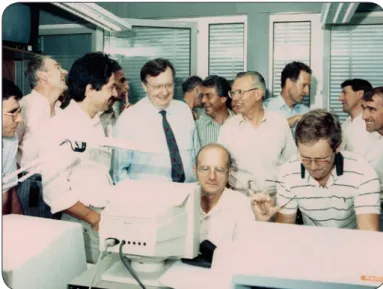
ceremony for the Super Proton Synchrotron (SPS). Figure 5. Physicists gathered around a computer monitor in the LEP control room at the start-up of the LEP on 14 July 1989. Carlo Rubbia (CERN’s Director General at that time) is in the centre, with Herwig Schopper (a former Director-General of the organisation) to his left.
17
Annual Report 2014 Nikhef
responding fields, the W and Z bosons, photons and gluons) is a precision theory, to many decimal places. It would not have been possible to confirm the status of the Standard Model as a preci-sion theory without a quantitative framework derived from the work of Gerardus ‘t Hooft and Martinus Veltman (renormalis-ability of interactions of massive gauge particles, especially the W and Z bosons, Nobel Prize 1999). Over time, LEP’s energy was extended to just over 100 GeV per beam. However, it was unable to find any evidence of the Higgs boson (the vital missing ingre-dient of the Standard Model). This meant that it had to have a mass in excess of 114 GeV. The next step required the LHC.
Large Hadron Collider
Having spent a long time reviewing its options, the CERN Council finally gave the go-ahead for the LHC in 1994 [3]. That
go-ahead was accompanied by a plan to close LEP, to make way for the LHC [4] (in the same way as the ISR was closed to make way
for LEP). The investment budget would have to come from the Member States’ contributions (which, being more or less guaran-teed, made it possible to take out loans as well). It was also neces-sary to acquire substantial additional resources through bilateral agreements with interested Non-Member States, particularly the United States and Japan.
In 2012, twelve years after the closure of LEP, the ATLAS and CMS (the two general-purpose detectors) teams announced the discovery of a Higgs-like boson, a particle with a mass of 125 GeV. Further measurements and analyses were (and still are) required to establish the properties of this Higgs-like particle. Evidence such as its spin and its couplings to the bosons, quarks and leptons into which it decays indicates that we can drop the term ‘Higgs-like’, and simply refer to this particle as the Higgs boson. In 2013, François Englert and Peter Higgs were finally able to collect their Nobel Prize. Full acknowledgement was, of course, given to the ATLAS and CMS teams.
Unlike CERN’s accelerators, the particle physics experiments (detectors) are designed and built by consortia of universities and institutes (such as Nikhef), usually with the assistance of a CERN group. Among the scientists who work at CERN there are a number of top flight instrumentation physicists. This was amply demonstrated by the award of the 1992 Nobel Prize to Georges Charpak, for the invention of the Multi-wire Proportional Chamber. CERN also offered Tim Berners-Lee the ideal envi-3 It was initially decided that the LHC would be constructed in two phases. The initial phase
would involve fewer magnets, to spread the requisite investment over several years. This plan was reviewed in 1996, at which point the decision was taken to complete the project in a single step. 4 That took place in the year 2000. At that time, I was a member of CERN’s Research Board. I
supported the plan to close the LEP, even though it had provided hints of a putative Higgs boson at 110 GeV. That stance made me the target of some very angry comments at the time…
ronment in which to develop his ideas about information man-agement. In late 1990, he launched the world’s first website. The LHC’s detectors are marvels of high-tech instrumentation. When the LHC project was given formal approval (1994), it still faced many technical hurdles. For instance, no one was entirely sure how to build detectors capable of recording the products of clumps of protons colliding forty million times per second (producing more than a billion particles each second) accurately enough to detect the decay products of the Higgs boson. (Walter Hoogland, who was CERN’s Director of Research at the time, took the important initiative to combine the requisite R&D efforts and to introduce an element of competition.) The detectors proved to be a great success, thanks to imagination, perseverance and a little bit of luck. The LHC’s detectors involve innovative semiconduc-tor detecsemiconduc-tors, new deep submicron electronics, incredibly fast and smart online hardware and software (trigger and data acquisi-tion) and a ground-breaking worldwide computing grid. They are universal precision instruments with a level of sophistication that, twenty years ago, no one would have thought possible.
Cooperation in the Netherlands
During the 1970s, the scientific community in the Netherlands became increasingly aware that cooperation at national level was a prerequisite for optimal participation in CERN. To this end, the National Institute for Nuclear Physics and High-Energy Physics (Nikhef) was established. The idea was to create partner-ships between university groups that were active in the field of subatomic physics, in the form of a joint venture with a coherent scientific programme established by a single board, and imple-mented under the direction of a single executive. Nikhef was just such a partnership, consisting of four universities and the FOM
Figure 6. A crowd looked on while the first proton beam was steered around the LHC ring on 10 September 2008.
Foundation. A partnership that, set against the background of the contemporary Dutch research system, was far ahead of its time. While this approach does suffer from a few drawbacks (first-mover disadvantage), which I will not go into here, these are far outweighed by the benefits. These benefits relate to substance (a focused and ambitious research programme based on scientific choices) and infrastructure (infrastructure for innovative instru-mentation development, state-of-the-art computing).
For instance, various LHC detectors (ATLAS, ALICE and LHCb) have benefitted from Nikhef’s exceptionally creative, high-value contributions. (ALICE and LHCb are specialised detectors. ALICE makes unique measurements of ‘drops’ of quark-gluon plasma, a new aggregate state of matter generated in collisions of lead nuclei. LHCb specialises in measurements of B mesons and in the study of differences between matter and anti-matter.) This places Nikhef’s physicists (including many talented PhD students) in an excellent position to wring every last drop of information out of the LHC’s data, to track down the Higgs boson and –more… There are good reasons to be-lieve that there is more beyond the Standard Model. If this were not the case, then higher order quantum corrections (radiative corrections) would tend to produce a very large mass for the Higgs boson. Without an extension of the Standard Model, an unnatural degree of fine-tuning is needed to keep these correc-tions under control. In fact, we can be certain that the Standard Model is incomplete, simply because neutrinos have mass. This does not fit the Standard Model, which states that these par-ticles are all strictly ‘left-handed’ (i.e. the direction of spin is opposite to the direction of motion). It is not difficult to ac-commodate massive neutrinos in the Standard Model, but it is also entirely possible that the neutrino’s vanishingly small mass indicates the existence of ‘new physics’. Finally, we can cher-ish the hope that explanations for cosmological issues, such as dark matter and inflation, will be found in physics beyond the Standard Model. A first step beyond the Standard Model would be the discovery of supersymmetry, as this theory offers at least the beginning of a solution to some of the above problems. While its data have been subjected to some very profound and advanced analyses, the LHC has not yet afforded us so much as a glimpse of supersymmetry. All hopes are now pinned on the LHC upgrade, which will double the collider’s energy when it resumes operation in 2015, and on an expanded investigation of the possible realisations of supersymmetry. The LHC’s scien-tific programme will surely dictate trends at the forefront of high-energy physics for the next ten years, at least.
The future
The successful partnership at CERN, its haul of scientific results, and its level of technical excellence have drawn the interest of countries other than the original Member States. CERN current-ly has 21 Member States and two candidate Member States, plus five observers (including the United States, Japan and Russia). Possibly the growth in the number of Member States is somewhat out of step with CERN’s plans for the future. The Trippenhuis would form an excellent backdrop to gatherings where people reflect on those plans for the future!
The big challenge facing CERN today is to be as successful in the future as the organisation has been over the past sixty years. Happily, the LHC’s upcoming increase in beam energy and lu-minosity, together with the associated upgrade of the detectors, represent a solid bridge to that future. The new results, combined with recently acquired knowledge, should then serve as a spring-board for a new, challenging and ambitious European accelerator project for the future. There are calls for CERN to participate in an interim project, such as a multi-billion dollar linear accelera-tor in Japan. In my view, that would be the end of CERN –an organisation whose raison d’être stems from pioneering projects in Europe.
My thanks to Karel Gaemers for his comments on an initial ver-sion of this article and for a discusver-sion of neutrino physics, and to Bert Diddens for pointing out the discovery (made by a team working with the SC) of the electron decay of the pion.
19
Annual Report 2014 Nikhef
1.4 Big Data: Wat en Hoe?
Jeff Templon
“Wat en Hoe” is Dutch for “What and How”, and this title is borrowed from a series of very practical language guides I made frequent use of during my travels in the days before Google Translate existed. I hope that this piece can serve a similar function, to explain in a very practical fashion, What Big Data is, What it is good for, How it can be used, and How you can learn more.
What Is Big Data?
Big Data, in the most general sense, is the enormous amount of data stored in digital form on computers connected to net-works. The network is important, because it enables the enor-mous amount of data to be collected (e.g., computers at Vodafone collecting the location data from all mobile phones connected to their 3G network) as well as to be accessed by others (e.g., TomTom traffic information being accessed by thousands of navigation devices spread across the country).
There are a lot of definitions for ‘Big Data’ in circulation, partly because of industry hype — if you call it ‘Big Data’ then it sells better. Below I will describe two ways of understanding Big Data, and they are both linked to what is called ‘exponential growth’ as displayed in Fig. 1. For example, if you start with two cents and add two cents each day, this is called linear growth. Exponential growth is if you double your money each day. In both cases, on the second day you will have four cents instead of two; on the second day you will have either six cents (linear) or eight cents (exponential). At the end of the month, this is 62 cents (linear) or 21 million euros (exponential). Big data is, in many cases, grow-ing exponentially.
One way to see Big Data is how big it is. Taking digital music as an example, music in mp3 format started to become popular in 1997, when the WinAmp program was introduced. In those days, an average computer disk drive could hold about 400 songs of high-quality mp3 music (2 GB). Nowadays a home computer can hold more like one hundred thousand songs — assuming you don’t already have your disk filled up with digital photos, also a novelty in 1997. However, many people now use streaming music services like Spotify to listen to music; these services offer around 50 million songs. This is too much data to fit within a sin-gle computer, and this is another common definition of ‘Big Data’ — your data is big if it no longer fits on a single computer. At Nikhef, about 50 large-capacity storage computers are net-worked together to hold our share of the data from the experi-ments we work on at CERN and elsewhere in the world. Taken together, these computers at Nikhef have enough storage capac-ity to hold three copies of the entire (all 50 million songs) iTunes
store. Although Nikhef operates one of the largest data reposito-ries, there are hundreds of others scattered across the globe, lead-ing to yet another definition used for ‘Big Data’: your data is big if it no longer fits in the same building.
Why is there so much interest in Big Data?
Big Data is certainly interesting just because it is ‘big’, as the digital music example shows. In the early 1990s, when I went on vacation, I used to carry two small briefcase-sized cases full of cassette tapes with me. Now a mobile phone, a pair of speakers and an internet connection takes up much less space and pro-vides access to much more music.
Big Data is, however, much more than this, as the large amounts of data allow us to do many new things that were previously dif-ficult, if not impossible, to do. The very first examples mentioned in this article (mobile phones and traffic information) make a good example. The mobile phone location data, collected several times per minute, can be converted to a mobile phone ‘speed’, especially for those mobile phones located in cars moving along highways and streets. Taken together, these speeds show how fast traffic is moving. If the speed limit on a certain portion of the A9 is 100 km/hr but the phones are moving at 40 km/hr, this indi-cates a traffic jam, and that information is sent out to connected navigation devices.
In the past, traffic jams were deduced mainly by looking at traf-fic cameras on major highways. There was a signitraf-ficant delay before this information reached drivers, since the traffic report was broadcast only a few times per hour on the radio. The mod-ern systems include all roads, and are updated every few minutes;
Figure 1: Estimated total amount of stored data in the past eight years. One Exabyte [EB] is equal to 1000 million Gigabyte. The curve represents expo-nential growth that doubles the size each 18 months.
0 1000 2000 3000 4000 5000 2006 2007 2008 2009 2010 2011 2012 2013 Size [EB]
Stored Big Data www.emc.com
they also include other information like gasoline prices, lists of nearby restaurants, and weather reports, having collected this data from other sources on the internet.
Big Data and machine learning
Perhaps the most exciting (and sometimes frightening) aspect of Big Data has to do with how it has changed how we program computers. Until recently, in most cases scientists, or other grammers, ‘wrote a program’ and the computer used this pro-gram to produce some output. So you put a propro-gram ‘in’ to the computer and you get data back ‘out’.
There is another way to do it: you put the data ‘in’ to the com-puter, and you get the program back ‘out’. The program you get out is the one that would have generated the data you put in. This program can then be put back ‘in’ and used for tasks to gener-ate similar data that you don’t have yet. This is called Machine Learning and can best be illustrated by example.
Suppose you have a lot of text that was originally written in English, and had been translated into Dutch. You have computer files containing the text in both English and Dutch. You can give these files to a Machine Learning system, and it will give you back a program that would have been able to translate the Dutch text from the English. This in itself is not so useful, as you already had the Dutch text, but you could now give it a different English text and your program will translate it into Dutch.
The connection to Big Data comes because, in many interest-ing cases, Machine Learninterest-ing needs a lot of examples in order to ‘learn’ a program like the translator. As an example, one can teach a speech-recognition program to make the proper choice between confusing words: did the speaker say “go to”, “go too”, or “go two”? In order to learn a program that gets the right answer 99% of the time, you need to give it billions of examples. This was unthinkable in the pre-internet age, so people were still trying to write the translation program in the old-fashioned way. Now with so much written text on the web, and much of it already translated, it is possible (even relatively easy) to get billions of examples. Big Data is making things possible which were not pos-sible before.
Translation programs, recommendation systems at web stores like Amazon, the little boxes that appear by people’s faces on your camera (how did the camera know that this part of the picture was a face?), web services like Evernote that can recognise words inside scanned images: all these systems are based on Machine Learning systems. Some of the most advanced Machine Learning
systems are called ‘Neural Networks’ and are built to mimic the way neurons are connected in the human brain.
I mentioned that this aspect of Big Data could be frightening. More on this later on, but one of the problems is that the Machine Learning ‘output’ program is only as good as the data ‘input’. The financial crisis of 2008 was a surprise to most; with all the financial data available, and claims being made that economic theory was no longer needed, we could use Big Data to under-stand everything: why did nobody predict the crisis? One of the main reasons is: the machine learning programs that were used to predict how well the market would do, were produced from input data on the previous ten or so years. Those years were eco-nomically quite calm, so the learned programs had no example data on what a financial crisis looked like, and hence had no way of being able to spot all the warning signs.
Some example uses of Big Data
Most of what we call ‘Big Data’ is publicly available on the web, so anyone can use it. One use I personally like is, checking how well weather forecasters are doing. In the pre-web times, you could find the weather forecast for the coming days, but they never included data on how well they predicted yesterday, or for this day in his-tory, how much did the forecast and the actual weather differ, on average? If you were a determined person, you could keep a note-book every day of the forecast and the actual weather, the more cit-ies and more forecasts you try, the more of a chore this becomes. Once the weather services started making web sites where current temperatures, and the forecasts, were published, anybody could write a small program that picks up the forecast once per day, and the temperatures a few times a day, for as many cities as they liked. It turns out that the weather predictions are generally better than a) guessing, b) saying “tomorrow will be just like today” and c) “to-morrow’s weather will be the historical average high and low for today”. This is true for the day after tomorrow, but just barely true for today next week … and the weather services may like to publish weather forecasts for two weeks, but after 8 days, the forecasts are actually worse than just looking at the historical weather.
Also how well the forecast predicts the weather, depends on where you get your forecasts from. The national weather services are gen-erally pretty good; local radio and tv stations are the worst. This was unexpected, as these stations get their weather predictions from the national services. So why are they worse? Because these local stations adjust the forecasts to be ‘wetter’. They do this be-cause people in general prefer a pleasant surprise to an unpleasant
21
Annual Report 2014 Nikhef
surprise, so you will make your audience happier if you are wrong about rain more often than wrong about sunshine.
The weather example is from 2002, and was discovered by a computer-science graduate student, who was doing Big Data before it was called Big Data. A more recent example comes from one of our colleagues, prof.dr. Barend Mons, who works at the Leiden University Medical Center. Prof. Mons’ group has played a leading role in collecting all available biomedical data into a single unified framework. Fig. 2 shows a graphical representation of a research result extracted from that data collection. The re-search question was to find genes (yellow boxes) involved in both ‘inflammation’ and ‘HIV disease progression’ (red boxes). The black boxes represent published papers linking genes to either HIV or inflammation. The two genes displayed in the figure have many published papers that link to either of the diseases, but never to both diseases in the same paper. This link is only dis-covered when big-data analysis techniques are used on the entire collection.
How can Big Data keep expanding exponentially?
Big Data has continued to expand because the number of con-nected things continues to increase, and because the underlying technology — especially in networks — allows more and more stuff to be put online.
When the World Wide Web was started, first all high-energy physics labs were connected together; the Web was invented at CERN, and Nikhef was the third site to join worldwide. Very quickly many other academic departments and research insti-tutes joined the web, and commerical sites started to join. In 1992 there were only about 15,000 .com sites, now there are several hundred million. The expansion continued as people (not companies) started to put more and more things online, think of Facebook, Instagram, Twitter, and the many Google services. In recent years, the number of smartphones (see Fig. 3) has been increasing rapidly, adding the location history of millions of people (and millions of ‘selfies’) to the available Big Data. One might think that with all companies online, all people online, and everyone using a smartphone, the expansion would be over; the next wave is to connect ‘everything’ to the internet. This wave has started with home thermostats; now there are internet-connected washing machines, cars, garage doors, home lighting, pet collars; you can even have your doorbell send you an email if someone rings it. In most cases, cloud services are involved which means that there is a company that receives this data on its servers and can process it to learn things about the owners. You might be able to learn a lot about a neighborhood, or a person, by studying how often, and at what times, the doorbell is being rung. Even more if you could connect that data to a Facebook profile, and use cell-phone tracking data to find out exactly who it is that is visiting when the doorbell rings.
Risks of Big Data
The situation just described makes it pretty clear that the more we get connected, and the more connected our data is, the less privacy we have. Even if the company you give your data to (doorbell, thermostat, cell phone location) is not doing anything shady with this data, they do have the data and it is connected to the internet. Lots of people who would like to misuse your data
Figure 2. Graphical representation of a big-data search for genes related to both HIV and inflammation. Those genes (yellow boxes) are identified when published papers (black boxes) can be found mentioning either HIV or inflammation (red boxes). None of the papers mention both diseases; the link between them is only evident through the massive data set.
Figure 3. Growth of the usage of –location revealing!– items like laptops, smartphones and tablets in the years 2007–2012. Source: CBS
Total Laptop Smartphone Tablet 2007 2008 2009 2010 2011 2012 0 10 20 30 40 50 60 70 % of internet users


![Figure 1: Estimated total amount of stored data in the past eight years. One Exabyte [EB] is equal to 1000 million Gigabyte](https://thumb-us.123doks.com/thumbv2/123dok_us/9950443.2889553/20.871.448.830.196.434/figure-estimated-total-stored-years-exabyte-million-gigabyte.webp)