The Border Effects in Brazil
Marie Daumal
∗, Soledad Zignago
†November 2005
(preliminary version)
Abstract
This paper applies the ”border effect” method to estimate the degree of inte-gration between Brazilian states over the period 1991-99 and to analyse the mag-nitude of Brazilian states’ engagement in international trade. Our paper shows that the average border effects of Brazil are larger than those estimated for OECD countries. The Brazilian market is fragmented and Brazil’s integration into in-ternational trade is limited by large inin-ternational border effects. This paper also explores state-specific border effects. The results underline wide differences in trade openess across Brazilian states. The most domestically integrated States are also the most engaged in international trade.
Classification JEL : F14, F15
Keywords : Border effects; Brazil; International trade; Domestic integration
Introduction
Perfect integration of markets has in theory strong welfare properties. Trade integration permits to exploit economies of scale and comparative advantages. Trade competition stimulates the competitiveness and the productivity of national firms. Some studies 1 show that trade integration can be a factor of development and growth.
Thus the question of domestic market integration in Brazil takes on particular im-portance for these reasons but also for Brazil-specific reasons.
Firstly, there is a growing consensus among the Brazilian political parties that ad-dressing regional inequalities is a major challenge and a priority for Brazil. In 2004, the Minister of National Integration, Ciro Gomes, declared that regional disparities face the country with the ”risk of fragmentation.” According to the Minister, inequalities among regions increased during the 1990s. Inequality in Brazil is linked to race and ∗PhD Researcher, University Paris Dauphine, Laboratoire Eurisco, Place du Mar´echal de Lattre de
Tassigny, 75775 Paris cedex 16, France. Email : [email protected]. I especially wish to thank Jean-Marc Siro¨en, my thesis supervisor (University Paris Dauphine), for his precious advice.
†Economist, CEPII, 9, rue Georges Pitard, 75015 Paris.
geographic location, with the North and North East being the poorest regions2. These regional disparities are also an explanation for important domestic migrations, from Amazonia and Nordeste to Sao Paulo. Brazilian governments have tried to fight these inequalities by promoting economic zones in poorest regions3. As domestic integration can be a factor of development and growth for the whole national territory, fighting regional disparities may imply fighting domestic market fragmentation. Our measure of internal border effects by Brazilian state will underline the marginalization of some Brazilian regions from the rest of the country.
Secondly, during the 1990s, Brazil pursued a strategy of a new economic model based on market reforms and outward orientation which led to reductions in tariffs and removal of other trade barriers. Our paper will determine whether domestic market integration and Brazil’s insertion to international trade have progressed in conjunction with these reforms.
And finally, Brazil is a federal country in which states have political autonomy. These political subnational borders may generate additional trade costs for inter-state trade by creating administrativ, legal and fiscal heterogeneity. For example, the ICMS (Imposto sobre Circula¸cao de Mercadorias e Servi¸cos) is a Brazilian tax applied to inter-state trade. The rate of ICMS is set separately by each inter-state. Differential rates depend on the specific direction of trade. Thus, policy-driven trade barriers such as the ICMS tax may operate on the Brazilian subnational level.
This paper proposes to investigate the Brazil’s domestic market fragmentation. A number of recent studies have found rather large border effects within countries. Wolf (1997) explores the American internal fragmentation and finds a border effect of 4. Canadian domestic market integration is studied by Helliwel (1997) who estimates a border effect of 2 4 and Poncet (2003) analyzes the Chinese market integration and
finds a border effect slightly over 20 for the year 1997. The fragmentation of China’s domestic market is the highest, suggesting a correlation between the level of development and domestic integration. Our paper shows that Brazilian domestic market is rather highly fragmented with an internal border effect of 11 in 1999.
Other studies have found intranational trade to be excessive compared to inter-national trade. McCallum (1995) and Anderson and Van Wincoop (2001) have esti-mated the trade integration between the United States and Canada. Head and Mayer (2000) have calculted the integration among european countries and Nitsch (2002) be-tween Germany and nine european countries. Poncet (2003) finds that China’s greater engagement in international trade went hand in hand with a domestic market disin-tegration between 1987 and 1997. Senne Paz (2003) underlines that Brazilian states trade approximately thirty times more with other Brazilian states than with equidis-tant and equisized foreign countries. We would like to check if Brazilian states have
2However this is a partial truth because there are areas of prosperity in all States of the country 3For example, in the late 1970s, the Brazilian government tried to promote the economic development
of the Amazon Region. The Manaus Free Trade Zone (ZFM) model was a project of the Brazilian Federal Government. The aim was also to maintain a political and military control on the region.
4see also Djankov and Freund (2000) for the ex-USSR market integration and Combes, Lafourcades
and Mayer (2003) for the French market integration. The number of empirical research is limited because data on trade flows for subnational units are rare.
greater involvement in international trade since the globalization is said to be extending. Our paper analyzes the magnitude and evolution of Brazilian states’ engagement in domestic and international trade over the period 1991-1999. Our paper proposes the first measure of Brazilian domestic integration and the first measure of international border effects by Brazilian state. We calculate border effects for each of the 26 Brazil-ian states. Data for inter-state trade flows are available for the years 1991, 1997, 1998 and 1999.
We use a theory-defined gravity equation to estimate the negative impact of Brazilian states’ borders on export flow towards the other Brazilian states and towards interna-tional partners. We follow the gravity model developped by Anderson and Van Wincoop (2001). We pay great attention to the calcul of bilateral distance. Head and Mayer (2002) argue that distances are often mismeasured in the existing literature. According to them, intranational and international distances must be calculated in an accurate and comparable manner. In consequence, we create a original distance database by calculating all distances from the same methodology and by taking into account the spatial distribution of economic activity in each country and in each Brazilian state.
Our results underline the imperfect integration of the Brazilian domestic market and the limited integration of Brazilian states into global markets for goods and services.
This paper proceeds as follows: Section 1 discusses the notion of trade integration. We then present the gravity model developped by Anderson and Van Wincoop (2001) and our empirical model used. We next describe the data set. Section 2 discusses domestic and international integration of Brazilian states. The final chapter provides some robustness checks.
1
The Effect of Borders and the Measure of
Eco-nomic Fragmentation
1.1
The Notion of Trade Integration
There is perfect trade integration when national (or subnational) borders don’t influence commercial transactions. Borders have an impact on trade when domestic firms have greater access to their domestic market than to foreign markets. We measure the effect of borders as the difference between the observed trade and the trade that ”would be” in the absence of borders.
We need a theoric framework in order to derive a consistent prediction of what would happen to trading patterns in the absence of border effects. We use a theoretical gravity equation derived from the monopolistic competition model. We follow Anderson and van Wincoop (2001).
1.2
The Gravity Model
In its simplest form, the gravity equation states that bilateral trade between two coun-tries is proportional to their economic sizes and inversely proportional to the distance
between them. The gravity equation is successful in explaining bilateral trade flows and is a very popular formulation for statistical analyses of trade. McCallum (1995) was the first to use the traditionnal gravity equation to estimate the border effects between Canada and the United States.
Anderson and van Wincoop (2001) argue that the traditional gravity equation is not correctly specified as it does not take into account multilateral resistance terms. This implies that estimation suffers from omitted variables bias. Anderson and van Wincoop (2001) use a monopolistic competition trade model to derive a multilateral version of the gravity model. This model includes the ”multilateral resistance” explanatory variable that represents the magnitude of alternative trading opportunities faced by the members of the bilateral trading pair. The main hypotheses of the model are : the elasticity of substitution (CES) between goods is constant and goods are differentiated by region of origin. Anderson and van Wincoop assume that each region is specialized in the production of only one good5.
The program of maximization of the consumer utility function subject to the budget constraint gives: Xij = YiYj Yw t ij PiPj 1−σ (1)
Here Xij is exports from region i to region j; σ is the elasticity of substitution
between all goods; Yi and Yj are the nominal incomes ; tij are trade costs between i
and j andPiandPj are the multilateral resistances of i, j. Pi andPj are also consumer
price indexes.
Equation (1) shows that exports from region i to region j depend on three kinds of trade resistance: (a) the bilateral trade costs between i and j (such as distanceDij
or border effectBij); (b)Pi, i’s multilateral resistance; (c)Pj, j’s multilateral resistance.
Assuming bilateral trade costs are function of bilateral distance Dij and of the
border effect between i and jBij, Anderson and van Wincoop obtain :
lnXij YiYj
=k+ (1−σ)ρlnDij+ (1−σ)lnBij
−(1−σ)lnPi−(1−σ)lnPj (2)
The indexes of multilateral resistancePi andPj are unobserved. Anderson and van
Wincoop (2001) and Feenstra (2002) indicate three methods to estimate this equation including resistance multilateral : (1) using published price index as proxies ofPiandPj;
(2) calculating the unknownPiandPiaccording to the estimation strategy of Anderson
and van Wincoop or (3) using fixed effects to take account of the multilateral resistance. 5for more details about the model, see Anderson and van Wincoop (2001) and Feenstra (2002)
According to Feenstra (2002), the fixed-effects method seems the most appropriate method since it gives consistent estimates of border effects and is easy to follow. So we use this method to estimate Brazil’s border effects.
1.3
The Empirical Gravity Equation
We estimate the gravity equation (3) while using ordinary least squares (OLS) :
lnXij YiYj
=a0+a1lnDij+a2Home+a3Brasil+aiEi+ij (3)
i indicates an exporting Brazilian state andj indicates an importing Brazilian state or an importing foreign country. Xij is exports from a Brazilian state i to another
Brazilian state j or to a foreign country j. Xii is the intra-state trade. Dij is the
distance between i and j. More details aboutXii andDij are presented in Appendix.
Yi, Yj are the Gross Domestic Products in current dollars.
We include explanatory variables in order to estimate the effects of crossing a border.
Homeis a dummy equal to one for intra-state trade and 0 for inter-state or international trade. Brasil is a dummy equal to one for inter-state trade and 0 for intra-state and international trade.
Home captures the preference for trading within a state rather than with a foreign country. The antilog of the coefficient on theHome dummy variable measures the size of the international average border effect of Brazilian states. The antilog of ”a2(Home)
-a3 (Brasil)” measures the degree of internal fragmentation. This coefficient captures
the preference of a Brazilian state for trading with itself rather than with the rest of Brazil.
We include Ei, the exporter fixed-effects. Ei denotes a indicator variable that is
unity if state i is the exporter. As the inclusion of importer fixed-effects leads to a problem of perfect collinearity between the vectorBrasil and the importer fixed-effects, we can’t include them. Brasil is a unilateral variable and indicates if the importer j is a Brazilian state or not. A unilateral variable is always perfectly colinnear with some region specific-dummies.
The final subsection of this paper provides some robustness checks. One of these tests consists in completing the data set by including the export flows from foreign countries to Brazil. So the dummy Brasil is now a bilateral variable equal to one if i and j are Brazilian states. We include the importer fixed-effects but we find that there is still a problem of high multicollinearity between the explanatory variables.
1.4
Data
The Federative Republic of Brazil consists of 26 states and 1 federal district (distrito federal). We merge two states, Tocantins and Goias, since they were a unique state until 1989. In this paper, Goias means Goias and Tocantins states altogether.
Our data set contains for each year 26 intra-state trade flows, 650 inter-state flows (26*26), and 4264 international export flows from Brazilian states to each of the 164
foreign countries included in the sample (26*164). About half of trade observations are equal to zero.
The data for inter-state trade are available only for 1991, 1997, 1998 et 1999. The trade flows data are calculated from the information on the ICMS tax. The ICMS tax (Imposto sobre Circulacao de Mercadorias e Servicios) is applied to inter-state trade. The trade flows Xij can be calculated according to the information provided by the
exporter state or according to the information provided by the importer state. The correlation between exporter and importer data is about 0.96 for each year. Our paper uses the data based on information given by the importer states. The data for the year 1991 come from SEFAZ-PE(1993) and have been calculated by the Ministry of Finance of the Pernambuco State. The data for the year 1997 are taken from COTEPE/ CONFAZ (2000) and the data for 1998 and 1999 come respectively from Vasconselos (2001a) and Vasconselos (2001b). The data are in current Brazilian currency, Cruzeiro for 1991 and Real for 1997, 1998 and 1999. The exchange rates (see Table 1) used to convert the data to current US dollars are from the World Bank and are the same exchange rates used to convert Brazilian GDP from local currency to current US dollars. The international trade flow data are provided by the AliceWeb system maintained by SECEX, the Foreign Trade Secretariat of the Brazilian Ministry of Development. The data are in current US dollars.
Table 1: Exchange rate, growth and inflation Year exchange rate growth rate 1991 1 dollar = 406,6 cruzeiros 1.3 1997 1 real = 0.927 dollar 3.3 1998 1 real = 0.862 dollar 0.1 1999 1 real = 0.55 dollar 0.8
Note: Data come from World Bank and UN Statistics Division
The Gross Domestic Product data of the foreign countries come from the United Nations Statistics Division. The data for Brazilian states are from IBGE (Instituto Brasileiro de Geografia e Estat´ıstica) and are provided in local currency.
We need the production of each economic sector, by Brazilian state, in order to calculate the intra-state trade (see Appendix). These data also come from IBGE. We use data of the World Gazetteer web site, which provides current population figures and geographic coordinates for cities, in order to calculate distances (see Appendix).
2
The Border Effects of Brazilian States
2.1
Internal Fragmentation and International Integration
We estimate a cross-section OLS model of Equation (3) for each year 1991, 1997, 1998 and 1999. The estimation of Equation (3) allows us to assess the average border effects
value of Brazilian states6. Table 2 reports the results.
Table 2: The Border Effects of Brazilian States
lnXij/YiYj lnXij/YiYj lnXij/YiYj lnXij/YiYj
(1999) (1998) (1997) (1991) lnDij -1.398 -1.496 -1.365 -1.478 (.061)∗∗∗ (.062)∗∗∗ (.060)∗∗∗ (.061)∗∗∗ Home 5.917 5.490 5.784 5.756 (.455)∗∗∗ (.454)∗∗∗ (.453)∗∗∗ (.470)∗∗∗ Brasil 3.483 3.219 3.244 2.839 (.117)∗∗∗ (.118)∗∗∗ (.118)∗∗∗ (.119)∗∗∗ cons -23.984 -23.149 -24.171 -22.312 (.666)∗∗∗ (.694)∗∗∗ (.736)∗∗∗ (.606)∗∗∗ N 2441 2415 2421 2249 R2 0.685 0.687 0.673 0.687
Export Fixed-Effects yes yes yes yes
Note: Standard errors in parentheses: ***, ** and * represent respectively statistical significance at the 1%, 5% and 10% levels.
All explanatory variables are highly significant and display coefficients with the ex-pected signs. We find high and decreasing internal border effects and high and increasing international border effects.
The coefficient on our distance measure (equal to -1.39 in 1999) is just a bit larger than the ones on McCallum (from -1.12 to -1.42 ) or Anderson and van Wincoop (from -0.79 to -1.25) distances.
The antilog of ”a2 (Home) - a3 (Brasil)” measures the degree of internal
fragmen-tation. The average internal border effect has fallen from 19 (exp2.92) in 1991 to 11 (exp2.43) in 1999. This evolution underlines a rise in the intensity of inter-state trade since 1991 and indicates an ongoing process of domestic integration in Brazil. Despite of this evolution, the magnitude of the Brazilian market fragmentation is high in com-parison with others countries. In 1999, a Brazilian state trades 11 times more with itself than with another Brazilian state, after controlling for economic size and distance. The coefficient on theBrasil variable is 3.48. This result shows that intranational Brazilian trade exceeds the international trade by a factor of approximately 33, after controlling for distance and economic size.
TheHomecoefficients are highly significant. The dummyHome compares the rela-tive volumes of intra versus international trade. The average international border effect of Brazilian states has risen from 315 (exp 5.75) in 1991 to 370 (exp 5.92) in 1999. In 1999, a Brazilian state trades 370 times more with itself than with a foreign country. The international trade integration of Brazil decreased over the period 1991-1999 in 6The Breusch-Pagan / Cook-Weisberg test confirms heteroskedasticity. We use the
Hu-ber/White/sandwich estimator to provide robust standard deviation. The Ramsey Reset regression specification error test for omitted variables rejects the functional form of the estimation
spite of economic reforms promoting openess. This result contrasts with other studies since the literature of the border effects indicates that border effects decline over time in conjunction with trade liberalization.
Theory shows that the border effect is equal to the product of the elasticity of substitution between goods and the equivalent of the border barrier. The tariff-equivalent of the border barrier is given by the following formula: tariff-tariff-equivalent =
exp[(border)/(σ−1)]−1. The literature7 shows that the elasticity of substitutionσ
must be in the range of 5 to 10. We calculate the tariff-equivalent of the border barrier assuming that the elasticity of substitution is equal to 9. 8 The tariff-equivalent of
internal border effect amounts to 34% in 1999 and the tariff-equivalent of border effects between Brazilian states and foreign countries is 77% in 1999.
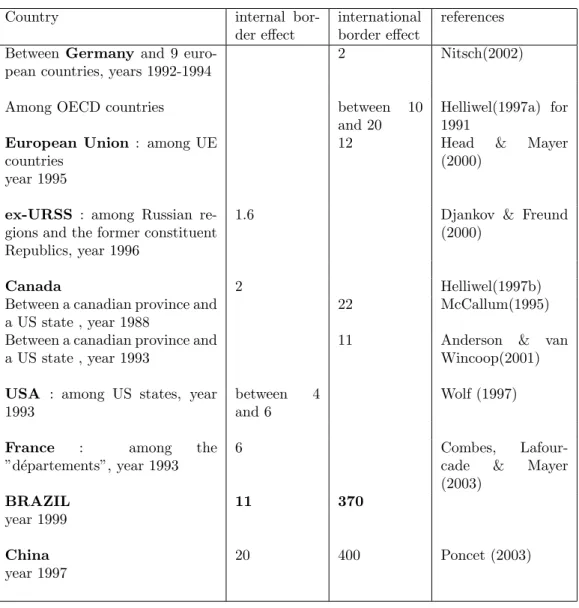
Our results suggest that domestic integration in Brazil increased over the period 1991-1999 and emphasize the limited and decreasing international trade integration of Brazilian states. Table 3 compares border effects of Brazil with those of other countries. Relative to most countries excepted China, Brazil is less integrated into global markets for goods and its domestic market is more fragmented. The magnitude of border effects among Brazilian states is close to the value of border effects among European countries. The magnitude of Brazilian border effects is close to those of China, suggesting a cor-relation between trade integration and level of development.
2.2
Border Effects by Brazilian State
We now turn to the analysis of border effects across Brazilian states. We expect Brazilian states to have different levels of border effects. This heterogeneity in trade openess could reflect for example differences in economic structures and geography.
Brazil consists of 26 states and 1 federal district (distrito federal). Brazil and its 26 states and Federal District are divided into 5 distinctive regions: North, Northeast, Center-West, Southeast and South.
We want to estimate the internal border effect by Brazilian state. We estimate Equation (3) on a sub-sample data set containing only inter-state and intra-state trade flows. As the dummy Brasil disappears from the equation, there isn’t a problem of multicollinearity any more. Therefore, we can include in the equation the exporter and importer fixed-effects. TheHome dummy in Equation (3) is replaced by state-specific
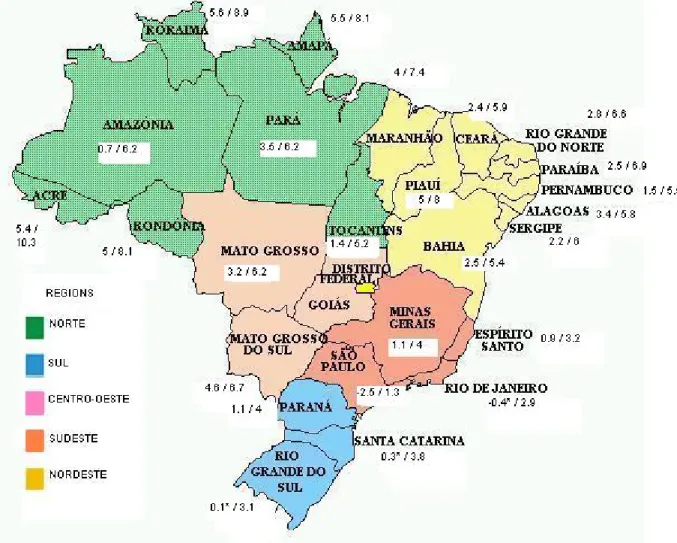
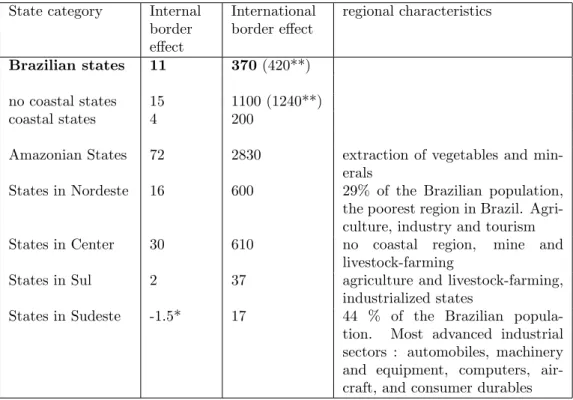
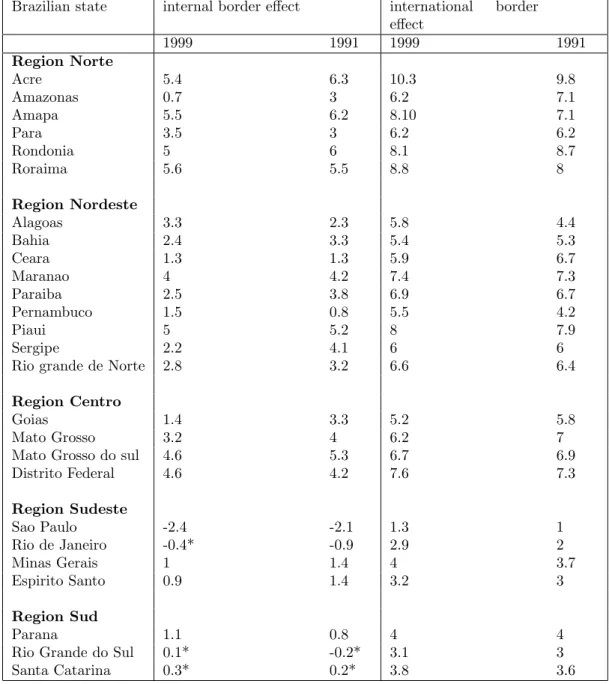
Home dummies so that 26 internal border coefficients are now estimated. Figure 1, Tables 4 and 5 present the results.
We now turn to the estimation of the international border effect by Brazilian state. We estimate Equation (3) and replace theHomedummy by state-specifichomedummies so that 26 international border coefficients are now estimated.
7see Head and Ries (2001)
8of course, some products are highly substitutable and some other products are not. This makes
To economise on space, we only report the results. Figure 1, Tables 4 and 5 present the results for each state or for category of states. As regards Figure 1 and Table 5, the size of border effect is the antilog of the coefficients reported.
Border effects differ across Brazilian states. The results show that integration in domestic trade is higher for States of the South region than for States of the Nordeste and Amazonian Regions. The most domestically integrated States are also the most engaged in international trade. In 1999, Acre, an Amazonian state, displays the highest coefficient for international border effect (10.3) and the highest (with Roraima) for the internal border effect (5.4). On the opposite, Sao Paulo shows the smallest international border effect (1.34) and the smallest internal border effect (-2.4). This is not surprising given the geographical and industrial structure of this state. It suggests that Sao Paulo functions as a provider for Brazil or as a trade platform, importing from foreign coun-tries and exporting to the rest of Brazil.
The finding of home bias on the subnational level can be surprising because one generally believes that a country has a high degree of cultural and institutional homo-geneity which could lead to a unified market. Some studies have proposed explanations for domestic fragmentation. According to Poncet (2003), Chinese market fragmentation may be the result of local protectionnism (implemented by provinces) and could also be explained by cultural and linguistic heterogeneity among Chinese provinces. Combes, Lafourcade and Mayer (2003) explain that intra-national border effects in France may be the result of the social and business networks.
The reasons for a large internal border effect in Brazil remain to be discovered. We can speculate about its determinants. Internal border effects in Brazil may be explained by the ICMS tax, geography, economic structures, cultural differences across states and by local biases in state government procurement. Therefore, the reasons why subnational borders matter in Brazilian inter-state trade have to be explored.
Figure 1: Border Effects by Brazilian State in 1999
Map of Brazil provides for each state the internal and international border effects. For example, ( 2.5 / 5.4 ) are reported for the state of Bahia. The first figure (2.5) is the internal border effect and the second figure (5.4) is the international border effect.
Table 3: Border Effects
Country internal
bor-der effect
international border effect
references BetweenGermany and 9
euro-pean countries, years 1992-1994
2 Nitsch(2002)
Among OECD countries between 10
and 20
Helliwel(1997a) for 1991
European Union : among UE countries
12 Head & Mayer (2000)
year 1995
ex-URSS : among Russian re-gions and the former constituent Republics, year 1996
1.6 Djankov & Freund
(2000)
Canada 2 Helliwel(1997b)
Between a canadian province and a US state , year 1988
22 McCallum(1995) Between a canadian province and
a US state , year 1993
11 Anderson & van Wincoop(2001) USA : among US states, year
1993
between 4 and 6
Wolf (1997)
France : among the ”d´epartements”, year 1993
6 Combes,
Lafour-cade & Mayer (2003)
BRAZIL 11 370
year 1999
China 20 400 Poncet (2003)
Table 4: Border Effect by Category of State in 1999
State category Internal border effect International border effect regional characteristics Brazilian states 11 370(420**) no coastal states 15 1100 (1240**) coastal states 4 200
Amazonian States 72 2830 extraction of vegetables and min-erals
States in Nordeste 16 600 29% of the Brazilian population, the poorest region in Brazil. Agri-culture, industry and tourism States in Center 30 610 no coastal region, mine and
livestock-farming
States in Sul 2 37 agriculture and livestock-farming, industrialized states
States in Sudeste -1.5* 17 44 % of the Brazilian popula-tion. Most advanced industrial sectors : automobiles, machinery and equipment, computers, air-craft, and consumer durables
Note: (*) indicates border effects whose coefficient is not significant
(**) indicates border effect calculated when we include in the data set the exports from foreign countries to Brazilian states. These border effects are reported only if their magnitude is very different from the other ones
Table 5: Border effects by Brazilian State in 1999 and 1991
Brazilian state internal border effect international border effect 1999 1991 1999 1991 Region Norte Acre 5.4 6.3 10.3 9.8 Amazonas 0.7 3 6.2 7.1 Amapa 5.5 6.2 8.10 7.1 Para 3.5 3 6.2 6.2 Rondonia 5 6 8.1 8.7 Roraima 5.6 5.5 8.8 8 Region Nordeste Alagoas 3.3 2.3 5.8 4.4 Bahia 2.4 3.3 5.4 5.3 Ceara 1.3 1.3 5.9 6.7 Maranao 4 4.2 7.4 7.3 Paraiba 2.5 3.8 6.9 6.7 Pernambuco 1.5 0.8 5.5 4.2 Piaui 5 5.2 8 7.9 Sergipe 2.2 4.1 6 6
Rio grande de Norte 2.8 3.2 6.6 6.4
Region Centro
Goias 1.4 3.3 5.2 5.8
Mato Grosso 3.2 4 6.2 7
Mato Grosso do sul 4.6 5.3 6.7 6.9
Distrito Federal 4.6 4.2 7.6 7.3 Region Sudeste Sao Paulo -2.4 -2.1 1.3 1 Rio de Janeiro -0.4* -0.9 2.9 2 Minas Gerais 1 1.4 4 3.7 Espirito Santo 0.9 1.4 3.2 3 Region Sud Parana 1.1 0.8 4 4
Rio Grande do Sul 0.1* -0.2* 3.1 3
Santa Catarina 0.3* 0.2* 3.8 3.6
2.3
Robustness Tests
This section examines the robustness of the results.
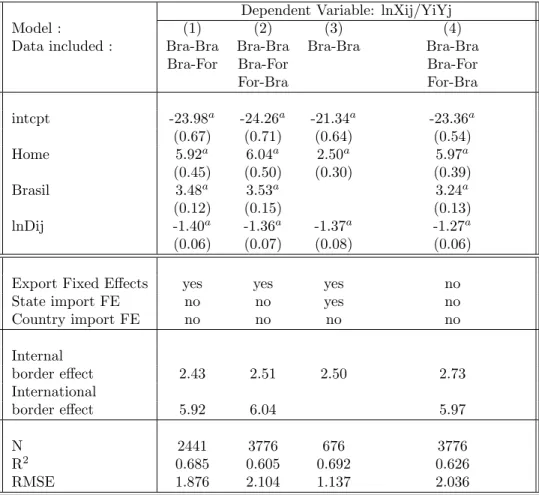
First, we estimate Equation (3) by including in the data set exports from foreign countries to Brazilian states for the years 1999 and 1991. For 1999, the coefficient on the dummyHome is now 6.04 (instead of 5.92) suggesting that the border effects on imports are a bit larger than the border effects on exports. Column (2) of Table 6 reports the results. Column (1) reports our previous results in order to compare. For the year 1991, the coefficient of the international border effect is now 5.84 (instead of 5.75) also suggesting that in 1991 the border effects on imports are greater than the border effects on exports.
The inclusion of these import data in the data set makes the dummyBrasila bilateral variable, equal to one for Brazilian trade (when i and j are Brazilian states) and to zero for international trade. However, we can’t estimate Equation (3) with the importer fixed-effects because there is still a problem of multicollinearity between the variables9.
We next estimate for the year 1999 the internal border effect by using only the inter-state and intra-state trade data. As the dummy Brasil doesn’t appear in this specification any more, we can include exporter and importer fixed-effects. There is no collinearity. The results are reported in column (3) of Table 6. The results are very similar to our previous findings given that the coefficient on the dummyHome is now 2.50.
Finally, we regress for the year 1999 the traditionnal gravity equation without any fixed-effects (see column (4)). The results are again very similar. We can also estimate separately border effects on exports and border effects on imports10. The international
border effect on exports amounts to 370 (exp 5.92) and the international border effect on imports is 490 (exp 6.19).
According to these robustness checks, we think that our empirical results tend to be robust.
We next provide more robustness checks.
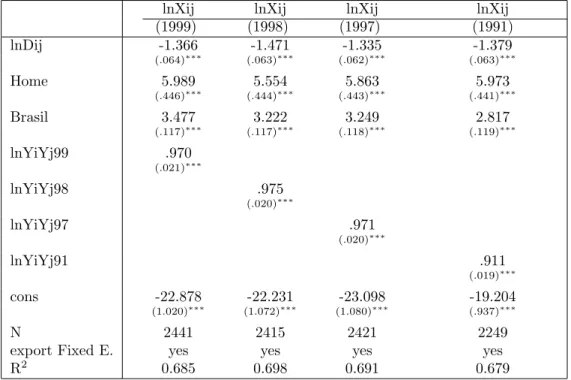
We don’t impose unitary coefficients on the GDP variables any more. We now regress the bilateral trade on the GDP variables. This makes comparison with our theoretically based gravity equation. Results are reported in Table 7. This estimation displays very similar results. The coefficients on GDP are close to one. The internal border effect has fallen from 23 (exp3.15) in 1991 to 12 (exp2.52) in 1999. The international average border effect of Brazilian states remains the same between 1991 and 1999 and amounts to 395.
In our data set, about 50% of exports from Brazilian states to foreign countries are equal to zero. The inclusion of the zeroes remains an open question : it is appropriate 9VIF values (variance inflation factor) are about 500 for the dummyBrasiland about 100 for the
importer fixed-effects
10It is not possible to estimate separately these borders effects if exporter fixed-effects are included
Table 6: Robustness Test for the year 1999 Dependent Variable: lnXij/YiYj
Model : (1) (2) (3) (4)
Data included : Bra-Bra Bra-Bra Bra-Bra Bra-Bra
Bra-For Bra-For Bra-For
For-Bra For-Bra intcpt -23.98a -24.26a -21.34a -23.36a (0.67) (0.71) (0.64) (0.54) Home 5.92a 6.04a 2.50a 5.97a (0.45) (0.50) (0.30) (0.39) Brasil 3.48a 3.53a 3.24a (0.12) (0.15) (0.13) lnDij -1.40a -1.36a -1.37a -1.27a (0.06) (0.07) (0.08) (0.06) Export Fixed Effects yes yes yes no
State import FE no no yes no
Country import FE no no no no Internal border effect 2.43 2.51 2.50 2.73 International border effect 5.92 6.04 5.97 N 2441 3776 676 3776 R2 0.685 0.605 0.692 0.626 RMSE 1.876 2.104 1.137 2.036
Note: Standard errors in parentheses: a,bandcrepresent respectively statistical significance at the 1%, 5% and 10% levels. ”For-Bra” indicates the exports from foreign countries to Brazilian states
Table 7: Estimation on GDP Variables
lnXij lnXij lnXij lnXij
(1999) (1998) (1997) (1991) lnDij -1.366 -1.471 -1.335 -1.379 (.064)∗∗∗ (.063)∗∗∗ (.062)∗∗∗ (.063)∗∗∗ Home 5.989 5.554 5.863 5.973 (.446)∗∗∗ (.444)∗∗∗ (.443)∗∗∗ (.441)∗∗∗ Brasil 3.477 3.222 3.249 2.817 (.117)∗∗∗ (.117)∗∗∗ (.118)∗∗∗ (.119)∗∗∗ lnYiYj99 .970 (.021)∗∗∗ lnYiYj98 .975 (.020)∗∗∗ lnYiYj97 .971 (.020)∗∗∗ lnYiYj91 .911 (.019)∗∗∗ cons -22.878 -22.231 -23.098 -19.204 (1.020)∗∗∗ (1.072)∗∗∗ (1.080)∗∗∗ (.937)∗∗∗ N 2441 2415 2421 2249
export Fixed E. yes yes yes yes
R2 0.685 0.698 0.691 0.679
Note: Standard errors in parentheses: ***, ** and * represent respectively statistical significance at the 1%, 5% and 10% levels.
or not to include the zeroes? If the inclusion of the trade equal to zero is necessary , we have to find an appropriate estimator to estimate a gravity equation by taking account for the bilateral trade equal to zero.
On the one hand, it seems appropriate to include the zeroes since they contain information. On the other hand, the problem of including the zeroes is that a bilateral trade equal to zero can be explained by very different values of the independant variables and can lead to econometric problems and estimation bias. Further research about the utility of including or not the zeroes seems to be necessary.
There are various alternatives to estimate the gravity equation including the zeroes. The first alternative is to regress ln(1+Xij) by using a tobit procedure, therefore fol-lowing Eichengreen and Irwin (1993, 1998). The second alternative that we test in our paper is to use the Poisson Pseudo-Maximum Likelihood (PPML) method. We follow Santos Silva and Teyreyro (2005). According to these authors, heteroskedasticity and misspecification11are severe problems both in the traditional gravity equation and in a gravity equation with fixed effects. The parameters of log-linearized models estimated by ordinary least squares can be highly misleading in the presence of heteroskedasticity.
Not only the PPML method is not heteroskedastic but this method also provides a good alternative to deal with zero values of the dependent variable since this method consists in estimating in levels the bilateral trade Xij.
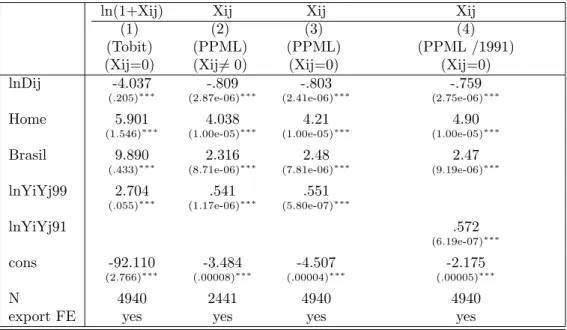
Table 8 reports the following results. Column(1) reports the results from a tobit procedure. Column (2) regresses in levels Xij using the PPML method without the zeroes and column (3) with the zero trade. Column (4) uses the PPML method with the zeroes for 1991. We want to check the magnitude and the evolution of the border effect.
The PPML estimator provides less great border effects. The international border effects of Brazilian States amounts to 135 (exp4.90) in 1991 and to 67 (exp4.21) in 1999. Contrary to our previous results, the international average border effect of Brazilian states decreased over the period 1991-1999. The internal border effect has fallen from 11 (exp2.43) in 1991 to 5.5 (exp1.73) in 1999. The coefficients on the distance variable (equal to -0.8) and on the GDP variables (equal to 0.55) are close to those estimated by Santos Silva and Tenreyro (2005). They find GDP elasticities just above 0.7 and a distance elasticity of 0.78.
The Tobit estimation provides a international average border effect of 365 (exp5.90), the same that we have found in our first results. However, the coefficients on the other variables seem inconsistent. The internal border effect is negativ and amounts to -55. Some econometric issues remain to be solved in the future.
Table 8: Tobit Procedure and PPML Method for the year 1999
ln(1+Xij) Xij Xij Xij
(1) (2) (3) (4)
(Tobit) (PPML) (PPML) (PPML /1991) (Xij=0) (Xij6= 0) (Xij=0) (Xij=0)
lnDij -4.037 -.809 -.803 -.759
(.205)∗∗∗ (2.87e-06)∗∗∗ (2.41e-06)∗∗∗ (2.75e-06)∗∗∗
Home 5.901 4.038 4.21 4.90
(1.546)∗∗∗ (1.00e-05)∗∗∗ (1.00e-05)∗∗∗ (1.00e-05)∗∗∗
Brasil 9.890 2.316 2.48 2.47
(.433)∗∗∗ (8.71e-06)∗∗∗ (7.81e-06)∗∗∗ (9.19e-06)∗∗∗
lnYiYj99 2.704 .541 .551 (.055)∗∗∗ (1.17e-06)∗∗∗ (5.80e-07)∗∗∗ lnYiYj91 .572 (6.19e-07)∗∗∗ cons -92.110 -3.484 -4.507 -2.175 (2.766)∗∗∗ (.00008)∗∗∗ (.00004)∗∗∗ (.00005)∗∗∗ N 4940 2441 4940 4940
export FE yes yes yes yes
Note: Standard errors in parentheses: a,b andc represent respectively statistical significance at the 1%, 5% and 10% levels.
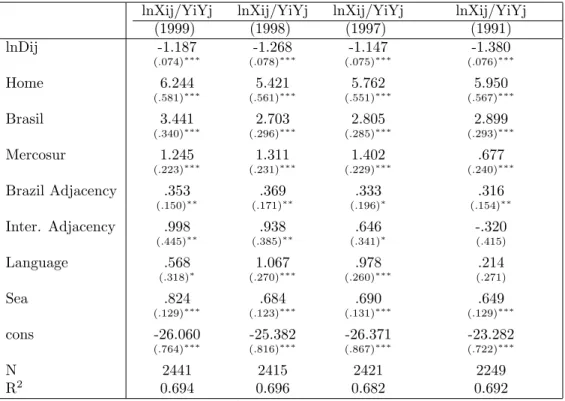
Finally, as a test of robustness, we include five more explanatory variables. Language
is a dummy equal to one when language of country j is Portuguese12. The dummy variableInternational Adjacency is equal to one when a Brazilian state and a foreign country share a common border andBrazil Adjacencyis equal to one when two Brazilian states i and j share a common border. The dummy Mercosur takes on the value of 1 when country j is a Mercosur member.13 The dummySea is equal to one when i and j
are both coastal. Table 9 reports the results for the years 1991, 1997, 1998 and 1999. In all estimations, the explanatory variables are significant and display coefficients with the expected signs. The impact of Mercosur on Brazilian exports has increased since 1991. In 1999, a Brazilian state exports 3.5 more times to a Mercosur member country than to another country, all things being equal. A common border and a common language have significant impact on exports of Brazilian state. A direct access to sea has an impact on exports.
Table 9: Estimation of Border Effects with more Independant Variables lnXij/YiYj lnXij/YiYj lnXij/YiYj lnXij/YiYj
(1999) (1998) (1997) (1991) lnDij -1.187 -1.268 -1.147 -1.380 (.074)∗∗∗ (.078)∗∗∗ (.075)∗∗∗ (.076)∗∗∗ Home 6.244 5.421 5.762 5.950 (.581)∗∗∗ (.561)∗∗∗ (.551)∗∗∗ (.567)∗∗∗ Brasil 3.441 2.703 2.805 2.899 (.340)∗∗∗ (.296)∗∗∗ (.285)∗∗∗ (.293)∗∗∗ Mercosur 1.245 1.311 1.402 .677 (.223)∗∗∗ (.231)∗∗∗ (.229)∗∗∗ (.240)∗∗∗ Brazil Adjacency .353 .369 .333 .316 (.150)∗∗ (.171)∗∗ (.196)∗ (.154)∗∗ Inter. Adjacency .998 .938 .646 -.320 (.445)∗∗ (.385)∗∗ (.341)∗ (.415) Language .568 1.067 .978 .214 (.318)∗ (.270)∗∗∗ (.260)∗∗∗ (.271) Sea .824 .684 .690 .649 (.129)∗∗∗ (.123)∗∗∗ (.131)∗∗∗ (.129)∗∗∗ cons -26.060 -25.382 -26.371 -23.282 (.764)∗∗∗ (.816)∗∗∗ (.867)∗∗∗ (.722)∗∗∗ N 2441 2415 2421 2249 R2 0.694 0.696 0.682 0.692
Note: Standard errors in parentheses: a,b andc represent respectively statistical significance at the 1%, 5% and 10% levels.
12The countries are Portugal, Angola, Mozambique, Cap Verde, Guinea-Bissau, West Timor and Sao
Tome and Principe)
13Mercosur (Southern Common Market) is a trading zone between Brazil, Argentina, Uruguay and
Conclusion
This paper underlines the imperfect integration of the Brazilian domestic market and the limited integration of Brazilian states into global markets for goods and services.
The current literature considers a range of explanations for the observed border effects: the formal and informal trade barriers (such as tariffs), the cultural and institu-tionnal heterogeneity between countries, the use of separate national currencies, home bias in consumer preferences and the national structure of economies. More specific factors may operate on the Brazilian subnational level.
For policy analysis, it is important to discover the reasons for border effects in Brazil. We have to determine whether these border effects are the result of barriers to be removed or whether they represent rational factors such as the local preferences or the national structure of economies. The policy-makers in Brazil will be able to respond to the problem of domestic fragmentation only if these internal border effects represent policy-driven trade barriers. Explaining the border effects in Brazil is an important question for future research.
References
[1] ANDERSON J.A, VAN WINCOOP E. (2001), ”Gravity with Gravitas : a Solution to the Border Puzzle”,NBER Working Paper n◦8079
[2] ANDERSON J.A, VAN WINCOOP E. (2004), ”Trade Costs”, Working Paper, in preparation for the Journal of Economic Literature. Second draft.
[3] CHEN N. (2004), ”Intra-national versus international trade in the European Union : Why do national borders matter?”, Journal of International Economics 63(1)
[4] COMBES P.P, LAFOURCADE M., MAYER T. (2003), ”Can Business and Social Networks Explain the Border Effect Puzzle ?”,CEPII Working Paper N◦2003-02 [5] COTEPE/ CONFAZ (2000), ”Balan¸ca Comercial Interestadual de 1997”, Comissao
Tecnica Permanente do ICMS do Confaz
[6] DJANKOV, FREUND (2000), ”Disintegration and Trade Flows : Evidence from the former Soviet Union”, World Bank working paper, 2378
[7] EICHENGREEN, B., IRWIN, D.A., (1993) ”Trade blocs, currency blocs and the disintegration of world trade in the 1930s” Centre for Economic Policy Research Discussion Paper 837
[8] EICHENGREEN, B., IRWIN, D.A., (1998) ”The role of history in bilateral trade flows” In: Frankel, J.A. (Ed.), The Regionalization of the World Economy. The University of Chicago Press, pp. 3357.
[9] FEENSTRA R. (2002) ”Border Effect and the Gravity Equation : consistent meth-ods for estimation”,Scottish Journal of Political Economy, vol 49, n◦5
[10] HEAD K., MAYER T., (2002), ”Illusory Border Effect : how internal geography affects external trade volume”,CEPII Working Paper 2002-1
[11] HEAD K., MAYER T. (2000), ”Non-Europe : The Magnitude and Causes of Market Fragmentation in the EU”, Weltwirtschaftliches Archiv, 136 (2)
[12] HEAD, K. and RIES J. (2001), ”Increasing returns versus national product dif-ferentiation as an explanation for the pattern of USCanada trade”, American Economic Association, vol. 91(4), pages 858-876.
[13] HELLIWEL J.F (1997b), ”Do National Borders Matter for Quebec’s Trade ?”,
Canadian Journal of Economics, 29 (3)
[14] HELLIWEL J.F (1997a),”National Borders, Trade and Migration” Pacific Eco-nomic Review 2 (3), 165-185.
[15] McCALLUM J. (1995), ”National Borders Matter : Canada-US Regional Trade Patterns”, American Economic Review, 70
[16] NITSCH V. (2002), ”Border Effects and Border Regions : Lessons from the German Unification”, HWWA Discussion Paper 203
[17] PONCET S. (2003), ”Int´egration ou Fragmentation interne de l’´economie chinoise”, Th`ese de Doctorat en Sciences Economiques
[18] RIVERA-BATIZ L.A, ROMER P.M (1991), ”Economic Integration and Endoge-nous Growth”,Quaterly Journal of Economics, 106(2)
[19] SANTOS SILVA, TENREYRO (2005), ”The Log of Gravity”, working paper [20] SEFAZPE (1993), ”Operacoes Interestaduais Tributadas pelo ICMS no Brazil
-1991”, Recife : Secretaria da Fazenda de Pernambuco
[21] SENNE PAZ L. (2003), ”Brazilian International and Inter-State Trade flows : an explanatory Analysis using the Gravity Model”, PHD Dissertation
[22] SPOLAORE E., WACZIARG R. (2002), ”Borders and Growth”,NBER Working Paper 9223
[23] THERY H. (2000), ”Le Br´esil”, Armand Colin, collection U, Paris
[24] WEI S.J (1996), ”Intra-National Versus International Trade: How Stubborn Are Nations in Global Integration”,NBER Working Paper, n◦5531
[25] VASCONSELOS J. (2001a), ”Matriz do Fluxo de comercio Interestadual de bens e servi¸cos no Brasil - 1998”. Document de travail 783. IPEA
[26] VASCONSELOS J. (2001b), ”Matriz do Fluxo de comercio Interestadual de bens e servi¸cos no Brasil - 1999”. Document de travail 817. IPEA
[27] WOLF H.C (1997), ”Intranational Home Bias in Trade”,The Review of Economics and Statistics, 82 (4)
Appendix: The Measurement of Intrastate trade
and Distances
Intrastate trade
Intrastate trade Xii is the difference between the total output of the state and its total exports to the rest of Brazil and to the rest of the world. The total output of a state i corresponds to the sum of outputs of the following sectors : agriculture, mining, industry and tradable services (transport, construction, communications, Financial services and Business services).
International and Domestic Distances
We need measures of distances between i and j (Dij) and distance within
a Brazilian state (Dii). We follow Head and Mayer (2001). The idea is to take
account for the spatial distribution of population inside each country. They calculate distance between two countries based on bilateral distances between the biggest cities of those trade partners. The bilateral distances between cities are weighted by the share of the city in the overall country’s population and are calculated by the ”great circle distance” formula. We take the 25 more populated cities by country and by Brazilian state (we use data of the World Gazetteer web site). For five Brazilian states and a few countries, we are obliged to take fewer cities (between three and five).
This method permits the calculation of both intra and international distances using the same methodology.
Dij = Σkiwk(Σljwldθkl)
1/θ
(4)
wk =popk /popi is the share of the cityk in the overall country’s population
θ measures the sensitivity of trade flows to bilateral distance. θ is set equal to 1. It could also be set to -1 since the elasticity of trade flows to bilateral distance is close to -1 according to the estimation from gravity equation.