TRANS Asian Research Journals
http://www.tarj.in 14
P u b l i s h e d b y : T R A N S A s i a n R e s e a r c h J o u r n a l s
TAJMMR:
T R A N S
A s i a n J o u r n a l o f
M a r k e t i n g & M a n a g e m e n t
R e s e a r c h
( A D o u b l e B l i n d R e f e r r e d & R e v i e we d I n t e r n a t i o n a l J o u r n a l )
JOB ATTITUDE AND QUALITY OF WORK LIFE AS A PREDICTOR OF
ORGANIZATIONAL COMMITMENT: A STUDY OF MANAGERS
Amjad Ali*; Abu Sufiyan Zilli**
*Post Doctoral Research Associate, Department of Humanities and Social Science,
National Institute of Technology, Rourkela, Odisha, India. **Professor & Chairman, Department of Psychology, Aligarh Muslim University,
Aligarh, UP, India.
ABSTRACT
TRANS Asian Research Journals
http://www.tarj.in 15
their level of Organizational Commitment could be enhanced. Results are explained in the light of present scenario in existing private and public undertakings.
KEYWORDS: Job Attitude, Managers, Organizational Commitment, Quality of
Work Life.
________________________________________________________________________
INTRODUCTION
The present research is an attempt towards making Indian Organizations more effective and helping managers in actualizing their full potential. Managers are the most important assets of the organization as they have to interact with their subordinates, colleagues, top managements, customers and people at large. So, their major portion of time is utilized in working with different kinds of people. Therefore, it can be expected that characteristics of Quality of Work Life and Job Attitudes have influential roles in determining their Commitment towards the work and the organization as a whole.
Attitudes are propensities or tendencies to react in a favorable or unfavorable way toward an object. The object could be almost anything in the world around us. Attitudes reflect a person’s likes and dislikes toward other persons, objects, events and activities in their environment. Therefore, it makes sense to study and know about attitude because strong attitudes will very likely affect a person’s behaviour such as attitudes toward supervision, pay, benefits, promotion or anything that might trigger positive or negative reactions. Thus, employee’s satisfaction and attitudes represents one of the key areas for measuring organizational effectiveness.
Job Attitudes can be defined as summary evaluations of psychological objects in the work domain. There are at least three broad categories of Job Attitudes, which have been frequently studied by researchers: task-based attitudes, people-based attitudes, and organization-based attitudes. Tett and Burnett (2003) have suggested that employees interact with three levels of their work environments on a daily basis such as the task level, the social level, and the organizational level.
The term Quality of Work Life appeared only after Davis (1972) presented a paper in a conference at Arden House, US. Thereafter, the phenomenon of Quality of Work Life attracted the attention of psychologists, managers and supervisors for undertaking it as a philosophy or as an approach in designing the strategy for enhancing employees’ well-being, attachment and involvement with the organization.
TRANS Asian Research Journals
http://www.tarj.in 16
environment within the organization, administrative system and relationship between life on and off the job (Cunningham et al., 1990).
In fact, Quality of Work Life refers to “overall quality of human experiences in the workplace”, or in other words, it can be said that Quality of Work Life is the degree of excellence in work and working conditions which contribute to overall satisfaction of individual, thereby, enhancing the organizational effectiveness.
The present study defines QWL as good compensation, favourable conditions and environment, fair capacities of authority, rewarding potential growth and supportive organizational climate. Excellent work environment is seen as nurture to employee’s affective commitment.
The concept of Organizational Commitment has grown in popularity in the literature on industrial and organizational psychology (Cohen, 2003). Employees’ Organizational Commitment refers to the physical as well as behavioural involvement and attachment with the work and organization. According to Kanter (1968) Organizational Commitment can be defined as the willingness of workers to devote energy and loyalty to an organization. Kim et al. (1993) enumerated that Organizational Commitment is the employees’ loyalty to the employer. Venkatachalam (1997) viewed Organizational Commitment as "talking on the organizational identity". In general, Organizational Commitment is considered as a useful measure of organizational effectiveness (Steers, 1975). In particular, “Organizational Commitment is a “multidimensional construct” (Morrow, 1993) that has the potential to predict organizational outcomes such as performance, turnover, absenteeism, tenure, and organizational goals” (Meyer & Allen, 1997).
Meyer and Allen (1997) developed a framework of commitment on the basis of three components such as affective, continuance and Normative Commitment.
1. Affective Commitment refers to emotional attachment, identification with and
involvement of an employee in the organization; i.e. an employee intrinsically desires to continue in the organization.
2. Continuance commitment, which relates to the cost the employee associates with leaving
the organization i.e. the employee thinks that it is his or her need to continue working in the organization, and
3. Normative Commitment reflects a feeling of obligation to give back to the organization
and an employee high on Normative Commitment would continue because he or she ought to do so.
TRANS Asian Research Journals
http://www.tarj.in 17
REVIEW OF LITERATURE
A number of studies have been conducted in recent past in the area concern. According to Maume (2006) “Organizational Commitment is typically measured by items tapping respondents’ willingness to work hard to improve their companies, the fit between the firm’s and the worker’s values, reluctance to leave and loyalty toward pride taken in working for their employers”, provide a better picture of Organizational Commitment in work settings.
Based on a literature review of Job Attitude research, Herzberg, Mausner and Snyderman (1959) developed a model of job satisfaction, which assumed that job satisfaction and dissatisfaction are not on opposite ends of a continuum, but are separate attitudes. Steers & Porter (1983), Walton (1985) and Miller & Monge (1986) confirm that proponents of job enrichment and quality-of-work-life intervention have cited specific improvements in Job Attitudes, specifically job satisfaction and Organizational Commitment.
Job related attitudes play a major role in shaping the work behaviours of managers in organizations. Lynn et al. (1990) have developed a theoretical model to describe the differential relationship that organizational attitudes such as Organizational Commitment and satisfaction and Job Attitudes like Job involvement and satisfaction have with several behaviour intentions (turnover, absenteeism and performance).
Parker & Bradley (2000) found that the public-private distinction brings important differences not only in organizational structure, diversity of goals and resources but in Job Attitudes and behavioural intentions as well. Sahinidis and Bouris (2008) found the significance correlation between employees’ Organizational Commitment, job satisfaction, motivation and their perceived training effectiveness which in turns will improves training outcomes.
An effective Quality of Work Life (QWL) is basically a tool to improve working conditions (an employee’s perspective) and greater organizational efficiency (mainly from an employer’s perspective). Positive results of QWL have been supported by a number of previous studies, among which is reduced in absenteeism, lower turnover, and improved job satisfaction (Havlovic, 1991; Cohen et al., 1997;). QWL does not only contribute to an organization’s ability to recruit quality human capital, nevertheless it also enhances –the organization’s competitiveness. Schurman (1998) reviewed employee satisfaction as always an important management goal in job design and human resource policies.
TRANS Asian Research Journals
http://www.tarj.in 18
Hartenstein and Huddleston (1984) enumerated that for Quality of Work Life measures to be successful, management and labour must have shared values, without such values, managers are often authoritarian and deny workers sense of involvement, responsibility and autonomy, resulting in the workers lack of commitment and low productivity. On the other hand Venkatachalam et. al (1997) found significant positive relationship between Quality of Work Life and Organizational Commitment.
Researches in recent past have mainly focused on controllable external factors influencing Organizational Commitment such as modification of HRM policies and practices (Paul & Anantharaman, 2004), increasing socialization (Mathieu & Zajac, 1990), improving compensation (Mowday et al., 1982; O’Reilly & Chatman, 1986), leadership and interpersonal dynamics (Tu, Raghunathan, & Raghunathan, 2001), and hygiene factors (Balaji, 1985; Khokle, 1998). Very few dispositional characteristics have been tested for their influence on an individual’s Organizational Commitment.
In an interesting study Porter et al. (1974) suggested that job satisfaction is changed more readily than Organizational Commitment, and therefore concluded that job satisfaction is also likely to be affected by a successful Quality of Work Life effort.
In one of the significant study Allen and Meyer (1990) tested the aspect of three component (affective, continuance and normative) model of Organizational Commitment that integrates various conceptualizations (affective attachment, perceived cost and obligation). The results revealed that the affective and continuance components of Organizational Commitment are empirically distinguishable constructs with different correlates. The affective and normative components, although distinguishable, appear to be somewhat related. Thus the quality of the workplace is a vital factor in promoting Organizational Commitment. In contrast, good leadership and management may not guarantee committed employees. Samad (2007) found that Committed and satisfied employees are normally high performers and contribute towards organizational productivity.
OBJECTIVES OF THE STUDY
Keeping in view the paramount importance of Job Attitude, Quality of Work Life and Organizational Commitment, the present study is aimed as follows:
To see the prediction level of Job Attitude and Quality of Work Life on Organizational Commitment among Managers of Private Undertakings,
To see the prediction level of Job Attitude and Quality of Work Life on Organizational Commitment among Managers of Public Undertakings, and
TRANS Asian Research Journals
http://www.tarj.in 19
HYPOTHESES OF THE STUDY
In the light of available literature related to the present study, following hypotheses have been formulated:
H-1: Job Attitude and Quality of Work Life will positively predict Organizational Commitment among Managers of Private Undertakings,
H-2: Job Attitude and Quality of Work Life will positively predict Organizational Commitment among Managers of Public Undertakings, and
H-3: Managerial personnel of private and public undertakings will differ with each other on Job Attitude Quality of Work Life and on Organizational Commitment dimensions.
METHODOLOGY
PARTICIPANTS
The sample of present research consists of a total of (N=300) Managers, 150 each from private and public undertakings. All the respondents were randomly selected from different parts of Delhi and its NCR (National Capital Region). The age of the sample ranges from 30 to 55 years. The data was collected from following private and public undertakings, Reliance, Airtel, Idea, Kingfisher, Britannia, Ultratech, Hero Honda, DLF, TMT, Maruti Suzuki, CMS, UTI Mutual Fund, Barclays Bank, Ottogon, Religare and MTNL, BSNL, NDPL, BHEL, GAIL, BRT, DDA, LIC, SBI, Allahabad Bank and IDBI Bank etc. The methodology of the study was planned systematically keeping in view its lofty objectives.
INSTRUMENTS
JOB ATTITUDE SCALE: The Job Attitude scale was developed by Srivastava (1999). This
scale comprises 15 true-keyed items. The 14 items of this scale was rated on four-point rating scale i.e., absolutely true, Almost true, partially true, and False where as the final item i.e. 15 item of this scale was rated on 5-point scale i.e. Always, Quite often, Sometimes, Seldom, and Never. The reliability of this scale was found to be r=.79.
QUALITY OF WORK LIFE SCALE: This scale was developed by Shawkat and Ansari
(2001) which assesses numerous dimensions of Quality of Work Life. This scale contains 48 items and rated on 5 point likert type rating scale ranging from strongly disagree to strongly agree with the score 48-240. The reliability and validity of the scale was found to be r=.70 and r=.89 respectively.
ORGANIZATIONAL COMMITMENT SCALE: The Organizational Commitment scale was
TRANS Asian Research Journals
http://www.tarj.in 20
The analysis of the data was done by using stepwise multiple regression analysis and t-test respectively.
RESULTS AND DISCUSSION
RESULTS OBTAINED BY REGRESSION ANALYSIS
Table 1.1a and 1.1b: Job Attitude and Quality of Work Life as a predictor of Overall Organizational Commitment among Managers of Private Undertakings.
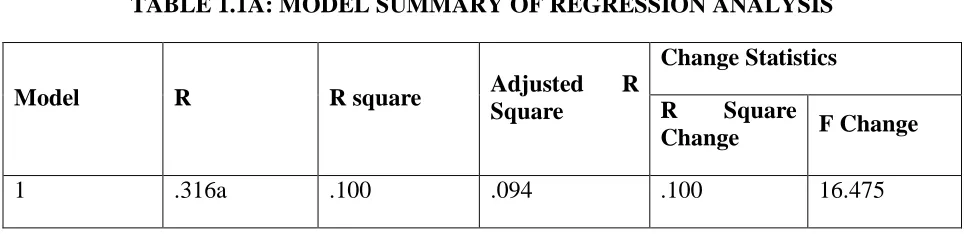
TABLE 1.1A: MODEL SUMMARY OF REGRESSION ANALYSIS
Model R R square Adjusted R
Square
Change Statistics
R Square
Change F Change
1 .316a .100 .094 .100 16.475
Predictor (constant): Quality of Work Life.
Table 1.1a shows the model summary indicating only one predictor of the model. Multiple correlation (R) was found to be .316 for Quality of Work Life. Further R square which represents the contribution of predictor variables to the criterion variable was found to be .100. Another considerable aspect is R square change, which is the actual contribution of predictor variables to the criterion variable which was found to be .100. It means that Quality of Work Life contributed 10.0% to the dependent variable (Overall Organizational Commitment).
TABLE 1.1B: COEFFICIENT
Model
Unstandardized Coefficient
Standardized Coefficient
t Sig.
Correlation
B Std.
Error Beta partial
1 (Constant) 53.394 4.214 12.671 .000
Quality of
Work Life .100 .025 .316 4.059 .000 .316
TRANS Asian Research Journals
http://www.tarj.in 21
Table 1.1b depicts that only Quality of Work Life influences overall Organizational Commitment of managers of private undertakings. The statistical value given in the table indicates t=4.059 for Quality of Work Life which was significant beyond .01 level. The correlation (partial) was found to be r=.316 for Quality of Work Life which shows that there is positive correlation between Quality of Work Life and Overall Organizational Commitment. Since, t-value of Quality of Work Life was found significant which means that Quality of Work Life positively influence the level of Overall Organizational Commitment among Managers of Private Undertakings. Thus, it partially proves the first hypotheses (H-1) of the present research that “Job Attitude and Quality of Work Life will positively predict Organizational Commitment among Managers of Private Undertakings”.
Table 1.2a and 1.2b: Job Attitude and Quality of Work Life as a predictor of Overall Organizational Commitment among Managers of Public Undertakings.
TABLE 1.2A: MODEL SUMMARY OF REGRESSION ANALYSIS
Model R R square Adjusted R
Square
Change Statistics
R Square Change
F Change
1 .330a .109 .103 .109 18.076
a. Predictor : (constant), Quality of Work Life.
Table 1.2a shows the model summary indicating only one predictor of the model. Multiple correlation (R) was found to be .330 for Quality of Work Life. Further R square which represents the contribution of predictor variables to the criterion variable was found to be .109. Another considerable aspect is R square change, which is the actual contribution of predictor variables to the criterion variable which was found to be .109. It means that Quality of Work Life contributed 10.9% to the dependent variable (Overall Organizational Commitment).
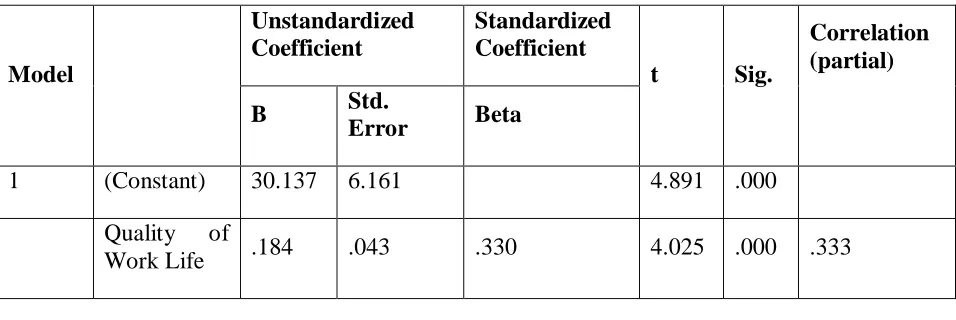
TABLE 1.2B: COEFFICIENT
Model
Unstandardized Coefficient
Standardized Coefficient
t Sig.
Correlation (partial)
B Std.
Error Beta
1 (Constant) 30.137 6.161 4.891 .000
Quality of
TRANS Asian Research Journals
http://www.tarj.in 22
Criterion variable: Overall Organizational Commitment.
Table 1.2b clearly depicts that only Quality of Work Life influences Overall Organizational Commitment of Managers of Public Undertakings. The statistical value given in the table indicates t=4.025 for Quality of Work Life which was significant beyond .01 level. The correlation (partial) was found to be r=.333 for Quality of Work Life which shows that there is positive correlation between Quality of Work Life and Overall Organizational Commitment. Since, t-value of Quality of Work Life was found significant it can be said that Quality of Work Life positively influence the level of Overall Organizational Commitment among Managers of Public Undertakings. Thus, it partially proves the second hypotheses (H-2) of the present research that “Job Attitude and Quality of Work Life will positively predict Organizational Commitment among Managers of Public Undertakings”.
RESULTS OBTAINED BY T-TEST
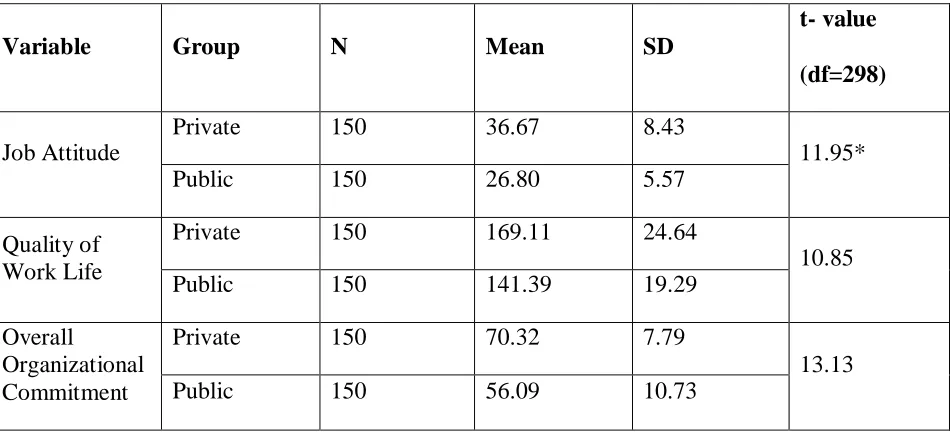
Table 1.3 : Means, SDs and t-values of managers of private and public undertakings on Quality of Work Life, Ego-Strength and Organizational Commitment.
Variable Group N Mean SD
t- value
(df=298)
Job Attitude
Private 150 36.67 8.43
11.95*
Public 150 26.80 5.57
Quality of Work Life
Private 150 169.11 24.64
10.85
Public 150 141.39 19.29
Overall
Organizational Commitment
Private 150 70.32 7.79
13.13
Public 150 56.09 10.73
*Significant at 0.01 level.
TRANS Asian Research Journals
http://www.tarj.in 23
Furthermore, the mean and SD in the case of managers of private undertakings on Overall Organizational Commitment dimension were found to be 70.32 and 7.79 while in the case of managers of public undertakings the mean and SD were found to be 56.09 and 10.73 respectively the t-value between the two means was found to be 13.13 which was significant at 0.01 level. Thus, it proves the last hypothesis i.e., (H-3) of the present study that “Managerial Personnel of private and public undertakings will differ with each other on Job Attitude, Quality of Work Life and on Organizational Commitment dimensions”.
CONCLUSIONS AND SUGGESTIONS
In the present research, many new areas along with the old had been explored. So, in the present investigation the researcher will discuss the results in the light of previous empirical findings and in the case of relational and comparative results hardly any guidelines has been followed just because of the absence of empirical evidences in this regards.
Job related attitudes play a major role in shaping the work behaviours of Managers in organizations. Lynn et al. (1990) have developed a theoretical model to describe the differential relationship between organizational attitudes such as Organizational Commitment and satisfaction and Job Attitudes like Job involvement and satisfaction. Earlier study conducted by Parker & Bradley (2000) viewed that the Public-Private distinction brings important differences not only in organizational structure, diversity of goals and resources but also in Job Attitudes and behavioural intentions as well.
Quality of Work Life is a multidimensional construct usually referring to overall satisfaction with work life and with work/life balance, a sense of belonging to a working group, a sense of becoming oneself, and a sense of being worthy and respectable. Research conducted by Finegold et al. (2002) revealed that construct of Quality of Work Life has positive impact on employee commitment. Donaldson, et al. (1999) also revealed that Quality of Work Life factors significantly predicted Organizational Commitment, absenteeism, and tardiness and suggested to consider the value of improving the system of work in which employees are embedded as part of comprehensive work. Robert (1998) explained that Quality of Work Life plays a pivotal role in enhancing the commitment of employees which leads to organizational development.
On the other hand Rhinehard et al. (1969) and Johnson and Marcrum (1968) simultaneously revealed that increased dissatisfaction was found among Managers of Public Undertakings as compared to the Managers of Private Undertakings. In the same manner Dhillon and Dandona (1988) found significant difference between Managers of Private and Public banks on Quality of Work Life dimensions.
TRANS Asian Research Journals
http://www.tarj.in 24
Finally, it can be concluded that in the present scenario different types of industrial set ups are growing up rapidly, which have different structures, organizational culture and climate providing different types of services. In such a scenario managers and workforce working in these industries differ from each other in a host of ways. Hence, they should be studied and compared separately on different variables taking greater sample size of the study.
REFERENCES
Allen, N.J. and Meyer, J.P., 1990. The Measurement and Antecedents of Affective, Continuance, and Normative Commitment to the Organization. Journal of Occupational Psychology 63, 1-18.
Balaji, C., 1985. Organizational commitment and human resource management: A study of managers in cooperatives. Unpublished Doctoral Dissertation, Indian Institute of Management Ahmedabad, Ahmedabad.
Boyne, G.A., 2002. Public and Private Management: What is the difference. Journal of Management Studies, 39(1), 98-122.
Cohen, A., 1997. On the discriminant validity of the Meyer and Allen measure of organizational commitment: How does it fit with the work commitment construct? Educational and Psychological Measurement, 56, 494-503.
Cohen, A., 2003. Multiple commitments in the workplace: An integrative approach. Mahwah, NJ: Erlbaum.
Costello, J.M. and Sang, I.M., 1974. Need fulfillment and job satisfaction of professionals. Public Personnel Management, 3(5), 454-461.
Cunningham J.B. and T. Eberle., 1990. A guide to job enrichment and redesign. Personnel, 67, 56-61.
Davis, L.E., 1972. Paper presented at International conference. Arden House, Hariman New York, September, 25-29.
Dhillon, P.K. and Dondona, N., 1988. Quality of work life and job involvement – a comparative study of managers of public and private Banks. Paper presented at 25th Annual conference of Indian Academy of Applied Psychology, Hyderabad.
Donaldson, S.I., Sussman, S., Dent, C.W., Sevesson, H.H. and Stoddard, J.L., 1999. Health behavior, quality of work life and organizational effectiveness in the lumber industry. Health Education Behaviour, 26(4), 579-591.
TRANS Asian Research Journals
http://www.tarj.in 25
Hartenstein, A. and Huddleston, K.F., 1984. Values: The cornerstone of QWL. Human Relations, 38(10), 65-66.
Havlovic, S.J., 1991. Quality of work life and human resource outcomes. Industrial Relations, 30 (3), 469-79.
Herzberg, F., Mausner, B. and Snyderman, B.B., 1959.The Motivation to Work, Wiley, New York, NY.
Johnson, P. and Marcrum, R.H., 1968. Perceived deficiencies in individual need fulfillment career army officers. Journal of Applied Psychology, 52, 457-461.
Kanter, R.M., 1968. Commitment and social organization: A study of commitment mechanism in Utopian countries. American Sociological Review, 33, 499-517.
Khokle, P.W., 1998. Factors influencing commitment of key individuals towards and organizational transformation. Unpublished Doctoral Dissertation, Indian Institute of Management Ahmedabad, Ahmedabad.
Kim, M. and Hunter. J., 1993. Attitude-behavior relations: A meta-analysis of attitudinal relevance and topic. Journal of Communication, 43, 101–142.
Lynn, M., Lucy, N.A. and George, T.C., 1990. Job and organisational attitudes in relation to employee behavioural intentions. Journal of Organisational Behaviour. 11(1), 57-67.
Mathieu, J.E. and Zajac, D.M., 1990. A review and meta-analysis of the antecedents, correlates, and consequences of organizational commitment. Psychological Bulletin, 108, 171-194.
Maume, D.J., 2006. Gender differences in taking vacation time. Work and Occupations, 33(2), 161-190.
Meyer, J. and Allen, N., 1997. Commitment in the workplace. Thousand Oaks, CA: SAGE Publications.
Miller, K.I. and Monge, P.R., 1986. Participation, satisfaction and productivity: A metaanalytic review. The academy of Management Journal, 29(4), 727-753.
Morrow, P.C., 1993. Introduction: Understanding and managing loyalty is a multi-commitment world. Journal of Business Research, 26, 1-2.
TRANS Asian Research Journals
http://www.tarj.in 26
O'Reilly, C.A.I. and Chatman, J., 1986. Organizational commitment and psychological attachment: The effects of compliance, identification, and internalization on pro-social behavior. Journal of Applied Psychology, 71, 492-499.
Parker, C and Bradley, L., 2000. Organisational Culture in the Public Sector: Evidence from six organisations. The International Journal of Public Sector Management, 13 (2), 125-141.
Paul, A.K. and Anantharaman, R.N., 2004. Influence of HRM practices on organizational commitment: A study among software professionals in India. Human Resource Development Quarterly, 15, 77-88.
Porter, L.W., Steers, R.M., Mowday, R.T. and Boulian, P., 1974. Organizational commitment, job satisfaction and turnover among psychiatric technicians. Journal of Applied Psychology, 59, 603-609.
Rhinehard, B. and Dewolf., 1969. Comparative study of need satisfaction in government and business hierarchies. Journal of Applied Psychology, 53, 530-535.
Robert, K.T., 1998. Job involvement and organisational commitment as longitudinal predictors of job performance: A study of scientists and engineers. Journal of Applied Psychology, 82(4) 539-545.
Sahinidis, A.G., and Bouris, J., 2008. Employee perceived training effectiveness relationship to employee attitudes. Journal of European Industrial Training, 32(1) 63-76.
Samad, S., 2007. Assessing the Effects of Job Satisfaction and Psychological Contract on
Organizational Commitment among Employees in Malaysian SMEs. The 4th SMEs IN A Global
Economy Conference.
Schurman., 1998. A longitudinal study of quality of work life and business performance, South Dekota Business Review, 58(2), 556-568.
Shawkat, S. and Ansari, S.A., 2001. Organizational Commitment scale. Unpublished Ph. D thesis, A.M.U., Aligarh.
Srivastava, A.K., 1974. Job Attitude Scale, Varanasi: Rupa Publications.
Steers, R.M., 1975. Effects of Need Achievement on the Job Performance- Job Attitude Relationship. Journal of Applied Psychology, 60, 678-682.
Steers, R.M., and Porter, L.W., 1983. Motivation and Work Behavior. New York: McGraw-Hill.
TRANS Asian Research Journals
http://www.tarj.in 27
Tett, R.P. and Burnett, D.D., 2003. A personality trait-based interationist model of job performance. Journal of Applied Psychology, 88, 500–517.
Tu, Q., Raghunathan, B. and Raghunathan, T.S., 2001. A path analytic study of the antecedents of organizational commitment of IS managers. Information Resource Management Journal, 14, 27-36.
Venkatachalam, J. and Velayudham, A., 1997. Quality of work life: A review of literature. South Asian Journal of Management, 4(1), 45-57.