© 2015, IRJET.NET- All Rights Reserved
Page 235
Experimental Study on Compressive Strength of Concrete
by Using Metakaolin
Yogesh R. Suryawanshi1
1, Amar G. Kadam2
2, Sagar S. Ghogare
3, Ramrao G. Ingale
4,
Priyanka L.
Patil
51
Associate Professor, Department of Civil Engineering, JSPM’s ICOER, Pune, Maharashtra, India.
2Research
Scholars, Department of Civil Engineering, JSPM’s ICOER, Pune, Maharashtra, India.
3Research Scholars,
Department of Civil Engineering, JSPM’s ICOER, Pune, Maharashtra, India.
4Research Scholars, Department of Civil
Engineering, JSPM’s ICOER, Pune, Maharashtra, India.
5Research Scholars, Department of Civil Engineering, JSPM’s
ICOER, Pune, Maharashtra, India
---***---
Abstract -
Now-a-days enormous development occurred in the field of concrete technology. Many engineers, scientists and researcher have been developed several techniques to improve strength parameter of the concrete. A number of studies have been carried out to investigate the possibility of utilizing a broad range of materials as partial replacement material for cement in the production of concrete. The use of supplementary cementitious material in production of concrete can result in major saving of energy and cost. It also helps to improve strength, durability, impermeability and chemical resistance of concrete.The present study investigates the effects of Metakaolin & Super plasticizer on strength properties of M-35 grade concrete. The experimental program is designed to find the compressive strength of concrete by partially replacing the cement in concrete production. The replacement levels of cement by metakaolin are selected as 4%, 8%, 12%, 16% and 20% for constant water-cementitious material ratio of 0.43. For all mixes compressive strength is determined at 3, 7, 28 days for 150 X 150 X 150 mm size cubes. Current experimental study shows that 12% replacement of cement by metakaolin gives higher strength.
Key Words:
Concrete, supplementary cementitiousmaterial, metakaolin, super plasticizer, compressive strength.
1. INTRODUCTION
The production of Portland cement is not only costly and energy intensive, but it also produces large amount of
carbon emission. The production of one to of Portland cement produces approximately one ton of CO2 in the atmosphere. Limestone is a raw material available in nature; it is primary need for production of cement material. Earlier it was used directly to form silica flume mortar as a binding material in construction.
Supplementary cementitious materials are often used to reduce cement contents and improve the workability of fresh concrete, increase strength and enhance durability of hardened concrete. SCMs used in the manufactured concrete products industry as well as a review of blended cements. There are various types of supplementary cementitious material as fly ash, silica fume, slag cement, metakaolin, rice husk ash, coconut shell etc. Out of above Supplementary Cementitious Materials (SCMs) we use Metakaolin as partial replacement of cement and experimental investigation is carried out.
© 2015, IRJET.NET- All Rights Reserved
Page 236
2. EXPERIMENTAL PROGRAM AND RESULTS
DISCUSSION
2.1 Experimental Program
A. Materials Used:
The following materials were used for experiment confirming to various standards.
1. Cement:
Ordinary portland cement of 53 grade (Coromandal King) available in the local market is used in the investigation. The cement used has been tested for various properties as per IS 4031-1988 and found to be conforming to various specifications of IS 12269-1987. The specific gravity is 3.09 and fineness is 2600 cm2/gram.
2. Fine aggregate:
Locally available crushed sand was used as fine aggregate which confirms to zone II of IS 383-1983. Coarser sand were preferred, as finer sand increases the water demand of concrete and very fine sand may not be essential in metakaolin concrete as it usually has larger content of fine particles in the form of cement and mineral admixtures such as metakaolin etc. The specific gravity of fine aggregate is 2.69 and fineness modulus is 3.23
3. Coarse aggregate:
Crushed angular granite metal from a local source was used as coarse aggregate having size ranging from 10mm to 20mm. The specific gravity of coarse aggregate is 2.68, fineness modulus is 7.2 and water absorption is 0.7%. 4. Metakaolin:
Commercially available Metakaolin from Jeetmull Jaichandlall (Madras) Pvt. Ltd. Chennai, having the properties as shown in Table 1 is used.
TABLE 1:PHYSICAL AND CHEMICAL PROPERTIES OF METAKAOLIN
Bulk Density 167 kg/m3
5. Water:
The water used for the study was free of acids, organic matter, suspended solids, alkalis and impurities which when present may have adverse effect on the strength of concrete.
6. Super plasticizer:
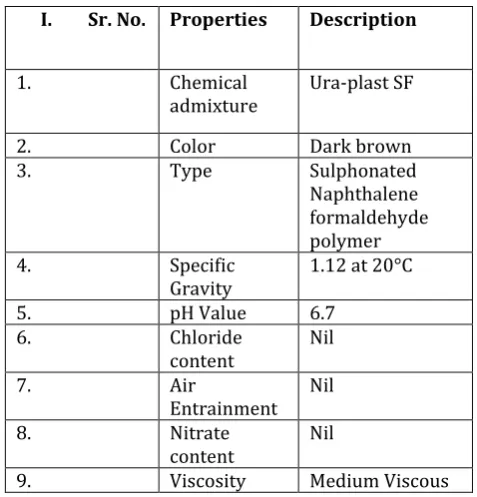
Super plasticizers used in the experimental work conforming to IS 9103-1999, was supplied by a private agency and it is a Sodium Naphthalene Sulphonate based retarder type Super plasticizers EB-821/R with a dosage of 0.8 to 1.2% by volume to weight of total binder contentof concrete. Necessary properties, given by supplier are given in Table 2.
TABLE 2: PROPERTIES OF SUPER PLASTICIZERS
I. Sr. No. Properties Description
1. Chemical
9. Viscosity Medium Viscous
B. Mix Proportion:
© 2015, IRJET.NET- All Rights Reserved
Page 237
TABLE 3: QUANTITIES OF MATERIALS PER 1m3OF CONCRETEComposition of the concrete mixtures (Kg/m3) per m3 of concrete
Mix w/c OPC
(kg)
Metaka-olin (kg)
Fine Agg. (kg)
Coarse Agg. (kg)
Super plasticizer (kg)
Water (kg)
NC 0.43 380 0 881 1135 4.56 163
NC + 4% MK 0.43 364.8 15.2 881 1135 4.56 163
NC + 8% MK 0.43 349.6 30.4 881 1135 4.56 163
NC + 12% MK 0.43 334.4 45.6 881 1135 4.56 163
NC + 16% MK 0.43 319.2 60.8 881 1135 4.56 163
NC + 20% MK 0.43 304 76 881 1135 4.56 163
C. Preparation of Test Specimen:
In this study, a total number of 54 cubes for the control and cement replacement levels of 4%, 8%, 12%, 16% and 20% were produced respectively. All the mixes were cast using 1:2.3:2.98 mix proportion with constant w/c ratio of 0.43. For the compressive strength, 150mm x 150mm x 150mm cube moulds were used to cast the cubes. During moulding the cubes were mechanically vibrated. All freshly cast specimens were left in the moulds for 24 hours before being de-moulded and then submerged in water for curing until the time of testing 3 specimens were tested for each age in a particular mix (i.e. the cubes were tested at 3, 7 and 28 days respectively). The specimens were tested for compressive strength using a compression testing machine.
D. Testing Of Specimen:
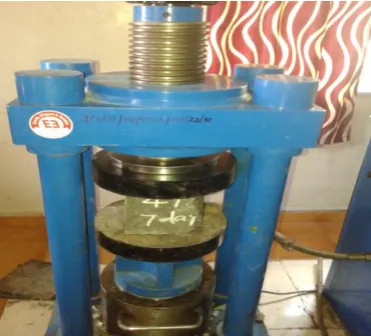
Compressive strength test were carried out at specified ages on the cubes. For the compression test, the cubes are placed in machine in such a manner that the load is applied on the forces perpendicular to the direction of cast.
FIGURE 1: COMPRESSIVE STRENGTH TEST SETUP
In Compression Testing Machine, the top surface of machine is fixed and load is applied on the bottom surface of specimen. The rate of loading is gradual and failure (crushing) load is noted. Also the failure pattern is observed precisely. Figure 1 shows compressive strength test setup.
2.2 Results Discussion
A. Results of compressive strength of concrete:
© 2015, IRJET.NET- All Rights Reserved
Page 238
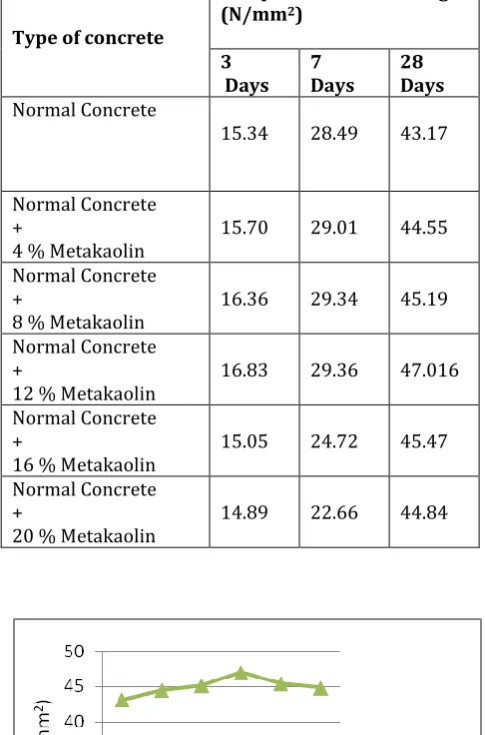
TABLE 4: COMPRESSIVE STRENGTH FOR VARIOUS MIXPROPORTIONS
Type of concrete
Compressive Strength
(N/mm2)
3 Days
7 Days
28 Days Normal Concrete
15.34 28.49 43.17
Normal Concrete +
4 % Metakaolin
15.70 29.01 44.55
Normal Concrete +
8 % Metakaolin
16.36 29.34 45.19
Normal Concrete +
12 % Metakaolin
16.83 29.36 47.016
Normal Concrete +
16 % Metakaolin
15.05 24.72 45.47
Normal Concrete +
20 % Metakaolin
14.89 22.66 44.84
CHART NO.1: COMPRESSIVE STRENGTH OF CONCRETE CUBES FOR DIFFERENT TRIAL MIXES FOR 3, 7 & 28 DAYS CURING PERIOD
B. Discussion:
As expected the compressive strength increases with increase in content of metakaolin. As the total water/binder ratio is kept constant, the variation of strength with respect to constant water/cement ratio remains open to discussion. The compressive strength of metakaolin / metakaolin concrete increases with increase in metakaolin content upto 12% and further increment of metakaolin will result in strength reduction. The graph plotted denotes that the highest compressive strength of M-35 grade metakaolin concrete at optimum dose of 12 % is 47.016 MPa.
3. CONCLUSIONS
Both the physical and chemical properties of metakaolin and cement are in compliance with the standard.
Cement replacement up to 12% with metakaolin leads to increase in compressive strength for M-35 grade of concrete. From 16% there is decrease in compressive strength for 3, 7 and 28 days of curing period.
The optimum dose of metakaolin for achieving higher compressive strength is 12%.
Metakaolin increases the compressive strength of concrete more than 10%.
In mixes blended with high percentage of metakaolin, the water demand will be more because of fineness of metakaolin. To maintain workability of concrete at construction site, use of super plasticizers becomes necessary.
By effective usage of Metakaolin in optimum percentage in concrete may make concrete economic and environmental friendly.
ACKNOWLEDGEMENT
© 2015, IRJET.NET- All Rights Reserved
Page 239
REFERENCES
[1]Ramlochan, T.; Thomas, M.; and Gruber, K. A., "The
Effect of Metakaolin on Alkali-Silica Reaction in
Concrete," Cement and Concrete Research, V. 30,
2000,pp. 339-344.
[2]Wild, S., and Khatib, J. M., "Portlandite
Consumption in Metakaolin Cement Pastes and
Mortars," Cement and Concrete Research, V. 27,
1997, pp. 137-146.
[3]Bentz, D. P., and Garboczi, E. J., "Simulation Studies
of the Effects of Mineral Admixtures on the Cement
Paste-Aggregate Interfacial Zone," ACI Materials
Journal, V. 88, No. 5, Sept.-Oct. 1991, pp. 518-529.
[4]Poon, C.; Lam, L.; Kou, S. C.; Wong, Y.; and Wong,
R., "Rate of Pozzolanic Reaction of Metakaolin in
High-Performance Cement Pastes," Cement and
Concrete Research, V. 31, 2001, pp. 1301-1306.
[5]Aquino, W.; Lange, D. A.; and Olek, J., "The
Influence of Metakaolin and Silica Fume on the
Chemistry of Alkali-Silica Reaction Products,"
Cement and Concrete Composites, V. 23, 2001, pp.
485-493.
[6]Diamond, S.; Sahu, S.; and Thaulow, N., "Reaction
Products of Densified Silica Fume Agglomerates in
Concrete," Cement and Concrete Research, V. 34,
2004, pp. 1625-1632.
[7]Boddy, A.; Hooton, R. D.; and Gruber, K. A.,
"Long-Term Testing of the Chloride- Penetration Resistance
of Concrete Containing High-Reactivity Metakaolin,"
Cement and Concrete Research, V. 31, 2001, pp.
759-765.
[8]Khatib, J. M., and Wild, S., "Sulphate Resistance of
Metakaolin Mortar," Cement and Concrete Research,
V. 28, 1998, pp. 83-92.
[9]Courard, L.; Darimont, A.; Schouterden, M.;
Ferauche, F.; Willem, X.; and Degeimbre, R.,
"Durability of Mortars Modified with Metakaolin,"
Cement and Concrete Research, V. 33, 2003, pp.
1473-1479.
[10]Brooks, J. J., and Megat Johari, M. A., "Effect of
Metakaolin on Creep and Shrinkage of Concrete,"
Cement and Concrete Composites, V. 23, 2001, pp.
495- 502.
[11]Ding, J., and Li, Z., "Effects of Metakaolin and
Silica Fume on Properties of Concrete," ACI Materials
Journal, V. 99, No. 4, July-Aug. 2002, pp. 393-398.
[12]Jensen, O. M., and Hansen, P. F., "A Dilatometer
for Measuring Autogenous Deformation in Hardening
Cement Paste," Materials and Structures, V. 28, No.
181, 1995, pp. 406-409.
[13]Geiker, M., and Knudsen, T., "Chemical Shrinkage
of Portland Cement Pastes," Cement and Concrete
Research, V. 12, 1982, pp. 603-610.
[14]Knudsen, T., and Geiker, M., "Obtaining
Hydration Data by Measurement of Chemical
Shrinkage with an Archimeter," Cement and Concrete
Research, V. 15, 1985, pp. 381-382.
[15]Bérubé, M.; Duchesne, J.; and Chouinard, D.,
"Why the Accelerated Mortar Bar Method ASTM C
1260 is Reliable for Evaluating the Effectiveness of
Supplementary Cementing Materials in Suppressing
Expansion due to Alkali-Silica Reactivity," Cement,
Concrete, and Aggregates, V. 17, 1995, pp. 26-34.