Lapped Block Image Analysis via the Method
of Legendre Moments
Hakim El Fadili
D´epartement de physique, Facult´e des Sciences Dhar el Mehraz, Universit´e Sidi Mohamed Ben Abdellah, BP 1796 Atlas, F`es, Morocco
Email:el fadili [email protected] Khalid Zenkouar
D´epartement de physique, Facult´e des Sciences Dhar el Mehraz, Universit´e Sidi Mohamed Ben Abdellah, BP 1796 Atlas, F`es, Morocco
Email:[email protected] Hassan Qjidaa
D´epartement de physique, Facult´e des Sciences Dhar el Mehraz, Universit´e Sidi Mohamed Ben Abdellah, BP 1796 Atlas, F`es, Morocco
Email:[email protected]
Received 22 August 2002 and in revised form 16 April 2003
Research investigating the use of Legendre moments for pattern recognition has been performed in recent years. This field of research remains quite open. This paper proposes a new technique based on block-based reconstruction method (BBRM) using Legendre moments compared with the global reconstruction method (GRM). For alleviating the blocking artifact involved in the processing, we propose a new approach using lapped block-based reconstruction method (LBBRM). For the problem of selecting the optimal number of moment used to represent a given image, we propose the maximum entropy principle (MEP) method. The main motivation of the proposed approaches is to allow fast and efficient reconstruction algorithm, with improvement of the reconstructed images quality. A binary handwritten musical character and multi-gray-level Lena image are used to demonstrate the performance of our algorithm.
Keywords and phrases:Legendre moments, global image reconstruction method, block-based reconstruction method, maximum entropy principle, blocking artifact, lapped block-based reconstruction method.
1. INTRODUCTION
Moments and functions of moments have been extensively employed as the invariant global features of an image in pat-tern recognition, image classification, target identification, and scene analysis [1,2,3,4,5].
In the recent years, research investigating the use of mo-ments for pattern reconstruction has been performed. Teh and Chin [6] performed an extensive analysis and com-parison of the most common moment definitions, where conventional, Legendre, Zernike, pseudo-Zernike, rotational, and complex moments were all examined in terms of image representation ability, information redundancy, and noise sensitivity. Both analytic and experimental methods were used to characterize the various moment definitions. They concluded that, in terms of overall performances, Zernike and pseudo-Zernike moments outperform the other types.
In general, orthogonal moments are better than other types of moments in terms of information redundancy and image representation.
More recently, an important and significant work con-sidering moments for pattern reconstruction was performed by Liao and Pawlak [7]. In this study, the error analysis and characterization of Legendre moments descriptors have been investigated, where several new techniques to increase the accuracy and the efficiency of the moments are proposed. Based on these improvements, Liao and Pawlak performed image reconstruction via Legendre moments, specially re-constructed image quality.
In order to propose an approach which allows fast and
efficient reconstruction algorithm in the case of multi-gray
polynomials on small intervals instead of high orders on a single one [8]. Hence, the input image is partitioned into blocks of pixels which are then reconstructed as separate en-tities. This allows a fast and efficient reconstruction algo-rithm, with improvement of the reconstructed image
qual-ity. Furthermore, if any block is affected by a
reconstruc-tion error, the others are not affected, keeping by this way the reconstructed errors as a local distortion; such a fact preserves the integrity of the reconstructed image. Unfor-tunately, when adjacent blocks have different reconstruction errors, the block boundaries become visible, producing ver-tical and horizontal lines in the reconstructed images. This blocking artifact is therefore more noticeable at lower re-construction orders. We propose a new approach for allevi-ating the blocking artifact using lapped block-based recon-struction method (LBBRM). This method results in signif-icant objective and subjective improvement in image qual-ity.
For the problem of selecting an optimal number of mo-ments from the digital images, Teh and Chin [6] have con-sidered the mean square error (MSE) between an image and its reconstructed version as a good measure of image repre-sentation ability. However, this method depends on the un-known original image function, which puts a severe limi-tation on the application of this criterion. In order to re-solve this problem, Liao and Pawlak suggested a statistics
cross-validation methodology [7,9]. The lack of a complete
study concerning this method makes its implementation dif-ficult.
In this paper, we introduce the maximum entropy prin-ciple (MEP) as a selection criterion, an automatic technique, which allows estimating the optimal number of moment di-rectly from the available data, where no a priori information is needed [10,11].
Our proposed method, which is the combination of the LBBRM with the MEP as selection criteria, achieves improve-ment in the four following points:
(i) the reduction of the reconstruction space and, by the way, the reduction of the information quantity to ma-nipulate, involving a great reliability on the recon-struction process where only moments of low orders are used;
(ii) the simplicity of moment calculation and reconstruc-tion into each block constituting the whole image, in-volving a computation time improvement;
(iii) the robustness against the reconstruction errors which remain local and do not affect the other blocks consti-tuting the whole image;
(iv) the automation of the proposed algorithm, without any a priori information.
In this paper, a class of Legendre orthogonal moments is examined, due to the fact that they possess better recon-struction power than geometrical moments and they attain a
zero value of redundancy measures [6,12,13,14].
Neverthe-less, the presented results can be extended to other types of
orthogonal moments [6,14,15,16].
Our paper is organized as follows. InSection 2, some
ba-sic definitions are given to build up the necessary mathe-matical background, including Legendre moments and their
properties. Section 3performs the block-based
reconstruc-tion method (BBRM) using the MEP.Section 4presents the
LBBRM method and its performance. Finally, Sections5and
6 deal with the summary of important results and
conclu-sions of the paper.
2. LEGENDRE MOMENTS
The Legendre moments of order (p+q) are defined for a
given real image intensity function f(x, y) as
λp,q=
where f(x, y) is assumed to have bounded support.
The Legendre polynomialsPp(x) are a complete
orthog-onal basis set on the interval [−1,1], for an orderp. They are
The orthogonality property is guaranteed by the equality
1
−1Pp(x)Pq(x)dx=
2
(2p+ 1)δp,q, (3)
whereδp,qis the Kronecker function, that is,
δp,q=
2.1. Image reconstruction by Legendre moments
By taking the orthogonality principle into consideration, the
image function f(x, y) can be written as an infinite series
expansion in terms of the Legendre polynomials over the square [−1,1]×[−1,1]:
where the Legendre moments λp,q are computed over the
same square.
If only Legendre moments of order smaller than or equal toθare given, then the function f(x, y) can be approximated by a continuous function which is a truncated series:
fθ(x, y)=
Furthermore,λp,q’s must be replaced by their numerical
section. The number of moments used in the reconstruction
of the image for a given orderθis defined by
Ntotal=(θ+ 1)(θ+ 2)
2 . (7)
2.2. Approximation of the Legendre moments
The aforementioned properties of the Legendre moments are valid as long as one uses a true analog image function. In practice, the Legendre moments have to be computed from sampled data, that is, the rectangular sampling of the
orig-inal image function f(x, y), producing the set of samples
f(xi, yj) with an (M, N) array of pixels; thus we define the
discrete version ofλp,qin terms of summation by the
tradi-tional commonly used formula (see [6]):
˜
intervals in thexandydirections.
It is clear, however, that ˜λp,qis not a very accurate approx-imation ofλp,q, in particular, when the moment order (p+q) increases [7].
The piecewise constant approximation of f(x, y) in (1),
proposed recently by Liao and Pawlak [7,9], yields the
fol-lowing approximation ofλp,q:
ˆ
with the supposition that f(x, y) is piecewise constant over the interval
This approximation allows a good quality of recon-structed images by reducing the reconstruction error. But, in this study, only bilevel and small-size images are taken into account, that is, multi-gray-level images with greater sizes have been ignored. Indeed, if we consider those later, higher-order moments are involved, and by the way, the computa-tion of moments becomes a time-consuming procedure, too long to be tolerated, with no high quality image successfully reconstructed from the original version.
3. BLOCK IMAGE RECONSTRUCTION
To overcome this situation, our strategy lies in the utilization of polynomials having low orders on small intervals instead of high orders on a single one [8]; that is, the input image is partitioned into square blocks of pixels of size (k, l), a thing that produces a number of subimages which will be recon-structed separately.
Let (M, N) be the image size by pixels and let (k, l) repre-sent the block size. By introducing the variables
s1=M
k, s2=
N
l , (12)
we can deduce the total number of image blocks, which can be set asNb=s1·s2.
Given the image space which takes the form
Ω=xi, yj|0≤xi≤M,0≤yj≤N
It should be noticed that this subspace, which can also be
termed image block space (see Figure 1), is related to Ω
with
Then let the image function associated to eachDn1,n2subset be defined as follows:
fn1,n2(x, y)=fx
From these definitions, we introduce the Legendre moment related to each image block as
D0,0
Figure1: Illustration of the BBRM. (a) Division of the input image intoNbsubimages, (b) moment extraction for each block, and (c) reconstruction and merging theNbblocks.
The block image function reconstructed fromλn1,n2
p,q up to
a given orderθcan intuitively be defined as
ˆ
The image function up toθcan be finally obtained by
ˆ
The proposed technique of reconstruction achieves the first three improvements presented in the introduction.
3.1. Optimal-order moments selection using MEP
The image recovery from its moments is quite difficult and computationally expansive because we ignore the order of the truncated expansion of f(x, y), which gives a good qual-ity of the reconstructed image.
Here, we introduce the MEP for the reconstruction. This automatic technique can estimate the optimal number of moments directly from the available data and does not re-quire any a priori image information.
Let ˆp(xi, yj) be the estimated probability density function obtained by normalizing ˆf(xi, yj) [10]:
LetGwbe a set of estimated underlying probability
den-sity function for various Legendre moment ordersθ:
Gw= By applying the MEP for noisy images, we deduce that among these estimates of the probability density function, there is one and only one probability density function denoted as
ˆ
p∗θ(xi, yj) whose entropy is maximum [10,17] and which represents the optimal probability density function, and then gives the optimal order of moments. For noise-free images, the entropy function monotonically increases up to a certain optimal order where the maximum image information is recreated, and then become relatively constant.
and the optimal ˆpθ∗(xi, yj) is such that
Spˆθ∗xi, yj=maxSpˆθxi, yj|pˆθxi, yj∈Gw
.
(26)
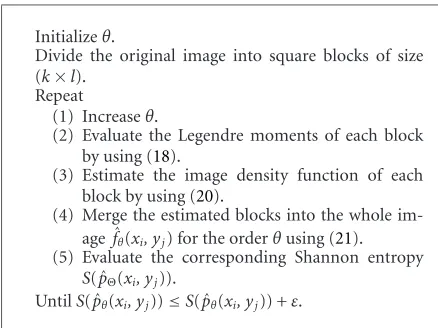
3.2. Block reconstruction algorithm using the MEP
The Legendre moments representation and reconstruction method by block processing is the same as illustrated in Section 2, except that, in this case, the algorithm will try to reconstruct each block separately; and the optimal or-der of reconstruction, controlled by the MEP, will be given after merging all the subimages into the whole output im-age.
The following are the steps of the block reconstruction algorithm using the MEP as a measure of moment-order selection; here we use the following iterative algorithm ver-sion:
Initializeθ.
Divide the original image into square blocks of size (k×l).
Repeat
(1) Increaseθ.
(2) Evaluate the Legendre moments of each block by using (18).
(3) Estimate the image density function of each block by using (20).
(4) Merge the estimated blocks into the whole im-age ˆfθ(xi, yj) for the orderθusing (21). (5) Evaluate the corresponding Shannon entropy
S( ˆpΘ(xi, yj)).
UntilS( ˆpθ(xi, yj))≤S( ˆpθ(xi, yj)) +ε.
Algorithm1
Takeθas the optimal order and ˆfθ(xi, yj) as the optimal reconstructed density function.
To evaluate experimentally the values taken byε,
com-puter simulations have been carried out, applied on Lena and handwritten musical character with different input block sizes (4×4), (8×8), (16×16), and (32×32).
The iterative LBBRM algorithm produces good results in
terms of image quality only ifεverifies the following
condi-tion:
|ε|<1. (27)
The values ofεaccording to the results indicated inTable 1
are indicated inSection 5.
4. LAPPED BLOCK-BASED RECONSTRUCTION
METHOD
The proposed block image reconstruction using the method
of moments offers a good trade-off between computation
Table1: The optimal orders given by the MEP in each block size of the LBBRM and GRM, with the corresponding image qualities.
LBBRM GRM
Block size 4×4 8×8 16×16 32×32
Optimal order 4 8 13 25 80
PSNR (dB) 32.67 36.19 29.20 26.12 24.08
time and subjective image quality. Unfortunately, when ad-jacent blocks have different reconstruction errors, the block boundaries become visible. This blocking artifact is therefore more noticeable in the reconstructed images at lower recon-struction orders. These vertical and horizontal lines, caused by this blocking artifact, are generally considered objection-able to human viewers.
One technique for mitigating artifacts in block process-ing involves a posteriori processprocess-ing of the reconstructed images. Such techniques allow substantial reduction of the blocking artifact, despite the expense of an increase in the overall mean square reconstruction error [18].
It is well known that the blocking effect is a consequence of ignoring the interblock correlation during the reconstruc-tion process because every block is taken as an indepen-dent entity. Therefore, one of the best ways to minimize the disturbance in the output image is to make use of the in-terblock correlation. Our method exploits for every block the neighborhood information related to its adjacent blocks during the moment computation. This approach can achieve a remarkable performance in eliminating the blocking ef-fect and, by the way, avoid other strategies to restore or en-hance the image quality by using postprocessing techniques. Consequently, the elimination of the blocking artifact is in-cluded in the moment computation and reconstruction pro-cess.
Figure 2shows the block diagram of the proposed LB-BRM. Note that there are two stages in this block diagram:
(i) the moment computation which extracts the block neighborhood information by proceeding on lapped blocks;
(ii) the reconstruction process which acts on output blocks and merge them into the final image.
The proposed LBBRM algorithm controlled by the entropy principle is the same as in the previous section, except that moments are computed for lapped blocks composing the
in-put image as defined in (18), and according toFigure 2, the
image function is obtained by merging the output blocks as defined in (20) and (21).
Controlled by the entropy principle, the LBBRM ap-proach estimates the optimal number of moments directly from the available data. Consequently, it does not require any a priori information about the image.
As a summary, the LBBRM achieves improvement in the following points:
Input lapped block Image pixel
Output block
Lapped block moment computation
Block reconstruction process .
. .
k−2
k−1
k
k+ 1
k+ 2
. . .
Lapp
ed
block
. . .
k−2
k−1
k
k+ 1
k+ 2
. . . Moment computation and
reconstruction for lapped image blocks
Output blocks
Figure2: Illustration of the different stages of the LBBRM using Legendre moments.
(a)
PSNR=16.23 PSNR=23.12 (b)
PSNR=22.55 PSNR=28.37 (c)
Figure3: (a) The original Lena image, (b) the reconstructed Lena via the BBRM (left image) and LBBRM (right image) using Leg-endre moments with the block size (4×4) and for reconstruction order 0, and (c) the image via the BBRM (left image) and LBBRM (right image) for block size (4×4) and order 4.
during the moment computation stage, a thing that al-lows to avoid enhancement postprocessing techniques which is a time-consuming procedure.
(ii) the automatic estimation of the optimal order from the available data; hence, there is no need to a priori infor-mation about image.
As shown inFigure 3, this method results in significant
objective and subjective improvement in image quality.
5. EXPERIMENTAL RESULTS
In this section, we introduce some criteria commonly used for measuring image quality and, therefore, rating the per-formance of the reconstruction as a processing technique.
5.1. Mean square error
The MSE is defined for an image having the size (M, N) as
MSE= 1
MN
M
i=1
N
j=1
f
xi, yj
−fˆxi, yj2
, (28)
where ˆf(xi, yj) is the reconstructed version of the original function f(xi, yj) over the (xi, yj) pixel.
5.2. Peak signal-to-noise ratio
In [19], the peak signal-to-noise ratio (PSNR) is defined in decibels (dB) as
PSNR=10 log10
k2
MSE
(a) (b) (c) (d) (e)
(f) (g) (h) (i) (j)
Figure4: Global reconstruction of the “Clef de Sol” image by the Legendre moments. (a) Original input image; reconstructed images from (b) to (j) represent orders 10, 20, 30, 40, 50, 60, 70, 80, and 90, respectively.
80 75 70 65 60
Ent
rop
y
0 20 40 60 80 100
Order
Figure5: The corresponding entropy function of the reconstructed images versus the order of reconstruction. The optimal order of the reconstruction is 80, with PSNR 24.08.
wherekis the gray-level maximum value of the original
im-age.
In order to illustrate our approach, we consider a (128×
128) real binary image representing a special handwritten musical note called “Clef de Sol” scanned at 256 gray-level,
and binarized into 0 and 255 (Figure 4a), and the (128×128)
real multi-gray-level Lena image.
Figures 4 and 9 show examples of the reconstruction
for the (128×128) handwritten character and Lena image,
respectively, from its Legendre moment with the classical global reconstruction method (GRM), where the processing is done on the whole image by including increasingly higher-order moments. It illustrates the fact that the fine detail can
10000 8000 6000 4000 2000 0
MSE
0 20 40 60 80 100
Order GRM
4×4 8×8
16×16 32×32
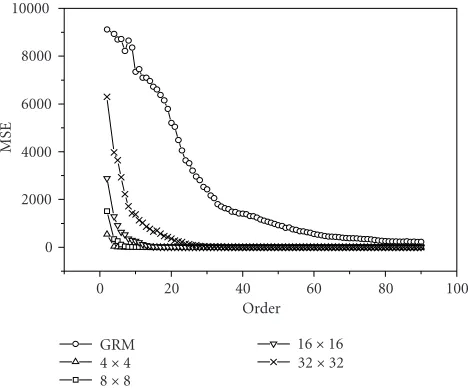
Figure 6: Comparison of the LBBRM, with different block sizes,
and GRM in terms of the reconstruction MSE for the handwritten musical character.
be recreated only by including higher-order moments. The corresponding entropy function of the handwritten charac-ter, as defined in (25), is computed and shown versus the
re-construction order inFigure 5.
The reconstructed images for the same handwritten char-acter and the Lena image by the LBBRM, including sizes
(4 ×4) and (8 × 8), are shown in Figures 7, 10, and
(A)
(a) (b) (c) (d)
(e) (f) (g) (h)
(B)
(a) (b) (c) (d) (e) (f) (g)
(h) (i) (j) (k) (l) (m) (n)
(C)
100 90 80 70 60 50
Ent
rop
y
0 10 20 30 40
Order 4×4
8×8
16×16 32×32
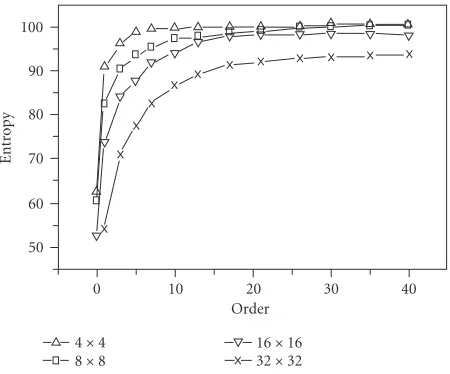
Figure 8: Entropy function for the reconstructed images via the new proposed LBBRM with different sizes.
with no need to include higher-order moments. The corre-sponding entropy functions in each case are regrouped in Figure 8.
Table 1summarizes the optimal orders obtained in each case with the corresponding PSNR. The following values of
ε have been obtained according to the results indicated in
Table 1:
(i) for (4×4) block size,ε=0.70 with optimal order=4; (ii) for (8×8) block size,ε=0.85 with optimal order=8;
(iii) for (16×16) block size,ε=0.91 with optimal order
=13;
(iv) for (32×32) block size,ε=0.93 with optimal order
=25.
It is clear from the results that the optimal number of mo-ments, which are useful to the reconstruction process, in-creases as the reconstruction block size inin-creases. The com-parison in terms of the mean square reconstruction errors (MSE), as defined in (28), of GRM and LBBRM, is plotted in Figure 6for the handwritten character, and inFigure 12for the Lena image.
Figures 6 and 12 show the dramatic reduction of the
reconstruction error while reconstructing image by smaller
block sizes. As shown inTable 2, the proposed LBBRM can
recreate high-quality images for lower-order of moments,
compared with the GRM.Table 3shows the important
com-putation time-reduction factors obtained by using the pro-posed LBBRM compared with the GRM.
6. CONCLUSION
This paper proposes a new technique based on block im-age reconstruction using Legendre moments. We propose, for the problem of selecting the optimal number of
mo-Table2: Values of the PSNR (dB) for the reconstructed images rep-resenting Lena for the proposed LBBRM, with different block sizes, and GRM via the reconstruction order.
PSNR with LBBRM
PSNR with GRM Size 4×4 8×8 16×16 32×32
Order
0 21.91 18.56 15.96 13.45 11.21 5 28.98 22.62 21.72 19.55 16.24 10 35.32 25.36 24.86 22.15 17.42 15 36.22 34.38 25.95 24.12 18.32 20 37.11 34.81 27.70 25.59 19.34 25 38.94 31.91 32.95 26.85 20.35 30 35.22 32.68 33.64 28.25 21.19 35 38.00 36.91 35.83 29.58 21.89 40 39.24 38.64 37.47 31.16 22.70 45 41.77 38.23 35.18 32.56 23.28 50 40.38 39.52 33.66 33.54 23.66
Table3: The reduction factors of reconstruction time for LBBRM in comparison with GRM for PSNR=26.
LBBRM
Block size 4×4 8×8 16×16 32×32
Musical character 80.23% 86.61% 86.45% 81.66% Corresponding moment order 1 3 6 13
Lena 82.26% 88.26% 87.94% 84.62% Corresponding moment order 3 11 16 25
ments used to represent a given image, the MEP method. This method requires no a priori image information.
The processing of the image by blocks of size (4×4),
(8×8), (16×16), and (32×32) involves a dramatic
reduc-tion of the reconstrucreduc-tion error, and a considerable gain in the computation time, compared with the GRM, in the case
of (128×128) binary and multi-gray-level images. Hence
we can obtain better reconstruction quality on each block with order of moments considerably low. This new method can involve a blocking artifact, especially at lower recon-struction orders. We propose a new approach for allevi-ating the blocking artifact by using LBBRM. This method results in significant objective and subjective improvement in the reconstructed image quality, as shown in the exper-imental results in the case of binary and multi-gray-level images.
The proposed approach which is a combination of the LBBRM with the PME as selection criteria allows not only improvement of the reconstructed images quality but also a surprising acceleration of the reconstruction process, as
(a) (b) (c) (d)
(e) (f) (g) (h)
(i) (j) (k) (l)
Figure9: Global reconstruction of the Lena image by the Legendre moments. (a) Original input image; reconstructed images from (b) to (l) represent orders 10, 20, 30, 40, 50, 60, 70, 80, 90, 100, and 110, respectively.
(a) (b) (c) (d)
(e) (f) (g) (h)
(i) (j) (k) (l)
(a) (b) (c) (d)
(e) (f) (g) (h)
Figure11: The original Lena image (a) and its reconstructed patterns via the proposed LBBRM with the block size (8×8) using Legendre moments; from (b) to (h) are the reconstructed images for orders 1, 10, 15, 20, 25, 30, and 35, respectively.
3000 2500 2000 1500 1000 500 0
MSE
0 20 40 60 80 100 120 140 160
Order GRM
4×4 8×8
16×16 32×32
Figure12: Comparison of LBBRM, with different block sizes, and
GRM in terms of the reconstruction MSE for Lena image.
REFERENCES
[1] F. L. Alt, “Digital pattern recognition by moments,” Journal of the Association for Computing Machinery, vol. 9, no. 2, pp. 240–258, 1962.
[2] M. K. Hu, “Pattern recognition by moment invariants,” Proc. IRE, vol. 49, pp. 1428, September 1961.
[3] M. K. Hu, “Visual pattern recognition by moment invariants,” IRE Transactions on Information Theory, vol. 8, no. 2, pp. 179– 187, 1962.
[4] R. J. Prokop and A. P. Reeves, “A survey of moment-based techniques for unoccluded object representation and recogni-tion,” Graphical Models and Image Processing, vol. 54, no. 5, pp. 438–460, 1992.
[5] C.-H. Teh and R. T. Chin, “On digital approximation of mo-ment invariants,”Computer Vision, Graphics, and Image Pro-cessing, vol. 33, no. 3, pp. 318–326, 1986.
[6] C.-H. Teh and R. T. Chin, “On image analysis by the methods of moments,” IEEE Trans. on Pattern Analysis and Machine Intelligence, vol. 10, no. 4, pp. 496–513, 1988.
[7] S. X. Liao and M. Pawlak, “On image analysis by moments,” IEEE Trans. on Pattern Analysis and Machine Intelligence, vol. 18, no. 3, pp. 254–266, 1996.
[8] J. Baranger, Analyse numerique, Hermann, Editeurs des Sci-ences et des Arts, Paris, France, 1991.
[9] S. X. Liao, Image analysis by moments, Ph.D. thesis, Depart-ment of Electrical and Computer Engineering, University of Manitoba, Winnipeg, Manitoba, Canada, 1993.
[10] H. Qjidaa and L. Radouane, “Robust line fitting in a noisy image by the method of moments,” IEEE Trans. on Pattern Analysis and Machine Intelligence, vol. 21, no. 11, pp. 1216– 1223, 1999.
[11] C. Robert, “Mod`eles statistiques pour l’intelligence artifi-cielle,” in Techniques Stochastiques, Masson, Paris, France, 1991.
[12] Y. S. Abu-mostafa and D. Psaltis, “Recognitive aspects of mo-ment invariants,”IEEE Trans. on Pattern Analysis and Machine Intelligence, vol. 6, no. 6, pp. 698–706, 1984.
[13] M. Pawlak, “On the reconstruction aspects of moment de-scriptors,” IEEE Transactions on Information Theory, vol. 38, no. 6, pp. 1698–1708, 1992.
[14] M. R. Teague, “Image analysis via the general theory of mo-ments,” Journal of Optical Society of America, vol. 70, no. 8, pp. 920–930, 1980.
[15] A. Khotanzad and Y. H. Hong, “Invariant image recognition by Zernike moments,” IEEE Trans. on Pattern Analysis and Machine Intelligence, vol. 12, no. 5, pp. 489–497, 1990. [16] S. X. Liao and M. Pawlak, “On the accuracy of Zernike
mo-ments for image analysis,” IEEE Trans. on Pattern Analy-sis and Machine Intelligence, vol. 20, no. 12, pp. 1358–1364, 1998.
[18] H. S. Malvar, “The LOT: transform coding without blocking effects,” IEEE Trans. Acoustics, Speech, and Signal Processing, vol. 37, no. 4, pp. 553–559, 1989.
[19] A. K. Jain,Fundamentals of Digital Image Processing, Prentice-Hall Information and System Sciences Series. Prentice-Prentice-Hall, Englewood Cliffs, NJ, USA, 1989.
Hakim El Fadiliwas born in Azrou, Mo-rocco in 1976. He graduated from the Fac-ulty of Science, University Sidi Mohamed Ben Abdellah, Fez, and received the DESA degree in automatic and system analysis in 2000. Presently, he is preparing his Doc-torat National in image processing, pattern recognition, and machine intelligence.
Khalid Zenkouarwas born in Meknes, Mo-rocco in 1971. He obtained his DUT de-gree in Mechanic and Computer-Integrated Manufacturing from High school of tech-nology, Fez in 1993. He graduated from the Faculty of Science, University Sidi Mo-hamed Ben Abdellah, Fez, and received the DESA degree in automatic and system anal-ysis in 2000. Presently, he is preparing his Doctorat National in image processing and mathematical morphology.
Hassan Qjidaawas born in Rabat, Morocco in 1958. He graduated from the Faculty of Science, University Sidi Mohamed Ben Ab-dellah, Fez, and received the Th`ese d’Etat degree in automatic and system analysis in 2000. Presently, he is a Professor of infor-matics and image processing. He is a mem-ber in the Laboratoire d’Electronique, Sig-naux Syst`emes et d’Informatique (LESSI). His current research interests are in image