837
Summary Refinement through Denoising
Nikola I. Nikolov, Alessandro Calmanovici, Richard H.R. Hahnloser
Institute of Neuroinformatics, University of Z¨urich and ETH Z¨urich, Switzerland
{niniko, dcalma, rich}@ini.ethz.ch
Abstract
We propose a simple method for post-processing the outputs of a text summa-rization system in order to refine its over-all quality. Our approach is to train text-to-text rewriting models to correct infor-mation redundancy errors that may arise during summarization. We train on syn-thetically generated noisy summaries, test-ing three different types of noise that in-troduce out-of-context information within each summary. When applied on top of extractive and abstractive summarization baselines, our summary denoising models yield metric improvements while reducing redundancy.1
1 Introduction
Text summarization aims to produce a shorter, in-formative version of an input text. While ex-tractive summarization only selects important sen-tences from the input, abstractive summariza-tion generates content without explicitly re-using whole sentences (Nenkova et al.,2011). In recent years, a number of successful approaches have been proposed for both extractive (Nallapati et al., 2017;Narayan et al.,2018) and abstractive (Chen and Bansal,2018;Gehrmann et al.,2018) summa-rization paradigms. Despite these successes, many state-of-the-art systems remain plagued by overly high output redundancy (See et al.(2017); see Fig-ure3), which we set out to reduce.
In this paper, we propose a simple method (Fig-ure 1, Section 3) for post-processing the outputs of a text summarization system in order to im-prove their overall quality. Our approach is to train dedicated text-to-text rewriting models to correct
1Code available at https://github.com/
ninikolov/summary-denoising.
Ground Truth Summary Noisy Summary
1. Synthesize noisy summaries
Denoising Model Noise Model
Clean Summary Noisy Summary
2. Train/apply summary denoising model
Figure 1:Overview of our approach to summary denoising. We alter ground truth summaries to generate a noisy dataset, on which we train denoising models to restore the original summaries.
errors that may arise during summarization, fo-cusing specifically on reducing information redun-dancy within each individual summary. To achieve this, we synthesize from clean summaries noisy summaries that contain diverse information redun-dancy errors, such as sentence repetition and out-of-context information (Section3.2).
In our experiments (Section 5), we show that denoising yields metric improvements and reduces redundancy when applied on top of several extrac-tive and abstracextrac-tive baselines. The generality of our method makes it a useful post-processing step applicable to any summarization system, that stan-dardizes the summaries and improves their over-all quality, ensuring fewer redundancies across the text.
2 Background
to a different domain (Isabelle,2007).
In (Xie et al., 2018), authors synthesize gram-matically incorrect sentences from correct ones using backtranslation (Sennrich et al., 2016a), which they use for grammar error correction. They enforce hypothesis variety during decoding by adding noise to beam search. Another work that is close to ours is (Fevry and Phang,2018), where authors introduce redundancy on the word level in order to build an unsupervised sentence compres-sion system. In this work, we take a similar ap-proach, but instead focus on generating informa-tion redundancy errors on the sentence rather than the word level.
3 Approach
Our approach to summary refinement consists of two steps. First, we use a dataset of clean ground truth summaries togeneratenoisy summaries us-ing several different types of synthetic noise. Sec-ond, we train text rewriting models to correct and denoise the noisy summaries, restoring them to their original form. The learned denoising models are then used to post-process and refine the outputs of a summarization system.
3.1 Generating Noisy Summaries
To generate noisy datasets, we rely on an exist-ing parallel dataset of articles and clean ground truth summaries S = {s0, , ..., sj}. We iterate
over each of the summaries and perturb them with noise, according to a sentence noise distribution
pnoise = [p0, p1, ..., pN]. pnoisedefines the
proba-bility of adding noise to a specific number of sen-tences within each summary (from0up to a max-imum ofN noisy sentences), withP
pnoise = 1.
For all experiments in this work, we use
pnoise = [0.15,0.85] in order to ensure
consis-tency, meaning that ˜15% of our noisy summaries contain no noisy sentences, while ˜85% contain one noisy sentence. Initial experiments showed that distributions which enforce larger or smaller amounts of noise lead to stronger or weaker de-noising effects. Our choice of noise distribution showed good results on the majority of systems that we tested; we leave a more rigorous investiga-tion of the choice of distribuinvestiga-tion to future work.
In addition to adding noise, we generate 3 noisy summaries for each clean summary by picking multiple random sentences to noise. This step in-creases the dataset size while introducing variety.
3.2 Types of Noise
We experiment with three simple types of noise, all of which introduce information redundancy into a summary. Our aim is to train denoising models that minimize repetitive or peripheral in-formation within summaries.
Repeat picks random sentences from the sum-mary and repeats them at the end. Repetition of phrases or even whole sentences is a problem commonly observed in text generation with RNNs (See et al.,2017), which motivates efforts to detect and minimize repetitions.
Replace picks random sentences from the sum-mary, and replaces them with the closest sentence from the article. This type of noise helps the model to learn to refine sentences from the generated summaries, paraphrasing sentences when they are too long or contain redundant information.
Extra picks random sentences from the article, paraphrases them, and inserts them into the sum-mary, preserving the order of the sentences as they appear in the article. With this type of noise, a model learns to delete sentences which are out of context or contain redundant informa-tion. To paraphrase the sentences, we use the sen-tence paraphrasing model from (Chen and Bansal, 2018), trained on matching sentence pairs from the CNN/Daily Mail dataset.
Mixture mixes all the above noise types uni-formly into a single dataset, keeping the same dataset size as for the individual noise types. With mixture, we explore whether the benefits of each noise type can be combined into a single model.
4 Experimental Setup
Dataset We use the CNN/Daily Mail dataset2 (Hermann et al.,2015) of news articles and sum-maries in the form of bullet points, and follow the preprocessing pipeline from (Chen and Bansal, 2018). We use the standard split of the dataset, consisting of 287k news-summary pairs for train-ing and 13k pairs for validation. We follow Sec-tion3.1to generate noisy versions of the datasets to be used during training. During testing, instead of clean summaries that contain noisy sentences, we input summaries produced by existing extrac-tive or abstracextrac-tive summarization systems.
2https://github.com/abisee/
System Denoising approach ROUGE-1 ROUGE-2 ROUGE-L Repeat #Sent #Tok
Human - - - - 28.86 3.88 61.21
Article - 14.95 8.54 14.41 70.5 26.9 804
Article Mixture 30.47 13.97 28.24 53.43 10.67 304.7
RNN - 35.61 15.04 32.7 51.9 2.93 58.46
RNN Overlap 36.41 15.92 33.73 26.84 2.39 47.31
RNN Repeat 36.5 15.94 33.79 27.65 2.41 48.34
RNN Replace 35.2 14.86 32.4 51.51 2.98 57.0
RNN Extra 33.95 14.58 31.2 37.19 2.21 42.82
RNN Mixture 35.08 15.3 32.44 27.27 2.2 42.14
RNN-RL - 40.88 17.8 38.54 39.29 4.93 72.82
RNN-RL Overlap 40.76 17.69 38.43 37.71 4.83 71.02 RNN-RL Repeat 40.84 17.76 38.49 38.78 4.86 71.69 RNN-RL Replace 40.78 17.72 38.46 39.24 4.93 72.2
RNN-RL Extra 39.12 16.7 36.76 34.04 3.84 55.43
RNN-RL Mixture 40.11 17.33 37.76 35.45 4.18 61.15
Table 1: Results on denoising abstractive summarization.Repeatis the Repeat rate, while#Sentand#Tokare the average numbers of sentences or tokens in the summaries. BestROUGEresults for each model are in bold.Humanis the result of the ground truth summaries, whileArticleuses the original article as the summary.
0 1500 3000 4500 6000 7500 9000 # of repeating sentences no denoising
mixture no denoising mixture human
RNN
RNN-RL Human
Figure 3: Number of sentence repetitions before and after denoising.
tional denoising operations learned by our models (see Figure4a) are beneficial and can lead to more polished summaries that also may contain abstrac-tive elements.
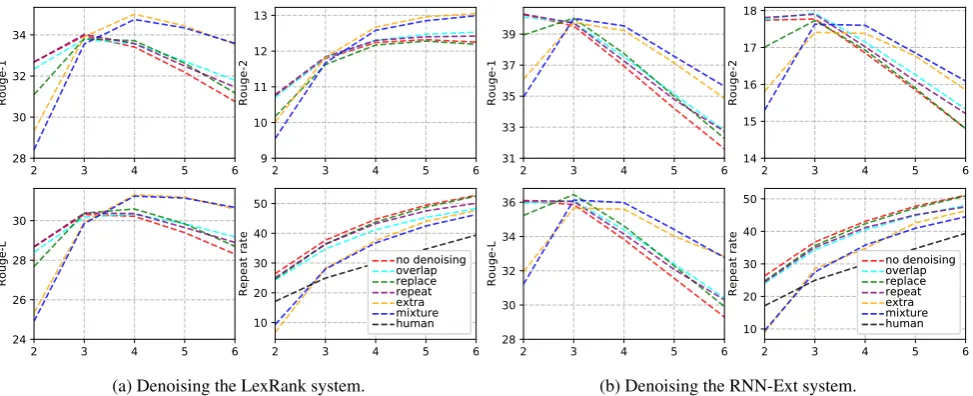
The gains from denoising are greater for longer summaries of more than two sentences. Long summaries are more likely to be affected by redun-dancy. For shorter summaries, denoising might lead to deletion of important information, thus de-noising needs to be applied more carefully in such cases. Furthermore, for all sentence lengths and noise types, we observe a reduction in the Re-peat rate after denoising, demonstrating that our approach is effective at reducing redundancy.
In Table 1, we additionally include the result from using the whole articles (Article) as input to our mixture model. Denoising is effective in this case, indicating that our approach may be promising for developing abstractive summariza-tion systems that are fully unsupervised, similar to recent work in unsupervised sentence compression (Fevry and Phang,2018).
5.2 Abstractive Summarization
For abstractive summarization, we test two sys-tems. The first is a standard LSTM
encoder-decoder model with an attention mechanism (RNN), identical to our denoising network from Section 4. The second, RNN-RL, is a state-of-the-art abstractive system proposed in (Chen and Bansal, 2018) that combines extractive and abstractive summarization using reinforcement learning. We trainRNNourselves, while for RNN-RL, we use the outputs provided by the authors.
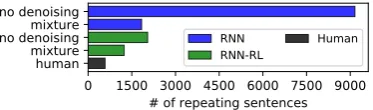
Our metric results from denoising abstractive summarization are in Table1. In Figure3, we also compute the approximate number of sentence rep-etitions on the test set, by calculating the number of sentences that overlap significantly (> 80%) with at least one other sentence in the summary.
how-extra
no change
deletion modificationdeletion & modification repeat
0 25 50 75 100
% of outputs replace
0 25 50 75 100
% of outputs mixture
(a) RNN-Ext extractive system, extracting 5 sentences.
extra
no change
deletion modificationdeletion & modification repeat
0 25 50 75 100
% of outputs replace
0 25 50 75 100
% of outputs mixture
(b) RNN abstractive system.
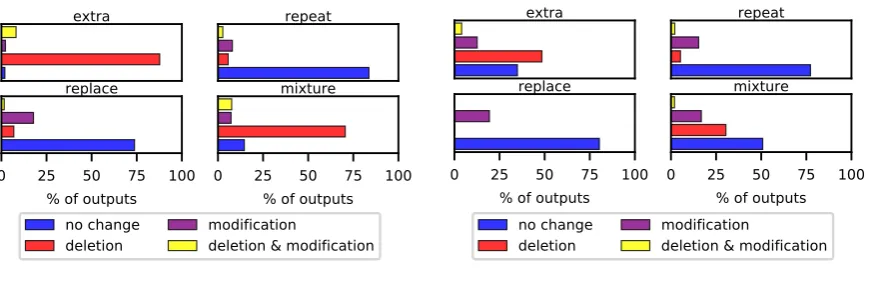
Figure 4: Types of denoising operations applied to an extractive (left) and an abstractive (right) system (averaged over our test set).
ever this comes with a potential loss of informa-tion, which can lead to a reduction in ROUGE. Thus, our denoising methods are currently better suited for extractive than for absctractive summa-rization. Our work therefore calls for the develop-ment of novel types of synthetic noise that target abstractive summarization.
5.3 Analysis of Model Outputs
In Figure 4, we quantify the types of operations (deletion or modification of one or more sen-tences, or no change) our denosing models per-formed on the summaries produced by the extrac-tiveRNN-Ext(Figure4a) and abstractiveRNN sys-tem (Figure 4b). The replace and repeat noises are the most conservative, leaving over 75% of the summaries unchanged. extrais the most prone to delete sentences, while repeat and replace are most prone to modify sentences. We see a similar pattern for both extractive and ab-stractive summarization, with an increase of dele-tion for longer summaries produced by the extrac-tive system. This indicates that our approach flexi-bly learns to switch between operations depending on the properties of the noisy input summary.
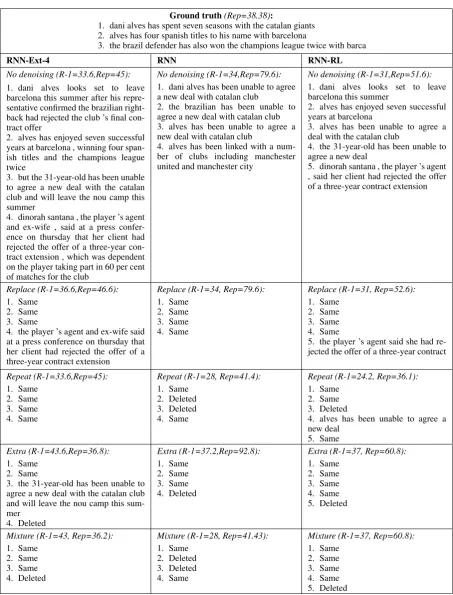
In Table 2 we show example outputs from de-noising extractive and abstractive summaries pro-duced for a sports article from our test set. All baseline summarization systems produced outputs that contain redundancy: for example, the first three sentences generated by theRNNsystem, and the 3rd and 4th sentences produced by the RNN-RL system are almost identical. To denoise the summaries, our models used diverse operations such as deletion of one or two sentences (e.g.RNN system, Repeat noise), rewriting (e.g. RNN-RL
system,Replacenoise, where”dinorah santana , the player s agent , said her client had rejected the offer of a three-year contract extension” is paraphrased to ”the player s agent said she had rejected the offer of a three-year contract”), or even a combination of deletion and rewriting (e.g. RNN-RLsystem,Repeatnoise).
6 Conclusion
We proposed a general framework for improving the outputs of a text summarization system based on denoising. Our approach is independent of the type of the system, and is applicable to both ab-stractive and extractive summarization paradigms. It could be useful as a post-processing step in a text summarization pipeline, ensuring that the sum-maries meet specific standards related to length or quality.
Acknowledgments
We acknowledge support from the Swiss National Science Foundation (grant 31003A 156976).
References
Dzmitry Bahdanau, Kyunghyun Cho, and Yoshua
Ben-gio. 2014. Neural machine translation by jointly
learning to align and translate. arXiv preprint
arXiv:1409.0473.
Rajen Chatterjee, Matteo Negri, Raphael Rubino, and
Marco Turchi. 2018. Findings of the wmt 2018
shared task on automatic post-editing. In
Proceed-ings of the Third Conference on Machine Transla-tion: Shared Task Papers. pages 710–725.
Yen-Chun Chen and Mohit Bansal. 2018. Fast abstrac-tive summarization with reinforce-selected sentence rewriting. InProceedings of ACL.
G¨unes Erkan and Dragomir R Radev. 2004. Lexrank: Graph-based lexical centrality as salience in text summarization. Journal of artificial intelligence re-search22:457–479.
Thibault Fevry and Jason Phang. 2018.
Unsuper-vised sentence compression using denoising auto-encoders. In Proceedings of the 22nd Conference on Computational Natural Language Learning. As-sociation for Computational Linguistics, pages 413– 422. http://aclweb.org/anthology/K18-1040.
Sebastian Gehrmann, Yuntian Deng, and Alexander
Rush. 2018. Bottom-up abstractive summarization.
In Proceedings of the 2018 Conference on Empiri-cal Methods in Natural Language Processing. Asso-ciation for Computational Linguistics, pages 4098–
4109.http://aclweb.org/anthology/D18-1443.
Karl Moritz Hermann, Tomas Kocisky, Edward
Grefenstette, Lasse Espeholt, Will Kay, Mustafa
Su-leyman, and Phil Blunsom. 2015. Teaching
ma-chines to read and comprehend. InAdvances in
Neu-ral Information Processing Systems. pages 1693– 1701.
P Isabelle. 2007. Domain adaptation of mt systems
through automatic postediting. Proc. 10th Machine
Translation Summit (MT Summit XI), 2007.
Diederick P Kingma and Jimmy Ba. 2015. Adam: A method for stochastic optimization. InInternational Conference on Learning Representations (ICLR).
Chin-Yew Lin. 2004. Rouge: A package for
auto-matic evaluation of summaries. Text Summarization
Branches Out.
Ramesh Nallapati, Feifei Zhai, and Bowen Zhou. 2017. Summarunner: A recurrent neural network based se-quence model for extractive summarization of docu-ments. InThirty-First AAAI Conference on Artificial Intelligence.
Shashi Narayan, Shay B. Cohen, and Mirella
Lap-ata. 2018. Ranking sentences for extractive
sum-marization with reinforcement learning. In Pro-ceedings of the 2018 Conference of the North American Chapter of the Association for Com-putational Linguistics: Human Language Tech-nologies, Volume 1 (Long Papers). Association for Computational Linguistics, pages 1747–1759.
https://doi.org/10.18653/v1/N18-1158.
Ani Nenkova, Sameer Maskey, and Yang Liu. 2011.
Automatic summarization. In Proceedings of the
49th Annual Meeting of the Association for Com-putational Linguistics: Tutorial Abstracts of ACL
2011. Association for Computational Linguistics,
page 3.
Nikola Nikolov, Michael Pfeiffer, and Richard Hahn-loser. 2018. Data-driven summarization of scien-tific articles. InProceedings of the Eleventh Interna-tional Conference on Language Resources and Eval-uation (LREC 2018). European Language Resources Association (ELRA), Paris, France.
Alla Rozovskaya and Dan Roth. 2016. Grammatical error correction: Machine translation and classifiers. In Proceedings of the 54th Annual Meeting of the Association for Computational Linguistics (Volume 1: Long Papers). volume 1, pages 2205–2215.
Abigail See, Peter J Liu, and Christopher D Manning. 2017. Get to the point: Summarization with
pointer-generator networks. InProceedings of the 55th
An-nual Meeting of the Association for Computational Linguistics (Volume 1: Long Papers). volume 1, pages 1073–1083.
Rico Sennrich, Barry Haddow, and Alexandra Birch.
2016a. Improving neural machine translation
mod-els with monolingual data. InProc. of ACL. Asso-ciation for Computational Linguistics, pages 86–96.
https://doi.org/10.18653/v1/P16-1009.
Rico Sennrich, Barry Haddow, and Alexandra Birch.
2016b. Neural machine translation of rare words
with subword units. InProc. of ACL. Association for Computational Linguistics, pages 1715–1725.
https://doi.org/10.18653/v1/P16-1162.
Ilya Sutskever, Oriol Vinyals, and Quoc VV Le. 2014. Sequence to sequence learning with neural
net-works. InAdvances in neural information
process-ing systems. pages 3104–3112.
Ziang Xie, Guillaume Genthial, Stanley Xie, Andrew
Ng, and Dan Jurafsky. 2018. Noising and denoising