International Journal of Emerging Technology and Advanced Engineering
Website: www.ijetae.com (ISSN 2250-2459, ISO 9001:2008 Certified Journal, Volume 4, Issue 12, December 2014)
220
Survey on Intrusion Detection System using Support Vector
Machine
Pooja Champaneria
1, Prof. Bhavin Shah
2, Asst. Prof. Krunal Panchal
31
Department of Computer Engineering, L. J Institute of Engineering & Technology, Ahmedabad, India.
2M.C.A. Programme, L. J Institute of Management Studies, Ahmedabad, India.
3PG Department, L. J Institute of Engineering & Technology, Ahmedabad, India.
Abstract— Various transaction activities like air ticket
reservation, online banking, distance learning, group discussion and so on are carried out using Internet. Carrying out such activities include exchange of useful data which is to be protected from malicious attacks. If some malicious activities are taking place in the network, it is essential to alert the user about it. Detection of malicious activities is of prime importance to protect our data. To protect the data that are exchanged on the network, we need to implement a system that realizes faster attack detection and response accordingly. For detecting malicious activities, we use Intrusion Detection System (IDS) for security purpose. This paper focuses on IDS using Support Vector Machine (SVM). During the survey, the major challenges found are low detection rate and more response time. To overcome these challenge, parallel implementation of SVM classifier and appropriate feature reduction technique should be applied to achieve high detection rate and low response time.
Keywords —- Classification, Intrusion Detection System,
Multiclass SVM, Neural Network, Support Vector Machine.
I. INTRODUCTION
Due to explosive growth of information exchange and electronic commerce in recent decade, we are using Internet. We use Internet to exchange our useful assets. So we need to implement some security mechanism in order to protect our useful assets. For sharing of confidential, private, public or business assets using Internet connection, protection of these assets against intrusive attacks is of prime importance. Detection of the intrusive behavior is the most important part in the network to prevent the intrusive attacks. For detecting this intrusive behavior in the network, intrusion detection systems are being incorporated in the network. Intrusion detection mechanism can be defined as the process of monitoring the events occurring in a computer system or network and analyzing the same for the signs of intrusion [8].
Various emerging field like genetic algorithm, swarm intelligence, fuzzy logic, neural network are used for incorporating security mechanism in the network.
This paper focus on one of the technique of neural
network namely SVM for incorporating security
mechanism in the network. Support Vector Machine (SVM) is a supervised learning approach. SVM algorithm, invented by Vladimir N Vapnik, performs the function of classification on the input data.
Section II gives brief overview about Intrusion Detection System. Section III discusses about Support Vector Machine. Section IV includes discussion about literatures reviewed. Section V includes comparison table and comparison analysis of the literatures surveyed. Section VI includes conclusion of the literatures surveyed.
II. INTRUSION DETECTION SYSTEM
We carry out various activities like online shopping, bill payment, movie ticket reservation, air ticket reservation, form filling for examinations and so on. While carrying out activities mentioned above we share important assets so we need some security mechanism for protecting our useful assets from damage caused by intruder. For protecting and preventing our assets from intrusive attacks, Intrusion Detection System is implemented to detect the intrusive behavior in the network. Intrusion detection system is classified [7] mainly as (1) host based intrusion detection system which analyzes activity of one single host in the network and (2) network based intrusion detection system which analyzes activities performed on the network. Technique to detect intrusion in the network is categorized [7] as misuse detection and anomaly detection. Misuse detection performs match of current activities with the attack signatures stored and if match occurs, attack is detected. In anomaly detection if any deviation is found is daily profile of user activity, system is under attack and alarm is triggered. Four main type of network attack [18] are categorized as:
DoS: Denial of Service, e.g. sync flood
R2L: Unauthorized access form remote machine,
International Journal of Emerging Technology and Advanced Engineering
Website: www.ijetae.com (ISSN 2250-2459, ISO 9001:2008 Certified Journal, Volume 4, Issue 12, December 2014)
221
U2R: Unauthorized access to local super
user(root) privileges, e.g. various buffer overflow attack
Probe: probing and surveillance, e.g. port
III. SUPPORT VECTOR MACHINE
The original SVM algorithm was invented by Vladimir N. Vapnik and the current standard incarnation i.e. soft margin was proposed by Corinna Corted and Vapnik in 1993 and published in 1995[13]. SVM is a kind of statistical learning based on structural risk minimization principle [11,12]. SVM do not require feature reduction in order to avoid over fitting as the number of parameter depends on the margin that separated the data point [9].
SVM takes input as
where
and i=1,2,…l is set of inputs and classifies them into which is the target class. SVM uses hyper
plane for separating the data points where the data point may belong to one of the positive or negative target class.
The optimization problem can be defined as:
Minimize,
(1)
Subject to,
Where C denoted the regularization parameter. The decision function i.e. hyper plane which performs classification of the SVM is defined as:
(2)
Where is the Langrange multiplier. Figure below
shows the optimal hyper plane for binary classification of data points. An optimal hyper plane should be selected which maximizes the distance between the nearest points in the class [16]. This distance is known as margin.
As SVM performs binary classification, we need some mechanism that classifies the data intelligently when more than one target class is present. In order to perform classification of data into more than one class, multiclass classification approach is adopted. SVM performs multiclass classification using one the following approach 1) one against rest approach 2) one against one approach 3)directed acyclic graph approach[17].
Figure1: Optimal Separating Plane and Support Vector [14]
IV. LITERATURE REVIEW
A. Network Intrusion Detection based on Agent and SVM[1]
This paper introduces the network intrusion detection using agent and SVM to improve the detection precision of intrusive attacks. The network intrusion detection system consists of data acquisition module, intrusion detection agent and the management agent. The model in this paper uses four SVM classifiers which classifies the network data into five classes: DoS, probe, U2R, R2L and normal. Experiment is performed on KDDCUP99 dataset to detect the accuracy of attack by applying the SVM model. Same dataset is used to measure the attack detection precision by applying the back propagation approach. By comparing the results, we can know that detection precision of SVM is 0.9457 which is more compared to back propagation which is 0.8771. From the experiment conducted, applying the technique of SVM and agent is better than applying artificial neural network (back propagation).
B. A Hybrid Method of Rough Set and Support Vector Machine in Network Intrusion Detection[2]
International Journal of Emerging Technology and Advanced Engineering
Website: www.ijetae.com (ISSN 2250-2459, ISO 9001:2008 Certified Journal, Volume 4, Issue 12, December 2014)
222
Lastly, experiment is performed on the dataset selected and from the results of the experiment conclusion is made that detection accuracy of RS-SVM is more(93.64%) as compared to SVM(86.62%).
C. An Approach towards Intrusion Detection using PCA Feature Subsets and SVM[3]
PCA is used for feature transformation into high dimension for finding the feature subset after which their performance can be determined during testing process in terms of detection rate and false alarms. PCA explores the correlation between each of the features and determine the important axis to express the scattering of data. Reduced features will be used in training SVM classifier which speeds up the learning of normal and intrusive pattern and to detect these patterns in cross validation. Different feature subsets are selected from transformed feature to evaluate the best subset by applying the steps of PCA. Experiments are performed and various parameters like sensitivity, specificity, false positive rate and false negative rate are evaluated for different feature subsets. From the results of the experiments, we can conclude that improvement in accuracy and false alarm is seen for subset of 10 features where accuracy is 99.465% and false alarm rate is 0.525%.
D. Fuzzy multi-class support vector machine based on binary tree in network intrusion detection[4]
Combining the fuzzy support vector machine and multi-class support vector machine improves the detection accuracy and reduces the training time. One of the important things of FSVM is choosing an appropriate fuzzy membership function [15].Different membership represents different contributions to the learning of decision surface. A fuzzy membership is assigned during training so it can reduce the influence of outliers and reduce the time of interaction. To construct a binary tree using fuzzy multi class support vector machine, each data class is assigned a fuzzy membership after removing it from the dataset and then train a SVM classifier. This is repeated until all the data in the dataset are trained .Here KDDCUP99 dataset is used for experiment. From the results we conclude that the approach used in this paper is better than Back Propagation, one-versus-rest and Multi class Support Vector Machine.
E. Fuzzy ESVDF approach for intrusion detection system[5]
For feature selection Enhanced Support Vector Decision Function (ESVDF) approach integrated with fuzzy inferencing model is used in this paper.
Contribution of each feature is calculated using a decision function which is weighted sum of training pattern plus a bias. Fuzzy inference model works on three basic components: 1)database 2)knowledge base 3)inference engine. ESVDF is based on SVDF and forward selection ranking (FSR) or backward elimination ranking (BER) to select the most effective features. Experiment is performed on KDDCUP99 dataset. Fuzzy ESVDF approach uses 7 features. Experiment is performed using SVM and neural network approach and from the results, the conclusion can be made easily that using fuzzy ESVDF, improvement in parameters like training time, testing time, accuracy and false positive rate are seen. Execution time of fuzzy ESVDF is short compared to ESVDF/FSR and
ESVDF/BER
.
F. Detection of DDoS attacks using Enhanced Support Vector Machines with real time generated dataset[6] Aim of the paper is to generate Distributed Denial of Service dataset and detect them using the Enhanced Support Vector Machine. These dataset contains 10 type of DDoS attack with 14 attributes. EMCSVM is used to classify attack data and normal data. The dataset used focuses on both application layer and network layer DDoS attack.
For training three kernel functions: linear, polynomial and radial basis kernel function are used. Testing result shows that classification rate using radial basis function is more efficient. Also classification using ESVM is more efficient than SVM. The classification accuracy using the generated dataset is more compared to using the KDDCUP99 dataset using EMCSVM approach.
G. A Hybrid Artificial Immune System for IDS based on SVM and belief function[7]
International Journal of Emerging Technology and Advanced Engineering
Website: www.ijetae.com (ISSN 2250-2459, ISO 9001:2008 Certified Journal, Volume 4, Issue 12, December 2014)
223
V. COMPARISON ANALYSIS
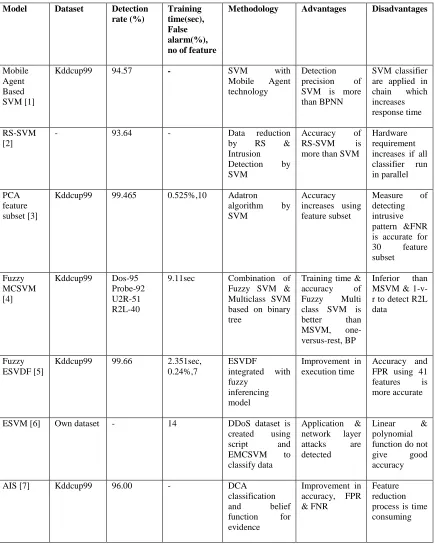
The comparison of all the literatures discussed above is shown in TABLE I. In the table, almost all approach used
the standard benchmark KDDCUP99 dataset for
experiment basis which potentially makes the task of comparison easy. The main aim of using SVM in real time application is due to its fast learning and classification. The main focus of incorporating IDS system in network is to increase the rate of attack detection and minimize the generation of false alarms. As KDDCUP99 dataset contains total 41 features, we need to train our data using all of them. The experimental results shows that by reducing the feature set before performing the experiment, we can observe improvement in the detection rate of the system. Also more time is required to process more features. So we can extract the useful feature which helps in improving the performance of our system.
Objective of this paper is to find the current challenges of IDS using SVM technique. From the comparison table shown below for the literatures studied, we can find response time [1][7] and detection rate [1][2][4][5][7] as two major challenges.
(1) Response time:
Reason for more response time is mentioned as following. First reason is the use of SVM classifier in sequential manner [1]. Second reason is use of all features [2][4].
Solution to the first problem is implementing SVM classifier in parallel. But parallel implementation requires more hardware resources.
As a solution to second problem, we can use PCA feature reduction technique to minimize feature set [3] which decreases the computational time and hence can improve response time.
(2) Detection rate:
Reason for low detection rate is selection of improper method for preprocessing the data [4][7].
As a solution to the problem stated above, results in the literatures show that improvement in detection rate is observed when PCA feature subset[3] is used instead of using fuzzy membership function[4] for preprocessing the dataset.
(3) False alarm:
Reason for false alarm generation in the system is either due to over training or lack of training provided the data points during preprocessing step.
In paper [3] by applying feature selection process, reduction in false alarm rate is achieved as training process is improved. By applying DCA and Dempster belief theory of paper [7] reduction in false alarm rate is observed as shown in experimental results.
VI. CONCLUSION
Various new types of attacks are generated everyday to harm network data. We need to protect and prevent our important assets that we exchange on the network. To detect these abnormal or attack data, we implement Intrusion Detection System. SVM have properties of high scalability and high speed of classification which proves it efficient for Intrusion Detection System. The current problem observed during the survey, are low detection rate and more response time for IDS using SVM. To achieve higher detection rate and low response time we should apply PCA feature reduction technique and parallel implementation of SVM classifier
VII. DECLARATION
All the content of the current paper is purely written by Pooja Champaneria under guidance of Bhavin Shan and Krunal Panchal. The content of this paper is written by Author1 (Pooja Champaneria) while Author2 (Prof. Bhavin Shah) had guided the work and Author3 (Asst. Prof. Krunal Panchal) had reviewed this paper. Hence Author1 is responsible for the content and issues related with plagiarism.
REFERENCES
[1] Guan Xiaoqing,Guo Hebin,Chen Luyi,“Network intrusion detection method based on Agent and SVM” ,The 2nd International Conference on Information Management and Engineering (ICIME), IEEE 2010.
[2] Liu Zhiguo, Kang Jincui, Li Yuan “A hybrid method of rough set and support vector machine in network intrusion detection” 2nd International Conference on Signal Processing System(ICSPS),IEEE 2010.
[3] Noreen Kausar, Brahim Belhaouari Samir, Suziah Sulaiman, Iftikhar Ahmad, Muhammad Hussain “An Approach towards Intrusion Detection using PCA Feature Subsets and SVM”International Conference on Computer & Information Science (ICCIS),IEEE 2012.
[4] Lei Li, Zhi-ping Gao, Wen-yan Ding ,“Fuzzy multi-class support vector machine based on binary tree in network intrusion detection”, International Conference on Electrical and Control Engineering(ICECE),IEEE 2010.
International Journal of Emerging Technology and Advanced Engineering
Website: www.ijetae.com (ISSN 2250-2459, ISO 9001:2008 Certified Journal, Volume 4, Issue 12, December 2014)
224 [6] Subbulakshmi T, Shalinie S. M, Ganapathi Subramanian V,
BalaKrishnan K, AnandKumar D, Kannathal K “Detection of DDoS attacks using Enhanced Support Vector Machine with real time generated dataset” Third International Conference on Advanced Computing(ICoAC), IEEE 2011.
[7] Singh S, Singh J P, Shrivastva G “A hybrid artificial immune system for IDS based on SVM and belief function”, Fourth International Conference on Computing, Communications and Networking Technologies(ICCCNT),IEEE 2013.
[8] D.S Bauer, M.E Koblentz “NIDX- an expert system for real-time network intrusion detection”,IEEE, Proceedings of the Computer Networking Symposium, 1988. pp. 98-106.
[9] Srinivas Mukkamala, Guadalupe Janoski, Andrew Sung “Intrusion Detection Using Neural Networks and Support Vector Machines”,IEEE, International Joint Conference on neural network,IEEE 2002.
[10] Safaa Zaman and Fakhri Karray “Features Selection for Intrusion Detection Systems Based on Support Vector Machines”, 6th IEEE
Consumer Communications and Networking Conference, IEEE 2009.
[11] V.N. Vapnik, “An Overview of Statistical Learning Theory”, IEEE Transactions on Neural Networks, 10(5):988-999, 1999.
[12] Xuehua Li, Lan Shu “Fuzzy Theory Based Support Vector Machine Classifier”, Fifth International Conference on Fuzzy Systems and Knowledge Discovery, IEEE 2008.
[13] Cortes C Vapnik V "Support-vector networks", 1995 Machine Learning20: 273.
[14] Ginny Mak, G. Ratzer, H. Vangheluwe “The implementation of support vector machine using the sequential minimal optimization approach”.
[15] A. Zadeh “Fuzzy Sets”, Information and Control 8,338-353, 1965. [16] Colin Campbell “Simple Learning Algorithms for Training Support
Vector Machines”.
[17] Mahesh Pal “Multiclass Approaches for Support Vector Machine Based Land Cover Classification”.
International Journal of Emerging Technology and Advanced Engineering
Website: www.ijetae.com (ISSN 2250-2459, ISO 9001:2008 Certified Journal, Volume 4, Issue 12, December 2014)
[image:6.612.91.526.161.706.2]225
TABLE I Comparison Table
Model Dataset Detection rate (%)
Training time(sec), False alarm(%), no of feature
Methodology Advantages Disadvantages
Mobile Agent Based SVM [1]
Kddcup99 94.57 - SVM with
Mobile Agent technology
Detection precision of SVM is more than BPNN
SVM classifier are applied in chain which increases response time
RS-SVM [2]
- 93.64 - Data reduction
by RS & Intrusion Detection by SVM
Accuracy of RS-SVM is more than SVM
Hardware requirement increases if all classifier run in parallel
PCA feature subset [3]
Kddcup99 99.465 0.525%,10 Adatron algorithm by SVM
Accuracy increases using feature subset
Measure of detecting intrusive pattern &FNR is accurate for 30 feature subset
Fuzzy MCSVM [4]
Kddcup99 Dos-95 Probe-92 U2R-51 R2L-40
9.11sec Combination of Fuzzy SVM & Multiclass SVM based on binary tree
Training time & accuracy of Fuzzy Multi class SVM is better than MSVM, one-versus-rest, BP
Inferior than MSVM & 1-v-r to detect R2L data
Fuzzy ESVDF [5]
Kddcup99 99.66 2.351sec, 0.24%,7
ESVDF integrated with fuzzy
inferencing model
Improvement in execution time
Accuracy and FPR using 41 features is more accurate
ESVM [6] Own dataset - 14 DDoS dataset is created using script and EMCSVM to classify data
Application & network layer attacks are detected
Linear & polynomial function do not give good accuracy
AIS [7] Kddcup99 96.00 - DCA
classification and belief function for evidence
Improvement in accuracy, FPR & FNR