FACULDADE DE
ENGENHARIA DA
UNIVERSIDADE DO
PORTO
Using named entity recognition for
relevance detection in social network
messages
Filipe Daniel da Gama Batista
Mestrado Integrado em Engenharia Informática e Computação Supervisor: Álvaro Pedro de Barros Borges Reis Figueira
Using named entity recognition for relevance detection in
social network messages
Filipe Daniel da Gama Batista
Abstract
The continuous growth of social networks in the past decade has led to massive amounts of in-formation being generated on a daily-basis. While a lot of this inin-formation is merely personal or simply irrelevant to a general audience, relevant news being transmitted through social networks is an increasingly common phenomenon, and therefore detecting such news automatically has become a field of interest and active research.
The contribution of the present thesis consisted in studying the importance of named entities in the task of relevance detection. With that in mind, the goal of this work was twofold: 1) to implement or find the best named entity recognition tools for social media texts, and 2) to analyze the importance of extracted entities from posts as features for relevance detection with machine learning.
There are already well-known named entity recognition tools, however, most state-of-the-art tools for named entity recognition show significant decrease of performance when tested on social media texts, in comparison to news media texts. This is mainly due to the informal character of so-cial media texts: the absence of context, the lack of proper punctuation, wrong capitalization, the use of characters to representemoticons, spelling errors and even the use of different languages in the same text. To address these problems, four different state-of-the-art toolkits — Stanford NLP, GATE with TwitIE, Twitter NLP tools and OpenNLP — were tested on social media datasets. In addition, we tried to understand how differently these toolkits predicted Named Entities, in terms of their precision and recall for three different entity types (PERSON, LOCATION, ORGANIZA -TION), and how they could complement each other in this task in order to achieve a combined performance superior to each individual one, creating an Ensemble of Toolkits.
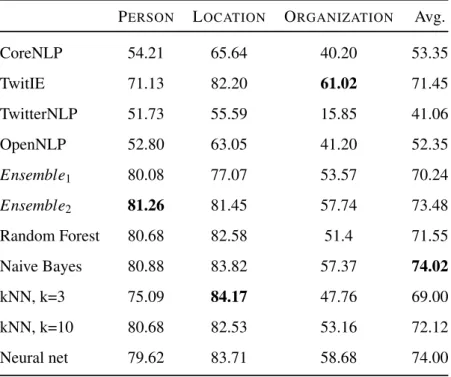
The developed Ensemble was then used to extract entities and different features were gener-ated: the number of persons, locations and organizations mentioned in a post, statistics retrieved fromThe Guardian’s open API, and finally word embeddings. Multiple machine learning models were then trained on a relevance-labelled dataset of tweets. The obtained performances of different combinations of selected features, ML algorithms, hyperparameters, and datasets, were analyzed. Our results on two publicly available datasets from the workshops WNUT-2015 and #MSM-2013 showed that the Ensemble of Toolkits was able to improve the recognition of specific entity types - up to 10.62% for the entity type PERSON, 1.97% for the type LOCATION and 1.31% for the type ORGANIZATION, depending on the dataset and the criteria used for the voting. Our re-sults also showed improvements of 3.76% and 1.69%, in each dataset respectively, on the average performance of the three entity types.
The relevance analysis showed that Named Entities can indeed be useful for relevance de-tection, proving to be useful not only when used alone, having achieved up to 73.4% of AUC, but also helpful when combined with other features such as word embeddings, having achieved a maximum AUC of 92.7% in that case, a 1.4% improvement over word embeddings alone.
Resumo
O crescimento contínuo das redes sociais ao longo da última década levou a que quantidades massivas de informação sejam geradas diariamente. Enquanto grande parte desta informação é de índole pessoal ou simplesmente sem interesse para a população em geral, tem-se por outro lado vindo a testemunhar cada vez mais a propagação de notícias importantes através de redes sociais. Como tal, a deteção automática destas notícias é uma temática cada vez mais investigada.
Esta tese foca-se no estudo da relação entre entidades mencionadas numa publicação de rede social e a respetiva relevância jornalística dessa mesma publicação. Nesse sentido, este trabalho foi dividido em dois grandes objetivos: 1) implementar ou encontrar o melhor sistema de reconheci-mento de entidades mecionadas (REM) para textos de redes sociais, e 2) analisar a importância de entidades extraídas de publicações como atributos para deteção de relevância com aprendizagem computacional.
Apesar de existirem diversas ferramentas para extração de entidades, a maioria apresenta uma perda significativa de desempenho quando testada em textos de redes sociais. Isto deve-se essen-cialmente à informalidade característica deste tipo de textos, traduzida pela ausência de contexto, pontuação desadequada, capitalização errada, representação deemoticons com recurso a carac-teres, erros gramaticais ou lexicais e até mesmo utilização de diferentes línguas no mesmo texto. Face a estes problemas, quatro ferramentas de reconhecimento de entidades — Stanford NLP, Gate com TwitIE, Twitter NLP tools e OpenNLP — foram testadas em “datasets" de redes sociais. Para além disso, tentamos compreender quão diferentemente é que estas ferramentas se comportavam, em termos de Precisão eRecallpara 3 tipos de entidades (PESSOA, LOCALe ORGANIZAÇÃO), e de que forma estas ferramentas se poderiam complementar de forma a obter um desempenho su-perior, criando assim umEnsemblede ferramentas de REM. O Ensemble desenvolvido foi então utilizado para extrair entidades, e diferentes atributos foram gerados: o número de pessoas, locais e organizações mencionados numa publicação, estatísticas obtidas a partir da API pública do jornal The Guardian, e finalmenteword embeddings. Vários modelos de aprendizagem foram treinados num dataset detweetsmanualmente anotados. Os resultados obtidos das diferentes combinações de atributos, algoritmos,hyperparameterse datasets foram analisados.
Os nossos resultados em dois datasets públicos, das conferências WNUT-2015 e #MSM2013, mostraram que utilizar o Ensemble de ferramentas de NER melhorou o reconhecimento de tipos de entidade específicos - até 10.62% para PESSOA, 1.97% para LOCALe 1.31% para ORGANI
-ZAÇÃO, dependendo do dataset e do critério de voto utilizado. Os resultados motraram também melhorias de 3.76% e 1.69% na média geral dos três tipos de entididades, em cada um dos datasets mencionados, respectivamente.
A análise de relevância mostrou que entidades mencionadas numa publicação podem de facto ser úteis na deteção da sua relevância, não apenas quando usadas isoladamente, tendo alcançado até 73.4% de AUC nesse caso, mas também úteis quando combinadas com outros atributos como word embeddings, tendo alcançado nesse caso um máximo de 92.7%, uma melhoria de 1.4% em relação a usar exclusivamenteword embeddings.
Acknowledgements
First, I would like to thank my supervisor Álvaro Figueira, for his help and guidance along the course of this thesis.
I would also like to thank the whole team of project REMINDS, especially my friends Filipe Miranda and Nuno Guimarães for their constant availability and helpful suggestions. I would also like to extend my appreciation to the “ERDF – European Regional Development Fund through the COMPETE Programme (operational programme for competitiveness)" and “FCT (Portuguese Foundation for Science and Technology)", for financing project REMINDS and my research grant. Last but not least, I would like to express my deepest gratitude for everyone that supported me throughout this journey, including my family, girlfriend and closest friends.
“The important thing is not to stop questioning. Curiosity has its own reason for existing.”
Contents
1 Introduction 1
1.1 Context . . . 1
1.2 Project . . . 2
1.3 Motivations and Goals . . . 2
1.4 Thesis structure . . . 3
2 Named Entity Recognition: Literature review 5 2.1 Introduction . . . 5 2.2 The NLP Pipeline . . . 5 2.2.1 Tokenization . . . 6 2.2.2 POS tagging . . . 6 2.2.3 Chunking . . . 6 2.2.4 NER . . . 7 2.3 Methodologies . . . 7 2.3.1 Dictionary-based Approach . . . 7 2.3.2 Rule-based Approach . . . 8
2.3.3 Machine Learning Approaches . . . 8
2.4 Evaluation measures in NLP . . . 9 2.5 Corpora types . . . 11 2.5.1 Formal text . . . 11 2.5.2 Informal text . . . 11 2.6 NLP toolkits . . . 13 2.6.1 Stanford CoreNLP . . . 13 2.6.2 NLTK . . . 14 2.6.3 OpenNLP . . . 14 2.6.4 GATE - ANNIE . . . 14 2.6.5 Twitter NLP tools . . . 15 2.6.6 TwitIE . . . 15 2.6.7 Performance comparison . . . 15
2.6.8 Ensemble methods in NER . . . 16
2.7 Conclusions . . . 17
3 Features in Machine Learning: Literature review 19 3.1 Feature Selection . . . 19
3.1.1 Filter Methods . . . 20
3.1.2 Wrapper Methods . . . 20
3.1.3 Embedded Methods . . . 22
CONTENTS
3.2 Feature Construction . . . 22
3.3 Conclusions . . . 23
4 Named Entity Recognition on Social Media Texts 25 4.1 Problem definition . . . 25
4.2 Solution outline . . . 25
4.3 Experimental Setup . . . 27
4.3.1 Datasets . . . 27
4.3.2 Toolkits and Data preparation . . . 28
4.3.3 Ensemble voting methods . . . 29
4.4 Experimental results . . . 30
4.4.1 Dataset 1 - REMINDS . . . 30
4.4.2 Dataset 2 - WNUT NER . . . 32
4.4.3 Dataset 3 - #MSM2013 . . . 34
4.4.4 Dataset 4 - Subset of #MSM2013 . . . 35
4.5 Results summary . . . 36
4.6 Ensemble tool implementation in Java . . . 36
4.7 Conclusions . . . 37 5 Relevance Detection 39 5.1 Problem definition . . . 39 5.2 The Data . . . 40 5.2.1 Training Dataset 1 . . . 40 5.2.2 Validation dataset . . . 40 5.2.3 Feature extraction . . . 41 5.3 Descriptive Analysis . . . 43 5.3.1 Data distribution . . . 43
5.3.2 Feature correlation analysis . . . 43
5.3.3 Feature weights by Information Gain Ratio . . . 46
5.4 Predictive Analysis . . . 46 5.4.1 Methodology . . . 46 5.4.2 Experimental results . . . 47 5.5 Conclusions . . . 53 6 Conclusions 55 6.1 Synthesis . . . 55 6.2 Contributions . . . 57 6.3 Future work . . . 57 References 59 A Chapter 4 Extended results 63 B Detailed specifications of experimental setups 65 B.1 Ensemble NER . . . 65
B.1.1 Naïve Bayes classifier: . . . 65
B.1.2 Random Forest classifier: . . . 65
B.1.3 k-nearest neighbors classifier (k-NN): . . . 66
B.1.4 Neural Network classifier: . . . 66
CONTENTS
B.2 Relevance Detection . . . 66
B.2.1 Random Forest classifier: . . . 66
B.2.2 Logistic Regression classifier: . . . 67
B.2.3 SVM classifier: . . . 67
B.2.4 Neural Network classifier: . . . 68
B.2.5 Deep Learning classifier: . . . 68
CONTENTS
List of Figures
4.1 F1-scores of the entities Person, Location and Organization on the REMINDS
dataset . . . 31
4.2 F1-scores of the entities Person, Location and Organization on the WNUT dataset 33 4.3 F1-scores of the entities Person, Location and Organization on the MSM13 dataset 34 5.1 Example tweet from “Reuters Top News" . . . 41
5.2 Entity type distribution . . . 43
5.3 Correlation matrix for numerical features . . . 44
LIST OF FIGURES
List of Tables
2.1 NER toolkit performance comparison for 2 different datasets [PGOOA16] . . . . 16
3.1 Feature selection methods . . . 22
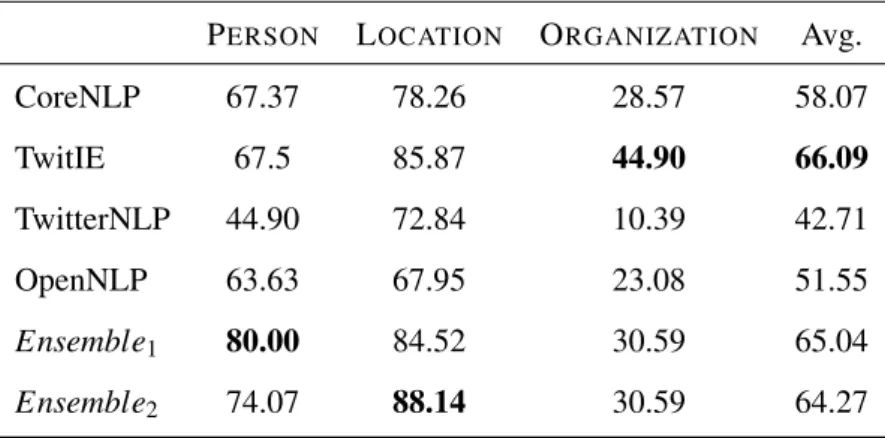
4.1 F1scores on Dataset 1 . . . 30
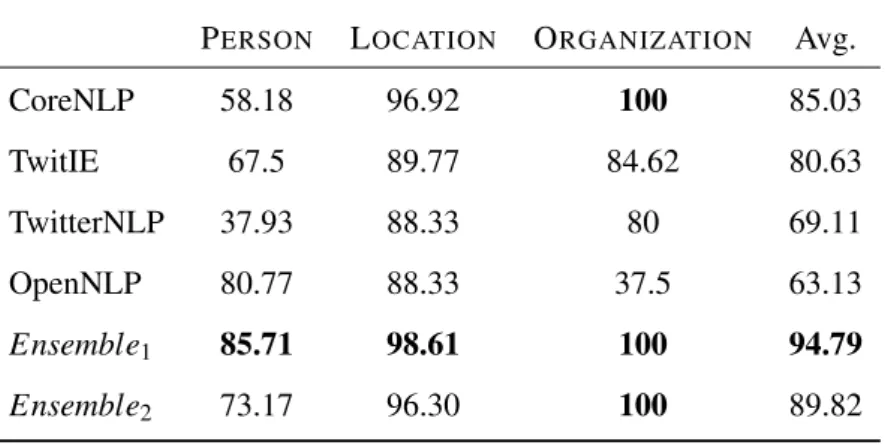
4.2 Recall scores on Dataset 1 . . . 32
4.3 Precision scores on Dataset 1 . . . 32
4.4 F1-scores on Dataset 2 . . . 33
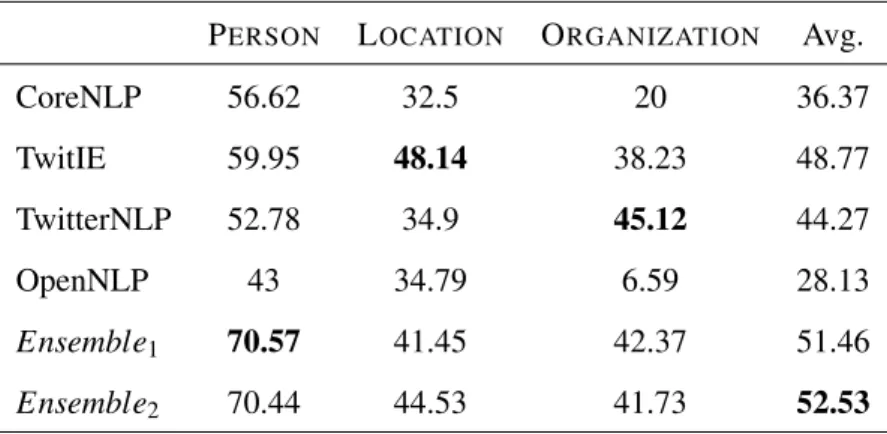
4.5 F1 scores on Dataset 3 . . . 34
4.6 F1 scores on Dataset 4 . . . 35
5.1 Features list . . . 42
5.2 Feature weights by information gain ratio . . . 46
5.3 Random Forest results . . . 48
5.4 Naive Bayes results . . . 49
5.5 Feature weights by Tree Importance . . . 50
5.6 Feature Selection . . . 50
5.7 Algorithms’ performances comparison with numerical entity features . . . 51
5.8 Original cross-validation results versus validation set results (Naive Bayes) . . . 52
5.9 Ensemble Results versus Stanford Results using Naive Bayes . . . 53
A.1 Recall scores on Dataset 2 . . . 63
A.2 Precision scores on Dataset 2 . . . 63
A.3 Recall scores on Dataset 3 . . . 64
LIST OF TABLES
Abbreviations
NLP Natural language processing NER Named entity recognition POS Parts-of-speech
SVM Support vector machines
CoNLL Conference on Computational Natural Language Learning CRF Conditional Random Field
REMINDS Relevance Mining Detection System ML Machine Learning
API Application Programming Interface TP True positive
TN True negative FP False positive FN False negative
SFS Sequential Forward Selection SBS Sequential Backward Selection
Chapter 1
Introduction
This chapter will present the context of this thesis, not only in terms of its scientific domain but also in terms of the research project this thesis finds itself integrated in. The motivations and goals of this work will be explained, along with problems it aims to solve.
This introduction will also provide a brief summary of each of the following chapters.
1.1
Context
Everyday millions of people worldwide use social networks to communicate and share their opin-ions about virtually any topic. Well-known social networks such as Facebook and Twitter gener-ate and store massive amounts of data every second, constantly increasing potentially useful data available for study. With so much data being stored everyday emerges the obvious opportunity to analyze such data and learn from it.
On one hand, people began to willingly leave their footprint behind, by not only commenting and leaving their opinions on the Internet but also by creating and filling in their own online profiles. Therefore, most of this data could be considered personal and irrelevant to a general audience.
On the other hand, the phenomena of relevant information being transmitted through so-cial networks before being reported by the traditional media is becoming increasingly common [KLPM10]. In fact, social networks have enabled anyone with access to the Internet to report inci-dents around them in real time, creating a global “word of mouth" effect, as witnessed in multiple situations such as the recent Paris and London terror attacks.
The ability to detect and gather such information from multiple and scattered sources within the massive stream of posts generated by these social networks is therefore very useful for news agencies [BG13], which need to review and structure the information as soon as possible in order to deliver it as “news" to the public. This task, however, is very hard and presents great challenges becoming, as a result, a field of active research in recent years [MCG15,GAPGC+13].
Introduction
1.2
Project
The work of this thesis is integrated in a international research project, REMINDS, which stands for RElevance MINing Detection System.
This project is supported by the ERDF – European Regional Development Fund through the COMPETE Programme (operational programme for competitiveness) and by National Funds through the FCT (Portuguese Foundation for Science and Technology).
The goal of REMINDS is to build a system capable of automatically detecting relevant in-formation (in a news-worthy sense of relevance) in social media, by using machine learning to develop predictive data mining models.
To achieve this purpose, different algorithms have been be trained and tested on different manually labeled datasets, with a number of extracted features, in an attempt to obtain the best model able to predict the relevance of a social media post.
1.3
Motivations and Goals
While several studies have been conducted to address the problem of relevance detection [MCG15, GAPGC+13], there is still room for research.
The main motivation of the present thesis is to contribute to such research, by analyzing the potential usefulness of named entities mentioned in a post for assessing the relevance of the cor-responding post.
A named entity is a “sequence of words that designate some real-world entity" [AZ12], for example, the words “New York" should be identified and classified with the type LOCATION, while the words “Barack Obama" should be classified with the type PERSON. The process of identifying named entities in plain text is called Named Entity Recognition (NER), a sub-field of Information Extraction.
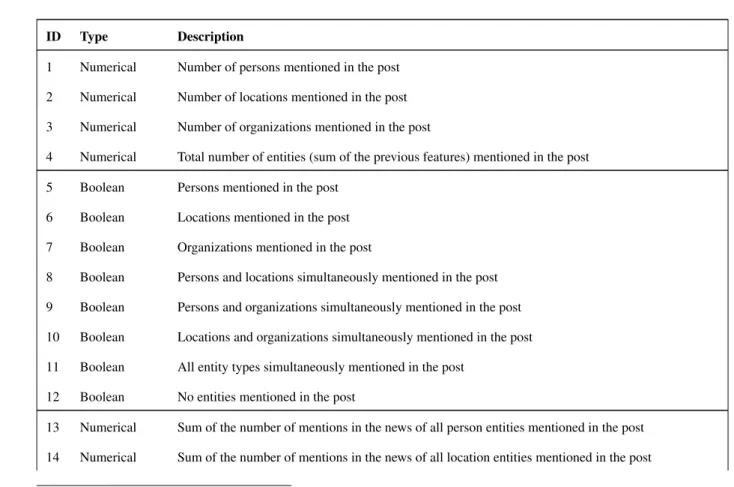
That being said, the main goal of this thesis is to try multiple features based on named entities mined from the text of the posts, such as the number of persons, locations and organizations mentioned in a post, together with features previously used in the project, and analyze how these features improve the system.
However, mining text data on social networks presents great challenges [RCE+11]. The main challenge consists in the difficulty of dealing with its non-standard vocabulary: the absence of context, the lack of proper punctuation, wrong capitalization, the use of characters to represent emoticons, spelling errors and even the use of different languages in the same text, are some examples of common problems which have been shown to significantly decrease named entity recognition performance, even on reputable state-of-the-art tools.
For that reason, the intermediate goal of this thesis is to study different state-of-the-art tools for NER — namely Stanford NER, OpenNLP, Twitter NLP tools and GATE with TwitIE — in the context of social media.
Introduction
In an attempt to attenuate the limitations imposed by the characteristics of this type of text, it is our goal to combine these tools to achieve the best possible performance in the task of entity recognition.
This will allow a more efficient entity extraction on posts from Facebook or Twitter, which will serve as the basis for our main purpose of studying relevance detection.
In summary, the goals of this thesis are as follows:
1. Compare different state-of-the-art tools for Named Entity Recognition in social network messages
2. Analyze how differently they perform in terms of the core entity types: PERSON, LOCA
-TION, ORGANIZATION
3. Study the possible complementary nature of such toolkits, by using rules and machine learn-ing to combine their outputs
4. Create an automatized ensemble of such NER tools with enhanced performance and use it for extracting entities from the relevance-labeled dataset
5. Perform feature extraction from the entities obtained in the previous goal 6. Study the importance of named entities for the task of relevance detection
1.4
Thesis structure
This thesis is structured as follows. In chapter2, a literature review on Named Entity Recognition will be presented, including its context on Natural Language Processing, the methodologies nor-mally used to perform this task, and the differences and difficulties encountered when performing Named Entity Recognition on social media texts versus formal texts. Chapter3 will provide a brief literature review on feature analysis for classification systems, including feature engineering, selection and generation techniques. Chapter4will be focused on the utilization of toolkits for the extraction of named entities, as well as the results of a developed Ensemble of those NER tools. In chapter 5, we will cover the process of features extraction based on named entities, and the importance of each feature in different machine learning models for relevance detection. Finally, in chapter6, we will summarize the results of the whole work and present our final conclusions.
Introduction
Chapter 2
Named Entity Recognition: Literature
review
This chapter presents the state of the art of Named Entity Recognition on different types of text, by reviewing related works and studies found in literature.
By the end of this section it should be clear what the current state of named entity recogni-tion is, not only on formal texts but especially on social media texts, and what measures can be implemented in order to tackle some of the challenges of these types of texts.
This chapter will also cover different tools chosen to be experimented in this project, and provide a brief summary about each of these tools.
2.1
Introduction
Information extraction is the branch of text mining that aims to gather information from unstruc-tured data. Named entity recognition is a sub-field of information extraction: its task is to structure data by finding names of entities such as people, organizations and locations within some text, and tag them with the respective predefined “label".
For example, given the unstructured sentence “In 2016, Donald Trump won the presidency of the United States", it would be expected of a named entity recognizer the following output:
“In[2016]time,[Donald Trump]personwon the presidency of the[United States]location”
2.2
The NLP Pipeline
In order to perform named entity recognition on a text, usually some preprocessing steps need to be taken beforehand. This preprocessing is often split into separate but sequential modules, where
Named Entity Recognition: Literature review
the output of one module is used as input by the next module, following what is called a pipeline design.
There is no standard structure for NLP pipelines, since multiple variations of the same can be found in literature. However, there are some common steps among most of the pipelines proposed, including tokenization, POS tagging, chunking and finally NER itself.
2.2.1 Tokenization
The tokenization step consists in dividing the text into multiple tokens. In the current context, tokens are usually words. While tokenization might appear to be a simple task, rules must be defined in order to clarify what a word is. A naive way to do so would be to consider a token every string separated by a whitespace. For instance, given the input string “In 2016, Donald Trump won the presidency of the United States", the corresponding output should be the following list of words: [’In’, ’2016,’,’Donald’, ’Trump’,’won’, ’the’, ’presidency’, ’of’, ’the’, ’United’, ’States’,’.’].
However, simple approaches are usually unable to solve certain ambiguities. For example, the commas and periods in “100.200,10" have a specific purpose and therefore the number should not be split as if it was a sentence [ARS13].
Current state of the art tokenizers such as the Stanford tokenizer use more sophisticated heuris-tics that allow it to determine when punctuation implies sentence boundaries, when single quotes are parts of words, etc. Recently, a high performance tokenizer was proposed, claiming to be 13.9 times faster than the Stanford while using half the memory [ARS13].
2.2.2 POS tagging
A Part-Of-Speech Tagger (POS Tagger), assigns a part-of-speech to each token previously ex-tracted. Examples of parts-of-speech are nouns, verbs, adjectives, adverbs, and determiners. There are different POS Tagsets available, the most commonly used being the Penn TreeBank [MMS93], composed of 45 tags.
Using the Stanford POS tagger as a state-of-the-art example, for the input string “This is an example sentence", the output tagged sentence would be “This_DT is_VBZ an_DT example_NN sentence_NN ", where DT stands for determiner, VBZ for Verb in the 3rd person singular present, and NN for Noun, singular.
Stanford NLP pipeline offers two different models for POS tagging, namely a bidirectional model and L3W (Left 3 words) model, the latter being the preferred tagger to use in practice. These models achieved respective accuracies of 97.32% and 96.89%, but the LW3 model was 18 times faster than the Bidirectional model [ARS13].
2.2.3 Chunking
Chunking (or shallow parsing), consists in finding short phrases, such as noun-phrases, inside a sentence.
Named Entity Recognition: Literature review
While POS tagging assigns parts-of-speech to each token individually, chunking goes further by grouping different parts-of-speech to give some insight about the structure of the sentence.
Taking the example given by Bird et al. [BKL09], for the input sentence: “We saw the yellow dog", the tagging output should have been “We_PRB saw_VBD the_DT yellow_JJ dog_NN ". Then, this tagged sentence would be fed as input to the chunking module, which would output the following “[We]_NP saw [the yellow dog]_NP".
In this case, “saw" was not grouped in any chunk. The standard representation for chunking is the IOB representation. “I" stands for an inside chunk, “O" for an outside chunk and “B" for the beginning of a chunk. Using this notation for the previous example, the output of the chunker would be: “[We]_B-NP [saw]_O [the]_B-NP [yellow]_I-NP [dog]_I-NP". [BKL09]
Chunking can be seen as a middle ground between full parsing and POS tagging. The idea be-hind chunking is that full parsing is computationally expensive and not always necessary. Besides, parsing adapts badly to new domains [BKL09], such as Twitter.
Chunkers can be regular expression-based, using only part-of-speech tags to decide the chunks. However using part-of-speech tags only and ignoring the content of the the words might not be sufficient. To solve this problem, a classifier-based chunker could be used [BKL09].
2.2.4 NER
The output from chunking will provide useful features for named entity recognition. For example, named entities are essentially definite noun phrases [BKL09], which were previously labeled by the chunking module.
The NLP pipeline usually does not end in entity recognition. It could proceed to other tasks af-ter named entity recognition, for example, relation extraction. For the scope of this work, however, further NLP tasks will not be discussed.
The entity recognition module of the pipeline will be comprehensively explained in the next section.
2.3
Methodologies
To perform Named Entity Recognition, different approaches were proposed over time. Early sys-tems started by implementing dictionaries, relying on a list of named entities [WA86]. Later, rule-based approaches were introduced to complement dictionary-rule-based approaches and solve prob-lems such as proper name recognition [SN14]. Nowadays, many state of the art entity recognizers use supervised machine learning to reduce the work of manually of defining rules, by automatizing the process.
2.3.1 Dictionary-based Approach
This approach makes use of a dictionary (also commonly referred to as gazetteer or lexicon) of named entities. A dictionary is no more than a list of words already labeled with a named entity.
Named Entity Recognition: Literature review
For every word in a text, the algorithm simply checks its corresponding category in the dictionary, and assigns that category to the word.
The obvious problem with this approach is the very large number of words existent and the impracticability of manually defining the correct entity of each one, and also the ambiguity of some words whose entity type might be context-dependent. Most NER systems also need frequent updates, which are not practical with this approach.
Dictionary-based approaches can be useful, however, in conjunction with other approaches or in specific contexts where we are only interested in identifying entities of a small and not very dynamic dictionary [Ker16].
2.3.2 Rule-based Approach
Rule-based approaches have also been widely used in Named Entity Recognition.
These approaches rely on a set of rules, which are no more than “if-then" statements: if a pattern, which can be defined by a regular expression for example, is detected in the text, then a predefined corresponding action is triggered.
Let us follow the example from Mining Text Data (Charu C. Aggarwal,ChengXiang Zhai,2011) [AZ12]:
“to label any sequence of tokens of the form “Mr. X" where X is a capitalized word as a person entity, the following rule can be defined:
(token = “Mr." orthography type = FirstCap) -> person name
The left hand side is a regular expression that matches any sequence of two tokens where the first token is “Mr." and the second token has the orthography type FirstCap. The right hand side indicates that the matched token sequence should be labeled as a person name.”
To prevent cases where multiple rules happen to be matched in a given string, a protocol should be defined to handle these conflicts appropriately. A simple way to handle conflicts is to order the rules by their priority, so that only the “stronger" rule is applied, for example. [AZ12]
These rules can either be defined manually or learned automatically (explained in the next subsection in further detail). The first approach is very demanding, and therefore expensive. The latter approach transfers most of the workload to the computer, although it still needs a training set with manually labeled named entities.
2.3.3 Machine Learning Approaches
Machine learning approaches have also been widely used for Named Entity Recognition. They are more versatile than rule-based approaches, and require less hand-work.
NER can be seen as multi-class classification problem. In this case, a dataset using some features will be used to train a model.
Named Entity Recognition: Literature review
2.3.3.1 Algorithms
One of the most commonly used ML approaches for named entity recognition is Conditional Random Fields (CRF), a special case of Markov Random Fields [AZ12]. The widely known Stanford Named Entity Recognizer implements a CRF [FGM05].
Notwithstanding, many other ML algorithms can be used for NER. In fact, sixteen systems have participated in the CoNLL-2003 shared task using multiple different machine learning ap-proaches, including Maximum Entropy Models (MEM), Hidden Markov Models (HMM), Support Vector Machines (SVM), among others. Some of the participants of the ConLL-2003 used com-binations of previously mentioned ML algorithms, with good results. [TKSDM03]
Ensemble learning for named entity recognition has also been evaluated in [SN14], where the authors compared several ML algorithms with this approach. This work concluded that NER based on ensemble learning can achiever higher F1-scores than most state-of-the-art algorithms (Stan-ford NER, Illionois,Balie, OpenNLP) and higher F1-scores than simple voting methods (studied for example by Wu et al. [WNC03]).
ML approaches can also be used in conjunction with previously explained approaches such as Rule or Dictionary based. In fact, most of the current implementations of Named Entity Recog-nition rely on a combination of some machine learning algorithm with one or even both of these approaches [Ker16].
2.3.3.2 Features
According to [TKSDM03], choosing good features is not only important but at least as important as choosing the learning approach.
In the ConLL-2003 shared task [TKSDM03] the features used included affix information (n-grams), parts-of-speech, bag-of-Words, global case information, chunk tags, global document in-formation, gazetteers, lexical features, orthographic information and patters, previously predicted named entities, quotation information and trigger words.
Studies have been conducted to study the best features for Named Entity Recognition. Tkach-enko et al. [TS12] explored multiple combinations of features and compared their impact on NER performance. The results showed that the set of features used had a significant impact on the performance of NER.
In summary, most state-of-the-art tools rely on machine learning approaches for Named Entity Recognition, due to their versatility and reduced overhead. However, other methods might be helpful in a few cases, such as when dealing with specific small domains.
2.4
Evaluation measures in NLP
Performance in classification systems is measured by comparing the output of a classifier on un-seen data with a golden standard - made by human annotators, and assumed as correct. A certain
Named Entity Recognition: Literature review
prediction can be either Positive or Negative, and according to the golden standard, that prediction can be True or False.
In the context of information extraction: [GAT]
• True Positive (TP) - corresponds to a correct annotation
• False Positive (FP) - the annotation is present in the output set but not in the golden standard set
• False Negative (FN) - the annotation is present in the golden standard set but not in the output set
• True Negative (TN) - the annotation is absent in both sets. Therefore, it is not considered in IE measures.
There are two ways of counting true positives. The strict way considers “only correct anno-tations covering exactly the correct span of text" while the leniant way considers that “«partially correct» or «overlap» annotations also count as correct: correct annotation covering part of the cor-rect span of text (shorter, longer, overlapping at either end)" [GAT]. Common metrics to measure performance of classification tasks include:
Accuracy: Calculates the percentage of correct predictions.
A= T P+T N
T P+T N+FP+FN (2.1)
Precision: Represents the ratio between correctly identified instances of a certain class and all the predictions made for that class.
P= T P
T P+FP (2.2)
Recall: Represents the ratio between correctly identified instances of a certain class and all the instances of that class. Thus, it tells us how much of the class is being predicted by the classifier.
R= T P
T P+FN (2.3)
Recall and Precision measures are not sufficient when used independently, meaning that know-ing recall without knowknow-ing precision, or vice-versa, does not provide enough information about the performance of the system. The most common way to combine Recall and Precision in one single measure is the F-measure.
F-measure: Calculates the harmonic mean of precision and recall. The relative importance (weight) of each component (precision and recall) is controlled by theβ parameter (higher values
ofβ mean more weight on recall) [CFL13].
Named Entity Recognition: Literature review
Fβ=(β
2+1)×P×R
β∗P+R (2.4)
F1 score: Used when both measures have the same importance (β = 1)
F1=2×P×R
P+R (2.5)
2.5
Corpora types
2.5.1 Formal textMost of the initial NER research focused on news articles, scientific articles, books or web pages [MWC05].
The text found in these types of documents is usually formal: writers are generally careful and therefore mistakes or non-standard words are not to be expected. Besides, formal texts are usually meant to be understood by anyone who could possibly read them. For this reason, they are usually clear and avoid incurring in context ambiguities.
This type of text has been studied extensively through different approaches and state-of-the-art systems, such as the Stanford NER, achieving F1 scores of over 92.0% [LZWZ11].
2.5.2 Informal text
Named entity recognition on formal text has been studied for longer than social media text. NER research started growing in early 1990’s, while major social networks appeared more than a decade later - Facebook was founded in 2004 and Twitter in 2006.
With huge (and still growing) social networks such as these, generating huge amounts of text data mostly written by the users, the study of NER applied to social media texts has increased greatly over time.
It is important to stress that social media texts differ from previously studied texts in their lack of formality and standardization. These differences have been shown to severely degrade the performance of standard NLP tools [RCE+11], and therefore multiple research studies have been conducted in an attempt to attenuate such losses.
Some of these problems, and proposed approaches in the literature, are listed below:
• Lexical variations
In social media it is very frequent to see lexical variations of words, either misspellings or often just to make texts more compact. For example, “tomorrow" could be written as “tomorow", “2morrow" or even “2m". An usually effective way to deal with these lexical variations is by using brown clustering [RCE+11], which relies on distributions to determine the similarity between words. The intuition behind brown clustering is that similar words
Named Entity Recognition: Literature review
appear in similar contexts, i.e. similar words have similar distributions of words that precede and follow them. This method can be applied to misspellings and abbreviations.
• Non-standard capitalization
Capitalization is an important detail in POS tagging and Named entity recognition since it often carries the information of whether a word is a proper noun or a common noun. For example, losing this information might lead a named entity recognizer to understand “apple" as a fruit, when it actually meant “Apple", the technology company.
In [DMR+15] a comparison of NER performances between capitalized and non-capitalized text was conducted, using the Standord NER, part of the CoNLL dataset (Tjong Kim Sang et al., 2003), and the same dataset with all tokens lowercased. In the first dataset (the original) the authors obtained 89.2 precision and 88.5 recall. In the lowercased dataset, the precision dropped to 81.7 and the recall to 4.1.
Restoring capitalization (truecasing) is therefore useful for multiple NLP tasks. Strategies to overcome the problem of unreliable capitalization have been proposed in existing literature. A recent article [NBG15] uses an SVM classifier to determine if the capitalization of a given tweet is informative or uninformative. According to [NBG15], this approach performed better than the Stanford Truecaser which implements a discriminative model using a CRF sequence tagger.
• Wrong punctuation and use of emoticons
As previously mentioned, punctuation is very important in NLP tasks, especially for the tokenization part, since it often uses punctuation as one of the criteria to delimit tokens. Many users, however, use punctuation to different purposes, such as to elaborate emoticons: “8<:-)”, “orz” (represents a kneeling man), “<(-’.’-)>”, “(ò_ó)” or “(=^-^=)”. The range of possibilities is so large that it would be nearly impossible to cover all of them in a dictionary. The use of characters to represent emoticons presents a challenge in the tokenization pro-cess, as punctuation is very important to determine where two tokens should be separated [LSTO10]. In [LSTO10] a classification-based approach using SVM was tested, and shown to outperform rules manually defined for the purpose of tokenization.
• Use of multiple languages
Most information extraction methods are primarily focused on the English language. How-ever, the presence of other languages in social media texts is far from negligible. In fact, a study has shown that in a 62 million tweet dataset only 51% of the tweets were actually writ-ten in English [HCC11]. Most of the algorithms used for English text perform worse when applied to other languages, and are also difficult to adapt to multiple languages [DMR+15].
Named Entity Recognition: Literature review
One approach to deal with this problem is to identify the language being used before an-alyzing the text, and then choosing the algorithm according to the language. The TwitIE is an example of a toolkit which implements language identification as the first step of the pipeline [BDF+13].
This approach, however, does not solve the problem of multiple languages being used within the same post.
• Infrequent named entity types and lack of context
The fact that tweets are limited to short messages means they often lack sufficient context to disambiguate the types of the entities mentioned in them. Usually, we (humans) can easily understand these mentions because we have some prior knowledge that allows us to understand what the likely context of that post is. For a computer, however, this can be difficult to achieve since more training data is needed. This problem gets even worse due to the fact that many different entity types can be found in Tweets, requiring even more training data [RCE+11]. Ritter et al. addresses this problem with a distant supervision approach applying LabeledLDA [RCE+11], to make use of a large list of entities gathered from Freebase [BEP+08], an open-domain ontology, with large amounts of unlabeled data in learning.
2.6
NLP toolkits
2.6.1 Stanford CoreNLPWidely used as reference in NLP tasks, the Stanford CoreNLP1provides a set of natural language processing tools. As stated in [Cor16] “it can give the base forms of words, their parts-of-speech, whether they are names of companies, people, etc., normalize dates, times, and numeric quantities, mark up the structure of sentences in terms of phrases and word dependencies, indicate which noun phrases refer to the same entities, indicate sentiment, extract particular or open-class relations between entity mentions, get quotes people said, etc".
The Stanford NER2is able to detect the following named entities: PERSON, LOCATION, OR
-GANIZATION, MISC, MONEY, NUMBER, ORDINAL, PERCENT, DATE, TIME, DURATION, SET
[Cor16].
Stanford CoreNLP can be used from the command-line, from its Java API or using third party APIs when using other programming languages [Cor16] (Python, Ruby, Perl, Scala, Clo-jure, Javascript (node.js), and .NET languages [MSB+14]) . Compared to other frameworks, it is said to be simple to set up and use [PGOOA16].
1http://stanfordnlp.github.io/CoreNLP/
Named Entity Recognition: Literature review
At the tokenization level, CoreNLP tries to mimic the Penn Treebank 3 tokenization [MMS93] and implements a Maximum Entropy Model. At the NER level, CoreNLP uses a Conditional Random Field (CRF) and is trained with the CoNLL-2003 dataset.
2.6.2 NLTK
NLTK3is another toolkit, written in Python, for Natural Language processing, gathering not only program modules (tokenizers, taggers, chunkers, entity recognizers) but also different datasets, lexicons and tutorials.
One of the primary principles of NLTK, besides simplicity, consistency and extensibility, was modularity. Modularity provides components that can be used independently [BKL09]. This might be specially useful to tune only specific parts of the pipeline or even use third parties in conjunction with this toolkit. Since NLTK uses Python, other Python libraries can also be used to complement it, such as Scikits.learn, which includes algorithms for machine learning and prepro-cessing.
The efficiency of NLTK in terms of runtime performance is not highly optimized, since the goal of NLTK was to provide a simple and easy to understand out of the box tool, mainly for learning purposes [BKL09].
2.6.3 OpenNLP
The Apache OpenNLP4[Fou] is another natural language processing library written in Java, but it can also be used in R using the openNLP package.
It is machine learning based and supports tokenization, sentence segmentation, part-of-speech tagging, named entity extraction, chunking, parsing, and co-reference resolution.
With this toolkit it is possible to either use out-of-the-box pre-trained models or to train a Perceptron or a Maximum Entropy Model, for each of the mentioned NLP tasks. POS tagging and chunking make use of the Penn Treebank tagset, and the Chunker is trained on the CoNLL-2000 dataset [PGOOA16].
OpenNLP is able to detect entities of the typesPERSON,LOCATION,ORGANIZATION,TIME, DATEandPERCENTAGE, when using the pre-trained models provided.
2.6.4 GATE - ANNIE
GATE5 is an open source software for solving text processing problems, including Information Extraction, which is done by a built-in IE component set called ANNIE [CMBT02].
This component includes a Sentence Splitter (which tries to identify individual sentences in documents), a POS Tagger and three different Named Entity Recognition resources:
• ANNIE Gazetteer is a dictionary-based NER engine.
3http://www.nltk.org/book/ 4https://opennlp.apache.org/ 5https://gate.ac.uk
Named Entity Recognition: Literature review
• ANNIE NE Transducer is rule-based NER
• ANNIE OrthoMatcher is rule-based NER
With this tool it is possible to add new entity types manually, besides the traditional entities
PERSON,LOCATION,ORGANIZATION.
ANNIE components can be used independently or even in conjunction with customized mod-ules in order to create new applications [BDF+13].
2.6.5 Twitter NLP tools
Ritter et al. [RCE+11] rebuilt the NLP pipeline (POS tagging, chunking and NER), for the specific purpose of dealing with Tweets.
The novelty of this pipeline is that it “leverages the redundancy inherent in tweets" outper-forming this way the Stanford NER system, by training tools on unlabeled in-domain and out-of-domain data [RCE+11].
This NER tool can deal with distinctive named entity types, by using Freebase and LabeledLDA. Some of these distinctive types arePRODUCT,TV SHOWandFACILITY.
2.6.6 TwitIE
TwitIE is a full GATE pipeline, including [BDF+13] social media data Language identification, Twitter tokenizer, Twitter part-of-speech tagger and Text normalization.
It is another open-source NLP tool customized for Twitter text at every module of the pipeline [BDF+13], based on GATE’s ANNIE algorithms.
As explained before in2.6.4, ANNIE’s modules can be integrated with new customized ones. That being said, TwitIE makes use of the default ANNIE’s sentence splitter (given that most tweets consist in only one sentence, changing this module would not lead to significant improvements) and name gazetteer (which includes lists of cities, organizations, days of the week, etc.), but the other components of the pipeline have been adapted.
The first step of the pipeline is language identification. Then for the tokenization module, TwitIE follows Ritter’s approach [RCE+11][BDF+13]. The following two steps are sentence split-ting and gazetteer look-up, which are the unmodified ANNIE’s modules. After that, there is the normalizer, which is basically a spell-corrector designed for social media texts. Then comes the POS tagger, an adapted version of the Stanford POS tagger. All these modifications proved useful for the final component of the pipeline, NER, which has performed better than Ritter’s approach [BDF+13].
2.6.7 Performance comparison
Table2.1, taken from a study of different NER toolkits by Pinto et al. [PGOOA16], presents the precision, recall and F1 scores of five different toolkits (NLTK, OpenNLP, CoreNLP, TwitterNLP,
Named Entity Recognition: Literature review
TwitIE) when applied on two different datasets, the one used in CoNLL-2003 shared task (Reuters corpus) and the one used by Ritter et al. [RCE+11].
Table 2.1: NER toolkit performance comparison for 2 different datasets [PGOOA16]
Task NER
Data set CoNLL Alan Ritter - Twitter
Tool P±σ R±σ F1±σ P±σ R±σ F1±σ
NTLK 0.88±0.12 0.89±0.11 0.89±0.11 0.77±0.16 0.84±0.13 0.80±0.15 OpenNLP 0.88±0.09 0.88±0.08 0.88±0.08 0.85±0.14 0.90±0.11 0.87±0.12 CoreNLP 0.70±0.30 0.70±0.30 0.70±0.30 0.87±0.15 0.89±0.14 0.88±0.15
Pattern n/a n/a n/a n/a n/a n/a
TweetNLP n/a n/a n/a n/a n/a n/a
TwitterNLP 0.88±0.11 0.89±0.10 0.88±0.11 0.96±0.07 0.97±0.05 0.97±0.06 TwitIE 0.74±0.16 0.80±0.14 0.77±0.15 0.77±0.17 0.83±0.14 0.80±0.15
Most of these tools implement different algorithms to perform NER, and their performances on different entity types varies significantly [AL13,RBBL12,PGOOA16]. Moreover, it is common to find disagreements between these tools regarding specific tokens and their corresponding named entity.
2.6.8 Ensemble methods in NER
While ensemble methods have been proposed in literature for the task of NER, usually these methods were applied at the level of the machine learning algorithms, rather than at the level of ready-to-use toolkits. An example of previous use of ensemble methods for NER, proposed by Wu, Chia-Wei, et al. [WJTH06], consisted in applying a memory-based ensemble method on Chinese datasets to achieve better results than using individual classifiers. Another example of the same use was proposed by S. Saha and A. Ekbal [SE13], once again showing that combining different learning algorithms can improve the performance of Named Entity Recognition.
To the best of our knowledge, there have been few attempts to simultaneously use different out-of-the-box toolkits to perform Named Entity Recognition on social media texts. The idea of combining toolkits was applied in one of the submissions to the Making Sense of Microposts challenge in 2013 [CBVR+13]. In this study the authors combined different toolkits using machine learning techniques, and their results showed that several classification models could achieve better results than the best individual tools [CBVR+13].
A more recent example of combining toolkits used two different toolkits (SpaCy and CoreNLP) together to create an hybrid NER tool [JBL16].
Named Entity Recognition: Literature review
2.7
Conclusions
Named entity recognition has been widely studied in recent years. Multiple widely known NLP toolkits are available for free use, such as the Stanford CoreNLP, OpenNLP and NLTK.
While most of these tools have shown solid performance on different, generally formal, text corporas, there has also been a consistent decrease in performance when applying these tools to texts extracted from social media.
Several measures have been proposed, studied and shown to improve performances in dif-ferent parts of the pipeline, most of them by using techniques to normalize the irregularities of this type of text. However, information about these techniques is sparse and few studies have tried to summarize them and do explicit comparisons between their performances. Many of these techniques have also been tried independently from each other, and the possible co-existence of different techniques has not been studied comprehensively.
A few general NLP tools have been assembled for social media though, examples of that being the Twitter NLP tools by Ritter et al. [RCE+11], an entire pipeline developed specifically for twitter posts, and the TwitIE ANNIE’s modified pipeline.
It is fair to say that named entity recognition is far from a closed topic, specially in the social media context, given there is still room for significant improvement. However, there is a wide variety of tools available for free use that perform reasonably well, and while some tools have been proved to be robust in many situations and datasets, no tool has been shown to outperform all others in every context.
For the purpose of our work, the main take home messages from this literature review are as follows:
• NER has been widely studied in formal text corpora, and multiple out-of-the-box tools are freely available for use
• NER on social media texts presents great challenges, due to the text informality, which reduce the performance of such tools
• There have been multiple attempts to attenuate these problems, and new out-of-the-box tools have been developed for the specific purpose of NER in social media
• Each tool has specific strengths and weaknesses in terms of entity types
• Ensemble methods have not been extensively studied for out-of-the-box-tools, and to the best of our knowledge, no attempts have been made to combine 4 of the most well-known NER tools (Stanford NER, OpenNLP, Twitter NLP tools, TwitIE) for the task of NER in social media. Our research intends to fill this gap.
Named Entity Recognition: Literature review
Chapter 3
Features in Machine Learning:
Literature review
In a classification problem the goal is to obtain a model able to automatically label unseen objects, based on their features or attributes.
The most common approach to induce such model consists in using a machine learning algo-rithm to learn from some training data, which is basically a set of pre-labeled objects [Seb02]. By looking at previously labeled data the model will hopefully learn how the characteristics (repre-sented by the features) of the objects relate with their label, and from there be able to predict new unlabeled objects.
3.1
Feature Selection
The process of feature selection in classification is important for two main reasons. Firstly, most algorithms perform worse with irrelevant features, and secondly feature selection provides faster training and testing phases.
In some cases, variable dependencies can be important for the predictive power of a classifier. Some of those situations, mentioned in [GE03] are:
• “Noise reduction and consequently better class separation may be obtained by adding vari-ables that are presumably redundant. Varivari-ables that are independently and identically dis-tributed are not truly redundant."
• “a variable that is completely useless by itself can provide a significant performance im-provement when taken with others."
Features in Machine Learning: Literature review
For the reasons mentioned above, the process of finding subsets of features that together have good predictive power [GE03] can be useful.
3.1.1 Filter Methods
Filter methods remove features based on their characteristics and independently of the predictive algorithm to be used. They are usually faster than other approaches like wrappers and can also be used as a preprocessing step to reduce space dimensionality and avoid overfitting [GE03].
Filter methods can be either univariate or multivariate. The former ignores feature dependen-cies and redundancy since only one feature is analyzed at a time. On text classification problems, this drawback assumes even greater importance, given that text classifiers are usually of multivari-ate nature, i.e, usually their analysis is based on a combination of features [For07].
On the other hand, this also means that univariate filters are even faster than multivariate filters. Two examples of filter methods, explained by Sánchez-Maroño et al. [SMABTS07] are:
• RelieF
This algorithm is an example of a multivariate filter [GE03], which estimates the quality of features based on how well they differentiate two objects from different classes that are near each other. This is done by randomly selecting an object, and then calculating the Euclidean distance to find its nearest same-class object, called "nearest hit", and the nearest different-class object, called “nearest miss". The weights for each feature are then updated according to the difference between the object, the nearest hit and the nearest miss [SMABTS07] [LM07].
• Correlation-based
This algorithm ranks a feature subset based both on the correlation of its features with the class and the correlation between its features. Essentially, a feature will be more relevant if it has a high correlation with the class but not with other features, ensuring this way that each feature "predicts classes in areas of the instance space not already predicted by other features" [SMABTS07].
The advantages of Filter methods [KQ13] are that they work well even on high-dimensional datasets, they are fast and computationally simple, and they are independent of learning algo-rithms (can also be seen as disadvantage), which is also good since this way feature selection only happens once, and then different classifiers can be evaluated.
3.1.2 Wrapper Methods
Differently from filter methods, wrapper methods are tested for a given predictive algorithm. The algorithm is run with multiple subsets of features and the one that achieves best performance (within that algorithm) is chosen. Therefore, the best feature subset depends on the algorithm to be used.
Features in Machine Learning: Literature review
• Exhaustive Search (forward and backward)
As the name suggests, this method consists in searching all possible feature subsets. The problem with this approach is that it suffers from combinatorial explosion, since a dataset withnfeatures has a total of 2n−1 possible subsets. For a high number of features this ap-proach becomes very expensive computationally. For a small number of features, intuitively it would seem better to perform an exhaustive search, instead of other heuristics, since an optimal solution would be guaranteed that way. However, research shows that exhaustive search can also lead to data overfitting, and thus heuristic searches might be preferred in some cases [For07].
Exhaustive search could be done by forward selection (begins with empty subset and adds relevant features to the subset iteratively) or backward selection (begins with a full set of features and removes features iteratively).
• Sequential Forward Selection
Sequential Forward Selection (SFS) is an example of an heuristic method. As in the exhaus-tive forward selection approach, this method begins with an empty subset and iteraexhaus-tively adds features that are relevant to the algorithm.
The major difference between SFS and the exhaustive forward selection method is that in this case the algorithm stops when some termination criteria is met.
Examples are stopping the algorithm when adding a new feature does not improve the per-formance of the algorithm [LM07] or when the increase is smaller than a given threshold. One problem with this approach is that once a feature is added to the subset, it cannot be removed. Another problem is that, being an heuristic method, this method may get "stuck" in a local optima.
• Sequential Backward Selection
Sequential Backward Selection (SBS) is another example of an heuristic method. Differ-ently from SFS, SBS starts with all the features present in the subset and iteratively elimi-nates features [GE03]. It stops when removing a feature does not improve the performance of the algorithm. Similarly to SFS, in SBS once a feature is removed from the subset that same feature will not be added back.
The drawbacks of these approach are the same as the drawbacks of SFS, namely the risk of getting stuck on local optima.
The methods above are examples of deterministic wrapper methods. There are other non-deterministic approaches, such as genetic algorithms and simulated annealing, which are usually less prone to local optima. The negative side is that they are also more computationally expensive than deterministic methods. [LD11]
In general, wrapper methods have a higher risk of overfitting than filtering methods, and are more computationally expensive [LD11], but they perform better than filter methods.
Features in Machine Learning: Literature review
3.1.3 Embedded Methods
While wrappers use machine learning in a black box manner, embedded methods incorporate variable selection as part of the training process [GE03].
Embedded methods try to optimize two things at the same time, the goodness-of-fit term and a penalty for a large number of variables. These methods are usually specific to a given learning algorithm [GE03].
According to [GE03], embedded methods are more efficient than wrappers for two reasons. First, the data does not need to be split into training and validation sets, leading to more data available. Second, they are also faster in finding a solution since they avoid retraining classifiers for each possible subset.
3.1.4 Summary
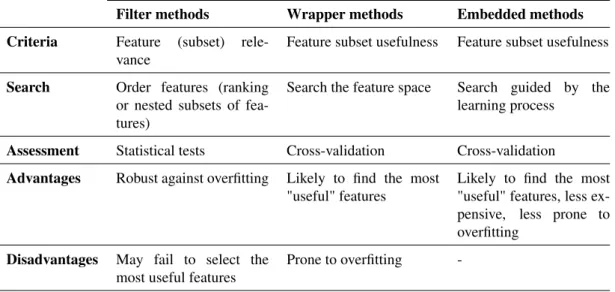
Table 3.1 table provides a side-by-side summarized comparison of 3 different feature selection methods.
Table 3.1: Feature selection methods
Filter methods Wrapper methods Embedded methods Criteria Feature (subset)
rele-vance
Feature subset usefulness Feature subset usefulness
Search Order features (ranking or nested subsets of fea-tures)
Search the feature space Search guided by the learning process
Assessment Statistical tests Cross-validation Cross-validation
Advantages Robust against overfitting Likely to find the most "useful" features
Likely to find the most "useful" features, less ex-pensive, less prone to overfitting
Disadvantages May fail to select the most useful features
Prone to overfitting
-3.2
Feature Construction
Feature construction aims at finding better ways of representing the original data (for example to compact data), or generating features more efficient for making predictions [GE03].
It can be done not only by manually adding some specific domain knowledge to the input, but also by using generic algorithms for feature construction [GE03].
An example of a feature construction method is clustering. In this method the idea is to group similar features, generating a cluster, and then using its centroid as a new feature. This is frequently
Features in Machine Learning: Literature review
used for bag of words representations of labeled texts, where each word corresponds to a feature. These features are then grouped in a cluster, and the new features become categories of words, instead of words [GE03].
Another example of feature construction happens in the hidden units of artificial neural net-works. Each layer of the network constructs more abstracted features from the input features.
While feature construction is often associated with the idea of dimensionality reduction, it can also be used to expand the feature space, by for exampling computing products of the original features to create monomials (Non-linear expansions) [GE06]. This can be useful for very complex problems where the initial features are not enough for the model to learn properly.
3.3
Conclusions
One of the most fundamental parts of a classification problem relies on having the right features. Feature selection methods serve essentially three purposes: reduce the feature set, in order to save resources; improve the performance; make data more understandable. There is no feature selection method better than all others, and the choice on which to use will depend on the specific problem addressed.
Feature construction may be seen as a method to reduce dimensionality while keeping impor-tant information, or even as a preprocessing step. However, they may also be used to expand the feature set in cases where the data is too complex to learn with the initial features.
In our study we will use two wrapper methods, Sequential Forward Selection and Sequential Backward Selection. The reason for this choice was based on the availability of such methods among the software and tools used.
Features in Machine Learning: Literature review
Chapter 4
Named Entity Recognition on Social
Media Texts
4.1
Problem definition
The fundamental goal of this thesis depends on the ability to perform named entity recognition on a dataset of social media posts.
As explained in detail in 2.5.2 , Named Entity Recognition on social media posts presents great challenges mainly due to the inherent informality of the content of such posts.
The first part of this thesis consists therefore in finding a way to address these challenges, and building or finding a Named Entity Recognizer able to extract entities from the dataset in the most efficient way.
Therefore, the following research questions arise:
• Which is the best available tool for Named Entity Recognition in social media?
• How can we improve such tool(s)?
4.2
Solution outline
Our solution to this problem begins therefore with the exploration of different out-of-the-box NER tools.
As concluded in2, multiple text normalization techniques have been proposed that can be used to improve the accuracy of named entity recognition in informal texts, many of them included in entire NLP pipelines designed for this specific task, such as the Twitter NLP tools [RCE+11] (with part-of-speech tagging, chunking and named-entity recognition) and Gate with TwitIE plu-gin [BDF+13] (a sequence of modules including language identification, tokenization, spelling and orthographic corrector, Stanford POS tagger adapted to Twitter, and a Named Entity Recog-nizer).
Named Entity Recognition on Social Media Texts
Besides these two twitter-specific NLP pipelines, we decided to still use two traditional sys-tems: CoreNLP and OpenNLP.
The reason to do so is because the results presented in different studies may differ in the presence of a completely new dataset, as will be the case in this work. For example, according to a toolkit performance comparison by Pinto et al.[PGOOA16], both CoreNLP and OpenNLP actually performed better than the Ritter et al.’s [RCE+11] approach - which was proposed specifically for twitter posts - on a twitter dataset. These examples of unexpected results support the idea that no tool has a clear superiority over others in every context, and therefore analyzing as many tools as possible can be important. This step includes:
• Finding appropriate annotated datasets of social media posts
• Setting up and experimenting Stanford NER
• Setting up and experimenting GATE (with the TwitIE plugin)
• Setting up and experimenting OpenNLP
• Setting up and experimenting Ritter et al. approach [RCE+11]
We could settle for the best-performing tool available and use that one for our further exper-iments. However, as explained in section 2.6.7 these tools have different behaviours regarding different entity types, and it is common to find disagreements between these tools. Therefore, it was our intuition that the simultaneous use of different toolkits might help achieve better results than using them separately. Apart from the obvious benefit that some of these toolkits predict dif-ferent sets of entity types, complementing each other that way, we will analyze, for a standard set of core entities (PERSON, LOCATION, ORGANIZATION), if a ponderation between toolkits reveals
to be beneficial.
That being said, in this chapter we study the combined use of four different NLP toolkits — Stanford CoreNLP, GATE, OpenNLP and Twitter NLP tools — in the context of social media. Previous studies have shown performance comparisons between these tools, both on news and social media corpora. Here, we go further by trying to understand how differently these toolkits predict Named Entities, in terms of their precision and recall for three different entity types, and how they can complement each other in this task in order to achieve a combined performance superior to each individual one.
The proposed solution to the problem, which from now on will be referred to as the "Ensemble of NER tools" brought two new research questions:
• Can an ensemble of different toolkits achieve overall higher NER performance than any of the involved toolkits, independently, for the same task?
• What is the best way to resolve conflicts/disagreements between different toolkits regarding their entity predictions?
Named Entity Recognition on Social Media Texts
The remainder of this chapter is presented as follows: in section4.3 we describe our experi-mental setup, including details on the datasets used, brief descriptions of the toolkits used and the necessary steps taken to obtain their results for our analysis, the ensemble itself and the different voting protocols tested, as well as the performance measures used; in4.4we present the results and discuss them in detail; finally, in section4.7we present our conclusions and ideas for future work.
4.3
Experimental Setup
4.3.1 Datasets
For comparison purposes, every toolkit used equally pre-tokenized datasets, following Ritter’s [RCE+11] tokenization method. We also chose to focus only on the entities PERSON,LOCATION
andORGANIZATION. The reason for this choice was that these entities are the only three entities detected by all the toolkits tested.
For the first experiment, an original dataset of tweets from our project [FSF16] was partially used. This dataset consists of 840 entries: 420 tweets, 107 Facebook posts and 313 Facebook comments, retrieved by a crawler about 6 topics highly discussed in 2016: “Refugees Syria", “Elections US", “Olympic Games" , “Terrorism" , “Daesh" and “Referendum UK EU".
This original dataset was then tokenized. Therefore, instead of 840 entries, the tokenized dataset had 28172 entries (one per token). From the tokenized dataset, a subset of 3474 tokens was extracted. The final dataset contains one token per row, and one entity for each token. The ground truth for this dataset was manually annotated by the authors.
For the second experiment, a dataset from “WNUT NER - Workshop on Noisy User-generated Text" [BDMH+15] - was used. This dataset used the same format seen in Twitter NLP tools by Ritter et al., including less common entity types that were dropped for the purpose of this study, which focuses only on the 3 core entities PERSON, LOCATIONand ORGANIZATION.
In the third experiment, we tested the dataset from the 3rd workshop on “Making Sense of Microposts" (#MSM13) [CBVR+13], which took place in 2013. It is important to note that for this dataset we used the PTBTokenizer available as part of the CoreNLP libraries. The reason for this choice was that in the conversion process we had to tokenize both the entities and the text of the tweets, and for the tokenizations to match we needed a deterministic tokenizer.
Therefore, our testing datasets are (each entry corresponds to a token):
• Dataset 1: Project REMINDS - 3474 entries
• Dataset 2: WNUT NER - 48 862 entries
• Dataset 3: #MSM2013 - 62 494 entries
![Table 2.1: NER toolkit performance comparison for 2 different datasets [PGOOA16]](https://thumb-us.123doks.com/thumbv2/123dok_us/9060541.2804177/38.892.105.783.255.507/table-ner-toolkit-performance-comparison-different-datasets-pgooa.webp)