A
University
of
Sussex
PhD
thesis
Available
online
via
Sussex
Research
Online:
http://sro.sussex.ac.uk/
This
thesis
is
protected
by
copyright
which
belongs
to
the
author.
This
thesis
cannot
be
reproduced
or
quoted
extensively
from
without
first
obtaining
permission
in
writing
from
the
Author
The
content
must
not
be
changed
in
any
way
or
sold
commercially
in
any
format
or
medium
without
the
formal
permission
of
the
Author
When
referring
to
this
work,
full
bibliographic
details
including
the
author,
title,
awarding
institution
and
date
of
the
thesis
must
be
given
DECIPHERING CLINICAL TEXT
Concept Recognition in Primary Care Text Notes
aleksandar dimitrov savkov
Philosophiae Doctor (PhD) Department of Informatics School of Engineering and Informatics
University of Sussex December 2015
This thesis, whether in the same or different form, has not been previously submitted to this or any other University for a degree. Some of the ideas and figures in this thesis have been previously published as noted below. The work on designing a set of annotation guidelines described in Chapter3was jointly produced with Prof. John Carroll, Prof. Jackie Cassell, and Dr. Rob Koeling. The Harvey corpus annotation with chunks and medical concepts was carried out by Mwenya Kosomo, Katie Ellis, Lauren Bignell, Matthew Cadd, and Fiona Dogan under my supervision.
Brighton, UK, December 2015
Dedicated to the loving memory of Dechko Yordanov Ivanov 1929 – 2014
the one that heralds new discoveries, is not “Eureka!”, but “That’s funny...”
A B S T R A C T
Electronic patient records, containing data about the health and care of a patient, are a valuable source of information for longitudinal clinical studies. The General Practice Research Database (GPRD) has collected patient records from UK primary care practices since the late 1980s. These records contain both structured data (in the form of codes and numeric values) and free text notes. While the structured data have been used extensively in clinical studies, there are significant practical obstacles in extracting information from the free text notes. The main obstacles are data access restrictions, due to the presence of sensitive information, and the specific language of medical practitioners, which renders standard language processing tools ineffective.
The aim of this research is to investigate approaches for computer analysis of free text notes. The research involved designing a primary care text corpus (the Harvey Corpus) annotated with syntactic chunks and clinically-relevant semantic entities, developing a statistical chunking model, and devising a novel method for applying machine learning for entity recognition based on chunk annotation. The tools produced would facilitate reliable information extraction from primary care patient records, needed for the development of clinically-related research. The three medical concept types targeted in this thesis could contribute to epidemiological studies by enhancing the detection of co-morbidities, and better analysing the descriptions of patient experiences and treatments.
The main contributions of the research reported in this thesis are: guidelines for chunk and concept annotation of clinical text, an approach to maximising agreement between human annotators, the Harvey Corpus, a method for using a standard part-of-speech tagging model in clinical text chunking, and a novel approach to recognising clinically-relevant medical concepts.
Some ideas and figures in this thesis have appeared previously in the following publications:
Savkov, A., Carroll, J., and Cassell, J. (2014). Chunking Clinical Text Containing Non-canonical Language. In Proceedings of the 13th BioNLP Workshop, Baltimore, USA. Savkov, A., Carroll, J., Koling, R., and Cassell, J. (in print 2015). Annotating Patient Clinical Records with Syntactic Chunks and Named Entities. Language Reources and Evaluation.
A C K N O W L E D G M E N T S
A friend of mine once said that despite its purpose of producing a new independent re-searcher, a doctorate is in fact a team effort — one led by the student, but contributed to by his or her supervisors and a whole department or school.
I should thank first and foremost my supervisorsProf. John CarrollandProf. Jackie Cassell, without whose advice, attention, and collaboration producing this thesis would have been infinitely more difficult. Thank you for your support!
I am incredibly grateful to my good friends and colleagues Matti Lyra and Miroslav Batchkarov, with whom I shared an office for the longest time, for being a motivating benchmark, as well as the occasional rubber duck or an emotional punching bag. I should also mention other members of the department and the Brighton and Sussex Medical School Dr. Novi Quadrianto,Dr. Rob Koeling, and Dr. Elizabeth Ford, who contributed to my research with ideas and advice.
A special thank you and a hat tip to Jeremy Maris and Christian Caterham for the work they did in supporting the staff and students at the department.
Special thanks to my friends Dr. Kevin B. Cohen and Dr. Kostadin Cholakov who provided me with critical advice on several occasions.
My whole research is underpinned by a dataset that was annotated by a group of medical students who took interest in helping me and made time in their busy schedules to listen to me blabber about language, linguistics, and other seemingly boring subjects. My sincere thanks toMwenya Kosomo,Lauren Bignell,Katie Ellis,Mattew Cadd, andFiona Dogan.
Also a very special thank you to Thomas Kober for providing high quality proof reading on a short notice. I hope I can return the favour!
Finally, it is difficult to express how much my family has helped me through the past years, silently caring, worrying, and supporting me from afar. I am truly grateful for all of it!
1 introduction 1
1.1 Data Background . . . 2
1.1.1 Read Code System . . . 3
1.1.2 The General Practice Research Database . . . 3
1.1.3 Research Using UK Primary Care Data . . . 4
1.2 The Challenges . . . 5
1.3 A Processing Road Map to Concept Extraction . . . 8
1.4 Main Contributions of the Thesis . . . 12
1.5 Thesis Summary . . . 12
2 background & related work 14 2.1 Corpora . . . 15
2.1.1 Biomedical Corpora . . . 17
2.1.2 Clinical Corpora . . . 18
2.2 Inter-Annotator Agreement . . . 22
2.2.1 Chance Corrected Agreement Coefficients . . . 23
2.2.2 Weighted Agreement Coefficients . . . 26
2.2.3 Pairwise Agreement Coefficients . . . 30
2.2.4 Agreement on a Large or Unknown Number of Items . . . 32
2.2.5 MUC-7 Scoring for NER Annotation . . . 36
2.2.6 Micro- and Macroaveraging off-score Results . . . 37
2.2.7 Agreement Calculation in the Context of This Thesis . . . 39
2.3 Machine Learning in NLP . . . 39
2.3.1 Common Classifiers . . . 40
2.3.2 Feature Engineering . . . 47
2.3.3 Word Representation . . . 48
2.3.4 Evaluation of Machine Learning Classifiers . . . 51
2.4 Basic Natural Language Processing . . . 53
2.4.1 Segmentation . . . 53
2.4.2 Spelling Correction . . . 54
2.4.3 Part-of-Speech Tagging . . . 55
2.4.4 Parsing & Chunking . . . 56
2.4.5 Word Sense Disambiguation . . . 60
2.4.6 Information Extraction . . . 61
2.5 Clinical Natural Language Processing . . . 64
2.5.1 Preprocessing . . . 64
2.5.2 Information Extraction . . . 66
3 building the harvey corpus 71 3.1 GPRD Data . . . 72
3.2 Annotation Design . . . 73
3.2.1 Inter-Annotator Agreement for the Harvey Corpus . . . 75
3.2.2 Annotation Scheme . . . 77
3.2.3 Annotation Guidelines . . . 80
3.2.4 Refinement . . . 82
3.2.5 Annotator Training . . . 83
3.3 The Harvey Corpus . . . 86
3.3.1 Data Selection . . . 86 3.3.2 Data Assembly . . . 87 3.3.3 Data Analysis . . . 88 3.3.4 Corpus Availability . . . 90 3.3.5 Additional Data . . . 90 3.4 Extrinsic Evaluation . . . 91 3.5 Chapter Summary . . . 93
4 core natural language processing 96 4.1 Applying Existing Technology . . . 96
4.1.1 Approximate Evaluation of Part-of-Speech Processing . . . 97
4.1.2 Approximate Evaluation of Existing Chunking Models . . . 99
4.1.3 Training Models with Standard Tool Configurations . . . 101
4.2.1 Experimental Setup . . . 104
4.2.2 CRF++ vs. YamCha . . . 105
4.2.3 Chunk Representation . . . 106
4.2.4 Result Summary & Discussion . . . 108
4.3 Further Feature Engineering . . . 108
4.3.1 CRFSuite Feature Extractor . . . 109
4.3.2 Using The Universal Tagset . . . 111
4.3.3 Common Feature Types . . . 113
4.3.4 Word Representation & Clinical Text . . . 118
4.4 Solving a Complex Parameter Tuning Problem . . . 124
4.4.1 Bayesian Optimisation . . . 125
4.4.2 Greedy Parameter Group Optimisation . . . 127
4.5 Final Optimisation . . . 128
4.6 Chapter Summary . . . 129
5 medical concept recognition 133 5.1 Extending the Harvey Corpus . . . 134
5.1.1 Annotation Approach . . . 135
5.1.2 Guidelines Design & Annotator Training . . . 136
5.1.3 Analysis . . . 138
5.2 Traditional Concept Recognition . . . 139
5.2.1 Feature Set Optimisation . . . 140
5.2.2 Performance Analysis . . . 142
5.3 An Alternative Approach: Divide & Conquer . . . 146
5.3.1 Surveying Classifiers . . . 148
5.3.2 Feature Engineering: Bag of Words . . . 149
5.3.3 Feature Engineering: Positional Features . . . 150
5.3.4 Feature Selection . . . 152
5.3.5 Performance Analysis . . . 154
5.4 Dynamic Model Evaluation . . . 155
5.5 Chapter Summary . . . 156
6 discussion & future work 158 6.1 Thesis Summary . . . 158
6.2 Main Findings . . . 161
6.3 Contributions to NLP & Clinical Research . . . 162
6.4 Limitations of the Work . . . 163
6.5 Future Work . . . 164
a appendix a: annotation guidelines i 166 a.1 Introduction . . . 166
a.2 Common Grammar . . . 167
a.2.1 Parts of speech . . . 167
a.2.2 Phrases . . . 167
a.2.3 Verbs . . . 168
a.2.4 Gerunds . . . 169
a.3 Annotation Types . . . 169
a.3.1 Base Noun Phrase Chunks . . . 169
a.3.2 Adjective Chunks . . . 170
a.3.3 Main Verb Chunks . . . 170
a.3.4 Expressions . . . 170
a.4 Annotation Process . . . 171
a.4.1 Annotation Tasks . . . 171
a.4.2 Prime Annotation Tips . . . 172
a.4.3 Priority and Embedding of Annotation . . . 172
a.4.4 Including Conjunctions . . . 173
a.4.5 Redacted Text . . . 173
a.4.6 Abbreviations and Acronyms . . . 173
a.4.7 Punctuation and Special Symbols . . . 174
a.4.8 Brat Annotation Tool . . . 174
a.4.9 Annotation Referee . . . 175
b appendix b: annotation guidelines ii 176 b.1 Semantic Entities . . . 176
b.2 Annotation Mechanics . . . 176
b.3 Disagreement Resolution . . . 176
c appendix c: miscellaneous 177
L I S T O F F I G U R E S
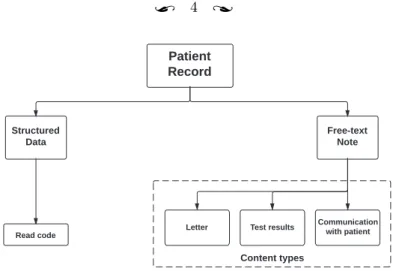
Figure 1.1 Patient record content diagram . . . 4
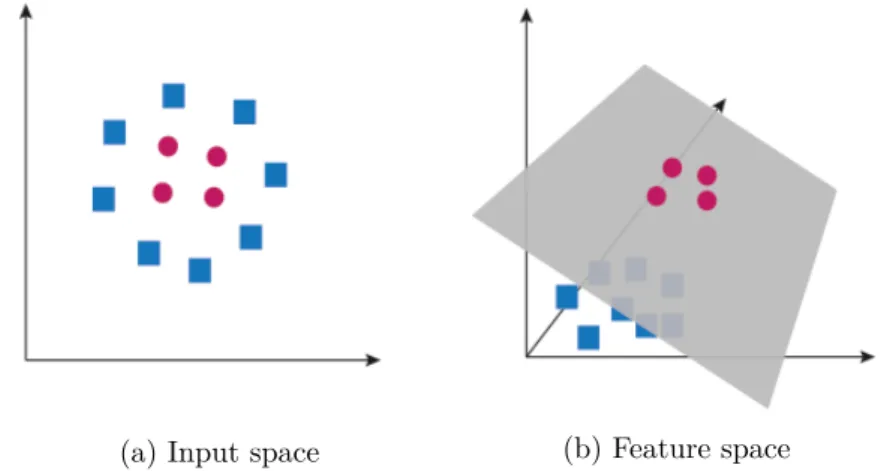
Figure 2.1 SVM visualisations . . . 44
Figure 2.2 Kernel trick illustration . . . 44
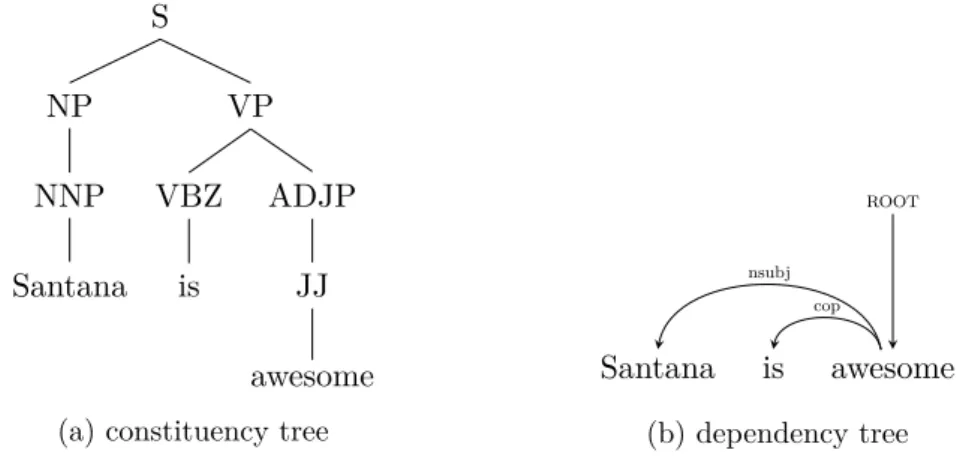
Figure 2.3 Stanford NLP parse tree . . . 58
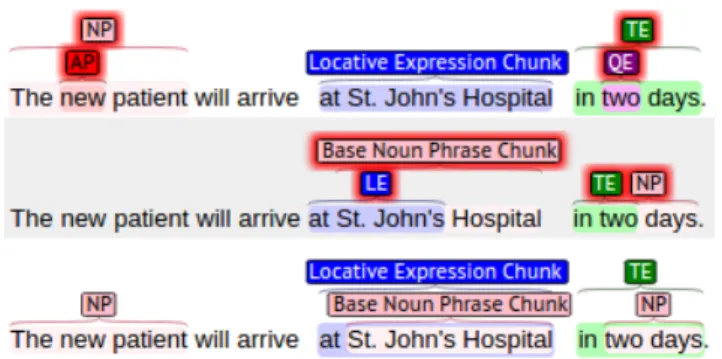
Figure 3.1 Two different annotations of the same text . . . 76
Figure 3.2 Examples illustrating correct and incorrect use of embedded anno-tations. . . 80
Figure 3.3 Brat annotation showing labelled spans . . . 81
Figure 3.4 Inter-annotator agreement during the training period . . . 84
Figure 3.5 Distributions of annotations by by annotation type. . . 89
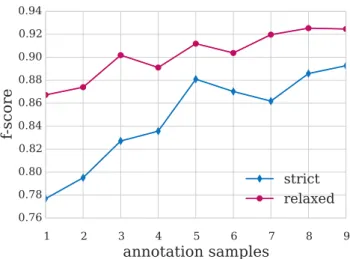
Figure 3.6 Inter-annotator agreement for the nine annotation batches of the corpus, in the order they were annotated. . . 90
Figure 3.7 500-fold bootstrapping learning curves. . . 92
Figure 4.1 Training speed (in seconds) benchmark comparing CRFSuite to Wapiti and CRF++. . . 109
Figure 5.1 Distributions of the precision-recall gap in concept recognition, and chunking. . . 144
Figure 5.2 Left: average precision and recall values of top 100 development models across β values between 0.5 and 2. Right: precision-recall gap for the top 100 development models compared to the average across all models. . . 144
Figure 5.3 Averagef-score distribution of development results across different βvalues, compared to the distribution of topf-score for β=0.5,1,2. 145 Figure A.1 Examples of annotation overlapping. NP chunks are denoted with bold face and temporal expressions are underlined . . . 173
Table 2.1 Confusion matrix of the agreement categories for a two-class anno-tation task with two annotators (Rogot and Goldberg,1966). Each cell represents unit counts. . . 35
Table 3.1 IAA between annotators C and D on their training annotation batches. . . 85
Table 3.2 Pairwise IAA between all annotators. . . 86
Table 3.3 Harvey Corpus Statistics. . . 88
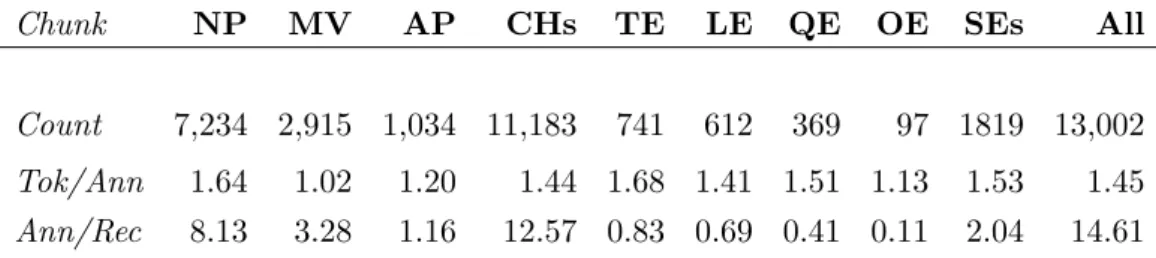
Table 3.4 Harvey Corpus Statistics: annotation counts, average tokens per annotation, and average annotations per record . . . 89
Table 3.5 Extended Harvey Corpus Statistics: annotation counts, average to-kens per annotation, and average annotations per record . . . 91
Table 4.1 Accuracy of POS tagging models evaluated on 100 manually anno-tated records from the Harvey Corpus. . . 98
Table 4.2 Statistical significance between pairs of POS models evaluated on Harvey Corpus data. P-values were calculated using approximate randomisation test. . . 99
Table 4.3 F-scores of four chunking models on the Harvey Corpus . . . 100
Table 4.4 Impact of part-of-speech annotation on chunking using various POS models and chunking configurations. . . 102
Table 4.5 List of POS tagging models used in the chunking feature optimisa-tion experiments. . . 104
Table 4.6 Comparison between CRF++and YamCha chunkers . . . 106
Table 4.7 Comparison between chunking models using different chunk repre-sentation schemes. . . 107
Table 4.8 A comparison between development models built usingCRF++and
CRFSuite and the top feature set for each POS model from the experiments in Section 4.2. . . 110
Table 4.9 Comparison of chunkingf-score between models using original POS annotation generated by the model, models using annotation con-verted to UT after POS tagging, and annotation generated by mod-els trained using UT. . . 112
Table 4.10 Comparison between models without affix features (Base), and models with medical affix features, part-of-speech based features, and the combination of the two. . . 114
Table 4.11 Comparison between models with manually-crafted affix features, automatically generated suffixes and prefixes, and models with tai-lored affixes and automatically generated suffixes. . . 115
Table 4.12 A comparison between models with affix features, models with canonicalisation features, and models with both. . . 117
Table 4.13 A comparison between a model using affix and canonicalisation features, one with token bigram features, one with POS bigram features, and one with all of the above . . . 118
Table 4.14 Comparison of chunking models using pre-computed word embed-dings. . . 120
Table 4.15 Comparison of chunking models using pre-computed cluster fea-tures. Top result indicated in bold. . . 122
Table 4.16 Chunking performance of models with word2vec embeddings gen-erated from GPRD data. Top result indicated in bold. . . 123
Table 4.17 Chunking performance by models using Brown and Ney-Essen clus-ter features generated from the GPRD data. Top result indicated in bold. . . 123
Table 4.18 Final optimisation results for models with Ney-Essen and Brown clustering, using GPRD data, PubMed abstracts, and Reuters Cor-pus. . . 129
Table 5.1 A confusion matrix of the disagreement between the two annotators measured on the whole corpus annotation. Note that this matrix showsdisagreement rather than the more usualagreement. . . 138
Table 5.2 Annotation statistics for the Harvey Corpus extension. . . 139
Table 5.4 Token-level error analysis by category as percentage of all annota-tions in that category. . . 146
Table 5.5 F-score of classifiers on the concept classification task using a posi-tional and a bag-of-words style feature set. . . 148
Table 5.6 Performance comparison between different SVM kernels and multi-class strategies. . . 149
Table 5.7 Comparing positional DC performance impact of word representa-tion features, separately and together. . . .152
Table 5.8 Comparison of models using feature selection to a model using a manually crafted feature set. . . 153
Table 5.9 Precision-recall gap comparison in top scoring models. . . 153
Table 5.10 Label error rate comparison between the development set and the test set as a proportion of all correct occurrences of this label. . . . 154
Table C.1 MUC-7 scoring table. . . 177
Table C.2 Final feature vector with context windows used for chunking models.178
Table D.1 Significance test results for chunking models using embeddings fea-tures. The p-values were calculated using Wilcoxon signed-rank test. Negativep-values signify performance lower than the baseline. 179
Table D.2 Comparison of performance impact by different Ney-Essen clus-ter features in DC entity recognition with positional feature sets. Baseline model uses word, POS, and preceding context word features.179
Table D.3 A non-exhaustive list of notable clinical corpora. Note that the size of GP notes is around 30 tokens, while the length of other documents varies, but is generally greater. . . 180
Table D.4 Significance test results for chunking models using word representa-tion cluster features. The p-values were calculated using Wilcoxon signed-rank test. Negativep-values signify performance lower than the baseline. . . 181
Table D.5 Comparing different scopes of context features for positional DC document classification of entity recognition. Baseline without any additional context is in italics. . . 181
Table D.6 Comparison of performance impact by different word embeddings features in DC entity recognition with positional feature sets. Base-line model uses word, POS, and preceding context word features. . 182
Table D.7 Comparison of performance impact by different Brown cluster fea-tures in DC entity recognition with positional feature sets. Baseline model uses word, POS, and preceding context word features. . . 182
Table D.8 All experiment results with affix features using linear kernel SVM with positional features. The baseline uses words, POS, preceding context words, word bigrams, and all word representation features. 183
Table D.9 Comparison between DC models using different classifiers with au-tomatically selected positional and BoW features (10%, 20%, 50%, and 90%), and the crafted feature set. . . .184
AI Artificial Intelligence
AIDS Acquired Immune Deficiency Syndrome
AP Adjectival Phrase
BEISO Beginning, End, Inside, Single, Outside
BIO Beginning, Inside, Outside
BNC British National Corpus
BO Bayesian Optimisation
BoW Bag-of-Words
CL Computational Linguistics
CRAFT Colorado Richly Annotated Full-Text Corpus
CRF Conditional Random Field
CS Computer Science
CTV3 Clinical Terminology Version 3
CV Cross-Validation
DC Divide & Conquer
EMR Electronic Medical Records
GP General Practitioner
GPRD General Practice Research Database
HIV Human Immunodeficiency Virus
HLBL Hierarchical Log-Bilinear (Embeddings)
HPSG Head-Driven Structure Grammar
IAA Inter-Annotator Agreement
IE Information Extraction
IR Information Retrieval
kNN k-Nearest Neighbours
KPSC Kaiser Permanente Southern California
LE Locative Expression
LFG Lexical Function Grammar
MaxEnt Maximum Entropy
MHRA Medicines and Healthcare Products Regulatory Agency
ML Machine Learning
MUC-7 Seventh Message Understanding Conference
MV Main Verb
NB Naïve Bayes
NE Named Entities
NER Named Entity Recognition
NLP Natural Language Processing
NHS National Health Service
NP Noun Phrase
OE On-Examination Expression
PCFG Probabilistic Context-Free Grammar
PHI Protected Health Information
POS Part of Speech
PP Prepositional Phrase
PPMI Positive Pointwise Mutual Information
PREP Patient Records Enhancement Programme
PTB Penn TreeBank
QE Quantitative Expression
RBF Radial Basis Function
SVM Support Vector Machine
TAG Tree-Adjoining Grammar
TE Temporal Expression
tf-idf term frequency - inverted document frequency
UMLS Unified Medical Language System
UPMC University of Pittsburgh Medical Center
UT Universal Tagset
WSD Word Sense Disambiguation
N O TAT I O N
The notation used in this thesis generally follows the conventions in NLP literature. The notation related to inter-annotator agreement is based on the one used byArtstein and Poesio (2008) with minor changes aimed at better consistency. Also the term coder is replaced with annotator in order to comply with the terminology in the rest of the thesis.
A inter-annotator agreement (IAA)
Ao observed IAA
Ae IAA expected by chance
K set of annotation categories
C set of annotators
I set of annotation items
n number of annotation items|I| η number of judgment pairs(n
2
)
mi number of annotators that have assigned a category to itemi
S IAA coefficient defined byBennett et al.(1954)
π IAA coefficient defined byScott (1955)
κ IAA coefficient defined byCohen (1960)
α IAA coefficient defined byKrippendorff(1980,2004)
δ difference function appropriate to the metric of the data; used forKrippendorf’s α
X matrix of annotation categories with annotation items as rows and annotators as columns; Xi,c is the annotation category to which annotatorcassigned itemi
Y matrix of annotation counts with annotation items as rows and annotation categories as columns;Yi,k is the number of annotators that assigned itemito category k
Z coincidence matrix of annotation categories;Zi,jis the co-incidence of thei-j category pair
Θ square matrix of disagreement weights between categories;
Θi,j is the disagreement weight of the category pair iand
j; weights are in the range[0,1]zero being the agreement
P(x) probability of x
ˆ
P(x) observed probability of x
Upper case letters are used for sets and their lower case versions for the set members, e.g.kis a category from the set of annotation categories K. The size of sets is denoted by straight lines — the number of annotation categories is |K|.
1
I N T R O D U C T I O N
Clinical text — text written by healthcare workers about the care given to individual patients — is a source of rich, detailed information that could be of great use for health service planning and for the study of disease. However, unlocking that information at scale for research purposes is hindered by processing difficulties caused by the peculiarities of clinical language use, and the limited available development data due to the presence of sensitive information that could potentially identify patients. An important research goal is to achieve a reliable language processing foundation to allow more complex information extraction (IE) tasks to reach a sufficiently reliable performance level. Achieving this goal would allow the use of automated algorithms for processing clinical text in secure storage environments, thereby allowing researchers to analyse data without accessing it directly. Such analysis will avoid the manual de-identification currently required for researchers accessing the data, which will decrease the time and financial costs of their work.
Over the past fifteen years or so, Natural Language Processing (NLP) technology has reached a state of maturity that has allowed it to be used in a diverse range of real-world applications, some involving clinical text. Most NLP systems are developed on standard, grammatical, edited text, and are intended to be applied to text of the same type. Their accuracy is significantly degraded when applied to clinical text. Therefore, researchers have created new clinical text corpora to facilitate the development of accurate NLP tools in the clinical domain. Apart from terminology and some idiosyncratic expressions, discharge summaries — the predominant document type in clinical corpora — typically consist of well formed descriptive grammatical text. In contrast, progress notes and primary care notes give rise to difficult language processing issues arising from their typically heavy use of abbreviations, acronyms, medical jargon, ungrammatical constructions, and other
non-canonical (or non-standard) language. The goal of the studies conducted for this the-sis is to achieve reliable automatic concept extraction for UK primary care text, adapting existing machine learning (ML) technology and language resources where appropriate, and developing new technology and research when necessary. The medical concepts targeted in the studies are diseases,symptoms and signs of diseases, and drug names. In the context of clinical notes, those are mentions of diseases and drug names, and records of symp-toms stated by the patients and signs observed by the medical practitioner. On the one hand these concepts are interesting for epidemiological, pathological and pharmaceutical research, while on the other existing technology can be adapted to their natural language occurrence patterns.
While the trivial way to identify these concepts is to compile an approximation of a comprehensive keyword list, in reality such an approach has two significant limitations. First, keyword lists are not easily scalable. Compiling an exhaustive list of keywords for a single concept may seem like an easy enough task, but scaling the list to all possible concepts is an arduous task, especially in the clinical domain where the same concept may be expressed in many and unpredictable ways. Second, even a well crafted keyword list needs to deal with false positives — not all contexts of a word may align with the presumed meaning. On the other hand, recent advances in NLP technology could allow more accurate and scalable recognition of clinical concepts. Given the challenges of the language of primary care data, it is difficult develop solutions for all components of such a system to their respective state-of-the-art levels, but constructing a robust prototype could 1) serve as proof of concept for further research in exploring primary care data, and 2) confirm the feasibility of the approach.
1.1 data background
Large samples of primary care electronic patient records in the UK are collected and kept in regional and national databases, the largest of which is the General Practice Research Database (GPRD), hosted at the UK’s Medicines and Healthcare Products Regulatory Agency (MHRA). These records have a structured part, based on the Read code system (Bentley et al., 1996), and a free-text part also referred to as a note. The primary care
data relevant for this thesis was manually de-identified and supplied to the Patient Records Enhancement Programme (PREP)1 by the GPRD under a licence for research purposes.
1.1.1 Read Code System
The Read codes are a clinical terminology system used in primary care in the United Kingdom. The Read code system encodes a wide variety of patient data including symp-toms and observations, diagnosis, performed procedures, gender, race, religion, and others, including administrative items such as missed appointments. The original codes in the system were developed in the 1980s by Dr. James Read to facilitate the input of certain aspects of patient care into a computer system. There are three designs of the code sys-tem, the latest of which, the Clinical Terminology Version 3 (CTV3), was mandated by the UK National Health Service (NHS) for standard use in general practice electronic medical records (EMR). In its latest designs the codes are structured as a polyhierarchy of indefinite depth, meaning that a code in the hierarchy can have more than one parent. The CTV3 system is set to be phased out of primary care, and replaced by its successor SNOMED-CT by the end of 20162.
1.1.2 The General Practice Research Database
The GPRD is a longitudinal database of primary care medical records. It contains com-prehensive observational data from general practices, which makes it a valuable resource for a broad range of research areas, such as clinical epidemiology, disease patterns, disease management, research outcomes, and drug utilisation. Its data consists of primary care medical records; in these, general practitioners (GP) and other healthcare workers input information on events regarding their patients as structured data and free text. The struc-tured data varies between the several software systems for primary care certified by the National Health Service, although a Read code and a term associated with it are always present in each record (see Figure1.1).
1 http://prep.sussex.ac.uk/
Communication with patient Test results Letter Read code Content types
Figure 1.1: Patient record content diagram
The language and content of the free text is related to the role of GPs in the NHS. They are the gatekeepers to specialist care, charged with basic care for the patients, and with initial assessment and recommendation for specialist treatment. They are organised in practices of one or a small number of general practitioners, set up independently from the hospital system. Apart from correspondence with specialists, GP notes are mainly intended for use within the general practice in which they were created.
1.1.3 Research Using UK Primary Care Data
The information in UK primary care records is an important medical research resource, but so far only a small fraction of the information in the free text has been extracted and utilised. Some of the first studies in this area show that information gathered from free text notes has great potential.
The Freetext Matching Algorithm (Shah et al., 2012) is an automated method for ex-tracting information from free text. The algorithm uses dictionaries of Read code terms (the text representation of Read codes) and “regular” words, as well as spelling correction software to make the language more canonical (i.e. more like standard English). Then it uses synonym look-up tables and phrase patterns to identify diagnoses, dates, and selected kinds of test results. The algorithm creates approximate matches between words and ex-pressions in the free text on one side, and Read codes and OXMIS codes3 on the other.
3 The Oxford Medical Information System (OXMIS) was an earlier terminology system used in primary care computer systems from 1987, when GPRD started. Practices switched over to the Read code system at different times in the 1990s (Shah et al.,2012).
It was tested on two sets of 1,000 records — one general and one associated with death — each taken from the GPRD. The algorithm achieved 98 precision and 93 recall on the death related dataset, and 92 precision and 77 recall on the other dataset. The authors also presented a cause of death detection algorithm aided by the Freetext Matching Algorithm to deal with records where the cause of death was recorded only in the free text. They conclude that the algorithm has achieved sufficient precision, and may facilitate research using patient record free text, particularly for extracting cause of death.
Koeling et al.(2011b) describe the development of a method for automatically determin-ing common symptoms of ovarian cancer in free text notes. The model was based on 344 annotated records of women in the year prior to an ovarian cancer diagnosis. The study was concerned with finding the incidence of five common symptoms of ovarian cancer. Through manual annotation of notes, the estimates of the incidence of symptoms increased by 40% or more when the coded data was augmented with the free text annotation. The automatic symptom detection method was able to extract a significant proportion of this extra in-formation (46 recall) with high precision (96). The automated approach developed for the study was intended to aid medical researchers wishing to validate studies based on codes, or to accurately assess symptoms, using information that can be automatically extracted from free text.
1.2 the challenges
While great efforts are being made to process, interlink, and reuse the structured part of primary care patient records, as well as secondary care data (Frederick, 2003; Ávarez et al., 2011; Trust, 2015), very few studies have used the information in the free text notes. Details about symptoms and diseases typed by general practitioners, have not only the potential to enrich the majority of their structured information counterparts, but in many cases they can be the only source of relevant information. The latter is well illustrated by structured (coded) data entries such as had a chat to patient and telephone encounter, which have no association with a medical concept and rely solely on the information recorded in the associated text to convey details about the patient encounter (see Example 1.1). Similar arguments are made byStubbs et al.(2015b),
moti-vating the organisation of the 2014 i2b2 track on recognising risk factors associated with heart disease.
Telephone encounter tel from wife pt v scared re mri next wed- ok for small dose dz
Constipation NOS 1 BM 3 days ago following 5 days without any. now no BM last 3 days either. breast fed baby ! o/e abd soft. no palpable faeces. try lactulose 2.5 ml bd
Cardiac failure therapy Hxnsyx settled ? feels abit better OE creps R base only. jvp not seen. IMP better re fluid status, rate still ok. P cont w bloods 2/7, rv 1w
Had a chat to patient re. cough at night; see letter from Mr ~~~~~
Example 1.1: Examples of examination records from the GPRD consisting of a structured entry (left) and a text note (right).
It is important to compare the more refined language of the MED corpus of clinical notes (Coden et al.,2005), shown in Example1.2, to the one demonstrated in Example1.1. The differences are even starker when primary care text is compared to the terminology-rich biomedical text of GENIA (Ohta et al.,2002), or the edited news text of the Penn Treebank (Marcus et al.,1993).
A good idea of the importance of the information contained in primary care text can be drawn from a review of information extraction research focused on secondary care text, such as the i2b2 challenges (Uzuner et al., 2007a, 2010b, 2011; Sun et al., 2013a) and the Conference and Labs of the Evaluation Forum (CLEF) initiative (Roberts et al.,
2009). Some of the studies focus on identifying specificconceptslike a subset of symptoms, drugs and time expressions, while others also aim to recognise relations between them, e.g. the locus of a medical finding or the frequency of the administration of a drug. Other studies, such as the one reported byUzuner(2009), look even further and consider relations between concepts spread throughout the medical history of a patient. Studies with such scope and the tools they produce approach the real-life needs for NLP tools in large scale clinical research. Aiming to achieve that is the long term goal of processing primary care text.
Although the coreference resolution study by Uzuner et al. (2012) showed good results for rule-based and hybrid methods, the majority of research into NLP technologies for
MED # 1 Left ACL disruption, return-to-work evaluation Patient of Dr. NAME. Samples mailed to home address. Patient is on Prilosec 20 mg bid. The ACE level remains in the lower limit of normal. Total cholesterol is 160 with an HDL cholesterol of 43, and LDL of 92, and a triglyceride of 123.
GENIA TI - IL-2 gene expression and NF-jB activation through CD28 requires re-active oxygen production by 5-lipoxygenase. AB-activation of the CD28 surface receptor provides a major costimulatory signal for T-cell acti-vation resulting in enhanced production of interleukin-2 (IL-2) and cell proliferation.
PTB The asbestos fiber, crocidolite, is unusually resilient once it enters the lungs, with even brief exposures to it causing symptoms that show up decades later, researchers said. Lorillard Inc., the unit of New Yorkbased Loews that makes Kent cigarettes, stopped using crocidolite in its Mi-cronite cigarette filters in 1956.
Example 1.2: Text samples from the MED (Coden et al., 2005), GENIA (Ohta et al., 2002), and Penn Treebank (Marcus et al.,1993) corpora provided byCoden et al.(2005).
processing secondary care text has been based on machine learning techniques. In contrast, the few studies that have successfully made use of UK primary care clinical notes mostly use heuristics and rule-based algorithms to achieve their goals (Koeling et al.,2011b;Shah et al.,2012). No significant studies to date have applied machine learning methods to them. The main reason is the difference between the non-canonical language of the notes, and the grammatically well-formed language of edited text that is normally targeted in NLP research. Primary care notes are characterised by extreme brevity of expression, numerous medical terms and jargon, ungrammatical constructions, spelling mistakes, and irregular and unorthodox usage of punctuation. Successful use of machine learning based methods benefits from an adequate choice of task and sufficient amount of training data. Therefore, a corpus of reasonable size needed to be developed. Certain similarities exist between primary care text notes and some types of secondary care text such as radiology reports and progress notes, but applying tools trained on the latter to primary care text would not produce optimal results. There are differences in the types of language they use, as well as in the topics they discuss – general practices use a much wider variety of topics and vocabulary compared to radiology reports for instance.
A key factor in the development of NLP tools for specific high level tasks is the relia-bility of core processing: text normalisation, part-of-speech (POS) tagging, chunking, and parsing. These processing steps supply an important part of the information needed for
good application performance. Syntactic chunks, for instance, are an important feature for concept recognition models. Using existing tools developed for other kinds of text would save development effort, but differences in the type of language and vocabulary might degrade their performance too much. Therefore, the first challenge is to find out which tools and resources can be used or adapted to primary care notes, and which ones should be rebuilt from scratch. Once a set of reliable core NLP processes is established, these can support the development of concept recognition models.
1.3 a processing road map to concept extraction
Extracting medical concepts, such as symptoms, diseases, and drug names, from clinical text is in essence similar to Named Entity Recognition (NER) in generic text. Both aim to identify various types of multi-token constructions representing some sort of semantic entity, and have been approached in similar ways in previous research involving clinical text (Uzuner,2009;Uzuner et al.,2010a,2011). A processing pipeline producing concept annotation is typically made up of a tokeniser and a sentence splitter, a part-of-speech tagger, a chunker or a constituency parser, and a concept recognition module. There are readily available tools and models to build a processing pipeline that prepares data for developing a concept recognition model, but the cost of applying this successfully across domains is unclear. Evaluating them in some way on primary care text was needed before drawing a clear road map for achieving reliable medical concept extraction. Ideally, such an evaluation would use a substantial amount of annotated gold standard data, but unfor-tunately such a resource was not available at the beginning of the work described in this thesis.
Another potential alternative is evaluating the tools on a small manually annotated data set, but the results of such an evaluation would most likely be misleading given the data sparsity. This approach would also not provide much insight into the shortcomings of the tools. Instead, an approach of observing and analysing the errors manually was used to determine the applicability of tools and statistical models. The following paragraphs describe the observations made on initial attempts to apply core NLP analysis tools to the data.
tokenisation and sentence splitting are fundamental tasks in NLP appli-cations, yet there is relatively little research in this area due to the widespread use of es-tablished gold standard annotated corpora containing segmented text (Dridan and Oepen,
2012). Although there are a number of segmentation tools developed for less canonical types of text (Kulick et al., 2004b; Gimpel et al., 2011), adapting one of them still left too many segmentation issues unresolved, and the errors would inevitably propagate in further processing. The observed tokenisation errors, although unusual, were simple, and could be addressed by developing a tokeniser specific to this type of text. In contrast, sentence structures in the primary care text could not be identified by the tools, nor by humans for that matter, due to missing sentence-level syntax in this telegraphic style of expression.
part-of-speech tagging is the task of assigning parts of speech to words or to-kens. The assignment is mostly dependent on the word itself and the immediately preceding and following words, so it should remain mostly unaffected by the terseness of primary care text. Unknown words were an expected source of errors, due to the lack of coverage of clinical vocabulary in the text the model was trained on (Penn Treebank described in
Marcus et al. 1993and GENIA described inOhta et al. 2002). Despite the issues, the POS annotation seemed to be at a level of accuracy that would be sufficient for recognising higher level syntactic structure.
chunking is preferred to other forms of syntactic parsing in NER-like tasks, because it focuses on phrases rather than sentences, thereby minimising the error rate while re-taining the most important information about the syntactic structure. A few chunking tools (YamChamodels as described inKudo and Matsumoto 2003,CRF++models4, and GENIA as described in Kulick et al. 2004b) were applied in order to draw general con-clusions about errors. Chunking used POS annotation generated by the Stanford POS tagger (Toutanova et al.,2003). The chunkers correctly identified most chunks, but often attempted building longer chunks and thereby wrongly attached part of a neighbouring chunk, or merged two smaller chunks into one. Other causes of errors were error propaga-tion from the POS annotapropaga-tion, and unseen words. Despite the many mistakes, the
vations showed that if short (base) noun phrases could be recognised, chunking could be adapted to primary care text, given sufficient amount of annotated text from the domain. This observation was important, as it showed that chunking is a potentially successful approach to the syntactic analysis of this type of primary care text but only if the models are trained on annotated data from the same domain. The reason a new annotation was necessary was that all other available English language resources that involved chunking were produced by trimming down constituency parse trees.
full parsing , being a more complex sentence-based syntactic analysis, had little chance of presenting a better alternative to chunking considering the qualities of the data; however, an overview of the errors seemed beneficial for the better understanding of the challenges presented by the data. The Stanford dependency parser (Manning,2011) and the RASP constituency parser (Briscoe et al.,2006) were used for the tests. Due to the lack of sentence structure, the data was input to the parsers without any sentence segmentation. An important observation became obvious: the lack of sentence units caused the parsers to make major errors. They would try to stitch relatively well parsed small segments into a sentence, when in fact they were separate sentence-like units with no syntactic connection.
the plan for the research described in this thesis took into account the preliminary observations and analysis outlined above. Achieving satisfactory medical concept recogni-tion would require most NLP processes to be adapted to the target data. A new tokeniser was necessary to deal with the text peculiarities; an existing POS tagger could be used, but the most suitable one had to be determined; a corpus with chunk annotation was needed to develop an accurate chunker; finally, a concept annotation model could be built taking the NP chunk annotation as input.
the motivation for this particular way of developing a system has several key aspects. Ideally, a new dataset with all core NLP annotations would be needed to address all of the issues identified above, but due to limited time and resources, a cheaper and faster compromise had to be reached. Noun chunking offered a good chance to eliminate the flaws of the readily available models, while relying on the relatively good performance of POS tagging models. It also provided a platform for concept annotation at a low cost, assuming
certain qualities of medical concepts. The assumption was that since the targeted concepts are noun-centric constructions — symptoms, drug names, diseases — noun chunks can be used as candidate units for annotation, i.e. after (noun) chunks are annotated, the output annotations are annotated again with concept types (or nothing). This style of annotation simplified the task, and consequently the preparation for it. These advantages of chunking made it the most promising annotation type out of the three in consideration.
an alternative approach would be to use a parsing method designed to deal with ungrammatical sentences. The approach suggested by Foster (2007) allows parsing mod-els to overcome grammar or spelling errors in a sentence. Fan et al. (2013) implements a method following this approach. It accounts for missing and spurious words by adding special nodes in the annotation. It also simplifies the internal structure of some of the phrases, making them flatter to avoid errors caused by unusual or ungrammatical expres-sions. This approach is more complex than chunking, yet only slightly more informative. Another major problem with applying it to the primary care data was the lack of identified sentence boundaries.
another alternative approach would be using domain adaptation (Ben-David et al., 2010) — a technique which adapts machine learning models trained on a domain with a sufficient amount of labelled data to a domain with little labelled data. The method is likely to be suitable for adapting a part-of-speech tagger model to primary care text, but even if an adapted model is successfully developed, it is also very likely that an adapted chunking model should be developed as well. The prospect of developing not one but two layers of annotation of the target data set, made this approach seem like high-cost alterna-tive, which may have required more time and resources than were available for the writing of this thesis. Nevertheless, it is a viable approach and could be part of the future develop-ment of this work. The use of domain adaptation for chunking alone was also considered, but it was not clear if that would be a successful approach given the stark differences in syntax between edited text and the targeted primary care text. In addition, such an approach would require some labelled data and creating manual annotation compatible with the types of chunks produced automatically through constituency parsing seemed difficult and somewhat risky compared to starting from scratch.
1.4 main contributions of the thesis
The main contributions of the research reported in this thesis are an approach to devel-oping a system for extracting information from primary care text, the Harvey Corpus of clinical text, two sets of guidelines used for annotating the corpus, an approach to maximis-ing agreement between human annotators, a method for usmaximis-ing a standard part-of-speech tagging model in clinical text chunking, and a novel method of concept recognition for text with terse expressions.
The challenges of primary care text, and the limited applicability of standard NLP tools to this kind of text make the implementation of a prototype concept recognition system an important first step towards deeper and more flexible analysis of primary care data. Such a system could be of great benefit to epidemiologists and other clinical researchers. Fast, automated analysis of this type could also support better exploratory analyses of large samples of data.
Even though access to the Harvey Corpus is still very limited, if the corpus could be released under a research license, it could be of significant importance for the development of clinical NLP research. In addition, from a corpus linguistics point of view, the set of chunking guidelines are an important document as it is the first of its kind for the English language (previous chunking annotation having been produced only for edited text, and as a by-product of parsing).
Finally, the new approach to concept recognition points the way towards tackling similar issues in the processing of other kinds of terse text, such as hospital progress notes.
1.5 thesis summary
This thesis presents the Harvey Corpus of primary care text notes, named after the six-teenth century English physician William Harvey5, and a medical concept extraction
sys-tem tuned to the specific language of the domain. Chapter 2gives an overview of theory and research literature relevant to the topics and aims of the thesis. It discusses other avail-able corpora inside and outside the clinical domain, corpus annotation, relevant machine
5 The first accurate account of blood circulation is attributed to William Harvey, and presented in his book
learning methods including classification, word embeddings, clustering, and evaluation, as well as fundamental NLP processes and how they have been used for analysing clinical text. Chapter3traces the design and building processes of the Harvey chunking annotation guidelines and corpus, and the training of medical specialists to annotate text. It describes in detail the aims, rationale, and the process behind building the two resources, as well as issues encountered along the way. Chapter 4 describes an extensive series of experiments developing the optimal combination of an existing publicly available part-of-speech model, and a feature set for a chunking model. The experiments also explore the role of word representation, a broad variety of context features, common classification algorithms, and problems of parameter optimisation. Chapter5introduces a further, clinical concept layer of annotation of the Harvey Corpus produced using another set of guidelines, and the final step of the system: recognising clinical concepts. The discussion focuses on a comparison between the usual method of concept recognition, and a novel approach that exploits the specific characteristics of the kind of text being processed. The chapter concludes with an evaluation of the entire system in real world conditions. Finally, Chapter 6 summarises the experimental results and achievements of this work, relates its contributions to various practical aspects of science and industry, discusses its limitations, and proposes directions for future work.
2
B A C K G R O U N D & R E L AT E D W O R K
The medical concept recognition at the centre of this thesis is an information extraction (IE) task, focusing on recognising and classifying specific types of clinical concepts; as such it is similar to named entity recognition (another information extraction task) in the types of linguistic constructions they both target and partial overlap of some entities. For example, they both target dates and various types of measures, as well as different types of noun phrases. The most significant difference is perhaps that named entity recognition includes all kinds of named entities, i.e. names of places, objects and people, while medical concept recognition focuses on entities that are relevant for the medical narrative of a text, like drug and disease names, symptoms, procedures, and others. The two tasks are also approached in similar ways using virtually the same sequence tagging techniques. As these techniques rely on the output of a number of lower level NLP analyses and techniques, it is essential to review the relevant theory and literature for everything that was used or considered during the studies described in the following chapters, in order to determine their relevance to the primary care notes domain.
Regardless of the chosen methodology, adapting existing processing to a new domain requires a certain amount of labelled data. The data is needed for validation purposes if rule-based, unsupervised or cross-domain machine learning methods are used, and for both training and validation in the case of supervised machine learning methods. Section 2.1
introduces the notion of text corpora, some of the key issues in corpus development, and the most notable corpora in the biomedical and clinical domains. A particularly important aspect of corpus development and an objective measure of annotation quality is inter-annotator agreement (IAA). Section 2.2surveys the different IAA metrics, explaining the choices made for the annotation processes in Chapter3 and Chapter5.
Machine learning methods dominate most parts of modern NLP, as well as the ap-proaches taken in this thesis. Therefore, the chapter reviews the fundamental concepts and theory in order to facilitate the description of the methods discussed in the following chapters. Section 2.3gives a shallow overview of classifiers, the broad feature engineering process, and recent research word representation clusters and embeddings. It also describes evaluation techniques commonly applied in classification tasks, and the domain adaptation technique in machine learning.
The basic principles and issues behind the various NLP processing steps leading up to information extraction are the culmination of this chapter. A typical IE system consists of a text segmentation step, optionally a word normalisation stage, a POS tagger, a chunker or a full syntactic parser, and various high level IE processes, such as named entity recognition and coreference resolution. Section2.4gives a description of each step and a brief account of relevant research literature, while Section2.5provides a more specific overview of NLP challenges, methods and research in the domain of clinical text.
2.1 corpora
The field of corpus linguistics is based on the assumption that linguistic theory can be abstracted or induced in an empirical way from large samples of recorded natural language usage, also known as text corpora. The authors of the Brown corpus (Kučera and Francis,
1967), one of the most notable early resources of its kind, stated that it should “offer useful material for the development and improvement of statistical procedures of linguistic analysis and will make possible the construction of more satisfactory mathematical models of language.”
With advances in computing, larger language corpora have underpinned the develop-ment of modern natural language processing, especially so using statistical models. How-ever, having a large enough corpus is not sufficient to solve all problems in NLP, as there needs to be a good match between the text in the corpus and the one to be processed. The reason for this dependency is that corpora are usually annotated with information that helps analyse a particular type of language, but more importantly it allows the induction of such information from unseen text based on some automatic processing. Thus the us-ability of corpora is still limited by various aspects of the language type they were sampled
from. Their characteristics remain dependent on the frequency distribution of word types, syntactic constructions, and other language patterns. However, there are some measurable qualities of corpora that may play a role in their applicability to certain tasks.McEnery and Hardie(2012) define therepresentativenessof a corpus as “one that is sampled in such a way that it contains all the types of text, in the correct proportions, that are needed to make the contents of the corpus an accurate reflection of the whole of the language or variety that it samples.” They further define a corpus as balanced if “the relative sizes of each of its subsections have been chosen with the aim of adequately representing the range of language that exists in the population of texts being sampled.” The two qualities are somewhat related, because a representative corpus has to be balanced, but a balanced corpus is not necessarily representative (Temnikova et al.,2014). For example, the British National Corpus (Clear,1993) may have been representative and balanced at the time of its creation, but currently it is only balanced.
Despite the properties described above, comparing corpora in an objective and quantifi-able manner still remains an open issue in the field of corpus linguistics (Kilgarriff,2001). Therefore improving or adapting corpora to a new domain remains difficult and somewhat of a “black art”. Adapting statistical language models to new domains, however, is still a necessity in NLP, because it remains the best means of developing and validating methods and models adapted to a new domain.
Beyond the language qualities of corpora, the types of annotation they are equipped with are another one of their important aspects. Even though corpora can be used to explore language characteristics on a large scale and derive or support linguistic theory through empirical methods, their main purpose in modern natural language processing is mainly as gold standard resources to be used for training statistical models and performance validation. Thus, corpora often have more than one annotation layer to serve different NLP tasks. The layers can be both manually created by human annotators, as in the cases of the Penn Treebank (Marcus et al.,1993) and the Prague Dependency Treebank (Bejček et al.,2013), or automatically generated by an annotation tool, as in the case of the British National Corpus (BNC). Treebanks are a common format of annotated corpora, which, as suggested by the name, contain (both constituency or dependency) parse tree annotations as well as the necessary parts of speech, and sometimes additional annotation.
Creating manually annotated corpora can be an arduous and convoluted process, de-pending on the annotation type and complexity. Each annotation process requires the selection or design of a set of annotation guidelines to set the course of the process. Some annotation formats like the Penn Treebank (Marcus et al.,1993) have become a de facto standard, and are frequently reused or modified by other corpora (Ritter et al., 2011;
Derczynski et al.,2013), but very few are suitable for cross-language usage (Petrov et al.,
2012). Strategies such as double-blind annotation are often used in corpus building in or-der to ensure the reliability of the data and to minimise the human bias of the annotators. The agreement between annotators is usually a good measure of the overall reliability of the annotation. It is usually reported using special coefficients, accounting for chance agreement, which are discussed in detail in Section 2.2.
Even though a great variety of corpora have already been created and there are some established good practices (Roger Garside and Geoffrey Leech and Anthony McEnery,
1997; Wynne, Martin,2005), it is still difficult to identify firm rules about how to build or evaluate corpora in an objective and consistent way. The rest of this section briefly presents the more important corpora in the biomedical (Section 2.1.1) and the clinical (Section 2.1.2) domains, giving some details on how and why they were built and what data was used in the process.
2.1.1 Biomedical Corpora
The term biomedical corpora is generally used to refer to collections of text on topics in the life and biomedical sciences. Typically, they may contain a very wide range of studies and annotation types, but generally keep to sources of scientific writing commonly found through MEDLINE and PubMed. The rich terminology of such texts along with some semantic differences presents some difficulties for their processing with tools developed for general domain text, such as news articles. Given the similarities discussed above, it is important to review the corpora with more widely recognised impact in the field. In addition, Verspoor et al.(2012) provide a link to a nearly comprehensive list of publicly available biomedical corpora 1.
GENIA (Ohta et al., 2002) and GENETAG (Tanabe et al., 2005) are two of the best established and widely applied biomedical NLP resources. They both contain protein and gene annotation, providing a solid base for Information Extraction (IE) research. GE-NIA was manually annotated by domain experts using an ontology developed in parallel with the annotation process. Tanabe et al. (2005) used annotation guidelines that pro-vided several related alternatives for each annotated protein or gene. This allowed a more structured partial matching for the evaluation of the entity recognition models it aimed to develop. They used a Naïve Bayes classifier to determine the likelihood of a docu-ment containing a gene or protein name. The selected docudocu-ments were tagged using the AbGene tagger (Tanabe and Wilbur, 2002) and finally the annotations were manually transformed into GENETAG annotation by three domain experts. The Colorado Richly Annotated Full-Text (CRAFT) corpus described by Cohen et al.(2010) is a more recent resource that comprises 97 Open Access journal articles with syntactic, coreference, and concept annotations. Initially coreference was annotated using a modified version of the OntoNotes guidelines (Hovy et al., 2006). Later Verspoor et al. (2012) added syntactic annotation following the Penn Treebank annotation guidelines (Bies et al.,1995) and the BioIE addendum (Warner et al.,2004). At the same time, concept annotation was added to the corpus, identifying mentions of nearly all concepts from nine prominent biomedical ontologies and terminologies (Bada et al.,2012).
Another group of biomedical corpora worth mentioning were created through the BioCre-ative series of challenges. Most of the challenges in the series focus on proteprotein in-teraction extraction (Hirschman et al.,2005;Morgan et al.,2008;Krallinger et al.,2008;
Leitner and Krallinger, 2010) as well as other types of relation extraction (Wei et al.,
2016).
2.1.2 Clinical Corpora
Clinical text is written by medical practitioners in a clinical setting, describing interviews with patients, their medical history and pathology, medical findings established during interviews or procedures, and others. The spectrum of texts covered by the term “clinical” is, in fact, quite wide and can vary significantly in content, length, and style. For example, the GP notes central to this thesis are generally short with terse expressions, and difficult
to understand language, while internal research reports can resemble biomedical texts in both length and writing style.
During the past ten years a number ofclinical corporahave been developed by the NLP community, thereby facilitating a great number of studies in the area (see Table D.3for a representative list). Although the corpora have favoured longer text with more standard language such as admission and discharge summaries, other types of documents are also commonly included in the studies, e.g. progress notes and radiology reports.
Due to the difficulty in getting access to these kinds of data, shared tasks and chal-lenges have played an important role in the development of the field, providing relatively easy access to the same resources to a wider range of scientists. Perhaps the most notable such enterprise is the i2b2 series of shared tasks and challenges, which also included a community annotation task. Uzuner et al. (2010b) present a set of guidelines for the an-notation of a list of seven attributes associated with medications in discharge summaries. The guidelines were developed through an iterative process during which a group of stu-dents annotated a small number of discharge summaries and provided feedback used for the next revision of the guidelines. The guidelines were used in the i2b2 community an-notation experiment, comparing the inter-annotator agreement (measured in F1-score) of
community annotator teams and expert annotator teams. The authors found that the IAA of the community teams was comparable to that of the experts, and concluded that involving the community in fairly complex annotation processes is an acceptable alterna-tive to using expert annotators. The second part of the task was to automatically extract medication information (Uzuner et al.,2010a). The rest of the i2b2 challenge corpora were provided to the community in order to promote research in particular areas.Uzuner et al.
(2007b) present an evaluation of the participating automatic de-identification systems, trained and evaluated on a corpus of 889 de-identified discharge summaries. A subset of that corpus containing 502 summaries was also annotated with patient smoker status for the purposes of one of the challenge subtasks (Uzuner et al., 2007a). Another i2b2 chal-lenge was aimed at identifying obesity and its comorbidities in clinical text using a corpus of 1,237 discharge summaries (Uzuner,2009). A subset of this corpus was later annotated with medical concepts and relations pertinent to congestive heart failure as part of the PhenoCHF corpus (Alnazzawi et al.,2014). The 2010 i2b2 challenge focused on identifying medical concepts, assertions, and relations (Uzuner et al.,2011). The organisers provided
the participants with 871 discharge summaries suitably annotated. Finally, a corpus of 310 discharge summaries annotated with temporal relations was provided for the latest i2b2 challenge (Sun et al.,2013a). The data annotation of all challenge corpora used two independent annotators and an adjudicator when possible. However, it is interesting to note that the adjudicators of the last challenge corpus were also allowed to edit or remove annotations in cases where the other annotators disagreed.
Other shared tasks have focused on document level annotation of clinical corpora. The Medical Records track of TREC 2011 and 2012 used 17,264 clinical documents of vari-ous types from the University of Pittsburgh NLP repository for a topic modelling task (Voorhees and Hersh, 2012). Pestian et al. (2007) present a small corpus of radiology reports annotated with ICD-9-CM codes.
Wang and Patrick (2009) present a small corpus of 311 admission summaries (45,953 tokens, 13,576 annotations), annotated with ten types of concepts based on SNOMED-CT. The guidelines were developed jointly by linguists and clinicians who annotated ten notes together. The guidelines were further refined in five iterations of annotation and analysis during each of which further five notes were annotated. The guidelines were completed once the inter-annotator agreement reached stable levels, at which point the real annotation began involving two computational linguists with some medical knowledge.
The CLEF corpus is another prominent clinical text resource (Roberts et al., 2008,
2009). It was developed to assist the development and evaluation of an IE system as part of a larger framework for the capture, integration and presentation of clinical information. The corpus includes 565,000 de-identified records of 20,234 deceased patients of the Royal Marsden Hospital oncology centre. An annotation scheme was developed using a cyclic process of annotating, analysing and improving. The records were first annotated by two medical domain experts and then the two sets of annotations were adjudicated by a third medical expert.
A few studies have focused on dealing with annotation supporting core NLP tasks such as part-of-speech (POS) tagging and syntactic parsing of clinical text. Pakhomov et al.
(2004) describe the annotation of 271 clinical notes (100,650 tokens across 7,299 sentences) using the Penn Treebank guidelines (Santorini,1990), achieving 87.95% average agreement of POS tagging annotation between three medically trained annotators calculated using Cohen’s kappa (Cohen, 1960). More recently, Fan et al. (2011) presented two sets of 25
annotated progress notes from Kaiser Permanente Southern California (KPSC) and the University of Pittsburgh Medical Center (UPMC), a subset of the i2b2/VA challenge. They were annotated with POS tags for the purpose of developing and evaluating POS tagging models. The corpus comprises 31,400 tokens in 3,283 sentences annotated using a modified version of the original Penn Treebank part-of-speech tagging guidelines (Santorini,1990). A following study on part of the same data presented a set of guidelines for syntactic parsing of ill-formed clinical sentences and a Treebank of 1,100 syntactically annotated sentences from the i2b2/VA challenge (Fan et al.,2013). The presented guidelines are an extended version of the Penn Treebank II bracketing guidelines (Bies et al., 1995). They were modified to help the annotators handle the non-canonical language of clinical text by flattening certain syntactic constructions, introducing a mechanism for handling omitted words, amongst other issues. The authors report IAA F1-score reaching 93 on the final
set of 450 sentences, and parsing accuracy reaching 81 using a statistical model trained on mixed data (newspaper and clinical text). Another syntactically annotated clinical re-source is the MiPACQ corpus of Mayo Clinic pathology notes presented byAlbright et al.
(2013). The corpus consists of 127,606 tokens of text related to colon cancer annotated with POS tags and constituency parsed trees using a version of the Penn Treebank guide-lines adapted to clinical text with some additional non-terminal nodes, e.g. for dropped subjects. In contrast with other corpora, the MiPACQ corpus was automatically anno-tated for the most part using existing tools (Coden et al., 2005; Bikel, 2002), and then corrected according to the guidelines, while only a small part was double blind annotated. Additionally, the MiPACQ corpus was annotated with semantic roles in the style of Prop-Bank (Palmer et al.,2005), UMLS entities, and syntactic dependen