econ
stor
www.econstor.eu
Der Open-Access-Publikationsserver der ZBW – Leibniz-Informationszentrum Wirtschaft
The Open Access Publication Server of the ZBW – Leibniz Information Centre for Economics
Nutzungsbedingungen:
Die ZBW räumt Ihnen als Nutzerin/Nutzer das unentgeltliche, räumlich unbeschränkte und zeitlich auf die Dauer des Schutzrechts beschränkte einfache Recht ein, das ausgewählte Werk im Rahmen der unter
→ http://www.econstor.eu/dspace/Nutzungsbedingungen nachzulesenden vollständigen Nutzungsbedingungen zu vervielfältigen, mit denen die Nutzerin/der Nutzer sich durch die erste Nutzung einverstanden erklärt.
Terms of use:
The ZBW grants you, the user, the non-exclusive right to use the selected work free of charge, territorially unrestricted and within the time limit of the term of the property rights according to the terms specified at
→ http://www.econstor.eu/dspace/Nutzungsbedingungen By the first use of the selected work the user agrees and declares to comply with these terms of use.
zbw
Leibniz-Informationszentrum Wirtschaft Leibniz Information Centre for EconomicsBuchenrieder, Gertrud (ed.); Möllers, Judith (ed.)
Research Report
Structural change in Europe's rural regions: Farm
livelihoods between subsistence orientation,
modernisation and non-farm diversification
Studies on the agricultural and food sector in Central and Eastern Europe, No. 49 Provided in cooperation with:
Leibniz Institute of Agricultural Development in Central and Eastern Europe (IAMO)
Suggested citation: (2009) : Structural change in Europe's rural regions: Farm livelihoods between subsistence orientation, modernisation and non-farm diversification, Studies on the agricultural and food sector in Central and Eastern Europe, No. 49, urn:nbn:de:gbv:3:2-10739 , http://hdl.handle.net/10419/45970
49
Studies on the Agricultural and Food Sector
in Central and Eastern Europe
Leibniz-institut für AgrArentwickLung in MitteL- und OsteurOpA
S
S
St
t
tu
u
ud
d
d
i
i
i
e
e
e
s
s
s
o
o
o
n
n
n
t
t
t
h
he
h
e
e
A
A
A
g
g
g
r
r
r
i
i
i
c
c
c
u
u
u
l
lt
l
t
t
u
ur
u
r
ra
a
a
l
l
l
a
a
a
n
nd
n
d
d
F
Fo
F
o
o
o
o
o
d
d
d
S
S
S
e
e
e
c
c
c
t
t
t
o
o
o
r
r
r
i
i
in
n
n
C
Ce
C
e
e
n
nt
n
t
tr
r
r
a
a
a
l
l
l
a
a
a
n
nd
n
d
d
E
Ea
E
a
a
s
s
s
t
te
t
e
er
r
r
n
n
n
E
E
E
u
ur
u
r
r
o
o
o
p
pe
p
e
e
Structural change in Europe’s rural regions
Farm livelihoods between subsistence orientation,
modernisation and non-farm diversification
Edited by
Gertrud Buchenrieder and Judith Möllers
Sector in Central and Eastern Europe
werden durch das IAMO
Monographien und Tagungsberichte herausgegeben, die sich
mit agrarökonomischen Fragestellungen zu Mittel- und Osteuropa
beschäftigen. Wissenschaftlern, die in diesem Bereich forschen,
steht die Schriftenreihe als Diskussionsforum offen.
In its series
Studies on the Agricultural and Food Sector in Central
and Eastern Europe
IAMO publishes monographs and proceedings
focusing on agricultural economic issues specific to Central and
Eastern Europe. This series offers a forum to researchers studying
this area.
ISSN 1436-221X
ISBN 978-3-938584-39-2
In der Schriftenreihe
Studies on the Agricultural and Food
Sector in Central and Eastern Europe
werden durch das IAMO
Monographien und Tagungsberichte herausgegeben, die sich
mit agrarökonomischen Fragestellungen zu Mittel- und Osteuropa
beschäftigen. Wissenschaftlern, die in diesem Bereich forschen,
steht die Schriftenreihe als Diskussionsforum offen.
In its series
Studies on the Agricultural and Food Sector in Central
and Eastern Europe
IAMO publishes monographs and proceedings
focusing on agricultural economic issues specific to Central and
Eastern Europe. This series offers a forum to researchers studying
this area.
ISSN 1436-221X
ISBN 978-3-938584-39-2
27
thInternational Conference of Agricultural Economists (IAAE)
Beijing, China, August 16-22, 2009
"The New Landscape of Global Agriculture"
IAAE Mini-symposium
"Structural change in Europe’s rural regions –
Farm livelihoods between subsistence orientation,
modernisation and non-farm diversification"
Studies on the Agricultural and Food Sector
in Central and Eastern Europe
Edited by
Leibniz Institute of Agricultural Development
in Central and Eastern Europe
IAMO
Volume 49
Structural change in Europe’s rural regions
Farm livelihoods between subsistence orientation,
modernisation and non-farm diversification
Edited by
Gertrud Buchenrieder and Judith Möllers
IAMO
2009
Die Deutsche Bibliothek verzeichnet diese Publikation in der Deutschen Nationalbibliografie; detaillierte bibliografische Daten sind im Internet über http://dnb.ddb.de abrufbar.
Bibliographic information published by Die Deutsche Bibliothek
Die Deutsche Bibliothek lists the publication in the Deutsche Nationalbibliografie; detailed bibliographic data are available in the internet at: http://dnb.ddb.de.
Diese Veröffentlichung kann kostenfrei im Internet unter
<www.iamo.de/dok/sr_vol49.pdf> heruntergeladen werden.
This publication can be downloaded free from the website
<www.iamo.de/dok/sr_vol49.pdf>.
© 2009
Leibniz-Institut für Agrarentwicklung in Mittel- und Osteuropa (IAMO)
Theodor-Lieser-Straße 2 06120 Halle (Saale) Tel. 49 (345) 2928-0 Fax 49 (345) 2928-199 e-mail: [email protected] http://www.iamo.de ISSN 1436-221X ISBN 978-3-938584-39-2
A
CKNOWLEDGEMENTSThe contributions in this edited volume constitute the mini-symposium on "Structural change in Europe’s rural regions – Farm livelihoods between subsistence orientation, modernization and non-farm diversification" at the international conference of the International Association of Agricultural Economists (IAAE) on "The New Landscape of Global Agriculture" in Beijing, China, August 16-22, 2009.
The majority of the contributions emerge from two structured research frameworks. The first is the scientific network and research of an ongoing (2007-2009) EU-financed FP6 project on "Structural Change in Agriculture and Rural Livelihoods" (SCARLED). SCARLED addresses past and future key social and agricultural restructuring processes for a living countryside in the NMS of the EU. Methodologically, the topic is approached by comparative, structured multi-country farm surveys (in Bulgaria, Hungary, Poland, Romania, Slovenia) as well as case studies on rural development in selected regions of five established Member States (from Austria, Ireland, the new German Bundesländer, Spain, and Sweden). The other is the Graduate School "Prospects for small-scale farm structures in the New Member States of the European Union", which was installed at the Leibniz Institute for Agricultural Development in Central and Eastern Europe (IAMO) in 2007. It looks at the lessons to be learned from a selection of countries that spans from the EU-15 member states, Austria and Germany across the NMS Bulgaria, Hungary, Poland and Romania to the non-member region Kosovo. One contribution is an outcome of the EU tender project "Sustainability of Semi-Subsistence Farming Systems in New Member States and Acceding Countries (S-FARM)" funded and coordinated by the Institute for Prospective Technological Studies (IPTS) in Seville, Spain.
Subsequently, we are grateful to a number of people. First and foremost, we would like to express our gratitude to the IAAE, particularly those responsible for organizing the review process of the submitted mini-symposia, Johann Kirsten and Cerkia Bramley. We also sincerely thank Csaba Csáki (Corvinus University Budapest) for moderating and guiding the discussions during the mini-symposium.
We are particularly indebted to the contributors of this volume:
• Cosmin Salasan (Banat’s University of Agricultural Sciences and Veterinary
Medicine Timisoara, Romania),
• Jarmila Curtiss and Sergio Gomez y Paloma (Institute for Prospective
Technological Studies, JRC European Commission, Spain).
• Gertrud Buchenrieder, Jana Fritzsch, Thomas Glauben, Heinrich Hockmann,
Lioudmila Möller, Agata Pieniadz, Swetlana Renner, and Stefan Wegener
(Leibniz Institute of Agricultural Development in Central and Eastern Europe, Germany),
• Sophia Davidova, Lena Fredriksson, and Dan Petrovici (University of Kent,
Kent Business School, UK),
• Plamen Mishev (University of National and World Economy, Bulgaria),
• Carmen Hubbard and Matthew Gorton (University of Newcastle upon Tyne,
Centre for Rural Economy, UK), and
• Tomasz Wołek (Warsaw University, Department of Economic Sciences;
Poland).
Finally, we would also like to thank Silke Scharf for her support in printing this
book and JamesCurtiss for his English proof-reading. Last but not least we are
grateful that the Leibniz Institute for Agricultural Development in Central and Eastern Europe (IAMO) supported the costs associated with publishing this volume.
Halle (Saale), July 20, 2009 Gertrud Buchenrieder & Judith Möllers
Graduate School
Prospects for small-scale farm structures in the New Member States of the EU
financed by the Leibniz Pact for Innovation and Research
Graduate School
Prospects for small-scale farm structures in the New Member States of the EU
Foreword to
Structural change inEurope’s rural regions - Farm livelihoods between subsistence orientation, modernisation and non-farm diversification
Since 2004, the European Union (EU) has undergone an unprecedented enlargement, reuniting the Western and Eastern parts of the continent. Subsequently, the share of rural areas and of those employed in agriculture grew notably in the 27. Europe's rural areas represent 93% of the territory in EU-27 and about 58% of the population live in predominantly and significantly rural areas. Rural areas generate 45% of gross value added in EU-27 and 53% of the employment, but tend to lag behind urban areas for a number of important socio-economic indicators such as income, activity rates and access to services (EC, 2008). The new Member States (NMS) in Central and Eastern Europe have already undergone substantial sector restructuring and socio-economic transformation (Rozelle and Swinnen, 2004). Nevertheless, as regards the agricultural sector and rural livelihoods, a great number of them still display a tremendous disparity as compared to the EU15-average. For instance, the share of those employed in agriculture ranges from 4.8% in the Czech Republic to 42.7% in Romania. The EU15 employs, on average, about 4% of the workforce in the agricultural sector (Copus et al., 2006). In addition, the average farm size in the NMS10 (pre-2007) is approximately five hectares, and 27% of the land is cultivated by farms smaller than five hectares (Davidova, 2005). Often, the rural economy can not sufficiently support rural livelihoods. Especially, those living from (semi-) subsistence farming are prone to low productivity, low incomes and vulnerable livelihoods. Therefore, it is important that the ground is prepared for significant structural changes in the labour force, farming structures, and the wider rural economy. If structural change does not take place, rural areas in the NMS will continue to lose attractiveness and competitiveness.
Particularly in Eastern Europe we find the phenomenon of a re-orientation towards farming and the existence and persistence of a large number of tiny (semi-) subsistence farms. Effective rural policies have to consider that these farms do not necessarily react to the same policy signals as larger scaled (commercial) farms. When farming incomes are small, the functioning and continuous development of rural labour markets is important. Non-farm activities could play a decisive role for rural development by allowing families
to overcome poverty and, in the medium term, possibly exit the farming sector and thus allowing more competitive farms to grow. Some of the developments that we observe and expect to happen in the NMS are comparable to earlier experiences in the EU-15. These experiences could give hints how successful change can be effectively implemented.
Structural change in agriculture1, let alone in rural economies, is a complex
phenomenon. Structural change affects rural livelihoods through changes in agricultural productivity and profitability, and in wider rural labour markets. There is little consensus on how to judge structural change. For instance, efficiency-increasing structural change, in terms of a better allocation of resources, might be desirable from a pure economic point of view. Yet, the decreased labour demand may make smaller-scale, part-time farm households to losers, especially if the wider rural labour market is weak. Furthermore, some argue, it is the smaller-scale subsistence and (semi-) subsistence farming households that contribute most to a living countryside. Whatever the effects of structural change in agriculture and rural livelihoods are and how they might be judged, understanding the driving factors, obstacles and pathways and their interactions is crucial. Therefore this mini-symposium aims at stimulating a discussion on possible developments and success factors of rural development in an enlarged Europe.
References
Copus, A., Hall, C., Barnes, A., Dalton, G., Cook, P., Weingarten, P., Baum, S., Stange, H., Lindner, C., Hill, A., Eiden, G., McQuaid, R., Grieg, M., Johansson, M. (2005): Study on employment in rural areas. Draft Final Deliverable prepared for the European Commission, DG Agri.
Davidova, S. (2005): Memorandum submitted by Dr Sophia Davidova, Imperial College, London April 2005. In The future financing of the Common Agricultural Policy, House of Lords, European Union Committee (ed.): 154-162, 2nd Report of Session 2005-06. London, UK: http://www.parliament.the-stationery-office.co.uk/pa/ld200506/ldselect/ ldeucom/007/5030902.htm (accessed March 2006).
1 Structural change in agriculture is characterised by constant changes in the deployment of
production factors. It manifests itself in a clear change in the structure of production. Within agriculture the size of the workforce and the number of farms are reduced. In relation to the national economy, the proportion of those employed in agriculture falls.
EC (2008): Europe’s rural areas in action. Facing the challenges of tomorrow. Limassol, Cyprus, 16-17 October, 2008, organized by DG Agri of the European Commission.
Rozelle, S., Swinnen, J.F.M. (2004). Success and failure of reform: insights from the transition of agriculture. Journal of Economic Literature XLII: 404-346.
Table of contents
Can we really talk about structural change? The issue of small-scale farms in rural Poland
Tomasz Wołek (WUDES)...1-22 The role of farm activities for overcoming rural poverty in
Romania
Cosmin Salasan (USAMVB) & Jana Fritzsch (IAMO)...23-41 Comparative Analysis of the contribution of subsistence production to household incomes in five EU New Member States: Lessons learnt Sophia Davidova (UNIKENT), Lena Fredriksson
(UNIKENT), Matthew Gorton (UNEW), Plamen Mishev (UNWE)
& Dan Petrovici(UNIKENT)...43-68 The flexibility of family farms in Poland
Swetlana Renner, Heinrich Hockmann, Agata Pieniadz, &
Thomas Glauben (IAMO)...69-89 Agriculture and rural structural change: An analysis of the
experience of past accessions in selected EU15 regions
Carmen Hubbard & Matthew Gorton (UNEW)...91-112 Expanding biogas production in Germany and Hungary:
Good prospects for small scale farms?
Lioudmila Möller (IAMO)...113-133 Impact of topical policies on the future of small-scale farms
in Poland - A multiobjective approach
Stefan Wegener (IAMO), Jana Fritzsch (IAMO), Gertrud Buchenrieder
List of abbreviations
AFS Average farm size
AWU Annual work units
BMW Border, Midlands and Western, Ireland
CAP Common Agricultural Policy
CEE Central and Eastern Europe
CHP combined heat and power units
CUB Corvinus University Budapest
dena Deutsche Energie-Agentur
EEG Erneuerbare Energien Gesetz
ESU European Size Unit
EU European Union
FSS Farm Structure Survey
GAMS General Algebraic Modeling System
GDP Gross domestic product
GVA Gross value added
IAAE International Association of Agricultural Economist
IAMO Leibniz Institute for Agricultural Development in Central
and Eastern Europe
IPTS Institute for Prospective Technological Studies
JRC Joint Research Center
KU Leuven Catholic University Leuven, Centre for Transition
Economic
LAG Local action group
LEADER Liaison entre actions de développement de l´économie
rurale
LFA Less favoured areas
MDG Millennium Development Goals
MOLP Muliobjective linear programing
NEP National Energy Saving Plan
NMS New member states
NUTS Nomenclature des unités territoriales statistiques
OGA Other gainful activities
PPP Purchasing power parity
PPS purchasing power standard
RDR Rural Development Regulation
RES Renewable Energy Strategy
RHS Right-hand side
SCARLED Structural change in agriculture and rural livelihoods
S-FARM Sustainability of semi-subsistence farming systems in new
member states and acceding countries
SFH Semi-subsistence farm household
UAA Utilised agricultural area
UNDP United Nations Development Programme
UNEW University of Newcastle upon Tyne
UNIKENT University of Kent
UNWE University of National and World Economy
USAMVB Banat’s University of Agricultural Sciences and Veterinary
Medicine Timisoara
VIF Variance inflation factor
Can we really talk about structural change?
The issue of small-scale farms in rural Poland
Tomasz WOŁEK
Warsaw University, Department of Economic Sciences (WUDES) [email protected]
Abstract
From the beginning of transition to the market economy, Polish agriculture has undergone substantial structural changes. However, most of the macro-indicators characterizing the agricultural structure in Poland still point to profound socio-economic problems. According to the Central Statistical Office, in 2007 there were approximately 900,000 agricultural households, or 38% of all farms in Poland, that consumed more than 50% of the value of their agricultural production. Given this situation, the question arises whether we can truly talk about structural change in Polish agriculture or whether Poland merely faces two distinct groups of farm structures, small and large?
Key words: structural change, small-scale farms, agriculture, Poland
Table of contents
1 Introduction
2 Structural problems of Polish agriculture
3 Ambiguity of structural changes in Polish agriculture
4 The ‘myth’ of average farm size
5 Different dimensions of structural changes in Polish agriculture (2005-2007)
1 Introduction
Five years have passed since the accession of Poland to the European Union (EU) and the introduction of the Common Agricultural Policy (CAP) measures in Polish agriculture. Despite billions of Euros being allocated to measures of both Pillars (Pillar 1: market policy and Pillar 2: rural development policy) most of the macro-indicators characterizing the Polish agricultural sector still point to profound structural problems.
The first part of the contribution is focused on the general structural problems of the Polish agricultural sector. The next portion concerns the theoretical aspects of the term ‘structural change’ and some controversies over understanding this process in Poland. The analysis in the third section refutes the myth of average farm size being a measure of structural changes in Polish agriculture. The last portion presents various dimensions of structural changes that have occurred in Poland since EU accession. This analysis is based on the latest available data from the Farm Structure Surveys of 2005 and 2007.
2 Structural problems of Polish agriculture
Poland, due to its historical heritage of an abundance of small and highly
fragmented private farms1, began the transition process with an unfavorable
agrarian structure. Since 1989 the total number of private farms has been constantly decreasing, in 2007 reaching slightly more than 2.5 million. Considering private farms, between 1990 and 2007, more than 330,000 of them possessing over 1 ha, and about 900,000 smaller than 1ha have disappeared. Since 1996 the acreage of total agricultural land utilized in private farms has dropped by 800,000 ha. A significant decrease of employment in agriculture, from over 25% in 1996 to less than 15% in 2007, has been also observed. The share of agriculture in gross value added has decreased twice between 1996 and 2007, to 4.3% (Table 1).
1 Private farms are understood as an agricultural holding from 0.1 ha of agricultural land,
being exclusive property or used by natural person or group of persons as well as an agricultural holding of person having no agricultural land or with agricultural land less than 0.1 ha who has at least: 1 head of cattle or (and) 5 heads of pigs or 1 sow or (and) 3 heads of sheep or goats or (and) 1 horse or (and) 30 heads of poultry or (and) 1 ostrich or (and) 5 females of fur animals (rabbits included) or (and) 3 heads of animals kept for slaughter or (and) 1 beehive.
Table 1 Agricultural structure in Poland (1990-2007) 1990 1996 2000 2004 2006 2007 Private farms 3 829 000 3 066 535 2 854 374 2 839 664 2 594 579 2 575 113 including: < 1 ha 1 691 000 1 025 155 973 492 987 887 788 184 771 050 ≥1 ha 2 138 000 2 041 380 1 880 882 1 851 777 1 806 395 1 804 065 Agricultural land (mln
ha) in private farms 18.5
a 15.2 15.5 14.3 14.1 14.4
Average area of agricultural land in
private farm (ha) - 4.96 5.43 5.04 5.43 5.59 Employment in
agriculture (% of total employed persons – annual average) b
- 25.5c 25.8 15.6 15.3 14.8
Share in gross value added (current prices) of agriculture, hunting and forestry (%)
- 8.0c 4.9 5.1 4.2 4.3
“price gap” e 100 93.4c 74.0 65.7 64.4 69.0
Source: Statistical Yearbooks of Central Statistical Office, Statistical Yearbook of Agriculture and Rural Areas, Agricultural Census 1996 and 2002.
Notes: a) In agricultural holdings;
b) Data regarding employed persons on private farms in agriculture for 2002/2006 are not strictly comparable to those for previous years;
c) data for 1995;
d) Data are compiled Population and Housing Census 2002 as well as the Agricultural Census 2002, in the denominator — of the Agricultural Census 1996;
e) Index of price relations of sold agricultural products to goods and services purchased by private farms in agriculture – 1990=100
Structural adjustments in agriculture are in most cases analyzed in reference to agricultural employment and farm size. These two structural aspects may be joined in one simple measure – average utilized area (Rosner, 2001). Despite considerable changes, the average area of agricultural land utilized by private farms has exhibited surprising stability and increased by only 0.63 ha between 1996 and 2007. This is mainly due to a dual structural arrangement that has distinguished Polish agriculture during transition. Its elements consist of viable farms (estimated at 600-800,000) and the social agricultural sector (1.3-1.5 million). The latter group plays two roles: they contribute to the family’s well-being, assuring the economic existence of its members; they absorb and keep
hundreds of thousands persons who otherwise would be unemployed (Woś,
As a result of structural problems, Polish agriculture still has unfavorable relations between the share of agriculture in gross domestic product (GDP) and its share of total employment. Another interrelated problem refers to the excessive production capacities of the Polish agricultural sector compared to market demand (besides the possibility of exporting to EU markets, agricultural producers encounter difficulties in selling their products).
3 Ambiguity of structural changes in Polish agriculture
Traditionally, with regard to farming, the term ‘structure’ is understood as the allocation of land, and thus concerns mainly farm size. However, as a result of technological progress in agriculture, the importance of land resources has significantly diminished. Nowadays, a much broader approach prevails,
encompassing economical factors of production2, production trends, sales
figures and types of connections with the market (Szemberg, 1998). Therefore, the main aspects of structural transformation in agriculture should refer to the optimal allocation of production factors, which are adequate to the specificity of the given farm. Moreover, besides changes inside the farm, structural transformation concerns the evolution of closer and further socio-economic
environments within rural areas (Woś, 2003). Structural change in agriculture is
a complex phenomenon, under which we should understand the whole picture of changing variables describing the agro-food sector and its wider role in the economy of rural areas.
During the debates over what is the most desirable structural change in Polish agriculture, the answer is generally accepted, and states that concentration is one of the main processes leading to an improvement in the structure of ‘peasant farming’ (Frenkel and Rosner, 1999).
Concentration of production is very often viewed as a simple function of land consolidation, but this is an unjustified simplification. Of course, concentration of land is a very important aspect of structural change, but it is neither the only nor always the main. Concentration of production may sometimes be achieved without enlarging the utilized area, e.g., it may be achieved by intensifying production in some farms and by various forms of formal and informal
2 These are natural resources, physical capital, financial capital, human capital and social
cooperation between agrarian producers, suppliers of inputs and the agricultural processing industry. Another simplification concerns the problem of land concentration, and the opinion that it can be solely achieved by increasing the average farm size. However, concentration should be interpreted more carefully. It is possible to achieve concentration through polarizing the area’s structure: increasing the area of the smallest and the largest farms and reducing the area of the medium-sized farms. In this situation, concentration can take place without increasing the average farm size. One more simplification appears when the concept of agrarian structure transformation is reduced merely to change of utilized area. Meanwhile, structural change should include the evolution of farm functions with regard to the importance of farming as a main or supplementary source of family income (Frenkel and Rosner, 1999). This process particularly determines the emergence of different farm structures across the country, which is adjusted to specific local conditions.
4 The ‘myth’ of average farm size3
There is no such thing as average for Polish agriculture! This is true for many different indicators describing features of the Polish agricultural sector, but especially concerning the average acreage owned by farms. Data from the Agricultural Census conducted in 2002 reveal the spatial diversity of average
farm size by Poviats (NTS-44) (Figure 1). The north and west parts of Poland are
characterized by much larger farms than the country’s average (from 11.5 to 32 ha), due to the presence of bigger state-owned farms mostly privatized and taken over by private farms during transition. In the central and southwest regions, the size of farms is mostly close to the country average. In the southeast Poviats the majority of farms represent ‘weak’ agrarian structures with an area below the country’s average.
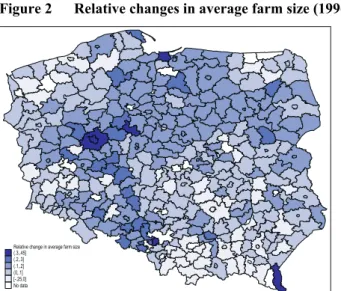
Comparison of the data from both Agricultural Censuses 1996 and 2002 reveal another interesting fact on the average farm size. Table 2 presents the relative changes of this measure (AFSyear – Average Farm Size in the given year) that have occurred between surveys. In 16% of Poviats, a decrease in average farm size was recorded. Subsequently, in 74% of Poviats, AFS increased by 0 – 20%,
3 Average farm size in Poviat is calculated as a quotient of total acreage of agricultural land
and total number of holdings.
while in only 9% of Poviats it increased by more than 20%. At the same time, average farm acreage in the country increased by 6% (CSO, 2003).
Figure 1 Average farm size in Poviats (NTS-4) in 2002
Average farm size in 2002 (11.52,32] (8.43,11.52] (5.19,8.43] [0,5.19]
Source: Own depiction based on data from the Agricultural Census 2002.
Table 2 Relative changes in average farm size (1996-2002)
(AFS2002 - AFS1996)/AFS1996 No./share of Poviats
[-0.25, 0] 50 / 16%
[0, 0.1] 117 / 38%
[0.1, 0.2] 112 / 36%
[0.2, 0.3] 23 / 7%
[0.3, 0.45] 5 / 2%
Source: Own calculation based on data from the Agricultural Census 1996 and 2002.
Figure 2 confirms that the most significant changes in average farm size occurred in those parts of the country where the land from state farms was accessible. Unfortunately, in Poviats where the farm structure was already highly fragmented (in the southeast regions), a decrease of average size was recorded.
Figure 2 Relative changes in average farm size (1996-2002)
Relative change in average farm size (.3,.45] (.2,.3] (.1,.2] (0,.1] [-.25,0] No data
Source: Own depiction based on data from the Agricultural Census 2002.
Obviously, changes of average farm size are dependent on the changes in total number of farms belonging to the specific area groups. However, it is more complicated to indicate the area groups which have a significant influence on average farm size. This problem is tested by the following linear regression model: (1) i 4 i i change_ β Y=
∑
× areagroup (2) i 7 i i change_ β Y=∑
× areagroupY = relative change in average farm size (AFS) in particular Poviat (AFS2002 - AFS1996) / AFS1996)
βi = coefficient for the ith change_area_group
change_area_groupi = change in share of private farms belonging to respective
area group in total number of private farms in particular Poviat (number of
farms_area_group2002/ total number of Farms2002 - number of
Due to the existence of collinearity5, one independent variable is removed in
each model: change_15-50ha from model (1)d change_20_50ha from model (2). Both models are significant and explain: (1) – 43% and (2) – 48% of the variance of the relative change in average farm size (Table 3). The results of model (1) indicate that all variables influence significantly changes in ‘AFS’, but in the case of changes in number of farms from area groups 1-5 ha and 5-15 ha, dependency is negative and from the group over 50 ha, dependency is positive. In model (2), variables ‘change_1-5ha’, ‘change_5-10ha’ and ’10-15ha’ are significant and negatively influence changes in ‘AFS’, and variable ‘change_50-100ha’ is significant and positively influences ‘AFS’(Table 3). Both models give very similar results, and prove that between 1996 and 2002 only changes in the number of the smallest farms (negatively) and in the number of the largest farms (positively) significantly influenced relative changes in average farm size. This result also proves that in case of a simultaneous increase in the number of small and large farms (polarization of agrarian structure) in proper proportions, both effects can cancel each other out and the average farm area in Poland may remain relatively stable.
In fact, according to data presented in Table 4, between 1996 and 2002, the polarization of agrarian structure was observed: there was almost a 12% increase in the number of private farms possessing 1-2 ha, 27.7% of 20-50 ha farms, and 92% for farms larger than 50ha. Meanwhile, a decrease in the number of farms possessing 2-20 ha was noted.
However, since 2002, a tendency other than the polarization of acreage structure can be noticed. Positive changes in the number of private farms occurred in the medium area group (10-15 ha) and those above 20 ha. Calculation of dynamics based on data from the latest Farm Structure Survey 2007 clearly reveals the new trend in the structural arrangement in Polish agriculture. Between 2005 and 2007, there was a significant increase in the number of medium farms and a high
increase in number of large farms (≥ 50 ha).
5 High values of Variance Inflation Factor (VIF) indicate collinearity between independent
Table 3 Determinants of changes in average farm size (AFS) in Poland (1996-2002) Independent variable (t-Statistics) [p-value] (n=307)
Model (1) (no collinearity)Model (1) Model (2) Model (2) (no collinearity) Change_1-5ha change_5-10ha change_5-15ha change_10-15ha change_15-20ha change_15-50ha change_20-50ha change_50-100ha change_>50ha change_>100ha _constant -4.052088 (-3.60) [0.000] - -- -3.270636 (-2.95) [0.003] - - - - - - -2.084029 (-1.88) [0.061] - - - - - - 1.701256 (1.55) [0.122] - - - 0.0621931 (7.91) [0.000] -1.956463 (-13.22) [0.000] - - - -1.214523 (-6.51) [0.000] - - - - - - - - - - - - - - - 3.554282 (7.38) [0.000] - - - 0.0629599 (7.99) [0.000] -2.533633 (-2.08) [0.038] -1.204524 (-1.00) [0.316] - - - -2.177446 (-1.63) [0.105] -1.25419 (-1.09) [0.275] - - - 0.1140962 (0.09) [0.931] 2.978105 (1.88) [0.062] - - - -2.381359 (-1.23) [0.220] 0.0690331 (8.43) [0.000] -2.636722 (-9.60) [0.000] -1.304884 (-4.00) [0.000] - - - -2.289104 (-6.11) [0.000] -1.330764 (-1.82) [0.070] - - - - - - 2.887577 (2.42) [0.016] - - - -2.437566 (-1.34) [0.182] 0.0690573 (8.45) [0.000] R2 Adjusted R2 F-statistics (p-value) 0.4401 0.4327 59.35 (0.000) 0.4336 0.4280 77.31 (0.000) 0.4799 0.4677 39.41 (0.000) 0.4799 0.4695 46.13 (0.000) Source: Own calculation based on data from Central Statistical Office.
Table 4 Number of private farms (1996 – 2007)
Total numbers (in thousands) 1996 = 100 2002 = 100 2005 = 100
1996 2002 2005 2007 2002 2005 2007 2005 2007 2007 0-1 ha - 976.9 946.6 771.05 - - - 96.9 78.9 81.5 1-2 ha 462.2 516.8 446.8 422.6 111.8 96.7 91.4 86.5 81.8 94.6 2-5 ha 667.6 629.5 585.1 614.3 94.3 87.6 92.0 93.0 97.6 105.0 5-10 ha 520.8 426.5 388.2 400.1 81.9 74.5 76.8 91.0 93.8 103.1 10-15 ha 217.2 152.5 167.6 166.6 70.2 77.2 76.7 109.9 109.2 99.4 15-20 ha 89.4 83.8 77.1 77.6 93.7 86.2 86.8 92.0 92.6 100.6 20-50 ha 75.2 96 98.7 102.8 127.7 131.3 136.7 102.8 107.1 104.1 ≥ 50 ha 8.9 17.1 18.8 24.1 192.1 210.8 270.8 109.7 140.9 128.5 Total >1 ha 2041.3 1922.2 1782.3 1808.1 94.2 87.3 88.6 92.7 94.1 101.4
Source: Own calculations based on the data from Central Statistical Office.
As a result, during the considered period, average area of agricultural land in private farms grew by 9% (in comparison with 2.6% for period 1996-2002 and 0.8% for period 2002-2005) (Table 1). This effect is consistent with the results of econometric models presented above, and confirms that average farm size in Poland increases along with the growth in number of big farms only.
As it was argued, average farm size can be a misleading measure of structural change in Polish agriculture; however, it is very often used for making assessments of the level of agricultural sector performance. Especially confusing can be claims that, without in-depth study, accuse small (in terms of acreage) farming units of being responsible for the unfavorable agrarian structure. The mistake of such statements has a dual nature: first, it is hard to decide which farm should be called small; second, it is questionable if low productivity and
efficiency can be attributed mostly to small, in term of acreage, farms6.
5 Different dimensions of structural changes in Polish agriculture
(2005-2007)
As ‘the myth’ of average farm size is refuted, another question arises about ‘smallness’ and ‘largeness’ of farms. Currently, there is a lack of precise criterion for placing farms in the given group. This is a crucial problem in the
discussion on structural changes in agriculture due to the fact that small structures do not necessarily react to the same policy signals as large farms. In this context, the efficacy of governmental measures aimed at structural transformation in agriculture or wider, at development of rural areas, can be questioned.
The general problem refers to the selection of criterions which could separate farms into different size groups. Two basic ones come to mind: production potential and incomes of private farm conducting agricultural activity. It seems
that European Size Unit (ESU)7 is a proper measure because it embraces
production potential as well as incomes (Chlebicka et al., 2009).
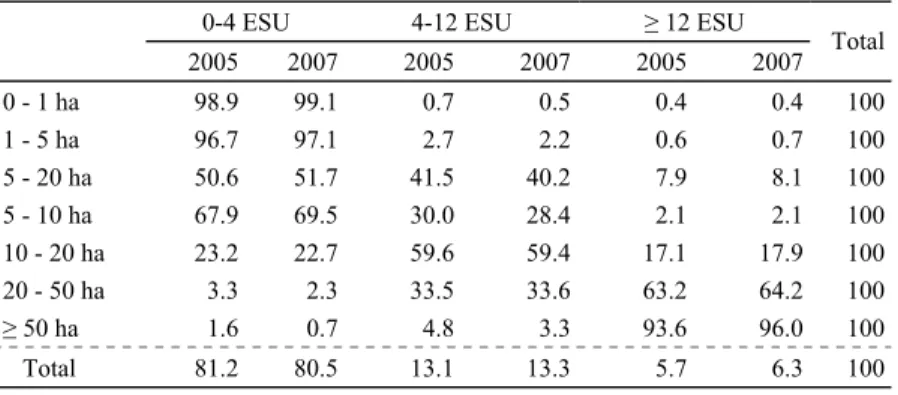
Table 5 Holdings (in %) conducting agricultural activity by area groups and economic size
0-4 ESU 4-12 ESU ≥ 12 ESU
2005 2007 2005 2007 2005 2007 Total 0 - 1 ha 98.9 99.1 0.7 0.5 0.4 0.4 100 1 - 5 ha 96.7 97.1 2.7 2.2 0.6 0.7 100 5 - 20 ha 50.6 51.7 41.5 40.2 7.9 8.1 100 5 - 10 ha 67.9 69.5 30.0 28.4 2.1 2.1 100 10 - 20 ha 23.2 22.7 59.6 59.4 17.1 17.9 100 20 - 50 ha 3.3 2.3 33.5 33.6 63.2 64.2 100 ≥ 50 ha 1.6 0.7 4.8 3.3 93.6 96.0 100 Total 81.2 80.5 13.1 13.3 5.7 6.3 100
Source: Farm Structure Survey 2005 and 2007, CSO.
Farms between 2-4 ESU in Poland are officially called semi-subsistence farms8.
In order to encompass the whole spectrum of features related to small-scale farms, it is reasonable to expand this definition by adding holdings generating 0-2 ESU. This is a very numerous group represented by more than 1.6 million farms. Holdings between 4-12 ESU can be classified as medium units in terms of economic size. According to various analysis, the threshold of 8 or 12 ESU
7
European Size Unit (ESU) represents 1,200 EUR standard gross margin (SGM): http://ec.europa.eu/agriculture/rica/methodology1_en.cfm.
8 Such definition is accepted in Rural Development Plan 2004-2006 and Rural Development
enables farms to achieve income at the parity level9, thus these units can be
categorized as large (Jóźwiak, 2009).
In 2007, there were over 1.9 million small-scale farms (80.5% of the total number of farming holdings), 317,000 medium-scale farms (13%) and roughly 150,000 large-scale farms (6%). Table 5 presents the relation between area size and economic size of Polish farms. In the first group (0-4 ESU), ‘area smallness’ denotes ‘economic smallness’, however it must be stressed that some special production types generate large incomes from a small area (in group of farms possessing 0-10 ha, 3.2% constitute farms generating more than 12 ESU). Between 2005 and 2007, noticeable changes have occurred regarding economic size structure: the share of small farms (0-4 ESU) increased within the group of holdings possessing 0-10 ha, but dropped significantly within the group of medium and large farms in terms of acreage. This situation can be interpreted as a strengthening of the economic position of medium and large farms but a weakening of the position of small farms (0-10 ha). During the same period, within all acreage groups except 20-50 ha, the share of farms with medium economic size (4-12 ESU) has decreased. The share of the largest, in terms of
ESU farms (≥ 12 ESU), has increased considerably in the group of farms
possessing more than 10 ha, which can be interpreted as a tendency towards the commercialization of farms with medium and large area potential.
One more interesting fact can be noticed regarding trends in structural changes in Polish agriculture. Similar to the acreage criterion, between 2005-2007 slow growth of the share of medium and large farms (in terms of ESU) and a decline in the group of small units was observed (last row in Table 5). If the group of 0-4 ESU is divided into two more detailed categories (0-2 and 2-0-4 ESU) opposing tendencies are revealed: a decrease in the first group (69.4% to 67.9%) and increase in second group (11.8% to 12.5%). The growing number of semi-subsistence farms (2-4 ESU) may be related to the introduction of Rural Development Policy (Pillar 2 of the CAP) measure addressed to this specific category. From 2005-2007, the total value of support for semi-subsistence farms reached over 1 billion Zlotys.
In fact, land is still the most important factor of production in agriculture which determines farms’ economic sizes; however its role constantly diminishes in favor of innovative solutions in the process of production (technical and product innovations). The measure of economic size (ESU) is more appropriate than area size to present diversity among various farming units, unfortunately the further analysis of structural changes will be based on acreage criterion due to the lack of data categorizing holdings according to ESU in 2005.
9 Income achieved from farming at the level comparable to the country average net income
5.1 Sources of incomes
The whole picture of structural changes in the Polish agricultural sector would be incomplete without an analysis of the evolution of farm functions with regard to the importance of farming as a main or supplementary source of income for the family. This issue is crucial for understanding the role of agriculture in the wider context of economic changes in rural areas and even nationwide.
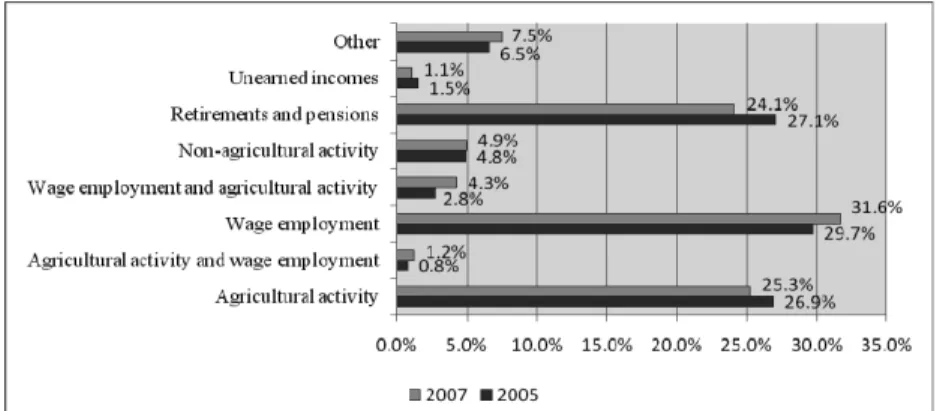
In general, the total number of farming households can be divided into three groups according to the importance of agriculture for income generation: (1) about 25% of farms oriented towards agricultural activity as a main source of income; (2) those with combined sources – 5.5%; (3) farms treating agriculture as additional source of incomes or as a ‘hobby’ or ‘lifestyle’ – roughly 70% (Figure 3).
Figure 3 Structure of households conducting agricultural activity by the main source of income
Source: Own depiction based on the data from Central Statistical Office.
The role of agriculture as a source of income diminished between 2005 and 2007 (Figure 3). Combined sources of incomes, agricultural and wage employment, and only wage employment increased in importance. The share of non-agricultural activity stayed at an almost unchanged level. A significant decline of importance of retirements and pensions and unearned incomes can be noticed.
As progress of diversification of income sources and marginalization of agriculture is visible, the question arises how this process is distributed among different farm structures. First, it is worth stressing that the total number of holdings conducting agricultural activity decreased by 3.5% for the period
2005-2007 (last row in Table 6). Second, the greatest number of holdings that ceased farming is belonging to the category of the smallest farms (0-1ha). Meantime, the total number of farms from medium acreage categories increased slightly and from the group of the largest units increased by roughly 15%.
An analysis of the dynamics of changes in income strategies (Table 6) delivers very interesting information about the pace and directions of structural transformation in Polish agriculture. The total number of farming holdings existing due to agricultural activity diminished in all area groups up to 20 ha, but tiny farms gave up agricultural activity most often.
Table 6 Households conducting agricultural activity and achieving over 50% of their total income from the following sources
2007 (2005=100) Source of income
Total 0 - 1 1 - 5 5 - 10 10 - 20 20 - 50 ≥ 50 Agricultural activity 90.8 36.4 87.1 93.9 96.6 101.5 113.7 Agricultural activity and
wage employment 157.1 148.7 155.3 157.2 146.7 242.3 132.6 Wage employment 102.8 88.4 111.7 118.2 111.9 102.1 113.0 Wage employment and
agricultural activity 149.0 137.3 152.3 149.2 145.5 178.0 131.0 Non-agricultural activity 98.0 89.6 99.3 104.7 104.2 130.7 115.7 Retirements and pensions 85.8 82.6 89.9 89.4 75.1 47.8 79.4 Unearned incomes 72.0 75.6 71.3 61.9 67.0 39.5 43.6 Other 111.4 116.9 107.0 113.2 115.9 133.6 145.3 Total 96.5 84.0 101.9 103.3 99.9 103.9 114.7
Source: Own calculation based on data from Central Statistical Office.
In the same timeframe, the increased role of diversified sources of incomes, especially amongst farms possessing 20-50 ha, as well as in all acreage groups, the total number of farms achieving incomes from combined sources increased significantly. This proves that improving macroeconomic conditions in Poland and better job opportunities encouraged farmers to seek additional sources of income outside agriculture. In fact, non-farm employment did not bring about significant structural change (bottom row in Table 6). This leads to the conclusion that wage employment may help smaller farms survive and in this way small-scale, part-time farming structures persist.
It is somewhat interesting that in the case of wage employment as a category of dominating source of income, a decrease of the number of farms in the smallest acreage group (0-1 ha) is noted. Persons running these farms are not officially
classified as farmers according to the national insurance law10 in Poland, and
additionally they do not receive direct support from Pillar 1 of the CAP. The lack of financial incentives can be recognized as a reason to get rid of tiny farms. It is characteristic that the number of holdings achieving incomes mainly from retirements and pensions decreased considerably. It is very likely that this situation is related to ongoing demographic changes among farmers (see Table 10).
Table 7 Agricultural households consuming more than 50% of the value of their agricultural production
Total 0 - 1 1 - 5 5 - 10 10 - 20 20 - 50 ≥ 50 2005 1014951 496473 409056 72685 28999 7056 681 2007 908171 407802 394207 71786 25874 7668 835
2007 (2005=100)
89.5 82.1 96.4 98.8 89.2 108.7 122.6
Source: Own calculation based on data from Central Statistical Office.
Another dimension of structural changes in Polish agriculture is related to the purpose of agricultural production. According to Table 5 there were, in 2005, over 1 million households with people running a private farm, in which the majority of the value of production was consumed. Bearing in mind that in medium area groups insignificant growth in the total number of private farms is noted, a diminishing number of farms producing mainly for the household`s consumption indicates a moderate increase of the level of commercialization. 5.2 Changes in the acreage of private farms
As land is one of the most important production factors in agriculture, structural transformation should be demonstrated by changes in land allocation between different area groups. Figure 4 depicts the relative stability in land distribution for the medium acreage groups and a slight increase for the largest groups. The group of 50-100 ha constitutes an exemption and the share of land owned by farms from this category increased considerably.
Between 2005 and 2007, the acreage of set-aside and fallow land decreased substantially, especially for the smallest and the largest area groups. Due to the
entitlements of fallow land to be supported by direct payments11 at the basic
10
The national insurance law for farmers is more preferential than for other professional groups in Poland.
11 It involves the payment of uniform amounts per eligible hectare of agricultural land:
rate, a great number of farmers decided to utilize their set-aside and fallow land for production in order to receive so-called Complementary National Direct
Payments12.
Figure 4 Acreage (ha) of private farms by area groups of agricultural land in 2005 and 2007
Source: Own depiction based on data from Central Statistical Office.
Table 8 Set-aside and fallow land area
Year Total 0 - 1 1 - 5 5 - 10 10 - 20 20 - 50 ≥ 50 2005 1028568 82186 307029 132296 86643 49380 371034 Set-aside and fallow
land area (ha) 2007a 440938 23436 146684 77335 52494 30818 110172
2007 (2005=100)
Set-aside and fallow
land area (ha) 42.87 28.52 47.78 58.46 60.59 62.41 29.69
Source: Own calculation based on data from Central Statistical Office.
Notes: a Fallow land only - includes arable land not used for production purposes, but maintained in good agricultural and environmental condition.
12 On top of the EU funded direct payments, the new Member States may pay complementary
5.3 Manpower transformation
Structural change in agriculture is also characterized by constant changes in the deployment of labor. In 2007 there were roughly five million persons, including family labor force and employees, engaged in work on private farms (a decrease of 1.5% in comparison to 2005). A different picture emerges when a full-time
employment measure (Annual Work Units13) is used – data in Table 9 indicates
that in 2007 there were over 2.2 million full-time workers. This number stayed almost unchanged since 2005; however different tendencies can be noticed for various area groups.
Table 9 Full-time employment in private farms by area groups of agricultural land Year Total 0 - 1 1 - 5 5 - 10 10-20 20 - 50 ≥ 50 2005 2246.9 219.8 783.4 551.8 433.3 207.2 51.4 Full-time employment in thousands of AWU a) 2007 2245.8 198.2 796.8 556.9 426.2 209.3 58.6 2005 0.91 0.29 0.81 1.44 1.78 2.11 2.75 AWU / private farm
2007 0.94 0.31 0.81 1.41 1.75 2.05 2.73
2007 (2005=100)
Full-time employment in
thousands of AWU a) 99.95 90.17 101.71 100.92 98.36 101.01 114.01
Source: Own calculations based on data from Central Statistical Office. Note: a Including employees and neighbors` help.
A decrease of full-time employment can be observed in the group of the smallest farms (nearly 10%) and medium ones (10-20 ha) (~1.6%) and significant increase is noticeable in the group of the largest farms (14%). All these changes are closely related to changes in the total number of private farms (Table 4). Considering the number of fully-employed per one private farm, small changes are visible (Table 9). It is worth stressing that the rate of ‘AWU/farm’ is disproportionately distributed among acreage groups. Indeed, larger farms employ absolutely more labor force per holding, however smaller farms, especially from the groups of 1-5 ha and 5-10 ha, engage much more workforce in relation to the acreage of utilized land. This relationship did not change considerably between 2005 and 2007.
13 Annual work unit (AWU) means the equivalent of full-time employment. It is calculated by
dividing the total annual number of hours worked by the average annual number of hours worked in full-time jobs. The annual work unit used in Poland equals 2120 working hours per a year, i.e., 265 working days per 8 working hours a day. To calculate the labor input expressed in AWU (in accordance with the Eurostat methodology) the assumption was applied that more than 1 AWU cannot be attributed to 1 person, even if the actual amount of work was higher.
A very important aspect influencing the pace of structural transformation in agriculture is the demographic structure of persons running farms. According to Table 10, over 35% of persons were, in 2007, aged 55 or older. In the same timeframe, only 1.2% of farmers were younger than 24 years old. More than 60% of people running farms were aged 25 to 54 years old.
Table 10 Persons running (%) private farms conducting agricultural activity by age groups in 2005 and 2007
a – 2005 b – 2007 Total = 100 0 - 1 1 - 5 5 - 10 10 – 20 20 – 50 ≥ 50 a 1.4 11.0 35.7 24.3 20.6 7.5 0.6 to 24 years old b 1.2 7.7 34.0 28.4 20.7 8.1 1.1 a 11.3 18.7 37.6 21.1 14.8 6.6 1.2 25 – 34 years old b 11.1 13.4 39.7 22.7 15.6 7.0 1.6 a 22.2 23.0 39.2 18.4 12.7 5.7 1.0 35 – 44 years old b 21.5 19.7 40.7 19.6 13.0 5.9 1.2 a 30.9 27.5 37.5 17.9 11.6 4.6 0.9 45 – 54 years old b 30.9 22.1 40.3 19.1 12.3 5.1 1.1 a 17.2 37.8 40.9 11.9 6.7 2.2 0.5 55 – 64 years old b 19.2 34.9 42.7 12.8 6.6 2.5 0.6 a 17.1 51.1 39.9 6.6 1.9 0.4 0.1 65 and above b 16.1 47.2 42.6 7.4 2.1 0.6 0.1 Source: Own calculation based on data from Central Statistical Office.
It is very often argued that the interest of young people in farming will be diminishing in the coming years mainly due to better job opportunities offered by other sectors, mostly in bigger cities. However, the profession of farmer gained prominence and attractiveness among graduates of agricultural schools between 2000 and 2007 (Bujak, 2009). In fact, demographic factor can become the main one responsible for structural changes in agricultural employment in Poland.
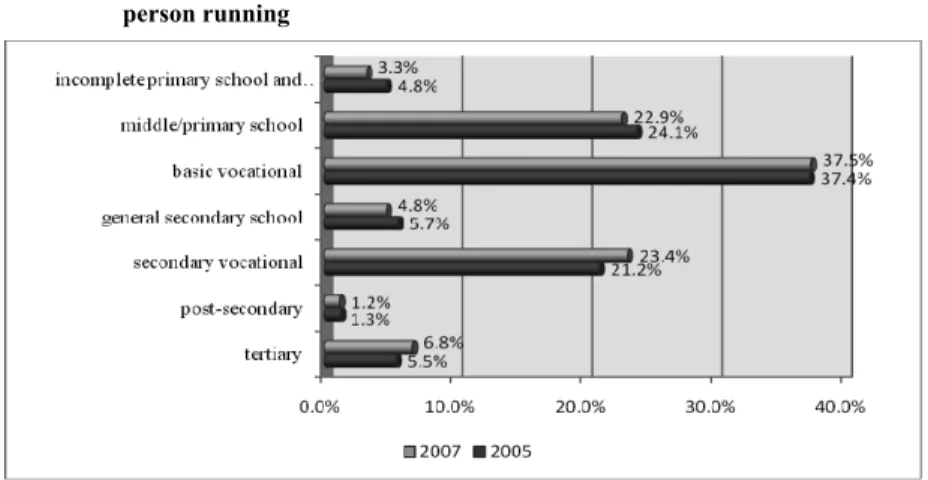
The last important aspect of manpower transformation is related to the managerial capabilities of persons running farms. Managerial capability is crucial for adaptive reactions to increasing dynamics in any economic sector, including agriculture. It can be assumed that the higher the level of education is, the better managerial capabilities characterize the given person. In Poland, more than 26% of farmers (627,000) in 2007 were educated at the basic level (incomplete primary, primary or middle school) and a further 37.5% (897,000) were educated at the basic vocational level (Figure 5). Less than 7% of all farmers had tertiary education. The dynamics of changes in educational level is quite slow, though some positive tendencies can be noticed. Between 2005 and
2007, the number of farmers with the lowest education decreased and the number of farmers having secondary vocational and tertiary education increased.
Figure 5 Structure of holdings conducting agricultural activity by education level of person running
Source: Own calculation based on data from Central Statistical Office.
In all acreage groups above 1ha, an increase in the number of farms run by persons with the highest education levels (secondary, post-secondary and tertiary) was observed (Table 11). There was a significant decrease in the number of small farms, with the lowest education of the managing farmer, but positive changes affected mostly medium and large farms.
Observed dynamics of growth in farmers’ education level is very important for an increase in labor productivity, and simultaneously with increasing non-farm employment opportunities due to overall economic growth can accelerate employment shifts. Education is also crucial for the absorption of innovative solutions by farmers, which leads to improvements in the process of food production.
Table 11 Holdings conducting agricultural activity by education level of person running and area groups of agricultural land
2007 (2005 = 100) Level of education Total 0 - 1 ha 1 – 5 ha 5 – 10 ha 10 – 20 ha 20 – 50 ha ≥ 50 ha Tertiary 118.5 96.4 128.1 126.8 152.2 140.4 124.9 Post-secondary 91.5 71.1 102.2 107.9 109.1 151.3 110.1 Secondary vocational 106.5 89.0 113.5 118.3 110.5 112.5 117.0 General secondary school 81.4 65.2 86.6 111.8 105.5 127.7 112.6 Basic vocational 97.0 84.9 101.7 102.6 99.3 99.3 106.6 Middle/primary school 92.0 86.7 95.4 94.5 89.2 93.6 103.3 Incomplete primary school, no education 66.6 68.7 72.9 57.0 41.0 45.7 28.9 Total 96.5 84.0 101.9 103.3 99.9 103.9 113.1
Source: Own calculation based on data from Central Statistical Office.
6 Conclusions
When assessing structural changes in the Polish agricultural sector, one must be very careful in interpreting the basic and generally accepted measure of average farm size. The results of analysis indicates that in the case of Poland, average
farm size increases only along with the growth in number of the largest farms (≥
50 ha). Meanwhile, during the 1990s, the polarization of agrarian structure was observed, with an increase in total area occupied by the smallest and the largest farms, and a reduction in medium-sized farms. In this situation, the concentration of land took place without increasing the average farm area. Since 2002, different tendencies have been noticed - average farm size has increased substantially due to the growing number of medium-sized and large farms. It is generally accepted that structural change in Polish agriculture can be achieved through production concentration, which is very often understood solely as land consolidation. Despite agricultural land being the most important factor of production in agriculture, acreage criterion constantly loses its importance in favor of innovative solutions applied in production. As a result, small-scale in terms of acreage does not necessarily mean small-scale in terms of economic size. However, analysis reveals the fact that the economic position of small farms (0-10 ha) weakened between 2005 and 2007, and the medium-sized and large farms exhibited moderate tendencies to commercialization. Analysis of structural changes should include the evolution of farm functions with regard to the role of farming being a main or supplementary source of income for the family. From 2005-2007 progress with the diversification of income sources was significant within all acreage groups and the
marginalization of agriculture was noticeable within the small and medium-sized groups.
The main symptom of structural transformation in agriculture refers to the constant changes in the deployment of labor. Only for the group of the smallest farms can the decrease of full-time employment be noticed. Larger farms employ more labor in absolute values, whereas smaller farms engage much more labor in relation to utilized area.
Demographic changes will likely be of key importance for the pace of structural transformation in Polish agriculture. The age structure of persons running farms indicates that over 35% of them were aged 55 or older in 2007.
List of References
Chlebicka, A., Fałkowski, J., Wołek, T. (2009): Small-scale farms in Poland – Characteristics.
The Agricultural Policy Analysis Unit, (FAPA), http://www.fapa. com.pl/gfx/saepr/Male_gospodarstwa_w_Polsce.pdf (accessed in June 2009).
Fałkowski, J. (2008): Changes in number of farm holdings in Poland over the period
1996-2002. The Agricultural Policy Analysis Unit (FAPA), http://www.fapa.com.pl/ gfx/saepr/zmiany%20w%20iczbie%20gospodarstw%20rolnych%201996-2002-raport% 2009-08.pdf (accessed in June 2009).
Frenkel, I., Rosner, A. (1999): Prospects for change in the employment structure of the rural
population. In Village and Agriculture, vol. 2, Polish Academy of Science (ed.): 65-74.
Warsaw, Poland: Polish Academy of Science, Institute of Rural and Agricultural Development.
Goraj, L. (2005): The impact of direct payments on incomes of Polish farm holdings. Office of the Committee for European integration, http://www.ukie.gov.pl/HLP/files.nsf/0/ 4DFAE390F01AF8ACC125727C00347FBB/$file/Platnosci_bezposrednie_listopad200 5.pdf?Open (accessed in June 2009).
Gorton, M., Davidova S. (2004): Farm productivity and efficiency in the CEE applicant
countries: a synthesis of results. Agricultural Economics 30: 1-16.
Jóźwiak, W. (2009): Effectiveness of Polish Farms. A problem or a hope? Village and
Agriculture, vol. 1, Polish Academy of Science (ed.): 35-43. Warsaw, Poland: Polish Academy of Science, Institute of Rural and Agricultural Development..
Lerman, Z. (2001): Productivity and Efficiency of Individual Farms in Poland: A case for Land Consolidation. Paper presented at the Annual Meeting of the American Agricultural Economics Association, Long Beach, CA, July 28-31, 2001.
Orłowski, W. (2001): Macro-economical conditions for the development of the Polish
agriculture in the long run. Village and Agriculture, vol. 2, Polish Academy of Science
(ed.): 19-27. Warsaw, Poland: Polish Academy of Science, Institute of Rural and Agricultural Development.
Rosner, A. (2008): Socio-economic conditions related to restructuring of agricultural function of rural areas. Ministry of Regional Development, http://www.mrr.gov.pl/Rozwoj%20 przestrzenny/Polska%20polityka%20przestrzenna/Prace%20nad%20KPZK%202008-2033/ Documents/Rosner.pdf (accessed in June 2009).
Szemberg, A. (1998): The agricultural structural policies: Woś A. (ed.), The agro business
Van Zyl, J., Miller, B., Parker, A. (1996): Agrarian Structure in Poland. The Myth of Large-Farm Superiority. Policy Research Working Paper No. 1596. Washington, DC, USA: World Bank, Agriculture and Natural Resources Department.
Woś, A. (2003): Structural transformations of agriculture in the time of the European
Integration. Problems of Agricultural Economics (4): 5-14.
The role of farm activities for overcoming
rural poverty in Romania
Cosmin SALASAN* and Jana FRITZSCH**
*Banat’s University of Agricultural Sciences and Veterinary Medicine Timisoara (USAMVB) and **Leibniz Institute for Agricultural Development in
Central and Eastern Europe (IAMO) [email protected] and [email protected] Abstract
During the last two decades the agricultural sector in Romania has faced many changes and challenges. This paper links the most critical issues that the country faces with the recorded development of the agricultural structures, the overall economic development of the country and the evolution of poverty in rural areas. Earlier research on rural poverty attributes agriculture with an important role in poverty reduction or improving standards of living. In recent years, Romania has successfully reduced both development gaps and poverty rates. Though the agricultural sector served as a social buffer for several million people in the 1990s, in the background lies a very fragmented land property in which most rural households hold subsistence or semi-subsistence farms. These farms are often managed by retired elderly people lacking basic agricultural training. The authors aim to identify and present the triggers of future development in the rural economy, as well as the role that farming can play in poverty reduction and in fostering community development.
Keywords: poverty, agriculture, rural economy, transition, development
Table of contents
1 Poverty in Romania
2 Economic development in Romania and the role of the agricultural sector
3 Structure of Romanian agriculture and its position in rural economy
4 Agriculture's role in fighting rural poverty and in driving economic development
1 Poverty in Romania1
The literature discusses several indicators for measuring poverty. Absolute measures use a threshold of daily disposable money and allow us to compare figures from different countries for longer time periods. Relative measures refer to countries' average incomes and show poverty in relation to country specific standards of living. Inequality indices like Gini coefficients show the dispersion of income among the population. Each indicator has its pros and cons (Petrovici and Gorton, 2005); therefore representatives from all three groups are used to describe the phenomenon of poverty in Romania.
In September 2000 the world's leaders agreed upon eight Millennium Development Goals (MDGs) to be achieved by 2015. The first goal is to "eradicate extreme poverty and hunger". In 2003 the first Romanian MDGs
Report substantiated this first goal for Romania to halve the severe poverty rate2
by 2009 (Government of Romania, 2003). Already in 2008, the United Nations Development Programme (UNDP) in Romania could indicate a reduction of the severe poverty in Romania for the last five years, from 10.5% in 2002 to 4.1% in 2006 (Figure 1). Though in the same period, severe poverty also decreased in rural areas from 17.5% to 7.1% (Figure 1), the discrepancy between rural and urban regions still persists.
1 The authors gratefully acknowledge financial participation from the European Community
under the Sixth Framework Programme for Research, Technological Development and Demonstration Activities, for the Specific Targeted Research Project "SCARLED" SSPE-CT-2006-044201. The views expressed in this publication are the sole responsibility of the authors and do not necessarily reflect the views of the European Commission.
The following SCARLED partners oversaw the process of data collection: University of National and World Economy (Bulgaria), Research Institute for Agricultural Economics (Hungary), Department of Economic Sciences, Warsaw University (Poland), Banat's University of Agricultural Sciences and Veterinary Medicine, Timisoara (Romania), and University of Ljubljana (Slovenia). The authors are also grateful to C. Suta for her assistance. For an extended version of the article, see Salasan and Fritzsch (2009).
2 Severe poverty rate: proportion of population living from less than $ PPP 1/day (UNDP
Figure 1 Severe poverty rate in Romania
0 2 4 6 8 10 12 14 16 18 20 1995 1996 1997 1998 1999 2000 2001 2002 2003 2004 2005 2006 %
Severe poverty rate, total ($ PPP 1/day) Severe poverty rate, urban ($ PPP 1/day) Severe poverty rate, rural ($ PPP 1/day)
Source: UNDP Romania (2008)
Alam et al. (2005) propose using an absolute poverty line of $ PPP 2.15 per capita and day because this would better approximate basic needs in regions where the climate requires expenditures for heating and warm clothing. In addition, a second line is drawn at $ PPP 4.30 per capita and day to signify
"economic vulnerability"3. Both indicators show that Romania has greatly
progressed in poverty reduction during recent years (Figure 2) but the share of economically vulnerable people remains unsatisfactorily high and requires further action.
The Gini coefficient is still low in Romania and increased only slightly from 0.27 in 1998 to 0.29 in 2003 (Alam et al. 2005). These low coefficients show that although there are only small income differences in Romania, the gap between rich and poor is widening. This is also underpinned by the inequality of
3 According to Alam et al. (2005), people who are not absolutely poor but could become poor
income distribution index4, which stood at 4.5 in 2000 and increased to 5.3 in
2006 (Eurostat 2008a).
Figure 2 Poverty rate and economic vulnerability in Romania
0 10 20 30 40 50 60 70 80 90 1998 1999 2000 2001 2002 2003 %
Poverty rate, total ($ PPP 2.15/day) Poverty rate, urban ($ PPP 2.15/day) Poverty rate, rural ($ PPP 2.15/day) Economic vulnerability, total ($ PPP 4.30/day) Economic vulnerability, urban ($ PPP 4.30/day) Economic vulnerability, rural ($ PPP 4.30/day)
Source: Alam et al. (2005).
The at-risk-of-poverty-rate5 has increased by 3% before social transfers (from
21% to 24%) and by 1% after social transfers (from 17% to 18%) as presented in Table 1. The situation is only marginally better for males than for females. When comparing the Romanian figures to that of the Euro area or to the EU-25,
4 "Inequality of income distribution: The ratio of total income received by the 20% of the
population with the highest income (top quintile) to that received by the 20% of the population with the lowest income (lowest quintile). Income is based on equivalised disposable income." (Eurostat 2008b, p. 534)
5 "The at-risk-of-poverty rate is defined as the share of persons with an equivalised income
that is below the at-risk-of-poverty threshold, set at 60% of the national median disposable income. This rate may be expressed before or after social transfers, with the difference measuring the hypothetical impact of national social transfers in reducing poverty risk. Retirement and survivor's pensions are counted as income before transfers and not as social transfers." (Eurostat 2008b, p. 220)
the Romanian situation appears rather comparable, showing that relative to the median disposable income of the basis region, i.e., EU-25 Euro area and Romania, poverty is no worse in Romania than in the EU-25 or the Euro area. These figures may be misleading because they neglect that Romanian living conditions are still below EU standards. Therefore, total consumption expenditures are considered to scale these figures. Data from Table 2 confirms that the Romanian situation appears to be far from the European standard at the end of 2005. Moreover, the share of expenditures for food and non-alcoholic beverages in Romania in 2005 was, with 44.2%, very high and greatly exceeded the average for the EU-27 (16.9%) (Eurostat, 2008a).
Romania progressed significantly in poverty reduction in recent years. It is questionable,