Universal Dependency Evaluation
Joakim Nivre
Dept. of Linguistics and Philology Uppsala University
Chiao-Ting Fang
Dept. of Linguistics and Philology Uppsala University
Abstract
Multilingual parser evaluation has for a long time been hampered by the lack of cross-linguistically consistent annotation. While initiatives like Universal Depen-dencies have greatly improved the situa-tion, they have also raised questions about the adequacy of existing parser evaluation metrics when applied across typologically different languages. This paper argues that the usual attachment score metrics used to evaluate dependency parsers are biased in favor of analytic languages, where gram-matical structure tends to be encoded in free morphemes (function words) rather than in bound morphemes (inflection). We therefore propose an alternative evaluation metric that excludes functional relations from the attachment score. We explore the effect of this change in experiments using a subset of treebanks from release v2.0 of Universal Dependencies.
1 Introduction
The last decade has seen a steadily growing in-terest in multilingual parsing research, inspired by such events as the CoNLL shared tasks on multi-lingual dependency parsing (Buchholz and Marsi, 2006; Nivre et al., 2007) and the SPMRL shared tasks on parsing morphologically rich languages (Seddah et al., 2013; Seddah et al., 2014). This has led to a number of conjectures about the suitabil-ity of different parsing models for languages with different structural characteristics, but it has been surprisingly hard to study the interplay of pars-ing technology and language typology in a sys-tematic way. To some extent, this is due to data-related factors such as text genre and training set size, which are hard to control for, but even more important has been the fact that syntactic anno-tation is not standardized across languages. This
has made it almost impossible to isolate the in-fluence of typological variables, such as word or-der or morphosyntactic alignment, from the effect of more or less arbitrary choices in linguistic rep-resentations. The absence of cross-linguistically consistent annotation has also been a constant source of noise in the evaluation of cross-lingual learning of syntax (Hwa et al., 2002; Zeman and Resnik, 2008; McDonald et al., 2011).
Fortunately, there is now also a growing interest in developing cross-linguistically consistent syn-tactic annotation, which has led to a number of initiatives and proposals (Zeman et al., 2012; Mc-Donald et al., 2013; Tsarfaty, 2013; de Marneffe et al., 2014). Many of these initiatives have now converged into Universal Dependencies (UD), an open community effort that aims to develop cross-linguistically consistent treebank annotation for many languages and that has so far released 70 treebanks representing 50 languages (Nivre, 2015; Nivre et al., 2016). The basic idea behind the UD scheme is to maximize parallelism across lan-guages by focusing on dependency relations be-tween content words, which are more likely to be similar across languages, and to use cross-linguistically valid categories for morphological and syntactic analysis. The UD scheme is illus-trated in Figure 1 for two translationally equivalent sentences in English and Finnish. For readability, we display only a subset of the full annotation, in particular suppressing all morphological features except case.
The example shows that English and Finnish have rather different structural characteristics. What is expressed by eight words in English is expressed by four words in Finnish, and whereas word order and function words likefromare cru-cial in English for understanding who does what to whom, the same information is encoded in Finnish mainly by nominal case inflection (nominative for the subject, accusative for the object, and
DET NOUN VERB DET NOUN ADP DET NOUN
the dog chased the cat from the room
Case=Nom Case=Acc Case=Ela
NOUN VERB NOUN NOUN
koira jahtasi kissan huoneesta
det nsubj
nsubj
det obj
obj
det case obl
[image:2.595.154.448.55.185.2]obl
Figure 1: Simplified UD annotation for equivalent sentences from English (top) and Finnish (bottom).
tive for the locative modifier). Moreover, Finnish has no explicit encoding of the information ex-pressed by the definite articlethein English. Nev-ertheless, the main grammatical relations are ex-actly parallel in the two sentences, with the main verb chased/jahtasi having three direct nominal dependents, which can be categorized in both lan-guages as (nominal) subject (nsubj), object (obj), and oblique modifier (obl). This illustrates how UD maximizes parallelism by giving priority to dependency relations between content words.
It is tempting to assume that cross-linguistically consistent annotation automatically guarantees cross-linguistically valid parser evaluation. Unfor-tunately, this is not the case, because our old es-tablished evaluation metrics may not be adequate for the new harmonized representations. The most commonly used metric in dependency parsing is the (labeled or unlabeled) attachment score, which measures the percentage of words that have been assigned the correct head (with or without taking the dependency label into account). Suppose now that a parser makes a single mistake on each of the sentences in Figure 1, say, by attaching the locative modifier to the object instead of to the verb. It seems intuitively correct to say that the parser has done an equally good job in both cases. However, for simple arithmetical reasons, the Eng-lish parser will be credited with an attachment score of 87.5%, while the Finnish parser only gets 75%. In other words, the impact of a single error is doubled in Finnish because of the smaller de-nominator. Using the attachment score for cross-linguistic comparisons can therefore be quite mis-leading even if the annotation has been harmo-nized across languages.
What should we do about this? A drastic pro-posal would be to give up intrinsic evaluation al-together, on the grounds that it will always be
bi-ased one way or the other, and instead put all our hope on extrinsic evaluation. In doing so, how-ever, we would run the risk of just moving the problem elsewhere. For example, if we decide to evaluate parsers through their impact on machine translation quality, how do we guarantee that the latter evaluation is comparable across languages? Furthermore, intrinsic evaluation metrics will al-ways be useful for internal testing purposes, so we might as well do our best to develop new metrics that are better suited for cross-linguistic compar-isons. This is the purpose of this paper.
More precisely, we want to find an alternative evaluation metric for parsing with UD representa-tions, a metric that puts more emphasis on depen-dency relations between content words in order to maximize comparability across languages, follow-ing the same principle as in the design of the an-notation itself. We will begin by dividing the syn-tactic relations used in UD representations into a number of different groups and study their impact on evaluation scores. We will then propose a new metric called CLAS, for Content-Word Labeled Attachment Score, and analyze in more depth how different languages are affected by excluding dif-ferent functional relations from the evaluation.
2 Syntactic Relations in UD
which is a revised version of the universal Stan-ford dependencies (de Marneffe et al., 2014).
As explained in the introduction, the syntac-tic tree gives priority to grammasyntac-tical relations be-tween content words, while function words are at-tached to the content word they specify using spe-cial relations such ascase(for adpositions),mark (for subordinating conjunctions) andaux(for aux-iliary verbs). Although these functional relations are formally indistinguishable from other relations in the tree, they can be seen as encoding features of the content word rather than representing real dependency relations.
When applying the standard attachment score metrics to UD, functional relations are scored just like any other relation encoded in the dependency tree (except the specialpunctrelation for punctua-tion, which is often excluded from evaluation). If a language makes frequent use of function words to encode grammatical information, these relations will therefore make a large contribution to the overall score. Since these relations tend to be lo-cal and involve highly frequent words, they also tend to have higher than average accuracy, which means that the overall score comes out higher if they are included. For a language that instead uses morphology to encode grammatical information of a similar kind, there will be no corresponding boost to the evaluation score, because morpholog-ical features are not included in the parsing score. Moreover, as illustrated earlier, errors on content word dependencies will be more severely penal-ized in such a language, because the error rate is normalized by the number of words. In this way, languages with a lower ratio of function words are in effect doubly penalized.
One strategy for dealing with this problem could be to come up with a more comprehensive metric that considers the full grammatical repre-sentation and abstracts over different realization patterns and puts morphological features and func-tion words on a more equal footing. Such a met-ric has been proposed in the context of grammar-based parsing by Dridan and Oepen (2011). In the context of UD, however, this would require a sub-stantial research effort in order to establish corre-spondences between many languages. And while this is precisely the type of research that UD is meant to enable, it would be premature to assume that we already have the required knowledge. For the time being, we will therefore propose a new
metric for syntactic dependencies that is limited to those dependencies that we can expect to find in all or most languages. Besides being less biased from a cross-linguistic perspective, such a metric may also be more relevant for downstream lan-guage understanding tasks, where errors on func-tional relations often matter less than errors on ar-gument and modifier relations. And by compar-ing results for this metric to those obtained with standard attachment scores, we can estimate the degree of bias inherent in the older metric.
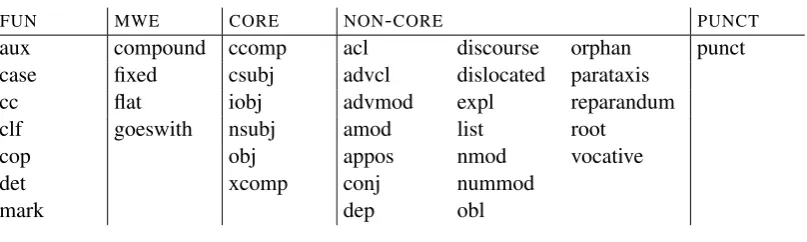
As a preliminary to defining the new metric, we first divide the 37 syntactic UD relations into five disjoint subsets, listed in Table 1. FUNis the sub-set of relations that relate a function word to a content word, including determiners (det), clas-sifiers (clf), adpositions (case), auxiliaries (aux, cop), and conjunctions (cc,mark). The first three can be grouped together as nominal functional relations, because they are associated with noun phrases (in the extended sense that includes adpo-sitional phrases), whileauxandcopare connected to clausal predicates, andmarkandcclink clauses (or other phrases) in relations of subordination or coordination.
FUN MWE CORE NON-CORE PUNCT
aux compound ccomp acl discourse orphan punct
case fixed csubj advcl dislocated parataxis
cc flat iobj advmod expl reparandum
clf goeswith nsubj amod list root
cop obj appos nmod vocative
det xcomp conj nummod
[image:4.595.99.503.59.180.2]mark dep obl
Table 1: Subsets of UD relations: core, non-core, functional, multiword and punctuation.
errors, where a single word has accidentally been split into two, but it is similar in that it does not denote a proper syntactic relation.
The remaining UD relations are divided into CORE, NON-CORE and PUNCT. CORE includes relations for core arguments of predicates, which play a central role in the UD taxonomy and ar-guably in all syntactic representations. NON-CORE includes all other syntactic relations, including modifier relations at various syntactic levels as well as relations for analyzing coordination and special phenomena like ellipsis and disfluencies. PUNCT, finally, contains the single relationpunct, which has an unclear status as a syntactic relation and is often excluded in evaluation metrics. 3 Labeled Attachment Score
The labeled attachment score (LAS) evaluates the output of a parser by considering how many words have been assigned both the correct syntactic head and the correct label. If parse trees and gold stan-dard trees can be assumed to have the same yield, and if no syntactic relations are excluded, then it reduces to a simple accuracy score, but in general it can be defined as the labeledF1-score of
syntac-tic relations.
To get a better view of the impact of different relation types on the overall LAS, we performed a simple experiment where we trained and evalu-ated MaltParser (Nivre et al., 2006) on treebanks from the latest UD release (v2.0). The parser used an arc-standard transition system with online re-ordering and a lazy oracle (Nivre et al., 2009) and an extended feature model that takes all morpho-logical features into account. We selected one treebank per language1 but only included
tree-banks containing morphological features and at 1For languages with more than one treebank, we selected
the treebank without a suffix except in the case of Ancient Greek and Latin, where we selected the PROIEL treebanks
least 30,000 words. We used the dedicated train-ing sets for traintrain-ing and the development sets for evaluation. To make evaluation scores compara-ble across languages, we replaced all language-specific subtypes of syntactic relations by their universal supertypes.
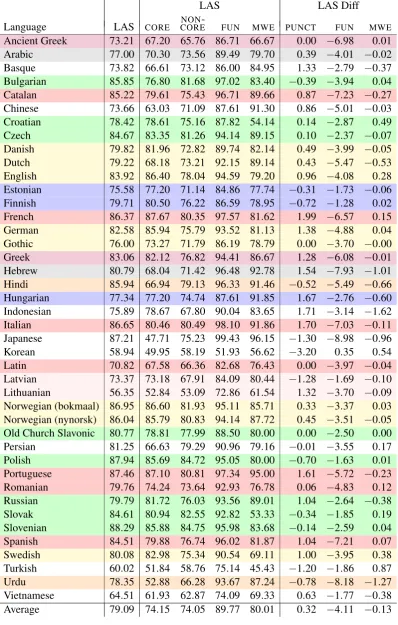
Table 2 shows the results for the 42 treebanks included in the experiment. The LAS column re-ports the standard LAS score over all relations (including punctuation). The next four columns report the LAS for CORE, NON-CORE, FUN and MWEseparately. The last three columns report the difference in LAS score when excluding relations inPUNCT,FUNandMWE, respectively.
The first thing to note is that there is a very large variation in LAS scores, ranging from a high of 88.29 for Slovenian to a low of 56.35 for Lithua-nian. Some of this variation can be explained by data set specific properties like text genre and training set size, and it is undeniable that the pars-ing model used works better for some languages than others. However, the results in Table 2 also show that the exact difference between two lan-guages is sensitive to which syntactic relations are included.
Examining the LAS scores for different sub-sets of relations, we find that FUN relations on average are parsed with almost 90% accuracy, to be compared with CORE and NON-CORE rela-tions at about 75% andMWEat about 80%. This means that including FUN relations in the LAS score generally leads to higher scores and that lan-guages with a high share of function words re-ceive a boost. It is also worth noting that, even if CORE and NON-CORE relations are on aver-age parsed with the same accuracy, there is con-siderable variation across languages. Most lan-guages have a higher LAS score for CORE than
LAS LAS Diff NON
-Language LAS CORE CORE FUN MWE PUNCT FUN MWE
Ancient Greek 73.21 67.20 65.76 86.71 66.67 0.00 −6.98 0.01
Arabic 77.00 70.30 73.56 89.49 79.70 0.39 −4.01 −0.02 Basque 73.82 66.61 73.12 86.00 84.95 1.33 −2.79 −0.37 Bulgarian 85.85 76.80 81.68 97.02 83.40 −0.39 −3.94 0.04
Catalan 85.22 79.61 75.43 96.71 89.66 0.87 −7.23 −0.27 Chinese 73.66 63.03 71.09 87.61 91.30 0.86 −5.01 −0.03 Croatian 78.42 78.61 75.16 87.82 54.14 0.14 −2.87 0.49
Czech 84.67 83.35 81.26 94.14 89.15 0.10 −2.37 −0.07 Danish 79.82 81.96 72.82 89.74 82.14 0.49 −3.99 −0.05 Dutch 79.22 68.18 73.21 92.15 89.14 0.43 −5.47 −0.53
English 83.92 86.40 78.04 94.59 79.20 0.96 −4.08 0.28 Estonian 75.58 77.20 71.14 84.86 77.74 −0.31 −1.73 −0.06 Finnish 79.71 80.50 76.22 86.59 78.95 −0.72 −1.28 0.02
French 86.37 87.67 80.35 97.57 81.62 1.99 −6.57 0.15
German 82.58 85.94 75.79 93.52 81.13 1.38 −4.88 0.04 Gothic 76.00 73.27 71.79 86.19 78.79 0.00 −3.70 −0.00
Greek 83.06 82.12 76.82 94.41 86.67 1.28 −6.08 −0.01
Hebrew 80.79 68.04 71.42 96.48 92.78 1.54 −7.93 −1.01 Hindi 85.94 66.94 79.13 96.33 91.46 −0.52 −5.49 −0.66
Hungarian 77.34 77.20 74.74 87.61 91.85 1.67 −2.76 −0.60
Indonesian 75.89 78.67 67.80 90.04 83.65 1.71 −3.14 −1.62 Italian 86.65 80.46 80.49 98.10 91.86 1.70 −7.03 −0.11
Japanese 87.21 47.71 75.23 99.43 96.15 −1.30 −8.98 −0.96
Korean 58.94 49.95 58.19 51.93 56.62 −3.20 0.35 0.54 Latin 70.82 67.58 66.36 82.68 76.43 0.00 −3.97 −0.04 Latvian 73.37 73.18 67.91 84.09 80.44 −1.28 −1.69 −0.10
Lithuanian 56.35 52.84 53.09 72.86 61.54 1.32 −3.70 −0.09 Norwegian (bokmaal) 86.95 86.60 81.93 95.11 85.71 0.33 −3.37 0.03 Norwegian (nynorsk) 86.04 85.79 80.83 94.14 87.72 0.45 −3.51 −0.05
Old Church Slavonic 80.77 78.81 77.99 88.50 80.00 0.00 −2.50 0.00 Persian 81.25 66.63 79.29 90.96 79.16 −0.01 −3.55 0.17 Polish 87.94 85.69 84.72 95.05 80.00 −0.70 −1.63 0.01
Portuguese 87.46 87.10 80.81 97.34 95.00 1.61 −5.72 −0.23 Romanian 79.76 74.24 73.64 92.93 76.78 0.06 −4.83 0.12 Russian 79.79 81.72 76.03 93.56 89.01 1.04 −2.64 −0.38
Slovak 84.61 80.94 82.55 92.82 53.33 −0.34 −1.85 0.19 Slovenian 88.29 85.88 84.75 95.98 83.68 −0.14 −2.59 0.04 Spanish 84.51 79.88 76.74 96.02 81.87 1.04 −7.21 0.07
Swedish 80.08 82.98 75.34 90.54 69.11 1.00 −3.95 0.38 Turkish 60.02 51.84 58.76 75.14 45.43 −1.20 −1.86 0.87 Urdu 78.35 52.88 66.28 93.67 87.24 −0.78 −8.18 −1.27
[image:5.595.102.501.64.690.2]Vietnamese 64.51 61.93 62.87 74.09 69.33 0.63 −1.77 −0.38 Average 79.09 74.15 74.05 89.77 80.01 0.32 −4.11 −0.13
forNON-CORE, including most Germanic and Ro-mance languages. But there are also languages that have a considerably lower score for CORE than forNON-CORE. The most extreme example is Japanese, where the difference is almost 30 per-centage points, but large discrepancies can also be found for Basque, Chinese, Korean, Hindi and Persian. It seems that the parsing model used in the experiment fails to learn how core arguments are encoded in these languages, which is an inter-esting observation but not directly related to the topic of this paper.
Next we examine how the LAS score is affected when different subsets are excluded. Starting with PUNCT, we see that LAS sometimes increases and sometimes decreases. This may be due to incon-sistent annotation of punctuation across treebanks, but it could also be due to differences in syntactic complexity, as short and simple sentences increase the frequency of easily predictable punctuation re-lations while long and complex sentences have the opposite effect. For most languages, the difference is less than a percentage point, but in a few cases it is quite substantial. For Korean, for example, excluding PUNCT from the LAS score decreases the score by over 3 percentage points. We also see that some of the classical languages (Ancient Greek, Gothic, Latin and Old Church Slavonic) lack punctuation completely, and the same would have been true if we had included treebanks of spoken language. This casts additional doubt on the inclusion ofPUNCTin an evaluation score for syntactic analysis, and we will propose to exclude it in the new score.
As expected, the relations in FUN have a more significant and differential impact on the score. On average, LAS scores decrease by 4.11 points when these relations are not included, which is consis-tent with their being parsed more accurately than other relations, but the cross-linguistic variation is considerable. The largest drop is almost 9 points, for Japanese, and 12 languages have a drop of over 5 points. In this group, Romance languages like Catalan, Italian and Spanish and Greek (both an-cient and modern) are prominent. At the opposite of the scale, Korean in fact sees a small improve-ment (0.35) when excludingFUN, and 7 languages have a drop smaller than 2 points. Finno-Ugric language like Estonian and Finnish are in this group, together with Turkish, Vietnamese and a few Baltic and Slavonic languages. This is mostly
in line with our expectations based on linguistic typology (although the result for Japanese is un-expected) and consistent with the view that focus-ing on relations between content words will give a more balanced picture of parsing accuracy. Our new metric will therefore exclude all relations in FUN.
Omitting MWE has a more marginal effect on the evaluation scores. On average, LAS scores decrease by 0.13 points, and for most languages the difference (whether positive or negative) is less than 0.5 points, with a small number of outliers like Indonesian (−1.62), Urdu (−1.27), Hebrew (−1.01) and Turkish (+0.87). Based on these
re-sults, it is hard to draw any clear conclusions about the status of these relations in a cross-linguistically valid evaluation metric. For the time being, we will therefore simply leave them intact.
4 Content Labeled Attachment Score Based on the theoretical discussion in the intro-duction and with further support from the empiri-cal results in the previous section, we propose an alternative evaluation metric for UD parsing called Content-Word Labeled Attachment Score, abbre-viated CLAS. CLAS is defined as the labeledF1
-score over all relations except relations inFUNand PUNCT. To make this precise, letSandGbe the set of labeled dependencies in the system output and in the gold standard, respectively, and letC(X)
de-note the subset of labeled dependencies in the set X that are not in FUNorPUNCT. Then we define precision (P), recall (R) and CLAS in the obvious way:
P(S,G) = |C(S)∩C(G)|
|C(S)|
R(S,G) = |C(S)∩C(G)|
|C(G)|
CLAS(S,G) = 2·P(S,G)·R(S,G)
P(S,G) +R(S,G)
LAS Diff
Language LAS CLAS Diff DET CLF CASE AUX COP MARK CC
Ancient Greek 73.21 66.23 −6.98 −4.05 0.00 −1.67 0.01 0.07 −0.28 0.56 Arabic 77.00 72.95 −4.05 −0.09 0.00 −3.25 −0.08 0.05 −0.24 0.12 Basque 73.82 72.04 −1.79 −0.26 0.00 −0.35 −2.20 0.10 0.03 0.22
Bulgarian 85.85 80.42 −5.43 −0.35 0.00 −2.03 −0.52 0.02 −0.10 −0.26 Catalan 85.22 78.14 −7.08 −2.27 0.00 −2.11 −0.43 −0.02 −0.15 −0.11 Chinese 73.66 68.71 −4.95 −0.51 −0.18 −2.07 −0.06 −0.24 −0.85 −0.10
Croatian 78.42 75.25 −3.17 −0.22 0.00 −1.75 −0.44 0.18 −0.13 −0.05
Czech 84.67 81.91 −2.75 −0.25 0.00 −1.42 −0.14 −0.02 −0.17 −0.05 Danish 79.82 75.64 −4.18 −0.86 0.00 −1.22 −0.39 −0.11 −0.49 0.02
Dutch 79.22 73.28 −5.94 −2.09 0.00 −1.85 −0.16 0.05 −0.17 −0.06
English 83.92 80.42 −3.50 −1.09 0.00 −0.79 −0.52 −0.23 −0.36 −0.15 Estonian 75.58 73.02 −2.55 −0.17 0.00 −0.44 −0.48 0.17 −0.21 −0.36
Finnish 79.71 77.28 −2.42 −0.04 0.00 −0.20 −0.45 −0.05 −0.22 −0.14
French 86.37 81.86 −4.51 −2.18 0.00 −1.95 −0.27 −0.10 −0.08 −0.19 German 82.58 78.69 −3.89 −1.99 0.00 −1.10 −0.46 0.00 −0.07 −0.10
Gothic 76.00 72.31 −3.70 −0.73 0.00 −2.05 −0.04 0.00 −0.54 0.45
Greek 83.06 77.93 −5.13 −2.95 0.00 −1.29 −0.39 0.03 −0.01 0.00 Hebrew 80.79 73.67 −7.11 −2.12 0.00 −3.37 0.02 −0.03 −0.34 −0.21 Hindi 85.94 78.99 −6.95 −0.23 0.00 −2.72 −0.93 −0.08 −0.32 0.10
Hungarian 77.34 76.26 −1.08 −2.21 0.00 −0.32 −0.00 0.01 −0.31 0.38 Indonesian 75.89 74.19 −1.70 −0.20 0.00 −2.10 0.00 −0.18 −0.02 −0.30 Italian 86.65 80.94 −5.71 −2.45 0.00 −2.00 −0.31 −0.04 −0.17 −0.08
Japanese 87.21 74.03 −13.18 −0.03 0.00 −3.53 −1.73 −0.17 −0.71 −0.04 Korean 58.94 55.95 −2.98 0.62 0.00 −0.12 0.00 0.00 −0.10 −0.04 Latin 70.82 66.85 −3.97 −0.48 0.00 −2.11 −0.25 0.14 −0.48 0.03
Latvian 73.37 69.54 −3.84 −0.41 0.00 −0.77 −0.16 0.07 −0.13 −0.11 Lithuanian 56.35 53.26 −3.10 −1.32 0.00 −0.93 −0.12 −0.07 −0.37 −0.34 Norwegian (bokmaal) 86.95 83.40 −3.56 −0.50 0.00 −0.99 −0.38 −0.07 −0.37 −0.23
Norwegian (nynorsk) 86.04 82.56 −3.48 −0.63 0.00 −0.96 −0.33 −0.07 −0.48 −0.16 Old Church Slavonic 80.77 78.28 −2.50 −0.19 0.00 −1.56 −0.43 0.00 −0.33 0.52 Persian 81.25 77.22 −4.03 −0.33 0.00 −2.01 −0.21 0.16 −0.13 −0.37
Polish 87.94 85.01 −2.93 −0.15 0.00 −0.91 −0.13 −0.00 −0.07 −0.17 Portuguese 87.46 83.04 −4.42 −1.98 0.00 −1.95 −0.17 −0.10 −0.05 0.04 Romanian 79.76 73.96 −5.80 −1.00 0.00 −1.86 −0.49 −0.03 −0.26 −0.20
Russian 79.79 77.70 −2.09 −0.19 0.00 −1.80 −0.09 −0.01 −0.08 −0.23 Slovak 84.61 81.94 −2.67 −0.33 0.00 −1.33 0.07 0.05 −0.06 −0.04 Slovenian 88.29 84.96 −3.33 −0.19 0.00 −1.13 −0.38 0.05 −0.22 −0.20
Spanish 84.51 77.58 −6.93 −2.38 0.00 −2.31 −0.16 −0.02 −0.16 −0.13 Swedish 80.08 76.95 −3.13 −0.89 0.00 −1.10 −0.42 −0.04 −0.28 −0.32 Turkish 60.02 56.32 −3.70 −0.70 0.00 −0.90 −0.03 −0.40 0.05 0.26
Urdu 78.35 68.28 −10.07 −0.36 0.00 −3.78 −1.53 −0.13 −0.42 0.03
[image:7.595.80.522.73.690.2]Vietnamese 64.51 63.15 −1.36 −0.63 0.00 −0.90 −0.07 −0.20 0.26 −0.03 Average 79.09 74.76 −4.32 −0.94 −0.00 −1.59 −0.36 −0.03 −0.23 −0.05
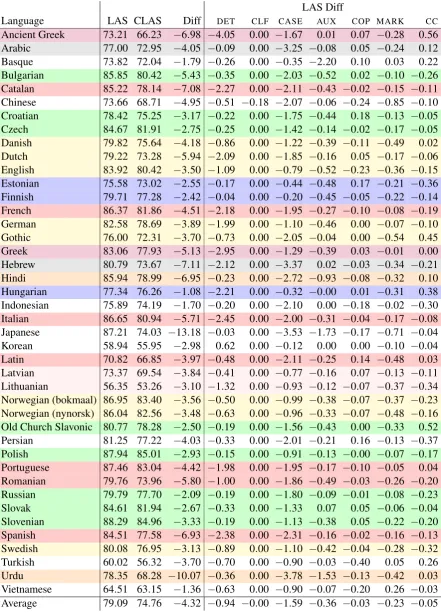
In order to explore the properties of the new metric, we present additional evaluation scores for the same parsing experiment in Table 3. The first three columns show LAS, CLAS and difference CLAS−LAS. The final seven columns show the difference in LAS when excluding the relations in FUN, one at a time.2 Comparing CLAS to LAS, we see essentially the same picture as when exclud-ing FUN from LAS in Table 2, although there is sometimes a combined effect when also excluding PUNCT. The average difference is−4.32 points, and the language-specific differences range from
−1.08 for Hungarian to−13.18 for Japanese.
Among the languages that exhibit the smallest decrease, we find the Finno-Ugric languages (Es-tonian, Finnish, Hungarian) together with Basque and Indonesian, which are all agglutinating lan-guages. More surprisingly, the low-decrease group also includes Vietnamese, which is usually described as an analytic language. The explana-tion seems to be a low LAS for FUN relations in Vietnamese, only 74.09 as shown in Table 2.
Slavonic languages, which are morphologically rich but not agglutinating, mostly have a relatively low decrease in the 2–3 point range, with the ex-ception of Bulgarian (−5.43), which has devel-oped in a typologically different direction from the other Slavonic languages in the sample. The closely related Baltic languages (Latvian, Lithua-nian) behave similarly to Slavonic languages, but with a slightly higher decrease, and Germanic lan-guages, which in general are less morphologi-cally rich, are a little higher still with an average decrease of 3–4 points, although Dutch deviates from the general pattern by having an unexpect-edly large decrease (−5.94).
Among the languages with the highest decrease we find Japanese, which is again somewhat unex-pected and may have to do with particular annota-tion choices when applying the UD guidelines to Japanese. A high decrease is also observed for In-dian languages (Hindi and Urdu), most of the Ro-mance languages (especially Catalan, Italian and Spanish), Greek (both ancient and modern) and the Semitic languages (especially Hebrew).
Zooming in on the individual relations in FUN, we see that most of the difference can be attributed to functional relations in noun phrases, in partic-ular det and case. (The third relation clf is cur-2All scores areF1-scores, which explains why the
differ-ences under LAS Diff do not add up to the difference CLAS
−LAS. In addition, CLAS also excludesPUNCT.
rently only used in Chinese.) The det relation has the largest impact on Ancient Greek, followed by modern Greek, a group of Romance languages (French, Italian, Spanish), Hungarian and Hebrew. Thecase relation instead shows the largest effect for Urdu, Japanese, Hebrew and Arabic.
The remaining four FUN relations aux, cop,
mark and cc have a less significant effect than the nominal relations. The cc relation is differ-ent from the rest in that scores sometimes go up when it is excluded. This effect is noticeable for two of the classical languages, Ancient Greek and Gothic, and for Hungarian. More research will be needed to find out why this is the case.
5 Conclusion
Proving that one evaluation metric is superior to another is very difficult in general. Ideally, we should show that it correlates better with indepen-dent quality criteria, but such criteria are often not available. This is especially tricky for a compo-nent task like syntactic parsing, where there are no real end users and where human assessments are notoriously unreliable. In this paper, we have in-stead relied primarily on rational argumentation. Since UD has been explicitly designed to capture cross-linguistic similarities in grammatical rela-tions between content words, we argue that multi-lingual evaluation should focus primarily on these relations. The main metric should therefore ex-clude both function words and morphological fea-tures, to prevent bias towards either analytical or synthetic languages. (In addition, the main metric should exclude punctuation, which is completely absent in some of the treebanks and arguably not part of the syntactic structure.) To back up these rational arguments, we have presented empirical results from a parsing experiment, studying the ef-fect of excluding different relations and showing that the new metric behaves, by and large, as we can expect based on typological considerations.
be the metric of choice for monolingual evalua-tion, where structural differences across languages are not relevant. Secondly, we are convinced that, in order to achieve high accuracy on argument and modifier relations, a parser must be able to recover other structures that provide information about these relations. For analytical languages, parsers will therefore be forced to pay attention to functional relations, even if they are not scored in the evaluation metric. For more synthetic lan-guages, parsers will instead have to focus more on morphological information. Hence, bydirectly fa-voring accuracy on major grammatical relations, we areindirectlyencouraging parsers to pay atten-tion to grammatically relevant informaatten-tion, be it encoded in morphology, function words, or word order patterns. Therefore, we think the risk for an unwanted bias is in fact less of a problem than with the traditional LAS metric, where parsers can score well (for some languages) by being accurate mainly on functional relations, which are highly frequent and easy to parse.
At this point, it is still an empirical question which metric will give the right or wrong kind of bias, although some of the results reviewed in pre-vious sections at least illustrate that the traditional LAS score can be severely inflated for some lan-guages. More research will definitely be needed to better understand the effects of using different metrics, in particular experiments with different parsers and perhaps also different variants of the new metric, but we hope that the proposal made in this paper can be a first step towards more sound metrics for multilingual parser evaluation.
References
Sabine Buchholz and Erwin Marsi. 2006. CoNLL-X shared task on multilingual dependency parsing. InProceedings of the 10th Conference on Computa-tional Natural Language Learning (CoNLL), pages 149–164.
Marie-Catherine de Marneffe, Timothy Dozat, Na-talia Silveira, Katri Haverinen, Filip Ginter, Joakim Nivre, and Christopher D. Manning. 2014. Uni-versal Stanford Dependencies: A cross-linguistic ty-pology. In Proceedings of the 9th International Conference on Language Resources and Evaluation (LREC), pages 4585–4592.
Rebecca Dridan and Stephan Oepen. 2011. Parser evaluation using elementary dependency matching. InProceedings of the 12th International Conference on Parsing Technologies (IWPT), pages 225–230.
Rebecca Hwa, Philip Resnik, Amy Weinberg, and Okan Kolak. 2002. Evaluating translational cor-respondence using annotation projection. In Pro-ceedings of the 40th Annual Meeting of the Asso-ciation for Computational Linguistics (ACL), pages 392–399.
Ryan McDonald, Slav Petrov, and Keith Hall. 2011. Multi-source transfer of delexicalized dependency parsers. In Proceedings of the Conference on Em-pirical Methods in Natural Language Processing (EMNLP), pages 62–72.
Ryan McDonald, Joakim Nivre, Yvonne Quirmbach-Brundage, Yoav Goldberg, Dipanjan Das, Kuz-man Ganchev, Keith Hall, Slav Petrov, Hao Zhang, Oscar T¨ackstr¨om, Claudia Bedini, N´uria Bertomeu Castell´o, and Jungmee Lee. 2013. Uni-versal dependency annotation for multilingual pars-ing. InProceedings of the 51st Annual Meeting of the Association for Computational Linguistics (Vol-ume 2: Short Papers), pages 92–97.
Joakim Nivre, Johan Hall, and Jens Nilsson. 2006. Maltparser: A data-driven parser-generator for de-pendency parsing. In Proceedings of the 5th In-ternational Conference on Language Resources and Evaluation (LREC), pages 2216–2219.
Joakim Nivre, Johan Hall, Sandra K¨ubler, Ryan Mc-Donald, Jens Nilsson, Sebastian Riedel, and Deniz Yuret. 2007. The CoNLL 2007 shared task on de-pendency parsing. In Proceedings of the CoNLL Shared Task of EMNLP-CoNLL 2007, pages 915– 932.
Joakim Nivre, Marco Kuhlmann, and Johan Hall. 2009. An improved oracle for dependency parsing with online reordering. InProceedings of the 11th International Conference on Parsing Technologies (IWPT’09), pages 73–76.
Joakim Nivre, Marie-Catherine de Marneffe, Filip Gin-ter, Yoav Goldberg, Jan Hajiˇc, Christopher D. Man-ning, Ryan McDonald, Slav Petrov, Sampo Pyysalo, Natalia Silveira, Reut Tsarfaty, and Dan Zeman. 2016. Universal Dependencies v1: A multilingual treebank collection. InProceedings of the 10th In-ternational Conference on Language Resources and Evaluation (LREC).
Joakim Nivre. 2015. Towards a universal grammar for natural language processing. In Alexander Gel-bukh, editor,Computational Linguistics and Intelli-gent Text Processing, pages 3–16. Springer.
Slav Petrov, Dipanjan Das, and Ryan McDonald. 2012. A universal part-of-speech tagset. InProceedings of the 8th International Conference on Language Re-sources and Evaluation (LREC).
Habash, Marco Kuhlmann, Wolfgang Maier, Joakim Nivre, Adam Przepi´orkowski, Ryan Roth, Wolfgang Seeker, Yannick Versley, Veronika Vincze, Marcin Woli´nski, Alina Wr´oblewska, and Eric Villemonte de la Clergerie. 2013. Overview of the SPMRL 2013 shared task: A cross-framework evaluation of parsing morphologically rich languages. In Pro-ceedings of the Fourth Workshop on Statistical Pars-ing of Morphologically Rich Languages, pages 146– 182.
Djam´e Seddah, Sandra K¨ubler, and Reut Tsarfaty. 2014. Introducing the SPMRL 2014 shared task on parsing morphologically-rich languages. In Pro-ceedings of the First Joint Workshop on Statisti-cal Parsing of MorphologiStatisti-cally Rich Languages and Syntactic Analysis of Non-Canonical Languages, pages 103–109.
Reut Tsarfaty. 2013. A unified morpho-syntactic scheme of Stanford dependencies. InProceedings of the 51st Annual Meeting of the Association for Com-putational Linguistics (Volume 2: Short Papers), pages 578–584.
Daniel Zeman and Philip Resnik. 2008. Cross-language parser adaptation between related lan-guages. InProceedings of the IJCNLP-08 Workshop on NLP for Less Privileged Languages, pages 35– 42.
Daniel Zeman, David Mareˇcek, Martin Popel, Loganathan Ramasamy, Jan ˇStˇep´anek, Zdenˇek ˇZabokrtsk´y, and Jan Hajiˇc. 2012. HamleDT: To parse or not to parse? InProceedings of the 8th In-ternational Conference on Language Resources and Evaluation (LREC), pages 2735–2741.