ENHANCED FACE LIVENESS DETECTION BASED
ON FEATURES FROM NONLINEAR DIFFUSION
USING SPECIALIZED DEEP CONVOLUTION
NETWORK AND ITS APPLICATION IN OAUTH
Aziz Alotaibi
Under the Supervision of Dr. Ausif Mahmood
DISSERTATION
SUBMITTED IN PARTIAL FULFILMENT OF THE REQUIREMENTS FOR THE DEGREE OF DOCTOR OF PHILOSOPHY IN COMPUTER SCIENCE
AND ENGINEERING THE SCHOOL OF ENGINEERING
UNIVERSITY OF BRIDGEPORT CONNECTICUT
iii
ENHANCED FACE LIVENESS DETECTION BASED ON
FEATURES FROM NONLINEAR DIFFUSION USING
SPECIALIZED DEEP CONVOLUTION NETWORK AND ITS
APPLICATION IN OAUTH
iv
ENHANCED FACE LIVENESS DETECTION BASED ON
FEATURES FROM NONLINEAR DIFFUSION USING
SPECIALIZED DEEP CONVOLUTION NETWORK AND ITS
APPLICATION IN OAUTH
ABSTRACT:
The major contribution of this research is the development of enhanced algorithms that will prevent face spoofing attacks by utilizing a single image captured from a 2-D printed image or a recorded video. We first apply a nonlinear diffusion based on an additive operator splitting (AOS) scheme with a large time step to acquire a diffused image. The AOS-based scheme enables fast diffusion that successfully reveals the depth information and surface texture in the input image. Then a specialized deep convolution neural network is developed that can extract the discriminative and high-level features of the input diffused image to differentiate between a fake face and a real face. Our proposed method yields higher accuracy as compared to the previously implemented state-of-the-art methods. As an application of the face liveness detection, we develop face biometric authentication in an Open Authorization (OAuth) framework for controlling secure access to web resources. We implement a complete face verification system that consists of face liveness detection followed by face authentication that uses Local Binary Pattern
v
as features for face recognition. The entire face authentication process consists of four services: an image registration service, a face liveness detection service, a verification service, and an access token service for use in OAuth.
vi
ACKNOWLEDGEMENTS
My thanks are wholly devoted to God who has helped me all the way to complete this work successfully. I owe a debt of gratitude to my family for understanding and encouragement.
I would like to express my deepest appreciation to my advisor Dr. Ausif Mahmood for his guidance and for his tremendous help and support.
I would like to thank my dissertation committee of Dr. Navarun Gupta, Dr. Prabir Patra, Dr. Maid Faezipour, Saeid Moslehpour and Dr. Khaled M. Elleithy for their time and valuable comments that helped me to improve the quality of this dissertation.
vii
TABLE OF CONTENTS
ABSTRACT: ... iv
ACKNOWLEDGEMENTS ... vi
TABLE OF CONTENTS ... vii
LIST OF TABLES ... x
LIST OF FIGURES ... xii
Chapter 1: introduction ... 1
1.1. Research Problem and Scope ... 1
1.2. Motivation Behind the Research ... 2
1.3. Potential Contributions of the Proposed Research ... 3
Chapter 2: Literature Survey ... 6
2.1 Face Liveness Detection ... 6
2.1.1 Introduction to Anti-Spoofing Methods ... 6
2.1.2 Software based techniques ... 7
2.1.2.1 Static technique ... 7
2.1.2.2 Dynamic technique ... 19
2.2 Open Authorization Protocol ... 24
2.3 Conclusion ... 27
CHAPTER 3: FACE LIVENESS DETECTION ... 29
3.1 Introduction to biometric authentication ... 29
viii
3.3.1 Additive Operator Splitting ... 33
3.3.2 ConvolutionNeuralnetwork ... 36
3.3 Auto-encoder ... 41 3.3.1 Introduction ... 41 3.3.2 Motivation ... 42 3.3.3 Proposedmethod ... 42 3.3.4 Fine tuning ... 43 3.3.5 Analysis... 45 3.4 Conclusion ... 46
CHAPTER 4: IMPLEMENTATION AND PRELIMINARY RESULTS ... 47
4.1 Single image Attack (Picture of a Picture) ... 47
5.3.1 NUAA dataset ... 47
5.3.2 Discussion and analysis ... 49
5.3.3 Result ... 51
5.3.4 Statistical Power Analysis ... 57
5.3.5 Processing Time ... 58
4.2 Replay Video Attack ... 58
5.4.1 ReplayAttackdataset ... 58
5.4.2 Implementation ... 60
5.4.3 Discussion and analysis ... 62
5.4.4 Result ... 64
CHAPTER 5: ENHANCING OAUTH SECURITY USING FACE RECOGNITION ... 66
6.3 Introduction to Open Authorization Protocol ... 66
6.4 Introduction to Biometrics System ... 68
ix
6.5.1 Imageregistrationservice: ... 72
6.5.2 Face liveness detection service ... 74
6.5.3 Verificationservice ... 74
6.5.4 Accesstokenservice ... 76
6.5.5 Implementation ... 77
CHAPTER 6: CONCLUSION ... 79
x
LIST OF TABLES
Table 2.1 HTER(%)oftheclassificationondifferentdatabase 12 Table 2.2 HTER (%) of classification with (X2) for different LBP
operators on Replay-Attack Database
13
Table 2.3 Performance on NUAA, PRINT-ATTACK, and CASIA 15 Table 2.4 Gaussian filter (3, 3) with σ1 =1.0 and 0.5 respectively 16
Table 2.5 Experiment result for NUAA database 17
Table 3.1 Forward and Backpropagation algorithm 39
Table 4.1 NUAA Database 48
Table 4.2 Performance with different parameters using the NUAA dataset
52
Table 4.3 Performance evaluation for different numbers of iterations. The time step is fixed at a value of 100
52
Table 4.4 Performance comparison using the NUAA dataset 53 Table 4.5 HTER (%) of classification for the NUAA dataset 56
Table 4.6 Time Processing 58
Table 4.7 Replay-Attack Database 60
xi
Table 4.9 HTER (%) of classification with different parameters using the Replay Attack dataset
64
Table 4.10 Performance evaluation for different numbers of iterations. The time step is fixed at a value of 100.
xii
LIST OF FIGURES
Figure 2.1 The basic LBP Operator 8
Figure 2.2 ApplyingLBPoperatoronnormalizedfaceimage 9
Figure 2.3 A frame of short videos from 10
Figure 2.4 a) Modified b) Transition c) Direction LBP. 11 Figure 2.5 Example of diffusion image u^k with different iteration
number and time step equals to 10. (a) original image. (b) k = 5. (c) k = 10. (d) k = 20.
14
Figure 2.6 (a) input image, (b) Gσ1 =0.5 ,(c) Gσ2 =0.5, (d) Difference of
Gaussian.
16
Figure 2.7 Illustration of the closity for a blinking activity sequence. 21
Figure 3.1 Face Recognition System. 32
Figure 3.2 a) The top image is a real face; the bottom image is a fake. b) A normalized face with a size of 64 × 64 pixels. c) A diffused image using AOS with a time-step size of 100 and 5 iterations.
35
Figure 3.3 Figure 3.3 The top row images (a) and (c) are real faces, whereas the bottom row images (a) and (c) are fake. In both rows, images (b) and (d) represent diffused surfaces scaled
xiii from [0, 255]
Figure 3.4 Our proposed convolution neural network architecture 37
Figure 3.5 Single Layer Autoencoder 41
Figure 3.6 Diffused image obtained through auto-encoder 43
Figure 3.7 Fine tuning 44
Figure 3.8 Example of the NUAA database, a) The top image is a real face from Test set; the bottom image is a fake face. b) A diffused image obtained through the Auto-encoder. c) A diffused image obtained through AOS with a time-step size of 100 and 5 iterations.
46
Figure 4.1 Example of the NUAA database (Top: Live photograph, Bottom: Fake photograph)
48
Figure 4.2 Process of our proposed approach. 50
Figure 4.3 a) Normalized image, b) diffused image with 𝜏 = 50, c) diffused image with 𝜏 = 100, and d) diffused image with 𝜏 = 200
51
Figure 4.4 Performance comparison using the NUAA dataset. 54 Figure 4.5 Performance comparison between 5 and 10 iterations. 54 Figure 4.6 Performance evaluation for different numbers of iterations
with different time step.
55
Figure 4.7 Performance evaluation for different numbers of iterations. The time step is fixed at a value of 100.
xiv
Figure 4.8 Examples of misclassified face images. The top face images are rejected clients, and the bottom face images are accepted printed images.
56
Figure 4.9 Examples of Replay Attack Dataset (Controlled and Adverse scenario)
59
Figure 4.10 (a) and (b) Original face of real access – Controlled scenario (c) (d) Diffusion speed map scaled from [0, 255].
61
Figure 4.11 One frame of a short video of real access. 63 Figure 4.12 Performance evaluation for different numbers of iterations.
The time step is fixed at a value of 100.
65
Figure 5.1 Access token request 68
Figure 5.2 Biometric authentication system 70
Figure 5.3 OAuth 2.0 using Authorization code 71
Figure 5.4 our proposed Authentication Service 72
Figure 5.5 Example of basic LBP codes 75
Figure 5.6 LBP Histogram for one block. 76
Figure 5.7 Access token string 77
1
CHAPTER 1: INTRODUCTION
1.1.
Research Problem and Scope
Face recognition authentication is vulnerable to several attacks especially face spoofing attacks. A spoofing attack manipulates the system by presenting a forgery to the acquisition sensor with the goal of penetrating the biometric authentication system. More specifically, a face-spoofing attack can be accomplished by presenting a 2D image, digital video or 3D mask to the camera, mimicking the user and thus gaining access as a valid user. This vulnerability has induced researchers to propose several countermeasures to prevent face-spoofing attacks. These countermeasures are intended to detect the “liveness”
of the face before performing the face recognition operation. Such anti-spoofing approaches can be further classified into two groups: static techniques and dynamic techniques. The static techniques are based on the analysis of a 2D single static photograph. In contrast, dynamic techniques are based on analyzing the temporal features of a sequence of input frames. Dynamic techniques are slow and difficult to implement. Furthermore, some of the dynamic techniques require users to follow instructions to validate their presence, but not all users may cooperate in this respect. This makes the dynamic methods unfavorable.
2
OAuth protocol implements traditional credentials to authenticate the resource
owner which makes the security of users’ information at risk. Therefore, creating reliable, scalable, and maintainable systems has become an essential core of function of security. Several security methods have been developed to authenticate users’ identities, including
knowledge-based methods and ownership-based methods. These methods are commonly
implemented in online user authentication to control access to users’ data and verify their
identities. However, knowledge-based methods (e.g., username/password, secret questions) are vulnerable to attacks, such as the man-in-the-middle attack, the replay attack, and stolen-verifier attacks. In contrast, ownership-based methods are based on something the user owns, such as a smart card or a token that can be reused, stolen, or manipulated. In both knowledge and ownership methods, the authentication system verifies what the user knows or possesses rather than truly verifying the identity of the requester. As an alternative, biometric authentication verifies the identity of requesters by using their physiological and/or behavioral characteristics.
1.2.
Motivation Behind the Research
The adoption of cloud computing and web services-based software architectures has grown rapidly, and these technologies have played a vital role in the information technology field [1] [2]. Secure access to the web API has become more important and gets more complex with the increasing adoption of cloud and web services. Controlling the user level to access the right resources has brought several security issues to the web API field. One of the most popular API access control models that has been proposed is a standard
3
known as open authorization (OAuth) [3]. OAuth uses traditional credentials as an authentication method for different applications and services. In OAuth, the authorization
server is responsible for managing and securing users’ information as well as issuing the access token. Since the majority of OAuth providers are implementing traditional credentials to authenticate the resource owner, the entire system is exposed to dictionary and brute force attacks. If either of these attacks should occur, the attackers have access to
the user’s system, and thus can grant their third-applications access to all register services. To overcome this issue, biometric authentication cabaple of providing security. A system that employs biometric authentication ideally exhibits five qualities: robustness, distinctiveness, availability, accessibility and acceptability [4]. In online user authentication, accessibility and acceptability are the most significant qualities that can be found in face and voice characteristics. However, face recognition is commonly favored over other biometric traits due to its accessibility and non-intrusive form of interaction. Face recognition has been actively explored and researched in the field of security. However, any photograph of a valid user (easily obtained by capturing a close-up
photograph without the user’s consent or obtained via the Internet) can be used to spoof
face recognition systems. Therefore, developing a face recognition authentication service as an authentication mechanism is essential to secure web services and OAuth.
1.3.
Potential
Contributions
of the Proposed ResearchWe developed an efficient and non-intrusive method to counter face spoofing attacks that uses a static print photograph, or recorded video, of a valid user. We first apply a nonlinear diffusion based on an additive operator splitting (AOS) scheme to acquire a
4
diffused image with a large time step value. To extract the information features from the diffused image, previous approaches used handcrafted features, such as the LBP algorithm. In contrast, this dissertation developed a specialized deep convolution neural network (CNN) that can extract the discriminative and high-level features to differentiate between a fake face and a real face. Our developed CNN architecture was able to extract the most significant features from the diffused image. We achieved the highest reported accuracy of 99% on the widely-used NUAA dataset. In addition, we tested our method on the Replay Attack dataset which consists of 1200 short videos of both real-access and spoofing attacks. An extensive experimental analysis was conducted, and demonstrated better results when compared to previous static algorithms results.
In addition, we introduced a Secure Login Service to enhance OAuth security using face recognition in order to authenticate the identity of the user. The Secure Login Service process consists of four services: an image registration service, a face liveness detection service, a verification service, and an access token service. We built these services in the authorization server to verify the user and issue the access token. The entire web services are built based on the RESTful architecture style. Two preprocesses occur prior to using Local Binary Pattern (LBP) texture method. The first preprocess localizes five landmark points: the outer right eye, center right eye, outer right eye, center left eye, and the center of nose. While the second preprocess performs the alignments. The LBP texture method is used to extract the image features, and then apply the correlation function to classify the captured image and decide whether to verify or deny the user. If the user is verified and authenticated, the access token is issued with a specific scope of authorization level. This
5
Secure Login Service enhances OAuth security by providing biometric authentication. This can be used in addition to the regular authentication.
6
CHAPTER 2: LITERATURE SURVEY
2.1Face Liveness Detection
2.1.1 Introduction to Anti-Spoofing Methods
Recently, the performance of the face recognition system has been enhanced significantly because of improvements found within hardware and software techniques in the computer vision field [5]. However, face recognition is still vulnerable to several attacks such as spoofing attacks. These techniques are getting more complex and hard to identify, especially with the advancement in printer technology such as high-definition laser printers. Therefore, researchers have proposed and analyzed several approaches to protect face recognition systems against these vulnerabilities. Based on the proposed techniques, face anti-spoofing methods are grouped into two main categories: hardware-based technique and software-hardware-based technique. First, hardware-hardware-based technique requires an extra device to detect a particular biometric trait such as finger sweat, blood pressure, facial thermogram, or eye reflection [6]. This sensor device, incorporated into the biometrics authentication system, requires the user’s cooperation to detect the signal of the
living body. Some auxiliary devices, such as infrared equipment, achieve higher accuracy when compared to simpler devices. However, auxiliary devices are expensive and difficult to implement [7]. Second, the software-based technique extracts the feature of the
7
biometric traits through a standard sensor to distinguish between real and fake traits. The feature extraction occurs after the biometric traits, such as the texture features in the facial image, are acquired by the sensor [8]. The software-based techniques treat both the acquired 3D and 2D traits as 2D to extract the information feature. Therefore, the depth information is utilized to differentiate between 3D live face and flat 2D fake face images [9]. This dissertation covers only the software-based techniques that can be categorized further into static-based techniques and dynamic-based techniques as described in the following sections.
2.1.2 Software based techniques
Static-based and dynamic-based techniques are less expensive and easy to implement compared to hardware-based techniques. First, static techniques are based on the analysis of a 2D static image. It is a non-intrusive interaction which is convenient for many users. On other hand, dynamic techniques exploit the temporal and spatial features using a sequence of input frames. Some of the dynamic methods are intrusive interactions which force the user to follow specific instructions.
2.1.2.1 Statictechnique
A variety of proposed methods are presented to address spoofing attack problems that utilize a single static image. The static-based techniques are divided into two categories: texture analysis methods and fourier spectrum methods:
Texture analysis methods: these methods extract the texture properties of the facial image based on the feature descriptor. Maatta et al. [10] analyzed the texture of a 2D facial
8
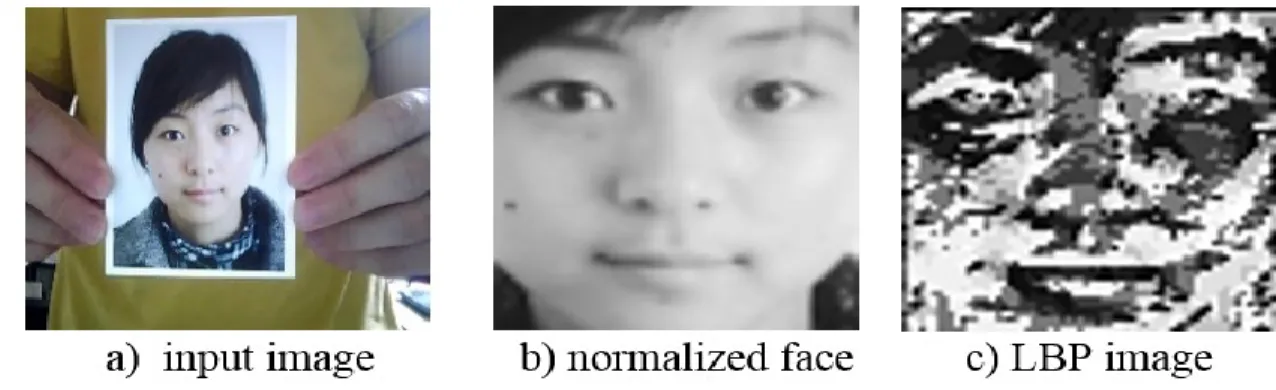
image using multi-scale local binary pattern (LBP) to detect face liveness. The authors applied multi- LBP operators on the 2D face image to generate a concatenated feature histogram. The histogram is then fed into the Support Vector Machine (SVM) classifier in order to determine whether the facial image is real or fake. The Local Binary Pattern (LBP), introduced by Ojala et al. [11], is a nonparametric method that extracts the texture properties of the 2D facial image with features based on the local neighborhood [12] as shown in Figure 2.1. The basic LBP pattern operator for each pixel in the facial image is calculated by using the circular neighborhood as shown in Figure 2.1.
Figure 2.1 The basic LBP Operator.
The intensity of the centered pixel is compared with the intensity value of the pixels located within its LBP 3*3 neighborhood.
𝐿𝐵𝑃𝑃𝑜𝑖𝑛𝑡,𝑅𝑎𝑑𝑖𝑢𝑠(𝑥𝑐+ 𝑦𝑐) = ∑ 𝑆(𝑖𝑝− 𝑖𝑐)2𝑝 (2.1) 𝑃−1
𝑃=0
Where
xc,yc represent the center pixel p represents the surrounding pixel
9 s(z) = {1, 𝑖𝑓 𝑧 ≥ 0
0, 𝑖𝑓 𝑧 < 0
Then, the center pixel will be updated with the new pixel value of 63. The LBP uses a uniform pattern to describe the texture image. If the generated binary number contains at most two bitwise 0 -1 or vice versa, then the LBP is called uniform. For instance, (01111110), (1100 0000), and (0001 1000) are uniform, whereas (0101 000), (0001 0010), and (0100 0100) are non-uniform. There are 58 uniform LBP Patterns and 198 non-uniform LBP patterns. The authors applied three multi-scale LBP operators on the normalized face images: LBP 8,1 u2 , LBP 8,2 u2, and LBP 16,2 u2.
Figure 2.2 Applying LBP operator on normalized face image.
LBP 8,1 u2 was applied on a nine-block region of the normalized face, and therefore, generated uniform patterns with a 59 –bin histogram from each region. The entire image equaled to a single 531-bin histogram. The LBP 8,2 u2, and LBP 16,2 u2 operators generates 59-bin and 243-bin histogram, respectively. The length of the concatenated feature histogram is 833. The concatenated histogram is passed through a nonlinear SVM classifier to determine whether the input face image is present or not. However, the basic
10
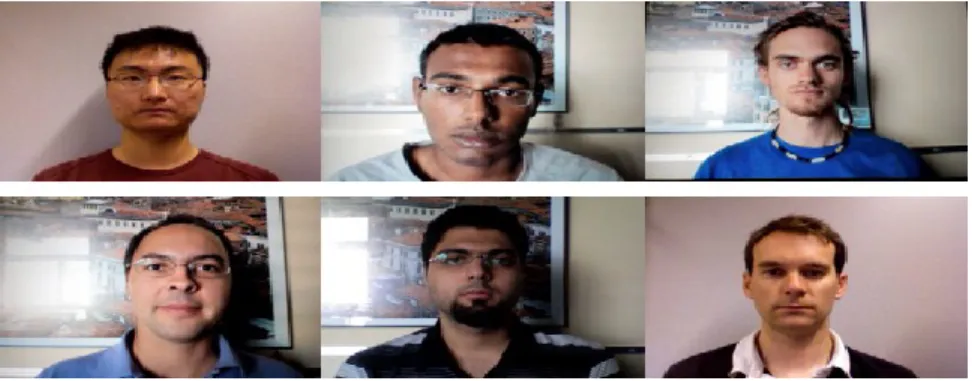
LBP operator is not the only operator applied to extract the information features, other LBP variations might be used as well such as transitional (tLBP), direction-coded (dLBP) and modified (mLBP). In [13], Chingovska et al. introduced Replay-Attack Database and studied the effectiveness of the local Binary Pattern on three types of attacks: printed photographs, photos, and video displays.
Figure 2.3 A frame of short videos from.
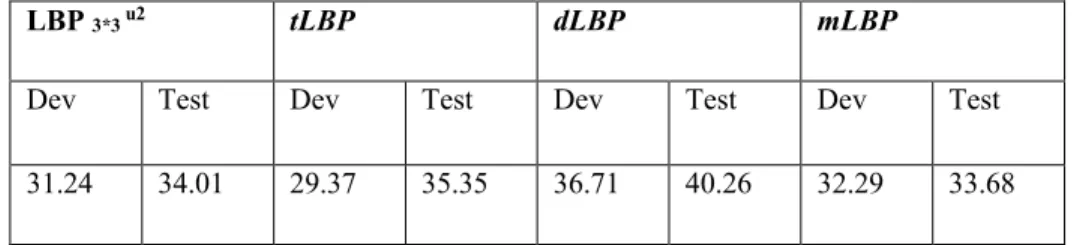
The authors applied different LBP operators and studied the performance evaluation of the anti-spoofing algorithm. The study included tLBP, dLBP and mLBP. The
tLBP operator is composed by comparing the two consecutive pixels’ value with their
neighbors in a clockwise direction for all pixels apart from the central pixel value.
𝐿𝐵𝑃𝑝,𝑅(𝑥𝑐+ 𝑦𝑐) = 𝑆(𝑖0− 𝑖𝑝−1) + ∑𝑃−1𝑃=0𝑆(𝑖𝑝− 𝑖𝑝−1)2𝑝 (2.2)
A direction-coded LBP operator is composed by comparing the intensity variation along the four base directions into two bits through the central pixel.
Let’s assume the original LBPP, R has P =2P’ neighbors.
𝑑𝐿𝐵𝑃𝑝,𝑅= ∑ ( 𝑆(𝑖𝑝′− 𝑖𝑐)(𝑖𝑝′+ 𝑝′ − 𝑖𝑐)22𝑝 ′ 𝑃′−1 𝑃=0 + 𝑆(|𝑖𝑝′− 𝑖𝑐 | − |𝑖𝑝′+ 𝑝′ − 𝑖𝑐 |22𝑝 ′+1 ) (2.3)
11
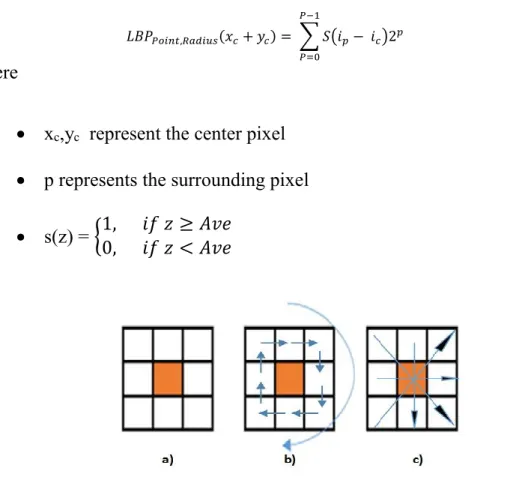
The dLBP compares the intensity of each pixel value of neighbors with the average of the intensity value in a 3 *3 neighborhood.
𝐿𝐵𝑃𝑃𝑜𝑖𝑛𝑡,𝑅𝑎𝑑𝑖𝑢𝑠(𝑥𝑐+ 𝑦𝑐) = ∑ 𝑆(𝑖𝑝− 𝑖𝑐)2𝑝 𝑃−1
𝑃=0
(2.4)
Where
xc,yc represent the center pixel
p represents the surrounding pixel
s(z) = {1, 𝑖𝑓 𝑧 ≥ 𝐴𝑣𝑒 0, 𝑖𝑓 𝑧 < 𝐴𝑣𝑒
Figure 2.4 a) Modified b) Transition c) Direction LBP.
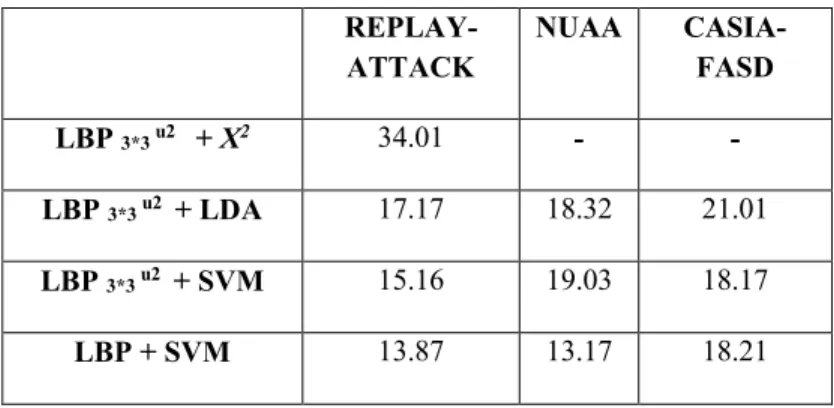
After applying the LBP Operators on the facial images, histograms are obtained as feature vectors. Then the applied classifier extracts the feature and determines whether the facial image is real or fake. Both linear and non-linear classifiers were examined, such as Linear Discriminant Analysis (LDA) and Support Vector Machine (SVM). The authors conducted an experiment to compare X2 statistics methods to other complex classifiers.
12
Table 2. 1 HTER (%) of the classification on different database REPLAY-ATTACK NUAA CASIA-FASD LBP 3*3 u2 + X2 34.01 - - LBP 3*3 u2 + LDA 17.17 18.32 21.01 LBP 3*3 u2 + SVM 15.16 19.03 18.17 LBP + SVM 13.87 13.17 18.21
From Table 2.1, we observed that the LBP extracts adequate features from the single static image, which assists in the classification of fake or real faces. The performance of the multi-scale LBP is calculated using the Half Total Error Rate (HTER). HTER is defined as half of the sum of the False Rejection Rate (FRR) and False Acceptance Rate (FAR). HTER is used to measure the performance on both the development and test sets. Both LDA and SVM show high performance on the development sets and low performance on the test sets.
𝐇𝐓𝐄𝐑 = 𝐅𝐑𝐑 + 𝐅𝐀𝐑
2 (2.5)
Where,
FRR = FR/ NR False Rejection, and Number of Real. FAR = FA/ NI False Acceptance, and Number of Imposter.
13
Table 2. 2 HTER (%) of classification with (X2) for different LBP operators on Replay-Attack Database.
LBP 3*3 u2 tLBP dLBP mLBP
Dev Test Dev Test Dev Test Dev Test
31.24 34.01 29.37 35.35 36.71 40.26 32.29 33.68
In [14] Kim et al. the authors proposed a real-time and non-intrusive method based on the diffusion speed of a single image to detect face liveness. Their idea is based on the difference in the illumination characteristic of both live and fake faces. The additive operator splitting (AOS) schema is used to compute the image diffusion [15]:
𝑢𝑘+1 = 1
2 ((𝐼 − 2 𝜋 𝐴𝑥(𝑢
𝑘)−1 + ((𝐼 − 2 𝜋 𝐴
𝑦(𝑢𝑘)−1 )𝑢𝑘 (2.6)
Where 𝐴𝑥 and 𝐴𝑦 denote the diffusion matrices computed in column wise and row wise. The AOS schema treats every coordinate axis in the same manner, and it is unconditionally stable with large time step, e.g. 𝜋 = 40.
To compute the diffusion speed at each pixel position (x, y):
𝑠(𝑥, 𝑦) = | log(𝑢0(𝑥, 𝑦) + 1 ) − log(𝑢𝐿(𝑥, 𝑦) + 1 )| (2.7)
The features are extracted using the Local pattern of the diffusion speed, the so-called Local Speed Pattern (LSP):
LSP (x, y) = ∑ 2𝑖−1 𝐿𝑆𝑃𝑖
1 ≤𝑖 ≤𝑛
(𝑥, 𝑦) (2.8)
𝐿𝑆𝑃(𝑥 , 𝑦) = {1, 𝑖𝑓 𝑠(𝑥, 𝑦) > (𝑥𝑖 , 𝑦𝑖) (2.9) 0, 𝑜𝑡ℎ𝑒𝑟𝑤𝑖𝑠𝑒,
14
Where n represents the number of sampling pixels. (𝑥, 𝑦) is the center pixel, and
(𝑥𝑖 , 𝑦𝑖) denotes the position neighborhood. The extracted feature is fed into the SVM classifier to determine whether the input face is real or fake.
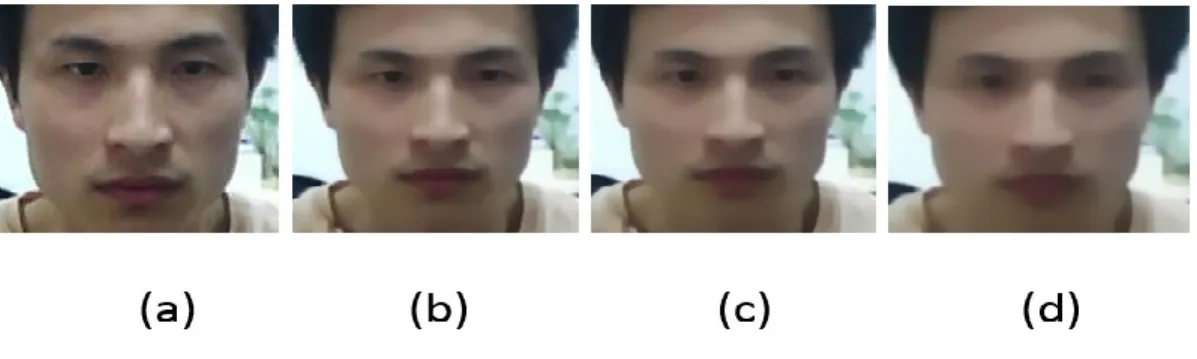
Figure 2.5 Example of diffusion image u^k with different iteration number and time step equals to 10. (a) original image. (b) k = 5. (c) k = 10. (d) k = 20.
Yang et al. [16] proposed a component-based face recognition coding approach for face liveness detection. First, the holistic face (H-Face) is divided into six components: the counter, facial, left eye, right eye, mouth, and nose regions. Subsequently, counter, and facial regions are further divided into 2 * 2 grids, respectively. Moreover, the dense low-level features such as LBP, LQP, HOG, etc. are extracted for all twelve components. Furthermore, component-based coding is performed to derive high-level face representation of each one of the twelve components from low-level features. Finally, the concatenating histograms from all twelve components are fed to a SVM classifier for identification. They achieved good accuracy compared with most of the proposed methods as shown in table 2.3.
15
Table 2. 3 Performance on NUAA, PRINT-ATTACK, and CASIA
Database Scenario Accuracy with
Metric (5)
NUAA -- 0.977
PRINT-ATTACK Fixed(F) sub-database 0.995
Hand (H)sub-database 0.991
(F) and(H)sub-databases 0.988
CASIA Low Quality 0.987
Low Quality 0.931
Warped Photo 0.930
Video Photo 0.997
Overall test 0.898
To sum up, the texture analysis methods are used to extract the discriminative features for texture based classifications. However, they are less sensitive to noise in uniform regions, and their performance is degraded under changing lighting directions and shadowing [17].
Methods based on Fourier spectra: Fourier spectra is used to capture the frequency distribution of the input images to detect spoofing attacks. The structure texture of fake images are 2-D and real images are 3-D. The reflection of the light on 2D and 3D objects result in different frequency distribution. Therefore, the intensity contrast of fake images contains a smaller frequency component. In [18]-[19], the authors analyzed the input images using 2D Fourier spectra to extract the feature information in order to detect whether the input image is real or fake. Unlike [4]-[46], which used very high frequency band which is too noisy, the authors applied a Difference of Gaussian (DoG) filter in which
16
two Gaussian filters with different standard deviation extract the difference of the image variability.
Figure 2.6 (a) input image, (b) Gσ1 =0.5 ,(c) Gσ2 =0.5, (d) Difference of Gaussian.
As depicted in Figure 2.6, DoG is applied to remove lighting variation in the input image and preserve as many features as possible without causing noise. Gaussian function
with standard deviation σ1 as given:
(2.10)
17
Gaussian filter g (u, v) with two different standard deviations σ1 =0.5, σ2 =1.0 on
the input image f(x, y) is defined as:
DoG (x, y) = ( Gσ1(u, v) ∗ f (x, y)) −
( Gσ2 (u, v) f (x, y) (2.11)
Peixoto et al. [19] used DoG with the Sparse Logistic Regression Model to detect the spoofing attack under extreme illumination. The Sparse Logistic Regression is given as:
𝑃𝑟𝑜𝑏(𝑦|𝑥) = 1
1 + exp (−y(𝑤𝑇𝑥 + 𝑏)) (2.12)
Where w is the weight vector, b is the intercept, and the average logistic loss is defined as:
𝐿𝑜𝑠𝑠(𝑤, 𝑏) = 1 𝑚∑ log (1 + exp(−𝑦𝑖 𝑤 𝑇 𝑥 𝑖+ 𝑏)) 𝑚 𝑖=0 (2.13)
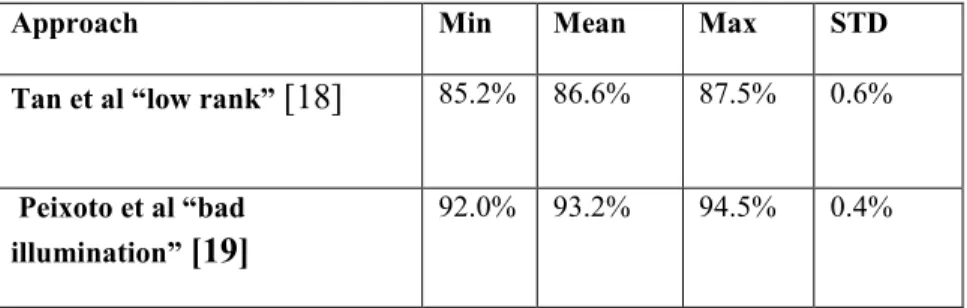
The authors used the contrast-limited adaptive histogram equalization [20] to deal with the illumination changes, which affect the input image. In addition, Tan et al [18] applied the DoG and the variation Retinex-based to extract the latent reflectance features. The authors modified the Sparse Logistic Regression to learn a “low rank” projection
matrix.
Table 2. 5. Experiment result for NUAA database.
Approach Min Mean Max STD
Tan et al “low rank” [18] 85.2% 86.6% 87.5% 0.6%
Peixoto et al “bad
illumination” [19]
18
Table 2.5. shows that the DoG with the Sparse Logistic Regression achieved 94.5% on the NUAA dataset. This result reflects that the Fourier spectra methods have the ability to capture enough feature of the input image in order to identify the spoof attack. Further, Zang, et al [21] used multiple difference of Gaussian (DoG) filters to extract the high frequency feature from the input face image. Four DoG filters are used to compute the inner and outer Gaussian variance. Let σ1 represent the inner variance, σ2 the outer
variance:
σ1 =0.5, σ2 = 1; σ1 =1.0, σ2 = 1.5; σ1 =1.5, σ2 = 2; and σ1 =1 , σ2 = 2.
Then the concatenated filtered images are fed into the SVM classifier. Moreover, Li et al. [22] detected the live and fake face images based on their analysis of their 2D Fourier Spectra on the face and [4] on the hair . The authors calculate the high frequency component using the high frequency descriptor equation. The high-frequency descriptor of a live face should be greater than a predefined threshold Tft , and the value of Fourier transform is more than the predefined threshold Tf.
19
Where F(u, v) represents the fourier transform of the input image, fmax denotes the highest radius frequency of F(u, v), Tf, and Tfd are a predefined threshold. The denominator denotes the total energy in the frequency domain which is the sum of Fourier coefficients relative to the direct coefficient.
2.1.2.2Dynamic technique
Dynamic methods rely on the detection of motion over the input frames sequence to extract dynamic features enabling the distinction between real and fake faces. Pereira et al. [23] proposed a novel countermeasure against face spoofing based on the Local Binary Pattern from three Orthogonal Plans (LBP-TOP) which combine both space and time information into a multi-resolution texture descriptor. Volume Local Binary Pattern (VLBP) [24], which is an extension to the Local Binary Pattern, was introduced to extract the features from the dynamic texture.
𝑉𝐿𝐵𝑃𝐿,𝑃,𝑅 = ∑ 𝑓(𝑖𝑐 3𝑃+1 𝑞=0 − 𝑖𝑞) 2𝑞 (2.15) And f(x) is defined: 𝑓(𝑥) = {0 𝑖𝑓 𝑥 < 0 1 𝑖𝑓 𝑥 ≥ 0
VLBP considers the frame sequence as parallel sequence planes, unlike LBP-TOP which considers the three orthogonal planes intersecting the pixel of the center for each pixel in a frame sequence. Orthogonal planes consist of an XY plane, XT plane, and YT plane, where T represents the time axis. Three different histograms are generated from the three orthogonal planes and then concatenated and fed to the classifier. In [25] , Bharadwaj
20
et al presented a new framework for face video spoofing detection using motion magnification. The Eulerian motion magnification technique is applied to enhance the facial expressions exhibited by clients in a captured video. In the feature extraction stage, the authors used both multi-scale LBP (LBP 8,1 u2 , LBP 8,2 u2 , and LBPu2 16,2 ), and the Histogram of Oriented Optical Flows (HOOF). The optical flow is the pattern of the apparent motion estimation technique that computes the motion of each pixel by solving the optimization problem. The PCA is used to reduce the dimensionality of the HOOF vector. Finally, an LDA classifier is used to classify the concatenated HOOF and detect whether the video input is real or face access.
Further, Pan et al. [26] proposed an eye-blinking behavior method to detect spoofing face recognition based on an unidirectional conditional graphic framework. The eye-blinking behavior is represented as temporal image sequences after being captured. The unidirectional conditional model reduces the computational cost. It is easy to extract the feature from the intermediate observation, where the conditional model increases the complexity and makes the problem more complicated. The authors developed an eye closity method by computing discriminative information for eye states:
𝑢𝑚 (𝐼) = ∑ (𝑙𝑜𝑔 1 𝛽𝑖 𝑀 𝑖=1 ) ℎ𝑖(𝐼) − 1 2∑ 𝑙𝑜𝑔 1 𝛽𝑖 𝑀 𝑖=1 (2.16) Where, 𝛽𝑖 = 𝜖𝑖/(1 − 𝜖𝑖)
And 𝑢(𝐼) is the eye closity, and ℎ𝑖(𝐼) ∶ 𝑅𝑑(𝑖) → {0,1}, 𝑖 = 1, 2 , . . , 𝑀 } is a set of
21
represents a closing eye state. The Adaboost algorithm is used to classify the positive value as a closed eye and a negative value as an open eye. A blinking activity sequence of eye closity is shown in Figure 2.7.
Figure 2. 1. Illustration of the closity for a blinking activity sequence.
In [27] Wen et al. proposed a face spoof detection algorithm based on Image Distortion Analysis (IDA). Four different types of IDA features (specular reflection, blurriness, color moments, and color diversity) have been extracted from the input frame. The IDA features are concatenated together to produce a 121-dimentional IDA feature vector. The feature vector is fed into an ensemble classifier; a multiple SVM classifier to distinguish between real and spoof faces. Their detection algorithm is extended to the multi-frame face detection in the playback video using a voting-based schema. IDA technique is computationally expensive and consumes time when using multi-frames to detect the spoofing attack.
In [28] , Singh et al. proposed a framework to detect the face liveness using eye and mouth movement. Challenge and response are randomly generated in order to detect and calculate the eye and mouth movements using Haar Classifier. The eye openness and closeness can be measured during the time interval while the mouth is
22
measured using the teeth Hue Saturation Value (HSV). If the calculated response is equal to the number of the challenges, the proposed system will recognize the user as live.
Kim et al. [29] presented a novel method for face spoofing detection using camera focusing. Two sequential images were taken with two different focusing: on the nose (IN) and the ears (IE). SUM Modified Laplacian (SML) is used to measure the degree of focusing for both the nose (SN) and ears (SE). After calculating SMLs, the SN is subtracted from SE to maximize the SML gap between the nose and ears regions. If the sum of the difference of SMLs (DoS) shows similar pattern consistently, the user is live. Otherwise it is fake. The difference in the patterns can be used as features to detect the face liveness.
In [30], Kim et al. segmented the video input into the foreground and background regions to detect the motion and similarity in order to prevent image and video spoofing attacks. The authors used a structural similarity index measure (SSIM) to measure the similarity between the initial background region and the current background region. The background motion index (BMI) is proposed to show the amount of motion in the background compared with foreground region. The motion and similarity in the background region should contain significant information to indicate liveness detection.
In [31], Tirunagari et al. used a recently-developed algorithm called Dynamic Mode Decomposition (DMD) to prevent replay attacks. The DMD algorithm is a mathematical method developed to analyze and extract relevant modes from empirical data generated by non-linear complex fluid flows. The DMD algorithm can represent the
23
as those images contained in the recorded video. The authors modified the original MDM that uses QR-decomposition and used LU decomposition to make it more practical. The DMD is used to capture the dynamic visual in the input video. The feature information is extracted from the visual dynamic using the LBP and fed to the SVM classifier.
Yan et al. [32] proposed a novel liveness detection method based on three clues in both temporal and spatial domain. First, non-rigid motion analysis is applied to find the non-rigid motion in the local face regions. The non-rigid motion can be exhibited in the real face while many fake faces cannot. Second, in face-background consistency both the fake face motion and background motion are consistent and dependent. Finally, the banding effect is the only spatial clue that can be detected in the fake images, because the image quality is degraded due to the reproduction. Their techniques show a better generalization capability on different datasets.
In [33]-[34]-[35], the authors analyzed the optical flow in the input image to detect spoofing attacks. The optical flow fields generated by the movement of a two-dimensional object and by a three-two-dimensional object are utilized to distinguish between real fake face images. They calculated the difference in the pixel intensity of image frames to extract the motion information. The motion information is fed to the classifier to determine whether the input images are real or not. In previous studies, 2D attacks were performed by showing printed photos or videos to the system on a flat surface. However, with the advancement in 3D printing technologies, the detection of a 3D mask against a 2D mask has become more complex and harder to identify [34]. Since the liveness detection
24
and motion analysis fail to detect and protect the system against 3D mask attacks, the texture analysis method is one of the reliable approaches that can detect a 3D mask.
In [36]-[37]-[38], Local Binary Pattern and its variations are proposed to protect face recognition system against 3D mask attacks. As explained before, LBP is used to extract features and generate a histogram using a 3D MAD database. The LBP histogram matching using x2 is applied to compare test samples with a reference histogram. Additionally, both linear (LDA) and non-linear (SVM) classifiers are tested. Principle Component Analysis (PCA) is used to reduce dimensionality, while 99% of the energy is preserved. The Inter Session Variability (ISV), an extension of the Gaussian Mixture Models approach, is applied to estimate more reliable client models by modeling and removing within-client variation using a low-dimensional subspace [39]. Their experimental result shows that using LDA classification is more accurate in 3D mask attacks, especially in the case of a 3DMAD database.
2.2Open Authorization Protocol
OAuth protocol allows the resource owner to grant permission to a third-party
application to access the owner’s protected resource, on their behalf, without releasing
their credentials (e.g., username, password) [40]. OAuth has provided a mechanism where the third-party application role is separated from the resource owner roles. There are four roles in the OAuth protocol:
Resource Owner: typically an end user who has the power to grant access to the protected resource [41].
25
Resource server: the server that hosts the protected resource owned by the resource owner, and has capability to accept access token.
Client: a third-party application that issues a request to access the protected resource.
Authorization server: the server that issues the access token to the third-party application.
Yang and Manoharan [42] give an overview of the vulnerabilities of the OAuth 2.0 protocol. The authors built an attacker model that simulates common network attacks on the OAuth 2.0 protocol that could be carried out to impersonate users, such as the replay attacks module, impersonating attack module, and phishing attack module. The attackers’
models were built on two assumptions: 1) the attacker has full access to the network and can eavesdrop on the communication between the three parties (client application, resource server, and authorization server), and 2) the attacker model has unlimited resources to launch an attack. Replay attack module is based on the reuse of an authorization code. The attacker may capture the authorization code and resend it back to the client application to login with the account associated with the specific authorization code. The phishing attack module has shown the misuse of web service to manipulate the user. The attacker can register with any web services to gain a client ID to masquerade as a legitimate website.
To launch a phishing attack, DNS cache records are poisoned on the user’s machine,
therefore, the user is redirected to a malicious client site that he/she did not intend to visit. The impersonating attack module takes advantages of secure vulnerability where the communication between the user-agent and client application is not protected using TLS. The attacker eavesdrops on the authorization code and blocks the original request to
26
prevent the authorization code’s use. The attacker initiates a forged request with the client application and send the stolen authorization code to start a new authorization flow.
Leinonen et al. [43] proposed a new mothed to secure OAuth using a portable secure memory card with NFC-enabled service. The authors implemented a software application prototype that shows how the secure credential storage on a user-configurable secure memory card can support an open authentication protocol. Proposed technique provides protection against copying and typing the credentials. The card involves two elements: 1) a consumer key that links the provider to web service, and 2) the user token that links the user to the user’s account for the service.
Gomaa [44] et al. provided a novel approach based on web camera to replace fingerprint biometric identifier with finger knuckles utilizing OAuth protocol. The users only need to show knuckles against an integrated web camera in order to capture the knuckles and authenticate instantly. This process requires having three gaps between the fingers visible. On the other hand, in a fingerprint authentication mechanism, users are required to scan their fingers with a certain position in order to allow the system to capture and scan clearly. The web camera is hosted in a cloud web service as a cost-effective acquisition device. The verification process consists of four phases: preprocessing, feature extraction, clustering and retrieving, and classification. The preprocessing phase applies different image filters to improve the picture quality. The feature extraction phase extracts and examines the structural information in the distribution of knuckle minutiae and SURF. The authors used K-Means to cluster and identify groups of samples. In the next stage of the identification process, Naïve Bays validates the identity of the group in the cluster. In
27
the classification phase, Naïve Bayesian network classifies all data into correct class category. The authors did not apply the results on a large scale database and did not cover different case suchs as gaining and skin color.
Meng-Yu et al. designed an API access control architecture based on OAuth protocol. The authors designed a system architecture that consists of three components: the APIs management platform, API provider, and API consumer. The APIs management platform is used to distribute, discover, and consume API. The API provider contacts the APIs management platform to register and publish API information such as capabilities, version, library, etc. After registration, the API Provider gets an API key that can be used to validate the source of the token publication. An API consumer can send a request to the APIs management platform to discover the published APIs and sign a Service Level Agreement. Further, the API provider obtains a client key. The authors are forcing the API consumer to follow the token based Access Control Model. The API consumer requests a temporary token from the APIs management platform, and then presents it to the API provider to validate it with the APIs management platform [3].
2.3Conclusion
Face liveness detection is an important precursor to online facial recognition. We provide a comprehensive review of the techniques for liveness detection which are categorized into static and dynamic groups. Most static techniques use either texture analysis methods such as Local Binary Pattern operators or Fourier spectra methods such as high frequency descriptor. The texture analysis is more powerful in extracting discriminative features such as the MLBP operator. However, its performance degrades
28
under changing lighting directions and shadowing. The Fourier spectra have the ability to capture high and low frequencies from the input face to detect a spoofing attack. The Difference of Gaussian with Sparse Logistic Regression has achieved a 94% on the NUAA dataset, where the MLBP only achieved a 92%. The Fourier spectra are sensitive to brightness effect, which causes the DoG to fail at detecting the border.
The dynamic techniques are based on the detection of motion over the input frames sequence to differentiate between real and fake faces. Since dynamic techniques utilize more than one frame, dynamic techniques achieve better performance compared with static techniques. Thus, dynamic techniques are slow and difficult to implement. Further, some of the dynamic techniques require users to follow instructions to validate their presence, but not all users may cooperate in this respect. This makes the dynamic methods an unfavorable technique to use in the face liveness methods. There are many different factors that might affect the performance of some of the proposed static and dynamic techniques such as media quality, illuminations and user cooperation. Some studies trained their proposed methods using low quality media, making their technique vulnerable to the use of high-quality media.
29
CHAPTER 3: FACE LIVENESS DETECTION
3.1Introduction to biometric authentication
Biometric authentication is an automated method that identifies or verifies a
person’s identity based on his/her physiological and/or behavioral characteristics or traits. The biometric authentication method is favored over traditional credentials (username / password) for three reasons: first, the user must be physically present in front of the sensor for it to acquire the data. Second, the user does not need to memorize login credentials. Third, the user is free from carrying any identification such as an access token. An additional advantage of biometric systems is that they are less susceptible to brute force attacks. Biometric authentication can be based on the physiological and/or behavior characteristics of an individual. Physiological characteristics may include, iris, palm print, face, hand geometry, odor, fingerprint, and retina etc. Behaviorial characteristics are related to a user’s
behavior: e.g., typing rhythm, voice, and gait.
The ideal biometric characteristics to use in a particular authentication should have five qualities[4]: robustness, distinctiveness, availability, accessibility and acceptability. Robustness refers to the lack of change of a user characteristic over time. Distinctiveness refers to a variation of the data over the population so that an individual can be uniquely identified. Availability indicates that all users possess this trait. Accessibility refers to the
30
ease in acquiring the characteristic using electronic sensors. Acceptability refers to the acceptance of collecting the characteristic from the user. The features that provide these five attributes are then used in a biometric authentication or verification system. Verification is defined as the matching of an individual’s information to a stored identity, whereas
identification refers to whether an incoming user’s data matches any user in the stored
dataset. Prior to authentication (verification or identification), an enrollment of allowed individuals is required.
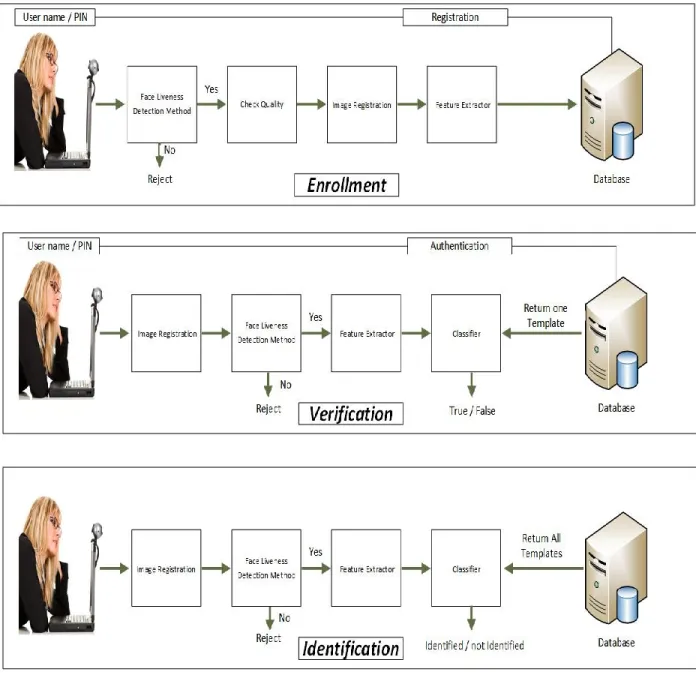
In the enrollment mode, the users are instructed to show their behavioral/physiological characteristics to the sensor. This characteristic data is acquired and passed through one of used algorithms that checks whether the acquired data is real or fake. Moreover, it ensures the quality of the image. The next step is to register the acquired data by performing localization and alignment. The acquired data is processed into a template that is a collection of numbers stored in the database.
In the authentication phase, the biometric system includes four steps before making the final decision: Data Acquisition, Preprocessing, Feature Extraction, and Classification [45] [46].
1) Data acquisition: it is a sensor, such as a fingerprint sensor and web camera, which captures the biometrics data with three different qualities: low, normal, and high-quality.
2) Preprocessing: its duty is to reduce data variation in order to produce a consistent set of data by applying noise filters, smoothing filters, or normalization techniques.
31
3) Feature extraction: it extracts the relevant information from the acquired data before classifying it.
4) Classification: it is a method that uses the extracted features as input and assigns it to one of the output labels.
The verification mode extracts the relevant information and passes it to the classifier to compare the captured acquired data with the template stored into the database to determine the match[45]. In the identification mode, the acquired data is compared with all
users’ template in the database to the user [46]-[47]. Figure 3. 1. is a simple description of these three modes.
32
Figure 3.1 Face Recognition System.
For biometric systems based on face recognition, adding a face liveness detection layer to the face recognition system prevents the spoofing attacks. Before proceeding to recognize or verify the user, the face liveness check eliminates the possibility that a picture of the person is presented to the camera instead of the person him/herself.
33
3.2Nonlinear Diffusion
The motivation behind our approach is to address spoofing attacks using a nonlinear diffusion based on an AOS scheme with a large time interval to obtain the sharp edges and preserve the boundary locations of the input image. Moreover, we propose a specialized deep convolution neural network architecture that can extract complex and high-level features to distinguish the diffused image, as explained in the next subsection.
3.3.1 Additive Operator Splitting
Nonlinear diffusion is used in our face liveness detection to obtain the sharp edges and preserve the boundary locations that help to distinguish a fake image from a real image by diffusing the input image quickly. Thus, the edges obtained from a flat image will fade out, whereas those from a real face will remain clear. In early computer vision, noise reduction and edge localization in multiscale descriptions of images was developed and explored in the field of image processing [48]. The Gaussian smoothing kernel, a low-pass filter, was used to smooth out image noise—particularly with a multiscale representation using a scale-space parameter (t).
𝐼(𝑥, 𝑦, 𝑡) = 𝐼𝑂𝑟𝑔𝑖𝑛𝑎𝑙 𝐼𝑚𝑎𝑔𝑒(𝑥, 𝑦) ∗ 𝐺 (𝑥, 𝑦; 𝑡). (3.1)
Koenderink [49] later noted that convoluting the image with a Gaussian at each scale is equivalent to linear diffusion solutions, such as heat equations.
34 The general diffusion equation is given as
𝜕𝐼 = 𝑑𝑖𝑣(𝑔 𝛻𝐼) (3.3)
Where the diffusivity g is a constant number ∊ ℝ that refers to the speed of the diffusion process. Linear diffusion has some limitations, such as blurring important features, including edges, and dislocating the edges as it smooths a finer scale to a coarser scale [15] [50]. Perona and Malik [51] proposed a nonlinear diffusion method based on a partial differential equation (PDE). They named this approach anisotropic diffusion; this approach avoids the blurring and localization issuesthat affect linear diffusion as follows:
𝜕𝐼 = 𝜕𝑥(𝑔(|𝛻𝐼|)𝜕𝑥) + 𝜕𝑦(𝑔(|𝛻𝐼|)𝜕𝑦) (3.4)
Here, the diffusivity g(.) is
𝑔(𝑠2) = 1
1 +𝑠2 𝜆2
(3.5)
The nonlinear diffusion filter detects the edges and preserves their locations during the diffusion process using explicit schemes. However, this schema suffers from regularization. Weickert [52] presented a semi-implicit scheme to address this problem. The scheme works with any time step size using an AOS scheme that treats the coordinates of all axes equally, as shown below: (𝐼𝑘)𝑡+1= ∑(𝑚 𝐼 − 𝜏 𝑑2 𝐴 𝑙)−1 𝐼𝑘𝑡 𝑑 𝑙=1 (3.6)
35
Where k represents the number of channels and d denotes the input dimension. I is the identity matrix, and 𝐴𝑙 is the diffusion in the vertical or horizontal direction. In a case where l = 2 (2D), the equation would be [53] :
(𝐼𝑘)𝑡+1= (2 𝐼 − 𝜏4 𝐴𝑥 )−1𝐼𝑘𝑡+ (2 𝐼 − 𝜏4 𝐴𝑦 )−1𝐼𝑘𝑡 (3.7) The AOS scheme enables fast diffusion even with a large time-step size value (e.g., 100) and can distinguish between edges in flat and rounded surfaces. As shown in Figure 3.2., the edges in printed fake images fade out from the smoothing of the surface texture, whereas the real image preserves its edges and prevents the diffusion from spreading.
Figure 3.2 a) The top image is a real face; the bottom image is a fake. b) A normalized face with a size of 64 × 64 pixels. c) A diffused image using AOS with a time-step size of 100 and 5 iterations.
36
a) b) c) d)
Figure 3.3 The top row images (a) and (c) are real faces, whereas the bottom row images (a) and (c) are fake. In both rows, images (b) and (d) represent diffused surfaces scaled from [0, 255].
We extract the information features from the image surface by calculating the diffusion speed as given in [14] [54]:
𝐼(𝑥, 𝑦) = |log(𝐼0 (𝑥, 𝑦) + 1) − log(𝐼𝑙(𝑥, 𝑦) + 1)| (3.8)
Where 𝐼0 represents the original image and 𝐼𝑙 denotes the diffused image. As shown
in Figure 3.3, the real image surface has relatively sharp edges (e.g., nose and cheek). In contrast, the surface of the fake images have smoother edges. All previous approaches used hand-crafted features, such as the LBP, to extract the information features. That approach has some limitations, such as a limited ability to extract complex features. Therefore, this work uses deep learning with gradient descent to extract the discriminative and higher-level features from the diffused image. We developed a specialized deep convolution neural network architecture to extract the most significant features, which leads to better classification, as explained in the next section.
3.3.2 ConvolutionNeuralnetwork
Machine learning has been successfully applied in many different applications, such as object detection [55], handwriting recognition [56] face detection [57], and face recognition [58]. The convolution neural network (CNN) was first introduced by LeCun et al. [55] [56] and is predominantly a biologically-inspired hierarchical multilayered neural network approach that simulates the human visual cortex and detects translation invariance features [59]. CNNs are designed to extract the local features by
37
Figure 3.4. Our proposed convolution neural network architecture
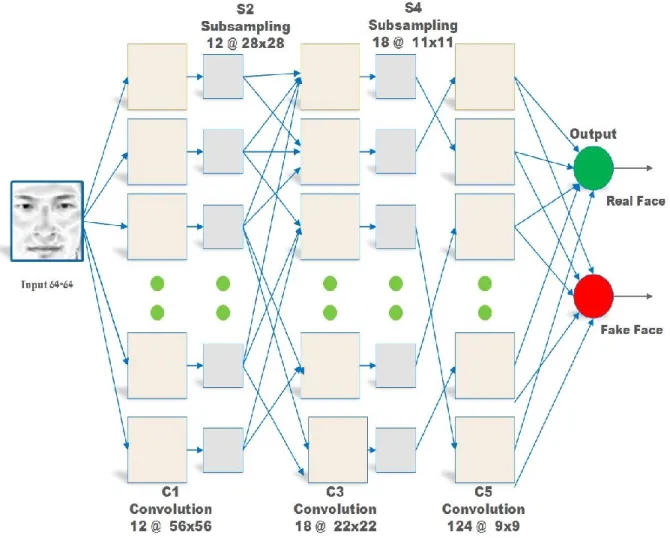
combining three architectural concepts that perform some degree of shift, scale, distortion invariance, local receptive fields, shared weight, and subsampling. The ability of both convolution and subsampling layers to learn distinctive features from the diffused image helps in extracting features and achieving the best classification for face liveness detection. Our developed deep convolution consists of six layers. The first five layers are convolutional and subsampling layers, and the last layer is the output layer, as shown in Figure 3.4. The input image, not counted in the CNN layer, has a size of 64 × 64 pixels. Layer C1 is the first convolution layer and consists of twelve feature maps. Each unit in the feature map is a result of connecting a 9 × 9 neighbor in the input image. The new size of
38
the feature map is 56 × 56 pixels. Layer S2 is a subsampling layer with twelve feature maps of 28 × 28 pixels. Each feature map in the subsampling layer is connected to an average kernel 2 × 2 neighborhood from the previous corresponding feature map in C1. The average 2 × 2 kernel is non-overlapping. Therefore, the size of the feature map in S2 is half the size of the feature map in C1. C3 is a convolution layer composed of eighteen feature maps of 22 × 22 pixels. Each feature map takes inputs from four random feature maps from the previous S2 subsampling layer. All four feature maps from subsampling are connected to only one 7 × 7 kernel. Layer S4 is a subsampling layer with eighteen feature maps of 11 × 11 pixels. Each feature map in the subsampling is connected to an average 2 × 2 kernel neighborhood from the previous corresponding feature map in C3. The 2 × 2 kernel is non-overlapping over the input and reduces the subsampling to half the size of the input. C5 consists of 124 feature maps of 9 × 9 pixels. Each unit in the feature map is a result of connecting the 3 × 3 neighbor in the input. Each feature map takes one random feature map from the previous S4 subsampling layer. Finally, the last layer is the output layer, a fully-connected layer. The proposed CNN was trained using the standard backpropagation algorithm, as shown in Table 4.1. We trained our network using the stochastic gradient descent method to calculate the true gradient at each iteration, which is considered faster than batch learning. CNNs learn faster from the unexpected input; thus, we shuffle the data randomly at each iteration. The value of the input image pixels is normalized between zero and one, setting the mean close to zero and the variance close to one. The output of each feature map is normalized or squashed between 1 and -1 using a hyperbolic tangent activation function called Tanh, which helps with the backpropagation learning. All weights (w) and biases (b) are randomly initialized between -1 and 1. We used a small learning rate
39
with a value of 0.005 to help the network learn quickly, especially to update the weight in the backpropagation. The last layer is the fully connected layer; we used the softmax activation function as a classifier to approximate the expected output to be-between 0 and 1 in our binary classification [60].
Table 3.1. Forward and Backpropagation algorithm.
Algorithm 1. Forward and backpropagation algorithms for our proposed convolution neural network
All weights (w) and biases (b) are initialized to a value between -1 and 1, and the learning rate
λ is set to 0.005
Input (I) of size 64 × 64 For i =1 to I do Forward
For layers l=1 to L do
For FeatureMap f =1 to F do If layer l is C layer then
𝒊𝒇 (𝒍)(𝒙, 𝒚) = ∅ ((∑𝒌 ∊𝑲∑(𝒎,𝒏) 𝒘𝒇(𝒍)(𝒎, 𝒏). 𝒊 𝒌 (𝒍−𝟏)
(𝒙 + 𝒎, 𝒚 + 𝒏)) + 𝒃𝒇(𝒍) (𝒙, 𝒚))
Else If layer l is S layer then
𝒊𝒇 (𝒍)(𝒙, 𝒚) = ∅ (( 𝒘𝒇 (𝒍)∗ ∑(𝒎,𝒏) 𝒊 𝒇(𝒍)(𝟐𝒙 + 𝒎, 𝟐𝒚 + 𝒏)) + 𝒃𝒇
(𝒍) (𝒙, 𝒚))
Else If layer is fully connected then 𝒊𝒇 (𝒍)= ∅ ((∑𝑲 (𝒘𝒌𝒇(𝒍) 𝒌=𝟏 . 𝒊 𝒌𝒇 (𝒍−𝟏) )) + 𝒃 𝒇 (𝒍) ) End if End for End for Backpropagation For layer l=L-1 to 1 do If layer l= L then 𝛅𝒌 (𝒍)= ( 𝑶𝒌 (𝒍)− 𝑬𝒌(𝒍))
40 Else if layer l+1 is fully connected then
𝛅𝒌 (𝒍)(𝒙, 𝒚) = (∑𝑲𝒌=𝟏 ∑(𝒙,𝒚)𝛅𝒌 (𝒍+𝟏) 𝒘𝒌𝒇
(𝒍+𝟏)(𝒙, 𝒚)) ∅′(𝑨 (𝒌) (𝒍)
) Else if layer l+1 is C then
𝛅𝒇 (𝒍)(𝒙, 𝒚) = (∑𝒌=𝑲𝒍 (𝑪𝒐𝒏𝒗𝒐𝒍𝒖𝒕𝒊𝒐𝒏)∑(𝒎+𝒊,𝒏+𝒋)𝛅(𝒍+𝟏)𝒌 (𝒊, 𝒋) 𝒘𝒌(𝒍+𝟏)(𝒎, 𝒏) ) ∅
′(𝑨 (𝒌) (𝒍)
)
Else if layer l+1 is S then
𝛅𝒇 (𝒍)(𝒙, 𝒚) = ( 𝛅𝒌 (𝒍+𝟏) (𝟐𝒙 + 𝒎, 𝟐𝒚 + 𝒏)/ 𝒘𝒇(𝒍+𝟏)(𝒎, 𝒏))∅′(𝑨(𝒌)(𝒍)) End if End for For layer l=1 to L do If layer l is C then 𝒘𝒇(𝒍)(𝒎, 𝒏) = 𝒘𝒇(𝒐𝒍𝒅 )(𝒎, 𝒏) + (−𝝀 ∑𝒌∊𝑲 ∑(𝒙,𝒚)(𝛅𝒇 (𝒍)(𝒙, 𝒚) 𝒊𝒌(𝒍−𝟏)(𝒙 + 𝒎, 𝒚 + 𝒏)) )
Else If layer l is S then 𝒘𝒇(𝒍)(𝒎, 𝒏) = 𝒘𝒇(𝒍)(𝒎, 𝒏)
Else If layer is fully connected, then
𝒘𝒇(𝒍)(𝒎, 𝒏) = 𝒘𝒇(𝒐𝒍𝒅 )(𝒎, 𝒏) + (−𝝀 ∑𝒌∊𝑲𝒊𝒌(𝒍−𝟏). 𝛅𝒇 (𝒍) ) End if If layer is C then 𝒃𝒇(𝒍)(𝒙, 𝒚) = 𝒃𝒇(𝒐𝒍𝒅)(𝒙, 𝒚) + (−𝝀 . 𝛅𝒇 (𝒍)(𝒙, 𝒚)) Else If layer is S then
𝒃𝒇(𝒍)(𝒙, 𝒚) = 𝒃𝒇(𝒐𝒍𝒅)(𝒙, 𝒚) + (−𝝀 . 𝛅𝒇 (𝒍)(𝒙, 𝒚))
Else if layer is fully connected then
𝒃𝒇(𝒍)(𝒙, 𝒚) = 𝒃𝒇(𝒐𝒍𝒅)(𝒙, 𝒚) + (−𝝀 . 𝛅𝒇 (𝒍)(𝒙, 𝒚))
End if End for
41
3.3Auto-encoder
3.3.1 Introduction
An auto-encoder is conceptually an artificial neural network used for learning useful data representation from unlabeled data through an unsupervised learning method [61]. The auto-encoder consists of an encoder and a decoder that remove the data redundancies and preserve significant data features as shown in Figure 3.5 . The encoder extracts the hidden representation 𝑦𝑖 ∈ 𝑅𝑑𝑎𝑡𝑒 𝑦 from the raw data 𝑥
𝑖 ∈ 𝑅𝑑𝑎𝑡𝑒 𝑥 using a function 𝑔(): 𝑦𝑖 = 𝑔(𝑊𝑥𝑖) + 𝑏
Where g() is the sigmoid function and W, x and b represent the weight, the input value and the bias respectively.
The decoder reproduces the initial data 𝑥′𝑖 ∈ 𝑅𝑑𝑎𝑡𝑒 𝑥 from the hidden representation
𝑦𝑖 ∈ 𝑅𝑑𝑎𝑡𝑒 𝑦:
𝑥′
𝑖 = 𝑔(𝑊′𝑦𝑖) + 𝑏
42
3.3.2 Motivation
The successful use of non-linear diffusion followed by deep learning to detect face spoofing attacks in the previous section, motivated us to explore a new method to extract ideal diffused image. We applied the non-linear diffusion based on an additive operator splitting (AOS) equation to extract the diffused image. We tried various numbers of number of iterations and different time steps parameters, which were chosen randomly and tested individually, to obtain the most distinguished diffused image. We proposed a specialized deep convolution neural network to extract complex and higher-level dimensional features. Therefore, we designed a spoofing detection system that utilizes the auto-encoder to automatically discover the ideal nonlinear diffusion’s parameters and to
extract the complex and high-dimensional features.
3.3.3 Proposedmethod
We propose a novel multi-model deep learning framework to extract the ideal diffused image along with the significant features to detect the spoofing attack. This multi-model deep learning consists of three stages: The first stage involves an auto-encoder that is pre-trained to produce the diffused image without employing an additive operator splitting (AOS) scheme equation. In the second stage, the output of the auto-encoder is used as input to pre-train the convolution neural network. In the final stage, the entire network both the auto-encoder and the convolution neural network are trained jointly as a single model to adopt the ideal diffused image parameters and weight to enhance the spoofing detection performance.