In 1966 the Educational Resources Information Center (ERIC) was formed as a national infor-mation system designed to provide users with ready access to an extensive body of education-related literature. Today, ERIC is supported by the US Department of Education, Office of Educational Research and Improvement. One of ERIC’s primary products is the ERIC data-base. It is the world’s largest source of education information, containing over 750,000 abstracts of documents and journal articles on education research and practice and is available at approxi-mately 3,000 locations worldwide.
The ERIC System, through its 16 subject-specific clearinghouses, five adjunct clearing-houses, and four support components, provides a variety of services and products. These include research summaries, bibliographies, reference and referral services, computer searches, online database access, and document reproduction.
AskERIC went online as a question/answer-ing service in November of 1992 as a special project of the ERIC Clearinghouse on Informa-tion and Technology. The service had a dedicat-ed staff of one, with assistance from the ERIC Clearinghouse on Information and Technology, and a doctoral student from Syracuse Universi-ty’s School of Information Studies. Within a year the service had added automated services (FTP, then Gopher, then WAIS) and had increased its staff by three.
As the question/answering service doubled in incoming questions, its staff increased. When the automated services (primarily Gopher) grew beyond the existing time and effort of a part-time doctoral student, a second coordinator level position was added to manage it. Once AskERIC expanded from a pilot project of three states (Texas, New York and North Dakota) to the entire country, the system needed to become available 24 hours a day, seven days a week, so that a separate research and develop-ment team was developed with separate resources for experimentation (which later led to the expansion of the virtual library into the WorldWideWeb). Also created with the expan-sion was a separate set of resources for interfac-ing with state and regional networks.
Internet Research: Electronic Networking Applications and Policy Volume 5 · Number 1 · 1995 · pp. 56–63
© MCB University Press · ISSN 1066-2243
library: lessons for
emerging digital
libraries
R. David Lankes
The author
R. David Lankes<[email protected]> heads the AskERIC Research and Development effort for the US Depart-ment of Education. Lankes helped begin the AskERIC project in the fall of 1992 as a doctoral student in Syracuse Universi-ty’s School of Information Studies, and continues to investi-gate in the areas of distributed multimedia systems, Internet applications, and the effect of wide area networks in the field of education.
Abstract
AskERIC was begun as a pilot project by the ERIC system of the US Department of Education in the fall of 1992. Since its inception, the project has grown from a pilot study to one of the major education digital libraries on the Internet. Major issues in creating and maintaining Internet services are explored, particularly the use of user input to drive and shape the service. It is the emphasis on the user and the inclusion of the human intermediary that makes AskERIC a model for other Internet services.
As of this writing, AskERIC is beginning its third year of operation. It provides almost all types of Internet services (Gopher, FTP, Telnet, WAIS, WorldWideWeb), and is one of eight SunSITEs[1] in the world. It has increased its staff and computing power by an order of mag-nitude, and has gone from a person in a back-room with a NeXT workstation, to staff around the country working on high-end workstations to meet the needs of educators around the country. Throughout that time, the growth has been user directed, with educators determining the types of services to be offered (see Appendix for a more complete list of AskERIC’s services), and the level of resources to be allocated.
AskERIC today
Today AskERIC serves over 20,000 educators a week through its services. It constantly seeks out new partners from education, industry, and government to provide its clients with the best information. AskERIC today has four primary components:
(1) AskERIC’s question/answering service: A set of trained information specialists around the country take educator’s questions via e-mail and use a variety of networked and traditional resources (the ERIC database, Internet sites, listservs, etc.) to answer these questions (2) AskERIC’s virtual library: A set of
coordinat-ed automatcoordinat-ed Internet information systems that provide documents on the process of education (including over 700 lesson plans, subject-oriented InfoGuides, and archives of educator discussion groups such as
LM_NET, and EDTECH)
(3) AskERIC’s network connections: An effort of AskERIC and the Department of Education to get schools and educators connected to the Internet by providing pointers and assistance in locating Internet service providers and Internet tools.
(4) AskERIC research and development: An effort to investigate the networking tools of today and tomorrow. Also, this group advocates the position of education in today’s high-perfor-mance computing and networking effort. AskERIC will no doubt continue to change in the future as educators’ needs change and as the network matures. Already several AskERIC
initiatives have begun looking to the larger National Information Infrastructure
(NII)(Executive Office of the President, 1993).
AskERIC as a virtual library
The concept of the digital library is not new. Recent advances in computing technology and the advance of wide area networks have spurred many institutions to collect and create digital information, and publish that information in digital format. Jane Ryland (1994) talked of the virtual library:
We are taking the first steps toward the creation of a virtual library, which could ultimately make the knowledge resources of the world accessible to every desktop workstation belonging to scholars, researchers, faculty members, administrators and students.
Recent initiatives of the federal government have increased attention on to the digital library component. Federal agencies are now seeking to use the Internet and other electronic means to publish agency information and meet key infor-mation dissemination missions (see, for exam-ple, Executive Office of the President, 1993, Information Infrastructure Task Force, 1994, and Office of Technology Assessment, 1993). AskERIC has served as one of the leading digital libraries in education on the Internet since its creation in November of 1992. With the passage of legislation forming the National Library of Education, Goals 2000: Educate America Act (PL 103-227) in 1994, AskERIC has become the leading digital library compo-nent of said library (in conjunction with the Department of Education’s internal INet system[2]). The project has learned many lessons in its short existence. This work attempts to define key issues in the creation of its digital library as it affects K-12 education. However, these issues have a wider application beyond the field of education.
Above all else, “it is the users, stupid” AskERIC has always been a user-based service, adding features and collections based not on a preconception of our audience, but on actual feedback and surveys of our user population. Constant monitoring and evaluation of the service and its uses have created a successful
operation quite different from its initial incep-tion. While the formal user-based design method of Dervin and Nilan (1986) and later Nilan (1993) as well as Eisenberg and Small’s (1993) information-based education work and Eisenberg and Berkowitz (1988) information problem solving were instrumental in the underlying philosophy of the service, it is a much more action-oriented model that per-vades AskERIC. That is, AskERIC is founded more on a gestalt of theory and methodology than a particular implementation of theory. AskERIC believes in the development and research process whereby action is emphasized over analysis.
As an example, when AskERIC first began, it had no digital library component. It was not until educators requested an established set of resources that the AskERIC virtual library (at the time the “AskERIC free library”) was formed. Even then, educators drove the content of the online service. AskERIC utilizes automat-ed Internet information systems (Gopher, FTP, WWW) as a representation of the tools used to answer user questions; therefore the contents of the library are driven by user queries. It is this symbiotic relationship between the human intermediary and the online service that allows a more action-driven user-based methodology. The data gathering techniques such as focus groups and interviews were replaced by the constant input of users in the form of queries as an ongoing “focus” group. Therefore, an essen-tial component of meeting the user’s needs is the human intermediary. Without the human component, AskERIC’s virtual library would be at best a static collection of digital information, not a dynamic system adapting to the changing environment of the education field.
Based on constant feedback from the AskERIC question/answering service we found educators want the following type of information:
• lesson plans;
• communication venues with other educators (such as listservs);
• full-text materials (e.g. articles, technology plans, journals).
These needs are evidenced by the highlights of AskERIC’s Gopher usage for the week of December 16 1994 (the most current log as of this writing):
32,161 instances of lesson
[AskERIC’s lesson plan collection] 24,000 instances of listservs 5,397 instances of clearinghouses
[Information provided by ERIC clearing-houses]
3,006 instances of news
[News and information about AskERIC] 2,808 instances of InfoGuides
[Subject-specific resources on the Internet and ERIC]
2,564 instances of Map [Organization of the Gopher] 968 instances of FAQ
[Frequently asked questions of the AskERIC Q&A service].
AskERIC has also found the importance of direct human interaction. This can be seen in the growth of the question/answering service as shown in Table I.
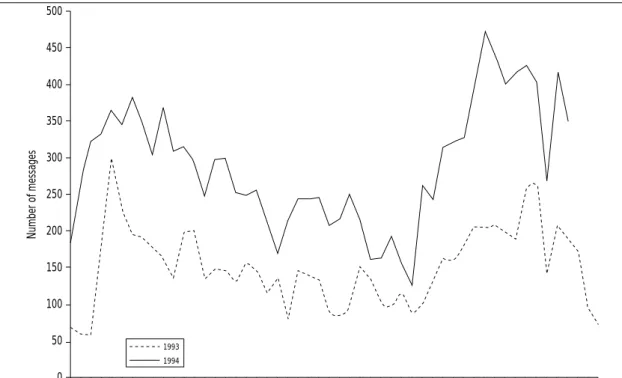
Figure 1 compares the running totals of questions answered between 1993 and 1994. Note the sustained increase.
Figure 2 represents the interaction between the AskERIC virtual library and the AskERIC question/answering service.
This is a synergistic model that constantly forces user feedback to be diffused through services utilized by the users.
Opening the door may involve many entrances
Some Internet developers complain about the potential pitfalls involved in being on the cutting edge of technology. As computing and network capacity change dramatically, the word “obso-lete” takes on a terrifying urgency. Companies and individuals can invest huge sums of money in technology that quickly becomes “second best”, or worse, completely useless in a new technology environment. These problems,
Week of 1993 1994 %Growth
12/5 192 349 81.8
11/29 208 419 101.4
11/22 141 267 89.4
11/15 266 427 60.5
Table I A comparison of the number of questions received between 1993 and 1994
AskERIC receives a question from a user Responds to user Determines trends in questions Places question in automated information services FTP/Gopher site
• Conducts a database search • Sends user results of the search • Suggests relevant listserv(s) and other internet resources
• Refers question to the relevant ERIC clearinghouse
• How many times has a question been asked? • How can question best be answered? • What are approriate resources for repeated questions?
Determines new services and resources based on user needs
• AskERIC MiniSearches • AskERIC InfoGuides • New resources based on requests • AskERIC briefings
Figure 2 The AskERIC question/answering process
500 450 400 350 300 250 200 150 100 50 0 51 49 47 45 43 41 39 37 35 33 31 29 27 25 23 21 19 17 15 13 11 9 7 5 3 1 1993 1994 Week number Number of messages
however, cannot compare with the disadvan-tages of being on the trailing edge of technology.
In public education, having any computer is fortunate, and having a modem – only 41 percent of school districts have modems (Quality Educa-tion Data, 1994, p. 90) – to use with that comput-er is a rarity. One must be aware of this fact when developing digital libraries with K-12 in mind. Table II describes the breakdown in operating systems in the K-12 market (Quality Education Data, 1994, p. 23).
There is simply no available software that allows Apple II computers to access directly Internet services such as Mosaic. For this reason alone, one needs to consider both graphical ser-vices and non-graphical serser-vices. That is, how can a service work for those using multimedia
browsers such as Mosaic, and those using simple character-based interfaces? Furthermore, a quick look at network statistics shows that FTP, Telnet, netnews (NNTP), and e-mail (SMTP) are still the biggest uses of the Internet, as shown in Table III.
For these reasons, AskERIC adopted a strict “full-access” policy. A service is not put in place (on the net, or advertised) that does not allow at least some form of the information to be
avail-able to text-based clients. AskERIC could not utilize the National Center for Supercomputing Applications’ (1993), Mosaic, for example, until Lynx (the terminal-based web browser from University of Kansas) became available. Even then, AskERIC provided a way to Telnet into these services for those not having popular clients available on their systems.
The requirement to meet the needs of broad-est range of Internet users has demanded a great deal of effort on AskERIC’s part. The most vexing problem faced was the question of Gopher versus Web. AskERIC believes that both are needed. However, the two services require two radically different file types: plain text for Gopher and HyperText Markup Language (see Berners-Lee, 1993) files for the Web. Keeping a parallel collection is very difficult, and there is yet to emerge an adequate solution to the dual collection problem. Furthermore, AskERIC has sought out multimedia collections owing to demand from both educators and Sun Microsystems, a major partner of AskERIC. While text-based versions of these materials are made available for Gopher, they are hardly equivalents.
More work will save you work
Many online services start without a clear focus as to what the service will become, which can allow for greater input by users to create the system. This was AskERIC’s approach, but it involves a clear definition of the user population
Apple II 49%
MS-DOS 33%
Macintosh 12%
Other 6%
Total number of computers 1,820,353
Table II Distribution of operating systems in schools
October 1994
Packet total: 100,133,948,600 Byte total: 21,197,056,320,800
Service name Port Rank Packet count % Packets Rank Byte count % Byte
FTP-data 20 1 19765276800 19.739 1 7030428058200 33.167 Telnet 23 2 12649938000 12.633 6 972569572750 4.588 NNTP 119 3 9857675150 9.844 2 2230098005750 10.521 SMTP 25 4 8084691350 8.074 4 1410130927700 6.652 WWW 80 5 7009616350 7.000 3 2152956666650 10.157 Domain 53 6 5270785150 5.264 8 518399058900 2.446 IP –4 7 3824054350 3.819 5 1302757353350 6.146 Gopher 70 8 3064327550 3.060 7 864259375300 4.077 Source: <gopher://nic.merit.edu:7043/00/statistics/nsfnet/1994/nsf-9410.highlights> Table III NSFNET traffic distribution highlights
in question. No service can be all things to all people. In order for the user approach to system development to work, one must know the users (Nilan, 1993). There seems to be a balance between a collection focus and a client focus. Emphasis on one can, at least in the short term, compensate for the other.
Yet, a lack of focus can also create immense headaches in the digital library environment. Electronic resources are extremely easy to create, copy, and manipulate. In the global Internet environment, to which resources are easy to point, this problem increases tenfold in complexity. As a service grows with little formal mission or goal, the system will become unmanageable and will lose its attraction for users. Moreover, the later necessary role of pruning and organizing the site will become a nightmare. AskERIC’s virtual library grew quickly. Two major library reorganizations were needed to bring the system back to a “user-friendly state” (Moen, 1993). It also led to thousands of files that had to be checked, cleaned and categorized in a very short amount of time. Work at the start of the project in clari-fying collection development policy would have saved hundreds of hours later.
Future directions
AskERIC has many issues left to resolve. The three primary areas of development will be: (1) An effort to identify and incorporate tools that
enhance the ability of AskERIC’s services to add intelligence to the network. AskERIC formed the research and development team in part as an effort to locate, incorporate, and enhance new Internet, networking, and computing tools. As the Internet grows and develops, AskERIC sees the rate of tool development as increasing. Furthermore, the refinement of such protocols as HTML and the WorldWideWeb as tools for other commercial publishers and information providers will have a major impact on digi-tal library development. AskERIC must continue to seek out and incorporate these tools to satisfy its users.
(2) Increase coordination between AskERIC’s services and diminish redundant information and disparate organizations of that informa-tion. AskERIC has two major collections,
one text based, the other multimedia. These services must be coordinated so that they reflect each other not only in terms of con-tent, but also in organization. AskERIC simply does not have the resources needed to maintain two separate large collections. Ideally, AskERIC would like to use a single common file base and dynamically create the format needed to take advantage of a given service delivery (i.e. there is one set of files that looks like text to text-based clients and looks “native” in a multimedia environ-ment).
(3) Diffuse AskERIC’s innovation throughout its parent organization and partner organizations. Already these priorities have led to the development of curriculum and training materials for use beyond AskERIC (Ryan, 1994). The project must grow throughout the ERIC system, and indeed the Depart-ment of Education, if it is to continue to survive. However, to increase the likelihood of institutionalization, many problems that AskERIC Research and Development now handles must be solved in such a way as to present clear policy solutions.
Conclusion
There is little doubt that the digital library concept will have an extreme impact on K-12 education. One need only look to the explosive growth of CD-ROM and other digital informa-tion being adopted by today’s schools to see these potential impacts. Educators want quality information, but primarily they want informa-tion that is readily available and as complete as possible.
AskERIC has successfully incorporated user perspectives into its system design and service planning. This incorporation not only increases the reach of the project, but also allows for a much more accurate allocation of the project’s limited resources. By allowing users to shape the service, a greater impact can be made on the user population with fewer resources.
Furthermore, AskERIC’s success has demonstrated the value of human to human interaction in an Internet service, and it has attempted to define the role of the information professional in an increasingly automated dis-semination system.
Notes
1 Sun SITE (Sun Information and Technology Exchange) is a Sun Microsystems sponsored program at key universi-ties around the world. The goals of Sun SITE are to: • provide easy access to public domain software on
the Internet;
• act as a repository for Sun and key government information;
• promote development and research of new Internet tools
• archive material of general interest including Internet Underground Music Archive and various Multimedia Expositions.
2 INet is the Department of Education’s Internet service, providing not only connection and service to the Internet for the Department, but also a set of Internet information services for the public <http://inet.ed.gov/>.
References
Berners-Lee, T. <[email protected]> and Connolly, D. <[email protected]>. (1993). HyperText Markup Language: A Representation of Textual Information and Metainformation for Retrieval and Interchange, Available: WWW: http://info.cern.ch/hypertext/ WWW/htm, July 13.
Dervin, B. and Nilan, M.S. (1986), “Information needs and uses”, in William, M.E. (Ed.), Annual Review of Infor-mation Science and Technology, Vol. 21, Knowledge Industry Publications, New York, NY.
Eisenberg, M.B. and Small, R.V. (1993), “Information-based education: an investigation of the nature and role of information attributes in education”, Information Processing and Management, Vol. 29 No. 2, pp. 263-75. Executive Office of the President (1993, September 15), The
National Information Infrastructure: Agenda for Change, Available: FTP: ftp.ntia.doc.gov File:niiagen-da.ascFTP:enh.nist.gov Password: guestFTP:isdres. er.usgs.gov Path: npr Command: binary File: niiagend.exe Gopher: gopher.nist.gov Path: doc Gopher: ace.esusda.gov Path: 6. Americans Communi-cating Electronically/3. National Technology Informa-tion/1. National Information Infrastructure Agenda E-mail: [email protected] Message: send niiagenda (For additional information: E-mail: [email protected] Message: none necessary.) Information Infrastructure Task Force (IITF), Committee on
Applications and Technology (CAT) (1994), Putting the Information Infrastructure to Work: Report of the Information Infrastructure Task Force Committee on Applications and Technology, NIST Special Publication 857, Washington, DC: NIST. Cost: $7 (GPO) $27 (NTIS) Available: National Institute of Standards and Technol-ogy. Committee on Applications and Technology, Building 225, Room B164, Gaithersburg, MD 20899,
Tel: 301 975 4529; Fax: 301 948 7242; GPO/Superin-tendent of Documents, Washington, DC 20402 Docu-ment No. SN003-003-03267-1, Tel: 703 487 4650 or 202 783 3238; NTIS, Springfield, VA 22161, Document No. PB 941 63 383, Tel: 703 487 4650 Gopher: iitfcat.nist.gov FTP: enh.nist.gov Path:
cat_iitf/appl_paper-5-3-94/ascii.dir OR postscript.dir. Moen, W.E. (1993, June 20). The AskERIC Electronic Library:
An Organizational Framework for User Access and Effective Navigation (unpublished study), Syracuse, New York, NY: AskERIC. Available from AskERIC, Syracuse University, School of Information Studies, Syracuse, NY 13244-4100, Att. R. David Lankes. National Center for Supercomputing Applications (NCSA)
<[email protected]. (1993). NCSA Mosaic, Champaign, IL: NCSA Mosaic for the Mac Development Team. University of Illinois, National Center for Super-computing Applications. Available: FTP: ftp.ncsa.uiuc. edu Path: Mosaic THEN Mac OR Windows OR Mosaic-Source (X-windows) OR Mosaic-binaries Further Information: University of Illinois, National Center for Supercomputing Applications, 152 Computing Applica-tions Building, 605 E. Springfield, Champaign, IL 61820.
Nilan, M.S. (1993), “Useability in system design: a brief description of the user-based approach”, Information and Technology Management, Vol. 11, pp 69-74. Office of Technology Assessment (OTA) (1993, September),
Making Government Work: Electronic Delivery of Federal Services, Government Printing Office, Washing-ton, DC, 188 pp. S/N 052-003-01346-1 Cost: $11.00 Available: Superintendent of Documents, PO Box 371954, Pittsburgh, PA 15250-7954, Tel: 202 783 3238; Fax: 202 512 2250. Available: FTP: otabbs.ota.gov OR 152.63.20.13 Path: pub File: make.govt.work Gopher: ace.esusda.gov Path: 4. Americans Communicating Electronically/7. Office of Technology Assessment, US Congress/1. Making Government Work – Electronic Delivery E-mail: [email protected] (No message or header) Further Information: Fred Wood <[email protected]> Tel: 202 228 6790.
Quality Education Data (1994), Technology in Public Schools. Ryan, J. (1995), Resources for Building and Managing
Internet Services, Ryan Information Management Press, Syracuse, New York, NY, 109 pp. Cost: $15, Available from Ryan Information Management Press, 1049 Ackerman Avenue, Syracuse, New York, NY 13210-3035.
Ryland, J. (1994, July), Computerworld, University of Kansas Computer Center (1993 to present), Lynx. University of Kansas. Available: FTP: ukanaix.cc.ukans.edu OR ftp2.cc.ukans.edu OR 129.237.33.1 Path: pub/WWW/ (operating environment DosLynx, Mac, lynx) For a description see: WWW: http://www.cc.ukans. edu/about_lynx/lynx2-2.html.